REVIEW 3 major objections 5 minor 33 references
Humanoid Loco-manipulation Planning based on Graph Search and Reachability Maps
T0 review · 3 major / 5 minor · reviewed 2026-08-07 · deepseek-v4-flash
Pith's one-line read A graph search plans a humanoid's steps, grasps, and rolling as one problem.
desk verdict Genuinely new integration of footstep and regrasp planning via switchable reachability maps, with a rolling-bobbin first, but validation is thinner than the claims. read the letter →
The pith
A machine-rendered reading of the paper's core claim, the machinery that carries it, and where it could break.
The reading
What carries the argument
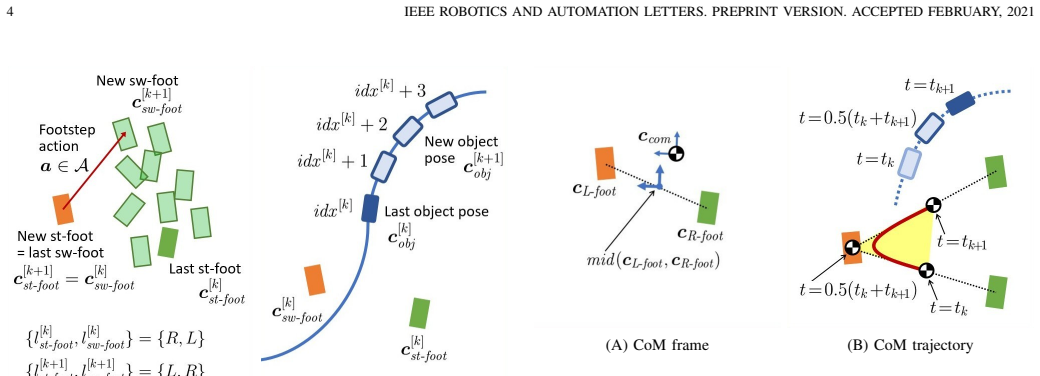
The load-bearing mechanism is the transition model with switchable reachability maps. Its movable condition checks the object pose at the middle timing of a step against a map anchored at the stance foot, and the end pose against a map anchored at the midpoint of the two feet; for rolling objects, maps are switched according to the distance rolled since the last regrasp, so the changing grasp point is handled by map selection instead of inverse-kinematics calls during the search.
What would settle it
Take a planned bobbin-rolling sequence and execute it on a real or high-fidelity simulated humanoid while recording the actual CoM and object pose through each step; if the hand loses the grasp or the reachability condition fails at some intermediate time even though the middle and end poses passed, the transition model's most-severe-case assumption is false.
Extended reading notes
Core claim
The paper claims that a humanoid's loco-manipulation planning can be posed as a graph path search over states describing the stance foot, swing foot, object pose, and grasping hand, where each transition is accepted only if a reachability map certifies that the hand can hold the object at the middle and end of the footstep. For rolling objects, several reachability maps indexed by the distance rolled since the last regrasp are switched during search, capturing the motion of the grasp point without expensive kinematic recomputation. The authors report that this yields the first automatically planned motion of a large cylindrical object moved by rolling with regrasping.
Load-bearing premise
The feasibility check assumes the robot's center of mass passes through the stance foot at the middle of each step and the object moves to the middle pose exactly in sync, so checking only the middle and end poses is enough to guarantee reachability throughout the transition.
Editorial extensions
If this is right
- A single planner covers pure locomotion, pure manipulation, and combined stepping-while-moving-object behaviors, because the transition set includes no-stepping and zero-object-progress actions.
- Regrasping emerges automatically when obstacles make it cheaper, since hand-label transitions are part of the search state, as shown in the door-opening case.
- Rolling objects are handled in the same framework as sliding or fixed-grasp objects by switching reachability maps according to the distance rolled since the last regrasp.
- An initial solution is found in roughly 100 milliseconds for the tested tasks, allowing the robot to keep moving while the anytime search improves the plan.
Reading between the lines
- The same switchable-map idea should extend to any object motion whose grasp point moves predictably, such as sliding, pivoting, or objects carried on a tray, without changing the search formulation.
- Because the reachability maps are precomputed in posture space, the planner's runtime depends mostly on the graph search itself rather than on the complexity of the robot model.
- The cost model's constant step and regrasp penalties could be replaced with task-specific costs such as energy, time, or stability margin without altering the transition model.
- The assumption that checking only the middle and end poses guarantees reachability could be tested offline by sampling dense CoM and object trajectories from the generated whole-body motion, giving a quantitative safety margin for execution.
Editorial analysis
A structured set of objections, weighed in public.
Referee Report
Summary. The paper proposes a three-stage planning framework for humanoid loco-manipulation: object path planning using RRT*, footstep and regrasping planning using AD* graph search with precomputed reachability maps, and whole-body motion planning using QP-based inverse kinematics. The main contribution is a transition model that represents combined locomotion and manipulation primitives, with feasibility evaluated by relocating and switching reachability maps according to the motion of the robot and the object. The framework is demonstrated in simulation on bobbin rolling with regrasping, door opening, and cart pushing tasks, with reported computation times of the order of seconds.
Significance. If the movability filter is reliable, the framework is a practically useful contribution to humanoid loco-manipulation planning: it is clearly formulated, modular, and computationally efficient, with initial solutions obtained in roughly 100 ms and the ability to handle rolling objects with automatic regrasping. The strengths include an explicit graph-search formulation, precomputed reachability maps that avoid repeated inverse kinematics, and a comparison of planning times against a prior method. However, the central claim rests on an assumption about CoM and object trajectories that is not validated against whole-body motion planning or hardware, which limits the strength of the feasibility claims. The paper also does not provide a formal correctness argument for the transition filter, so the current evidence is not sufficient to fully establish the purported versatility.
major comments (3)
- [Section IV-C3, Eq. (7)] The movable condition F_movable is evaluated at only two discrete instants, under the assumption that the CoM is on the destination stance foot at the middle timing and at the mid-foot pose at the end, while the object moves synchronously to the path midpoint. No argument is provided that these two samples bound the hardest reachability condition over the continuous CoM and object trajectories. Reachability maps are not convex in CoM position or object pose, so checking the "most severe" CoM pose does not in general imply reachability for all intermediate CoM positions. The actual CoM from preview control (Section V) is not constrained to pass through the stance foot at the middle timing, and the object is not forced to move synchronously to the midpoint. For rolling objects, the reachability map is switched only at finite rolling-angle increments (5 degrees), leaving intermediate angles unchecked. Consequently, the planner may accept transitions that are not executable by the WBM layer. The paper explicitly acknowledges the assumption in Fig. 6(B), but neither proves its conservatism nor validates it against full whole-body trajectories or hardware experiments. This issue is load-bearing because it directly affects the feasibility of the planned footstep and regrasp sequences, including the claimed rolling-with-regrasping result.
- [Section IV-B5, Eq. (5)] The heuristic h_nominal is inadmissible, as the paper itself states ("Without h_nominal, the heuristic is admissible"). Since AD* relies on an admissible heuristic for its suboptimality guarantees, the reported "heuristics inflation factor" in Table II does not provide a rigorous bound on solution quality when h_nominal is used. The authors should either provide an analysis of the bound with h_nominal or explicitly state that the anytime optimality guarantee is heuristic only, so that readers are not misled about the formal properties of the planner.
- [Section VI-B4 and Section V] The only dynamics validation of the planned motions is a ZMP check on a forward-rolling motion. ZMP staying within the support region does not guarantee that the hand can reach the object at all intermediate times, which is precisely what the movable condition (7) approximates. The paper should report whether the QP-based WBM planner actually finds feasible whole-body trajectories for the planned footstep and object sequences, and ideally execute the motions on a real robot, to substantiate the executability of the planned transitions. Without this validation, the experimental section is insufficient to support the claim that the rolling-with-regrasping motion is automatically planned and feasible.
minor comments (5)
- [Section IV-C3, Eq. (7)] The definition of c_mid_obj as c_P[(idx(c_obj[k]) + idx(c_obj[k+1]))/2] is ambiguous when the sum of the two indices is odd; please clarify whether the midpoint pose is obtained by interpolation, rounding, or some other rule.
- [Section IV-C1] The reachability map grid resolution is reported as 100 mm and 10 degrees in Section VI-B1, but the paper does not specify how an arbitrary object pose that does not coincide with a grid node is evaluated (e.g., nearest neighbor, bilinear interpolation). Please describe the evaluation rule.
- [Figure 14(B)] The horizontal axis of Fig. 14(B) is labeled "time [s]", but the figure shows the length of the footstep sequence over time; please clarify whether this is computation time and what the unit refers to.
- [Section VI-B2] The use of the Halton sequence to generate the footstep action set is interesting; please state the dimensionality of the sampled space and the number of samples used for the nominal action set, since these affect the planner's behavior.
- [Introduction, Contributions] The claim of being the first study to automatically plan rolling operation with regrasping could be tempered, since the experiments are simulations and prior work on non-prehensile manipulation may cover related tasks; a more careful comparison to existing rolling-manipulation literature would strengthen the novelty statement.
Circularity Check
No significant circularity: reachability maps are precomputed and task-independent; the Eq. (7) assumption is an acknowledged approximation, not a fitted input.
full rationale
The paper's derivation chain is not circular. OP-planning produces an object path using RRT*, FR-planning searches a graph whose transition feasibility is filtered by precomputed reachability maps, and WBM-planning solves a QP-based inverse kinematics problem. The reachability maps are computed offline from the specific robot models (HRP-5P, HRP-2Kai, HRP-4) with fixed grid sizes of 100 mm and 10 degrees, and for rolling objects in 5-degree rolling-angle increments; they are not fitted to the search results and do not encode the target task. The movable-condition check in Eq. (7) is the only point where the paper replaces a continuous CoM/object trajectory with an assumed worst-case mid-transition pose, but the paper explicitly states this assumption: 'we assume the CoM is on the stance foot at the middle timing of the transition... the object is considered to be in the middle pose.' This is a stated heuristic approximation, not a derived-from-inputs prediction. Using the same IK solver for map generation and WBM-planning is a consistency choice, not a fitted-parameter loop. The ZMP check is a consistency validation of the generated motion, not a result that is forced by the input planning parameters. Self-citations ([1], [2], [26], [29], [32]) support specific tools, prior robot models, or earlier applications, but the framework's key novelty—the switching reachability-map transition model—does not rest on any self-cited uniqueness theorem or on an ansatz smuggled in via citation. The acknowledged potential failure of Eq. (7) to guarantee continuous reachability is a correctness and robustness concern, not circularity.
Assumptions & free parameters
free parameters (5)
- Reachability map grid size =
100 mm, 10 degrees
- Nominal foot pose distance (h_nominal) =
1.2 m
- Cost constants c_step, c_regrasp =
not specified
- Rolling angle range and increment =
0 to 45 degrees, 5 degree increments
- N_obj incremental limit =
not specified
assumptions (3)
- domain assumption Reachability map membership implies whole-body kinematic feasibility for the relevant CoM frame and hand.
- domain assumption During a footstep transition, the CoM lies on the stance foot at the middle timing and the object moves synchronously, so checking the middle and end poses is sufficient.
- domain assumption The object path from RRT* is discretizable into a sequence of poses that the robot can follow with the planned steps and grasps.
Cite this review
Pith. "Pith review of Humanoid Loco-manipulation Planning based on Graph Search and Reachability Maps." pith.science (2026). https://pith.science/paper/FIGDLTGF
@misc{pith2026250523505,
  author       = {Pith},
  title        = {Pith review of: Humanoid Loco-manipulation Planning based on Graph Search and Reachability Maps},
  year         = {2026},
  howpublished = {\url{https://pith.science/paper/FIGDLTGF}},
  note         = {Machine review of arXiv:2505.23505}
}
read the original abstract
In this letter, we propose an efficient and highly versatile loco-manipulation planning for humanoid robots. Loco-manipulation planning is a key technological brick enabling humanoid robots to autonomously perform object transportation by manipulating them. We formulate planning of the alternation and sequencing of footsteps and grasps as a graph search problem with a new transition model that allows for a flexible representation of loco-manipulation. Our transition model is quickly evaluated by relocating and switching the reachability maps depending on the motion of both the robot and object. We evaluate our approach by applying it to loco-manipulation use-cases, such as a bobbin rolling operation with regrasping, where the motion is automatically planned by our framework.
Figures


Figures from the paper (8 more)


Reference graph
Works this paper leans on
-
[1]
Manipulation strategy decision and execution based on strategy proving operation for carrying large and heavy objects,
M. Murooka, S. Noda, S. Nozawa, Y . Kakiuchi, K. Okada, and M. Inaba, “Manipulation strategy decision and execution based on strategy proving operation for carrying large and heavy objects,” inIEEE International Conference on Robotics and Automation, 2014, pp. 3425–3432
2014
-
[2]
I. Kumagai, M. Morisawa, S. Nakaoka, T. Sakaguchi, H. Kaminaga, K. Kaneko, and F. Kanehiro, “Perception based locomotion system for a humanoid robot with adaptive footstep compensation under task constraints,” inIEEE/RSJ International Conference on Intelligent Robots and Systems, 2018, pp. 713–719
work page 2018
-
[3]
Humanoid teleoperation for whole body manipulation,
M. Stilman, K. Nishiwaki, and S. Kagami, “Humanoid teleoperation for whole body manipulation,” inIEEE International Conference on Robotics and Automation, 2008, pp. 3175–3180
work page 2008
-
[4]
Pivoting based manipulation by a humanoid robot,
E. Yoshida, M. Poirier, J.-P. Laumond, O. Kanoun, F. Lamiraux, R. Alami, and K. Yokoi, “Pivoting based manipulation by a humanoid robot,”Autonomous Robots, vol. 28, pp. 77–88, 2009
2009
-
[5]
Hu- manoid full-body controller adapting constraints in structured objects through updating task-level reference force,
S. Nozawa, I. Kumagai, Y . Kakiuchi, K. Okada, and M. Inaba, “Hu- manoid full-body controller adapting constraints in structured objects through updating task-level reference force,” inIEEE/RSJ International Conference on Intelligent Robots and Systems, 2012, pp. 3417–3424
2012
-
[6]
Finding locomanipulation plans quickly in the locomotion constrained manifold,
S. J. Jorgensen, M. Vedantam, R. Gupta, H. Cappel, and L. Sentis, “Finding locomanipulation plans quickly in the locomotion constrained manifold,” inIEEE International Conference on Robotics and Automa- tion, 2020, pp. 6611–6617
work page 2020
-
[7]
Manipulation of documented objects by a walking humanoid robot,
S. Dalibard, A. Nakhaei, F. Lamiraux, and J. Laumond, “Manipulation of documented objects by a walking humanoid robot,” inIEEE-RAS International Conference on Humanoid Robots, 2010, pp. 518–523
work page 2010
-
[8]
Humanoid whole-body planning for loco-manipulation tasks,
P. Ferrari, M. Cognetti, and G. Oriolo, “Humanoid whole-body planning for loco-manipulation tasks,” inIEEE International Conference on Robotics and Automation, 2017, pp. 4741–4746
work page 2017
Show all 33 references
-
[9]
Motion primitive based random planning for loco-manipulation tasks,
A. Settimi, D. Caporale, P. Kryczka, M. Ferrati, and L. Pallottino, “Motion primitive based random planning for loco-manipulation tasks,” inIEEE-RAS International Conference on Humanoid Robots, 2016, pp. 1059–1066
2016
-
[10]
Randomized multi-modal motion planning for a humanoid robot manipulation task,
K. Hauser and V . Ng-Thow-Hing, “Randomized multi-modal motion planning for a humanoid robot manipulation task,”The International Journal of Robotics Research, vol. 30, no. 6, pp. 678–698, 2011
2011
-
[11]
A skill-based motion planning framework for humanoids,
M. Kallmann, Y . Huang, and R. Backman, “A skill-based motion planning framework for humanoids,” inIEEE International Conference on Robotics and Automation, 2010, pp. 2507–2514
2010
-
[12]
Humanoid motion planning for dual-arm manipulation and re-grasping tasks,
N. Vahrenkamp, D. Berenson, T. Asfour, J. Kuffner, and R. Dillmann, “Humanoid motion planning for dual-arm manipulation and re-grasping tasks,” inIEEE/RSJ International Conference on Intelligent Robots and Systems, 2009, pp. 2464–2470
2009
-
[13]
Planning biped navigation strategies in complex environments,
J. Chestnutt, J. Kuffner, K. Nishiwaki, and S. Kagami, “Planning biped navigation strategies in complex environments,” inIEEE-RAS International Conference on Humanoid Robots, 2003
2003
-
[14]
Biped footstep planning,
N. Perrin, “Biped footstep planning,” inHumanoid Robotics: A Refer- ence. Springer, 2018, pp. 1–21
2018
-
[15]
ARA*: Anytime A* with provable bounds on sub-optimality,
M. Likhachev, G. J. Gordon, and S. Thrun, “ARA*: Anytime A* with provable bounds on sub-optimality,” inAdvances in Neural Information Processing Systems 16, 2004, pp. 767–774
2004
-
[16]
Anytime search-based footstep planning with suboptimality bounds,
A. Hornung, A. Dornbush, M. Likhachev, and M. Bennewitz, “Anytime search-based footstep planning with suboptimality bounds,” inIEEE- RAS International Conference on Humanoid Robots, 2012, pp. 674–679
2012
-
[17]
Humanoid robot locomotion and manipulation step planning,
K. Bouyarmane and A. Kheddar, “Humanoid robot locomotion and manipulation step planning,”Advanced Robotics, vol. 26, no. 10, pp. 1099–1126, 2012
2012
-
[18]
An efficient acyclic contact planner for multiped robots,
S. Tonneau, A. Del Prete, J. Pettr ´e, C. Park, D. Manocha, and N. Mansard, “An efficient acyclic contact planner for multiped robots,” IEEE Transactions on Robotics, vol. 34, no. 3, pp. 586–601, 2018
2018
-
[19]
A direct method for trajectory optimization of rigid bodies through contact,
M. Posa, C. Cantu, and R. Tedrake, “A direct method for trajectory optimization of rigid bodies through contact,”The International Journal of Robotics Research, vol. 33, no. 1, pp. 69–81, 2014
2014
-
[20]
Optimization-based locomotion planning, estimation, and control design for the atlas humanoid robot,
S. Kuindersma, R. Deits, M. Fallon, A. Valenzuela, H. Dai, F. Permenter, T. Koolen, P. Marion, and R. Tedrake, “Optimization-based locomotion planning, estimation, and control design for the atlas humanoid robot,” Autonomous Robots, vol. 40, no. 3, pp. 429–455, 2016
2016
-
[21]
Sampling-based algorithms for optimal motion planning,
S. Karaman and E. Frazzoli, “Sampling-based algorithms for optimal motion planning,”The International Journal of Robotics Research, vol. 30, no. 7, pp. 846–894, 2011
2011
-
[22]
Optimal paths for a car that goes both forwards and backwards
J. A. Reeds and L. A. Shepp, “Optimal paths for a car that goes both forwards and backwards.”Pacific J. Math., vol. 145, no. 2, pp. 367–393, 1990
1990
-
[23]
D* lite,
S. Koenig and M. Likhachev, “D* lite,” inEighteenth National Con- ference on Artificial Intelligence. American Association for Artificial Intelligence, 2002, pp. 476–483
2002
-
[24]
Anytime dynamic A*: An anytime, replanning algorithm,
M. Likhachev, D. Ferguson, G. Gordon, A. T. Stentz, and S. Thrun, “Anytime dynamic A*: An anytime, replanning algorithm,” inInterna- tional Conference on Automated Planning and Scheduling, 2005
2005
-
[25]
Accessed: 2020-9-30
SBPL. Accessed: 2020-9-30. [Online]. Available: https://github.com/ sbpl/sbpl
2020
-
[26]
Biped walking pattern generation by using preview control of zero-moment point,
S. Kajita, F. Kanehiro, K. Kaneko, K. Fujiwara, K. Harada, K. Yokoi, and H. Hirukawa, “Biped walking pattern generation by using preview control of zero-moment point,” inIEEE International Conference on Robotics and Automation, vol. 2, 2003, pp. 1620–1626
2003
-
[27]
Three-dimensional bipedal walking control based on divergent component of motion,
J. Englsberger, C. Ott, and A. Albu-Sch ¨affer, “Three-dimensional bipedal walking control based on divergent component of motion,”IEEE Transactions on Robotics, vol. 31, no. 2, pp. 355–368, 2015
2015
-
[28]
Kinematic control of redundant manipulators: Generalizing the task-priority framework to inequality task,
O. Kanoun, F. Lamiraux, and P. Wieber, “Kinematic control of redundant manipulators: Generalizing the task-priority framework to inequality task,”IEEE Transactions on Robotics, vol. 27, no. 4, pp. 785–792, 2011
2011
-
[29]
A strictly con- vex hull for computing proximity distances with continuous gradients,
A. Escande, S. Miossec, M. Benallegue, and A. Kheddar, “A strictly con- vex hull for computing proximity distances with continuous gradients,” IEEE Transactions on Robotics, vol. 30, no. 3, pp. 666–678, 2014
2014
-
[30]
ROS: an open-source Robot Operating Sys- tem,
M. Quigley, K. Conley, B. Gerkey, J. Faust, T. Foote, J. Leibs, R. Wheeler, and A. Ng, “ROS: an open-source Robot Operating Sys- tem,” inIEEE International Conference on Robotics and Automation Workshop on Open Source Software, 2009
2009
-
[31]
The Open Motion Planning Library,
I. A. S ¸ucan, M. Moll, and L. E. Kavraki, “The Open Motion Planning Library,”IEEE Robotics & Automation Magazine, vol. 19, no. 4, pp. 72–82, 2012
2012
-
[32]
Humanoid Robot HRP-5P: An electrically actuated humanoid robot with high-power and wide-range joints,
K. Kaneko, H. Kaminaga, T. Sakaguchi, S. Kajita, M. Morisawa, I. Kumagai, and F. Kanehiro, “Humanoid Robot HRP-5P: An electrically actuated humanoid robot with high-power and wide-range joints,”IEEE Robotics and Automation Letters, vol. 4, no. 2, pp. 1431–1438, 2019
2019
-
[33]
On the efficiency of certain quasi-random sequences of points in evaluating multi-dimensional integrals,
J. H. Halton, “On the efficiency of certain quasi-random sequences of points in evaluating multi-dimensional integrals,”Numerische Mathe- matik, vol. 2, pp. 84–90, 1960
1960
Reviewed August 7, 2026 · model on record in the stance chip above.
Discussion (0). Sign in to comment.