REVIEW 3 major objections 4 minor 10 references
Metagalactic Ultraviolet Background Tables for Calculating Diffuse Astrophysical Plasma Properties
T0 review · 3 major / 4 minor · reviewed 2026-08-07 · deepseek-v4-flash
Pith's one-line read A single, uniformly formatted table set now covers four standard models of the metagalactic ultraviolet background, with code to turn any of them into CLOUDY ionization tables.
desk verdict A useful data-release paper that standardizes four UVB models but leaves the faithfulness of the conversion unverified and the flux units ambiguous. read the letter →
The pith
A machine-rendered reading of the paper's core claim, the machinery that carries it, and where it could break.
The reading
What carries the argument
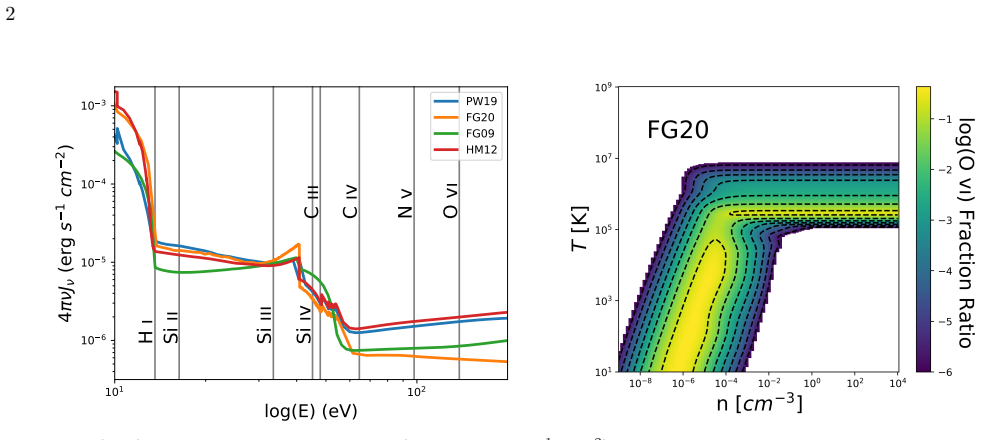
The load-bearing object is the reformatting script make_uvb_tables.py, which reads each model's CLOUDY-formatted UVB data and writes a CSV with intensity in $\mathrm{erg\,s^{-1}\,cm^{-2}}$ binned by photon energy in eV over a redshift axis. Around it sit plot_uvb_spec.py, which overlays spectra with the ionization thresholds of common CGM ions, and the cloudy cooling tools interface, which converts a chosen CSV back into CLOUDY format and produces ionization tables over number density and temperature grids. The argument is that no physics is added or removed: the same spectral data appear in a format that makes comparison and downstream ionization calculation routine.
What would settle it
Compute a standard quantity such as the hydrogen photoionization rate $\Gamma_{\mathrm{H\,I}}$ at several redshifts directly from the released CSV tables and compare it to the value published in each original model paper; a mismatch beyond the tables' binning precision would show the reformatting introduced an error. A reader could also regenerate an ionization table for FG20 and compare it with the O VI fraction map shown in the paper's Figure 1.
Extended reading notes
Core claim
The central claim is that four disparate UVB models can be presented as one uniformly binned dataset without changing the underlying physics. The authors take the original CLOUDY-formatted flux files, bin them by photon energy in eV, and write CSV tables giving intensity in $\mathrm{erg\,s^{-1}\,cm^{-2}}$ across each model's stated redshift range (FG09 from $z=0.0$ to $10.6$, HM12 to $14.849$, PW19 to $9.994$, and FG20 to $10.0$). A companion set of tools turns those CSVs back into CLOUDY input and runs ionization calculations, so that spectra and ion-fraction grids can be produced for any included model at any redshift where the model is defined.
Load-bearing premise
The load-bearing premise is that the reformatting scripts copy the original CLOUDY-formatted UVB data into the new CSV tables without changing the units, energies, or redshift binning, so that each table is exactly the same model in a new envelope.
Editorial extensions
If this is right
- Any user can read the UVB intensity at a given photon energy and redshift from the CSV tables for any of the four models without parsing the original authors' file formats.
- The included pipeline turns each model into ionization tables on the same density–temperature grid, so diffuse-plasma calculations are no longer tied to the model the table maker chose.
- Spectra such as those in the paper's Figure 1 can be regenerated for any included model and redshift, with CGM ionization thresholds marked.
- The shared formatting lets researchers compare models over the common redshift window spanning essentially the full range of galaxy-formation and CGM observations.
Reading between the lines
- A natural check would be to recompute a published photoionization rate, such as the hydrogen photoionization rate, from the CSV tables and compare it with the original model papers; agreement would confirm that the reformatting is lossless.
- If the tables are faithful, they supply a ready-made common input for quantifying how much predicted CGM ion fractions, for example O VI or C IV, shift when the UVB model changes at fixed density and temperature.
- The same CSV schema should make it easy to add future UVB models with a thin conversion script, turning this release into a growing comparison set rather than a one-off table dump.
Editorial analysis
A structured set of objections, weighed in public.
Referee Report
Summary. This paper presents a data release of reformatted metagalactic ultraviolet background (UVB) tables for four widely used models: FG09, HM12, PW19, and FG20. The tables are claimed to be in consistent units (erg s^-1 cm^-2 as a function of photon energy in eV) over stated redshift ranges, and the release includes Python scripts for plotting and for converting the CSVs back to CLOUDY format so that cloudy_cooling_tools can generate ionization tables for any of the models. The principal intended contribution is interoperability: direct model comparison and uniform downstream photoionization calculations for circumgalactic medium work.
Significance. If the reformatting is faithful, this is a useful community resource: it removes the need to handle disparate original formats, provides a single archive with a DOI, and makes ionization-table generation for four standard UVB models uniform. The authors ship code and a Zenodo repository, which supports reproducibility. The scientific content does not introduce new UVB physics, so the value is in curation and tooling rather than in new model predictions. The main risk is that the faithfulness of the conversion is currently unverified, and the physical units of the tabulated quantity are not specified precisely enough to support the claimed use in photoionization calculations.
major comments (3)
- [§2.1, Figure 1] The units of the tabulated intensity are stated as 'erg/s/cm2' (§2.1), but for a spectral radiation field this is incomplete: the quantity must be per unit frequency or per unit energy (e.g., erg s^-1 cm^-2 Hz^-1 or erg s^-1 cm^-2 eV^-1) unless the table entries are integrated bin fluxes. The figure axis label '4πJ (erg s^-1 cm^-2)' does not resolve the ambiguity. This matters because photoionization rates depend on the spectral density, and both the CSV columns and the legend need the correct per-interval units for the central claim of 'consistent units' to be meaningful.
- [§2.1] The paper provides no quantitative validation that the reformatted CSVs reproduce the original CLOUDY-format data: no comparison plots, no residual statistics, and no round-trip test through the included converter. Since the repository's central claim is faithful reformatting, the authors should add at least one cross-check, e.g., a relative difference plot between the CSVs and the original files on the same energy grid, and state a tolerance (e.g., agreement to 1% or better) to which the conversion was verified.
- [§2.1] The description 'binned according to the intensity' is ambiguous about whether the original energy grid is preserved or the data are rebinned or interpolated. If the script regrids the spectra, the paper must specify the interpolation scheme and the output grid (bin edges and centers), because bin-edge shifts can introduce systematic errors in the derived ionization tables. Without this information users cannot assess whether differences between models reflect the original models or the reformatting step.
minor comments (4)
- [Figure 1] The y-axis label '4πJ (erg s^-1 cm^-2)' should include the per-energy or per-frequency interval, matching the corrected units; also '102.3 eV' in the caption should read '10^2.3 eV' to avoid a typesetting ambiguity.
- [§2.1] The paper uses 'intensity' and 'flux' interchangeably; I recommend defining J versus 4πJ explicitly and stating which is stored in the CSV.
- [§2.2] For reproducibility, the version of cloudy_cooling_tools and the CLOUDY version should be specified, since ionization tables depend on both.
- [§2] The Zenodo DOI is cited in the references, but the text should also state the DOI or archive identifier in Section 2 so readers can locate the repository directly.
Circularity Check
No circularity: the paper is a data-release wrapper around externally published UVB models; reformatting is not a prediction, and the self-citation to the Zenodo archive is appropriate for a code release.
full rationale
The paper's central claim is that it provides consistently reformatted versions of four externally published ultraviolet background models (FG09, HM12, PW19, FG20) together with code to convert those tables into CLOUDY format and generate ionization tables. There is no derived physical result whose output is fed back into its own input. The load-bearing content—the original UVB spectra and ionization calculations—comes from prior published models (Faucher-Giguère et al. 2009; Haardt & Madau 2012; Puchwein et al. 2019; Faucher-Giguère 2020) and from the external CLOUDY code (Ferland et al. 2013) and cloudy_cooling_tools package, none of which are authored by the present paper's authors. The only self-citation, Taira et al. 2025, points to the Zenodo archive of the very code and tables being released, which is the normal and appropriate citation practice for a data release, not a load-bearing circular argument. The paper makes no prediction from fitted parameters and no uniqueness claim based on the authors' prior work. The skeptic's concern about unverified unit conventions (erg/s/cm2 versus per-eV spectral intensity) and the absence of a validation plot is a correctness and documentation risk, not a circularity: the original data are external and could in principle be checked against these tables, so the reformatting claim is falsifiable rather than definitionally forced. Because the derivation chain terminates in external, published inputs, the circularity score is 0.
Assumptions & free parameters
assumptions (3)
- domain assumption The original UVB model data files provided by the cited authors are correct representations of those models.
- domain assumption The CLOUDY spectral synthesis code is a correct tool for computing ionization fractions.
- domain assumption A uniform metagalactic UVB is the relevant ionizing radiation field for diffuse CGM plasma.
Cite this review
Pith. "Pith review of Metagalactic Ultraviolet Background Tables for Calculating Diffuse Astrophysical Plasma Properties." pith.science (2026). https://pith.science/paper/YW5HEK3I
@misc{pith2026250523544,
  author       = {Pith},
  title        = {Pith review of: Metagalactic Ultraviolet Background Tables for Calculating Diffuse Astrophysical Plasma Properties},
  year         = {2026},
  howpublished = {\url{https://pith.science/paper/YW5HEK3I}},
  note         = {Machine review of arXiv:2505.23544}
}
read the original abstract
In developing a deeper understanding of the Circumgalactic Medium, one feature that is poorly understood is the nature of the ultraviolet background (UVB) and its impact on observed column densities. A wide array of UVB models have been created over the years by many different authors, each based on the latest observational data available at the time. In addition to having a large variance between model properties, the formatting between released models is also inconsistent. This data release provides reformatted versions of several widely-used ultraviolet background models-Faucher-Gigu\`ere et al. 2009, Haardt and Madau 2012, Puchwein et al. 2019, and Faucher-Gigu\`ere 2020-such that each model is in the same units and thus can be utilized to directly compare these models over a wide redshift range. This release also includes code to run a 'cloudy_cooling_tools' pipeline to generate ionization tables for different UVB models.
Figures
Reference graph
Works this paper leans on
-
[1]
, " * write output.state after.block = add.period write newline
ENTRY address archivePrefix author booktitle chapter doi edition editor eprint howpublished institution journal key month number organization pages publisher school series title misctitle type volume year version url label extra.label sort.label short.list INTEGERS output.state before.all mid.sentence after.sentence after.block FUNCTION init.state.consts ...
-
[2]
write newline
" write newline "" before.all 'output.state := FUNCTION format.url url empty "" new.block "" url * "" * if FUNCTION format.eprint eprint empty "" archivePrefix empty "" archivePrefix "arXiv" = new.block " " eprint * " " * new.block " " eprint * " " * if if if FUNCTION format.doi doi empty "" " " doi * " " * if FUNCTION format.pid doi empty eprint empty ur...
-
[3]
c D ) @ S <@ yL 1
thebibliography [1] 20pt to REFERENCES 6pt =0pt -12pt 10pt plus 3pt =0pt =0pt =1pt plus 1pt =0pt =0pt -12pt =13pt plus 1pt =20pt =13pt plus 1pt \@M =10000 =-1.0em =0pt =0pt 0pt =0pt =1.0em @enumiv\@empty 10000 10000 `\.\@m \@noitemerr \@latex@warning Empty `thebibliography' environment \@ifnextchar \@reference \@latexerr Missing key on reference command E...
2021
-
[4]
2020, , 493, 1614, 10.1093/mnras/staa302
Faucher-Gigu \`e re , C.-A. 2020, , 493, 1614, 10.1093/mnras/staa302
-
[5]
2009, , 703, 1416, 10.1088/0004-637X/703/2/1416
Faucher-Gigu \`e re , C.-A., Lidz , A., Zaldarriaga , M., & Hernquist , L. 2009, , 703, 1416, 10.1088/0004-637X/703/2/1416
-
[6]
Ferland , G. J., Porter , R. L., van Hoof , P. A. M., et al. 2013, , 49, 137. 1302.4485
arXiv 2013
-
[7]
2012, , 746, 125, 10.1088/0004-637X/746/2/125
Haardt , F., & Madau , P. 2012, , 746, 125, 10.1088/0004-637X/746/2/125
-
[8]
Hummels , C. B., Smith , B. D., & Silvia , D. W. 2017, , 847, 59, 10.3847/1538-4357/aa7e2d
Show all 10 references
-
[9]
G., & Madau, P
Puchwein, E., Haardt, F., Haehnelt, M. G., & Madau, P. 2019, Monthly Notices of the Royal Astronomical Society, 485, 47, 10.1093/mnras/stz222
2019 doi
-
[10]
2025, tairaeli/Metagalactic\_Ultraviolet\_Background\_Data\_ Tables: Ultraviolet Background Data Table Reformat, v1.0.0, Zenodo, 10.5281/zenodo.15367103
Taira, E., O'Shea, B., & Kopenhafer, C. 2025, tairaeli/Metagalactic\_Ultraviolet\_Background\_Data\_ Tables: Ultraviolet Background Data Table Reformat, v1.0.0, Zenodo, 10.5281/zenodo.15367103
2025 doi
Reviewed August 7, 2026 · model on record in the stance chip above.
Discussion (0). Sign in to comment.