REVIEW 3 major objections 4 minor 1 cited by
The Dipole Instability in Gravitational $N$-body Systems: A Natural Explanation for Lopsidedness and Off-Centered Nuclei in Galaxies
T0 review · 3 major / 4 minor · reviewed 2026-08-07 · deepseek-v4-flash
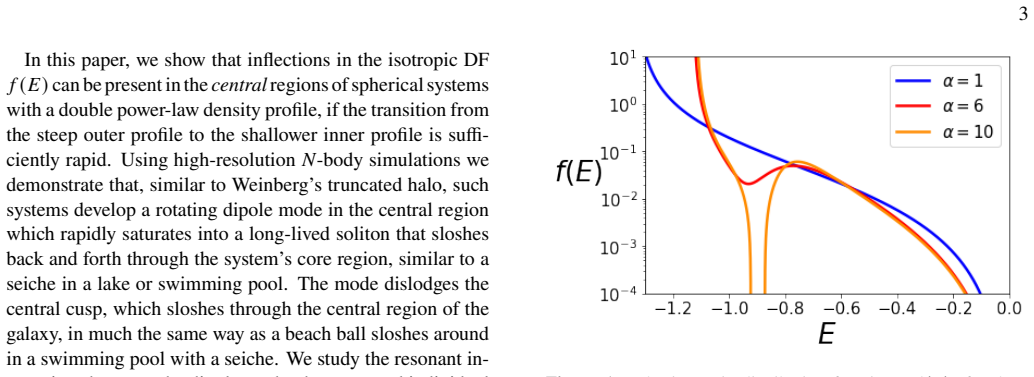
Pith's one-line read A sharp density break in a spherical galaxy destabilizes the halo into a rotating, sloshing $\ell=1$ mode that dislodges the central cusp and can explain lopsidedness and off-center nuclei.
desk verdict A well-supported linear instability with a saturation mechanism that is plausible but not fully proven; worth refereeing carefully. read the letter →
The pith
A machine-rendered reading of the paper's core claim, the machinery that carries it, and where it could break.
The reading
What carries the argument
The object that carries the argument is the bump in the isotropic distribution function $f(E)$: an energy interval where ${\rm d}f/{\rm d}E > 0$, obtained by Eddington inversion of the $(\alpha,\beta,\gamma)$ density profile. In the linear response matrix $M(\omega)$, the resonance denominator $1/(\omega - \ell\cdot\Omega)$ picks out exactly this gradient; with a positive gradient at the corotation resonance the $\ell=1$ Landau mode is reinforced rather than damped. In the nonlinear regime the same resonance traps particles into librating orbits, and the trapped-particle dynamics, the soliton, is what erodes the bump and sets the saturation amplitude.
What would settle it
Build the $(\alpha,\beta,\gamma)=(6,5,0.5)$ spherical model with the same density profile but replace the bump by a flat plateau in $f(E)$, then evolve it with at least $10^6$ particles; if a growing $\ell=1$ mode still appears, the inflection is not the cause. Conversely, the paper predicts the unmodified model should show exponential $\ell=1$ growth with ${\rm Im}(\omega)=0.044$ and pattern speed ${\rm Re}(\omega)=0.846$ in model units, so a high-resolution run that shows no such mode would refute the claim.
Extended reading notes
Core claim
The central claim is that isotropic, spherical, self-gravitating systems with a double power-law density profile are unstable to a rotating dipole ($\ell=1$) mode whenever the transition between the outer and inner slopes is sharp enough to create an inflection in the Eddington-inverted distribution function. The paper shows that such an inflection causes the linear response matrix to develop a growing zero at complex frequency $(0.846, 0.042)$ in model units, in close agreement with the exponential growth measured in the simulation. The growing mode dislodges the central cusp and carries it outward on a spiral before the pair settles into a long-lived soliton that rotates and sloshes through the center on a slowly precessing, moderately eccentric orbit. Resonant particles trapped at corotation and at nearby Lindblad resonances librate and exchange energy with the mode, eroding the bump in the distribution function; saturation coincides with the near-erasure of the inflection.
Load-bearing premise
The whole analysis assumes the system remains near enough to a spherical, isotropic equilibrium that the distribution function can be recovered from the spherically averaged potential and the density of states; if the real system is strongly anisotropic or the mode amplitude grows beyond the few-percent level, the measured bump erosion and the inferred mechanism could no longer be trusted.
Editorial extensions
If this is right
- A wide part of the $(\alpha,\beta,\gamma)$ parameter space is inherently unstable: profiles with small $\gamma$ and large $\alpha$ (shallow inner slope, sharp transition) violate Antonov's criterion, while the familiar cuspy profiles sit safely in the stable region.
- Cored profiles lie close to the stability boundary, so any process that turns a cusp into a core can push a system into the unstable regime and trigger a dipole mode.
- The resulting lopsidedness is long-lived: the saturated soliton keeps rotating and sloshing for the full duration of the simulation, so off-center structure need not be a transient disturbance.
- The saturation amplitude of the mode grows with the depth of the distribution-function bump, so the observable strength of lopsidedness encodes how strongly the stability criterion is violated.
- Because resolving the mode requires roughly $10^6$ particles, lower-resolution cosmological simulations are expected to miss this instability entirely.
Reading between the lines
- Extension: I would predict that core formation by feedback-driven outflows, which lowers $\gamma$, can actively drive a halo across the stability boundary; the paper lists this as plausible but does not simulate it.
- Extension: A direct test would be to look for coherent $\ell=1$ sloshing of the dark-matter density peak around the galaxy barycenter in cosmological zoom simulations with about $10^6$ or more particles per halo, since the paper shows the mode is invisible at lower resolution.
- Extension: The same resonance balance implies that dynamical buoyancy of a massive perturber in a cored halo is the finite-amplitude counterpart of this instability; measuring whether the buoyant phase corresponds to a positive ${\rm d}f/{\rm d}E$ at the perturber's energy would link the two phenomena.
- Extension: If off-center nuclei in dwarf galaxies are caused by this mode, their offsets should precess with a pattern speed tied to the central potential rather than wander randomly; tracking the phase of the offset over several dynamical times would distinguish the two cases.
Editorial analysis
A structured set of objections, weighed in public.
Referee Report
Summary. This paper investigates the stability of isotropic, spherical systems with generalized (alpha, beta, gamma) double power-law density profiles. The authors show that for rapid inner-to-outer slope transitions (large alpha), the Eddington-inverted distribution function develops an inflection with df/dE > 0 in a region of energy space, violating Antonov's sufficient stability condition. They map the stable, unstable, and unphysical regions in (alpha, gamma) for fixed beta and provide fitting functions for the boundaries. Using multimass N-body simulations of the fiducial (6,5,0.5) profile, they find an exponentially growing l=1 (dipole) mode whose growth rate (0.044) and pattern speed (0.829) match linear-response predictions (Im omega = 0.042, Re omega = 0.846). The mode dislodges the central cusp, which subsequently settles on a slowly precessing elliptical orbit, and the l=1 power saturates into a long-lived oscillating 'soliton'. The authors interpret the growth and saturation as a gravitational analogue of the bump-on-tail instability, with resonant particles eroding the bump in the distribution function, and discuss implications for lopsidedness, off-center nuclei, and dynamical buoyancy.
Significance. If the central mechanism is established, the paper identifies a broad, previously underappreciated class of unstable equilibria within a standard family of density profiles and connects it to observable lopsidedness and off-center nuclei. The paper's strengths are credible: the dispersion-relation calculation is a parameter-free evaluation from the same distribution function used to seed the simulations, and the growth rate and pattern speed agree with the simulation at the few-percent level. The resolution and convergence tests in Appendix A, the use of multimass initial conditions with no mass segregation, and the direct orbital-frequency analysis (NAFF) are careful and add support to the linear-instability claim. The main weakness is that the bump-erosion saturation mechanism rests on an f(E,L) reconstruction that assumes spherical symmetry in a deliberately non-spherical saturated state; this part of the evidence needs strengthening or qualification.
major comments (3)
- [Section 3.3 and Figure 6] The computation of the evolving distribution function assumes spherical symmetry: g(E,L) in Eq. (11) is evaluated in the instantaneous spherically averaged potential, and f(E) is obtained by marginalizing over L via Eq. (13). The justification given in Section 3.3, namely that the l=1 mode saturates at a normalized amplitude of about 10^-2, uses the global A1/A0 amplitude, but the saturated state is locally strongly non-spherical: the cusp is displaced to r approximately 0.15 (Figure 5) and the central l=1 density contrast in Figure 4 is much larger than the global A1/A0. For particles librating in or near the displaced cusp, the pair (E,L) computed in a spherical potential is not a canonical map of the true phase space, so the apparent flattening of the bump in Figure 6 could be partly an artifact of the analysis. Because the plateau-formation/bump-erosion mechanism is the stated saturation mechanism in Section 6.2, the paper should either recompute the DF in action space using the full non-spherical potential or quantify the bias in the spherical (E,L) reconstruction.
- [Section 4.3 and Section 6.2] The manuscript reports that the late-time f(E) still has a small region with df/dE > 0 and attributes this to unmodeled anisotropy. This is in tension with the claim that saturation occurs when the bump has been eroded to df/dE roughly equal to zero: if a positive gradient remains, the linear-response growth mechanism would not be fully switched off, and the plateau-formation picture is incomplete. Moreover, the residual gradient is measured with the same spherically biased estimator as in Figure 6, so it is not clear whether it is real or an artifact. The authors should quantify the residual df/dE; if it is real, they should explain how saturation is achieved despite it, and if it is an artifact, the erosion conclusion needs to be revised accordingly.
- [Section 6.2.1 and Figure 11] The blanket statement in Section 2.1 that all simulated systems in the unstable region are found to be unstable is not supported by the alpha=4 run, which shows no detectable l=1 mode in Figure 11. The explanation that the mode amplitude is too small to rise above Poisson noise is plausible but not demonstrated: no predicted saturation amplitude or noise floor is given for alpha=4, and the resolution tests in Appendix A are for the fiducial (6,5,0.5) model only. The paper should either provide a quantitative estimate (linear-theory amplitude versus expected noise) for the alpha=4 case or restrict the general claim to systems with deeper inflections.
minor comments (4)
- [Section 4.2 and Figure 3 caption] There is a typo in Section 4.2: 'we use can the trajectory' should read 'we can use the trajectory'; also, the Figure 3 caption has 'a dipole perturpation', which should be 'a dipole perturbation'.
- [Section 6.4] The phrase 'as eluded to above' should be 'as alluded to above'.
- [Section 3.1, Equation (7)] The mass-spectrum exponent zeta is introduced as a free parameter, but the main runs use only zeta=15 and the Appendix compares equal-mass runs rather than varying zeta; a sentence on the sensitivity of the results to zeta would be helpful.
- [Figure 6] The left panel of Figure 6 would be easier to read if the color scale were saturated at a stated value of |Delta f| and if the Delta f = 0 contour were overlaid, since the sign of the change is central to the bump-erosion argument.
Circularity Check
No significant circularity: the linear-theory instability, growth rate, and pattern speed are independent, parameter-free computations from the same initial DF that seeds the simulations; self-citations are contextual, not load-bearing.
full rationale
The central derivation chain is: (i) choose a double power-law density profile; (ii) compute f(E) by Eddington inversion (Eq. 4); (iii) compute the linear response matrix M(omega) from that f(E) and locate the zero of D(omega) (Eqs. 1-2); (iv) sample N-body initial conditions from the same f(E) and evolve them. Steps (ii)-(iii) share the same input DF, but that is not circular: the response calculation could in principle have returned a damped mode, yet it yields a positive imaginary frequency, and the simulation independently measures growth rate 0.044 versus the predicted 0.042 and pattern speed 0.829 versus Re(omega) = 0.846. The saturation claim that the bump in the DF is eroded is an observational inference from the simulation, not a quantity fitted to the simulation and then called a prediction. The spherical reconstruction of f(E,L) in Section 3.3 is an approximation whose limitations are acknowledged in Section 4.3, including the residual positive df/dE and possible anisotropy; this is a correctness or robustness concern, not a circular reduction. Self-citations to Weinberg (1994, 2023) provide the numerical implementation of standard linear response theory and prior context, but the present conclusion does not rest on an unverified self-citation chain: the dispersion relation is evaluated explicitly by marching squares and compared against an independent N-body integration (GyrfalcOn) and a separate basis-function expansion (EXP). The fitted gamma_stable and gamma_physical lines are auxiliary classifiers of parameter space, not inputs to the instability calculation, so no fitted parameter is renamed as a prediction. No load-bearing step reduces, by the paper's own equations or by self-citation, to its own inputs.
Assumptions & free parameters
free parameters (3)
- gamma_stable fit coefficients =
0.0550, 0.087, 0.136, 0.181
- gamma_physical fit coefficients =
0.0047, 0.043, 0.013, 0.102
- mass spectrum exponent zeta =
15
assumptions (6)
- standard math Antonov's stability criterion: isotropic spherical systems with df/dE < 0 everywhere are stable.
- standard math Eddington inversion determines f(E) uniquely from a spherically symmetric density profile.
- domain assumption The collisionless Boltzmann equation and Poisson equation govern the system; N-body simulations with GyrfalcOn approximate their solutions.
- domain assumption The system is isotropic, f = f(E), throughout the initial conditions.
- domain assumption The system remains spherical during the evolution, so the density of states can be computed from the spherically averaged potential.
- standard math The linear response matrix formalism (Kalnajs, Weinberg) correctly predicts discrete modes of the self-gravitating system.
Cite this review
Pith. "Pith review of The Dipole Instability in Gravitational $N$-body Systems: A Natural Explanation for Lopsidedness and Off-Centered Nuclei in Galaxies." pith.science (2026). https://pith.science/paper/EIRXXFLV
@misc{pith2026250523905,
  author       = {Pith},
  title        = {Pith review of: The Dipole Instability in Gravitational $N$-body Systems: A Natural Explanation for Lopsidedness and Off-Centered Nuclei in Galaxies},
  year         = {2026},
  howpublished = {\url{https://pith.science/paper/EIRXXFLV}},
  note         = {Machine review of arXiv:2505.23905}
}
abstract
We explore the stability of isotropic, spherical, self-gravitating systems with a double-power law density profile. Systems with rapid transitions between the inner and outer slopes are shown to have an inflection in their isotropic distribution function (DF), where ${\rm d} f/{\rm d} E > 0$, thereby violating Antonov's stability criterion. Using high-resolution $N$-body simulations, we show that the resulting instability causes the growth of a rotating dipole (or $l=1$) mode. The inflection feature in the DF responds to the mode by promoting its growth, driving the instability. The growth of the dipole results in a torque that dislodges the original cusp from its central location, and sets it in motion throughout the central region. Once the mode goes non-linear, it saturates, together with the cusp, into a long-lived soliton (the $l=1$ equivalent of a bar in a disk galaxy), which maintains its sloshing motion through the center of the halo along a slowly precessing, elliptical orbit. Concurrently, the soliton traps increasingly more particles into libration, and the exchange of energy and angular momentum with these trapped particles works towards eroding the bump in the distribution function. We point out similarities between the dipole mode and the bump-on-tail instability in electrostatic plasmas, and highlight a potential connection with core stalling and dynamical buoyancy in systems with a cored density profile. Finally, we discuss the astrophysical implications in terms of lopsidedness and off-center nuclei in galaxies.
Figures


Figures from the paper (9 more)


Forward citations
Cited by 1 Pith paper
-
Constraining the Milky Way dark matter halo with LMC-induced reflex motion
Basis-function-expansion N-body models show that the direction, not the amplitude, of the LMC-induced reflex motion of the Milky Way disc can constrain the outer dark matter halo, and reveal a slope-dependent halo ins...
Reference graph
Works this paper leans on
-
[1]
Antonov, V. A. 1962, Solution of the problem of stability of stellar system Emden’s density law and the spherical distribution of velocities
1962
-
[2]
Antonov, V. A. 1973, in Dynamics of Galaxies and Star Clusters, 139–143
1973
-
[3]
2021, MNRAS, 503, 2955, doi: 10.1093/mnras/stab634
Baes, M., & Camps, P. 2021, MNRAS, 503, 2955, doi: 10.1093/mnras/stab634
-
[4]
Banik, U., & van den Bosch, F. C. 2021, ApJ, 912, 43, doi: 10.3847/1538-4357/abeb6d —. 2022, ApJ, 926, 215, doi: 10.3847/1538-4357/ac4242
-
[5]
1986, ApJ, 300, 112, doi: 10.1086/163786
Barnes, J., Goodman, J., & Hut, P. 1986, ApJ, 300, 112, doi: 10.1086/163786
-
[6]
Begelman, M. C., Blandford, R. D., & Rees, M. J. 1980, Nature, 287, 307, doi: 10.1038/287307a0 Beraldo e Silva, L., Debattista, V. P., Anderson, S. R., et al. 2023, ApJ, 955, 38, doi: 10.3847/1538-4357/ace976
doi:10.1038/287307a0 1980
-
[7]
2000, A&A, 359, 447
Binggeli, B., Barazza, F., & Jerjen, H. 2000, A&A, 359, 447
2000
-
[8]
1988, MNRAS, 230, 597, doi: 10.1093/mnras/230.4.597
Binney, J., & Lacey, C. 1988, MNRAS, 230, 597, doi: 10.1093/mnras/230.4.597
Show all 86 references
-
[9]
2008, Galactic Dynamics: Second Edition
Binney, J., & Tremaine, S. 2008, Galactic Dynamics: Second Edition
2008
-
[10]
J., & Puerari, I
Bournaud, F., Combes, F., Jog, C. J., & Puerari, I. 2005, A&A, 438, 507, doi: 10.1051/0004-6361:20052631
2005 doi
-
[11]
Boyd, T. J. M., & Sanderson, J. J. 2003, The Physics of Plasmas, doi: 10.1017/CBO9780511755750
2003 doi
-
[12]
1943, ApJ, 97, 255, doi: 10.1086/144517
Chandrasekhar, S. 1943, ApJ, 97, 255, doi: 10.1086/144517
1943 doi
-
[13]
2016, A&A, 588, A48, doi: 10.1051/0004-6361/201527730
Chemin, L., Hur´e, J.-M., Soubiran, C., et al. 2016, A&A, 588, A48, doi: 10.1051/0004-6361/201527730
2016 doi
-
[14]
T., van den Bosch, F
Chiang, B. T., van den Bosch, F. C., & Schive, H.-Y. 2024, arXiv e-prints, arXiv:2411.03192, doi: 10.48550/arXiv.2411.03192
2024 doi
-
[15]
2023, MNRAS, 525, 3576, doi: 10.1093/mnras/stad2324
Chiba, R. 2023, MNRAS, 525, 3576, doi: 10.1093/mnras/stad2324
2023 doi
-
[16]
2022, MNRAS, 513, 768, doi: 10.1093/mnras/stac697
Chiba, R., & Sch¨onrich, R. 2022, MNRAS, 513, 768, doi: 10.1093/mnras/stac697
2022 doi
-
[18]
D., van Dokkum, P., et al
Conroy, C., Johnson, B. D., van Dokkum, P., et al. 2024, ApJ, 968, 129, doi: 10.3847/1538-4357/ad414a
2024 doi
-
[19]
J., & Wyse, R
Daniel, K. J., & Wyse, R. F. G. 2015, MNRAS, 447, 3576, doi: 10.1093/mnras/stu2683
2015 doi
-
[20]
M., & Shanny, R
Dawson, J. M., & Shanny, R. 1968, Physics of Fluids, 11, 1506, doi: 10.1063/1.1692136 de Zeeuw, T. 1985, MNRAS, 216, 273, doi: 10.1093/mnras/216.2.273
1968 doi
-
[21]
1993, MNRAS, 265, 250, doi: 10.1093/mnras/265.1.250 —
Dehnen, W. 1993, MNRAS, 265, 250, doi: 10.1093/mnras/265.1.250 —. 2001, MNRAS, 324, 273, doi: 10.1046/j.1365-8711.2001.04237.x —. 2002, Journal of Computational Physics, 179, 27, doi: 10.1006/jcph.2002.7026
1993
-
[22]
P., & Feix, M
Doremus, J. P., & Feix, M. R. 1972, A&A, 20, 259
1972
-
[23]
R., & Baumann, G
Doremus, J.-P., Feix, M. R., & Baumann, G. 1971, Phys. Rev. Lett., 26, 725, doi: 10.1103/PhysRevLett.26.725
1971 doi
-
[24]
E., Taylor, J
Drakos, N. E., Taylor, J. E., & Benson, A. J. 2017, MNRAS, 468, 2345, doi: 10.1093/mnras/stx652 —. 2020, MNRAS, 494, 378, doi: 10.1093/mnras/staa760
2017 doi
-
[26]
Eddington, A. S. 1916, MNRAS, 76, 572, doi: 10.1093/mnras/76.7.572
1916 doi
-
[27]
2001, ApJ, 560, 636, doi: 10.1086/322516
El-Zant, A., Shlosman, I., & Hoffman, Y. 2001, ApJ, 560, 636, doi: 10.1086/322516
2001 doi
-
[28]
B., Pichon, C., & Chavanis, P
Fouvry, J. B., Pichon, C., & Chavanis, P. H. 2015, A&A, 581, A139, doi: 10.1051/0004-6361/201525928
2015 doi
-
[29]
M., & Polyachenko, V
Fridman, A. M., & Polyachenko, V. L. 1984, Physics of gravitating systems. II - Nonlinear collective processes: Nonlinear waves, solitons, collisionless shocks, turbulence. Astrophysical applications
1984
-
[30]
I., & Stadel, J
Goerdt, T., Moore, B., Read, J. I., & Stadel, J. 2010, ApJ, 725, 1707, doi: 10.1088/0004-637X/725/2/1707
2010 doi
-
[32]
1971, Ap&SS, 13, 387, doi: 10.1007/BF00649168
Goldstein, S. 1971, Ap&SS, 13, 387, doi: 10.1007/BF00649168
1971 doi
-
[33]
2024, MNRAS, doi: 10.1093/mnras/stae305
Hamilton, C. 2024, MNRAS, doi: 10.1093/mnras/stae305
2024 doi
- [34]
-
[35]
A., Arzamasskiy, L., & Duarte, V
Hamilton, C., Tolman, E. A., Arzamasskiy, L., & Duarte, V. N. 2023, ApJ, 954, 12, doi: 10.3847/1538-4357/acd69b
2023 doi
-
[36]
P., Hogg, D
Haynes, M. P., Hogg, D. E., Maddalena, R. J., Roberts, M. S., & van Zee, L. 1998, AJ, 115, 62, doi: 10.1086/300166
1998 doi
-
[37]
C., Breen, P
Heggie, D. C., Breen, P. G., & Varri, A. L. 2020, MNRAS, 492, 6019, doi: 10.1093/mnras/staa272
2020 doi
-
[38]
1990, ApJ, 356, 359, doi: 10.1086/168845
Hernquist, L. 1990, ApJ, 356, 359, doi: 10.1086/168845
1990 doi
-
[40]
1983, MNRAS, 202, 995, doi: 10.1093/mnras/202.4.995
Jaffe, W. 1983, MNRAS, 202, 995, doi: 10.1093/mnras/202.4.995
1983 doi
-
[41]
Jog, C. J. 1997, ApJ, 488, 642, doi: 10.1086/304721 —. 1999, ApJ, 522, 661, doi: 10.1086/307664
1997 doi
-
[42]
J., & Combes, F
Jog, C. J., & Combes, F. 2009, PhR, 471, 75, doi: 10.1016/j.physrep.2008.12.002
2009 doi
-
[43]
Kalnajs, A. J. 1977a, ApJ, 212, 637, doi: 10.1086/155086 —. 1977b, ApJ, 212, 637, doi: 10.1086/155086
-
[44]
2018, ApJ, 868, 134, doi: 10.3847/1538-4357/aaeacf
Kaur, K., & Sridhar, S. 2018, ApJ, 868, 134, doi: 10.3847/1538-4357/aaeacf
2018 doi
-
[45]
King, I. R. 1966, AJ, 71, 64, doi: 10.1086/109857
1966 doi
-
[46]
2013, ApJ, 765, 10, doi: 10.1088/0004-637X/765/1/10
Kuhlen, M., Guedes, J., Pillepich, A., Madau, P., & Mayer, L. 2013, ApJ, 765, 10, doi: 10.1088/0004-637X/765/1/10
2013 doi
-
[47]
1992, Physica D Nonlinear Phenomena, 56, 253, doi: 10.1016/0167-2789(92)90028-L
Laskar, J., Froeschl´e, C., & Celletti, A. 1992, Physica D Nonlinear Phenomena, 56, 253, doi: 10.1016/0167-2789(92)90028-L
1992 doi
- [48]
-
[49]
Lynden-Bell, D., & Kalnajs, A. J. 1972, MNRAS, 157, 1, doi: 10.1093/mnras/157.1.1
1972 doi
-
[50]
2015, MNRAS, 449, 3393, doi: 10.1093/mnras/stv467
Massey, R., Williams, L., Smit, R., et al. 2015, MNRAS, 449, 3393, doi: 10.1093/mnras/stv467
2015 doi
-
[51]
McMillan, P. J. 2017, MNRAS, 465, 76, doi: 10.1093/mnras/stw2759
2017 doi
-
[52]
F., Santos-Santos, I., Ben´ıtez-Llambay, A., & Frenk, C
Meadows, N., Navarro, J. F., Santos-Santos, I., Ben´ıtez-Llambay, A., & Frenk, C. 2020, MNRAS, 491, 3336, doi: 10.1093/mnras/stz3280
2020 doi
-
[53]
Merritt, D., & Aguilar, L. A. 1985, MNRAS, 217, 787, doi: 10.1093/mnras/217.4.787
1985 doi
-
[54]
2024, MNRAS, 528, 5252, doi: 10.1093/mnras/stae292
Mezcua, M., & Dom´ınguez S´anchez, H. 2024, MNRAS, 528, 5252, doi: 10.1093/mnras/stae292
2024 doi
-
[55]
Michie, R. W. 1963, MNRAS, 125, 127, doi: 10.1093/mnras/125.2.127
1963 doi
- [56]
-
[57]
T., Nuritdinov, S
Mirtadjieva, K. T., Nuritdinov, S. N., Ruzibaev, J. K., & Khalid, M. 2011, Astrophysics, 54, 184, doi: 10.1007/s10511-011-9171-z
2011 doi
-
[58]
F., Frenk, C
Navarro, J. F., Frenk, C. S., & White, S. D. M. 1997, ApJ, 490, 493, doi: 10.1086/304888
1997 doi
-
[60]
L., & Papaloizou, J
Palmer, P. L., & Papaloizou, J. 1987, MNRAS, 224, 1043, doi: 10.1093/mnras/224.4.1043
1987 doi
-
[61]
1996, A&A, 307, 427
Papaphilippou, Y., & Laskar, J. 1996, A&A, 307, 427
1996
-
[62]
S., Roule, M., Fouvry, J.-B., Pichon, C., & Tep, K
Petersen, M. S., Roule, M., Fouvry, J.-B., Pichon, C., & Tep, K. 2024, MNRAS, 530, 4378, doi: 10.1093/mnras/stae732
2024 doi
-
[63]
S., & Weinberg, M
Petersen, M. S., & Weinberg, M. D. 2025, Journal of Open Source Software, 10, 7302, doi: 10.21105/joss.07302
2025 doi
-
[64]
S., Weinberg, M
Petersen, M. S., Weinberg, M. D., & Katz, N. 2022, MNRAS, 510, 6201, doi: 10.1093/mnras/stab3639
2022 doi
-
[65]
A., Gualandris, A., & Read, J
Petts, J. A., Gualandris, A., & Read, J. I. 2015, MNRAS, 454, 3778, doi: 10.1093/mnras/stv2235
2015 doi
-
[66]
A., Read, J
Petts, J. A., Read, J. I., & Gualandris, A. 2016, MNRAS, 463, 858, doi: 10.1093/mnras/stw2011
2016 doi
-
[67]
Plummer, H. C. 1911, MNRAS, 71, 460, doi: 10.1093/mnras/71.5.460
1911 doi
-
[68]
L., & Shukhman, I
Polyachenko, V. L., & Shukhman, I. G. 1981, Soviet Ast., 25, 533
1981
-
[69]
2012, MNRAS, 421, 3464, doi: 10.1111/j.1365-2966.2012.20571.x
Pontzen, A., & Governato, F. 2012, MNRAS, 421, 3464, doi: 10.1111/j.1365-2966.2012.20571.x
2012
-
[70]
D., & Hernquist, L
Quinlan, G. D., & Hernquist, L. 1997, NewA, 2, 533, doi: 10.1016/S1384-1076(97)00039-0
1997 doi
-
[71]
I., Goerdt, T., Moore, B., et al
Read, J. I., Goerdt, T., Moore, B., et al. 2006, MNRAS, 373, 1451, doi: 10.1111/j.1365-2966.2006.11022.x
2006
-
[72]
2008, ApJ, 677, 186, doi: 10.1086/526506
Kauffmann, G. 2008, ApJ, 677, 186, doi: 10.1086/526506
2008 doi
-
[73]
E., Condon, J
Reines, A. E., Condon, J. J., Darling, J., & Greene, J. E. 2020, ApJ, 888, 36, doi: 10.3847/1538-4357/ab4999
2020 doi
-
[74]
G., & Sancisi, R
Richter, O. G., & Sancisi, R. 1994, A&A, 290, L9
1994
-
[75]
S., Jog, C
Saha, K., Levine, E. S., Jog, C. J., & Blitz, L. 2009, ApJ, 697, 2015, doi: 10.1088/0004-637X/697/2/2015
2009 doi
-
[76]
Sellwood, J. A. 2008, ApJ, 679, 379, doi: 10.1086/586882 22 —. 2014, Reviews of Modern Physics, 86, 1, doi: 10.1103/RevModPhys.86.1
2008 doi
-
[77]
A., & Binney, J
Sellwood, J. A., & Binney, J. J. 2002, MNRAS, 336, 785, doi: 10.1046/j.1365-8711.2002.05806.x
2002
-
[78]
A., & Wilkinson, A
Sellwood, J. A., & Wilkinson, A. 1993, Reports on Progress in Physics, 56, 173, doi: 10.1088/0034-4885/56/2/001
1993 doi
-
[79]
Sigurdsson, S., Hernquist, L., & Quinlan, G. D. 1995, ApJ, 446, 75, doi: 10.1086/175769
1995 doi
-
[80]
Albada, T. S. 1999, MNRAS, 304, 330, doi: 10.1046/j.1365-8711.1999.02332.x
1999
-
[81]
1995, in Astronomical Society of the Pacific Conference
Teuben, P. 1995, in Astronomical Society of the Pacific Conference
1995
-
[82]
Teyssier, R., Pontzen, A., Dubois, Y., & Read, J. I. 2013, MNRAS, 429, 3068, doi: 10.1093/mnras/sts563
2013 doi
-
[83]
O., Byun, Y.-I., et al
Tremaine, S., Richstone, D. O., Byun, Y.-I., et al. 1994, AJ, 107, 634, doi: 10.1086/116883
1994 doi
-
[84]
Tremaine, S., & Weinberg, M. D. 1984, MNRAS, 209, 729, doi: 10.1093/mnras/209.4.729
1984 doi
-
[85]
P., Quinn, T., & Moore, B
Valluri, M., Debattista, V. P., Quinn, T., & Moore, B. 2010, MNRAS, 403, 525, doi: 10.1111/j.1365-2966.2009.16192.x
2010
-
[86]
P., Quinn, T
Valluri, M., Debattista, V. P., Quinn, T. R., Roˇskar, R., & Wadsley, J. 2012, MNRAS, 419, 1951, doi: 10.1111/j.1365-2966.2011.19853.x
2012
-
[87]
1998, ApJ, 506, 686, doi: 10.1086/306269
Valluri, M., & Merritt, D. 1998, ApJ, 506, 686, doi: 10.1086/306269
1998 doi
- [88]
-
[89]
2013, ApJ, 772, 135, doi: 10.1088/0004-637X/772/2/135
Zaritsky, D., Salo, H., Laurikainen, E., et al. 2013, ApJ, 772, 135, doi: 10.1088/0004-637X/772/2/135
2013 doi
-
[91]
2008, MNRAS, 387, 1719, doi: 10.1111/j.1365-2966.2008.13362.x
Zhang, M., & Magorrian, J. 2008, MNRAS, 387, 1719, doi: 10.1111/j.1365-2966.2008.13362.x
2008
-
[92]
baseline
Zhao, H. 1996, MNRAS, 278, 488, doi: 10.1093/mnras/278.2.488 23 Figure 12.Left panel: the average mass of simulation particles as a function of distance from the center of mass at𝑇=0 (orange) and𝑇=500 (black dotted) for a simulation of a spherical system with an initial Hernqu...
1996 doi
Reviewed August 7, 2026 · model on record in the stance chip above.
Discussion (0). Sign in to comment.