REVIEW 4 major objections 6 minor 110 references
Dynamical detection of extended nonergodic states in many-body quantum systems
T0 review · 4 major / 6 minor · reviewed 2026-08-07 · deepseek-v4-flash
Pith's one-line read The paper argues that the exponent of the long-time power-law decay of the time-averaged survival probability equals the correlation fractal dimension $D_2$, so fractal dimensions of many-body quantum states can be read off directly from…
desk verdict Useful dynamical probe of D2 in random-matrix settings with a solid GOE benchmark, but the many-body extension rests on single-size hand-picked fits and needs stability checks before it can be trusted. read the letter →
The pith
A machine-rendered reading of the paper's core claim, the machinery that carries it, and where it could break.
The reading
What carries the argument
The central object is the time-averaged survival probability $\langle SP(t)\rangle = \frac{1}{t}\int_0^t \langle SP(\tau)\rangle\, d\tau$, whose power-law tail exponent $\nu$ is claimed to equal $D_2$. Its role is to act as a filter: time averaging removes the spectral contributions that contaminate the raw survival probability — the Bessel-function oscillations from the edges of the energy distribution and the correlation hole from level repulsion — leaving only the correlations among the components $C^{(0)}_n$ of the initial state in the Hamiltonian eigenbasis. The independent definition of $D_2$ used for comparison is the box-counting method, $P(l)\propto l^{D_2}$, with $P(l)$ built from the squared projections of the initial state inside energy boxes of linear size $l$. In the Gaussian orthogonal ensemble case the machinery is fully explicit: integrating the analytical survival probability (Eq. 10) yields Eq. (12), whose large-time limit is $\langle SP(t\to\infty)\rangle \approx \frac{8}{9\pi}\frac{N}{\Gamma t} SP - \frac{1}{6}\frac{N}{\Gamma t} SP + SP$, giving $\nu = 1$ with no correlation hole.
What would settle it
Compute $\nu$ from $\langle SP(t)\rangle$ and $D^{\mathrm{box}}_2$ from the same initial states in the interacting Aubry-André model at $L=18$ or $20$ with a time-evolution algorithm: a systematic discrepancy, or the disappearance of a clean power-law window in the intermediate regime $0.7<h<1.7$, would falsify the claimed equality.
Extended reading notes
Core claim
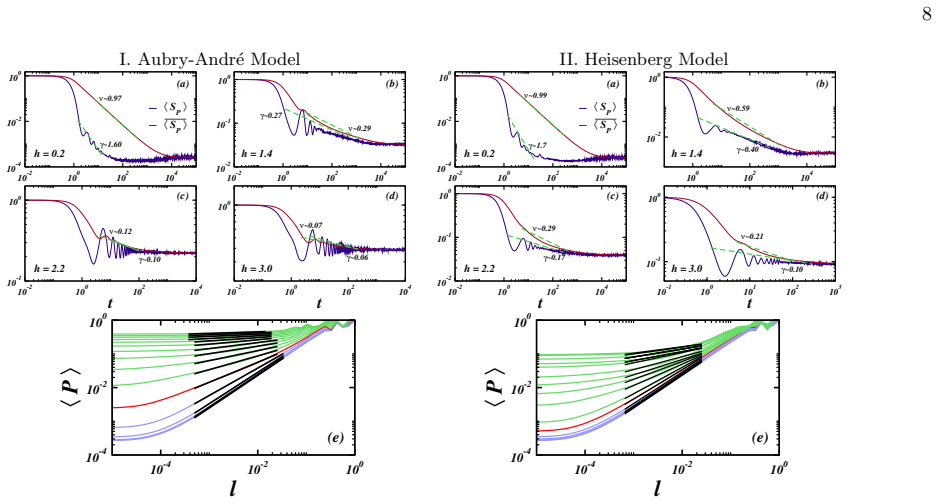
The paper's central claim is that the long-time power-law exponent $\nu$ of the time-averaged survival probability, $\langle SP(t)\rangle \propto t^{-\nu}$, coincides with the correlation fractal dimension $D_2$ obtained by box counting, $P(l)\propto l^{D_2}$, where $P(l)$ sums the squared amplitudes of the initial state inside energy boxes of size $l$. The claim is tested in five settings: full random matrices from the Gaussian orthogonal ensemble, the Rosenzweig-Porter ensemble, power-law banded random matrices, the interacting Aubry-André model, and the disordered spin-$1/2$ Heisenberg chain. In every case, $\nu$ agrees with $D^{\mathrm{box}}_2$ across the ergodic, extended nonergodic, and localized phases, even where the raw survival-probability exponent $\gamma$ or the IPR-based fractal dimension $D^{\mathrm{IPR}_0}_2$ deviate. For the Gaussian orthogonal ensemble the entire evolution of $\langle SP(t)\rangle$ is derived analytically (Eq. 12): Bessel oscillations and the correlation hole are averaged away, and the asymptotic decay is exactly $t^{-1}$, so $\nu = D_2 = 1$. The conclusion is that the time-averaged survival probability filters out spectral correlations and leaves a decay controlled solely by correlations among eigenstate components, making it a direct dynamical observable for $D_2$.
Load-bearing premise
The method assumes that in the time window chosen for the fit, the time-averaged survival probability has already lost all spectral correlations (level repulsion, spectral edges, and the correlation hole), so its decay exponent is governed only by correlations among the eigenstate components; the paper proves this filtering only for the GOE and checks it numerically at $L=16$ for the interacting models.
Editorial extensions
If this is right
- If $\nu = D_2$ holds, the fractal dimension of an initial state can be extracted from a single long-time dynamical trace, replacing the need to diagonalize many system sizes and perform finite-size scaling.
- Because the method uses time evolution rather than full exact diagonalization, it is compatible with large-scale evolution algorithms and can reach larger system sizes than IPR-based scaling studies.
- The basis is fixed to the energy eigenbasis, so the extracted $D_2$ is not affected by the choice of real-space or momentum-space basis that complicates eigenstate-based IPR analyses.
- In extended nonergodic phases, $\nu$ and $D^{\mathrm{box}}_2$ agree even when the IPR-based $D_2$ does not, so the dynamical exponent is a sharper indicator of nonergodicity.
- Since the survival probability is a fidelity, the approach may be usable in experiments without state tomography, as a direct probe of multifractal and extended nonergodic phases.
Reading between the lines
- A testable extension is to push the equality $\nu = D_2$ to larger system sizes in the interacting Aubry-André and Heisenberg models using time-evolution algorithms, checking whether a clean power-law window persists near the many-body localization crossover; the paper tests only $L=16$ for the interacting models.
- If the equality holds across the transition region, the time-averaged survival probability could become a dynamical order parameter for many-body localization, locating the transition by where $\nu$ (and hence $D_2$) extrapolates to zero.
- The faster decay of $\nu$ and $D^{\mathrm{box}}_2$ relative to $D^{\mathrm{IPR}_0}_2$ in intermediate regimes hints that box-counting and dynamics are more sensitive to weak multifractality than IPR scaling; a possible reason is that energy-box sums weight clusters of nearby components, an interpretation the paper does not develop.
Editorial analysis
A structured set of objections, weighed in public.
Referee Report
Summary. The manuscript proposes that the long-time power-law exponent ν of the time-averaged survival probability, Eq. (5), equals the box-counting fractal dimension Dbox2 of Eq. (8), and that this equality allows D2 to be extracted from dynamics alone, without finite-size scaling. The authors test this claim on GOE random matrices, the Rosenzweig-Porter (RP) model, power-law banded random matrices (PBRM), the interacting Aubry-André model, and the disordered Heisenberg spin chain. For GOE they provide an explicit analytical derivation of the full time-averaged survival probability in Appendix A and verify it numerically. For the other models they compare γ, ν, DIPR0_2, and Dbox2 as functions of the relevant control parameter and report excellent agreement between ν and Dbox2 in all cases, while γ and DIPR0_2 deviate in extended nonergodic and chaotic regimes. The conclusion is that the time-averaged survival probability is a robust and scalable dynamical probe of multifractality in many-body systems.
Significance. If the central equality ν = Dbox2 holds for interacting many-body systems, the paper offers a genuinely useful tool: it would replace multi-size scaling analyses of eigenstates with a single dynamical simulation, and it connects to tensor-network time-evolution methods that reach larger sizes than exact diagonalization. The GOE derivation is a concrete strength: the analytical expression in Appendix A is explicit, the asymptotic ν = 1 is derived, and the numerical curves agree with it. The RP and PBRM results are also valuable benchmarks because they scan ergodic, extended nonergodic, and localized regimes. However, the many-body part of the claim, which is the advertised main advance, rests on a single system size and on fitted exponents without uncertainty estimates; this is the load-bearing gap that prevents the paper from being accepted in its present form.
major comments (4)
- [Sec. IV A/B, Figs. 6–8] The central many-body claim, ν ≈ Dbox2, is demonstrated only at L = 16 (N = 12,870), a single system size. Since both ν from Eq. (5) and Dbox2 from Eq. (8) are extracted from the same finite system with hand-picked fitting windows, the agreement could be a common finite-size renormalization rather than the thermodynamic equality asserted in the abstract and conclusions. Please provide results for at least two or three additional sizes (e.g., L = 12, 14, 16) with error bars, showing that ν and Dbox2 converge to the same value, or demonstrate the dynamical method on larger systems using the tensor-network/MPO time evolution advertised in the Introduction. Without this, the scalable extraction claim is not supported by the data.
- [Sec. II A and Appendix A] The filtering property that time averaging removes spectral correlations and leaves only correlations among eigenstate components is derived analytically only for GOE matrices (Eq. (12) and Appendix A). For the interacting Aubry-André and Heisenberg models (Secs. IV A/B) no analogous argument is given, and at L = 16 the discrete spectrum and finite correlation-hole time scale can contaminate the fitted power-law window. The manuscript should state a concrete criterion for choosing the fitting windows for γ, ν, and the P(l) scaling region, and should quantify sensitivity to window endpoints for the many-body data. As written, ν from Eq. (5) may reflect the pre-saturation dynamics of a finite system rather than the asymptotic fractal dimension D2.
- [Figs. 2, 8, 9] No error bars or statistical uncertainties are reported for the fitted exponents γ, ν, DIPR0_2, or Dbox2, and the fitting windows are described only as 'the same for both exponents' with no procedure for their selection. Because every conclusion in the paper is a comparison of fitted exponents, the absence of uncertainty quantification makes it impossible to judge whether the reported agreement between ν and Dbox2 is significant or within expected numerical scatter. Please report bootstrap or realization-to-realization errors and explicitly list the fitting intervals used in each figure.
- [Introduction and Conclusions] The paper's stated practical advantage is that the dynamical approach 'avoids the need for scaling procedures and enables access to larger systems than those typically reachable via exact diagonalization.' This is not demonstrated for the many-body models: all many-body data in Secs. IV A/B come from exact diagonalization at L = 16, the same scale as standard finite-size scaling studies. A concrete demonstration on a larger system, even for one parameter point, using the tensor-network methods referenced in the Introduction would be needed to substantiate this claim.
minor comments (6)
- [Eq. (4)] The same angle brackets ⟨·⟩ are used for the disorder average and for the time average in Eq. (4), which is confusing; consider a different notation such as an overline for the time average.
- [Sec. IV B] In the sentence 'The figures also reiterates that' the verb should agree with the plural subject; it should read 'The figures also reiterate that.'
- [Appendix B] The text says 'The bottom left and right Fig. 8(d) show the analysis of ⟨P(l)⟩,' but the P(l) panels are labeled as Fig. 8(e); please correct the cross-reference.
- [Fig. 3 caption] The color assignments for the α values in the caption of Fig. 3 are ambiguous; labeling the curves directly or using distinct markers would improve readability.
- [Refs. [106] and [107]] References [106] and [107] appear to be the same article by Xu et al. with slightly different titles; please merge or remove the duplicate.
- [Sec. II A] The phrase '10 4 samples' appears twice and should be written as '10^4 samples'.
Circularity Check
No significant circularity: the exponent nu and the box-counting dimension Dbox_2 are extracted from independent temporal and static quantities, and their agreement is benchmarked against external results.
full rationale
The central claim of the paper is that the power-law exponent nu of the time-averaged survival probability, defined in Eqs. (4)-(5), coincides with the box-counting fractal dimension Dbox_2 extracted from P(l) in Eqs. (7)-(8). These are not the same quantity by construction: nu is a temporal decay exponent obtained by fitting the time average of the fidelity, while Dbox_2 is a static exponent obtained by binning the initial state's energy components over box sizes l. The two quantities live on different axes (time versus energy scale) and are fitted independently. For GOE matrices, the paper provides an explicit analytical derivation in Appendix A, showing nu = 1 and separately noting that Dbox_2 = 1 for random vectors; this is a genuine derivation, not a renaming. For the Rosenzweig-Porter and power-law banded random matrix ensembles, and for the interacting Aubry-Andre and Heisenberg models, the agreement between nu and Dbox_2 is established numerically from separate fits, and the paper explicitly cites the external result [4] for the general relation between Dbox_2 and the decay of the time-averaged survival probability. The self-citations to the authors' earlier expressions for the GOE survival probability [21, 67, 68] serve as inputs to the analytical GOE calculation, but they are not the sole support for the many-body claim, which is checked against independently computed static Dbox_2 values. No fitted parameter is relabeled as a prediction, and no uniqueness theorem or ansatz is smuggled in through a self-citation chain. The main limitation, namely that the interacting-model verification is performed only at L = 16 with manually selected fitting windows, is a finite-size and fitting-robustness concern rather than a circularity. Thus no specific circular step can be exhibited, and the appropriate finding is no significant circularity.
Assumptions & free parameters
free parameters (1)
- Power-law fitting windows for gamma, nu, and box-counting scaling ranges =
Not specified; chosen by hand
assumptions (4)
- domain assumption The time-averaged survival probability filters out spectral details and reflects only correlations among the eigenstate components.
- domain assumption The box-counting scaling P(l) proportional to l^D2 holds over the accessible box-size window.
- domain assumption The phase boundaries of the interacting Aubry-André model (0.7 < h < 1.7 for extended nonergodic) and the Heisenberg model's delocalization/localization behavior are as given by cited prior work.
- standard math Standard quantum mechanical time evolution with a closed Hamiltonian and initial states near the center of the spectrum.
Cite this review
Pith. "Pith review of Dynamical detection of extended nonergodic states in many-body quantum systems." pith.science (2026). https://pith.science/paper/STPWDDRS
@misc{pith2026250523910,
  author       = {Pith},
  title        = {Pith review of: Dynamical detection of extended nonergodic states in many-body quantum systems},
  year         = {2026},
  howpublished = {\url{https://pith.science/paper/STPWDDRS}},
  note         = {Machine review of arXiv:2505.23910}
}
abstract
Fractal dimensions are tools for probing the structure of quantum states and identifying whether they are localized or delocalized in a given basis. These quantities are commonly extracted through finite-size scaling, which limits the analysis to relatively small system sizes. In this work, we demonstrate that the correlation fractal dimension $D_2$ can be directly obtained from the long-time dynamics of interacting many-body quantum systems. Specifically, we show that it coincides with the exponent of the power-law decay of the time-averaged survival probability, defined as the fidelity between an initial state and its time-evolved counterpart. This dynamical approach avoids the need for scaling procedures and enables access to larger systems than those typically reachable via exact diagonalization. We test the method on various random matrix ensembles, including full random matrices, the Rosenzweig-Porter model, and power-law banded random matrices, and extend the analysis to interacting many-body systems described by the one-dimensional Aubry-Andr\'e model and the disordered spin-1/2 Heisenberg chain. In the case of full random matrices, we also derive an analytical expression for the entire evolution of the time-averaged survival probability.
Figures


Figures from the paper (5 more)



Reference graph
Works this paper leans on
-
[1]
Wegner, Inverse participation ratio in 2 + ε dimen- sions, Z
F. Wegner, Inverse participation ratio in 2 + ε dimen- sions, Z. Phys. B 36, 209 (1980)
1980
-
[2]
C. M. Soukoulis and E. N. Economou, Fractal character of eigenstates in disordered systems, Phys. Rev. Lett. 52, 565 (1984)
1984
-
[3]
Castellani and L
C. Castellani and L. Peliti, Multifractal wavefunction at the localisation threshold, J. Phys. A 19, L429 (1986)
1986
-
[4]
Ketzmerick, G
R. Ketzmerick, G. Petschel, and T. Geisel, Slow decay of temporal correlations in quantum systems with cantor spectra, Phys. Rev. Lett. 69, 695 (1992)
1992
-
[5]
Huckestein and L
B. Huckestein and L. Schweitzer, Relation between the correlation dimensions ofmultifractal wave functions and spectral measures in integer quantum Hall systems, Phys. Rev. Lett. 72, 713 (1994)
1994
-
[6]
J. X. Zhong and R. Mosseri, Quantum dynamics in quasiperiodic systems, Journal of Physics: Condensed Matter 7, 8383 (1995)
1995
-
[7]
H. Q. Yuan, U. Grimm, P. Repetowicz, and M. Schreiber, Energy spectra, wave functions, and quantum diffusion for quasiperiodic systems, Phys. Rev. B 62, 15569 (2000)
2000
-
[8]
Huckestein, Scaling theory of the integer quantum hall effect, Rev
B. Huckestein, Scaling theory of the integer quantum hall effect, Rev. Mod. Phys. 67, 357 (1995)
1995
Show all 110 references
-
[9]
Huckestein and R
B. Huckestein and R. Klesse, Spatial and spectral mul- tifractality of the local density of states at the mobility edge, Phys. Rev. B 55, R7303 (1997)
1997
-
[10]
Huckestein and R
B. Huckestein and R. Klesse, Wave-packet dynamics at the mobility edge in two- and three-dimensional sys- tems, Phys. Rev. B 59, 9714 (1999)
1999
-
[11]
Schreiber and H
M. Schreiber and H. Grussbach, Multifractal wave func- tions at the Anderson transition, Phys. Rev. Lett. 67, 607 (1991)
1991
-
[12]
Evers and A
F. Evers and A. D. Mirlin, Fluctuations of the inverse participation ratio at the Anderson transition, Phys. Rev. Lett. 84, 3690 (2000)
2000
-
[13]
Evers and A
F. Evers and A. D. Mirlin, Anderson transitions, Rev. Mod. Phys. 80, 1355 (2008)
2008
-
[14]
C. Yang, Y. Wang, P. Wang, X. Gao, and S. Chen, Dy- namical signature of localization-delocalization transi- tion in a one-dimensional incommensurate lattice, Phys. Rev. B 95, 184201 (2017)
2017
-
[15]
V. K. Varma, C. de Mulatier, and M. ˇZnidariˇ c, Frac- tality in nonequilibrium steady states of quasiperiodic systems, Phys. Rev. E 96, 032130 (2017)
2017
-
[16]
X. Deng, S. Ray, S. Sinha, G. V. Shlyapnikov, and L. Santos, One-dimensional quasicrystals with power- law hopping, Phys. Rev. Lett. 123, 025301 (2019)
2019
-
[17]
Z. Xu, H. Huangfu, Y. Zhang, and S. Chen, Dynami- cal observation of mobility edges in one-dimensional in- commensurate optical lattices, New J. Phys. 22, 013036 (2020)
2020
-
[18]
Jagannathan, The fibonacci quasicrystal: Case study of hidden dimensions and multifractality, Rev
A. Jagannathan, The fibonacci quasicrystal: Case study of hidden dimensions and multifractality, Rev. Mod. Phys. 93, 045001 (2021)
2021
-
[19]
E. J. Torres-Herrera and L. F. Santos, Dynamics at the many-body localization transition, Phys. Rev. B 92, 10 014208 (2015)
2015
-
[20]
D. J. Luitz, N. Laflorencie, and F. Alet, Extended slow dynamical regime close to the many-body localization transition, Phys. Rev. B 93, 060201 (2016)
2016
-
[21]
Schiulaz, E
M. Schiulaz, E. J. Torres-Herrera, and L. F. Santos, Thouless and relaxation time scales in many-body quan- tum systems, Phys. Rev. B 99, 174313 (2019)
2019
-
[22]
Laflorencie, G
N. Laflorencie, G. Lemari´ e, and N. Mac´ e, Chain break- ing and Kosterlitz-Thouless scaling at the many-body localization transition in the random-field Heisenberg spin chain, Phys. Rev. Res. 2, 042033 (2020)
2020
-
[23]
Sol´ orzano, L
A. Sol´ orzano, L. F. Santos, and E. J. Torres-Herrera, Multifractality and self-averaging at the many-body lo- calization transition, Phys. Rev. Research 3, L032030 (2021)
2021
-
[24]
Wang and M
Q. Wang and M. Robnik, Multifractality in quasienergy space of coherent states as a signature of quantum chaos, Entropy 23, 10.3390/e23101347 (2021)
2021 doi
-
[25]
Sarkar, R
M. Sarkar, R. Ghosh, A. Sen, and K. Sengupta, Sig- natures of multifractality in a periodically driven inter- acting Aubry-Andr´ e model, Phys. Rev. B105, 024301 (2022)
2022
-
[26]
Sierant and X
P. Sierant and X. Turkeshi, Universal behavior be- yond multifractality of wave functions at measurement- induced phase transitions, Phys. Rev. Lett. 128, 130605 (2022)
2022
-
[27]
M. A. Bastarrachea-Magnani, D. Villase˜ nor, J. Ch´ avez- Carlos, S. Lerma-Hern´ andez, L. F. Santos, and J. G. Hirsch, Quantum multifractality as a probe of phase space in the Dicke model, Phys. Rev. E 109, 034202 (2024)
2024
-
[28]
D. S. Bhakuni and Y. B. Lev, Dynamic scaling rela- tion in quantum many-body systems, Phys. Rev. B110, 014203 (2024)
2024
-
[29]
Sierant, M
P. Sierant, M. Lewenstein, A. Scardicchio, L. Vidmar, and J. Zakrzewski, Many-body localization in the age of classical computing*, Rep. Progr. Phys. 88, 026502 (2025)
2025
-
[30]
A. K. Das, A. Ghosh, and I. M. Khaymovich, Emer- gent multifractality in power-law decaying eigenstates (2025), arXiv:2501.17242 [cond-mat.dis-nn]
2025 arXiv
-
[31]
Hamanaka and K
S. Hamanaka and K. Kawabata, Multifractality of the many-body non-Hermitian skin effect, Phys. Rev. B 111, 035144 (2025)
2025
-
[32]
Varga and D
I. Varga and D. Braun, Critical statistics in a power- law random-banded matrix ensemble, Phys. Rev. B 61, R11859 (2000)
2000
-
[33]
A. D. Mirlin, Statistics of energy levels and eigenfunc- tions in disordered systems, Phys. Rep. 326, 259 (2000)
2000
-
[34]
Varga, Fluctuation of correlation dimension and in- verse participation number at the Anderson transition, Phys
I. Varga, Fluctuation of correlation dimension and in- verse participation number at the Anderson transition, Phys. Rev. B 66, 094201 (2002)
2002
-
[35]
Bogomolny and O
E. Bogomolny and O. Giraud, Eigenfunction entropy and spectral compressibility for critical random matrix ensembles, Phys. Rev. Lett. 106, 044101 (2011)
2011
-
[37]
Laflorencie, Quantum entanglement in condensed matter systems, Phys
N. Laflorencie, Quantum entanglement in condensed matter systems, Phys. Rep. 646, 1 (2016)
2016
-
[38]
B¨ acker, M
A. B¨ acker, M. Haque, and I. M. Khaymovich, Multi- fractal dimensions for random matrices, chaotic quan- tum maps, and many-body systems, Phys. Rev. E 100, 032117 (2019)
2019
-
[39]
Carrera-N´ u˜ nez, A
M. Carrera-N´ u˜ nez, A. Mart ´ ınez-Arg¨ uello, and J. M´ endez-Berm´ udez, Multifractal dimensions and statistical properties of critical ensembles characterized by the three classical wigner–dyson symmetry classes, Physica A 573, 125965 (2021)
2021
-
[40]
W. Chen, O. Giraud, J. Gong, and G. Lemari´ e, Describ- ing the critical behavior of the Anderson transition in infinite dimension by random-matrix ensembles: Log- arithmic multifractality and critical localization, Phys. Rev. B 110, 014210 (2024)
2024
-
[41]
Buijsman, M
W. Buijsman, M. Haque, and I. M. Khaymovich, Power-law banded random matrix ensemble as a model for quantum many-body Hamiltonians (2025), arXiv:2503.08825 [cond-mat.dis-nn]
2025
-
[42]
V. E. Kravtsov and K. A. Muttalib, New class of random matrix ensembles with multifractal eigenvectors, Phys. Rev. Lett. 79, 1913 (1997)
1997
-
[43]
Kravtsov, Critical spectral statistics as the luttinger liquid of energy levels at a finite temperature, Annalen der Physik 511, 621 (1999)
V. Kravtsov, Critical spectral statistics as the luttinger liquid of energy levels at a finite temperature, Annalen der Physik 511, 621 (1999)
1999
-
[44]
V. E. Kravtsov and A. M. Tsvelik, Energy level dy- namics in systems with weakly multifractal eigenstates: Equivalence to one-dimensional correlated fermions at low temperatures, Phys. Rev. B 62, 9888 (2000)
2000
-
[45]
M. L. Ndawana and V. E. Kravtsov, Energy level statis- tics of a critical random matrix ensemble, Journal of Physics A: Mathematical and General 36, 3639 (2003)
2003
-
[46]
Monthus, Many-body-localization transition in the strong disorder limit: Entanglement entropy from the statistics of rare extensive resonances, Entropy 18, 122 (2016)
C. Monthus, Many-body-localization transition in the strong disorder limit: Entanglement entropy from the statistics of rare extensive resonances, Entropy 18, 122 (2016)
2016
-
[47]
C. Monthus, Multifractality of eigenstates in the delo- calized non-ergodic phase of some random matrix mod- els: Wigner–weisskopf approach, Journal of Physics A: Mathematical and Theoretical 50, 295101 (2017)
2017
-
[48]
Sierant, M
P. Sierant, M. Schir` o, M. Lewenstein, and X. Turkeshi, Measurement-induced phase transitions in ( d + 1)- dimensional stabilizer circuits, Phys. Rev. B 106, 214316 (2022)
2022
-
[49]
Turkeshi, M
X. Turkeshi, M. Schir` o, and P. Sierant, Measuring non- stabilizerness via multifractal flatness, Phys. Rev. A 108, 042408 (2023)
2023
-
[50]
Yousefjani and A
R. Yousefjani and A. Bayat, Mobility edge in long-range interacting many-body localized systems, Phys. Rev. B 107, 045108 (2023)
2023
-
[51]
Hopjan and L
M. Hopjan and L. Vidmar, Scale-invariant survival probability at eigenstate transitions, Phys. Rev. Lett. 131, 060404 (2023)
2023
-
[52]
F. M. Izrailev, Simple models of quantum chaos: Spec- trum and eigenfunctions, Phys. Rep. 196, 299 (1990)
1990
-
[53]
C. R. de Oliveira and G. Q. Pellegrino, Quantum re- turn probability for substitution potentials, Journal of Physics A: Mathematical and General 32, L285 (1999)
1999
-
[54]
S. N. Evangelou and D. E. Katsanos, Multifractal quan- tum evolution at a mobility edge, Journal of Physics A: Mathematical and General 26, L1243 (1993)
1993
-
[55]
Kawarabayashi and T
T. Kawarabayashi and T. Ohtsuki, Diffusion of elec- trons in two-dimensional disordered symplectic systems, Phys. Rev. B 53, 6975 (1996)
1996
-
[56]
Karrasch, J
C. Karrasch, J. Hauschild, S. Langer, and F. Heidrich- Meisner, Drude weight of the spin- 1 2 XXZ chain: Den- sity matrix renormalization group versus exact diago- nalization, Phys. Rev. B 87, 245128 (2013)
2013
-
[57]
Chanda, P
T. Chanda, P. Sierant, and J. Zakrzewski, Time dynam- 11 ics with matrix product states: Many-body localization transition of large systems revisited, Phys. Rev. B 101, 035148 (2020)
2020
-
[58]
Strathearn, P
A. Strathearn, P. Kirton, D. Kilda, J. Keeling, and B. W. Lovett, Efficient non-markovian quantum dynam- ics using time-evolving matrix product operators, Nat. Commun. 9, 3322 (2018)
2018
-
[59]
Z. Hu, R. Xia, and S. Kais, A quantum algorithm for evolving open quantum dynamics on quantum comput- ing devices, Sci. Rep. 10, 3301 (2020)
2020
-
[60]
M. C. Ba˜ nuls, N. Y. Yao, S. Choi, M. D. Lukin, and J. I. Cirac, Dynamics of quantum information in many-body localized systems, Phys. Rev. B 96, 174201 (2017)
2017
-
[61]
E. J. Torres-Herrera, M. T´ avora, and L. F. Santos, Sur- vival probability of the N´ eel state in clean and disor- dered systems: an overview, Braz. J. Phys. 46, 239 (2015)
2015
-
[62]
Grassberger and I
P. Grassberger and I. Procaccia, Estimation of the kol- mogorov entropy from a chaotic signal, Phys. Rev. A 28, 2591 (1983)
1983
-
[63]
T. C. Halsey, M. H. Jensen, L. P. Kadanoff, I. Procaccia, and B. I. Shraiman, Fractal measures and their singu- larities: The characterization of strange sets, Phys. Rev. A 33, 1141 (1986)
1986
-
[64]
Pook and M
W. Pook and M. Janßen, Multifractality and scaling in disordered mesoscopic systems, Zeitschrift f¨ ur Physik B Condensed Matter 82, 295 (1991)
1991
-
[65]
Janssen, Multifractal analysis of broadly-distributed observables at criticality, International Journal of Mod- ern Physics B 08, 943 (1994)
M. Janssen, Multifractal analysis of broadly-distributed observables at criticality, International Journal of Mod- ern Physics B 08, 943 (1994)
1994
-
[66]
D. A. Zarate-Herrada, L. F. Santos, and E. J. Torres- Herrera, Generalized survival probability, Entropy 25, 205 (2023)
2023
-
[67]
L. F. Santos and E. J. Torres-Herrera, Analytical ex- pressions for the evolution of many-body quantum sys- tems quenched far from equilibrium, AIP Conference Proceedings 1912, 020015 (2017)
2017
-
[68]
E. J. Torres-Herrera, A. M. Garc ´ ıa-Garc ´ ıa, and L. F. Santos, Generic dynamical features of quenched inter- acting quantum systems: Survival probability, density imbalance, and out-of-time-ordered correlator, Phys. Rev. B 97, 060303 (2018)
2018
-
[69]
M. L. Mehta, Random Matrices (Academic Press, Boston, 1991)
1991
-
[70]
Rosenzweig and C
N. Rosenzweig and C. E. Porter, ”repulsion of energy levels” in complex atomic spectra, Phys. Rev. 120, 1698 (1960)
1960
-
[71]
multifractal
I. M. Khaymovich and V. E. Kravtsov, Dynamical phases in a “multifractal” Rosenzweig-Porter model, SciPost Phys. 11, 045 (2021)
2021
-
[72]
Venturelli, L
D. Venturelli, L. F. Cugliandolo, G. Schehr, and M. Tarzia, Replica approach to the generalized Rosenzweig-Porter model, SciPost Phys.14, 110 (2023)
2023
-
[73]
Zhang, W
X. Zhang, W. Zhang, J. Che, and B. Dietz, Experimen- tal test of the rosenzweig-porter model for the transi- tion from poisson to gaussian unitary ensemble statis- tics, Phys. Rev. E 108, 044211 (2023)
2023
-
[74]
Buijsman, Long-range spectral statistics of the rosenzweig-porter model, Phys
W. Buijsman, Long-range spectral statistics of the rosenzweig-porter model, Phys. Rev. B 109, 024205 (2024)
2024
-
[75]
A. D. Mirlin, Y. V. Fyodorov, F.-M. Dittes, J. Quezada, and T. H. Seligman, Transition from localized to ex- tended eigenstates in the ensemble of power-law random banded matrices, Phys. Rev. E 54, 3221 (1996)
1996
-
[76]
Bogomolny and M
E. Bogomolny and M. Sieber, Power-law random banded matrices and ultrametric matrices: Eigenvec- tor distribution in the intermediate regime, Phys. Rev. E 98, 042116 (2018)
2018
-
[77]
Rao, Power-law random banded matrix ensemble as the effective model for many-body localization tran- sition, The European Physical Journal Plus 137, 398 (2022)
W.-J. Rao, Power-law random banded matrix ensemble as the effective model for many-body localization tran- sition, The European Physical Journal Plus 137, 398 (2022)
2022
-
[79]
J. A. M´ endez-Berm´ udez, A. Alc´ azar-L´ opez, and I. Varga, Multifractal dimensions for critical random matrix ensembles, Europhys. Lett. 98, 37006 (2012)
2012
-
[80]
De Tomasi and I
G. De Tomasi and I. M. Khaymovich, Non-hermiticity induces localization: Good and bad resonances in power-law random banded matrices, Phys. Rev. B 108, L180202 (2023)
2023
-
[81]
S. Iyer, V. Oganesyan, G. Refael, and D. A. Huse, Many- body localization in a quasiperiodic system, Phys. Rev. B 87, 134202 (2013)
2013
-
[82]
Schreiber, S
M. Schreiber, S. S. Hodgman, P. Bordia, H. P. L¨ uschen, M. H. Fischer, R. Vosk, E. Altman, U. Schneider, and I. Bloch, Observation of many-body localization of inter- acting fermions in a quasirandom optical lattice, Science 349, 842 (2015)
2015
-
[83]
L. F. Santos, G. Rigolin, and C. O. Escobar, Entan- glement versus chaos in disordered spin systems, Phys. Rev. A 69, 042304 (2004)
2004
-
[84]
L. F. Santos, Transport and control in one-dimensional systems, J. Math. Phys 50, 095211 (1 (2009)
2009
-
[85]
ˇSuntajs, J
J. ˇSuntajs, J. Bonˇ ca, T. c. v. Prosen, and L. Vid- mar, Quantum chaos challenges many-body localiza- tion, Phys. Rev. E 102, 062144 (2020)
2020
-
[86]
E. J. Torres-Herrera, M. Vyas, and L. F. Santos, Gen- eral features of the relaxation dynamics of interacting quantum systems, New J. Phys. 16, 063010 (2014)
2014
-
[87]
E. J. Torres-Herrera and L. F. Santos, Nonexponential fidelity decay in isolated interacting quantum systems, Phys. Rev. A 90, 033623 (2014)
2014
-
[88]
Chalker, Scaling and eigenfunction correlations near a mobility edge, Physica A 167, 253 (1990)
J. Chalker, Scaling and eigenfunction correlations near a mobility edge, Physica A 167, 253 (1990)
1990
-
[89]
T´ avora, E
M. T´ avora, E. J. Torres-Herrera, and L. F. Santos, Inevitable power-law behavior of isolated many-body quantum systems and how it anticipates thermalization, Phys. Rev. A 94, 041603 (2016)
2016
-
[90]
T´ avora, E
M. T´ avora, E. J. Torres-Herrera, and L. F. Santos, Power-law decay exponents: A dynamical criterion for predicting thermalization, Phys. Rev. A 95, 013604 (2017)
2017
-
[91]
E. J. Torres-Herrera and L. F. Santos, Extended noner- godic states in disordered many-body quantum systems, Ann. Phys. (Berlin) 529, 1600284 (2017)
2017
-
[92]
L. A. Khalfin, Contribution to the decay theory of a quasi-stationary state, Sov. Phys. JETP 6, 1053 (1958)
1958
-
[93]
Fonda, G
L. Fonda, G. C. Ghirardi, and A. Rimini, Decay theory of unstable quantum systems, Rep. Prog. Phys., 41, 587 (1978)
1978
-
[94]
Urbanowski, General properties of the evolution of unstable states at long times, Eur
K. Urbanowski, General properties of the evolution of unstable states at long times, Eur. Phys. J. D 54, 25 (2009)
2009
-
[95]
Bauer, T.-M
J. Bauer, T.-M. Chang, and J. L. Skinner, Correlation length and inverse-participation-ratio exponents and 12 multifractal structure for anderson localization, Phys. Rev. B 42, 8121 (1990)
1990
-
[96]
A. D. Mirlin and F. Evers, Multifractality and critical fluctuations at the Anderson transition, Phys. Rev. B 62, 7920 (2000)
2000
-
[97]
Mildenberger, F
A. Mildenberger, F. Evers, and A. D. Mirlin, Dimension- ality dependence of the wave-function statistics at the anderson transition, Phys. Rev. B 66, 033109 (2002)
2002
-
[98]
Alhassid and R
Y. Alhassid and R. D. Levine, Spectral autocorrelation function in the statistical theory of energy levels, Phys. Rev. A 46, 4650 (1992)
1992
-
[99]
E. J. Torres-Herrera, J. Karp, M. T´ avora, and L. F. Santos, Realistic many-body quantum systems vs. full random matrices: Static and dynamical properties, En- tropy. 18, 359 (2016)
2016
-
[100]
Leviandier, M
L. Leviandier, M. Lombardi, R. Jost, and J. P. Pique, Fourier transform: A tool to measure statistical level properties in very complex spectra, Phys. Rev. Lett. 56, 2449 (1986)
1986
-
[101]
E. J. Torres-Herrera and L. F. Santos, Dynamical mani- festations of quantum chaos: correlation hole and bulge, Philos. Trans. Royal Soc. A 375, 20160434 (2017)
2017
-
[102]
A. K. Das, C. Cianci, D. G. A. Cabral, D. A. Zarate-Herrada, P. Pinney, S. Pilatowsky-Cameo, A. S. Matsoukas-Roubeas, V. S. Batista, A. del Campo, E. J. Torres-Herrera, and L. F. Santos, Proposal for many- body quantum chaos detection, Phys. Rev. Res. 7, 013181 (2025)
2025
-
[103]
M. Pino, J. Tabanera, and P. Serna, From ergodic to non-ergodic chaos in rosenzweig–porter model, Journal of Physics A: Mathematical and Theoretical 52, 475101 (2019)
2019
-
[104]
von Soosten and S
P. von Soosten and S. Warzel, Non-ergodic delocaliza- tion in the rosenzweig–porter model, Lett. Math. Phys. 109, 905 (2019)
2019
-
[105]
P. A. Nosov, I. M. Khaymovich, and V. E. Kravtsov, Correlation-induced localization, Phys. Rev. B 99, 104203 (2019)
2019
-
[106]
S. Xu, X. Li, Y.-T. Hsu, B. Swingle, and S. Das Sarma, Butterfly effect in interacting aubry-andre model: Ther- malization, slow scrambling, and many-body localiza- tion, Phys. Rev. Res. 1, 032039 (2019)
2019
-
[107]
S. Xu, X. Li, Y.-T. Hsu, B. Swingle, and S. Das Sarma, Butterfly effect in interacting Aubry-Andr´ e’ model: Thermalization, slow scrambling, and many-body local- ization, Phys. Rev. Res. 1, 032039 (2019)
2019
-
[108]
D. J. Luitz, N. Laflorencie, and F. Alet, Many-body localization edge in the random-field Heisenberg chain, Phys. Rev. B 91, 081103 (2015)
2015
-
[109]
Serbyn, Z
M. Serbyn, Z. Papi´ c, and D. A. Abanin, Criterion for many-body localization-delocalization phase transition, Phys. Rev. X 5, 041047 (2015)
2015
-
[110]
Colbois, F
J. Colbois, F. Alet, and N. Laflorencie, Statistics of systemwide correlations in the random-field xxz chain: Importance of rare events in the many-body localized phase, Phys. Rev. B 110, 214210 (2024)
2024
-
[111]
Niedda, G
J. Niedda, G. B. Testasecca, G. Magnifico, F. Balducci, C. Vanoni, and A. Scardicchio, Renormalization-group analysis of the many-body localization transition in the random-field xxz chain (2024), arXiv:2410.12430 [cond- mat.dis-nn]
2024
-
[112]
E. J. Torres-Herrera and L. F. Santos, Signatures of chaos and thermalization in the dynamics of many-body quantum systems, Eur. Phys. J. Spec. Top. 227, 1897 (2019)
2019
Reviewed August 7, 2026 · model on record in the stance chip above.
Discussion (0). Sign in to comment.