REVIEW 4 major objections 5 minor 41 references
Rules, agents and order
T0 review · 4 major / 5 minor · reviewed 2026-08-07 · deepseek-v4-flash
Pith's one-line read This paper claims that significant departures from purely random network evolution require two simultaneous conditions: critical structural complexity and dynamic feedback between topology and function.
desk verdict Useful GSR/SA taxonomy and ER-baseline diagnostics, but the two-condition necessity claim is contradicted by the paper's own Table II. read the letter →
The pith
A machine-rendered reading of the paper's core claim, the machinery that carries it, and where it could break.
The reading
What carries the argument
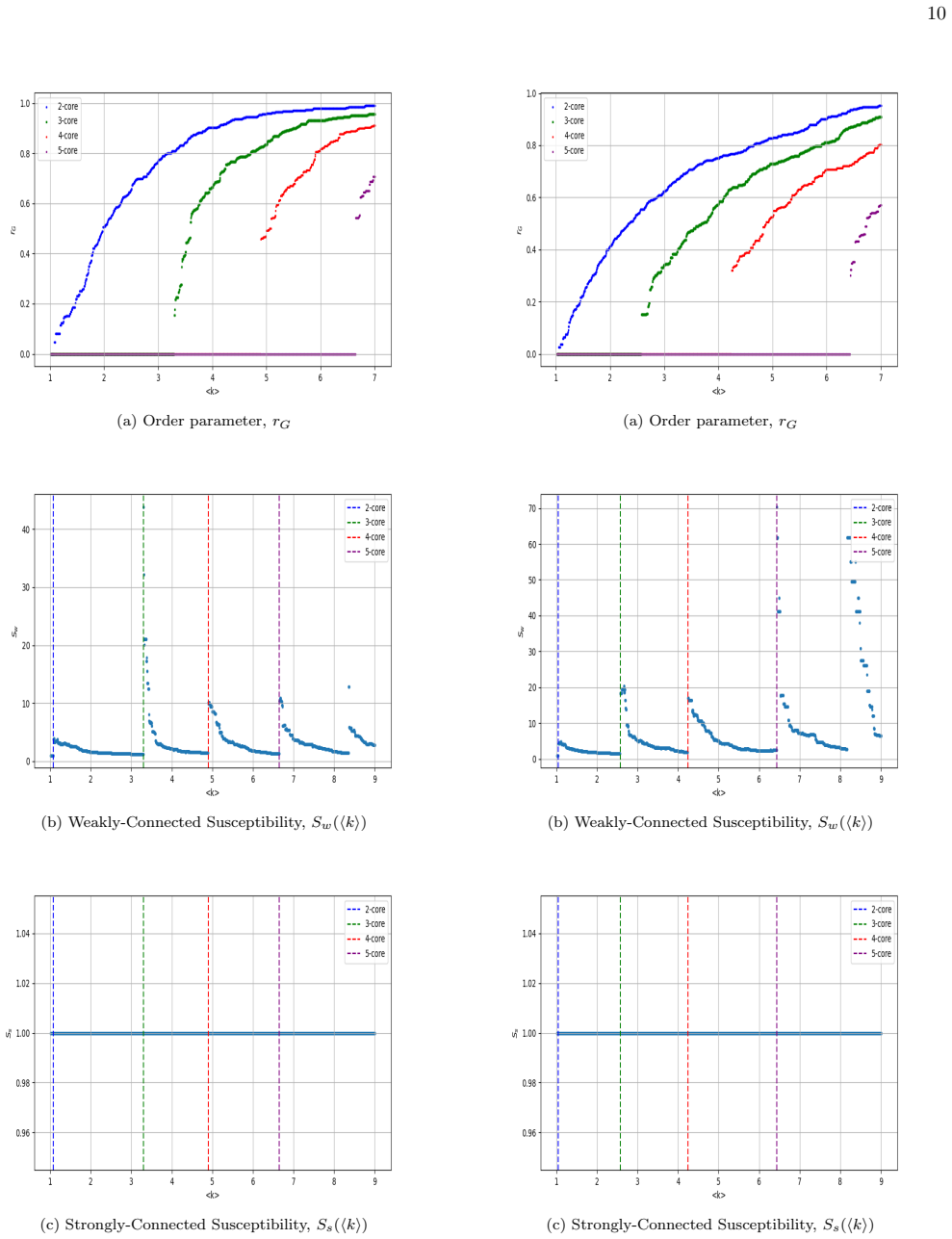
The argument is carried by comparing each model's trajectory of k-core emergence and hub formation against the Erdos-Renyi null model, using k-core peeling, weakly- and strongly-connected susceptibility, and HITS hub/authority scores. The classification separates models by whether they have global selection rules and special agents, producing four classes. Two normalized measures, delta_4,3 and delta_5,4, quantify whether successive k-core transitions are accelerated or delayed relative to ER, and the strongly-connected susceptibility S_s reveals whether feedback-rich cyclic structures form. These probes together provide the evidence that neither selection nor special agents suffice on their own.
What would settle it
Simulate a new finite-size link-adding process with uniform random edge selection, no feedback between edge placement and any functional goal, and no special agents, but with a structural rule that produces strong local clustering or redundancy beyond chance; if its k-core thresholds or HITS centralization deviate significantly from the Erdos-Renyi values, then critical complexity alone suffices and the claimed necessity of topology-functionality alignment is false.
Extended reading notes
Core claim
The central discovery is that in finite-size link-adding processes, whether hubs and deep k-cores emerge faster or slower than in an Erdos-Renyi random graph is governed by two jointly necessary conditions. First, the network must possess 'critical complexity': sufficient local redundancy, clustering, or a suppression of such structure beyond chance. Second, there must be 'topology-functionality alignment': dynamic feedback that lets selection preferentially reinforce or prune structures that help or hinder functional goals. The paper shows this through simulations of the Barabasi-Albert process, the Achlioptas product rule, two variants of a modified chip-firing model, and an intracellular network evolution process, all measured against large-N Erdos-Renyi thresholds for k-core emergence and HITS centrality. Where either condition is absent, the evolution follows ER-like trajectories; where both are present, as in the intracellular network evolution process, deep nested k-cores appear earlier and strongly-connected susceptibility shows repeated peaks, signaling cyclic, functionally integrated structures.
Load-bearing premise
The load-bearing premise is that the handful of studied models spans the relevant space of link-adding processes, so that the two conditions are necessary generically rather than being features of these particular implementations.
Editorial extensions
If this is right
- If the two conditions are genuinely necessary, then a real network whose k-core thresholds and centrality scores match Erdos-Renyi behavior can be diagnosed as lacking effective selection, effective special agents, or both.
- Engineered network growth processes can be designed by checking early k-core milestones against ER thresholds, rather than waiting for late-stage convergence to a complete graph.
- The intracellular network evolution process shows that deep k-cores forming faster than ER and repeated peaks in strongly-connected susceptibility are signatures of topology-functionality feedback, offering concrete markers for detecting such feedback elsewhere.
- In sparse early regimes, topology dominates strategy: selection rules and agent roles will not accelerate core formation until a minimal substrate of structural complexity exists.
- The unconstrained modified chip-firing model shows that random connectivity alone can produce modest functional gains, so apparent improvements in function do not by themselves imply goal-directed evolution.
Reading between the lines
- An implicit testable prediction is that adding feedback coupling to a model that currently looks ER-like, while keeping its selection rules unchanged, should lower k-core thresholds and produce HITS centralization; a reader could verify this by ablating the feedback in the constrained chip-firing model.
- The paper's 'critical complexity' condition suggests that pure degree heterogeneity, as in preferential attachment, is not enough for deep structural order, which points toward a broader conjecture: hub formation and core formation are governed by different mechanisms and should be treated as separate diagnostics.
- Because the conclusion is labeled generic but rests on a small set of models, the strongest next experiment is a systematic family scan over link-adding policies, varying only the amount of clustering or suppression, to test whether the two conditions remain necessary across the whole space.
- The placebo analogy implies that passive functional gains from random edge accretion could mislead observers studying biological or social networks; an auditor should compare such systems against ER thresholds before attributing order to hidden design.
Editorial analysis
A structured set of objections, weighed in public.
Referee Report
Summary. The paper studies link-adding network processes (ER, PA, APPR, MCFM variants, and INEP) and compares their k-core formation thresholds, susceptibilities, and HITS centrality scores against the large-N Erdős–Rényi baseline. It proposes a classification of models by the presence of global selection rules (GSR) and special agents (SA), and concludes in Section VII that significant deviations from purely random-network trajectories generically require two simultaneous conditions: critical topological complexity and topology–functionality alignment. The paper also argues that purely random processes can show modest functional gains via structural accretion, drawing an analogy with the placebo effect.
Significance. If the two conditions were established, the paper would offer a useful diagnostic framework for using random-graph baselines to infer the presence or effectiveness of functional structuring mechanisms in empirical networks. The explicit use of an external ER null baseline is methodologically sound, and the finite-size simulation data, particularly on the saturation of selection-driven dynamics in the MCFM, are informative. However, the central claim is currently not supported by the paper's own reported results, so the framework's value depends on a substantial revision of the conclusion, the deviation metrics, and the scope of the claimed generality.
major comments (4)
- [Section VII and Table II] The necessity claim is contradicted by the paper's own PA results. PA (rows 4–5) is classified as nGSRSA, without functionality (F=∅), yet its absolute k-core thresholds are significantly lower than ER (e.g., row 4: ⟨k⟩3=2.70±0.03 vs 3.34±0.01 for N=10000, several standard deviations apart). This constitutes a significant deviation from the ER trajectory under the paper's own stated criterion of comparing 'magnitudes and normalized differences'. The discussion in Section VI attempts to reinterpret PA's deviation by noting that higher k-cores appear at ER-like ratios, but this does not address the absolute shifts, and the conclusion's wording ('significant deviations from purely random-network trajectories') includes phase-specific deviations, which PA clearly exhibits. The claim that both conditions are necessary is therefore refuted by the presented data.
- [Eqs. (1)–(2) and Table III] The normalized metrics δ4,3 and δ5,4 measure ratios of interval widths between successive cores, not absolute deviations from the ER baseline. For PA, Table III shows δ≈0.95–1.03, while Table II shows absolute threshold shifts of several standard deviations; for APPR, δ values are near 0.94–0.95 even though the 2-core threshold is dramatically delayed (⟨k⟩2≈1.60 vs 0.88–0.97 for ER). The paper never specifies how absolute magnitudes and normalized differences are to be combined or what threshold defines a 'significant deviation', making the central claim unfalsifiable from the current presentation. This is a load-bearing issue because the conclusion rests on these metrics.
- [Section VII] The claim that the two conditions are required 'generically' is an extrapolation from a small hand-picked set of models (ER, PA, APPR, MCFM, INEP) that does not include a counterexample search or a systematic scan over model families. No theoretical derivation is provided, and the paper does not demonstrate that this set spans the relevant space of link-adding processes. Since the entire conclusion depends on the representativeness of this set, the necessity claim overreaches the evidence; a more limited statement about the studied models, or additional systematic evidence, is required.
- [Sections IV and V] For the directed models (MCFM and INEP), the paper reports k-core thresholds without clarifying whether the k-core peeling is applied to the underlying undirected projection or to a directed core notion. This ambiguity matters because the susceptibility measures distinguish weakly and strongly connected variants, and the INEP's distinctive Ss(⟨k⟩) peaks imply a directed-core analysis. Without this clarification, the comparability of the thresholds in Table II across directed and undirected models is uncertain, which affects the interpretation of the baseline comparisons.
minor comments (5)
- [Table III] The δ values are reported without propagated uncertainties, even though the underlying ⟨k⟩ thresholds carry standard deviations; without error bars it is impossible to assess whether δ≈1 is statistically distinguishable from the ER benchmark.
- [Section VI] In the combinatorial bottleneck example, the text states 'average degree is 2/3' for a graph with 6M vertices and 2M edges; while the arithmetic is correct, the surrounding sentence structure makes the relation between 2M edges and the average degree less clear than it should be.
- [Section VI] The phrase 'the deterministic side of APPR's selection mechanism' is misleading, since the Achlioptas process is stochastic; the product rule selects among randomly chosen candidate edges, so the selection mechanism is rule-based but not deterministic.
- [Section VI] The discussion of the ER baseline notes that finite-size effects are small (rows 2–3 of Table II), but the conclusion does not address how finite-size corrections might affect the two stated conditions, particularly for N=500 where deviations from the large-N thresholds are a few percent.
- [Section II.E and Table I] The text in Section II.E says the jamming process 'does not involve explicit SA', while Table I classifies Jamming under GSRnSA with 'No' for Special Agents; this is internally consistent, but the later discussion in Section VI repeatedly treats Jamming together with models that have SA, so a sentence clarifying the status would help.
Circularity Check
No significant circularity: the ER baseline is external, model thresholds are direct simulation outputs, and self-citations are background support only.
full rationale
The paper's central comparison is self-contained: k-core thresholds and δ ratios are measured against the analytic ER thresholds of Pittel–Spencer–Wormald, which are external to the paper and not fitted to the models. No free parameter is tuned to the output metric and then renamed a prediction; each model's thresholds and susceptibilities are direct simulation outputs. The self-citations (Refs. [10,19] for INEP) are background claims about prior explanatory successes and do not enter the load-bearing inference, which rests on the Table II and III data collected in this paper. The skeptical objection that PA and APPR contradict the necessity claim is a scientific validity concern about the δ normalization hiding absolute threshold shifts, not a circularity; it does not reduce a conclusion to its own inputs by construction. The absence of a systematic model-family scan also weakens the generality of the conclusion, but that is a scope limitation rather than a circular step. Accordingly, the circularity score is 0.
Assumptions & free parameters
free parameters (3)
- Number and identity of special agents (sources/sinks or nutrients/carriers) =
4 sources and 4 sinks for MCFM; 4 nutrients and 4 carriers for INEP; N=500
- MCFM initial chips on regular nodes =
not stated (fixed random number)
- INEP kinetic and mutation parameters =
not given in this paper, inherited from Refs. [10,19]
assumptions (4)
- domain assumption Link-adding processes on finite networks converge to a complete graph, so meaningful differences are confined to the transient regime.
- domain assumption The Erdos-Renyi model is the appropriate neutral null baseline for all link-adding processes.
- domain assumption k-core emergence and HITS hub/authority scores capture global order and functional architecture.
- ad hoc to paper The five implemented models are representative of all classes of link-adding random processes.
Cite this review
Pith. "Pith review of Rules, agents and order." pith.science (2026). https://pith.science/paper/E77HMZDD
@misc{pith2026250523985,
  author       = {Pith},
  title        = {Pith review of: Rules, agents and order},
  year         = {2026},
  howpublished = {\url{https://pith.science/paper/E77HMZDD}},
  note         = {Machine review of arXiv:2505.23985}
}
abstract
Complex systems often exhibit highly structured network topologies that reflect functional constraints. In this work, we investigate how, under varying combinations of system-wide selection rules and special agents, different classes of random processes give rise to global order, with a focus restricted to finite-size networks. Using the large-$N$ Erdos-Renyi model as a null baseline, we contrast purely random link-adding processes with goal-directed dynamics, including variants of the chip-firing model and intracellular network growth, both driven by transport efficiency. Through simulations and structural probes such as $k$-core decomposition and $HITS$ centrality, we show that purely stochastic processes can spontaneously generate modest functional structures, but that significant departures from random behavior generically require two key conditions: critical topological complexity and dynamic alignment between topology and functionality. Our results suggest that the emergence of functional architectures depends not only on the presence of selection mechanisms or specialized roles, but also on the network's capacity to support differentiation and feedback. These findings provide insight into how topology-functionality relationships emerge in natural and artificial systems and offer a framework for using random graph baselines to diagnose the rise of global order in evolving finite-size networks.
Figures


Figures from the paper (3 more)


Reference graph
Works this paper leans on
-
[1]
At each time step t, a set of candidate graphs Ct is generated by adding an edge to the current graph Gt−1, drawn randomly or according to a heuristic
-
[2]
A fitness function Pfit(G) is evaluated for each can- didate G ∈ Ct, estimating its compatibility with Gtarget
-
[3]
The candidate with the highest fitness score is se- lected to form the next graph Gt. Assuming ergodicity in the graph space and reacha- bility of the target ensemble, this process approximates a biased random walk over the graph space, increas- ingly favoring configurations consistent with the imposed constraints. By encoding the relevant constraints int...
-
[4]
If this average exceeds that of the previous itera- tion, the change is accepted; otherwise, the graph reverts to Gt. This selection rule introduces a feedback mechanism that guides structural evolution toward configurations that enhance chip absorption by the sinks, representing a kind of system-level optimization. The presence of source and sink nodes m...
-
[5]
A candidate edge is proposed and added to the cur- rent graph Gt, producing a modified graph Gt+1
-
[6]
A full firing process is run using the standard rules, and the system stabilizes
-
[7]
The average number of chips absorbed by the sink nodes is measured
-
[8]
Authoritative sources in a hyper- linked environment,
J. M. Kleinberg, “Authoritative sources in a hyper- linked environment,” Journal of the ACM , vol. 46, no. 5, pp. 604–632, Sept. 1999. doi:10.1145/324133.324140
Show all 41 references
-
[9]
Begin with a population of m mother networks
-
[10]
Each mother network is mutated by randomly adding a new chemically plausible link, yielding a population of daughter networks
-
[11]
This condition is defined as the doubling of the initial cell volume, which is computed as a functional of the concen- trations
For each daughter network, the associated system of ODEs is numerically integrated until a speci- fied duplication condition is met. This condition is defined as the doubling of the initial cell volume, which is computed as a functional of the concen- trations
-
[12]
The m daughter networks that reach the duplica- tion threshold in the shortest time are selected to form the next generation of mothers. This Intracellular Network Evolution Process (INEP) couples plausibility-constrained random mutations (link additions) with an externally im...
2000
-
[13]
In the classical for- mulation, the network grows by the sequential addition of new nodes, each of which forms links preferentially to existing nodes with higher degree
was originally proposed to explain the spontaneous emergence of hubs and the power-law degree distributions observed in many empirical networks. In the classical for- mulation, the network grows by the sequential addition of new nodes, each of which forms links preferentially ...
2000
-
[14]
Critical complexity: To allow functionally meaningful differentiation, the network must either contain sufficient local redundancy or clustering, or exhibit a suppression of such structures beyond what would arise by chance. Without structural motifs such as cycles, cliques, o...
-
[15]
T opology–functionality alignment: There must be a dynamic feedback between the evolv- ing network topology and the system’s functional goals, such that local or global selection mecha- nisms can preferentially reinforce or suppress struc- tural configurations that enhance or ...
2000
-
[16]
B. M. McCoy and T. T. Wu, The Two-Dimensional Ising Model, Harvard University Press, Cambridge, Mass., 1973
1973
-
[17]
Montvay and G
I. Montvay and G. M¨ unster, Quantum Fields on a Lattice, Cambridge University Press, Cambridge, 1994. (Cambridge Monographs on Mathematical Physics)
1994
-
[18]
Network structure of two-dimensional decaying isotropic turbu- lence,
K. Taira, A. G. Nair, and S. L. Brunton, “Network structure of two-dimensional decaying isotropic turbu- lence,” Journal of Fluid Mechanics, vol. 795, p. R2, 2016. doi:10.1017/jfm.2016.235
2016 doi
-
[19]
Barab´ asi and M
A.-L. Barab´ asi and M. P´ osfai,Network Science , Cam- bridge University Press, Cambridge, 2016. Available at: http://barabasi.com/networksciencebook/
2016
-
[20]
Network structure and minimum de- gree,
S. B. Seidman, “Network structure and minimum de- gree,” Social Networks, vol. 5, no. 3, pp. 269–287, 1983. doi:10.1016/0378-8733(83)90028-X
1983 doi
-
[21]
k-Core Organization of Complex Networks,
S. N. Dorogovtsev, A. V. Goltsev, and J. F. F. Mendes, “k-Core Organization of Complex Networks,” Phys- ical Review Letters , vol. 96, p. 040601, Feb 2006. doi:10.1103/PhysRevLett.96.040601
2006 doi
-
[22]
k-core: Theories and applications,
Y.-X. Kong, G.-Y. Shi, R.-J. Wu, and Y.-C. Zhang, “k-core: Theories and applications,” Physics Reports , vol. 832, pp. 1–32, 2019. doi:10.1016/j.physrep.2019.10.004
2019 doi
-
[23]
On the evolution of random graphs,
P. Erd˝ os and A. R´ enyi, “On the evolution of random graphs,” Publicationes Mathematicae, vol. 5, pp. 17–60, 1960
1960
-
[24]
Bifurcation in cellu- lar evolution,
D. Radillo-Ochoa, A. Rodr ´ ıguez-Hern´ andez, and C. A. Terrero-Escalante, “Bifurcation in cellu- lar evolution,” Physica A: Statistical Mechanics and its Applications , vol. 615, p. 128569, 2023. doi:10.1016/j.physa.2023.128569
2023
-
[25]
A Probabilistic Proof of an Asymptotic Formula for the Number of Labelled Regular Graphs,
B. Bollob´ as, “A Probabilistic Proof of an Asymptotic Formula for the Number of Labelled Regular Graphs,” European Journal of Combinatorics , vol. 1, no. 4, pp. 311–316, 1980. doi:10.1016/S0195-6698(80)80030-8
1980 doi
-
[26]
Ex- otic phase transitions of k-cores in clustered networks,
U. Bhat, M. Shrestha, and L. H´ ebert-Dufresne, “Ex- otic phase transitions of k-cores in clustered networks,” Physical Review E , vol. 95, no. 1, p. 012314, Jan. 2017. doi:10.1103/PhysRevE.95.012314
2017 doi
-
[27]
Emergence of Scaling in Random Networks,
A.-L. Barab´ asi and R. Albert, “Emergence of Scaling in Random Networks,” Science, vol. 286, no. 5439, pp. 509– 512, 1999. doi:10.1126/science.286.5439.509
1999 doi
-
[28]
Ex- plosive Percolation in Random Networks,
D. Achlioptas, R. M. D’Souza, and J. Spencer, “Ex- plosive Percolation in Random Networks,” Science, vol. 323, no. 5920, pp. 1453–1455, 2009. doi: 10.1126/sci- ence.1167782
2009 doi
-
[29]
Achlioptas process phase transitions are continuous,
O. Riordan and L. Warnke, “Achlioptas process phase transitions are continuous,” Annals of Applied Probabil- ity, vol. 22, no. 4, pp. 1450–1464, 2012. Available at: http://www.jstor.org/stable/41713365. 20
2012
-
[30]
A. J. Liu and S. R. Nagel, Jamming and Rheology: Constrained Dynamics on Microscopic and Macroscopic Scales, CRC Press, 2001
2001
-
[31]
The jamming transition is a k-core percolation transition,
F. Morone, K. Burleson-Lesser, H. A. Vinutha, S. Sastry, and H. A. Makse, “The jamming transition is a k-core percolation transition,” Physica A: Statistical Mechanics and its Applications , vol. 516, pp. 172–177, Feb. 2019. doi:10.1016/j.physa.2018.10.035
2019 doi
-
[32]
Self-Organized Criticality: An Explanation of 1/f Noise,
P. Bak, C. Tang, and K. Wiesenfeld, “Self-Organized Criticality: An Explanation of 1/f Noise,” Physical Re- view Letters, vol. 59, p. 381, 1987
1987
-
[33]
Evolutionary timeline of a mod- eled cell,
V. Ibarra-Junquera, D. Radillo-Ochoa, and C. A. Terrero-Escalante, “Evolutionary timeline of a mod- eled cell,” Journal of Theoretical Biology , vols. 551–552, p. 111233, 2022. doi:10.1016/j.jtbi.2022.111233
2022
-
[34]
Metabolic stability and epigenesis in randomly constructed genetic nets,
S. A. Kauffman, “Metabolic stability and epigenesis in randomly constructed genetic nets,” Journal of The- oretical Biology , vol. 22, no. 3, pp. 437–467, 1969. doi:10.1016/0022-5193(69)90015-0
1969 doi
-
[35]
Homeostasis and Differentiation in Random Genetic Control Networks,
S. A. Kauffman, “Homeostasis and Differentiation in Random Genetic Control Networks,” Nature, vol. 224, pp. 177–178, 1969. https://api.semanticscholar.org/ CorpusID:4179318
1969
-
[36]
Chaotic expression dy- namics implies pluripotency: when theory and ex- periment meet,
C. Furusawa and K. Kaneko, “Chaotic expression dy- namics implies pluripotency: when theory and ex- periment meet,” Biology Direct , vol. 4, p. 17, 2009. doi:10.1186/1745-6150-4-17
2009 doi
-
[37]
Zipf’s Law in Gene Expres- sion,
C. Furusawa and K. Kaneko, “Zipf’s Law in Gene Expres- sion,” Physical Review Letters, vol. 90, no. 8, p. 088102,
-
[39]
Evolutionary dimen- sion reduction in phenotypic space,
T. U. Sato and K. Kaneko, “Evolutionary dimen- sion reduction in phenotypic space,” Physical Re- view Research , vol. 2, no. 1, p. 013197, Feb. 2020. doi:10.1103/PhysRevResearch.2.013197
2020 doi
-
[40]
Random graphs as models of net- works,
M. E. J. Newman, “Random graphs as models of net- works,” in Handbook of Graphs and Networks , vol. 1, pp. 35–68, Wiley Online Library, 2003
2003
-
[41]
Sudden emer- gence of a giant k-core in a random graph,
B. Pittel, J. Spencer, and N. Wormald, “Sudden emer- gence of a giant k-core in a random graph,” Journal of Combinatorial Theory, Series B , vol. 67, no. 1, pp. 111– 151, 1996
1996
-
[2003]
doi:10.1103/PhysRevLett.90.088102
Reviewed August 7, 2026 · model on record in the stance chip above.
Discussion (0). Sign in to comment.