REVIEW 5 major objections 5 minor 17 references
Advancing Digital Accessibility In Digital Pharmacy, Healthcare, And Wearable Devices: Inclusive Solutions for Enhanced Patient Engagement
T0 review · 5 major / 5 minor · reviewed 2026-08-07 · deepseek-v4-flash
Pith's one-line read This paper argues that digital pharmacy, telemedicine, and wearable health products remain far from accessible, and that closing the gap requires treating accessibility as a usability outcome rather than a compliance checkbox.
desk verdict The accessibility survey direction is fine, but the paper's own data cannot be checked and one row of the compliance table is arithmetically impossible, so the empirical contribution collapses. read the letter →
The pith
A machine-rendered reading of the paper's core claim, the machinery that carries it, and where it could break.
The reading
What carries the argument
The load-bearing object is WCAG 2.1, the Web Content Accessibility Guidelines issued by the W3C, used here as the test standard for the eleven platforms. The machinery is the mixed-method pipeline: automated scans with WAVE, Axe, and Lighthouse to count violations, heuristic evaluation using Nielsen's usability principles, task-based testing with people who have auditory, visual, motor, or cognitive impairments, and semi-structured interviews analyzed thematically. These four passes produce the paper's quantitative compliance rates and its qualitative list of barriers, and the contrast between 'compliant in the checklist' and 'usable in practice' is what carries the argument.
What would settle it
Run an independent WCAG 2.1 audit, using WAVE, Axe, and Lighthouse plus task-based testing, on a larger random sample of pharmacy, telemedicine, and wearable apps; if the full-compliance rates do not reproduce near 20%, 33%, and 40%, or if most sampled apps pass all contrast and keyboard checks, the paper's central finding is not generalizable.
Extended reading notes
Core claim
On the paper's own terms, the central discovery is an empirical gap between stated accessibility guidance and real product behavior. Across eleven tested digital health products, the compliance rates with WCAG 2.1 run 20 percent for pharmacy apps, 33 percent for telemedicine, and 40 percent for wearable apps, with the remainder partially or fully non-compliant; roughly 40 percent of applications fail WCAG 2.1 color-contrast thresholds. Task-based testing then shows that even 'partially compliant' products create concrete barriers—screen-reader users cannot navigate prescription refills, CAPTCHA blocks visually impaired users, biometric logins fail for users with facial mobility limits, and wearable voice commands break in noisy settings. The interpretive claim is that such failures persist because organizations treat accessibility as a guideline-adherence exercise rather than a usability outcome, and that the viable remedy is user-centered design supported by AI-driven tools such as speech-to-text, voice assistants, medication chatbots, and haptic feedback.
Load-bearing premise
The percentages generalize only if the eleven unnamed platforms and the convenience sample of interviewees represent the wider app landscape and were actually measured as reported, neither of which the paper gives readers a way to verify.
Editorial extensions
If this is right
- If the rates are accurate, roughly four in five pharmacy apps will continue to block medication access for users who rely on screen readers or need high-contrast text until developers audit beyond the automated checks.
- Regulators can use the category-level percentages as a baseline for measuring whether enforcement of WCAG and ADA actually improves products.
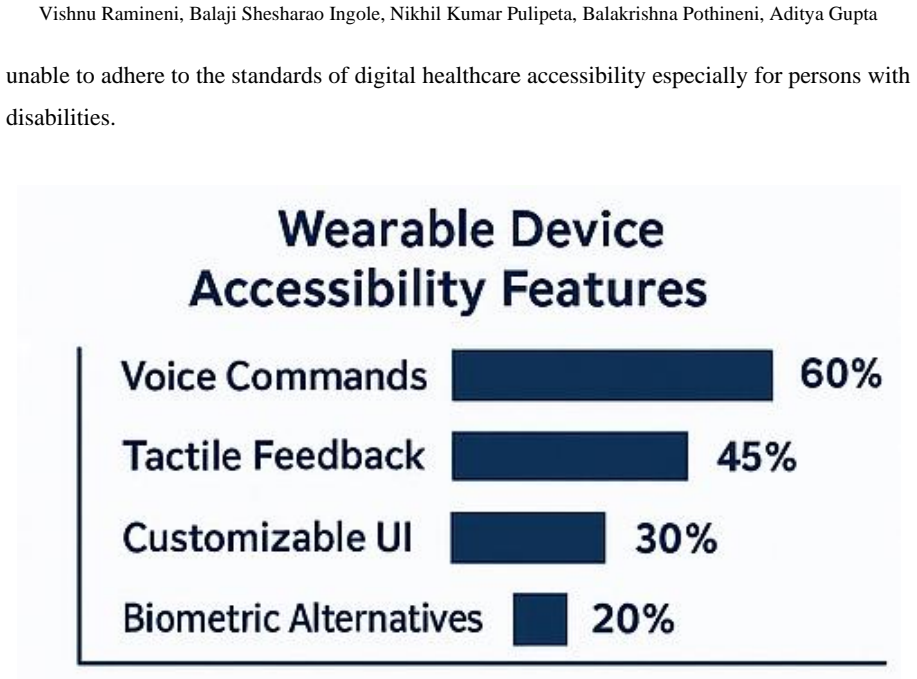
- AI tools such as speech-to-text, voice assistants, medication chatbots, and haptic alerts become the paper's primary remedy for the accessibility gap, not compliance checklists.
- Healthcare organizations would need to include users with disabilities in testing and design, and enforce accessibility audits, to bridge the gap between standards and usability.
- The paper's claim that 'fully compliant' is not the same as 'usable' means that accessibility certification should be paired with task-based success criteria.
Reading between the lines
- Beyond the paper: if the 20/33/40 percent rates are anywhere near typical, accessibility should be treated as a procurement condition in hospital and insurer contracts, not as a post-launch repair.
- Beyond the paper: the paper's own task-based results imply that automated compliance scores alone underestimate real barriers, so a useful next test would measure whether screen-reader task success correlates with WAVE, Axe, and Lighthouse scores across a larger app sample.
- Beyond the paper: the reported failure of biometric and CAPTCHA authentication points toward a concrete design direction—offering at least two alternative verification paths for every authentication step—which the paper does not specify.
Editorial analysis
A structured set of objections, weighed in public.
Referee Report
Summary. The manuscript reports a mixed-methods study of digital accessibility in digital pharmacy, telemedicine, and wearable health device platforms. It combines a literature review, an automated/heuristic usability analysis of 11 platforms (5 pharmacy, 3 telemedicine, 3 wearable), and semi-structured interviews with users and professionals. The authors conclude that WCAG compliance is low (20–40% fully compliant), identify recurring usability barriers, and advocate AI-driven tools and user-centered design as remedies. The empirical findings are presented in Section 4, with compliance percentages in Section 4.1 and qualitative themes in Section 4.3.
Significance. The topic is important, and the paper cites a relevant body of prior work (e.g., Lazar et al., Pettersson et al., Saleem et al.). If the compliance percentages were reliable, they would constitute a useful benchmark. However, the empirical core of the paper is not reproducible and contains an internal inconsistency in the wearable row of Table 1 (Section 4.1). No platform names, raw counts, tool outputs, or participant details are provided, and the WCAG contrast ratio is misstated. Consequently, the paper's novel quantitative contribution collapses, leaving a general literature review that does not require the reported data. The paper's main strength is its alignment with established accessibility research; its main weakness is the unsupported and internally inconsistent presentation of primary data.
major comments (5)
- [Section 4.1, Table 1] The wearable device row reports 40% fully compliant, 40% partially compliant, and 20% non-compliant for 3 tested platforms. Since 40% of 3 is 1.2 platforms and 20% of 3 is 0.6 platforms, these percentages cannot be derived from any integer count of 3 platforms. The distribution exactly matches a 2/2/1 split out of 5, suggesting a denominator mismatch. Because this table is the central evidence for the paper's claim of widespread non-compliance, the table must be corrected with raw counts, or the claim must be withdrawn.
- [Section 3.2 and Section 4.1] The usability analysis is not reported in a way that permits verification. The manuscript does not name the five pharmacy platforms, three telemedicine services, or three wearable apps, does not specify the WAVE/Axe/Lighthouse tool versions or the number of violations found, and does not describe the task-based testing protocol or the participants in that testing. Without these details, the percentages in Table 1 are unverifiable; the paper should either supply a supplementary appendix with the raw data or restrict claims to qualitative observations.
- [Section 3.3 and Section 4.3] The semi-structured interview component is described at a high level only. The manuscript does not report the number of interviewees, the distribution of impairments, recruitment criteria from advocacy groups, the interview protocol, or the coding scheme. The thematic results in Section 4.3 (e.g., "extensive dissatisfaction with assistive technology integration") are presented without any supporting quotes or counts. These qualitative findings should be supported with explicit evidence or explicitly labeled as impressions from a non-systematic consultation.
- [Section 4.2(b)] The manuscript states that WCAG 2.1 requires a contrast ratio of "4:5:1" for text readability. The correct WCAG 2.1 AA threshold is 4.5:1. This is a factual error that, together with the inconsistencies in Section 4.1, undermines confidence in the precision of the compliance assessment. It should be corrected, and the contrast analysis should be checked against the correct threshold.
- [Section 2 and Section 4] The manuscript refers to five figures reporting percentages and distributions (e.g., Fig. 2 "Compliance percentage by categories" and Fig. 4 "Percentage of disability groups with usability barriers"), but the figures are not included in the submitted text and no underlying data are provided. Without the figures, the claims attributed to them cannot be assessed. The authors should include the figures and their source data, or remove the references.
minor comments (5)
- [Section 2.2] The citation "Lazar et al., 20215" should be "Lazar et al., 2015" (the typo appears in the text).
- [Section 2.1] The citation "Saleem et al.," is missing a year; the reference list gives 2017, so the citation should be "(Saleem et al., 2017)".
- [Section 1] The sentence "There necessity of prioritizing accessibility..." should be "The necessity of prioritizing accessibility...".
- [Section 2.3] The phrase "Different AI-Drive accessibility features" should be "Different AI-Driven accessibility features".
- [Section 4.3] The numbering of subsections under 4.3 uses 1.1 and 1.2, which conflicts with the main section numbering; these should be renumbered as 4.3.1 and 4.3.2 (or similar).
Circularity Check
No significant circularity: the core accessibility claims are benchmarked against external WCAG criteria, and the proposed AI remedies are supported by independent literature; self-citations are ancillary.
full rationale
The paper's central empirical claim is that a sample of digital pharmacy, telemedicine, and wearable applications shows incomplete WCAG 2.1 compliance. That claim is checked against WCAG 2.1, an external standard, not against the paper's own outputs, so it cannot reduce to its inputs by construction. The qualitative findings are presented as interview and user-testing themes, not as predictions derived from fitted parameters. The proposed AI-based remedies are supported by external references (Giansanti 2025; Natarajan et al. 2025; Moon et al. 2019) as well as by the authors' prior work; the self-citations are parenthetical, and no load-bearing step depends solely on them. The internal inconsistency identified in the wearable-device percentages in Section 4.1 (40% of 3 platforms cannot be an integer app count) is a serious data-integrity or reporting problem, but it is not circularity: the table does not define or predict its own inputs. No equation, fitted parameter, uniqueness theorem, or ansatz is imported from the authors' prior papers as the decisive premise, so the derivation chain is self-contained with respect to circularity.
Assumptions & free parameters
assumptions (3)
- domain assumption WCAG 2.1 conformance measured by WAVE, Axe, and Lighthouse is a valid proxy for digital health accessibility quality
- domain assumption The 11-platform convenience sample and advocacy-group-recruited interviewees are representative of digital health platforms and of persons with the four impairment types
- domain assumption AI-driven voice, speech-to-text, and haptic features are effective accessibility remedies in healthcare contexts
Cite this review
Pith. "Pith review of Advancing Digital Accessibility In Digital Pharmacy, Healthcare, And Wearable Devices: Inclusive Solutions for Enhanced Patient Engagement." pith.science (2026). https://pith.science/paper/Q4B2G7GO
@misc{pith2026250524042,
  author       = {Pith},
  title        = {Pith review of: Advancing Digital Accessibility In Digital Pharmacy, Healthcare, And Wearable Devices: Inclusive Solutions for Enhanced Patient Engagement},
  year         = {2026},
  howpublished = {\url{https://pith.science/paper/Q4B2G7GO}},
  note         = {Machine review of arXiv:2505.24042}
}
read the original abstract
Modern healthcare facilities demand digital accessibility to guarantee equal access to telemedicine platforms, online pharmacy services, and health monitoring devices that can be worn or are handy. With the rising call for the implementation of robust digital healthcare solutions, people with disabilities encounter impediments in their endeavor of managing and getting accustomed to these modern technologies owing to insufficient accessibility features. The paper highlights the role of comprehensive solutions for enhanced patient engagement and usability, particularly, in digital pharmacy, healthcare, and wearable devices. Besides, it elucidates the key obstructions faced by users experiencing auditory, visual, cognitive, and motor impairments. Through a kind consideration of present accessibility guidelines, practices, and emerging technologies, the paper provides a holistic overview by offering innovative solutions, accentuating the vitality of compliance with Web Content Accessibility Guidelines (WCAG), Americans with Disabilities Act (ADA), and other regulatory structures to foster easy access to digital healthcare services. Moreover, there is due focus on using AI-driven tools, speech-activated interfaces, and tactile feedback in wearable health devices to assist persons with disabilities. The outcome of the research explicates the necessity of prioritizing accessibility for individuals with disabilities and cultivating a culture where healthcare providers, policymakers, and officials build a patient-centered digital healthcare ecosystem that is all-encompassing in nature.
Figures


Figures from the paper (3 more)


Reference graph
Works this paper leans on
-
[1]
A comparative study of automation testing tools for web applications,
E. Pelivani and B. Cico, "A comparative study of automation testing tools for web applications," 2021 10th Mediterranean Conference on Embedded Computing (MECO), Budva, Montenegro, 2021, pp. 1-6
work page 2021
-
[2]
Braun, V., & Clarke, V. (2019). Thematic analysis: A practical guide for qualitative research. SAGE Publications
work page 2019
-
[3]
Ramineni, V., Ingole, B. S., Krishnappa, M. S., Nagpal, A., Jayaram, V., Banarse, A. R., Bidkar, D. M., Pulipeta, N. K. (2024). AI-Driven Novel Approach for Enhancing E- Commerce Accessibility through Sign Language Integration in Web and Mobile Applications. 2024 IEEE 17th International Symposium on Embedded Multicore/Many-core Systems-on-Chip (MCSoC); pp...
work page 2024
-
[4]
Moon NW, Baker PM, Goughnour K. Designing wearable technologies for users with disabilities: Accessibility, usability, and connectivity factors. Journal of Rehabilitation and Assistive Technologies Engineering. 2019;6
work page 2019
-
[5]
A., Al -Muhtadi, J., Rodrigues, J
Saleem, K., Shahzad, B., Orgun, M. A., Al -Muhtadi, J., Rodrigues, J. J. P. C., & Zakariah, M. (2017). Design and deployment challenges in immersive and wearable technologies. Behaviour & Information Technology, 36(7), 687–698
work page 2017
-
[6]
Lazar, J., Goldstein, D. F., & Taylor, A. (2015). Ensuring digital accessibility through process and policy. Morgan kaufmann
work page 2015
-
[7]
Natarajan, H.; Thiyagarajan, K.; Maanvizhi, S. Pharm-AI: An Intelligent Chatbot for Addressing Medication Accessibility and Information Challenges During the COVID - 19 Pandemic. Preprints 2025, 2025031394
work page 2025
-
[8]
Ramineni, V., Ingole, B. S., Banarse, A. R., Krishnappa, M. S., Pulipeta, N. K., Jayaram, V. (2024). Leveraging AI and Machine Learning to Address ADA Non-Compliance in Web Applications: A Novel Approach to Enhancing Accessibility. 2024 Third International Conference on Artificial Intelligence, Computational Electronics and Communication System (AICECS); pp. 1–6
work page 2024
Show all 17 references
-
[9]
Mertens, D. M. (2020). Research and evaluation in education and psychology: Integrating diversity with quantitative, qualitative, and mixed methods . SAGE Publications. Advancing Digital Accessibility in Digital Pharmacy, Healthcare, and Wearable Devices: Inclusive Solutions f...
2020
-
[10]
Mishra, S., Sharma, S. (2025). User Experience for Inclusion: Analysis of WCAG 2.2 in Pharmacy App for Visually Impaired Group. In: Rangaswamy, N., Sim, G.R., Borah, P.P. (eds) Human -Computer Interaction. Design and Research. IndiaHCI 2024. Communications in Computer and Info...
2025
-
[11]
Nielsen, J. (2020). Usability heuristics for user interface design. NNGroup Research, Retrieved from https://www.nngroup.com/articles/ten-usability-heuristics/
2020
-
[12]
Pettersson, L., Johansson, S., Demmelmaier, I. et al. Disability digital divide: survey of accessibility of eHealth services as perceived by people with and without impairment. BMC Public Health 23, 181 (2023)
2023
-
[13]
Integrating AI and Assistive Technologies in Healthcare: Insights from a Narrative Review of Reviews
Giansanti, D.; Pirrera, A. Integrating AI and Assistive Technologies in Healthcare: Insights from a Narrative Review of Reviews. Healthcare 2025, 13, 556
2025
-
[14]
Krause-Jüttler G, Weitz J, Bork. (2022). Interdisciplinary Collaborations in Digital Health Research: Mixed Methods Case Study JMIR Hum Factors 2022;9(2):e36579
2022
-
[15]
S., Jayaram, V., Mehta, G., Krishnappa, M
Ramineni, V., Ingole, B. S., Jayaram, V., Mehta, G., Krishnappa, M. S., Nagpal, A., Banarse, A. R. (2024). Enhancing E -Commerce Accessibility Through a Novel Voice Assistant Approach for Web and Mobile Applications. 2024 Third International Conference on Artificial Intelligen...
2024
-
[16]
Guni A, Normahani P, Davies A, Jaffer. (2021). Harnessing Machine Learning to Personalize Web-Based Health Care Content J Med Internet Res 2021;23(10):e25497
2021
-
[17]
World Health Organization. (2022). WHO -ITU global standard for accessibility of telehealth services. Retrieved from https://www.who.int/publications/digital-health Citation: Vishnu Ramineni, Balaji Shesharao Ingole, Nikhil Kumar Pulipeta, Balakrishna Pothineni, Aditya Gupta. ...
2022
Reviewed August 7, 2026 · model on record in the stance chip above.
Discussion (0). Sign in to comment.