REVIEW 4 major objections 6 minor 23 references
A Benchmark Reference for ESP32-CAM Module
T0 review · 4 major / 6 minor · reviewed 2026-08-07 · deepseek-v4-flash
Pith's one-line read Measured ESP32-CAM frame rates: 50+ FPS below 320x240, 1.29 FPS at 1600x1200.
desk verdict Useful consolidated benchmark for ESP32-CAM with a real bug fix and open dataset, but the absolute FPS numbers need an independent timing check before you trust them. read the letter →
The pith
A machine-rendered reading of the paper's core claim, the machinery that carries it, and where it could break.
The reading
What carries the argument
The central object is the benchmark setup: the official Arduino CameraServer example firmware, patched to correct the FPS logging bug and to emit per-frame comma-separated log lines over UART containing instantaneous and average FPS, runtime, bytes transmitted, temperature, frame size, and voltage. These UART logs are captured over USB, parsed and stored as CSV by a flow-based tool, then analyzed to produce the tables. The FPS fix is the load-bearing mechanism, because the measured averages are only as trustworthy as the logging that generated them.
What would settle it
Set up a second device at the receiver that timestamps each arriving frame using its own clock, then compare those inter-frame intervals against the logged instantaneous FPS from the UART stream; any systematic difference shows the logging path distorts timing, and a resolution-dependent gap would specifically implicate serial logging overhead.
Extended reading notes
Core claim
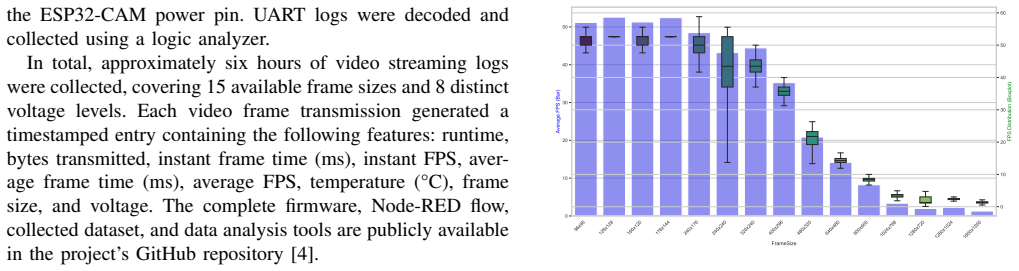
In the paper's own terms, the ESP32-CAM paired with the OV2640 sensor, streaming JPEG over an HTTP server on a local WiFi network, delivers a resolution-dependent frame-rate envelope: 51.17 FPS at 96x96, 52.59 FPS at 128x128, 44.44 FPS at 320x240, 14.19 FPS at 640x480, and 1.29 FPS at 1600x1200. The authors attribute the steep decline to sensor readout time, image signal processor load, and JPEG DCT operations with O($n^{2}$) complexity. Thermal readings stay stable at 69.73 to 74.18 degrees Celsius across resolutions, and over eight voltage settings between 2.958 V and 3.5 V the average frame rate stays within roughly 37 to 40 FPS, with the highest mean at 3.5 V. The paper also claims to fix a long-standing bug in the Arduino ESP32 core's CameraServer example that reported incorrect FPS values, and it releases the logs as a public dataset.
Load-bearing premise
The reported frame rates are only as good as the patched logging: the firmware that measures FPS also streams the video, so if the UART logging perturbs timing or the fix is wrong, every average in the tables is systematically off rather than just noisy.
Editorial extensions
If this is right
- Any ESP32-CAM application needing smooth video should stay at or below 320x240, where measured averages exceed 50 FPS.
- At 640x480 the envelope is about 14 FPS, making it workable for periodic analysis but not fluid preview.
- The highest resolution, 1600x1200, is effectively a still-image mode at 1.29 FPS.
- The stable roughly 70 degree Celsius temperature across all resolutions indicates thermal throttling is not driving the frame-rate drop.
- Voltage in the tested 2.958 to 3.5 V range is a minor lever: the spread of average FPS across all eight settings is under 4 FPS.
Reading between the lines
- An untested extension is network dependence: because FPS is measured after WiFi transmission, the envelope should be re-measured under different signal strength, channel congestion, and client load to separate sensor limits from network limits.
- The O(n^2) DCT explanation suggests a CPU-bound JPEG path; a test that streams uncompressed RGB at low and high resolutions would isolate whether the drop is compression or sensor readout.
- The public dataset enables unit-to-unit reproducibility checks; rerunning the same firmware on several boards would reveal whether the envelope is a property of the chip or of one sample.
Editorial analysis
A structured set of objections, weighed in public.
Referee Report
Summary. This paper reports an experimental benchmark of the ESP32-CAM module (OV2640 sensor, ESP32S) streaming JPEG over HTTP on a local WiFi network. The authors collected 15-minute logs for 15 resolutions and 8 supply voltages, using firmware based on Arduino's CameraServer example plus a fix to the FPS logging code (PR #10921). They report average FPS and chip temperature per resolution, a steep FPS drop beyond 320x240, thermal stability around 70 C, and a weak dependence of FPS on supply voltage. The dataset, firmware, and analysis tools are released on GitHub.
Significance. If the measurements are accurate, the paper provides a useful, citable baseline for ESP32-CAM performance, and the public release of logs, firmware, and analysis tools is a genuine strength. The headline resolution-to-FPS relationship is an external hardware behavior that is plausible and checkable. However, all FPS numbers come from the authors' own patched firmware without an independent timing reference, and the voltage section has unresolved specification and reporting inconsistencies. These gaps currently limit the reliability of the stated performance envelope.
major comments (4)
- [Section IV, Table I] All FPS averages in Table I are computed from UART logs emitted by the authors' modified CameraServer firmware, with the FPS calculation patched in the first author's PR #10921. The manuscript provides no independent timing verification (e.g., external frame counter, WiFi packet capture, logic-analyzer measurement of the camera VSYNC, or client-side timestamps), nor does it quantify the overhead or loss rate of per-frame serial logging at high FPS, where a log record is produced every ~19 ms. If the patch is incorrect or the logging perturbs frame pacing, every value in Table I is systematically biased rather than merely noisy. This is load-bearing for the paper's central claim, so I ask for an independent validation experiment or a quantitative bound on the measurement error.
- [Abstract, Section VI, Section VII] The abstract states that testing was done under "five distinct voltage conditions," but Table II lists eight voltages: 2.958 V, 2.98 V, 3.0 V, 3.1 V, 3.2 V, 3.3 V, 3.4 V, and 3.5 V. The conclusion additionally claims a threshold at 2.985 V, a value that does not appear in Table II. The authors should state the exact voltage set used and either justify the 2.985 V threshold with data or remove it, since it currently appears unsupported by the tabulated results.
- [Section VI, Table II] The voltage-sweep experiments do not specify which resolution, codec, or WiFi settings were used. The FPS values in Table II (37-40 FPS) do not match any row in Table I (e.g., 44.44 at 320x240, 48.49 at 240x176), so readers cannot interpret the voltage sensitivity or reproduce the experiment. Please specify the test configuration for Table II and, ideally, report voltage sweeps at more than one resolution.
- [Table I, Figure 2] Table I reports only point averages for FPS and temperature, with no sample size, standard deviation, or confidence intervals. Given the small differences among low-resolution rows (51.17 vs 51.30 vs 52.59 FPS) and the variability shown in Figure 2, the reader cannot tell which differences are significant. Please provide the number of runs, the number of frames per run, and dispersion measures for each row of Table I.
minor comments (6)
- [Figures 2-6] Several figure captions contain garbled text with sequences such as "/uni0000001c/uni00000019/..." and appear corrupted; please regenerate the PDF and replace these captions with readable text.
- [Author affiliations] There is a typo in the affiliations: "Enggineering" should be "Engineering."
- [Section V] The text states JPEG compression involves DCT operations with "O(n 2)" complexity; this should be formatted as O(n^2).
- [Section IV] The methodology says logs were collected via USB and Node-RED, but later states "UART logs were decoded and collected using a logic analyzer." Please clarify whether this is a second collection path or a different description of the same setup.
- [Table I] The column "File Size (Bytes)" should define what is being measured; if it is the mean frame size, say so explicitly and give units per frame rather than just bytes.
- [Reference [3]] Please state the current status of PR #10921 (e.g., merged, open, or superseded) and whether the fix is available in a released version of the Arduino ESP32 core; this is important for reproducibility.
Circularity Check
The reported FPS values rely on the authors' own unverified FPS-logging fix, but the central resolution-versus-FPS trend is an external, checkable hardware behavior.
-
self citation load bearing
[Abstract and Section IV (Methodology), with supporting reference [3]]
"A long standing bug in the official Arduino ESP32 driver, responsible for inaccurate frame rate logging, was fixed. ... The firmware used is based upon Arduino's CameraServer example code, with corrected longstanding FPS logging bug in the example code. ... [3] S. T. Nowroz, 'fix(logging): incorrect fps logging.' GitHub Pull Request #10921, 2025."
Every FPS average in Table I is computed from logs emitted by firmware that includes the first author's own bug fix, and the only cited authority for the correctness of that fix is the first author's own pull request. No independent timing reference, such as an external frame counter or logic-analyzer measurement of the camera sync line, is provided to validate the corrected FPS calculation. Thus the paper's central data-quality premise rests on a self-citation that is not independently verified. This is a load-bearing validity concern, but it is not a case where a derived quantity reduces to an input by construction: the resolution-versus-FPS relationship is an external hardware behavior that any user can reproduce with the same module, so the circularity score remains low.
full rationale
This paper is an empirical benchmark, not a mathematical derivation. It contains no equations in which an output is defined in terms of the claimed prediction, and no fitted parameter is relabeled as a prediction. The main relationship reported, higher resolution leading to lower FPS, is a physical property of the ESP32-CAM and OV2640 sensor that is externally checkable and independent of the paper's own assumptions. The only notable circularity-adjacent issue is that the accuracy of the FPS measurements depends entirely on the authors' patched firmware, supported by the first author's own pull request [3], without independent validation. This makes the reported absolute FPS numbers potentially dependent on an unverified self-citation, but it does not make the central empirical trend circular. Accordingly, a score of 2 reflects one minor load-bearing self-citation while recognizing that the benchmark has independent content that can be reproduced externally.
Assumptions & free parameters
free parameters (1)
- minimum safe input voltage threshold =
2.985 V
assumptions (4)
- domain assumption The ESP32-CAM and OV2640 sensor behave as specified in the AI-Thinker documentation, and the UART logs faithfully represent real-time streaming statistics.
- domain assumption The patched CameraServer firmware computes true FPS, and the FPS logging bug fix in PR #10921 is correct and does not introduce measurement bias.
- domain assumption One 15-minute streaming session per condition is representative of steady-state performance.
- domain assumption The local WiFi/HTTP setup represents the intended use case, and the client computer and network are not performance bottlenecks.
Cite this review
Pith. "Pith review of A Benchmark Reference for ESP32-CAM Module." pith.science (2026). https://pith.science/paper/WROG2WCP
@misc{pith2026250524081,
  author       = {Pith},
  title        = {Pith review of: A Benchmark Reference for ESP32-CAM Module},
  year         = {2026},
  howpublished = {\url{https://pith.science/paper/WROG2WCP}},
  note         = {Machine review of arXiv:2505.24081}
}
read the original abstract
The ESP32-CAM is one of the most widely adopted open-source modules for prototyping embedded vision applications. Since its release in 2019, it has gained popularity among both hobbyists and professional developers due to its affordability, versatility, and integrated wireless capabilities. Despite its widespread use, comprehensive documentation of the performance metrics remains limited. This study addresses this gap by collecting and analyzing over six hours of real-time video streaming logs across all supported resolutions of the OV2640 image sensor, tested under five distinct voltage conditions via an HTTP-based WiFi connection. A long standing bug in the official Arduino ESP32 driver, responsible for inaccurate frame rate logging, was fixed. The resulting analysis includes key performance metrics such as instantaneous and average frame rate, total streamed data, transmission count, and internal chip temperature. The influence of varying power levels was evaluated to assess the reliability of the module.
Figures


Figures from the paper (2 more)


Reference graph
Works this paper leans on
-
[1]
Protothread and cooperative multitasking scheduler on the arduino framework,
B. Y . L. ´Avila, C. A. G. V ´azquez, O. P. Baluja, M. Alexandru, D. T. Cotfas, P. A. Cotfas, and L. A. Q. Dom ´ınguez, “Protothread and cooperative multitasking scheduler on the arduino framework,” in 2024 International Conference on Applied and Theoretical Electricity (ICATE), pp. 1–5, 2024
work page 2024
-
[2]
AI-Thinker, “Esp32-cam documentation.” Online, 2025. Accessed: Feb 23, 2025
work page 2025
-
[3]
fix(logging): incorrect fps logging
S. T. Nowroz, “fix(logging): incorrect fps logging.” GitHub Pull Request #10921, 2025. Accessed: Feb 23, 2025
work page 2025
-
[4]
Esp32-cam performance reference benchmark
“Esp32-cam performance reference benchmark.” https://github.com/ TNeutron/ESP32-CAM-Performence-Reference-Benchmark. Accessed: May 22, 2025
work page 2025
-
[5]
Ubidots,Live Video Stream Monitoring using ESP32-CAM and Ubidots,
-
[6]
Coding arduino programming language: A comprehensive guide,
Emeritus, “Coding arduino programming language: A comprehensive guide,” 2025. Accessed: May 11, 2025
work page 2025
-
[7]
O. E. Amestica, P. Melin, C. Duran-Faundez, and G. Lagos, “An experimental comparison of arduino ide compatible platforms for digital control and data acquisition applications,” in2019 IEEE CHILEAN Conference on Electrical, Electronics Engineering, Information and Communication Technologies (CHILECON), pp. 1–6, 2019
work page 2019
- [8]
Show all 23 references
-
[9]
Chicken health detection system using edge impulse with esp32-cam,
Y . R. S. Rao and H. A. Majid, “Chicken health detection system using edge impulse with esp32-cam,”Progress in Engineering Application and Technology, vol. 5, no. 2, pp. 330–339, 2024
2024
-
[10]
New model to monitor plant growth remotely using esp32-cam and mobile application,
K. Elhattab, K. Abouelmehdi, and S. Elatar, “New model to monitor plant growth remotely using esp32-cam and mobile application,”2023 10th International Conference on Wireless Networks and Mobile Com- munications (WINCOM), pp. 1–6, October 2023
2023
-
[11]
Riddance of weed using an agri-robot employed by arduino and esp32 cam,
D. N. Vinod, B. Bhaskar, B. R. Teja, and A. Kamalesh, “Riddance of weed using an agri-robot employed by arduino and esp32 cam,” 2022 13th International Conference on Computing Communication and Networking Technologies (ICCCNT), pp. 1–6, June 2024
2022
-
[12]
Iot based farm protection system from animals and humans theft using esp32 with camera module,
P. Manikandan, G. Ramesh, P. Lokesh, P. N. Raju, M. D. Prasad, and P. Madhu, “Iot based farm protection system from animals and humans theft using esp32 with camera module,”2022 2nd International Conference on Advance Computing and Innovative Technologies in Engineering (ICACI...
2022
-
[13]
A face recognition application for alzheimer’s patients using esp32-cam and raspberry pi,
T. A. Kadhim, W. Hariri, N. Smaoui Zghal,et al., “A face recognition application for alzheimer’s patients using esp32-cam and raspberry pi,” Journal of Real-Time Image Processing, vol. 20, no. 100, 2023
2023
-
[14]
Towards a novel wearable solution for citrus inspection using edge ai,
J. C. Ferreira da Silva, M. C. Silva, and R. A. Oliveira, “Towards a novel wearable solution for citrus inspection using edge ai,” in2022 IEEE 46th Annual Computers, Software, and Applications Conference (COMPSAC), pp. 966–971, 2022
2022
-
[15]
Home security system using esp32-cam and telegram application,
G. C. Manjunath, B. Mahendra, M. Rashmi, M. G. Bhuvana, and M. Keerthi, “Home security system using esp32-cam and telegram application,”International Journal of Advanced Research in Science Communication and Technology, pp. 580–582, June 2022
2022
-
[16]
Home security with iot and esp32 cam - ai thinker module,
R. R. Pbv, V . S. Mandapati, S. L. Pilli, P. L. Manojna, T. H. Chandana, and V . Hemalatha, “Home security with iot and esp32 cam - ai thinker module,”Proceedings of 2024 International Conference on Cognitive Robotics and Intelligent Systems (ICC - ROBINS 2024), pp. 710–714, A...
2024
-
[17]
Design of a smart home door security system with face detection and smart bell using esp32-cam,
N. Salsabila, A. Siswanto, and L. Bayuaji, “Design of a smart home door security system with face detection and smart bell using esp32-cam,” Proceedings of the 6th International Conference on Mobile Computing and Sustainable Informatics (ICMCSI-2025), pp. 124–129, January 2025
2025
-
[18]
Tinyml: Analysis of xtensa LX6 microprocessor for neural network applications by ESP32 soc,
M. Z. H. Zim, “Tinyml: Analysis of xtensa LX6 microprocessor for neural network applications by ESP32 soc,”CoRR, vol. abs/2106.10652, 2021
2021 arXiv
-
[19]
A low-power low-cost system for disaster locations detection using esp32 cam and tinyml,
R. Samanta, B. Saha, and S. K. Ghosh, “A low-power low-cost system for disaster locations detection using esp32 cam and tinyml,” in2025 17th International Conference on COMmunication Systems and NET- works (COMSNETS), pp. 907–910, 2025
2025
-
[20]
Tinyml-on-the-fly: Real-time low-power and low-cost mcu-embedded on-device computer vision for aerial image classification,
R. Samanta, B. Saha, and S. K. Ghosh, “Tinyml-on-the-fly: Real-time low-power and low-cost mcu-embedded on-device computer vision for aerial image classification,” in2024 IEEE Space, Aerospace and Defence Conference (SPACE), pp. 194–198, 2024
2024
-
[21]
Esp32-cam github repository,
Prusa3D, “Esp32-cam github repository,” 2023. Accessed: Feb 23, 2025
2023
-
[22]
Network anomaly detection for iot using hyperdimensional computing on nsl-kdd,
G. Ghajari, A. Ghimire, E. Ghajari, and F. Amsaad, “Network anomaly detection for iot using hyperdimensional computing on nsl-kdd,” 2025
2025
-
[2025]
Accessed: May 11, 2025
2025
Reviewed August 7, 2026 · model on record in the stance chip above.
Discussion (0). Sign in to comment.