REVIEW 3 major objections 5 minor 24 references
Deception in Oligopoly Games via Adaptive Nash Seeking Systems
T0 review · 3 major / 5 minor · reviewed 2026-08-07 · deepseek-v4-flash
Pith's one-line read This paper proves that in an N-player oligopoly, a deceptive firm can tune a slow adaptive gain to steer the jointly learned prices near a shifted equilibrium while preserving closed-loop stability, and characterizes when that shifted…
desk verdict A correct but conditional extension of the authors' deception framework to N-player oligopolies; the multi-deceiver attainability condition is unverified, but the paper is honest about it and the math holds up. read the letter →
The pith
A machine-rendered reading of the paper's core claim, the machinery that carries it, and where it could break.
The reading
What carries the argument
The central object is the perturbed pseudogradient Q(δ)x + B(δ) defined by (11): the action of each deceiver k on a victim i's row is exactly δ_k times row k of the victim's cost Hessian, plus a matching shift in the linear term. This object turns the deceptive dynamics into a singularly perturbed system whose fast averaged price motion is \dot{\tilde u} = (1/ω)(-KQ(δ)\tilde u - KB(δ)) and whose slow gain motion drives the deceptive players' costs toward J^ref. The stability-preserving set Δ = {δ : -KQ(δ) is Hurwitz} carries the stability burden; Lemma 1 shows via Gershgorin's circle theorem that the open unit ball |δ|<1 is always inside Δ, and Theorem 2 uses diagonal dominance with |δ|<2 to certify that the shifted point is a Nash equilibrium of the deceptive game. Averaging and singular perturbation arguments from [7] supply the exponential convergence claimed in Theorem 1.
What would settle it
Run the paper's three-firm example (R1=0.67, R2=0.36, R3=0.8, m1=20, m2=29, m3=30, Sd=100) with player 1 deceiving player 3 toward J1^ref = -1200, using the stated gains and frequencies. If, after shrinking ε, a, and 1/ω, the time-averaged price of player 3 does not converge above its true Nash value and player 1's time-averaged cost does not converge toward -1200, Theorem 1's convergence claim is contradicted. Equivalently, solve J1(-Q(δ)^{-1}B(δ)) = -1200 for δ*, check Λ(δ*)<0, and compare the simulated equilibrium with u* = -Q(δ*)^{-1}B(δ*).
Extended reading notes
Core claim
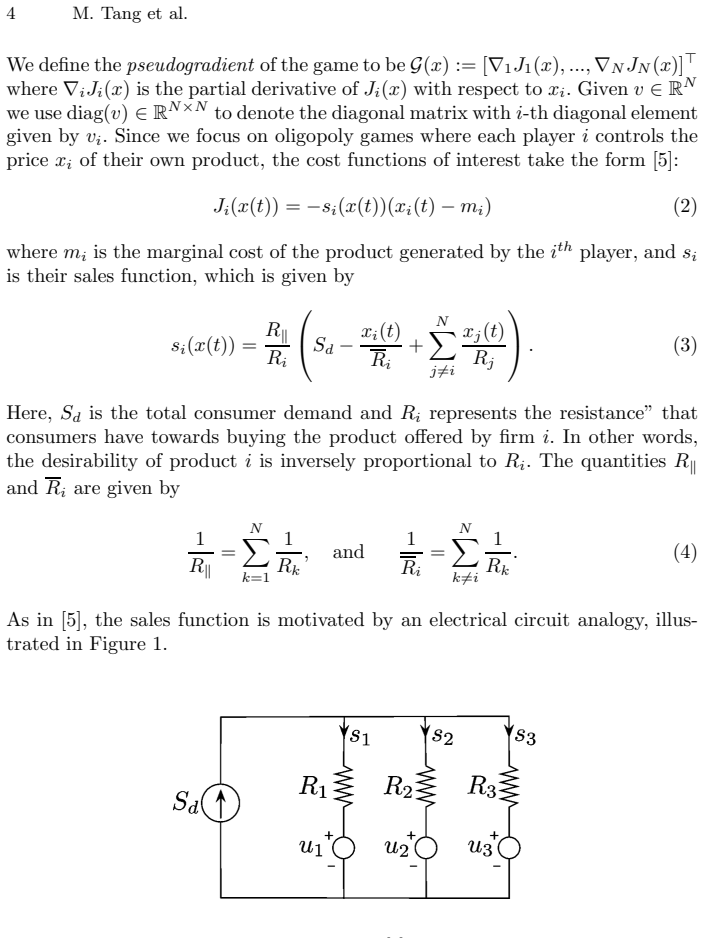
Starting from the standard model-free Nash equilibrium seeking rule in [5] and the deception idea in [16], the paper considers costs J_i(x) = -s_i(x)(x_i - m_i) with sales functions of the circuit-inspired form (3). Deceptive players add δ_i(t)Σ_{j∈D_i} a_j sin(ω_j t) to their action and tune δ_i by εε_i(J_i(x) - J_i^ref). The paper's central result is that if J^ref lies in the attainability set Ω of Definition 2—there exists δ* ∈ Δ such that J_{z_k}(-Q(δ*)^{-1}B(δ*)) = J^ref_{z_k} for every deceptive player and the Jacobian Λ(δ*) is Hurwitz—then for sufficiently small ε and a_i and sufficiently large ω, the state [u, δ] converges exponentially to an O(1/ω + max_i a_i) neighborhood of [u*, δ*] with u* = -Q(δ*)^{-1}B(δ*) (Theorem 1). Moreover, whenever 0<|δ|<2 and Q(δ) is invertible, u* is a Nash equilibrium of the deceptive game whose costs are given by (23) (Theorem 2). Along the way, the averaged dynamics reveal that victim i learns an effective competitor desirability 1/R_i - Σ_{k∈K_i} δ_k/R_k, so a positive net δ_k/R_k makes the victim treat other products as less desirable and raise its price, while a negative net value lowers the victim's price.
Load-bearing premise
The entire convergence guarantee rests on the target reference cost being attainable: there must exist a deceptive gain δ* that is itself stabilizing and whose induced equilibrium produces exactly the deceiver's chosen cost, with the derivative of that cost map Hurwitz; for more than one deceiver the paper provides no constructive way to verify this condition.
Editorial extensions
If this is right
- A firm can choose a target cost and, if attainable, force the market's learned prices to a shifted equilibrium while preserving closed-loop stability, so the deception is a persistent bias rather than a transient disturbance.
- Victims' pricing behavior is systematically distorted: positive Σ_{k∈K_i} δ_k/R_k makes the victim treat competitors as less desirable and raises its price, while negative values lower the price.
- Firms with more desirable products (smaller R_k) produce larger distortions per unit of δ, giving them more leverage as deceivers.
- The results hold for players using different gains k_i and exploration amplitudes a_i, removing the identical-gain restriction of earlier deception results.
- When 0<|δ|<2 and Q(δ) is invertible, the deceptive equilibrium is a true Nash equilibrium of the deceptive game, so the shifted outcome is self-consistent under the modified costs.
Reading between the lines
- A direct spectral check is a natural countermeasure: since victim i's cost measurements contain a sinusoid at frequency ω_k with amplitude proportional to δ_k a_k, a victim that knows its own exploration schedule could estimate δ_k from its measured cost and detect the deception; the paper does not discuss this.
- In multi-deceiver settings the attainability set Ω has no constructive test, so one practical extension is an iterative fixed-point search for δ*; if none exists, the reference-cost law may drive δ outside Δ and the convergence guarantee in Theorem 1 would not apply.
- The δ_k/R_k scaling suggests an empirical prediction: in markets with differentiated products, the price distortion inflicted on a victim should be largest when the deceiver's product has the smallest resistance R_k, a relation that could be tested with simulated or real market data.
- Because Theorem 2's condition is only |δ|<2 plus invertibility, the deceptive equilibrium can be stable even for δ values outside the unit-ball stability estimate of Lemma 1, as the numerical example with δ* ≈ 2.486 illustrates, so the true stability-preserving set is larger than the proven bound.
Editorial analysis
A structured set of objections, weighed in public.
Referee Report
Summary. This manuscript studies a model-free Nash equilibrium seeking (NES) algorithm with an additive deception signal for N-player oligopolies. The authors propose a modified update where deceptive players inject other players' exploration sinusoids into their own action and adjust a deceptive gain delta_i via an integral law tracking a reference cost. The main results are: Lemma 1, showing that the stability-preserving set Delta contains the unit ball for this oligopoly structure; Theorem 1, a local exponential convergence result for the adaptive deception dynamics to an O(1/omega + max_i a_i) neighborhood of a 'deceptive equilibrium' provided the reference cost vector is attainable (J_ref in Omega) and the associated Jacobian is Hurwitz; and Theorem 2, showing that for 0<|delta|<2 with Q(delta) invertible, the deceptive equilibrium is a Nash equilibrium of a constructed 'deceptive game.' The paper also gives an economic interpretation in which the victim over- or under-estimates competitor product desirability, and it includes a three-firm simulation with one deceptive player.
Significance. If the conditional statements are accepted, the paper extends deception in NES from the duopoly setting of [16] to an oligopoly with heterogeneous player gains and amplitudes, and it provides a sharper stability set estimate than the earlier work. The Gershgorin argument in Lemma 1 is sound, the averaging calculation in (15)-(19) is consistent with the model, and Theorem 2 is correct under its stated hypotheses. The main caveat is that the central convergence theorem is conditional on the attainability of the reference cost vector, and for more than one deceptive player the paper gives no existence check or example; the numerical section covers only a single deceiver and, moreover, uses a parameter value delta*=2.486 that falls outside the hypothesis |delta|<2 of Theorem 2. These gaps do not invalidate the conditional results, but they substantially limit the demonstrated scope of the 'N-player' claim.
major comments (3)
- [Section 3.1, Definition 2 and Theorem 1] The attainability hypothesis J_ref in Omega is not constructively verified for n>1 deceptive players. The text immediately after Theorem 1 states that computing Omega is 'a challenging problem,' and no multi-deceiver example is provided. This is not merely a numerical inconvenience: since h(0)=-Q(0)^{-1}B(0)=x0 and grad J_i(x0)=0 for every i, the derivative of the fixed-point map delta -> J_{z_k}(h(delta)) vanishes at delta=0, so Omega need not contain any neighborhood of the original cost vector, and the equations in Definition 2 may have no solution for economically natural targets. As written, the claimed N-player deception mechanism is therefore only established conditionally, with unverified applicability beyond the single-deceiver case. Please add either a constructive test for membership in Omega or at least one multi-deceiver example in which delta* in Delta and Lambda(delta*) Hurwitz are explicitly checked.
- [Section 4, Eq. (33) and Fig. 2] The numerical example uses delta*=2.486, which violates the hypothesis 0<|delta|<2 of Theorem 2, yet the text and Fig. 2 refer to x^delta as a 'deceptive Nash equilibrium.' Thus the simulation does not demonstrate Theorem 2 as claimed. Since Theorem 2 is only a sufficient condition, the example could still be valid if the second-order conditions [Q(delta*)]_ii>0 are verified directly at delta*, but the paper should either choose parameters with delta*<2 or perform that direct verification and state explicitly that Theorem 2's bound is not tight.
- [Section 3.1, proof of Theorem 1] The proof of Theorem 1 is a compressed combined averaging/singular-perturbation argument. It would benefit from a precise statement of the approximation theorem used, because the O(a) perturbation in (20) enters the fast u-dynamics and, after the time scale tau*=epsilon*tau, effectively produces terms of size O(a/epsilon). The theorem's quantifier order (epsilon first, then a*, then omega*) can accommodate this only if a* is chosen small relative to epsilon, and the proof should make this requirement explicit. As written, the steps 'by standard robustness results' and 'by standard averaging results' do not fully justify the joint convergence to an O(1/omega + max_i a_i) neighborhood.
minor comments (5)
- [Section 3.1, Eqs. (15)-(16)] The quadratic term in (15) is dropped when passing to (16) without comment; it contributes an O(max_i a_i) constant to the averaged u-dynamics. Please state that this term is absorbed into the O(a) perturbation in (20).
- [Section 2.1, Eq. (4) and Lemma 1] The notation R_i is used both for the player-specific resistance and for the parallel resistance of all other players (1/R_i = sum_{k neq i} 1/R_k). This makes equations like (13) hard to parse; a distinct symbol, e.g., R_{-i}, would improve readability.
- [Section 4] The text says 'we will only plot the profits P_i = -J_i,' but Fig. 2 plots prices rather than profits. Please align the text with the figures.
- [Section 3.2, Eq. (31)] The interpretation of the term (1-delta_k)/R_k as 'the degree to which each deceptive player affects player i's estimate' is intuitive but would be clearer if the sign conventions for delta were stated explicitly (positive delta corresponds to reduced perceived desirability).
- [Section 3.1, Lemma 1] The paper would benefit from a remark that Lemma 1's unit-ball estimate is sufficient but not necessary; the simulation uses delta*=2.486, which lies outside that bound, so stability there is verified only numerically and not by Lemma 1.
Circularity Check
No load-bearing circularity: the core theorems are conditional stability and algebraic results whose hypotheses are explicitly stated, with only minor inherited definitions from the authors' prior work.
full rationale
The paper's central Theorem 1 is conditional: given J_ref ∈ Ω (Definition 2), it proves via averaging and singular perturbation that the deceptive NES dynamics converge to (u*,δ*) with u*=-Q(δ*)^{-1}B(δ*) and J_{z_k}(u*)=J_ref. The attainability set Ω is defined by exactly the steady-state fixed-point equations plus a Hurwitz condition, so the theorem is a standard 'if a stable setpoint exists, integral action converges to it' result, not a derivation of attainability from the dynamics. The paper explicitly flags the computation of Ω as 'a challenging problem' for multiple deceivers, which is a limitation on applicability, not circularity. Theorem 2 is likewise a direct algebraic consequence of the deceptive game construction (23), whose gradient is Q(δ)x+B(δ) by construction; this is a straightforward derivation, not a disguised restatement of the conclusion. Self-citation of [16] supplies the deception mechanism, the attainability notion, and the deceptive-game definition, but the stability proofs and NE verification are carried out in this paper and do not reduce to the cited results. The numerical example fits δ* by solving J1(-Q(δ*)^{-1}B(δ*))=J_ref1, but this is a design/illustration calculation, not a prediction used as evidence for the theorems. No load-bearing circular reduction was found; the attainable-set restriction is an acknowledged hypothesis, not a conclusion smuggled in by definition.
Assumptions & free parameters
free parameters (2)
- Deceptive gain equilibrium δ* =
2.486 (in the Section 4 example, for deceiver 1)
- Reference cost J^ref_1 =
-1200
assumptions (4)
- domain assumption Costs are exactly the quadratic oligopoly form (2)-(3) with the linear demand and circuit structure.
- domain assumption Exploration frequencies satisfy Assumption 1 (distinct rational ratios), with small amplitudes and a large base frequency.
- ad hoc to paper The reference cost vector is attainable, i.e., J_ref ∈ Ω from Definition 2.
- standard math Standard averaging and singular perturbation theorems from [7] apply without additional verification of regularity and compactness conditions.
invented entities (1)
-
Deceptive game {J̃_i} for the N-player oligopoly
Cite this review
Pith. "Pith review of Deception in Oligopoly Games via Adaptive Nash Seeking Systems." pith.science (2026). https://pith.science/paper/M3OF6C45
@misc{pith2026250524112,
  author       = {Pith},
  title        = {Pith review of: Deception in Oligopoly Games via Adaptive Nash Seeking Systems},
  year         = {2026},
  howpublished = {\url{https://pith.science/paper/M3OF6C45}},
  note         = {Machine review of arXiv:2505.24112}
}
read the original abstract
In the theory of multi-agent systems, deception refers to the strategic manipulation of information to influence the behavior of other agents, ultimately altering the long-term dynamics of the entire system. Recently, this concept has been examined in the context of model-free Nash equilibrium seeking (NES) algorithms for noncooperative games. Specifically, it was demonstrated that players can exploit knowledge of other players' exploration signals to drive the system toward a ``deceptive" Nash equilibrium, while maintaining the stability of the closed-loop system. To extend this insight beyond the duopoly case, in this paper we conduct a comprehensive study of deception mechanisms in N-player oligopoly markets. By leveraging the structure of these games and employing stability techniques for nonlinear dynamical systems, we provide game-theoretic insights into deception and derive specialized results, including stability conditions. These results allow players to systematically adjust their NES dynamics by tuning gains and signal amplitudes, all while ensuring closed-loop stability. Additionally, we introduce novel sufficient conditions to demonstrate that the (practically) stable equilibrium point of the deceptive dynamics corresponds to a true Nash equilibrium of a different game, which we term the ``deceptive game." Our results show that, under the proposed adaptive dynamics with deception, a victim firm may develop a distorted perception of its competitors' product appeal, which could lead to setting suboptimal prices.
Figures


Reference graph
Works this paper leans on
-
[16]
Deception in Nash Equilibrium Seeking
Tang, M., Javed, U., Chen, X., Krstic, M., Poveda, J.I.: D eception in nash equi- librium seeking. arXiv preprint arXiv:2407.05168 (2024)
work page Pith review arXiv 2024
-
[1]
Ba¸ sar, T., Olsder, G.J.: Dynamic noncooperative game th eory. SIAM (1998)
work page 1998
-
[2]
IEEE control systems letters 1(2), 400–405 (2017)
Belgioioso, G., Grammatico, S.: Semi-decentralized nas h equilibrium seeking in aggregative games with separable coupling constraints and non-differentiable cost functions. IEEE control systems letters 1(2), 400–405 (2017)
work page 2017
-
[3]
Air Force Institute of Technology Scholar, Theses and Dissertations (2016)
Davis, A.: Deception in game theory: A survey and multiobj ective model. Air Force Institute of Technology Scholar, Theses and Dissertations (2016)
work page 2016
-
[4]
Autonomous Robots 39, 331–345 (2015) 14 M
Dragan, A., Holladay, R., Srinivasa, S.: Deceptive robot motion: synthesis, analysis and experiments. Autonomous Robots 39, 331–345 (2015) 14 M. Tang et al
work page 2015
-
[5]
IEEE Transactions on Automatic Control 57(5), 1192–1207 (2012)
Frihauf, P., Krstic, M., Basar, T.: Nash equilibrium seek ing in noncoopera- tive games. IEEE Transactions on Automatic Control 57(5), 1192–1207 (2012). https://doi.org/10.1109/TAC.2011.2173412
-
[6]
Ho, E., Rajagopalan, A., Skvortsov, A., Arulampalam, S., Piraveenan, M.: Game theory in defence applications: A review. Sensors 22(3), 1032 (2022)
work page 2022
-
[7]
Prentice Hall, Upper Sa ddle River, NJ (2002)
Khalil, H.K.: Nonlinear Systems. Prentice Hall, Upper Sa ddle River, NJ (2002)
work page 2002
Show all 24 references
-
[8]
Applied Soft Computing 75, 373–387 (2019)
Kouzehgar, M., Badamchizadeh, M.A.: Fuzzy signaling gam e of deception between ant-inspired deceptive robots with interactive learning. Applied Soft Computing 75, 373–387 (2019)
2019
-
[9]
SIAM Journal on Control and Optimization 49(4), 1659–1679 (2011)
Liu, S.J., Krsti´ c, M.: Stochastic nash equilibrium seek ing for games with general nonlinear payoffs. SIAM Journal on Control and Optimization 49(4), 1659–1679 (2011). https://doi.org/10.1137/100811738, https://do i.org/10.1137/100811738
2011 doi
-
[10]
SUNY press (1986)
Mitchell, R.W., Thompson, N.S., et al.: Deception: Pers pectives on human and nonhuman deceit. SUNY press (1986)
1986
-
[11]
Annals of Mathematics 54(2), 286–295 (1951), http://www.jstor.org/stable/1969529
Nash, J.: Non-cooperative games. Annals of Mathematics 54(2), 286–295 (1951), http://www.jstor.org/stable/1969529
1951
-
[12]
Journal of Optimization Theory and Applications 191(2), 700–735 (2021)
Oliveira, T.R., Rodrigues, V.H.P., Krsti´ c, M., Ba¸ sar, T.: Nash equilibrium seeking in quadratic noncooperative games under two delayed inform ation-sharing schemes. Journal of Optimization Theory and Applications 191(2), 700–735 (2021)
2021
-
[13]
IEEE Transactions on Automatic Control 68(4), 1954–1969 (2023)
Poveda, J.I., Krsti´ c, M., Ba¸ sar, T.: Fixed-time nash e quilibrium seeking in time- varying networks. IEEE Transactions on Automatic Control 68(4), 1954–1969 (2023). https://doi.org/10.1109/TAC.2022.3168527
2023
-
[14]
IEEE Transac- tions on Systems, Man, and Cybernetics - Part A: Systems and H umans 40(2), 224–235 (2010)
Santos, E., Li, D.: On deception detection in multiagent systems. IEEE Transac- tions on Systems, Man, and Cybernetics - Part A: Systems and H umans 40(2), 224–235 (2010). https://doi.org/10.1109/TSMCA.2009.20 34862
2010 doi
-
[15]
Cultu ral Anthropology 2(1), 50– 64 (1987)
Smith, E.O.: Deception and evolutionary biology. Cultu ral Anthropology 2(1), 50– 64 (1987)
1987
-
[17]
International Journal of Social Robotics 3, 5–26 (2011)
Wagner, A.R., Arkin, R.C.: Acting deceptively: Providi ng robots with the capacity for deception. International Journal of Social Robotics 3, 5–26 (2011)
2011
-
[18]
Automatica 122, 109255 (2020)
Wang, X.F., Sun, X.M., Teel, A.R., Liu, K.Z.: Distribute d robust nash equilibrium seeking for aggregative games under persistent attacks: A h ybrid systems approach. Automatica 122, 109255 (2020)
2020
-
[19]
IEEE Transactions on Automatic Control 68(10), 5862–5876 (2023)
Xu, W., Wang, Z., Hu, G., Kurths, J.: Hybrid nash equilibr ium seeking under partial-decision information: An adaptive dynamic e vent-triggered ap- proach. IEEE Transactions on Automatic Control 68(10), 5862–5876 (2023). https://doi.org/10.1109/TAC.2022.3226142
2023
-
[20]
Proceedings o f the IEEE 111(2), 140– 157 (2023)
Ye, M., Han, Q.L., Ding, L., Xu, S.: Distributed nash equi librium seeking in games with partial decision information: A survey. Proceedings o f the IEEE 111(2), 140– 157 (2023)
2023
-
[21]
IEEE Transactions on Automatic Control 62(9), 4811–4818 (2017)
Ye, M., Hu, G.: Distributed nash equilibrium seeking by a consensus based ap- proach. IEEE Transactions on Automatic Control 62(9), 4811–4818 (2017)
2017
-
[22]
Automatica 102, 111–121 (2019)
Yi, P., Pavel, L.: An operator splitting approach for dis tributed generalized nash equilibria computation. Automatica 102, 111–121 (2019). https://doi.org/https://doi.org/10.1016/j.au tomatica.2019.01.008, https://www.sciencedirect.com/science/article/pii/S0005109819300081
2019 doi
-
[23]
OUP Oxfo rd (2004)
Young, H.P.: Strategic learning and its limits. OUP Oxfo rd (2004)
2004
-
[24]
IEEE Transactions on Au tomatic Control 68(2), 1237–1244 (2022)
Zou, S., Lygeros, J.: Semidecentralized zeroth-order a lgorithms for stochastic gen- eralized nash equilibrium seeking. IEEE Transactions on Au tomatic Control 68(2), 1237–1244 (2022)
2022
Reviewed August 7, 2026 · model on record in the stance chip above.
Discussion (0). Sign in to comment.