REVIEW 4 major objections 5 minor 70 references
FeatureSense: Protecting Speaker Attributes in Always-On Audio Sensing System
T0 review · 4 major / 5 minor · reviewed 2026-08-07 · deepseek-v4-flash
Pith's one-line read Curated audio features can hide speaker age, gender, and ethnicity
desk verdict Useful leakage metric and a solid system paper; the headline privacy guarantee is not supported because the same data and classifier family are used to select and evaluate features. read the letter →
The pith
A machine-rendered reading of the paper's core claim, the machinery that carries it, and where it could break.
The reading
What carries the argument
The load-bearing mechanism is the curated feature library itself: roughly thirty granular features grouped into time-domain, spectral, perceptual, statistical, high-level, voice-specific, and derived categories, with phonetic/linguistic features (formants, MFCC, LPCC) excluded by appeal to the source-filter model of speech production, which ties those features to vocal tract resonances and thus to speaker identity. Feature selection first prunes features with high correlation, mutual information, or permutation importance for age, gender, and ethnicity (Chroma and Timbre are dropped), then a linear-programming optimizer selects a task-specific subset maximizing $\sum_i (\alpha u_i - (1-\alpha) p_i) x_i$ subject to a latency budget, where $u_i$ is the feature's utility for a sound category, $p_i$ its privacy leakage, and $\alpha$ the user's privacy-utility priority. Leakage is scored with the Speaker Information Leakage Index, SILI, the weighted average of normalized attribute-classification accuracies after processing.
What would settle it
Train a deep neural network, or a model that also uses pairwise feature interactions, on the pruned FeatureSense vectors from Common Voice to predict gender, age, or ethnicity: if held-out accuracy substantially exceeds the 33% random baseline, the privacy claim fails. A complementary check is to repeat the leakage evaluation on a conversational or noisy speech corpus and see whether attribute accuracy stays near chance.
Extended reading notes
Core claim
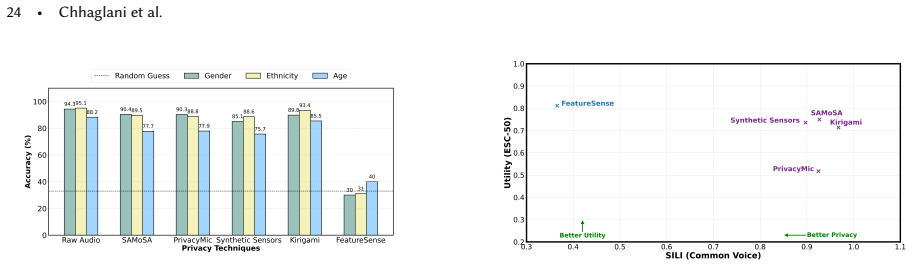
The central discovery is that speaker-attribute leakage is separable from speech leakage: techniques that effectively hide what is said (Kirigami, PrivacyMic, SAMoSA, Synthetic Sensors) still retain pitch, formant, spectral-envelope, and MFCC structure from which age, gender, and ethnicity can be inferred with high accuracy. FeatureSense addresses this by exposing only features that, individually and in combination, have low mutual information and low predictive power for speaker attributes after removing Chroma Features and Timbre, which are the most leakage-prone. With the pruned feature set, a Random Forest trained to predict gender, age, or ethnicity from Common Voice speech reaches close to random-chance accuracy (30%, 40%, and 31% against a 33% chance baseline), a 60.6% average reduction in speaker leakage compared with existing privacy techniques, while ESC-50 classification stays at 81.2% accuracy. The claim is that this feature-based approach is a general privacy layer for any non-speech, speaker-invariant audio sensing task.
Load-bearing premise
The load-bearing premise is that near-chance accuracy of Random Forest classifiers trained on Common Voice features is an adequate proxy for what a real adversary can infer from the exposed feature set, because the same data and classifier family are used both to select the features and to measure leakage.
Editorial extensions
If this is right
- A device running FeatureSense can expose only derived audio features to the cloud and still support environmental sound classification, cough detection, and urban sound event detection at 81-97% accuracy, making 'privacy mode' practical for always-on microphones.
- The SILI/CSLI pair gives developers a unified way to compare both speaker and speech leakage across privacy techniques, replacing the current reliance on word-error-rate alone.
- The task-specific optimizer lets non-experts pick a feature subset for a given sound category and latency budget without manual feature engineering, at the cost of a tunable $\alpha$ trade-off between utility and privacy.
- In the two case studies, reducing $\alpha$ from 1.0 to 0.3 cuts feature-extraction latency from about 9 ms to under 1.5 ms while keeping 92-93% of task utility and more than halving age or ethnicity leakage.
Reading between the lines
- The paper leaves implicit that the same feature-pruning recipe could transfer to other sensor modalities, such as accelerometer or radar microfeatures, that leak user traits while retaining event-detection utility.
- The appendix's finding that feature pairs like Low Band Energy plus Wavelet Features show 6.6x higher permutation importance than any single feature suggests a testable hardening step: extend the pruning to pairwise interactions, which the current selection algorithm does not yet model.
- Because leakage is measured on Common Voice read speech, the guarantees may not transfer to conversational or noisy recordings; a natural extension is to measure SILI on emotional or spontaneous speech corpora before deployment.
Editorial analysis
A structured set of objections, weighed in public.
Referee Report
Summary. This paper addresses speaker-attribute leakage in always-on audio sensing. It proposes the SILI and CSLI metrics, a curated audio feature library (FeatureSense), and a task-specific linear-programming feature-selection algorithm that trades off privacy, utility, and computational cost. The authors evaluate leakage in existing privacy filters, show that speech suppression does not remove speaker attributes, and claim that after removing Chroma and Timbre features, gender/age/ethnicity classifiers achieve near-chance accuracy (30%, 40%, 31% on three-class tasks) while utility remains high on ESC-50 (81.2%), UrbanSounds8k (97.1%), and a cough-detection case study, with sub-15 ms latency.
Significance. The paper makes a useful contribution by separating speaker demographic leakage from speech-content leakage and by providing a concrete, open-source feature library with latency and utility measurements. If the privacy claim were established against a stronger adversary, the system would be a practical deployable privacy layer for non-speech audio sensing. However, the central privacy claim currently rests on a same-data, single-family classifier evaluation, so the significance is conditional on a more convincing privacy evaluation.
major comments (4)
- [Sections 6.1 and 8.3.1] The 'close to random guess' claim is not an upper bound on leakage because the features were selected using the same CommonVoice labels and then evaluated with the same data. Section 6.1 removes features based on correlation, mutual information, and permutation importance computed on CommonVoice, and Section 8.3.1 measures Random Forest accuracy on the same corpus. The resulting 30%, 40%, and 31% accuracies therefore reflect selection on that corpus, not a bound for arbitrary corpora or adversaries. In addition, Section 9 acknowledges residual de-anonymization risk, which conflicts with the strong wording in the abstract and Section 1 that FeatureSense 'prevents' speaker leakage. Please evaluate on held-out speakers, on a second corpus with demographic labels, and with stronger adversaries (MLP, XGBoost, SVM), or revise the privacy claim to match the evidence.
- [Appendix, Figure 24] The paper's own screening procedure shows that individual-feature analysis is insufficient: the pair Low Band Energy + Wavelet Features has 6.6x the permutation importance of individual features, and other feature pairs also leak more than single features. Yet the final privacy evaluation in Section 8.3.1 trains classifiers on individual features only and does not use an interaction-aware adversary. Because the server receives the full low-dimensional feature vector, an adversary can construct pairwise products or use tree ensembles with built-in interactions. Please include interaction-aware leakage measurements, or state explicitly that the guarantee excludes interaction attacks.
- [Section 3.3 vs. Section 8.3.1] The threat model grants the adversary pretrained models, external datasets, and auxiliary knowledge, but the evaluation uses only a Random Forest trained on the same corpus and features. This does not instantiate the stated adversary capability. Please implement at least one attack that matches the threat model, such as a pretrained demographic classifier applied to the exposed features or a model trained on an external labeled speech corpus and tested on CommonVoice features.
- [Section 6.3] The feature-selection optimization is described as a binary selection problem, but the 'Binary Selection Constraint' is stated as 0≤x_i≤1, and the implementation uses scipy.optimize.linprog, which solves a continuous linear program. The returned x_i therefore need not be 0 or 1, so the claimed 'optimal subset of features' is not well-defined unless rounding or an integer solver is used. Please clarify whether the implementation rounds, thresholds, or uses mixed-integer programming; if the variables are continuous, the objective and the latency constraint need to be reinterpreted.
minor comments (5)
- [Section 7] The text says 'Figure 5 shows the APIs of FeatureSense library' but the API summary is in Table 5; please correct the cross-reference.
- [Appendix and Figure 24] The caption and text contain the typo 'Low Band Enegy'; it should be 'Low Band Energy'.
- [Sections 4.3, 6.1, 8.3.1] The paper uses 'ethnicity' for CommonVoice labels that are actually regional accent or nationality labels (us, ireland, australia); please clarify the terminology consistently.
- [Section 8.3.2] The mutual-information analysis with the first three formants is a useful screening tool, but the threshold of 0.22 is not justified; a sentence acknowledging that this is not a formal speech-leakage guarantee would help.
- [Tables 7 and 8] The 'Leakage Reduction (%)' numbers are presented inconsistently as both percentage-point reductions and relative reductions; for example, at alpha=1.0 in Table 7 the text says leakage drops from 66.1% to 38.9%, which is a 27.2 percentage-point drop, while the table labels this as a 27.22% reduction. Please define whether reductions are relative or absolute.
Circularity Check
Privacy claim rests on feature selection and evaluation sharing the same CommonVoice labels and classifier family, so the near-chance accuracies are partly a re-statement of the selection criterion; utility results remain independent.
-
fitted input called prediction
[Section 6.1, 'Feature Selection to Prevent Speaker Leakage'; Section 8.3.1, 'Speaker Privacy Leakage']
"Since Timbre and Chroma Features show highest high values across all metrics, indicating potential speaker attributes leakage. We eliminate these features from the FeatureSense library. In Section 8.3, we show that the removal of these features can significant reduce the accuracy of the age, gender, and ethnicity classification models, thus preserving privacy. ... After removing the highest correlated features (Chroma Features and Timbre) as discussed in Section 6, we achieve close to random guess accuracy for all three speaker attributes."
The features eliminated (Timbre, Chroma) are selected by ranking correlation, mutual information, and permutation importance with the speaker attributes on the CommonVoice corpus. The 'prediction' that FeatureSense preserves privacy is then measured by training Random Forest classifiers for gender/age/ethnicity on the same CommonVoice corpus after applying that exact blacklist. The evaluation therefore re-tests the selection criterion on the selection data: the reported near-chance accuracies are the expected reflection of that choice for the same label distribution, not an independent adversary upper bound. The 60.6% SILI improvement inherits this bias because SILI is computed from these same accuracies.
full rationale
FeatureSense's headline privacy result is weakened by a selection-evaluation loop rather than by a formal identity. Section 6.1 removes Timbre and Chroma because they show the highest correlation/MI/permutation importance with gender on CommonVoice; Section 8.3.1 then reports near-chance gender/age/ethnicity accuracies by training Random Forest classifiers on the same CommonVoice corpus after that removal. Because the blacklist was chosen using the same labels and data distribution that the evaluation uses, the 'close to random guess' figure is not an independent upper bound on what an adversary could infer; it partially reflects the feature-selection criterion itself. The paper's own appendix strengthens this concern by showing pairwise feature interactions (e.g., Low Band Energy + Wavelet Features) with 6.6x the permutation importance of individual features, yet no interaction-aware adversary is evaluated in Section 8.3.1. This is a correctness/robustness gap as much as a circularity: the SILI metric is a definition, and the 60.6% improvement is computed from the same biased SILI scores. On the other hand, the utility and latency evaluations (ESC-50, AudioSet, UrbanSound8k, Raspberry Pi) are independent benchmarks and are not circular; the source-filter motivation and the SILI/CSLI definitions do not depend on self-citations. I therefore score this as partial circularity (5), not as a fully forced derivation.
Assumptions & free parameters
free parameters (5)
- alpha privacy-utility trade-off =
0.3, 0.5, 0.8, 1.0 in case studies
- latency budget T =
0.1 s default, 0.15 s in case studies
- window size =
500 ms
- SILI attribute weights =
equal weights, 1/N
- manually removed features =
Timbre, Chroma features
assumptions (5)
- domain assumption The source-filter model of speech production accurately identifies which audio features carry speaker identity.
- domain assumption The adversary only sees extracted features and cannot access raw audio or tamper with the extraction pipeline.
- domain assumption Random Forest classifier accuracy on a specific feature set is a valid measure of speaker attribute leakage.
- ad hoc to paper Removing individually high-leakage features suffices to reduce combined leakage despite observed pairwise interactions.
- domain assumption CommonVoice labels for ethnicity are valid ethnicity labels rather than accent labels.
Cite this review
Pith. "Pith review of FeatureSense: Protecting Speaker Attributes in Always-On Audio Sensing System." pith.science (2026). https://pith.science/paper/BI2A5S34
@misc{pith2026250524115,
  author       = {Pith},
  title        = {Pith review of: FeatureSense: Protecting Speaker Attributes in Always-On Audio Sensing System},
  year         = {2026},
  howpublished = {\url{https://pith.science/paper/BI2A5S34}},
  note         = {Machine review of arXiv:2505.24115}
}
read the original abstract
Audio is a rich sensing modality that is useful for a variety of human activity recognition tasks. However, the ubiquitous nature of smartphones and smart speakers with always-on microphones has led to numerous privacy concerns and a lack of trust in deploying these audio-based sensing systems. This paper addresses this critical challenge of preserving user privacy when using audio for sensing applications while maintaining utility. While prior work focuses primarily on protecting recoverable speech content, we show that sensitive speaker-specific attributes such as age and gender can still be inferred after masking speech and propose a comprehensive privacy evaluation framework to assess this speaker attribute leakage. We design and implement FeatureSense, an open-source library that provides a set of generalizable privacy-aware audio features that can be used for wide range of sensing applications. We present an adaptive task-specific feature selection algorithm that optimizes the privacy-utility-cost trade-off based on the application requirements. Through our extensive evaluation, we demonstrate the high utility of FeatureSense across a diverse set of sensing tasks. Our system outperforms existing privacy techniques by 60.6% in preserving user-specific privacy. This work provides a foundational framework for ensuring trust in audio sensing by enabling effective privacy-aware audio classification systems.
Figures


Figures from the paper (10 more)




Reference graph
Works this paper leans on
-
[1]
mlung: Privacy- preserving naturally windowed lung activity detection for pulmonary patients
Mohsin Y Ahmed, Md Mahbubur Rahman, Viswam Nathan, Ebrahim Nemati, Korosh Vatanparvar, and Jilong Kuang. mlung: Privacy- preserving naturally windowed lung activity detection for pulmonary patients. In 2019 IEEE 16th International Conference on Wearable and Implantable Body Sensor Networks (BSN) , pages 1–4. IEEE, 2019
work page 2019
-
[2]
Cocoon: On-body microphone collaboration for spatial awareness
Bhawana Chhaglani, Utku Günay Acer, Si Young Jang, Fahim Kawsar, and Chulhong Min. Cocoon: On-body microphone collaboration for spatial awareness. In Proceedings of the 24th International Workshop on Mobile Computing Systems and Applications , pages 89–95, 2023
work page 2023
-
[3]
Aerosense: Sensing aerosol emissions from indoor human activities
Bhawana Chhaglani, Camellia Zakaria, Richard Peltier, Jeremy Gummeson, and Prashant Shenoy. Aerosense: Sensing aerosol emissions from indoor human activities. Proceedings of the ACM on Interactive, Mobile, Wearable and Ubiquitous Technologies , 8(2):1–30, 2024
work page 2024
-
[4]
Cough-dl: A deep learning model for ear-worn cough detection
Bhawana Chhaglani, Ebrahim Nemati, Sharath Chandrashekhara, Jilong Kuang, and Alex Gao. Cough-dl: A deep learning model for ear-worn cough detection. In 2024 46th Annual International Conference of the IEEE Engineering in Medicine and Biology Society (EMBC) , pages 1–5. IEEE, 2024
work page 2024
-
[5]
NeckCare: Preventing Tech Neck using Hearable-based Multimodal Sensing
Bhawana Chhaglani and Alan Seefeldt. Neckcare: Preventing tech neck using hearable-based multimodal sensing. arXiv preprint arXiv:2412.13579, 2024
work page Pith review arXiv 2024
-
[6]
Ubicoustics: Plug-and-play acoustic activity recognition
Gierad Laput, Karan Ahuja, Mayank Goel, and Chris Harrison. Ubicoustics: Plug-and-play acoustic activity recognition. In Proceedings of the 31st Annual ACM Symposium on User Interface Software and Technology , pages 213–224, 2018
work page 2018
-
[7]
Bodyscope: a wearable acoustic sensor for activity recognition
Koji Yatani and Khai N Truong. Bodyscope: a wearable acoustic sensor for activity recognition. InProceedings of the 2012 ACM conference on ubiquitous computing, pages 341–350, 2012
work page 2012
-
[8]
Mites: Design and deployment of a general-purpose sensing infrastructure for buildings
Sudershan Boovaraghavan, Chen Chen, Anurag Maravi, Mike Czapik, Yang Zhang, Chris Harrison, and Yuvraj Agarwal. Mites: Design and deployment of a general-purpose sensing infrastructure for buildings. Proceedings of the ACM on Interactive, Mobile, Wearable and Ubiquitous Technologies, 7(1):1–32, 2023
work page 2023
Show all 70 references
-
[9]
Privacy against real-time speech emotion detection via acoustic adversarial evasion of machine learning
Brian Testa, Yi Xiao, Harshit Sharma, Avery Gump, and Asif Salekin. Privacy against real-time speech emotion detection via acoustic adversarial evasion of machine learning. Proceedings of the ACM on Interactive, Mobile, Wearable and Ubiquitous Technologies , 7(3):1–30, 2023
2023
-
[10]
Flowsense: Monitoring airflow in building ventilation systems using audio sensing
Bhawana Chhaglani, Camellia Zakaria, Adam Lechowicz, Jeremy Gummeson, and Prashant Shenoy. Flowsense: Monitoring airflow in building ventilation systems using audio sensing. Proceedings of the ACM on Interactive, Mobile, Wearable and Ubiquitous Technologies , 6(1):1–26, 2022
2022
-
[11]
Kirigami: Lightweight speech filtering for privacy- preserving activity recognition using audio
Sudershan Boovaraghavan, Haozhe Zhou, Mayank Goel, and Yuvraj Agarwal. Kirigami: Lightweight speech filtering for privacy- preserving activity recognition using audio. Proceedings of the ACM on Interactive, Mobile, Wearable and Ubiquitous Technologies , 8(1):1–28, 2024
2024
-
[12]
Towards privacy-preserving audio classification systems
Bhawana Chhaglani, Jeremy Gummeson, and Prashant Shenoy. Towards privacy-preserving audio classification systems. arXiv preprint arXiv:2404.18002, 2024
2024 arXiv
-
[13]
Apple siri eavesdropping payout, "2025"
2025
-
[14]
Amazon’s alexa can accidentally record and share your conversations, 2018
2018
-
[15]
Apple contractors ’regularly hear confidential details’ on siri recordings, "2024"
2024
-
[16]
Samosa: Sensing activities with motion and subsampled audio
Vimal Mollyn, Karan Ahuja, Dhruv Verma, Chris Harrison, and Mayank Goel. Samosa: Sensing activities with motion and subsampled audio. Proceedings of the ACM on Interactive, Mobile, Wearable and Ubiquitous Technologies , 6(3):1–19, 2022
2022
-
[17]
Sound shredding: Privacy preserved audio sensing
Sumeet Kumar, Le T Nguyen, Ming Zeng, Kate Liu, and Joy Zhang. Sound shredding: Privacy preserved audio sensing. In Proceedings of the 16th international workshop on mobile computing systems and applications , pages 135–140, 2015
2015
-
[18]
A method for preserving privacy during audio recordings by filtering speech
Daniyal Liaqat, Ebrahim Nemati, Mahbubur Rahman, and Jilong Kuang. A method for preserving privacy during audio recordings by filtering speech. In 2017 IEEE Life Sciences Conference (LSC) , pages 79–82. IEEE, 2017
2017
-
[19]
Crowdotic: Transformer-based occupancy estimation for hospital waiting rooms with non-speech audio and differential privacy
Forsad Al Hossain, Tanjid Hasan Tonmoy, Andrew A Lover, George A Corey, Mohammad Arif Ul Alam, and Tauhidur Rahman. Crowdotic: Transformer-based occupancy estimation for hospital waiting rooms with non-speech audio and differential privacy. arXiv preprint arXiv:2309.10280, 202...
2023 arXiv
-
[20]
Pdvocal: Towards privacy-preserving parkinson’s disease detection using non-speech body sounds
Hanbin Zhang, Chen Song, Aosen Wang, Chenhan Xu, Dongmei Li, and Wenyao Xu. Pdvocal: Towards privacy-preserving parkinson’s disease detection using non-speech body sounds. In The 25th annual international conference on mobile computing and networking , pages 1–16, 2019
2019
-
[21]
Speaker identification from the sound of the human breath
Wenbo Zhao, Yang Gao, and Rita Singh. Speaker identification from the sound of the human breath. arXiv preprint arXiv:1712.00171, 2017
2017 arXiv
-
[22]
Privacy implications of voice and speech analysis–information disclosure by inference
Jacob Leon Kröger, Otto Hans-Martin Lutz, and Philip Raschke. Privacy implications of voice and speech analysis–information disclosure by inference. Privacy and Identity Management. Data for Better Living: AI and Privacy: 14th IFIP WG 9.2, 9.6/11.7, 11.6/SIG 9.2. 2 Internation...
2019
-
[23]
Common voice: A massively-multilingual speech corpus
Rosana Ardila, Megan Branson, Kelly Davis, Michael Henretty, Michael Kohler, Josh Meyer, Reuben Morais, Lindsay Saunders, Francis M Tyers, and Gregor Weber. Common voice: A massively-multilingual speech corpus. arXiv preprint arXiv:1912.06670, 2019
1912 arXiv
-
[24]
Privacy-sensitive audio features for speech/nonspeech detection
Sree Hari Krishnan Parthasarathi, Daniel Gatica-Perez, Hervé Bourlard, and Mathew Magimai Doss. Privacy-sensitive audio features for speech/nonspeech detection. IEEE transactions on audio, speech, and language processing , 19(8):2538–2551, 2011
2011
-
[25]
The source–filter theory of speech
Isao Tokuda. The source–filter theory of speech. In Oxford Research Encyclopedia of Linguistics . 2021
2021
-
[26]
Esc: Dataset for environmental sound classification
Karol J Piczak. Esc: Dataset for environmental sound classification. InProceedings of the 23rd ACM international conference on Multimedia, pages 1015–1018, 2015
2015
-
[27]
Audio set: An ontology and human-labeled dataset for audio events
Jort F Gemmeke, Daniel PW Ellis, Dylan Freedman, Aren Jansen, Wade Lawrence, R Channing Moore, Manoj Plakal, and Marvin Ritter. Audio set: An ontology and human-labeled dataset for audio events. In 2017 IEEE international conference on acoustics, speech and signal processing (...
2017
-
[28]
A dataset and taxonomy for urban sound research
Justin Salamon, Christopher Jacoby, and Juan Pablo Bello. A dataset and taxonomy for urban sound research. In Proceedings of the 22nd ACM international conference on Multimedia , pages 1041–1044, 2014
2014
-
[29]
Privacymic: Utilizing inaudible frequencies for privacy preserving daily activity recognition
Yasha Iravantchi, Karan Ahuja, Mayank Goel, Chris Harrison, and Alanson Sample. Privacymic: Utilizing inaudible frequencies for privacy preserving daily activity recognition. In Proceedings of the 2021 CHI Conference on Human Factors in Computing Systems , pages 1–13, 2021
2021
-
[30]
Synthetic sensors: Towards general-purpose sensing
Gierad Laput, Yang Zhang, and Chris Harrison. Synthetic sensors: Towards general-purpose sensing. In Proceedings of the 2017 CHI Conference on Human Factors in Computing Systems , pages 3986–3999, 2017
2017
-
[31]
How private is low-frequency speech audio in the wild? an analysis of verbal intelligibility by humans and machines
Ailin Liu, Pepijn Vunderink, Jose Vargas Quiros, Chirag Raman, and Hayley Hung. How private is low-frequency speech audio in the wild? an analysis of verbal intelligibility by humans and machines. arXiv preprint arXiv:2407.13266, 2024
2024 arXiv
-
[32]
Silence: Protecting privacy in offloaded speech understanding on resource-constrained devices
Dongqi Cai, Shangguang Wang, Zeling Zhang, Felix Xiaozhu Lin, and Mengwei Xu. Silence: Protecting privacy in offloaded speech understanding on resource-constrained devices. In The Thirty-eighth Annual Conference on Neural Information Processing Systems
-
[33]
Audio privacy: reducing speech intelligibility while preserving environmental sounds
Francine Chen, John Adcock, and Shruti Krishnagiri. Audio privacy: reducing speech intelligibility while preserving environmental sounds. In Proceedings of the 16th ACM international conference on Multimedia , pages 733–736, 2008
2008
-
[34]
Conversation detection and speaker segmentation in privacy-sensitive situated speech data
Danny Wyatt, Tanzeem Choudhury, and Jeff A Bilmes. Conversation detection and speaker segmentation in privacy-sensitive situated speech data. In Interspeech, pages 586–589, 2007
2007
-
[35]
Speaker change detection with privacy-preserving audio cues
Sree Hari Krishnan Parthasarathi, Mathew Magimai.-Doss, Daniel Gatica-Perez, and Hervé Bourlard. Speaker change detection with privacy-preserving audio cues. In Proceedings of the 2009 international conference on Multimodal interfaces , pages 343–346, 2009
2009
-
[36]
Symdetector: detecting sound-related respiratory symptoms using smartphones
Xiao Sun, Zongqing Lu, Wenjie Hu, and Guohong Cao. Symdetector: detecting sound-related respiratory symptoms using smartphones. In Proceedings of the 2015 ACM International Joint Conference on Pervasive and Ubiquitous Computing , pages 97–108, 2015
2015
-
[37]
Accurate and privacy preserving cough sensing using a low-cost microphone
Eric C Larson, TienJui Lee, Sean Liu, Margaret Rosenfeld, and Shwetak N Patel. Accurate and privacy preserving cough sensing using a low-cost microphone. In Proceedings of the 13th international conference on Ubiquitous computing , pages 375–384, 2011
2011
-
[38]
Inferring speakers’ physical attributes from their voices.Journal of experimental social psychology, 38(6):618–625, 2002
Robert M Krauss, Robin Freyberg, and Ezequiel Morsella. Inferring speakers’ physical attributes from their voices.Journal of experimental social psychology, 38(6):618–625, 2002
2002
-
[39]
User profiling based on nonlinguistic audio data
Jiaxing Shen, Jiannong Cao, Oren Lederman, Shaojie Tang, and Alex “Sandy” Pentland. User profiling based on nonlinguistic audio data. ACM Transactions on Information Systems (TOIS) , 40(1):1–23, 2021
2021
-
[40]
The voiceprivacy 2022 challenge: Progress and perspectives in voice anonymisation
Michele Panariello, Natalia Tomashenko, Xin Wang, Xiaoxiao Miao, Pierre Champion, Hubert Nourtel, Massimiliano Todisco, Nicholas Evans, Emmanuel Vincent, and Junichi Yamagishi. The voiceprivacy 2022 challenge: Progress and perspectives in voice anonymisation. IEEE/ACM Transact...
2022
-
[41]
Hyfe apps on google play
Hyfe Inc. Hyfe apps on google play. https://play.google.com/store/apps/dev?id=9063262839836886650. Accessed: 2025-05-01
2025
-
[42]
Smartthermostat with voice control
ecobee Inc. Smartthermostat with voice control. https://www.ecobee.com/en-us/smart-thermostats/. Accessed: 2025-05-01
2025
-
[43]
Alexa, are you invading my privacy? the dark side of our voice assistants
Alex Hern. Alexa, are you invading my privacy? the dark side of our voice assistants. The Guardian, 2019
2019
-
[44]
Ftc and doj charge company with violating children’s privacy law by keeping kids’ voice recordings, 2023
Federal Trade Commission. Ftc and doj charge company with violating children’s privacy law by keeping kids’ voice recordings, 2023. Accessed: 2024-04-28
2023
-
[45]
Apple will pay $95 million in siri privacy lawsuit settlement
Ben Popper. Apple will pay $95 million in siri privacy lawsuit settlement. Vox Media, 2021. Accessed: 2024-04-28
2021
-
[46]
New challenges for content privacy in speech and audio
Jennifer Williams, Karla Pizzi, Shuvayanti Das, and Paul-Gauthier Noé. New challenges for content privacy in speech and audio. arXiv preprint arXiv:2301.08925, 2023. , Vol. 1, No. 1, Article . Publication date: May 2025. FeatureSense: Protecting Speaker Attributes in Always-On...
2023 arXiv
-
[47]
Automatic speech disfluency detection using wav2vec2
Jiajun Liu, Aishan Wumaier, Dongping Wei, and Shen Guo. Automatic speech disfluency detection using wav2vec2. 0 for different languages with variable lengths. Applied Sciences, 13(13):7579, 2023
2023
-
[48]
Timit-tts: A text-to-speech dataset for multimodal synthetic media detection
Davide Salvi, Brian Hosler, Paolo Bestagini, Matthew C Stamm, and Stefano Tubaro. Timit-tts: A text-to-speech dataset for multimodal synthetic media detection. IEEE access, 11:50851–50866, 2023
2023
-
[49]
Speaker identification features extraction methods: A systematic review
Sreenivas Sremath Tirumala, Seyed Reza Shahamiri, Abhimanyu Singh Garhwal, and Ruili Wang. Speaker identification features extraction methods: A systematic review. Expert Systems with Applications, 90:250–271, 2017
2017
-
[50]
Selection of acoustic features for speaker identification
Marvin Sambur. Selection of acoustic features for speaker identification. IEEE Transactions on Acoustics, Speech, and Signal Processing , 23(2):176–182, 1975
1975
-
[51]
Opensmile: the munich versatile and fast open-source audio feature extractor
Florian Eyben, Martin Wöllmer, and Björn Schuller. Opensmile: the munich versatile and fast open-source audio feature extractor. In Proceedings of the 18th ACM international conference on Multimedia , pages 1459–1462, 2010
2010
-
[52]
A review on speech synthesis an artificial voice production
Smita S Hande. A review on speech synthesis an artificial voice production. International Journal of Advanced Research in Electrical, Electronics and Instrumentation Engineering , 3(3):8056–8063, 2014
2014
-
[53]
Feature learning from spectrograms for assessment of personality traits
Marc-André Carbonneau, Eric Granger, Yazid Attabi, and Ghyslain Gagnon. Feature learning from spectrograms for assessment of personality traits. IEEE Transactions on Affective Computing , 11(1):25–31, 2017
2017
-
[54]
Navigating the united states legislative landscape on voice privacy: Existing laws, proposed bills, protection for children, and synthetic data for ai
Satwik Dutta and John HL Hansen. Navigating the united states legislative landscape on voice privacy: Existing laws, proposed bills, protection for children, and synthetic data for ai. arXiv preprint arXiv:2407.19677, 2024
2024 arXiv
-
[55]
A statistical model-based voice activity detection
Jongseo Sohn, Nam Soo Kim, and Wonyong Sung. A statistical model-based voice activity detection. IEEE signal processing letters , 6(1):1–3, 1999
1999
-
[56]
Pams: Improving privacy in audio-based mobile systems
Stephen Xia and Xiaofan Jiang. Pams: Improving privacy in audio-based mobile systems. InProceedings of the 2nd International Workshop on Challenges in Artificial Intelligence and Machine Learning for Internet of Things , pages 41–47, 2020
2020
-
[57]
Preserving privacy in speaker and speech characterisation
Andreas Nautsch, Abelino Jiménez, Amos Treiber, Jascha Kolberg, Catherine Jasserand, Els Kindt, Héctor Delgado, Massimiliano Todisco, Mohamed Amine Hmani, Aymen Mtibaa, et al. Preserving privacy in speaker and speech characterisation. Computer Speech & Language , 58:441–480, 2019
2019
-
[58]
Emotionless: Privacy-preserving speech analysis for voice assistants
Ranya Aloufi, Hamed Haddadi, and David Boyle. Emotionless: Privacy-preserving speech analysis for voice assistants. arXiv preprint arXiv:1908.03632, 2019
1908 arXiv
-
[59]
Privacy-preserving speaker verification and identification using gaussian mixture models
Manas A Pathak and Bhiksha Raj. Privacy-preserving speaker verification and identification using gaussian mixture models. IEEE Transactions on Audio, Speech, and Language Processing , 21(2):397–406, 2012
2012
-
[60]
Face-mic: Inferring live speech and speaker identity via subtle facial dynamics captured by ar/vr motion sensors
Weilin Shi, Xiangyu Zhang, Yujie Zhang, Tao Xie, XiaoFeng Wang, and Yu Yao. Face-mic: Inferring live speech and speaker identity via subtle facial dynamics captured by ar/vr motion sensors. In Proceedings of the ACM Conference on Computer and Communications Security (CCS), pag...
2021
-
[61]
Micpro: Microphone-based voice privacy protection
Shilin Xiao, Xiaoyu Ji, Chen Yan, Zhicong Zheng, and Wenyuan Xu. Micpro: Microphone-based voice privacy protection. In Proceedings of the 2023 ACM SIGSAC Conference on Computer and Communications Security , pages 1302–1316, 2023
2023
-
[62]
Learning normality is enough: a software-based mitigation against inaudible voice attacks
Xinfeng Li, Xiaoyu Ji, Chen Yan, Chaohao Li, Yichen Li, Zhenning Zhang, and Wenyuan Xu. Learning normality is enough: a software-based mitigation against inaudible voice attacks. In 32nd USENIX Security Symposium (USENIX Security 23) , pages 2455–2472, 2023
2023
-
[63]
Safeear: Content privacy-preserving audio deepfake detection
Xinfeng Li, Kai Li, Yifan Zheng, Chen Yan, Xiaoyu Ji, and Wenyuan Xu. Safeear: Content privacy-preserving audio deepfake detection. In Proceedings of the 2024 on ACM SIGSAC Conference on Computer and Communications Security , pages 3585–3599, 2024
2024
-
[64]
Adversarial representation learning for robust privacy preservation in audio
Shayan Gharib, Minh Tran, Diep Luong, Konstantinos Drossos, and Tuomas Virtanen. Adversarial representation learning for robust privacy preservation in audio. IEEE Open Journal of Signal Processing , 5:294–302, 2024
2024
-
[65]
Privacy-preserving audio classification using variational information feature extraction
Alexandru Nelus and Rainer Martin. Privacy-preserving audio classification using variational information feature extraction. IEEE/ACM Transactions on Audio, Speech, and Language Processing , 29:2864–2877, 2021
2021
-
[66]
Coughbuddy: Multi-modal cough event detection using earbuds platform
Ebrahim Nemati, Shibo Zhang, Tousif Ahmed, Md Mahbubur Rahman, Jilong Kuang, and Alex Gao. Coughbuddy: Multi-modal cough event detection using earbuds platform. In 2021 IEEE 17th international conference on wearable and implantable body sensor networks (BSN), pages 1–4. IEEE, 2021
2021
-
[67]
Privacy-aware respiratory symptom detection in-the-wild
Manas Satish Bedmutha, Poorva Satish Bedmutha, and Nadir Weibel. Privacy-aware respiratory symptom detection in-the-wild. In Adjunct Proceedings of the 2023 ACM International Joint Conference on Pervasive and Ubiquitous Computing & the 2023 ACM International Symposium on Weara...
2023
-
[68]
Federated learning with differential privacy for end-to-end speech recognition
Martin Pelikan, Sheikh Shams Azam, Vitaly Feldman, Jan Silovsky, Kunal Talwar, Tatiana Likhomanenko, et al. Federated learning with differential privacy for end-to-end speech recognition. arXiv preprint arXiv:2310.00098, 2023
-
[69]
Advances in automated voice pathology detection: A comprehensive review of speech signal analysis techniques
Anitha Sankaran and Lakshmi Sutha Kumar. Advances in automated voice pathology detection: A comprehensive review of speech signal analysis techniques. IEEE Access, 2024
2024
-
[70]
A unique approach in text independent speaker recognition using mfcc feature sets and probabilistic neural network
Khan Suhail Ahmad, Anil S Thosar, Jagannath H Nirmal, and Vinay S Pande. A unique approach in text independent speaker recognition using mfcc feature sets and probabilistic neural network. In 2015 Eighth International Conference on Advances in Pattern Recognition (ICAPR), page...
2015
Reviewed August 7, 2026 · model on record in the stance chip above.
Discussion (0). Sign in to comment.