REVIEW 3 major objections 5 minor 31 references
Humanoid Loco-Manipulations Pattern Generation and Stabilization Control
T0 review · 3 major / 5 minor · reviewed 2026-08-07 · deepseek-v4-flash
Pith's one-line read By folding external manipulation forces into a single ext-ZMP variable, this paper extends the standard preview-control pattern generator and DCM-based stabilizer so a humanoid can plan and stabilize walking while sustained or alternating…
desk verdict A clean, useful extension of LIPM/DCM to external manipulation forces; the stabilizer's force-error compensation is solid for horizontal errors but rests on an unquantified constant-kappa assumption for vertical errors. read the letter →
The pith
A machine-rendered reading of the paper's core claim, the machinery that carries it, and where it could break.
The reading
What carries the argument
The central object is the ext-ZMP $\hat{z} = \kappa z - \gamma$, a single variable that absorbs horizontal and vertical hand forces into a modified ZMP. Here $\kappa = 1 - \sum_i f^{(i)}_{\mathrm{ex},z} / (m(\ddot{c}_z + g))$ is the scale factor produced by vertical external forces, and $\gamma$ collects the force and moment offsets. Substituting ext-ZMP into the preview-control pattern generator makes external-force reference tracking a drop-in extension, and the same definitions give the first- and second-order DCM error dynamics used to derive the stabilizer feedback law. The device carries the argument because all external-force effects are concentrated in one variable, so existing bipedal walking machinery survives intact.
What would settle it
Apply a humanoid to a pushing task while a sinusoidal vertical hand-force error of growing amplitude is commanded, and monitor the closed-loop DCM error or the ZMP fluctuation. If the $1/\kappa$ compensation terms in the stabilizer fail to keep the errors bounded beyond some force-error amplitude, the constant-$\kappa$ linearization is inadequate. A related calculation is to compare the closed-loop eigenvalues predicted by equation (23), which assume constant $\kappa$, with the response of the full nonlinear dynamics when $\kappa$ varies in time.
Extended reading notes
Core claim
By reorganizing the Newton-Euler equations under the usual horizontal angular momentum assumptions, the paper shows that external manipulation forces enter the linear inverted pendulum mode only through a scale factor $\kappa$ and an offset $\gamma$, leaving the natural frequency $\omega$ unchanged. This yields the ext-ZMP $\hat{z} = \kappa z - \gamma$, so the conventional preview control can be reused directly. The divergent component of motion keeps its usual form, $\dot{\xi} = \omega(\xi - \kappa z + \gamma)$, so a DCM-based stabilizer can be extended without changing the unstable mode. The stabilizer separates the force-error offset into high-frequency and low-frequency components: fast errors are rejected by shifting the ZMP, slow errors by shifting the desired CoM, and the feedback gains are scaled by $1/\kappa$ to match the conventional closed-loop response. Experiments show the robot walking while rolling a bobbin and pushing a cart with changing friction.
Load-bearing premise
The stabilizer linearizes the DCM error dynamics by assuming that the scale factor $\kappa$ computed from planned and measured vertical hand forces is equal and constant, so that vertical force errors do not change how the ZMP is scaled into the DCM dynamics; the paper states this error is 'not so large' but gives no quantitative bound.
Editorial extensions
If this is right
- Walking pattern generation can incorporate vertical hand forces exactly, without approximation, while keeping the same preview-control structure and constant gains.
- The stabilizer can reject manipulation-force errors directly by adjusting ZMP for fast components and CoM for slow components, rather than relying only on conservative whole-body motion.
- The proposed formulas run within 2 ms control cycles on the robot's embedded computer, so the added capability does not raise computational cost.
- The same ext-ZMP substitution extends naturally to other pattern-generation methods such as linear MPC and DCM-based walking control.
- Previous pushing controllers that only added an offset to the ZMP or CoM can be upgraded to include the full vertical-force scale effect.
Reading between the lines
- The frequency-domain separation in the stabilizer suggests a practical tuning recipe: the cutoff frequency can be chosen so that the fast ZMP strategy stays within the sole region while the slower CoM strategy handles drift, a design trade-off not explicitly quantified in the paper.
- The same ext-ZMP derivation should apply to other sustained contacts besides the hands, such as walking with a walker, carrying a heavy load on the torso, or pushing with the shoulder, wherever a known vertical force acts on the body.
- If a quantitative bound on $\kappa$ error were established, the stabilizer could be made adaptive by estimating $\kappa$ online from measured vertical forces rather than assuming it equals the desired value.
- Because the paper assumes the reference manipulation forces are given, coupling the controller with online force-prediction methods would extend it to tasks where the required object force is not known in advance.
Editorial analysis
A structured set of objections, weighed in public.
Referee Report
Summary. The manuscript extends the standard LIPM/DCM framework for bipedal walking to humanoid loco-manipulation. It derives forced LIPM and DCM equations that include external manipulation forces, introduces an 'ext-ZMP' variable that absorbs scaling and offset effects of those forces, and reuses preview control for pattern generation. The stabilizer extends DCM feedback control by separating the error between actual and desired manipulation forces into a low-frequency component handled by a CoM strategy and a high-frequency component handled by a ZMP strategy, with feedforward compensation terms. The approach is evaluated in three simulation test cases and in real-robot experiments (HRP-5P bobbin rolling and HRP-2Kai cart pushing).
Significance. If the claims hold, this is a practical and computationally cheap extension of widely used humanoid walking controllers to tasks with sustained hand forces. The derivation from Newton-Euler to the forced LIPM/DCM is clean and internally consistent, the ext-ZMP formulation is elegant, and the frequency-domain separation of force errors is a useful engineering idea. The real-robot demonstrations on HRP-5P and HRP-2Kai are valuable and support the pattern-generation part of the paper. The main weakness is that the stabilizer's force-error compensation is derived under an unquantified assumption on the ZMP scaling factor kappa and is not validated in the regime where that assumption matters, namely errors in vertical manipulation forces.
major comments (3)
- [Section V-B1, Eqs. (13)-(14)] The linearized DCM error dynamics is derived under the assumption that kappa^a = kappa^d = kappa is constant. When vertical hand-force errors are present, this assumption fails: writing kappa^a = kappa + Delta_kappa introduces an additional term -omega Delta_kappa z^a in the DCM error dynamics, and the feedforward terms (1/kappa) gamma_bar^a_H and (1/(kappa rho)) dot_gamma_bar^a_H in Eqs. (22) and (26) then cancel only a fraction kappa^a/kappa^d of the actual disturbance, leaving a residual proportional to Delta_kappa/kappa. The only justification given, that the error of kappa is 'not so large', is not a quantitative statement. Because the explicit compensation of manipulation-force errors is a central contribution, this approximation is load-bearing. Please provide a quantitative bound on Delta_kappa in terms of the vertical force error, an analysis of the resulting residual disturbance and its effect on stability, or revise the claim to state that the force-error compensation applies to gamma while kappa errors are neglected.
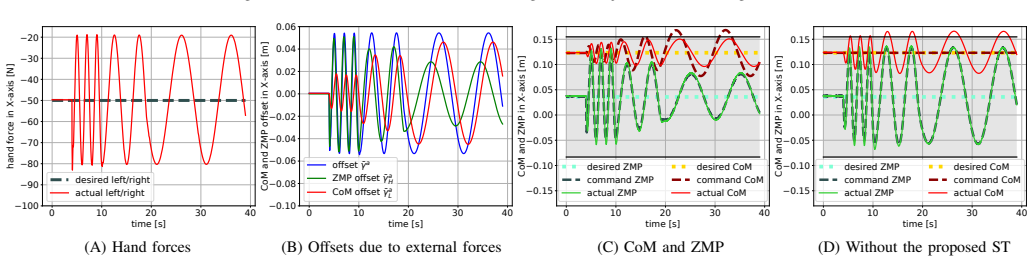
- [Section VII and test-case 2] The claimed robustness to vertical manipulation-force errors is not experimentally validated. Test-case 2 applies vertical forces of 200 N per hand but the actual forces track the reference, so it validates the pattern generator's ext-ZMP formulation, not the stabilizer's response to a mismatch in vertical forces. The real-robot experiments (bobbin turning, cart pushing) involve predominantly horizontal hand forces, for which kappa remains close to 1; they do not exercise the regime in which kappa changes. A dedicated experiment or simulation with a step or ramp error in the vertical force component is needed to support the second central contribution.
- [Section V-B4, Eqs. (17)-(20)] The derivation of the CoM strategy assumes dot_gamma_bar^a_L is approximately zero (and consequently double-dot_gamma_bar^a_L is also zero) when the low-frequency force-error component is used to shift the desired CoM. The neglected terms double-dot_gamma_bar_L + rho dot_gamma_bar_L are not obviously small for components near the 1.0-s filter cutoff, and no bound or sensitivity study is provided. Please quantify this approximation or demonstrate that it has negligible effect on the closed-loop response.
minor comments (5)
- [Section V-B1] The barred variables, such as gamma_bar^a, are defined as the difference between actual and desired values, but this is only implicit; please state the definition explicitly for all barred symbols.
- [Section V-B2, Eq. (15)] The first-order lag is written directly for the error variable z_bar^a, which is valid only when the desired ZMP derivative dot_z^d is negligible; please state this assumption explicitly or include the dot_z^d term, since the desired ZMP changes during footstep transitions.
- [Section VI] The reported gain values (tilde_k_i = 0, tilde_k_p = 1.25, tilde_k_d = 0) are used with Eq. (22), but the value of kappa used to scale the conventional gains is not reported; please specify kappa for the simulation and experiments so the conventional gains can be recovered.
- [Section VII] The phrase 'papering' in the bobbin description should be corrected to 'paper' or 'paper products'.
- [References] Reference [26] is cited as 'in press'; please update it with the final publication details if available.
Circularity Check
Derivation is self-contained; no circular step found. The ext-ZMP is a change of variables, and the stabilizer feedback uses measured force errors; the constant-kappa approximation is a robustness limitation, not circularity.
full rationale
The paper's central derivation (Section III) starts from the Newton-Euler centroidal equation (1) and algebraically derives the forced LIPM (4) and DCM dynamics (8) with no fitted parameters. The ext-ZMP (9) is a linear re-parametrization (zhat = kappa z - gamma) of the forced dynamics into conventional form, not a quantity fitted to outcome data; preview control then tracks this transformed quantity. The stabilizer (Section V) computes gamma^a from measured actual manipulation forces and adds feedforward compensation terms in (22)/(26); this is feedback using sensor measurements, not a prediction forced by construction. Self-citations ([2], [4]) are to standard DCM stabilizer implementations that the paper re-derives explicitly; they do not carry the mathematical argument, and the cited software is open source. The constant-kappa assumption in V-B1 is an explicit linearization whose residual effect is unquantified; that is a correctness/robustness concern, not a circularity: Eq (14) would contain an extra term if kappa^a != kappa^d, but that does not make any equation equivalent to its input by definition. Experimental comparisons against a kappa=1 baseline and with/without ST compensation provide external falsifiability. Therefore no circular step is present.
Assumptions & free parameters
free parameters (4)
- rho (ZMP first-order lag parameter)
- Preview control weights Q and R =
Q=1, R=1e-8
- DCM feedback gains =
k~i=0, k~p=1.25, k~d=0
- Low-pass filter cutoff period =
1.0 s
assumptions (6)
- domain assumption Horizontal components of angular momentum rate around the CoM are zero (Ldot_c,x = Ldot_c,y = 0)
- domain assumption Vertical CoM height and ZMP height are constant, so omega is constant
- standard math ZMP is defined so n_Z,x = n_Z,y = 0
- ad hoc to paper kappa = kappa^a = kappa^d is constant in the stabilizer
- domain assumption Low-frequency component gamma_L has negligible rate (dot gamma_L^a is approximately 0)
- domain assumption Actual ZMP follows command ZMP through a first-order lag with parameter rho
Cite this review
Pith. "Pith review of Humanoid Loco-Manipulations Pattern Generation and Stabilization Control." pith.science (2026). https://pith.science/paper/ICZLGKAE
@misc{pith2026250524116,
  author       = {Pith},
  title        = {Pith review of: Humanoid Loco-Manipulations Pattern Generation and Stabilization Control},
  year         = {2026},
  howpublished = {\url{https://pith.science/paper/ICZLGKAE}},
  note         = {Machine review of arXiv:2505.24116}
}
read the original abstract
In order for a humanoid robot to perform loco-manipulation such as moving an object while walking, it is necessary to account for sustained or alternating external forces other than ground-feet reaction, resulting from humanoid-object contact interactions. In this letter, we propose a bipedal control strategy for humanoid loco-manipulation that can cope with such external forces. First, the basic formulas of the bipedal dynamics, i.e., linear inverted pendulum mode and divergent component of motion, are derived, taking into account the effects of external manipulation forces. Then, we propose a pattern generator to plan center of mass trajectories consistent with the reference trajectory of the manipulation forces, and a stabilizer to compensate for the error between desired and actual manipulation forces. The effectiveness of our controller is assessed both in simulation and loco-manipulation experiments with real humanoid robots.
Figures


Figures from the paper (7 more)




Reference graph
Works this paper leans on
-
[1]
Biped walking pattern generation by using preview control of zero-moment point,
S. Kajita, F. Kanehiro, K. Kaneko, K. Fujiwara, K. Harada, K. Yokoi, and H. Hirukawa, “Biped walking pattern generation by using preview control of zero-moment point,” inIEEE International Conference on Robotics and Automation, vol. 2, 2003, pp. 1620–1626
work page 2003
-
[2]
Balance control based on capture point error compensation for biped walking on uneven terrain,
M. Morisawa, S. Kajita, F. Kanehiro, K. Kaneko, K. Miura, and K. Yokoi, “Balance control based on capture point error compensation for biped walking on uneven terrain,” inIEEE-RAS International Con- ference on Humanoid Robots, 2012, pp. 734–740
work page 2012
-
[3]
Three-dimensional bipedal walking control based on divergent component of motion,
J. Englsberger, C. Ott, and A. Albu-Sch ¨affer, “Three-dimensional bipedal walking control based on divergent component of motion,”IEEE Transactions on Robotics, vol. 31, no. 2, pp. 355–368, 2015
work page 2015
-
[4]
Stair climbing stabilization of the hrp-4 humanoid robot using whole-body admittance control,
S. Caron, A. Kheddar, and O. Tempier, “Stair climbing stabilization of the hrp-4 humanoid robot using whole-body admittance control,” in IEEE International Conference on Robotics and Automation, 2019, pp. 277–283
work page 2019
-
[5]
The 3d linear inverted pendulum mode: a simple modeling for a biped walking pattern generation,
S. Kajita, F. Kanehiro, K. Kaneko, K. Yokoi, and H. Hirukawa, “The 3d linear inverted pendulum mode: a simple modeling for a biped walking pattern generation,” inIEEE/RSJ International Conference on Intelligent Robots and Systems, vol. 1, 2001, pp. 239–246 vol.1
work page 2001
-
[6]
T. Takenaka, T. Matsumoto, and T. Yoshiike, “Real time motion generation and control for biped robot -1st report: Walking gait pat- tern generation-,” inIEEE/RSJ International Conference on Intelligent Robots and Systems, 2009, pp. 1084–1091
work page 2009
-
[7]
Pushing manipula- tion by humanoid considering two-kinds of zmps,
K. Harada, S. Kajita, K. Kaneko, and H. Hirukawa, “Pushing manipula- tion by humanoid considering two-kinds of zmps,” inIEEE International Conference on Robotics and Automation, vol. 2, 2003, pp. 1627–1632 vol.2
work page 2003
-
[8]
Pushing an object considering the hand reflect forces by humanoid robot in dynamic walking,
T. Takubo, K. Inoue, and T. Arai, “Pushing an object considering the hand reflect forces by humanoid robot in dynamic walking,” inIEEE International Conference on Robotics and Automation, 2005, pp. 1706– 1711
work page 2005
Show all 31 references
-
[9]
Motion control system that realizes physical interaction between robot’s hands and environment during walk,
K. Nishiwaki, W. Yoon, and S. Kagami, “Motion control system that realizes physical interaction between robot’s hands and environment during walk,” inIEEE-RAS International Conference on Humanoid Robots, 2006, pp. 542–547. 8 IEEE ROBOTICS AND AUTOMATION LETTERS. PREPRINT VERSI...
2006
-
[10]
Humanoid teleop- eration for whole body manipulation,
M. Stilman, Koichi Nishiwaki, and Satoshi Kagami, “Humanoid teleop- eration for whole body manipulation,” inIEEE International Conference on Robotics and Automation, 2008, pp. 3175–3180
2008
-
[11]
Pushing and pulling motion generation for humanoid robots using whole-body momentum control based on analytical inverse kinematics,
Y . Hakamata, S. Tsuichihara, G. A. G. Ricardez, J. Takamatsu, and T. Ogasawara, “Pushing and pulling motion generation for humanoid robots using whole-body momentum control based on analytical inverse kinematics,”Advanced Robotics, vol. 34, no. 21-22, pp. 1442–1454, 2020
2020
-
[12]
Online walking motion generation with automatic footstep placement,
A. Herdt, H. Diedam, P.-B. Wieber, D. Dimitrov, K. Mombaur, and M. Diehl, “Online walking motion generation with automatic footstep placement,”Advanced Robotics, vol. 24, no. 5-6, pp. 719–737, 2010
2010
-
[13]
Standing stabilizability and stepping maneuver in planar bipedalism based on the best com-zmp regulator,
T. Sugihara, “Standing stabilizability and stepping maneuver in planar bipedalism based on the best com-zmp regulator,” inIEEE International Conference on Robotics and Automation, 2009, pp. 1966–1971
2009
-
[14]
Pivoting based manipulation by a humanoid robot,
E. Yoshida, M. Poirier, J.-P. Laumond, O. Kanoun, F. Lamiraux, R. Alami, and K. Yokoi, “Pivoting based manipulation by a humanoid robot,”Autonomous Robots, vol. 28, pp. 77–88, 2009
2009
-
[15]
Manipulation strategy decision and execution based on strategy proving operation for carrying large and heavy objects,
M. Murooka, S. Noda, S. Nozawa, Y . Kakiuchi, K. Okada, and M. Inaba, “Manipulation strategy decision and execution based on strategy proving operation for carrying large and heavy objects,” inIEEE International Conference on Robotics and Automation, 2014, pp. 3425–3432
2014
-
[16]
Hu- manoid full-body controller adapting constraints in structured objects through updating task-level reference force,
S. Nozawa, I. Kumagai, Y . Kakiuchi, K. Okada, and M. Inaba, “Hu- manoid full-body controller adapting constraints in structured objects through updating task-level reference force,” inIEEE/RSJ International Conference on Intelligent Robots and Systems, 2012, pp. 3417–3424
2012
-
[17]
Human-humanoid collaborative carrying,
D. J. Agravante, A. Cherubini, A. Sherikov, P. Wieber, and A. Khed- dar, “Human-humanoid collaborative carrying,”IEEE Transactions on Robotics, vol. 35, no. 4, pp. 833–846, 2019
2019
-
[18]
Model preview control in multi-contact motion-application to a humanoid robot,
H. Audren, J. Vaillant, A. Kheddar, A. Escande, K. Kaneko, and E. Yoshida, “Model preview control in multi-contact motion-application to a humanoid robot,” inIEEE/RSJ International Conference on Intelli- gent Robots and Systems, 2014, pp. 4030–4035
2014
-
[19]
Multi-contact stabilization of a humanoid robot for realizing dynamic contact transitions on non-coplanar sur- faces,
M. Morisawa, M. Benallegue, R. Cisneros, I. Kumagai, A. Escande, K. Kaneko, and F. Kanehiro, “Multi-contact stabilization of a humanoid robot for realizing dynamic contact transitions on non-coplanar sur- faces,” inIEEE/RSJ International Conference on Intelligent Robots and Sy...
2019
-
[20]
Optimal contact force distri- bution for compliant humanoid robots in whole-body loco-manipulation tasks,
E. Farnioli, M. Gabiccini, and A. Bicchi, “Optimal contact force distri- bution for compliant humanoid robots in whole-body loco-manipulation tasks,” inIEEE International Conference on Robotics and Automation, 2015, pp. 5675–5681
2015
-
[21]
Robust vertical ladder climbing and transitioning between ladder and catwalk for humanoid robots,
M. Kanazawa, S. Nozawa, Y . Kakiuchi, Y . Kanemoto, M. Kuroda, K. Okada, M. Inaba, and T. Yoshiike, “Robust vertical ladder climbing and transitioning between ladder and catwalk for humanoid robots,” in IEEE/RSJ International Conference on Intelligent Robots and Systems, 2015,...
2015
-
[22]
Torque- based balancing for a humanoid robot performing high-force interaction tasks,
F. Abi-Farraj, B. Henze, C. Ott, P. R. Giordano, and M. A. Roa, “Torque- based balancing for a humanoid robot performing high-force interaction tasks,”IEEE Robotics and Automation Letters, vol. 4, no. 2, pp. 2023– 2030, 2019
2023
-
[23]
Online generation and control of quasi-static multi-contact motion by pwt ja- cobian matrix with contact wrench estimation and joint load reduction,
N. Hiraoka, M. Murooka, S. Noda, K. Okada, and M. Inaba, “Online generation and control of quasi-static multi-contact motion by pwt ja- cobian matrix with contact wrench estimation and joint load reduction,” Advanced Robotics, vol. 35, no. 1, pp. 48–63, 2021
2021
-
[24]
Multi-contact heavy object pushing with a centaur-type humanoid robot: Planning and control for a real demonstrator,
M. P. Polverini, A. Laurenzi, E. M. Hoffman, F. Ruscelli, and N. G. Tsagarakis, “Multi-contact heavy object pushing with a centaur-type humanoid robot: Planning and control for a real demonstrator,”IEEE Robotics and Automation Letters, vol. 5, no. 2, pp. 859–866, 2020
2020
-
[25]
Whole- body pushing manipulation with contact posture planning of large and heavy object for humanoid robot,
M. Murooka, S. Nozawa, Y . Kakiuchi, K. Okada, and M. Inaba, “Whole- body pushing manipulation with contact posture planning of large and heavy object for humanoid robot,” inIEEE International Conference on Robotics and Automation, 2015, pp. 5682–5689
2015
-
[26]
Humanoid loco-manipulation planning based on graph search and reachability maps,
M. Murooka, I. Kumagai, M. Morisawa, F. Kanehiro, and A. Kheddar, “Humanoid loco-manipulation planning based on graph search and reachability maps,”IEEE Robotics and Automation Letters, in press
-
[27]
Design of an optimal controller for a discrete-time system subject to previewable demand,
T. Katayama, T. Ohki, T. Inoue, and T. Kato, “Design of an optimal controller for a discrete-time system subject to previewable demand,” International Journal of Control, vol. 41, no. 3, pp. 677–699, 1985
1985
-
[28]
Biped walking stabilization based on linear MUROOKAet al.: HUMANOID LOCO-MANIPULATIONS PATTERN GENERATION AND STABILIZATION CONTROL 9 inverted pendulum tracking,
S. Kajita, M. Morisawa, K. Miura, S. Nakaoka, K. Harada, K. Kaneko, F. Kanehiro, and K. Yokoi, “Biped walking stabilization based on linear MUROOKAet al.: HUMANOID LOCO-MANIPULATIONS PATTERN GENERATION AND STABILIZATION CONTROL 9 inverted pendulum tracking,” inIEEE/RSJ Interna...
2010
-
[29]
Accessed: 2021-2-1
mc rtc. Accessed: 2021-2-1. [Online]. Available: https://jrl-umi3218. github.io/mc rtc/
2021
-
[30]
Choreonoid: Extensible virtual robot environment built on an integrated gui framework,
S. Nakaoka, “Choreonoid: Extensible virtual robot environment built on an integrated gui framework,” inIEEE/SICE International Symposium on System Integration, 2012, pp. 79–85
2012
-
[31]
Humanoid Robot HRP-5P: An electrically actuated humanoid robot with high-power and wide-range joints,
K. Kaneko, H. Kaminaga, T. Sakaguchi, S. Kajita, M. Morisawa, I. Kumagai, and F. Kanehiro, “Humanoid Robot HRP-5P: An electrically actuated humanoid robot with high-power and wide-range joints,”IEEE Robotics and Automation Letters, vol. 4, no. 2, pp. 1431–1438, 2019
2019
Reviewed August 7, 2026 · model on record in the stance chip above.
Discussion (0). Sign in to comment.