REVIEW 5 major objections 5 minor 56 references
Instantons and topological order in two-leg electron ladders: A universality class
T0 review · 5 major / 5 minor · reviewed 2026-08-07 · deepseek-v4-flash
Pith's one-line read A disordered two-leg electron ladder develops a universal topological entanglement entropy $\beta \approx 0.016$ and carries instantons with $e/2$ fractional charges, placing it in the universality class of zigzag graphene nanoribbons.
desk verdict The two-leg ladder numerics are new, but the β≈0.016 intercept is not a topological invariant; the K contradiction in the report is a misreading. read the letter →
The pith
A machine-rendered reading of the paper's core claim, the machinery that carries it, and where it could break.
The reading
What carries the argument
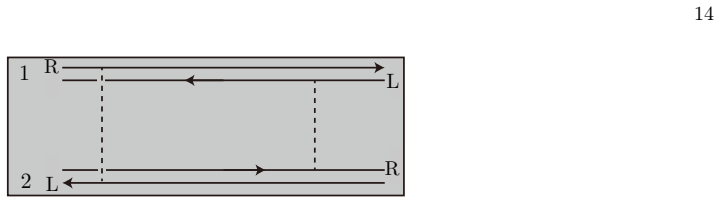
The load-bearing object is the instanton: a domain-wall excitation in which an electron fractionalizes into two $e/2$ charges, one on each leg, at nearly identical lateral positions — the ladder analog of the soliton-antisoliton pairs of polyacetylene. The signature quantity is the topological entanglement entropy $\beta$, defined as the universal subleading term in $S_D = \alpha L - \beta$ and computed from the eigenvalues of the Hartree-Fock correlation matrix for a half-ladder region; its parameter-independent value $\beta \approx 0.016$ is what defines the claimed universality class. The theoretical engine is a bosonized semion model: with chiral-boson commutation relations $[\hat\phi_{i,R}(x), \hat\phi_{j,R}(x')] = i\pi\nu\,\delta_{ij}\,\mathrm{sign}(x-x')$ at $\nu = 1/2$ and Klein factors satisfying $\hat F_{s,1L}\hat F_{s,2L} = e^{-i\pi\nu}\hat F_{s,2L}\hat F_{s,1L}$, the composite electron operator $\hat\Psi_{e,L} = \hat\psi_{s,1L}\hat\psi_{s,2L}$, built from one semion on each chain, reproduces the fermionic anticommutation relation, so a fermion (instanton) is the fusion product of two semions. A pinned-charge-density-wave calculation then yields the electron Green's function and the tunneling density of states $D(\omega) \sim \omega^{K-1}$ with $K \approx \pi\nu\sqrt{1 - e^{-L_0 m}}$, giving a soft gap for $K > 2$ and a linear density of states at $K \approx 2$, which the paper uses to interpret the numerics.
What would settle it
A concrete check: a density-matrix renormalization group or exact calculation of the half-ladder entanglement entropy for the disordered two-leg Hubbard ladder at $U = 3t$, $t' = 0.5t$, $\Gamma = 0.3t$–$0.7t$ at half-filling, testing whether the subdominant term $\beta$ in $S_D = \alpha L - \beta$ converges to a size-independent value near 0.016 — observing $\beta = 0$, strong size dependence, or the absence of $e/2$ charges at the magnetic domain walls would refute the central claim.
Extended reading notes
Core claim
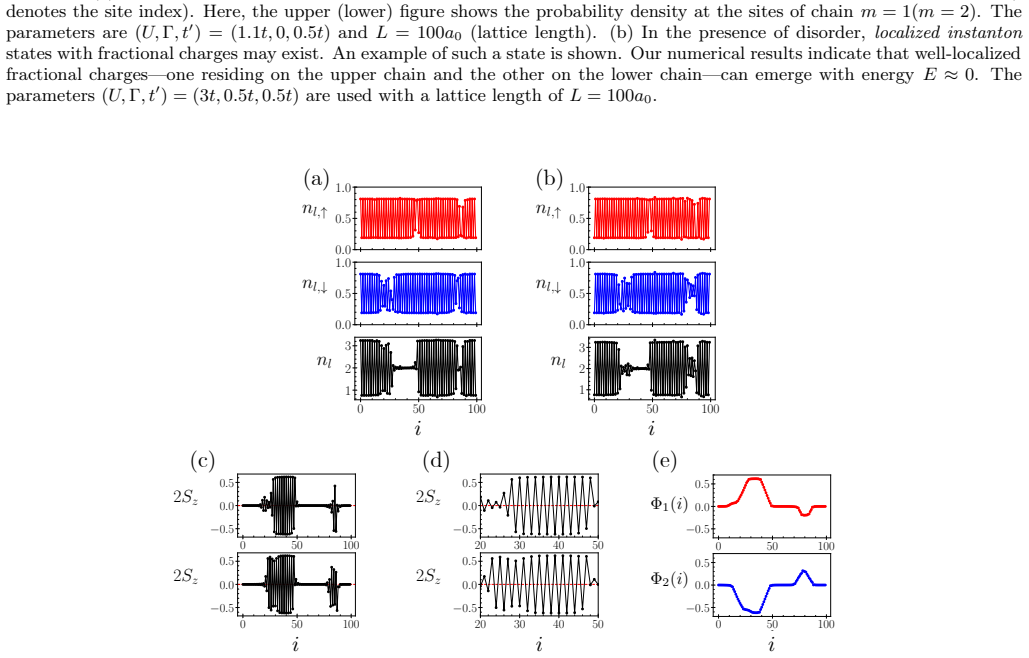
The central claim, stated the way the paper's authors would state it, is that a two-leg electron ladder with nearest-neighbor hopping, on-site repulsion, and random disorder becomes a topologically ordered insulator when its density of states shows a soft gap that decays exponentially toward $E = 0$. In this soft-gap regime the Hartree-Fock ground state exhibits antiferromagnetic domains separated by kinks, and at each domain wall an instanton appears: two fractional charges $e/2$ localized on opposite legs at nearly the same position, with the chain-occupation diagnostic $q_1 = 1/2$ signalling fractionalization. The topological entanglement entropy $\beta$, extracted from the subdominant term $S_D = \alpha L - \beta$ of the half-ladder entanglement entropy computed from the correlation matrix, takes the universal value $\beta \approx 0.016$ across a region of parameter space $(U, \Gamma, t')$, precisely where the soft gap is well developed. Because this value coincides with the topological entanglement entropy of disordered zigzag graphene nanoribbons, the paper concludes that the two-leg ladder and the nanoribbon share a universality class, characterized by the same $e/2$ fractional charges, the same universal $\beta$, and a similar density-of-states exponent $\eta \approx 2$, despite differences in lattice connectivity, band structure, and magnetic order. The paper further argues that an electron in this ladder is a composite of two semions on different chains, and that this semion fusion is mathematically consistent because the composite obeys Fermi anticommutation, providing a qualitative account of the numerically found linear or soft-gapped density of states.
Load-bearing premise
The load-bearing premise is that the Hartree-Fock mean-field ground state of the disordered, interacting ladder is quantitatively reliable for entanglement diagnostics: every fractional-charge signal, the soft-gap density of states, and the universal topological entanglement entropy $\beta \approx 0.016$ are computed from Hartree-Fock eigenstates, and although the paper argues that the excitation gap and Anderson localization suppress the quantum fluctuations this approximation neglects, it presents no DMRG or exact benchmark for the ladder itself.
Editorial extensions
If this is right
- If the claim holds, the two-leg ladder becomes a natural quasi-one-dimensional platform in which fractional $e/2$ charges and a nonzero topological entanglement entropy coexist, and a testbed for topological order in coupled-wire systems.
- The universality class is characterized by the pair ($\beta \approx 0.016$, $\eta \approx 2$): other one-dimensional or ladder systems predicted to lie in it should show the same entanglement-entropy value and the same exponentially decaying soft-gap form $D(E) \propto (e^{\alpha E^\eta} - 1)$ under disorder.
- The predicted linear tunneling density of states at the critical disorder strength, equivalent to a tunneling current $I \propto V^2$, is a direct experimental signature of electron fractionalization into $e/2$ charges and can be searched for by tunneling spectroscopy.
- Outside the soft-gap regime the paper predicts only quasi-topological order: $\beta$ becomes non-universal with growing variance and fractional charges lose their sharp meaning, so the topological region in the phase diagram is bounded rather than sharp everywhere.
- Because the electron is constructed as a pair of semions on opposite legs, the model implies that interleg tunneling acts as semion-pair creation, which should show up in interchain current and noise measurements.
Reading between the lines
- An implicit consequence the paper does not spell out: if $\beta \approx 0.016$ is truly universal, it should reappear in any lattice realization placed in the same class, so the value can act as a numerical fingerprint — applying the same Hartree-Fock plus correlation-matrix extraction to other quasi-one-dimensional geometries (coupled quantum wires, striped ladders) would either confirm or challe
- The semion-fusion construction suggests viewing the ladder as a quasi-one-dimensional slice of a doubled-semion topological order; a testable distinction is whether the ladder shows any topological ground-state degeneracy on a ring geometry, which a finite-size exact calculation could settle without invoking mean field.
- The paper's justification for mean-field reliability rests on a DMRG benchmark done for zigzag nanoribbons, not for ladders; an equally natural reading is that a DMRG computation inside the ladder's soft-gap window would find a small but nonzero correction to $\beta$, and the sign and size of that correction would calibrate how universal the Hartree-Fock number really is.
- The shot-noise test proposed in the paper for nanoribbon edges extends directly to ladders: tunneling between the two legs at an instanton position should show a Fano factor near $e/2$ per event if the semion picture is right, a measurement within reach of scanning tunneling spectroscopy on cleanly synthesized two-leg ladder structures.
Editorial analysis
A structured set of objections, weighed in public.
Referee Report
Summary. The paper studies a half-filled disordered Hubbard model on a two-leg ladder at the Hartree-Fock level. In the regime where the density of states shows an exponentially decaying soft gap, the authors report midgap states with chain-resolved probability q1 = 1/2, which they interpret as e/2 fractional charges, and they extract a value beta approximately 0.016 from a fit of the bipartite entanglement entropy S_D/L = alpha - beta/L. They claim this beta is a universal topological entanglement entropy matching that of zigzag graphene nanoribbons, placing the two-leg ladder in the same universality class. They then construct a semion bosonization Lagrangian with nu = 1/2 commutators, define the electron as a bound state of two semions on opposite chains, and use a pinned charge-density-wave model to derive a density of states proportional to omega^{K-1}, predicting a linear DOS at a critical disorder strength and a soft gap for stronger disorder. I find no internal contradiction in Eqs. (61)-(62): with nu = 1/2, K is bounded below by pi/2, so K = 2 and K > 2 are accessible; the reader's claimed K inconsistency does not land.
Significance. If correct, the central claim would be significant: a quasi-one-dimensional disordered electronic ladder would realize topologically ordered insulating behavior with semionic excitations, unified with zigzag graphene nanoribbons through a universal topological entanglement entropy. The paper has genuine strengths: the numerical data and code are deposited on Zenodo, the disorder-averaged Hartree-Fock computations are extensive, the Klein-factor algebra leading to Eqs. (43)-(44) is explicit and checkable, and the prediction of a linear DOS at a critical disorder strength is falsifiable. However, the central evidence for topological order rests on interpreting a one-cut bipartition intercept as a topological entanglement entropy, which is not a topological invariant, and on Hartree-Fock wave functions for an interacting ladder with no independent quantum benchmark. The significance is therefore not established by the manuscript as it stands.
major comments (5)
- [Sec. III C, Eq. (10), Figs. 7 and 9] The quantity beta is extracted from the intercept of S_D/L = alpha - beta/L for a single bipartition that cuts the ladder into upper and lower chains. This intercept is not a topological entanglement entropy. The Kitaev-Preskill and Levin-Wen constructions exist precisely to cancel nonuniversal boundary and endpoint contributions through linear combinations of entanglement entropies, and the paper explicitly states that the ladder geometry is too narrow for a Wilson loop. In a quasi-1D strip, the endpoint and short-range boundary contributions to a one-cut intercept are uncontrolled, so beta approximately 0.016 cannot be identified as a universal topological invariant. This identification is load-bearing for the universality-class claim.
- [Secs. II, III, and VIII] All numerical results, including the DOS, q1, and the entanglement entropy, are computed from Hartree-Fock Slater determinants. The paper appeals to gap and Anderson localization to suppress quantum fluctuations and cites DMRG support, but that support is for a different system, a zigzag graphene nanoribbon, not for the two-leg ladder studied here. No DMRG, exact diagonalization, or tensor-network benchmark is shown for the ladder. Since entanglement entropies are especially sensitive to correlations beyond mean field, the quantitative value beta approximately 0.016 is not adequately supported.
- [Sec. V, Eqs. (31)-(44)] The semion Lagrangian, the nu = 1/2 commutators in Eq. (34), and the Klein factors in Eq. (35) are assumed, and the numerical observation q1 = 1/2 is then interpreted as evidence for these semions. This is circular for the claim of fractional statistics: q1 = 1/2 measures only the probability weight of a single-particle eigenstate on one chain, not the braiding or exchange statistics of the excitations. The algebraic consistency of the composite electron operator is a valid check internal to the model, but it does not test whether the ladder ground state realizes the assumed semionic sector.
- [Sec. VI, Eqs. (59)-(62)] The derivation of the DOS exponent K is incomplete. Equation (59) states that K is a complicated function of L0, m, and nu, but Eq. (62) then gives an explicit closed form without derivation. The threshold Kc approximately 2 for a linear DOS is also introduced without justification. Because the linear-DOS and soft-gap predictions are central to the comparison with the numerics, the derivation needs to be completed or the claims presented explicitly as phenomenological.
- [Sec. VII] The universality-class claim rests on comparing beta for the two-leg ladder with beta for zigzag graphene nanoribbons, but both values are obtained with the identical one-cut fitting procedure. The agreement may therefore reflect a shared artifact of the extraction method rather than a common topological invariant. A convincing comparison would require a method that is known to isolate the topological contribution to the entanglement entropy, or an independent diagnostic.
minor comments (5)
- [Eq. (13)] The mutual information formula reads MI,J = SI + SI - SI,J; the second term should be SJ, not a repeated SI.
- [Sec. III C] The text says the authors performed GPU calculations on a superconductor; this should presumably read supercomputer.
- [Eq. (30)] The symbol Hs is used without definition; it is later identified as the Heaviside step function, which should be stated at first use.
- [Sec. IV C, Eq. (26)] The term psi^{dagger}_{2R} psi_{L2} appears with inconsistent subscript ordering; it should be psi^{dagger}_{2R} psi_{2L} for chain 2.
- [Sec. VI, Eq. (61)] The paper states that for K > 2 a soft gap is present and for Kc approximately 2 a linear DOS emerges, but the range 1.57 < K < 2 is not discussed; since nu = 1/2 gives K >= pi/2, this remaining range should be addressed for completeness.
Circularity Check
Fractional-charge observation is definitional and the ZGNR 'universal' β comparison is a self-citation; the semion DOS 'prediction' is post hoc, giving partial circularity.
-
self definitional
[Sec. III B, Eq. (9); Sec. V A]
"q1(E, σ) = X i∈chain 1 |ψE,σ (i)|2. It is a measure of the degree of fractionalization in the chain1. ... For a fractionalized state q1 = 1/2, while q1 = 1 for a localized electron on the chain1. ... The condition q1 = 1/2 is necessary for charge fractionalization."
The observable q1 is defined by Eq. (9) as the probability that an eigenstate sits on chain 1. Therefore q1 = 1/2 means, by definition, that the state is equally shared between the two chains. The paper then reports this value as the numerical evidence for e/2 fractional charges: 'For a fractionalized state q1 = 1/2.' No independent calculation of charge density, shot noise, or braiding connects q1 = 1/2 to a fractional charge e/2; the claim 'fractional charge is present' is the definitional statement q1 = 1/2 restated in different words. The abstract's 'instantons carrying e/2 fractional charges' thus reduces to the construction of the diagnostic.
-
self citation load bearing
[Sec. VII and Fig. 10 caption]
"Red-dashed line indicates the universal value of topological entanglement entropy of ZGNRs, β ≈ 0.016. ... Nonetheless, two-leg lattices and zigzag graphene nanoribbons belong to the same universality class [24], as they share the same topological entanglement entropy β [31], within numerical uncertainty."
The benchmark for the universality-class claim is Ref. [31] (Y. H. Kim, H. J. Lee, and S.-R. Eric Yang), a previous paper sharing an author with this manuscript. That paper obtained β ≈ 0.016 for zigzag graphene nanoribbons using the same Hartree-Fock correlation-matrix intercept technique that the present paper uses for the ladder. The ladder's β ≈ 0.016 is therefore validated by agreement with a number produced by the same pipeline in the authors' own earlier work. The claim that both systems 'share the same topological entanglement entropy' reduces to self-consistency of one group's method rather than an independent, externally benchmarked result.
1 more flagged steps
-
other
[Sec. VI, Eqs. (60)-(62)]
"D(ω) = −Im R dτ Ge,R(x, x, τ) |iω→ω+i0+ ∼ ωK−1, where K ∼ πν/√(1 − e−L0m). ... For K > 2, a soft gap is present for E ≈ 0, in agreement with Fig. 4. For the critical value Kc ≈ 2, a linear DOS may emerge, also in agreement with Fig. 15."
The semion-Lagrangian DOS calculation is presented in the Abstract and conclusions as a 'prediction' of a linear DOS or soft gap, but the numerical soft gap and near-linear DOS were already presented in Figs. 4 and 15 before the semion model was introduced. The derived exponent K is a free parameter depending on L0, m, and ν, and the stated criteria are merely the algebraic conditions for ω^{K−1} to be a soft gap (K > 2) or linear (K ≈ 2). No fixed model parameters are compared with the numerical DOS; the 'prediction' is the input power-law ansatz restated in terms of free parameters, and the matching regimes are selected to reproduce the already-observed data.
full rationale
The raw numerical content of the paper—Hartree-Fock eigenstates, the correlation-matrix entanglement entropy, q1 distributions, and the DOS—is computed rather than fitted as an input, so the central numerical ingredient is not circular. The circularity lies in three load-bearing interpretive steps. First, the e/2 fractional-charge claim is literally the diagnostic q1 = 1/2, which is defined as an equal probability on the two chains; no independent charge or statistics calculation is provided, so the observation reduces to its own definition. Second, the claimed universality class with zigzag graphene nanoribbons rests on β ≈ 0.016 from the authors' own earlier work obtained with the same Hartree-Fock intercept procedure; agreement with that self-citation is not independent support. Third, the semion-model DOS 'prediction' is post hoc: the model has free parameters and the linear/soft-gap outcomes are selected to match already-presented numerics, so the predictive content is essentially the power-law ansatz itself. Separately, the use of a single bipartition intercept (Eq. (10)) in a geometry too narrow for the Wilson-loop construction is a serious validity concern for calling β a topological entanglement entropy, but that is a methodological issue rather than a reduction of the result to its inputs. Overall, the paper has substantive computed results but its two headline claims—fractional charges and the universality class—are substantially self-referential, giving a partial circularity score of 6.
Assumptions & free parameters
free parameters (4)
- DOS soft-gap fit parameters A, alpha, eta =
eta approximately 1.91; A and alpha not quoted
- CDW pinning model parameters V0 and L0 =
not specified
- Critical exponent threshold Kc =
Kc approximately 2
- Disorder parameters Gamma and nimp =
Gamma = 0.5t, 0.7t, 0.3t, 0.1t, 0.45t; nimp = 0.1
assumptions (6)
- domain assumption Hartree-Fock mean-field theory gives the correct low-energy ground state for disordered interacting ladders when the DOS has a soft gap.
- domain assumption Quantum fluctuations of fractional charges are negligible because of localization and the exponentially small DOS at E = 0.
- domain assumption Disorder and interchain hopping can be represented by dilute local tunneling terms between chiral fermions of opposite chains.
- ad hoc to paper Chiral semion phase fields obey the FQH-type commutators (34) with nu = 1/2 and Klein factors (35)-(37).
- domain assumption An electron fractionalizes into two independent semions on different chains, so the electron operator is the product Eq. (40).
- domain assumption Pinned-CDW model with classical pinned phase theta and Gaussian fluctuations gives the local electron Green's function.
invented entities (2)
-
Chain-localized e/2 semions
-
Instanton as a bound pair of semions on opposite chains
Cite this review
Pith. "Pith review of Instantons and topological order in two-leg electron ladders: A universality class." pith.science (2026). https://pith.science/paper/2L4LCRA5
@misc{pith2026250524130,
  author       = {Pith},
  title        = {Pith review of: Instantons and topological order in two-leg electron ladders: A universality class},
  year         = {2026},
  howpublished = {\url{https://pith.science/paper/2L4LCRA5}},
  note         = {Machine review of arXiv:2505.24130}
}
read the original abstract
Our numerical study of the disordered Hubbard model with nearest-neighbor hopping shows that a two-leg electron ladder has a finite topological entanglement entropy in the regime where the density of states exhibits an exponentially decaying gap. The value of the topological entanglement entropy suggests that two-leg ladders belong to the same universality class as graphene zigzag nanoribbons, despite several structural differences. A Shankar-Witten-type bosonization Lagrangian with disorder captures several features of the numerically obtained results for disordered two-leg ladders. Additionally, we propose a Lagrangian in which the fusion of two semions residing on different chains generates a fermion (instanton). We apply this Lagrangian within the framework of the pinned charge-density-wave model and compute the relevant Green's function using the bosonization method. This approach predicts a linear density of states at a critical disorder strength. Below this threshold, a soft gap emerges, which is in qualitative agreement with our numerical results.
Figures


Figures from the paper (13 more)






Reference graph
Works this paper leans on
-
[1]
Wen, Colloquium: Zoo of quantum-topological phases of matter, Rev
X.-G. Wen, Colloquium: Zoo of quantum-topological phases of matter, Rev. Mod. Phys.89, 041004 (2017)
2017
-
[2]
F. D. M. Haldane, Nobel lecture: Topological quantum matter, Rev. Mod. Phys.89, 040502 (2017)
2017
-
[3]
S. M. Girvin and K. Yang,Modern condensed matter physics(Cambridge University Press, 2019)
2019
-
[4]
S.-R. Eric Yang,Topologically Ordered Zigzag Nanoribbon:e/2 Fractionally Charged Anyons and Spin-Charge Separation (World Scientific, 2023)
work page 2023
-
[5]
Kitaev and J
A. Kitaev and J. Preskill, Topological entanglement entropy, Phys. Rev. Lett.96, 110404 (2006)
2006
-
[6]
Levin and X.-G
M. Levin and X.-G. Wen, Detecting topological order in a ground state wave function, Phys. Rev. Lett.96, 110405 (2006)
2006
-
[7]
Li and F
H. Li and F. D. M. Haldane, Entanglement spectrum as a generalization of entanglement entropy: Identification of topological order in non-abelian fractional quantum hall effect states, Phys. Rev. Lett.101, 010504 (2008)
2008
- [8]
Show all 56 references
-
[9]
fractional statistics
F. D. M. Haldane, “fractional statistics” in arbitrary dimensions: A generalization of the pauli principle, Phys. Rev. Lett. 67, 937 (1991)
1991
-
[10]
Kalmeyer and R
V. Kalmeyer and R. B. Laughlin, Equivalence of the resonating-valence-bond and fractional quantum hall states, Phys. Rev. Lett.59, 2095 (1987)
1987
-
[11]
R. B. Laughlin, The relationship between high-temperature superconductivity and the fractional quantum hall effect, Science 242, 525 (1988), https://www.science.org/doi/pdf/10.1126/science.242.4878.525
1988 doi
-
[12]
G. S. Canright, S. M. Girvin, and A. Brass, Superconductive pairing of fermions and semions in two dimensions, Phys. Rev. Lett.63, 2295 (1989)
1989
-
[13]
Zee, Semionics: a theory of superconductivity based on fractional quantum statistics, in25th International Conference on High-Energy Physics, Vol
A. Zee, Semionics: a theory of superconductivity based on fractional quantum statistics, in25th International Conference on High-Energy Physics, Vol. 900802 (World Scientific, 1991) pp. 206–212
1991
-
[14]
Haddad, S
S. Haddad, S. Charfi-Kaddour, M. Héritier, and R. Bennaceur, Spin ladders : From 1 to 2 dimensions, J. Phys. IV France 10, Pr3 (2000)
2000
-
[15]
Grüninger, M
M. Grüninger, M. Windt, T. Nunner, C. Knetter, K. Schmidt, G. Uhrig, T. Kopp, A. Freimuth, U. Ammerahl, B. Büchner, and A. Revcolevschi, Magnetic excitations in two-leg spin 1/2 ladders: experiment and theory, Journal of Physics and Chemistry of Solids63, 2167 (2002), proceedi...
2002
-
[16]
D. C. Johnston, M. Troyer, S. Miyahara, D. Lidsky, K. Ueda, M. Azuma, Z. Hiroi, M. Takano, M. Isobe, Y. Ueda, M. A. Korotin, V. I. Anisimov, A. V. Mahajan, and L. L. Miller, Magnetic susceptibilities of spin-1/2 antiferromagnetic heisenberg ladders and applications to ladder o...
2000 arXiv
-
[17]
Haldane, Continuum dynamics of the 1-d heisenberg antiferromagnet: Identification with the o(3) nonlinear sigma model, Physics Letters A93, 464 (1983)
F. Haldane, Continuum dynamics of the 1-d heisenberg antiferromagnet: Identification with the o(3) nonlinear sigma model, Physics Letters A93, 464 (1983)
1983
-
[18]
Aghtouman and M
S. Aghtouman and M. V. Hosseini, Dimerized hofstadter model in two leg ladder quasi crystals, Scientific Reports14, 10.1038/s41598-024-59301-2 (2024)
2024 doi
-
[19]
C. L. Kane and M. P. A. Fisher, Transport in a one-channel luttinger liquid, Phys. Rev. Lett.68, 1220 (1992)
1992
-
[20]
Furusaki and N
A. Furusaki and N. Nagaosa, Single-barrier problem and anderson localization in a one-dimensional interacting electron system, Phys. Rev. B47, 4631 (1993)
1993
-
[21]
A. J. Heeger, S. Kivelson, J. R. Schrieffer, and W. P. Su, Solitons in conducting polymers, Rev. Mod. Phys.60, 781 (1988)
1988
-
[22]
Y. H. Jeong, S.-R. Eric Yang, and M.-C. Cha, Soliton fractional charge of disordered graphene nanoribbon, Journal of Physics: Condensed Matter31, 265601 (2019)
2019
-
[23]
Shankar and E
R. Shankar and E. Witten, The s-matrix of the kinks of the( ¯ψψ)2 model, Nuclear Physics B141, 349 (1978)
1978
-
[24]
J. K. Pachos,Introduction to Topological Quantum Computation(Cambridge University Press, 2012)
2012
-
[25]
Y. H. Kim, H. J. Lee, H.-Y. Lee, and S.-R. Eric Yang, New disordered anyon phase of doped graphene zigzag nanoribbon, Scientific Reports12, 14551 (2022)
2022
-
[26]
A. L. Efros and B. I. Shklovskii, Coulomb gap and low temperature conductivity of disordered systems, Journal of Physics C: Solid State Physics8, L49 (1975)
1975
-
[27]
Eric Yang and A
S.-R. Eric Yang and A. H. MacDonald, Coulomb gaps in a strong magnetic field, Phys. Rev. Lett.70, 4110 (1993)
1993
-
[28]
B. Altshuler, Inductory anderson localization, inAdvanced Workshop on Anderson Localization, Nonlinearity and Turbu- lence: A Cross-Fertilization(International Centre for Theoretical Physics Trieste, Italy, 2010)
2010
-
[29]
S. M. Girvin, The quantum hall effect: novel excitations and broken symmetries, inAspects topologiques de la physique en basse dimension. Topological aspects of low dimensional systems: Session LXIX. 7–31 July 1998(Springer, 2002) pp. 53–175
1998
-
[30]
Jiang, Z
H.-C. Jiang, Z. Wang, and L. Balents, Identifying topological order by entanglement entropy, Nature Physics8, 902 (2012)
2012
-
[31]
Y. H. Kim, H. J. Lee, and S.-R. Eric Yang, Topological entanglement entropy of interacting disordered zigzag graphene ribbons, Phys. Rev. B103, 115151 (2021)
2021
-
[32]
Kitaev, Fault-tolerant quantum computation by anyons, Annals of Physics303, 2 (2003)
A. Kitaev, Fault-tolerant quantum computation by anyons, Annals of Physics303, 2 (2003)
2003
-
[33]
B. Zeng, X. Chen, D.-L. Zhou, and X.-G. Wen,Quantum Information Meets Quantum Matter: From Quantum Entangle- ment to Topological Phases of Many-Body Systems, Quantum Science and Technology (Springer, 2019)
2019
-
[34]
Lee, H.-A
I.-H. Lee, H.-A. Le, and S.-R. Eric Yang, Mutual information and correlations across topological phase transitions in 25 topologically ordered graphene zigzag nanoribbons, Entropy25, 1449 (2023)
2023
-
[35]
A. O. Gogolin, A. A. Nersesyan, and A. M. Tsvelik,Bosonization and Strongly Correlated Systems(Cambridge University Press, 1998)
1998
-
[36]
Giamarchi,Quantum Physics in one dimension(Oxford Science Publications, 2004)
T. Giamarchi,Quantum Physics in one dimension(Oxford Science Publications, 2004)
2004
-
[37]
J. v. Delft and H. Schoeller, Bosonization for beginners-refermionization for experts, Annalen der Physik4, 225 (1998)
1998
-
[38]
N. D. Goldenfeld,Lectures On Phase Transitions And The Renormalization Group, Frontiers in physics (CRC Press, 1992)
1992
-
[39]
W. P. Su, J. R. Schrieffer, and A. J. Heeger, Solitons in polyacetylene, Phys. Rev. Lett.42, 1698 (1979)
1979
-
[40]
Jackiw and C
R. Jackiw and C. Rebbi, Solitons with fermion number1/2, Phys. Rev. D13, 3398 (1976)
1976
-
[41]
Jackiw, A
R. Jackiw, A. Kerman, I. Klebanov, and G. Semenoff, Fluctuations of fractional charge in soliton anti-soliton systems, Nuclear Physics B225, 233 (1983)
1983
-
[42]
Eric Yang, M.-C
S.-R. Eric Yang, M.-C. Cha, H. J. Lee, and Y. H. Kim, Topologically ordered zigzag nanoribbon:e/2 fractional edge charge, spin-charge separation, and ground-state degeneracy, Phys. Rev. Research2, 033109 (2020)
2020
-
[43]
R. B. Laughlin, Anomalous quantum hall effect: An incompressible quantum fluid with fractionally charged excitations, Phys. Rev. Lett.50, 1395 (1983)
1983
-
[44]
X. G. Wen, Theory of the edge states in fractional quantum hall effects, Int. Jour. Mod. Phys. B06, 1711 (1992)
1992
-
[45]
Eric Yang, S
S.-R. Eric Yang, S. Mitra, A. H. MacDonald, and M. Fisher, Momentum distribution function of a narrow hall bar in the fqhe regime, Journal of the Korean Physical Society29, S10 (1996)
1996
-
[46]
Polchinski,String Theory, Vol
J. Polchinski,String Theory, Vol. 1(Cambridge University Press, 2005)
2005
-
[47]
Fukuyama and P
H. Fukuyama and P. A. Lee, Dynamics of the charge-density wave. i. impurity pinning in a single chain, Phys. Rev. B17, 535 (1978); A. Larkin and Y. N. Ovchinnikov, Pinning in type ii superconductors, Journal of Low Temperature Physics 34, 409 (1979)
1978
-
[48]
Ruffieux, S
P. Ruffieux, S. Wang, B. Yang, C. Sánchez-Sánchez, J. Liu, T. Dienel, L. Talirz, P. Shinde, C. A. Pignedoli, D. Passerone, et al., On-surface synthesis of graphene nanoribbons with zigzag edge topology, Nature531, 489 (2016)
2016
-
[49]
Kolmer, A.-K
M. Kolmer, A.-K. Steiner, I. Izydorczyk, W. Ko, M. Engelund, M. Szymonski, A.-P. Li, and K. Amsharov, Rational synthesis of atomically precise graphene nanoribbons directly on metal oxide surfaces, Science369, 571 (2020)
2020
-
[50]
R. K. Houtsma, J. de la Rie, and M. Stöhr, Atomically precise graphene nanoribbons: interplay of structural and electronic properties, Chemical Society Reviews50, 6541 (2021)
2021
-
[51]
J. W. Negele and H. Orland,Quantum Many-Particle Systems(CRC Books, 1998)
1998
-
[52]
Peschel, Calculation of reduced density matrices from correlation functions, Journal of Physics A: Mathematical and General 36, L205 (2003)
I. Peschel, Calculation of reduced density matrices from correlation functions, Journal of Physics A: Mathematical and General 36, L205 (2003)
2003
-
[53]
instantons and topological order in two-leg electron ladders: A universality class
S.-R. Eric Yang, H. C. Lee, H.-A. Le, and I.-H. Lee, Dataset and code for "instantons and topological order in two-leg electron ladders: A universality class", 10.5281/zenodo.15307889 (2025). Appendix A: Mapping Into Two-Leg Ladder
2025 doi
-
[54]
(A1) The partition function is given byZ = Tre−β ˆH
Introduction to Grassmann path integral approach A density matrixe−β ˆH can be written as a product of factors (the so-called Trotter product formula) over infinites- imal (imaginary) time slices: e−β ˆH = lim N →∞ Y N times e− β N ˆH · · ·e− β N ˆH. (A1) The partition functio...
-
[55]
The partition function of the fermion system is then given by the following Grassmann path integral from Eq
Green’s function of two-leg ladder We can map the original system onto a subsystem by integrating out the variablesξα(τ ) with indices α that are exterior to the subsystem. The partition function of the fermion system is then given by the following Grassmann path integral from...
-
[56]
The goal is to obtain (or express) the correlation function in Eq
Effective Hamiltonian of two-leg ladder Next, consider the following effective Hamiltoniandefined on the subsystem(bd† j′σ, bdjσ are the corresponding cre- ation/annihilation operators, and|J| denotes the number of subsystem sites): bHσ eff = |J|X j′,j bd† j′σHσ j′jbdjσ, (A18)...
Reviewed August 7, 2026 · model on record in the stance chip above.
Discussion (0). Sign in to comment.