REVIEW 4 major objections 5 minor 59 references
Heterogeneous Graph Masked Contrastive Learning for Robust Recommendation
T0 review · 4 major / 5 minor · reviewed 2026-08-07 · deepseek-v4-flash
Pith's one-line read Random masking of meta-path neighborhoods, paired with cross-view contrastive learning, is claimed to make heterogeneous graph recommenders accurate even as noisy and redundant edges are added.
desk verdict A plausible but underspecified incremental HGNN+CL recipe with interesting robustness results; reproducibility and uncited same-author references need fixing before trusting the numbers. read the letter →
The pith
A machine-rendered reading of the paper's core claim, the machinery that carries it, and where it could break.
The reading
What carries the argument
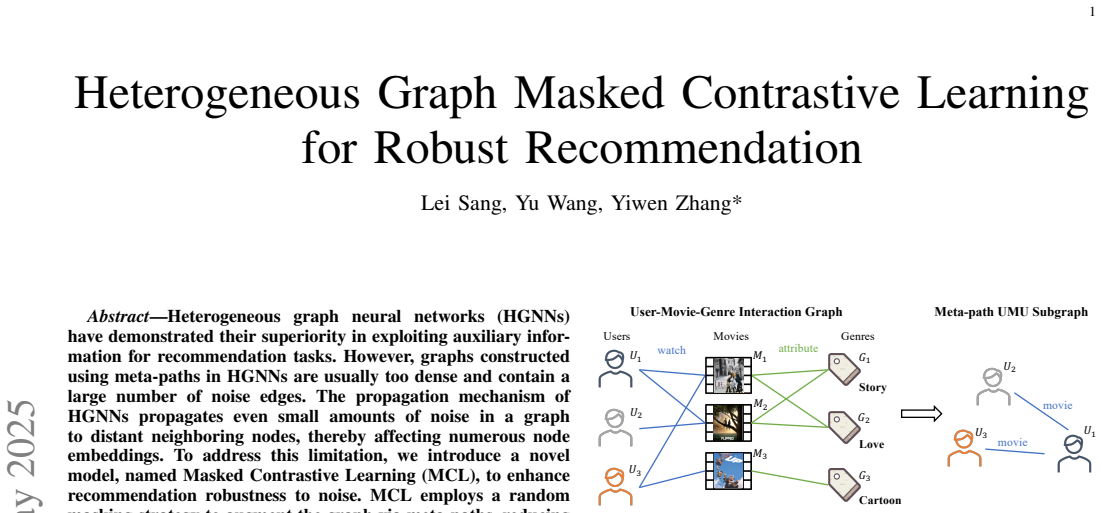
The load-bearing mechanism is the mask-then-propagate augmentation of user and item embeddings, combined with cross-view contrastive alignment. A Bernoulli mask multiplies each node's embedding by a 0/1 draw; the masked embeddings are then passed through L rounds of degree-normalized random propagation on the meta-path subgraphs, $\bar A = D^{-1/2} A D^{-1/2}$, and averaged across rounds. The resulting augmented embedding feeds into node-level and semantic-level attention, while a one-hop relational-attention branch produces a local view. The two projected views are contrasted through a similarity matrix in which positive entries are user-user or item-item pairs reachable by any meta-path, scored by $\mathrm{softmax}(\exp(\mathrm{sim}/\tau))$ and optimized by a log-loss that balances the two views. This mechanism is what lets the model keep high-order structure while dampening sensitivity to individual noisy edges.
What would settle it
Construct a deliberately meaningless meta-path by connecting users through a randomly permuted attribute that carries no preference signal, then run MCL with the same hyperparameters; if recall@20 and NDCG@20 drop as much as the unregularized HAN or RoHe baselines when that meta-path is added, the claimed robustness to redundant meta-paths is not real. A complementary check is to replace the multi-path positive matrix with random user-user positives: if performance does not collapse, the sampling mechanism, not the mask, is doing the work.
Extended reading notes
Core claim
MCL's central claim is that a noisy meta-path subgraph can be made usable for recommendation by perturbing the input embeddings rather than by cleaning the graph. User and item embeddings are first masked with Bernoulli draws, then randomly propagated over the meta-path subgraphs for L steps and averaged, so no single neighbor is critical to a node's representation. A two-level attention network aggregates these augmented embeddings per meta-path, while a parallel relational-attention branch aggregates one-hop heterogeneous neighbors. Contrastive learning then aligns the two views, using a multi-path sampling matrix that declares any user-user or item-item pair connected by at least one meta-path as a positive pair and all others as negatives, with a shared projection head and a temperature-scaled cosine similarity. The paper reports that this design outperforms prior heterogeneous graph recommendation and contrastive learning baselines on three datasets and, crucially, that its performance declines only slightly when 10% or 30% noise edges are injected or when additional redundant meta-paths are added.
Load-bearing premise
The result collapses if meta-path connectivity is not a reliable proxy for user-user or item-item similarity, because the contrastive loss would then treat false pairs as positives and train the model to align unrelated nodes.
Editorial extensions
If this is right
- If MCL's results hold, the most effective way to handle dense meta-path subgraphs may be to inject Bernoulli masking and random propagation before attention aggregation rather than to prune the graph explicitly.
- The cross-view contrastive loss with meta-path-based positives yields a stronger self-supervised signal than generic InfoNCE applied to user-item interactions, as the paper's comparison against an InfoNCE variant indicates.
- Sparse recommendation scenarios, where added noise harms graph structure most, stand to benefit most from this robustness behavior, with the largest reported relative gain on the sparsest dataset, Yelp.
- The mask component is the largest single contributor to the reported gains; removing it in the ablation hurts performance more than removing contrastive learning or either of the two views.
- Manual meta-path selection becomes less critical, because adding all reasonable meta-paths no longer forces a large performance penalty for MCL.
Reading between the lines
- A natural extension the paper does not test is to weight meta-path positives by estimated reliability rather than treating every meta-path connection as a binary positive, which could help when one meta-path is much noisier than others.
- The same mask-and-propagate augmentation could serve as a general denoising operator for other heterogeneous graph tasks, such as node classification, where dense relation subgraphs are also common.
- The paper's robustness tests cover injected interaction noise and redundant meta-paths but not adversarial edge attacks; a targeted-perturbation experiment would delimit how far the noise-resistance claim extends.
- The reported embedding visualization suggests a balance between clustering and uniformity that may reduce popularity bias, but the paper does not measure popularity bias directly; an evaluation on long-tail items would make that consequence explicit.
Editorial analysis
A structured set of objections, weighed in public.
Referee Report
Summary. The manuscript proposes Masked Contrastive Learning (MCL), a heterogeneous graph recommender that augments user and item embeddings by randomly masking entire embedding vectors with Bernoulli masks and averaging L random-propagation steps over meta-path-based homogeneous subgraphs. It then builds two views, one from one-hop relational attention and one from meta-path node/semantic attention, and aligns them with a contrastive loss whose positive pairs are derived from a meta-path-based user-user and item-item interaction matrix. The final objective combines the two contrastive terms with a BPR loss. Experiments on MovieLens-100k, Amazon, and Yelp compare MCL with HAN, HGT, HeCo, RoHe, HERec, KGAT, NGCF+, SMIN, and HGCL, and include noise-injection and redundant-meta-path robustness tests.
Significance. If the robustness claims hold, MCL offers a simple and transferable recipe: random mask plus random propagation as a graph-agnostic augmentation, and cross-view contrastive learning between one-hop and meta-path views. The paper's breadth of baselines and three datasets is a strength, and the ablation study isolates the mask, contrastive, one-hop, and meta-path components. The central empirical claim, however, depends on the exact construction of the positive-pair matrix and on the configuration of the robustness experiments, both of which are underspecified. The value of the contribution can be assessed only after these issues are resolved with concrete reporting.
major comments (4)
- [III-C2, Eqs. (8)-(9)] The definition of Pos_u and Pos_i is internally inconsistent. The text states that positive samples receive a value of 1 'based on all meta-paths that interact with each other', but the immediately following example excludes a pair connected by 'U-M-G-M-U' because the pair is not connected by 'U-M-U'. It must be specified whether a positive pair requires connectivity under every meta-path in the chosen set, under at least one meta-path, or under a manually selected subset. This choice determines whether dense meta-paths such as UAU and UMGMU enter the contrastive objective, so the robustness conclusions in Section IV-C2 cannot be evaluated without resolving this ambiguity.
- [IV-C2, Fig. 4 and Table IV] The redundant-meta-path experiment does not state whether the added meta-paths from Table IV are included in Pos_u and Pos_i for MCL. If they are included, the contrastive loss aligns pairs created by the very dense paths that the paper itself describes as noise; if they are excluded, MCL is tested with clean, validation-selected meta-paths while the baselines must use all meta-paths. The authors should report the exact meta-path set used to build the positive matrices, the density of Pos_u and Pos_i under the original and augmented settings, and how the noisy-interaction experiment in Fig. 3 changes Pos_u when random user-item edges are injected.
- [IV-A.3 and IV-E] No error bars, multiple seeds, or significance tests are reported in Tables II, III, and V or in Figs. 3-4, although several reported improvements are only 1-5% relative and could be within seed variance. In addition, the final values of the mask retain probability p, the propagation order L, the contrastive balance beta, the view balance lambda1, the temperature tau, and the learning rate are never listed; Section IV-E describes tuning ranges but not the selected settings. The experiments are therefore not reproducible as written.
- [III-C1, Eqs. (6)-(9)] The contrastive objective is not well-defined as presented. Eq. (7) applies softmax to a scalar expression exp(sim(...)/tau), score_u is defined in Eq. (8) as Pos_u * sim_u, but score^1_u and score^2_u in Eq. (9) are never defined, and the relation between sim^1_u, sim^2_u, Pos_u, and the two views is unclear. Please provide exact matrix dimensions and coordinate-wise definitions for all quantities in the loss.
minor comments (5)
- [Eq. (2)] In Eq. (2), the normalized adjacency is written as (D^{-1/2})^2, which is dimensionally impossible; it should presumably be D^{-1/2} A D^{-1/2}.
- [References] References [54]-[59] appear in the bibliography but are never cited in the body; several are same-author papers closely related to the proposed method, so they should be either cited where relevant or removed.
- [Conclusion] The model is introduced as 'Masked Contrastive Learning' throughout the paper, but the conclusion refers to 'Mask Contrastive Learning'; please make the name consistent.
- [III-A] The first sentence of Section III-A contains the typo 'offen' for 'often'.
- [Fig. 3] The caption of Fig. 3 says the histogram represents recall@20 and the line graphs represent NDCG@20, but the figure appears to use bars and line markers interchangeably; please align the caption with the figure.
Circularity Check
No significant circularity: the reported top-K metrics are empirical outputs of a trained model, and the paper's robustness claims are tested against held-out or perturbed data rather than derived from fitted parameters or self-citations.
full rationale
MCL's central claim is an empirical performance comparison: Table II reports Recall@K and NDCG@K obtained by training on an 80/10/10 split and evaluating on held-out interactions, with BPR loss (Eq. 10) as the supervised objective and the contrastive losses (Eqs. 7-9, 11) as regularizers. No fitted parameter is renamed as a prediction, and no equation reduces the reported metrics to the model's own inputs. The robustness experiments (Fig. 3 and Fig. 4) compare degradation across models under the same injected noise interactions and the same added meta-paths; this is a controlled stress test rather than a derivation that assumes its conclusion. The contrastive positive-matrix definition in Section III-C2 ('assign a value of 1 to the positive samples in the interaction matrix... based on all meta-paths') is admittedly ambiguous -- the UMGMU example suggests that the positive set uses the selected meta-path set, and the later 'UAU has only nine nodes' discussion raises a real false-positive concern. But that ambiguity affects internal validity and reproducibility, not circularity: it does not make any reported result true by construction. The same-author references [54]-[59] appear in the bibliography but are never cited in the body and carry no load in the argument, so they do not constitute load-bearing self-citation. On the evidence available, the derivation chain from loss functions to benchmark numbers is self-contained and empirically evaluated, so the appropriate finding is no significant circularity.
Assumptions & free parameters
free parameters (6)
- mask retain probability p
- random propagation order L
- contrastive loss balance beta
- view balance lambda1
- temperature tau
- learning rate
assumptions (4)
- domain assumption Homophily in meta-path subgraphs: nodes connected by meta-paths have similar preferences or labels, so masking a node can be repaired from its meta-path neighbors.
- domain assumption Meta-path connectivity is a reliable positive signal for contrastive learning.
- standard math BPR pairwise assumption: observed user-item interactions are more preferable than unobserved ones.
- ad hoc to paper Random masking plus averaging over L propagation steps approximates a robust augmentation without changing graph topology.
Cite this review
Pith. "Pith review of Heterogeneous Graph Masked Contrastive Learning for Robust Recommendation." pith.science (2026). https://pith.science/paper/AROGF7IP
@misc{pith2026250524172,
  author       = {Pith},
  title        = {Pith review of: Heterogeneous Graph Masked Contrastive Learning for Robust Recommendation},
  year         = {2026},
  howpublished = {\url{https://pith.science/paper/AROGF7IP}},
  note         = {Machine review of arXiv:2505.24172}
}
read the original abstract
Heterogeneous graph neural networks (HGNNs) have demonstrated their superiority in exploiting auxiliary information for recommendation tasks. However, graphs constructed using meta-paths in HGNNs are usually too dense and contain a large number of noise edges. The propagation mechanism of HGNNs propagates even small amounts of noise in a graph to distant neighboring nodes, thereby affecting numerous node embeddings. To address this limitation, we introduce a novel model, named Masked Contrastive Learning (MCL), to enhance recommendation robustness to noise. MCL employs a random masking strategy to augment the graph via meta-paths, reducing node sensitivity to specific neighbors and bolstering embedding robustness. Furthermore, MCL employs contrastive cross-view on a Heterogeneous Information Network (HIN) from two perspectives: one-hop neighbors and meta-path neighbors. This approach acquires embeddings capturing both local and high-order structures simultaneously for recommendation. Empirical evaluations on three real-world datasets confirm the superiority of our approach over existing recommendation methods.
Figures


Figures from the paper (4 more)


Reference graph
Works this paper leans on
-
[54]
Intent-guided heterogeneous graph contrastive learning for recommendation,
L. Sang, Y . Wang, Y . Zhang, Y . Zhang, and X. Wu, “Intent-guided heterogeneous graph contrastive learning for recommendation,” IEEE Transactions on Knowledge and Data Engineering (TKDE) , vol. 37, no. 4, pp. 1915–1929, 2025
work page 1915
-
[59]
Y . Zhang, Y . Zhang, Y . Wang, T. Chen, and H. Yin, “Towards distribution matching between collaborative and language spaces for generative recommendation,” arXiv preprint arXiv:2504.07363 , 2025
work page Pith review arXiv 2025
-
[1]
Item-based collabora- tive filtering recommendation algorithms,
B. Sarwar, G. Karypis, J. Konstan, and J. Riedl, “Item-based collabora- tive filtering recommendation algorithms,” in WWW, 2001, pp. 285–295
work page 2001
-
[2]
Matrix factorization techniques for recommender systems,
Y . Koren, R. Bell, and C. V olinsky, “Matrix factorization techniques for recommender systems,” Computer, vol. 42, no. 8, pp. 30–37, 2009
2009
-
[3]
Neural collaborative filtering,
X. He, L. Liao, H. Zhang, L. Nie, X. Hu, and T.-S. Chua, “Neural collaborative filtering,” in WWW, 2017, pp. 173–182
work page 2017
-
[4]
A survey of heterogeneous information network analysis,
C. Shi, Y . Li, J. Zhang, Y . Sun, and S. Y . Philip, “A survey of heterogeneous information network analysis,” IEEE Transactions on Knowledge and Data Engineering (TKDE) , vol. 29, no. 1, pp. 17–37, 2016
work page 2016
-
[5]
Y . Bi, L. Song, M. Yao, Z. Wu, J. Wang, and J. Xiao, “A heterogeneous information network based cross domain insurance recommendation system for cold start users,” in SIGIR, 2020, pp. 2211–2220
work page 2020
-
[6]
Metapath- guided heterogeneous graph neural network for intent recommendation,
S. Fan, J. Zhu, X. Han, C. Shi, L. Hu, B. Ma, and Y . Li, “Metapath- guided heterogeneous graph neural network for intent recommendation,” in KDD, 2019, pp. 2478–2486
work page 2019
Show all 59 references
-
[7]
Context- dependent propagating-based video recommendation in multimodal het- erogeneous information networks,
L. Sang, M. Xu, S. Qian, M. Martin, P. Li, and X. Wu, “Context- dependent propagating-based video recommendation in multimodal het- erogeneous information networks,” IEEE Transactions on Multimedia (TMM), vol. 23, pp. 2019–2032, 2020
2019
-
[8]
Graph attention networks,
P. Velickovic, G. Cucurull, A. Casanova, A. Romero, P. Lio, Y . Bengio et al. , “Graph attention networks,” STAT, vol. 1050, no. 20, pp. 10– 48 550, 2017
2017
-
[9]
Semi-supervised classification with graph convolutional networks,
T. N. Kipf and M. Welling, “Semi-supervised classification with graph convolutional networks,” arXiv preprint arXiv:1609.02907 , 2016
2016 arXiv
-
[10]
Graph random neural networks for semi- supervised learning on graphs,
W. Feng, J. Zhang, Y . Dong, Y . Han, H. Luan, Q. Xu, Q. Yang, E. Kharlamov, and J. Tang, “Graph random neural networks for semi- supervised learning on graphs,” NeurIPS, vol. 33, pp. 22 092–22 103, 2020
2020
-
[11]
Lightgcn: Simplifying and powering graph convolution network for recommenda- tion,
X. He, K. Deng, X. Wang, Y . Li, Y . Zhang, and M. Wang, “Lightgcn: Simplifying and powering graph convolution network for recommenda- tion,” in SIGIR, 2020, pp. 639–648
2020
-
[12]
Neural graph collaborative filtering,
X. Wang, X. He, M. Wang, F. Feng, and T.-S. Chua, “Neural graph collaborative filtering,” in SIGIR, 2019, pp. 165–174
2019
-
[13]
Heterogeneous graph attention network,
X. Wang, H. Ji, C. Shi, B. Wang, Y . Ye, P. Cui, and P. S. Yu, “Heterogeneous graph attention network,” in WWW, 2019, pp. 2022– 2032
2019
-
[14]
Self-supervised heterogeneous graph neural network with co-contrastive learning,
X. Wang, N. Liu, H. Han, and C. Shi, “Self-supervised heterogeneous graph neural network with co-contrastive learning,” in KDD, 2021, pp. 1726–1736
2021
-
[15]
Robust heterogeneous graph neural networks against adversarial attacks,
M. Zhang, X. Wang, M. Zhu, C. Shi, Z. Zhang, and J. Zhou, “Robust heterogeneous graph neural networks against adversarial attacks,” in AAAI, vol. 36, 2022, pp. 4363–4370
2022
-
[16]
A simple framework for contrastive learning of visual representations,
T. Chen, S. Kornblith, M. Norouzi, and G. Hinton, “A simple framework for contrastive learning of visual representations,” in ICML. PMLR, 2020, pp. 1597–1607
2020
-
[17]
Bootstrap your own latent-a new approach to self-supervised learning,
J.-B. Grill, F. Strub, F. Altch ´e, C. Tallec, P. Richemond, E. Buchatskaya, C. Doersch, B. Avila Pires, Z. Guo, M. Gheshlaghi Azar et al. , “Bootstrap your own latent-a new approach to self-supervised learning,” NeurIPS, vol. 33, pp. 21 271–21 284, 2020
2020
-
[18]
Heterogeneous graph contrastive learning for recommendation,
M. Chen, C. Huang, L. Xia, W. Wei, Y . Xu, and R. Luo, “Heterogeneous graph contrastive learning for recommendation,” in WSDM, 2023, pp. 544–552
2023
-
[19]
Self- supervised graph learning for recommendation,
J. Wu, X. Wang, F. Feng, X. He, L. Chen, J. Lian, and X. Xie, “Self- supervised graph learning for recommendation,” in SIGIR, 2021, pp. 726–735
2021
-
[20]
Representation learning with contrastive predictive coding,
A. v. d. Oord, Y . Li, and O. Vinyals, “Representation learning with contrastive predictive coding,” arXiv preprint arXiv:1807.03748 , 2018
2018 arXiv
-
[21]
Heterogeneous graph contrastive learning network for personalized micro-video recom- mendation,
D. Cai, S. Qian, Q. Fang, J. Hu, W. Ding, and C. Xu, “Heterogeneous graph contrastive learning network for personalized micro-video recom- mendation,” IEEE Transactions on Multimedia (TMM) , 2022
2022
-
[22]
Heterogeneous informa- tion network embedding for recommendation,
C. Shi, B. Hu, W. X. Zhao, and S. Y . Philip, “Heterogeneous informa- tion network embedding for recommendation,” IEEE Transactions on Knowledge and Data Engineering (TKDE) , vol. 31, no. 2, pp. 357–370, 2018
2018
-
[23]
Social recommendation with self-supervised metagraph informax network,
X. Long, C. Huang, Y . Xu, H. Xu, P. Dai, L. Xia, and L. Bo, “Social recommendation with self-supervised metagraph informax network,” in CIKM, 2021, pp. 1160–1169
2021
-
[24]
Are graph augmentations necessary? simple graph contrastive learning for recommendation,
J. Yu, H. Yin, X. Xia, T. Chen, L. Cui, and Q. V . H. Nguyen, “Are graph augmentations necessary? simple graph contrastive learning for recommendation,” in PSIGIR, 2022, pp. 1294–1303
2022
-
[25]
Pathsim: Meta path-based top-k similarity search in heterogeneous information networks,
Y . Sun, J. Han, X. Yan, P. S. Yu, and T. Wu, “Pathsim: Meta path-based top-k similarity search in heterogeneous information networks,” VLDB, vol. 4, no. 11, pp. 992–1003, 2011
2011
-
[26]
Understanding the difficulty of training deep feedforward neural networks,
X. Glorot and Y . Bengio, “Understanding the difficulty of training deep feedforward neural networks,” in Proceedings of the thirteenth international conference on artificial intelligence and statistics (ICAIS . JMLR Workshop and Conference Proceedings, 2010, pp. 249–256
2010
-
[27]
Birds of a feather: Homophily in social networks,
M. McPherson, L. Smith-Lovin, and J. M. Cook, “Birds of a feather: Homophily in social networks,” Annual Review of Sociology , vol. 27, no. 1, pp. 415–444, 2001
2001
-
[28]
Bpr: Bayesian personalized ranking from implicit feedback,
S. Rendle, C. Freudenthaler, Z. Gantner, and L. Schmidt-Thieme, “Bpr: Bayesian personalized ranking from implicit feedback,” arXiv preprint arXiv:1205.2618, 2012
2012 arXiv
-
[29]
Heterogeneous graph trans- former,
Z. Hu, Y . Dong, K. Wang, and Y . Sun, “Heterogeneous graph trans- former,” in WWW, 2020, pp. 2704–2710
2020
-
[30]
Kgat: Knowledge graph attention network for recommendation,
X. Wang, X. He, Y . Cao, M. Liu, and T.-S. Chua, “Kgat: Knowledge graph attention network for recommendation,” in KDD, 2019, pp. 950– 958
2019
-
[31]
Openhgnn: An open source toolkit for heterogeneous graph neural network,
H. Han, T. Zhao, C. Yang, H. Zhang, Y . Liu, X. Wang, and C. Shi, “Openhgnn: An open source toolkit for heterogeneous graph neural network,” in CIKM, 2022, pp. 3993–3997
2022
-
[32]
Leveraging meta-path based context for top-n recommendation with a neural co-attention model,
B. Hu, C. Shi, W. X. Zhao, and P. S. Yu, “Leveraging meta-path based context for top-n recommendation with a neural co-attention model,” in KDD, 2018, pp. 1531–1540
2018
-
[33]
Robust preference-guided based disentangled graph social rec- ommendation,
G.-F. Ma, X.-H. Yang, Y . Zhou, H. Long, W. Huang, W. Gong, and S. Liu, “Robust preference-guided based disentangled graph social rec- ommendation,” IEEE Transactions on Network Science and Engineering (TNSE), 2024
2024
-
[34]
Visualizing data using t-sne
L. Van der Maaten and G. Hinton, “Visualizing data using t-sne.” Journal of Machine Learning Research (JMLR) , vol. 9, no. 11, 2008
2008
-
[35]
Understanding contrastive representation learning through alignment and uniformity on the hypersphere,
T. Wang and P. Isola, “Understanding contrastive representation learning through alignment and uniformity on the hypersphere,” in ICML, ser. Proceedings of Machine Learning Research, H. D. III and A. Singh, Eds., vol. 119. PMLR, 13–18 Jul 2020, pp. 9929–9939
2020
-
[36]
Graph neural networks for social recommendation,
W. Fan, Y . Ma, Q. Li, Y . He, E. Zhao, J. Tang, and D. Yin, “Graph neural networks for social recommendation,” in WWW, 2019, pp. 417–426
2019
-
[37]
Modeling relational data with graph convolutional networks,
M. Schlichtkrull, T. N. Kipf, P. Bloem, R. Van Den Berg, I. Titov, and M. Welling, “Modeling relational data with graph convolutional networks,” in ESWC. Springer, 2018, pp. 593–607
2018
-
[38]
Graph-refined convolutional network for multimedia recommendation with implicit feedback,
Y . Wei, X. Wang, L. Nie, X. He, and T.-S. Chua, “Graph-refined convolutional network for multimedia recommendation with implicit feedback,” in MM, 2020, pp. 3541–3549. 12
2020
-
[39]
Bert: Pre-training of deep bidirectional transformers for language understanding,
J. Devlin, M.-W. Chang, K. Lee, and K. Toutanova, “Bert: Pre-training of deep bidirectional transformers for language understanding,” arXiv preprint arXiv:1810.04805, 2018
2018 arXiv
-
[40]
Distributed representations of words and phrases and their composi- tionality,
T. Mikolov, I. Sutskever, K. Chen, G. S. Corrado, and J. Dean, “Distributed representations of words and phrases and their composi- tionality,” NeurIPS, vol. 26, 2013
2013
-
[41]
Multi-behavior sequential recommendation with temporal graph transformer,
L. Xia, C. Huang, Y . Xu, and J. Pei, “Multi-behavior sequential recommendation with temporal graph transformer,” IEEE Transactions on Knowledge and Data Engineering (TKDE) , 2022
2022
-
[42]
News recommendation via multi-interest news sequence modelling,
R. Wang, S. Wang, W. Lu, and X. Peng, “News recommendation via multi-interest news sequence modelling,” in ICASSP. IEEE, 2022, pp. 7942–7946
2022
-
[43]
Heterogeneous network representation learning: A unified framework with survey and benchmark,
C. Yang, Y . Xiao, Y . Zhang, Y . Sun, and J. Han, “Heterogeneous network representation learning: A unified framework with survey and benchmark,” IEEE Transactions on Knowledge and Data Engineering (TKDE), vol. 34, no. 10, pp. 4854–4873, 2020
2020
-
[44]
User- context collaboration and tensor factorization for gnn-based social rec- ommendation,
W. Wang, Z. Quan, S. Zhao, G. Sun, Y . Li, X. Ben, and J. Zhao, “User- context collaboration and tensor factorization for gnn-based social rec- ommendation,” IEEE Transactions on Network Science and Engineering (TNSE), 2023
2023
-
[45]
Self-attentive graph convo- lution network with latent group mining and collaborative filtering for personalized recommendation,
S. Liu, B. Wang, X. Deng, and L. T. Yang, “Self-attentive graph convo- lution network with latent group mining and collaborative filtering for personalized recommendation,” IEEE Transactions on Network Science and Engineering (TNSE) , vol. 9, no. 5, pp. 3212–3221, 2021
2021
-
[46]
Meta-path based neighbors for behavioral target generalization in sequential recommendation,
J. Chen, Z. Gong, Y . Li, H. Zhang, H. Yu, J. Zhu, G. Fan, X.-M. Wu, and K. Wu, “Meta-path based neighbors for behavioral target generalization in sequential recommendation,” IEEE Transactions on Network Science and Engineering (TNSE) , vol. 9, no. 3, pp. 1658–1667, 2022
2022
-
[47]
Heterogeneous graph structure learning for graph neural networks,
J. Zhao, X. Wang, C. Shi, B. Hu, G. Song, and Y . Ye, “Heterogeneous graph structure learning for graph neural networks,” in AAAI, vol. 35, no. 5, 2021, pp. 4697–4705
2021
-
[48]
Sparse graph attention networks,
Y . Ye and S. Ji, “Sparse graph attention networks,”IEEE Transactions on Knowledge and Data Engineering (TKDE) , vol. 35, no. 1, pp. 905–916, 2021
2021
-
[49]
Hgate: heterogeneous graph attention auto-encoders,
W. Wang, X. Wei, X. Suo, B. Wang, H. Wang, H.-N. Dai, and X. Zhang, “Hgate: heterogeneous graph attention auto-encoders,” IEEE Transactions on Knowledge and Data Engineering (TKDE) , 2021
2021
-
[50]
Towards robust neural graph col- laborative filtering via structure denoising and embedding perturbation,
H. Ye, X. Li, Y . Yao, and H. Tong, “Towards robust neural graph col- laborative filtering via structure denoising and embedding perturbation,” ACM Transactions on Information Systems (TOIS) , vol. 41, no. 3, pp. 1–28, 2023
2023
-
[51]
Fedrecattack: Model poisoning attack to federated recommendation,
D. Rong, S. Ye, R. Zhao, H. N. Yuen, J. Chen, and Q. He, “Fedrecattack: Model poisoning attack to federated recommendation,” in 2022 IEEE 38th International Conference on Data Engineering (ICDE) . IEEE, 2022, pp. 2643–2655
2022
-
[52]
Revisiting graph- based recommender systems from the perspective of variational auto- encoder,
Y . Zhang, Y . Zhang, D. Yan, S. Deng, and Y . Yang, “Revisiting graph- based recommender systems from the perspective of variational auto- encoder,” ACM Transactions on Information Systems (TOIS) , vol. 41, no. 3, pp. 1–28, 2023
2023
-
[53]
Deep matrix factorization with implicit feedback embedding for recommenda- tion system,
B. Yi, X. Shen, H. Liu, Z. Zhang, W. Zhang, S. Liu, and N. Xiong, “Deep matrix factorization with implicit feedback embedding for recommenda- tion system,” IEEE Transactions on Industrial Informatics (TII), vol. 15, no. 8, pp. 4591–4601, 2019
2019
-
[55]
Denoising heterogeneous graph pre-training framework for recommendation,
L. Sang, Y . Wang, Y . Zhang, and X. Wu, “Denoising heterogeneous graph pre-training framework for recommendation,” ACM Transactions on Information Systems (TOIS) , 2024
2024
-
[56]
Generative- contrastive heterogeneous graph neural network,
Y . Wang, L. Sang, Y . Zhang, Y . Zhang, and X. Wu, “Generative- contrastive heterogeneous graph neural network,” IEEE Transactions on Big Data, 2025
2025
-
[57]
Intent representation learning with large language model for recommendation,
Y . Wang, L. Sang, Y . Zhang, and Y . Zhang, “Intent representation learning with large language model for recommendation,” arXiv preprint arXiv:2502.03307, 2025
2025 arXiv
-
[58]
Simple yet effective heterogeneous graph contrastive learning for recommendation,
L. Sang, H. Zhang, Y . Wang, and Y . Zhang, “Simple yet effective heterogeneous graph contrastive learning for recommendation,” IEEE Transactions on Consumer Electronics , 2025
2025
Reviewed August 7, 2026 · model on record in the stance chip above.
Discussion (0). Sign in to comment.