REVIEW 3 major objections 3 minor 35 references
Two-stage MCMC for Fast Bayesian Inference of Large Spatio-temporal Ordinal Data, with Application to US Drought
T0 review · 3 major / 3 minor · reviewed 2026-08-07 · deepseek-v4-flash
Pith's one-line read The paper claims that a two-stage MCMC algorithm—parallel independent fits per location followed by a Metropolis-Hastings reweighting step—samples the full spatio-temporal posterior for ordinal data at a fraction of single-stage cost.
desk verdict Two-stage MCMC for ordinal spatio-temporal data is a legitimate and well-executed methods contribution, but the 'full posterior' claim needs a quantitative distributional check, not just maps of posterior means. read the letter →
The pith
A machine-rendered reading of the paper's core claim, the machinery that carries it, and where it could break.
The reading
What carries the argument
The load-bearing object is the cancellation identity in the stage-two acceptance ratio. Because stage one and the full model share the same data model and latent-process model, the Metropolis-Hastings ratio reduces to a ratio of the full model's spatial conditional priors (ICAR densities for the spatially varying coefficients and logit-temporal-autoregression parameters) to the independent priors used in stage one. This identity lets stage two impose spatial dependence without ever evaluating the expensive $T$-dimensional latent process density $\pi(Z_{1:T}\mid\theta_Z,X_{1:T})$; the ICAR prior itself is a spatial smoothing prior that shrinks each location's parameters toward its neighbors' mean.
What would settle it
Simulate a dataset from the full spatio-temporal model with a spatial random effect deliberately chosen so that the independent stage-one prior assigns near-zero mass to the true mode, run both single-stage and two-stage MCMC, and check whether the two-stage posterior assigns negligible mass where the single-stage posterior has non-negligible mass—that would violate the support-coverage assumption. A simpler observational check on the existing application: per-location stage-two acceptance rates near zero would flag sites where stage one failed to explore the full conditional support.
Extended reading notes
Core claim
The authors establish that for a dynamical spatio-temporal model with ordinal observations and location-specific parameters, exact Bayesian inference can be organized as two stages without approximating the full model. Stage one replaces the spatial priors (intrinsic conditional autoregressive, ICAR) with independent priors, making the posterior factor across locations, so each site's Markov chain can be run in parallel. Stage two re-samples the pooled stage-one draws jointly for $(Z_{i,1:T}, \theta_{Z,i})$ with acceptance probability $R = \frac{\pi(\theta^*_{Z,i}\mid \theta_{Z,-i},\varphi)\,\tilde{\pi}(\theta^{(m-1)}_{Z,i})}{\pi(\theta^{(m-1)}_{Z,i}\mid\theta_{Z,-i},\varphi)\,\tilde{\pi}(\theta^*_{Z,i})}$; the data model and latent process densities cancel, so only the cheap spatial-prior-to-independent-prior ratio is evaluated. The result is a Metropolis-Hastings algorithm whose stationary distribution is the full spatio-temporal posterior, verified empirically by near-identical posterior means to single-stage MCMC on a subset, and a computational speedup large enough to fit the full US drought dataset that single-stage MCMC cannot handle.
Load-bearing premise
Stage-one posteriors must cover the entire region of parameter space that the full spatial model supports; if any of the thousands of parallel chains never explores a part of that space, the second stage cannot reweight its way back there.
Editorial extensions
If this is right
- On the western-US comparison subset, total compute time drops from 115.8 hours for single-stage MCMC to 0.95 hours for the two-stage algorithm, and time per 1,000 effective samples drops from 47.7 to 10.6 hours.
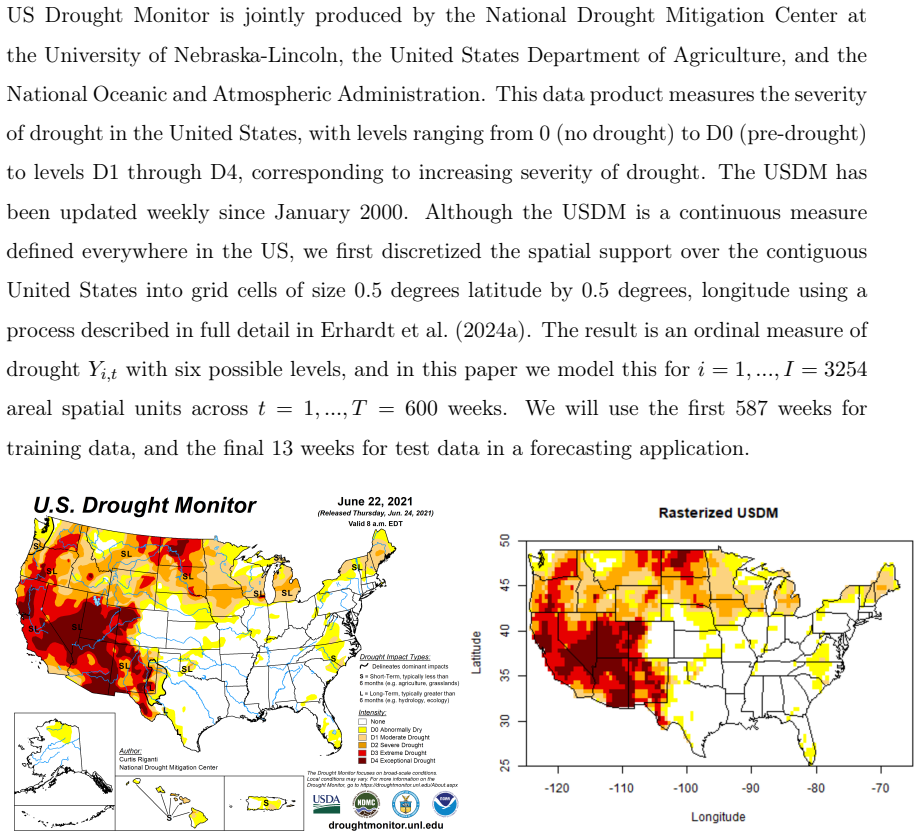
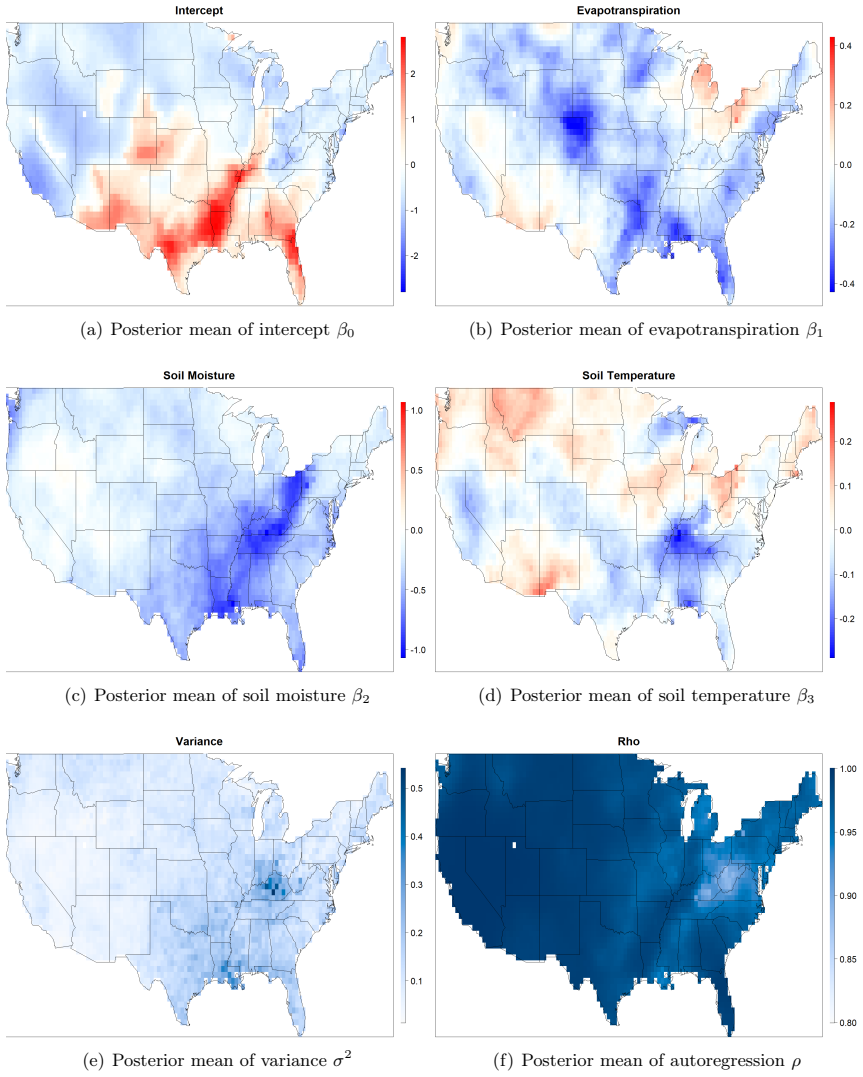
- The full US drought application, with 3,254 locations, 587 training weeks, and six ordinal levels, becomes tractable and yields spatially smoothed posterior maps for covariate effects, variance, and autoregression parameters.
- Thirteen-week probabilistic forecasts of drought level are produced from the posterior predictive distribution; the average probability of being within one drought category decays from about 95% at week 1 to about 75% at week 13.
- Because the same cancellation works for any data model whose latent process is shared across stages, the two-stage recipe extends to binary, count, and quantitative spatio-temporal responses, and to multivariate settings such as the covariate model fit here.
- The expensive part of fitting such models is pushed into stage one, which is embarrassingly parallel across locations and can be run as an array job.
Reading between the lines
- An implicit consequence of this design is that the practical bottleneck shifts from raw computation to design and diagnosis of the stage-one proposal: users need per-location checks, such as acceptance rates or effective sample sizes, to confirm the independent-stage posterior covers everything the full model supports.
- The same cancellation would apply to other hierarchical models that share a data model and process model between stages and differ only in location-specific priors, suggesting a general template: parallelize by breaking dependence, then reweight to restore it.
- A testable extension is whether jointly updating covariate parameters in stage two changes forecast coverage in smaller datasets where a full joint fit is feasible, since the paper's forecasting setup treats the covariate model and drought model as independent posterior blocks and then concatenates draws.
- The paper's own limitation section implies a scaling ceiling: acceptance will fall as the number of spatially prior-ed parameters in the joint update grows, so future extensions would likely block-update or factorize the proposal to stay efficient in higher-dimensional settings.
Editorial analysis
A structured set of objections, weighed in public.
Referee Report
Summary. The paper develops a two-stage MCMC algorithm for Bayesian spatio-temporal ordinal data. In stage one, the authors fit independent location-specific latent autoregressive ordinal models in parallel, using independent priors in place of the full model's ICAR priors. In stage two, draws from each location's stage-one posterior are used as proposals in a Metropolis-within-Gibbs update targeting the full model; the acceptance ratio in Eqs. (6)-(9) cancels the expensive data and process likelihoods and depends only on prior ratios. The authors compare their method to a single-stage NIMBLE fit on a Western US subset, reporting visually similar posterior means and standard deviations and a large reduction in compute time (0.95h vs. 115.8h total). They apply the method to full US Drought Monitor data with 3,254 locations and 587 weeks, and produce 13-week-ahead forecasts. The paper concludes that the method samples from the full spatio-temporal posterior at a fraction of the cost.
Significance. Provided the methodological claims hold up, this is a practically important contribution. The MH algebra in Eqs. (6)-(9) is correct, and the cancellation of the data-level and process-level densities makes the update computationally attractive. The computational gains are impressive, and the public data/code availability and out-of-sample forecasting evaluation are strengths. However, the central claim that stage two 'samples from the full spatio-temporal posterior' is not yet empirically established: the subset comparison rests on visual inspection of first moments from a single run, and no stage-one convergence/support-coverage diagnostics are reported for the full application. The authors themselves acknowledge in Section 6 that stage-two draws are a reweighting of stage-one draws and that the method fails if stage-one chains do not explore the full posterior support. These gaps are fixable and should be addressed before the claim can be accepted.
major comments (3)
- [Section 4, Figure 2, Figure A.2] The validation that the two-stage algorithm preserves the posterior is limited to visual comparison of maps of posterior means (Figure 2) and posterior standard deviations (Figure A.2) from a single run of each algorithm. This does not substantiate the abstract's claim that the two-stage method 'samples from the full spatio-temporal posterior.' Please add quantitative distributional comparisons, such as maximum absolute differences in posterior means and standard deviations, comparisons of quantiles or credible intervals for representative parameters, posterior predictive checks, and repeated independent runs with a convergence diagnostic (e.g., Gelman-Rubin) for both algorithms. Without such checks, differences in tails or joint dependence could go undetected.
- [Section 6 and Section 3.2.1] The paper correctly states in Section 6 that 'stage-two posterior draws are simply a re-weighting of stage one posterior draws' and that the method requires the stage-one posterior to explore the full parameter space. This makes stage-one convergence and support coverage load-bearing, yet no stage-one convergence diagnostics (trace plots, Gelman-Rubin statistics, or effective sample sizes) are reported for the 3,254 chains in the full application. In addition, the stage-one prior choices in Section 3.2.1 (beta prior standard deviation xi_p = 3 and independent logistic priors for gamma_i) are presented without sensitivity analysis. Please report diagnostics for a representative set of locations and assess sensitivity to the stage-one prior scale, since under-coverage of the full posterior by stage one would make stage two irreducible.
- [Section 5.1 and Section 6] For the full-data application, no single-stage reference fit exists, so the posterior-preservation claim is not directly checked there. The usefulness of the forecasts does not by itself validate the approximation. The authors note in Section 6 that the joint update's acceptance probability may become vanishingly small as the dimension of theta_i grows, but no acceptance rates or stage-two mixing diagnostics are reported for the full model. Please report stage-two acceptance rates and trace/ESS diagnostics for the full application, and discuss how the observed rates relate to the dimension of the location-specific parameter vector.
minor comments (3)
- [Section 5.2] The phrase 'full details are redacted' after stating that the covariate model is fit using the same two-stage algorithm is inappropriate for a methods paper; please include the details in the main text or in an appendix.
- [Table 1] Please clarify whether the 'Time to 1000 effective samples' entry for the two-stage method includes the stage-one time and why it exceeds the reported total time; the current caption says times include both stages for total time but is ambiguous for the effective-sample time.
- [Section 4, Figure 2] The text says the figure shows posterior means of 'all parameters in theta_Z,' but only the intercept, three regression coefficients, rho, and sigma^2 are displayed; please say 'selected parameters.'
Circularity Check
No significant circularity: the two-stage MCMC target is the full posterior via a valid Metropolis-Hastings acceptance ratio, and the only caveat is an acknowledged stage-one support/coverage assumption that is not a circular reduction.
full rationale
The derivation chain is not circular. Stage one approximates the posterior under independence across locations, yielding a product of site-specific posteriors (Eq. 5). Stage two proposes draws from that stage-one posterior and accepts them with the Metropolis-Hastings ratio derived in Eq. (8), which cancels the data likelihood and process density entirely, leaving only the ratio of full-model spatial priors to stage-one priors (Eq. 9). This is a standard proposal-recursive MH construction whose stationary distribution is the full posterior in Eq. (4), provided the chains converge and the stage-one posterior has support covering the full-model posterior. No fitted parameter is defined in terms of the quantity being predicted, and no claim reduces to its own input by construction. The Section 6 statement that 'stage-two posterior draws are simply a re-weighting of stage one posterior draws' is an explicit and correct description of a coverage requirement, not a hidden circularity: the method cannot visit regions that stage one never explores, but this is a convergence/support assumption that the authors disclose, not an equation that makes the target equal to the proposal. The subset comparison against a single-stage NIMBLE MCMC is an external, if partial, validation; the limitation that only posterior means are compared in the main text is a valid concern about empirical verification, but it is not a circular-reasoning defect. Self-citations appear only for data provenance and previous modeling choices (Erhardt et al. 2024a, 2024b) and are not load-bearing for the MH validity of the algorithm. Overall, the central claim is mathematically self-contained and independent of fitted values, so the circularity score is minimal.
Assumptions & free parameters
free parameters (3)
- Stage-one prior SD for regression coefficients (xi_p) =
3
- Stage-one prior scale for logistic(gamma_i) =
1
- Number of Fourier harmonics for covariate detrending =
5
assumptions (5)
- standard math Metropolis-Hastings acceptance ratio in equation (8) is correct and the proposal is a valid conditional density given the stage-one posterior.
- domain assumption Stage-one posterior factorizes across locations and has support covering the full-model conditional distributions.
- domain assumption Stage-one MCMC chains have converged and the thinned draws used as proposals are representative draws from the stage-one posterior.
- domain assumption ICAR is an acceptable improper prior for spatial random effects and yields valid full conditionals.
- domain assumption Latent ordinal threshold model with fixed cutoffs and modeled sigma_i^2 is identifiable.
Cite this review
Pith. "Pith review of Two-stage MCMC for Fast Bayesian Inference of Large Spatio-temporal Ordinal Data, with Application to US Drought." pith.science (2026). https://pith.science/paper/Q5KQLFVP
@misc{pith2026250524594,
  author       = {Pith},
  title        = {Pith review of: Two-stage MCMC for Fast Bayesian Inference of Large Spatio-temporal Ordinal Data, with Application to US Drought},
  year         = {2026},
  howpublished = {\url{https://pith.science/paper/Q5KQLFVP}},
  note         = {Machine review of arXiv:2505.24594}
}
read the original abstract
High dimensional space-time data pose known computational challenges when fitting spatio-temporal models. Such data show dependence across several dimensions of space as well as in time, and can easily involve hundreds of thousands of observations. Many spatio-temporal models result in a dependence structure across all observations and can be fit only at a substantial computational cost, arising from dense matrix inversion, high dimensional parameter spaces, poor mixing in Markov Chain Monte Carlo, or the impossibility of utilizing parallel computing due to a lack of independence anywhere in the model fitting process. These computational challenges are exacerbated when the response variable is ordinal, and especially as the number of ordered categories grows. Some spatio-temporal models achieve computational feasibility for large datasets but only through overly restrictive model simplifications, which we seek to avoid here. In this paper we demonstrate a two-stage algorithm to fit a Bayesian spatio-temporal model to large datasets when the response variable is ordinal. The first stage models locations independently in space, capturing temporal dependence, and can be run in parallel. The second stage resamples from the first stage posterior distributions with an acceptance probability computed to impose spatial dependence from the full spatio-temporal model. The result is fast Bayesian inference which samples from the full spatio-temporal posterior and is computationally feasible even for large datasets. We quantify the substantial computational gains our approach achieves, and demonstrate the preservation of the posterior distribution as compared to the more costly single-stage model fit. We apply our approach to a large spatio-temporal drought dataset in the United States, a dataset too large for many existing spatio-temporal methods.
Figures

Figures from the paper (2 more)


Reference graph
Works this paper leans on
-
[1]
, " * write output.state after.block = add.period write newline
ENTRY address author booktitle chapter edition editor howpublished institution journal key month note number organization pages publisher school series title type url volume year label extra.label sort.label short.list INTEGERS output.state before.all mid.sentence after.sentence after.block FUNCTION init.state.consts #0 'before.all := #1 'mid.sentence := ...
-
[2]
" write newline "" before.all 'output.state := FUNCTION n.dashify 't := "" t empty not t #1 #1 substring "-" = t #1 #2 substring "--" = not "--" * t #2 global.max substring 't := t #1 #1 substring "-" = "-" * t #2 global.max substring 't := while if t #1 #1 substring * t #2 global.max substring 't := if while FUNCTION word.in bbl.in capitalize " " * FUNCT...
-
[3]
Banerjee, S., Carlin, B. P., and Gelfand, A. E. Hierarchical modeling and analysis for spatial data\/ . Chapman and Hall/CRC (2003)
work page 2003
-
[4]
Banerjee, S., Gelfand, A. E., Finley, A. O., and Sang, H. Gaussian predictive process models for large spatial data sets. Journal of the Royal Statistical Society Series B: Statistical Methodology\/ , 70(4):825--848 (2008)
work page 2008
-
[5]
Billings, S. D., Newsam, G. N., and Beatson, R. K. Smooth fitting of geophysical data using continuous global surfaces. Geophysics\/ , 67(6):1823--1834 (2002)
work page 2002
-
[6]
Cressie, N. and Johannesson, G. Fixed rank kriging for very large spatial data sets. Journal of the Royal Statistical Society Series B: Statistical Methodology\/ , 70(1):209--226 (2008)
work page 2008
-
[7]
Cressie, N., Shi, T., and Kang, E. L. Fixed rank filtering for spatio-temporal data. Journal of Computational and Graphical Statistics\/ , 19(3):724--745 (2010)
work page 2010
-
[8]
Cressie, N. and Wikle, C. K. Statistics for spatio-temporal data\/ . John Wiley & Sons (2015)
work page 2015
Show all 35 references
-
[9]
O., and Gelfand, A
Datta, A., Banerjee, S., Finley, A. O., and Gelfand, A. E. Hierarchical nearest-neighbor Gaussian process models for large geostatistical datasets. Journal of the American Statistical Association\/ , 111(514):800--812 (2016 a )
2016
-
[10]
O., Hamm, N
Datta, A., Banerjee, S., Finley, A. O., Hamm, N. A., and Schaap, M. Nonseparable dynamic nearest neighbor Gaussian process models for large spatio-temporal data with an application to particulate matter analysis. The annals of applied statistics\/ , 10(3):1286 (2016 b )
2016
-
[11]
J., Anderson-Bergman, C., Lang, D
de Valpine, P., Turek, D., Paciorek, C. J., Anderson-Bergman, C., Lang, D. T., and Bodik, R. Programming with models: writing statistical algorithms for general model structures with NIMBLE. Journal of Computational and Graphical Statistics\/ , 26(2):403--413 (2017)
2017
-
[12]
A., Hepler, S
Erhardt, R., Di Vittorio, C. A., Hepler, S. A., Lowman, L. E., and Wei, W. Homogenized gridded dataset for drought and hydrometeorological modeling for the continental U nited S tates. Scientific Data\/ , 11(1):375 (2024 a )
2024
-
[13]
Spatio-temporal forecasting for the US Drought Monitor
Erhardt, R., Hepler, S., Wolodkin, D., and Greene, A. Spatio-temporal forecasting for the US Drought Monitor. Journal of the Royal Statistical Society Series C: Applied Statistics\/ , 73(5):1203--1220 (2024 b )
2024
-
[14]
Feng, X., Zhu, J., Lin, P.-S., and Steen-Adams, M. M. Composite likelihood estimation for models of spatial ordinal data and spatial proportional data with zero/one values. Environmetrics\/ , 25(8):571--583 (2014)
2014
-
[15]
O., Banerjee, S., and Gelfand, A
Finley, A. O., Banerjee, S., and Gelfand, A. E. Bayesian dynamic modeling for large space-time datasets using Gaussian predictive processes. Journal of geographical systems\/ , 14:29--47 (2012)
2012
-
[16]
G., and Nychka, D
Furrer, R., Genton, M. G., and Nychka, D. Covariance tapering for interpolation of large spatial datasets. Journal of Computational and Graphical Statistics\/ , 15(3):502--523 (2006)
2006
-
[17]
J., Datta, A., Finley, A
Heaton, M. J., Datta, A., Finley, A. O., Furrer, R., Guinness, J., Guhaniyogi, R., Gerber, F., Gramacy, R. B., Hammerling, D., Katzfuss, M., et al. A case study competition among methods for analyzing large spatial data. Journal of agricultural, biological and environmental St...
2019
-
[18]
Higgs, M. D. and Hoeting, J. A. A clipped latent variable model for spatially correlated ordered categorical data. Computational Statistics & Data Analysis\/ , 54(8):1999--2011 (2010)
2010
-
[19]
B., Buderman, F
Hooten, M. B., Buderman, F. E., Brost, B. M., Hanks, E. M., and Ivan, J. S. Hierarchical animal movement models for population-level inference. Environmetrics\/ , 27(6):322--333 (2016)
2016
-
[20]
B., Johnson, D
Hooten, M. B., Johnson, D. S., and Brost, B. M. Making recursive Bayesian inference accessible. The American Statistician\/ , 1--10 (2019)
2019
-
[21]
WFU High Performance Computing Facility
Information Systems and Wake Forest University . WFU High Performance Computing Facility . (2021). ://hpc.wfu.edu
2021
-
[22]
and Cressie, N
Katzfuss, M. and Cressie, N. Bayesian hierarchical spatio-temporal smoothing for very large datasets. Environmetrics\/ , 23(1):94--107 (2012)
2012
-
[23]
and Guinness, J
Katzfuss, M. and Guinness, J. A general framework for Vecchia approximations of Gaussian processes. Statistical Science\/ , 36(1):124--141 (2021)
2021
-
[24]
G., Schervish, M
Kaufman, C. G., Schervish, M. J., and Nychka, D. W. Covariance tapering for likelihood-based estimation in large spatial data sets. Journal of the American Statistical Association\/ , 103(484):1545--1555 (2008)
2008
-
[25]
Fully B ayesian hierarchical modelling in two stages, with application to meta-analysis
Lunn, D., Barrett, J., Sweeting, M., and Thompson, S. Fully B ayesian hierarchical modelling in two stages, with application to meta-analysis. Journal of the Royal Statistical Society. Series C, Applied Statistics\/ , 62(4):551 (2013)
2013
-
[26]
E., Lohmann, D., Houser, P
Mitchell, K. E., Lohmann, D., Houser, P. R., Wood, E. F., Schaake, J. C., Robock, A., Cosgrove, B. A., Sheffield, J., Duan, Q., Luo, L., et al. The multi-institution North American Land Data Assimilation System (NLDAS): Utilizing multiple GCIP products and partners in a contin...
2004
-
[27]
Nychka, D. W. Spatial-process estimates as smoothers. Smoothing and regression: approaches, computation, and application\/ , 329:393 (2000)
2000
-
[28]
G., and Sun, Y
Pan, Q., Abdulah, S., Genton, M. G., and Sun, Y. Block Vecchia Approximation for Scalable and Efficient Gaussian Process Computations. Technometrics\/ , 1--13 (2025)
2025
-
[29]
Peruzzi, M., Banerjee, S., and Finley, A. O. Highly scalable Bayesian geostatistical modeling via meshed Gaussian processes on partitioned domains. Journal of the American Statistical Association\/ , 117(538):969--982 (2022)
2022
-
[30]
and Held, L
Rue, H. and Held, L. Gaussian Markov random fields: theory and applications\/ . Chapman and Hall/CRC (2005)
2005
-
[31]
Schliep, E. M. and Hoeting, J. A. Data augmentation and parameter expansion for independent or spatially correlated ordinal data. Computational Statistics & Data Analysis\/ , 90:1--14 (2015)
2015
-
[32]
M., Groendyke, C., Haran, M., and Liechty, J
Tibbits, M. M., Groendyke, C., Haran, M., and Liechty, J. C. Automated factor slice sampling. Journal of Computational and Graphical Statistics\/ , 23(2):543--563 (2014)
2014
-
[33]
J., and Anderson-Bergman, C
Turek, D., de Valpine, P., Paciorek, C. J., and Anderson-Bergman, C. Automated parameter blocking for efficient Markov chain Monte Carlo sampling. Bayesian Analysis\/ , 12(2) (2017)
2017
-
[34]
Continental-scale water and energy flux analysis and validation for the North American Land Data Assimilation System project phase 2 (NLDAS-2): 1
Xia, Y., Mitchell, K., Ek, M., Sheffield, J., Cosgrove, B., Wood, E., Luo, L., Alonge, C., Wei, H., Meng, J., et al. Continental-scale water and energy flux analysis and validation for the North American Land Data Assimilation System project phase 2 (NLDAS-2): 1. Intercomparis...
2012
-
[35]
and Cressie, N
Zammit-Mangion, A. and Cressie, N. FRK: An R package for spatial and spatio-temporal prediction with large datasets. Journal of Statistical Software\/ , 98:1--48 (2021)
2021
Reviewed August 7, 2026 · model on record in the stance chip above.
Discussion (0). Sign in to comment.