REVIEW 3 major objections 5 minor 38 references
CGCS 6306, another X-ray-emitting asymptotic giant branch star confirmed to be a symbiotic binary
T0 review · 3 major / 5 minor · reviewed 2026-08-07 · deepseek-v4-flash
Pith's one-line read Optical spectra and X-ray data confirm that CGCS 6306, an X-ray-emitting AGB star, is a symbiotic binary with an accreting white dwarf companion.
desk verdict A solid, narrowly scoped observational paper that very likely confirms CGCS 6306 as a carbon-Mira symbiotic binary; the X-ray source association needs quantification but the optical evidence stands on its own. read the letter →
The pith
A machine-rendered reading of the paper's core claim, the machinery that carries it, and where it could break.
The reading
What carries the argument
The central diagnostic is the classical symbiotic-star test: optical emission lines from ions with ionization potentials above roughly 35 eV (here He I, [O I], and [O III]) that cannot be powered by the AGB star itself and signal a hot companion, combined with the X-ray signature of a $\delta$-type X-SySt, a heavily absorbed hard thermal plasma. The observations are deliberately timed at the minimum of the 362-day pulsation cycle, when the Mira's own recombination lines are absent and faint nebular lines from the region ionized by the white dwarf have maximum contrast against the diminished continuum. The H$\alpha$ line width, interpreted with a Keplerian-disk formula, converts the emission into a characteristic accretion-disk radius, connecting the optical and X-ray evidence into a single accreting-white-dwarf picture.
What would settle it
Fit the combined XMM-Newton and Chandra spectra with an absorbed power-law model and compare it to the thermal-plasma fit: if the power law is preferred and the 2010-2024 fluxes differ by more than a factor of three, a background AGN would remain a plausible alternative, removing one pillar of the symbiotic classification. A Chandra observation with astrometry tied to Gaia that places the X-ray centroid more than about 0.5 arcsec from the optical position of CGCS 6306 would likewise refute the association.
Extended reading notes
Core claim
The paper establishes that CGCS 6306, a carbon Mira pulsating with a period of 362 days, is a bona-fide symbiotic binary: a white dwarf companion accretes matter from the AGB donor. The evidence rests on two independent pillars. First, optical spectra obtained near light-curve minimum reveal emission lines of He I $\lambda$5876, [O I] $\lambda\lambda$6300,6363, and [O III] $\lambda\lambda$4959,5007, whose high excitation cannot originate in the Mira atmosphere and instead require a hot component; the [O III] diagnostic ratios place the star in the symbiotic region of the standard diagram. Second, X-ray observations with XMM-Newton in 2010 and Chandra in 2023 and 2024 detect a point source at the stellar position with a hard, heavily absorbed spectrum and an intrinsic luminosity of $\approx 2.8\times10^{32}$ erg s$^{-1}$, consistent with a $\delta$-type X-ray symbiotic star as classified by Mürset et al. (1997) and Luna et al. (2013). The broad H$\alpha$ profile, with a FWHM of about 110 km s$^{-1}$, is interpreted as emission from an accretion disk around the white dwarf, yielding a characteristic disk radius of about $14\,R_\odot$ and a lower limit to the accretion rate of $\gtrsim 10^{-11}\,M_\odot$ yr$^{-1}$. The system's X-ray luminosity is comparable to that of Y Gem, the only other X-ray AGB star confirmed as a symbiotic binary, although the absence of UV and blue photometry precludes a full estimate of the accretion rate.
Load-bearing premise
The load-bearing premise is that the hard X-ray point source detected near CGCS 6306 is physically the star's white-dwarf companion and not a background active galactic nucleus lying along the same line of sight, since an absorbed AGN would mimic the hard, soft-suppressed spectrum and roughly constant flux.
Editorial extensions
If this is right
- CGCS 6306 becomes the second X-ray-emitting AGB star (after Y Gem) confirmed to be a symbiotic binary, supporting the view that many of the 47 known X-AGBs may be hidden SySts with accreting white dwarfs.
- The system adds a carbon Mira to the small list of roughly ten confirmed Galactic carbon symbiotic stars, offering a rare local laboratory for mass transfer and wind accretion in a carbon-rich binary.
- The measured X-ray luminosity implies ongoing accretion at a rate of at least about $10^{-11}$ $M_\odot$ yr$^{-1}$, so the white dwarf is actively growing; the true rate, unknown without UV data, could be substantially higher.
- The success of the minimum-phase optical spectroscopy strategy validates it as a practical way to identify white-dwarf companions around X-ray AGB stars, and suggests systematic spectroscopic surveys of the X-AGB sample could reveal many more symbiotic binaries.
- The unexplained approximately 7-year photometric periodicity, if orbital, would make CGCS 6306 a wide symbiotic binary; continued photometric and X-ray monitoring could tie this period to the accretion behavior.
Reading between the lines
- If the approximately 7-year photometric period is the orbital period, CGCS 6306 should show correlated changes in X-ray luminosity and line emission across that cycle; archival X-ray data from other epochs could be re-examined for such modulation.
- Because CGCS 6306 lies about 1.5 kpc above the Galactic plane and may belong to the thick disk or halo, its carbon-rich symbiotic nature is consistent with the higher prevalence of carbon symbiotics in low-metallicity environments like the Magellanic Clouds, suggesting metallicity controls the visibility of such binaries.
- The unusually broad [O I] lines suggest formation in dense gas near the accreting white dwarf rather than in an extended photoionized nebula; high-resolution spectroscopy across the pulsation cycle, or spatially resolved radio observations of the circumstellar medium, could test where the forbidden-line region is located.
- If the white dwarf is truly accreting, CGCS 6306 is a candidate for a single-degenerate Type Ia supernova progenitor, although the low lower-limit accretion rate and wide possible orbit make this a long-shot; measuring the white dwarf mass through future UV spectroscopy would curb this speculation.
Editorial analysis
A structured set of objections, weighed in public.
Referee Report
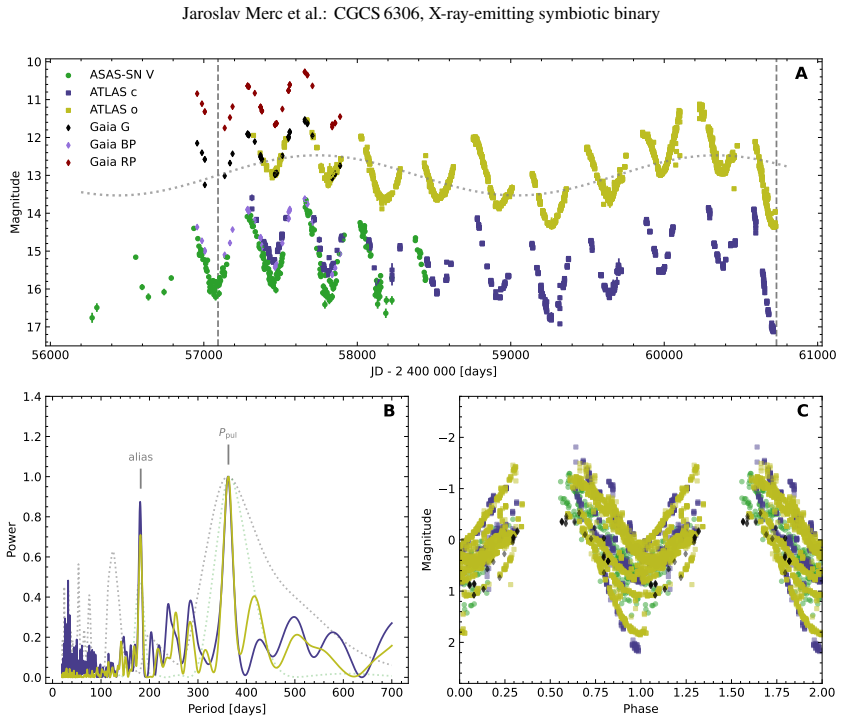
Summary. The paper reports a multi-wavelength study of CGCS 6306, a carbon Mira variable previously catalogued as an X-ray-emitting AGB star, with the aim of testing whether it is an unrecognized symbiotic binary. The authors use LAMOST and NOT/FIES optical spectra, ASAS-SN/ATLAS/Gaia photometry, and archival XMM-Newton plus new Chandra X-ray observations. They derive a 362-day pulsation period, identify high-excitation emission lines (He I, [O III], [O I]), find a broad Hα profile that they interpret as evidence for an accretion disk, and measure a hard X-ray spectrum that is roughly constant over 14 years. From these data they conclude that CGCS 6306 hosts an accreting white dwarf and is a bona-fide δ-type X-ray symbiotic star, with L_X ≈ 3×10^32 erg/s at d = 3.4 kpc. They also emphasize that CGCS 6306 adds a carbon-Mira member to the small group of Galactic carbon symbiotic stars.
Significance. If the classification is correct, CGCS 6306 becomes the second X-ray-emitting AGB star confirmed as a symbiotic binary (after Y Gem) and a rare example of a Galactic carbon-Mira symbiotic system. The paper's methodology is valuable: obtaining optical spectroscopy at pulsational minimum is a sensible strategy for detecting faint nebular lines that are otherwise outshone by the AGB star, and the combination of archival X-ray data with new optical spectra is a productive approach for surveying X-AGB stars. The optical evidence for a hot ionizing companion — particularly the detection of [O III] λ5007 and He I λ5876 at light minimum — is strong and largely independent of the X-ray analysis. However, the central X-ray claim rests on a serendipitous point source whose physical association with CGCS 6306 is asserted rather than quantitatively demonstrated. Given the low count statistics and the hard, absorbed spectrum, a background AGN is a realistic alternative that would mimic all reported X-ray properties. This gap is load-bearing for the specific δ-type X-SySt classification and for the quoted X-ray luminosity, even though the optical data may still support a symbiotic classification.
major comments (3)
- [§2.1, §3.3, §4.2] The physical association of the serendipitous X-ray point source with CGCS 6306 is not quantified. The paper states that the CXO observations confirm a point source 'at the location of CGCS6306' and then uses this source to compute fluxes and luminosities, but it does not report the angular offset between the X-ray centroid and the Gaia/2MASS optical position, the astrometric uncertainty of the X-ray-to-optical registration, or the chance-coincidence probability of finding an unrelated background AGN within the extraction region. This matters because the X-ray spectrum has only roughly 10–25 net counts per epoch, is hard with no counts below 2 keV, and is fitted with kT fixed at 10 keV: an absorbed background AGN would naturally produce such a spectrum with NH of order 10^22 cm^-2 and need not vary appreciably over 14 years. The δ-type X-SySt classification and the quoted L_X ≈ 3×10^32 erg/s depend directly on this association. I request a quantitative association test, including a local log N–log S estimate of the background AGN surface density and a statement of the X-ray/optical astrometric offset and its uncertainty.
- [§3.3, Table 2] The spectral analysis does not demonstrate that the hot-plasma interpretation is preferred over an absorbed power law. With the plasma temperature fixed at 10 keV and very few source counts in each epoch, the tbabs×apec model is not discriminative, and the reported NH values differ considerably between the two Chandra epochs (30±16 versus 8.9±3.4 ×10^21 cm^-2) while the fluxes are said to be consistent. I ask for a direct comparison with a tbabs×powerlaw model (or an equivalent two-model test), reporting the fitted photon index, column density, and unabsorbed flux. This is necessary to support the statement that the X-ray emission is 'typical of highly-extincted hot plasma emission' and to place the derived luminosity on a firmer footing.
- [§4.2, §5] The accretion-rate lower limit of ≳10^-11 M_sun/yr is derived from the X-ray luminosity under the assumption that the X-ray emission is accretion-powered. If the X-ray source is a background AGN, this estimate loses its basis. In addition, the accretion disk radius of ≈14 R_sun derived in §4.1 from the Hα FWHM depends on the assumed inclination angle of 45°, which is not constrained by observations; the radius scales as 1/sin^2(i) (or a similar geometric factor), so the quoted value should be presented as an illustrative estimate rather than a measured quantity. I recommend that the conclusions explicitly separate the secure optical evidence for a hot companion from the model-dependent X-ray and disk interpretation.
minor comments (5)
- [§3.1] The first paragraph refers to the variability of 'CGCS6303'; this should be 'CGCS6306'.
- [§4.2] The text says the GALEX NUV absolute magnitude is '≃10 mag at the distance of 1.53 kpc', but the distance adopted throughout the paper is 3.4±0.4 kpc from §3.1. The value 1.53 kpc is the height above the Galactic plane, so this sentence appears to contain an error or a confusingly worded reference to the plane height.
- [§3.2, §4.1] The [O III] diagnostic ratios quoted in §4.1 ([O III] λ4363/Hγ = 0.30 and [O III] λ5007/Hβ = 0.32) are not backed by reported line fluxes or equivalent widths from §3.2. Since these ratios are used to argue for high density and to support the symbiotic classification, the underlying measurements should be tabulated or at least reported with uncertainties.
- [§4.1, Eq. (4)] The derivation of the disk radius of 14 R_sun assumes an inclination angle of 45° and a white-dwarf mass of 0.6 M_sun. Because neither quantity is measured, the result should be explicitly labeled as an illustrative estimate, and the sensitivity of the radius to the assumed inclination should be mentioned.
- [§3.3] The statement that the X-ray flux 'seems to have remained constant' is based on only three epochs with large uncertainties; a softer wording such as 'is consistent with constancy within the current uncertainties' would be more appropriate.
Circularity Check
No significant circularity: the symbiotic classification rests on independent optical and X-ray diagnostics, and the self-citations are contextual rather than load-bearing.
full rationale
The central claim—that CGCS 6306 hosts an accreting white dwarf and is a bona-fide δ-type X-SySt—is not circular. It rests on independent observational diagnostics: high-excitation [O III] and He I emission lines in the LAMOST and NOT/FIES spectra (Sect. 3.2), the broad Hα profile and its Keplerian-disk radius estimate (Sect. 3.2, Eq. 4), and the hard, soft-suppressed X-ray spectrum with LX≈(2.8±1.4)×10^32 erg/s (Sect. 3.3, Table 2). None of these inputs is defined in terms of the conclusion, and no equation in the paper reduces a fitted parameter to the claimed classification. The X-ray spectral analysis fixes kT=10 keV owing to the low count rate and fits NH and normalization; this is a standard, admittedly underconstrained fit, not a fit to the target quantity followed by a relabeled 'prediction.' The paper cites earlier works by the same authors (Ortiz & Guerrero 2021; Guerrero et al. 2024, 2025) to define the X-AGB term and to compare with Y Gem, but these citations are contextual and comparative, not load-bearing: the optical high-excitation lines and Hα width are measured here and are standard symbiotic-star diagnostics independent of those papers. The main caveat—the serendipitous X-ray source's physical association with CGCS 6306—is an assumption about positional coincidence (Sects. 2.1 and 3.3) rather than a circular step; a background AGN might mimic the X-rays, but the symbiotic classification would still be supported by the optical lines. The paper explicitly acknowledges its limitations (accretion-rate estimate precluded by missing UV/blue data; the 7-year period of unknown origin), which further supports the absence of a hidden circular derivation.
Assumptions & free parameters
free parameters (7)
- X-ray plasma temperature kT =
10.0 keV (fixed by hand)
- Hydrogen column density N_H =
10.0e21 cm-2 fixed (XMM 2010); 30±16e21 (CXO 2023.99); 8.9±3.4e21 (CXO 2024.01)
- XSPEC normalization A =
2.9±1.0e-4, 1.0±0.8e-4, 7.8±2.6e-5 (10^-5 cm^-5)
- Distance to CGCS6306 =
3.4±0.4 kpc adopted
- White dwarf mass M_WD =
0.6 M_sun assumed
- Disk inclination angle =
45 degrees assumed
- Interstellar reddening E(B-V) =
0.042 mag adopted
assumptions (7)
- domain assumption High-ionization optical lines such as [O III] and He I in an AGB star trace photoionization by a hot source with photon energies above roughly 35 eV.
- domain assumption AGB stars do not have coronae, so X-ray emission from an AGB star requires a companion, either via accretion or a coronal secondary.
- domain assumption The Galactic carbon Mira period-luminosity relations of Groenewegen & Whitelock (1996) and Whitelock et al. (2006) apply to CGCS6306.
- ad hoc to paper The H-alpha line width can be modeled as Keplerian rotation in an accretion disk around a 0.6 solar-mass white dwarf viewed at 45 degrees.
- domain assumption The X-ray spectra are optically thin thermal plasma with solar abundances absorbed by neutral gas, modeled as tbabs times apec.
- domain assumption The serendipitous X-ray point source at the optical position is physically associated with CGCS6306 rather than a background AGN.
- standard math The 362-day period found by Lomb-Scargle analysis is the Mira pulsation period.
Cite this review
Pith. "Pith review of CGCS 6306, another X-ray-emitting asymptotic giant branch star confirmed to be a symbiotic binary." pith.science (2026). https://pith.science/paper/JJEI5G4H
@misc{pith2026250524660,
  author       = {Pith},
  title        = {Pith review of: CGCS 6306, another X-ray-emitting asymptotic giant branch star confirmed to be a symbiotic binary},
  year         = {2026},
  howpublished = {\url{https://pith.science/paper/JJEI5G4H}},
  note         = {Machine review of arXiv:2505.24660}
}
abstract
A number of asymptotic giant branch (AGB) stars are known to exhibit UV excess and/or X-ray emission. These have been considered signposts of a hot white dwarf (WD) companion in a symbiotic system (SySt), but AGB stars are so bright that they easily outshine these companions hampering their detection at optical wavelengths. A recent multi-wavelength investigation on the X-ray-emitting AGB (X-AGB) star Y Gem has confirmed the presence of a WD companion and, thus, its SySt nature. Our goal is to explore the true nature of another X-AGB star, namely CGCS 6306, to investigate whether some objects from this group may in fact be unnoticed symbiotic systems with AGB donors. Optical spectra and photometric data, together with X-ray observations, have been analyzed to investigate the properties of the stellar components and accretion process in CGCS 6306. CGCS 6306 is a carbon Mira with a pulsation period of 362 days. Its optical spectrum exhibits the typical saw-shaped features of molecular absorptions in addition to H I and He I recombination and [O I] and [O III] forbidden emission lines. The H$\alpha$ line profile is broad, which can be interpreted as evidence for an accretion disk. The X-ray spectrum is hard, typical of highly-extincted hot plasma emission, and the X-ray luminosity is $\approx10^{32}$ erg s$^{-1}$. The detection of high-excitation optical emission lines and the X-ray properties of CGCS 6306 confirm the presence of a WD companion, making it a bona-fide $\delta$-type X-SySt. Its X-ray luminosity is comparable to that of Y Gem, the other X-AGB confirmed to be a SySt, which was found to exhibit a high accretion rate. The lack of suitable information on the UV and blue optical properties of CGCS 6306, however, precludes a definitive estimate of the accretion rate in this system. Since CGCS 6306 is a carbon Mira, it adds to the small group of Galactic carbon SySts.
Figures


Figures from the paper (2 more)


Reference graph
Works this paper leans on
-
[1]
Alksnis, A., Balklavs, A., Dzervitis, U
Akras,S.,Guzman-Ramirez,L.,Leal-Ferreira,M.L.,etal.2019,ApJS,240,21. Alksnis, A., Balklavs, A., Dzervitis, U. et al., 2001, Baltic Astronomy, 10, 1 Allen, D. A. 1978, MNRAS, 184,
work page 2019
-
[11]
& Tamura, S., 2004, PASJ, 56, 353 Iłkiewicz, K
Ikeda, Y. & Tamura, S., 2004, PASJ, 56, 353 Iłkiewicz, K. & Mikołajewska, J. 2017, A&A, 606, A110. Ivezic,Z.,Nenkova,M.&Elitzur,M.,1999,UserManualfordusty,University Kentucky Internal Report Izumiura, H., Noguchi, K., Aoki, W., Honda, S., Ando, H., Takada-Hidai, M., Kambe, E., Kawanomoto, S., Sadakane, K., Sato, B. et al., ApJ, 682, 499 Jayasinghe, T., Ko...
work page 2004
-
[45]
A., Coriat, M., Traulsen, I., et al
Webb, N. A., Coriat, M., Traulsen, I., et al. 2020, A&A, 641, A136. Wetuski, J., Hynes, R. I., Maccarone, T. J., et al. 2021, MNRAS, 506,
work page 2020
-
[48]
Shetye, S., Van Eck, S., Jorissen, A., et al. 2021, A&A, 650, A118. Shingles, L., Smith, K. W., Young, D. R., et al. 2021, Transient Name Server AstroNote, 7 Smith, K. W., Smartt, S. J., Young, D. R., et al. 2020, PASP, 132, 085002. Sobotka, P., Pejcha, O., Šmelcer, L., et al. 2003, Symbiotic Stars Probing Stellar Evolution, 303,
work page 2021
-
[49]
Merrill, P. W. & Burwell, C. G. 1950, ApJ, 112,
work page 1950
-
[72]
1997, A&A, 327, 191 Miszalski, B., Mikołajewska, J., & Udalski, A
Mikolajewska, J., Acker, A., & Stenholm, B. 1997, A&A, 327, 191 Miszalski, B., Mikołajewska, J., & Udalski, A. 2013, MNRAS, 432,
work page 1997
-
[101]
S., Sarkissian, A., Russeil, D., et al
Gigoyan, K. S., Sarkissian, A., Russeil, D., et al. 2014, Astrophysics, 57,
work page 2014
-
[105]
& Contreras, C.S., 2022, Galaxies, 10, 62S Sanduleak, N
Sahai, R., Sanz-Forcada, J., Guerrero, M.A., Ortiz, R. & Contreras, C.S., 2022, Galaxies, 10, 62S Sanduleak, N. & Stephenson, C. B. 1973, ApJ, 185,
work page 2022
Show all 38 references
-
[123]
M., Lim, P
Astropy Collaboration, Price-Whelan, A. M., Lim, P. L., et al. 2022, ApJ, 935,
2022
-
[125]
I., Torres, M
Herbig, G.H., 2009, AJ, 138, 1502 Hynes, R. I., Torres, M. A. P., Heinke, C. O., et al. 2014, ApJ, 780,
2009
-
[147]
2000, A&AS, 146,
Belczyński, K., Mikołajewska, J., Munari, U., et al. 2000, A&AS, 146,
2000
-
[167]
& Rosner, R., 1981, ApJ, 250, 293 Bailer-Jones, C
Ayres, T.R., Linsky, J.L., Vaiana, G.S., Golub, L. & Rosner, R., 1981, ApJ, 250, 293 Bailer-Jones, C. A. L., Rybizki, J., Fouesneau, M., et al. 2021, AJ, 161,
1981
-
[169]
& Ortiz, R., 2020, MNRAS, 491, 680 Guerrero, M.A., Montez, R., Ortiz, R., Toalá, J.A
Guerrero, M.A. & Ortiz, R., 2020, MNRAS, 491, 680 Guerrero, M.A., Montez, R., Ortiz, R., Toalá, J.A. & Kastner, J.H., 2024, A&A, 689, A62 Guerrero, M. A., Vasquez-Torres, D. A., Rodríguez-González, J. B., et al. 2025, A&A, 693, A203. Gutierrez-Moreno, A., Moreno, H., & Cortes,...
2020
-
[171]
2021, ApJ, 911, L22
Soszyński, I., Olechowska, A., Ratajczak, M., et al. 2021, ApJ, 911, L22. Tonry, J. L., Denneau, L., Heinze, A. N., et al. 2018, PASP, 130, 064505. van Belle, G. T., Dyck, H. M., Thompson, R. R., et al. 1997, AJ, 114,
2021
-
[197]
& Östreicher, R., 1988, AJ, 95, 45 Arnaud, K
Appenzeller, I. & Östreicher, R., 1988, AJ, 95, 45 Arnaud, K. A. 1996, Astronomical Data Analysis Software and Systems V, 101, 17 Arrieta, A. & Torres-Peimbert, S., 2003, ApJS, 147, 97 Astropy Collaboration, Robitaille, T. P., Tollerud, E. J., et al. 2013, A&A, 558, A33. Astro...
1988
-
[241]
Henize, K. G. 1967, ApJS, 14,
1967
-
[270]
Scargle, J. D. 1982, ApJ, 263,
1982
-
[293]
J., Prieto, J
Shappee, B. J., Prieto, J. L., Grupe, D., et al. 2014, ApJ, 788,
2014
-
[294]
& Dopita, M.A., 1984, ApJ, 286, 337 Fruscione, A., McDowell, J
Fox, M.W., Wood, P.R. & Dopita, M.A., 1984, ApJ, 286, 337 Fruscione, A., McDowell, J. C., Allen, G. E., et al. 2006, Proc. SPIE, 6270, 62701V. Gabriel, C., Denby, M., Fyfe, D. J., et al. 2004, Astronomical Data Analysis Software and Systems (ADASS) XIII, 314, 759 Gaia Collabor...
1984
-
[407]
& García, L.G., 2009, A&A, 497, 815 Cohen, M., Wainscoat, R.J.„ Walker, H.J
Brandi, E., Quiroga, C., Mikolajewska, J., Ferrer, O.E. & García, L.G., 2009, A&A, 497, 815 Cohen, M., Wainscoat, R.J.„ Walker, H.J. & Volk, K., 1996, AJ, 111, 1333 Contini, M., 1997, ApJ, 483, 887 Corradi, R. L. M., Sabin, L., Munari, U., et al. 2011, A&A, 529, A56. Cui, X.-Q...
2009
-
[447]
Luna, G. J. M., Sokoloski, J. L., Mukai, K., et al. 2013, A&A, 559, A6. Matsunaga, N., Menzies, J. W., Feast, M. W., et al. 2017, MNRAS, 469,
2013
-
[462]
N., Tonry, J
Heinze, A. N., Tonry, J. L., Denneau, L., et al. 2018, AJ, 156,
2018
-
[510]
& Whitelock, P.A., 1996, MNRAS, 281, 1347 Gromadzki, M., Mikołajewska, J., Whitelock, P., et al
Groenewegen, M.A.T. & Whitelock, P.A., 1996, MNRAS, 281, 1347 Gromadzki, M., Mikołajewska, J., Whitelock, P., et al. 2009, Acta Astron., 59,
1996
-
[573]
& Groenewegen, M.A.T., 2006, MN- RAS, 369, 751 Wilms, J., Allen, A., & McCray, R
Whitelock, P.A., Feast, M.W., Marang, F. & Groenewegen, M.A.T., 2006, MN- RAS, 369, 751 Wilms, J., Allen, A., & McCray, R. 2000, ApJ, 542,
2006
-
[598]
2021, MNRAS, 506,
Merc, J., Gális, R., Wolf, M., et al. 2021, MNRAS, 506,
2021
-
[601]
& Grevesse, N
Anders, E. & Grevesse, N. 1989, Geochim. Cosmochim. Acta, 53,
1989
-
[800]
et al., 2004, AJ, 127, 2436 Woźniak, P.R., Williams, S.J., Vestrand, W.T
Woźniak, P.R. et al., 2004, AJ, 127, 2436 Woźniak, P.R., Williams, S.J., Vestrand, W.T. & Gupta, V., 2004, AJ, 128, 2965 Wright, E.L. et al., 2010, AJ, 140, 1868 Zhao, G., Zhao, Y.-H., Chu, Y.-Q., et al. 2012, Research in Astronomy and Astrophysics, 12,
2004
-
[835]
& Davis, M., ApJ, 500, 525 Seal, P
Schlegel, D.J., Finkbeiner, D.P. & Davis, M., ApJ, 500, 525 Seal, P. 1988, IAU Colloq. 103: The Symbiotic Phenomenon, 145,
1988
-
[899]
Sanford, R. F. 1950, ApJ, 111,
1950
-
[914]
R., Olivier, E
Wood, P. R., Olivier, E. A., & Kawaler, S. D. 2004, ApJ, 604,
2004
-
[1197]
doi:10.1088/1674-4527/12/9/003 Cutri et al., 2003,The IRSA 2MASS All-Sky Point Source Catalog, NASA/IPAC Infrared Science Archive. Dyck, H. M., van Belle, G. T., & Benson, J. A. 1996, AJ, 112,
2003 doi
-
[1274]
S., et al
Sahai, R., Sánchez Contreras, C., Mangan, A. S., et al. 2018, ApJ, 860,
2018
-
[2150]
T., Paladini, C., Aringer, B., et al
van Belle, G. T., Paladini, C., Aringer, B., et al. 2013, ApJ, 775, 1,
2013
-
[3145]
& Pols, O.R., 2002, PASA, 19, 515 Kochanek, C
Karakas, A.I., Latanzzio, J.C. & Pols, O.R., 2002, PASA, 19, 515 Kochanek, C. S., Shappee, B. J., Stanek, K. Z., et al. 2017, PASP, 129, 104502. Lagadec, E., Sloan, G.C., Zijlstra, A.A., Mauron, N. & Houck, J.R., 2012, MN- RAS, 427, 2588 Lebzelter,T.,Mowlavi,N.,Lecoeur-Taibi,I...
2002
-
[3186]
& Lançon, A., 2003, MNRAS, 338, 572 Munari, U
Mouhcine, M. & Lançon, A., 2003, MNRAS, 338, 572 Munari, U. 2019, arXiv:1909.01389. Munari, U., Tomov, T., & Rejkuba, M. 1999, Information Bulletin on Variable Stars, 4668, 1 Mürset, U., Wolff, B., & Jordan, S. 1997, A&A, 319, 201 Ortiz, R. & Guerrero, M.A., 2016, MNRAS, 461, ...
2003 arXiv
-
[4151]
2025, Galaxies, 13(3),
Merc, J. 2025, Galaxies, 13(3),
2025
-
[4949]
& Klotz, A., 2014, A&A, 562, A24 Mauron, N., 2008, A&A, 482, 151 Mauron, N., Gigoyan, K.S
Mauron, N., Gigoyan, K.S., Berlioz-Arthaud, P. & Klotz, A., 2014, A&A, 562, A24 Mauron, N., 2008, A&A, 482, 151 Mauron, N., Gigoyan, K.S. & Kendall, T.R., 2007, A&A, 475, 843 Masetti, N., Munari, U., Henden, A. A., et al. 2011, A&A, 534, A89. McKeever, J., Lutz, J., Wallerstei...
2014
-
[5619]
Whitelock, P. A. 1987, PASP, 99,
1987
Reviewed August 7, 2026 · model on record in the stance chip above.
Discussion (0). Sign in to comment.