REVIEW 4 major objections 7 minor 59 references
Identification of New Candidate Be/X-Ray Binary Systems in the Small Magellanic Cloud via Analysis of S-CUBED Source Catalog
T0 review · 4 major / 7 minor · reviewed 2026-08-07 · deepseek-v4-flash
Pith's one-line read The paper claims that six previously overlooked Be/X-ray binary systems in the Small Magellanic Cloud can be identified from their persistent optical, infrared, and ultraviolet emission, and that one of them was later confirmed by an…
desk verdict Useful, honest candidate paper with one confirmed source; the missing chance-coincidence estimate is a fixable but important gap. read the letter →
The pith
A machine-rendered reading of the paper's core claim, the machinery that carries it, and where it could break.
The reading
What carries the argument
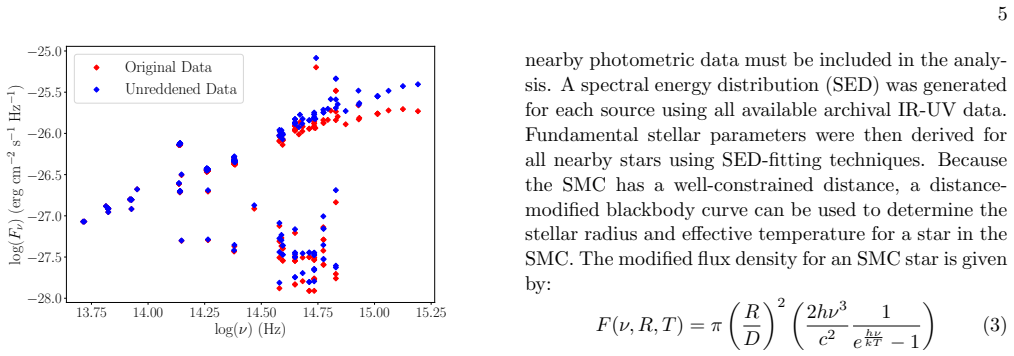
The load-bearing tool is the distance-modified blackbody SED fit, $F(\nu,R,T)=\pi(R/D)^2 (2h\nu^3/c^2)(e^{h\nu/kT}-1)^{-1}$ with $D=62.44$ kpc, used to convert archival magnitudes into estimates of stellar radius $R$ and temperature $T$ for every star within 8 arcseconds of an X-ray position. Extinction is removed first using a reddening map and a standard extinction law with $R_V=3.1$, because unreddened fits understate both temperature and radius for OB stars. A companion selection then keeps stars whose parameters land in the OB region of the Hertzsprung-Russell diagram and whose SEDs show the infrared excess expected from a Be circumstellar disk. The second mechanism is the UVOT $uvw1$-band light curve: persistent emission brighter than magnitude 17 plus variability of order 0.1 magnitude on weekly timescales, and larger over hundreds of days, is treated as the ultraviolet signature of a BeXRB, consistent with known systems.
What would settle it
A Monte Carlo count of bright B-type stars within 10 arcseconds of random positions in the SMC, using the same archival catalogs, would measure the expected number of chance alignments; if that number is close to one per source, the six candidates are not secure. A spectroscopic campaign would settle the issue directly: H-alpha emission or radial-velocity variations at plausible orbital periods would confirm BeXRB nature, and their absence would falsify it.
Extended reading notes
Core claim
The central claim is that six S-CUBED X-ray sources that lack convincing X-ray outbursts are nevertheless Be/X-ray binary systems, identifiable through the persistent emission of their Be-star companions. For each candidate, the paper fits archival UV-to-IR photometry with a blackbody of free radius and temperature at the adopted SMC distance, requiring the counterpart to look like an OB star and to show a circumstellar-disk infrared excess; it then requires the source to be persistent and variable in the UVOT ultraviolet band. This pipeline reduces more than 2,000 catalog sources to 20 plausible quiescent systems and finally to six candidates. The paper reports that one candidate, Swift J010902.6-723710, was independently confirmed as a BeXRB when it underwent an X-ray outburst on October 9, 2023, which the authors present as validation that the method uncovers systems missed by automated transient detection.
Load-bearing premise
The method rests on the premise that a faint X-ray source and a bright B-type star within a few arcseconds are the same physical system; the paper never computes how often chance alignments occur in the crowded Small Magellanic Cloud.
Editorial extensions
If this is right
- Quiescent BeXRBs are recoverable from archival multiwavelength data, so the SMC's roughly 111 known systems are not a complete census.
- X-ray sources with hard or unmeasurable spectra that sit near a bright B star deserve SED and UV-variability follow-up before being dismissed as background active galactic nuclei.
- UV variability is a workable BeXRB diagnostic even when X-ray light curves are sparse or contain only upper limits.
- The one confirmed outburst shows that candidate lists from this pipeline can be validated by continued monitoring rather than by waiting for historical detections.
- Applying the same procedure to the remaining unidentified S-CUBED sources could yield further candidates.
Reading between the lines
- A Monte Carlo chance-coincidence calculation using the local density of bright B stars would directly measure the contamination rate; the paper does not provide one, and several fields are exactly the ambiguous cases that such a test would resolve.
- Because the blackbody model ignores reprocessed disk emission, the reported radii for Be stars with infrared excess are likely biased low; fitting a disk-plus-star model would tighten spectral types and could separate Be stars from reddened normal B stars.
- The weekly UVOT sampling cannot resolve orbital periods shorter than about ten days; combining with ground-based optical light curves would convert several candidates into confirmed binaries if eclipses or ellipsoidal modulation appear.
- The same archival selection could estimate the hidden BeXRB fraction in other nearby galaxies, provided a distance and reddening map exist.
Editorial analysis
A structured set of objections, weighed in public.
Referee Report
Summary. This paper presents an archival search for new Be/X-ray binary candidates in the Small Magellanic Cloud using the S-CUBED Swift survey catalog. The authors filter 2014 X-ray sources by quality flag, photon index, SIMBAD matches, and the presence of a nearby bright B-type star; they then fit modified blackbody SEDs to archival VizieR photometry and analyze UVOT uvw1-band light curves. They report six new candidate BeXRBs, one of which (Swift J010902.6-723710) was subsequently confirmed by an X-ray outburst in October 2023. The paper argues that the combination of SED fitting and UV variability can identify quiescent BeXRBs missed by automated transient pipelines.
Significance. If the candidate list is robust, the paper offers a genuinely useful new route to finding quiescent BeXRBs in the SMC, complementing transient-based searches and making progress on the census problem. The one confirmed source (Swift J010902.6-723710) provides an independent anchor for the method, and the HR-diagram comparison with known BeXRBs is a sensible sanity check. The method is also computationally inexpensive and makes use of public archival data, which aids reproducibility. However, the central six-candidate claim is not yet statistically anchored: the paper lacks a chance-coincidence estimate, the SED fitting ignores measurement errors for a large fraction of points, and one candidate does not satisfy the stated UV-variability criterion. These issues do not invalidate the method but they do limit the confidence that can be placed in the unconfirmed candidates.
major comments (4)
- [§3.1, §4] The central six-candidate claim rests on the assumption that a B-type star within the XRT error circle is the physical counterpart of the X-ray source, but no chance-coincidence probability or control-field estimate is presented anywhere in the paper. This is not a pedantic point: the SMC is crowded, and the paper's own results contain explicit ambiguities. In §4.4, 1SCUBEDX J011535.0-731931 has two plausible counterparts with mutually inconsistent parameters (T=36900 K, R=2.3 R_sun versus T=50000 K, R=4.7 R_sun); in §4.3, 1SCUBEDX J010203.7-715130 is retained with no UVOT light curve; in §4.2, the counterpart of 1SCUBEDX J005606.0-722749 is a known eclipsing binary (OGLE-SMC-ECL-3357) that the authors admit could be 'some other type of eclipsing binary system'; and in §4.6, 1SCUBEDX J005708.8-724202 has weak IR excess and a remarkably stable long-term UV light curve. The one confirmed source (Swift J010902.6-723710) validates the method, but it does not validate the remaining five candidates. A quantitative background estimate (e.g., from random field positions or from the density of B stars in the SMC) is needed before the six-candidate list can be considered statistically anchored.
- [§3.3] The SED-fitting procedure as described discards measurement errors for roughly half of the photometric points: the text states that 'for approximately half of the measurements included in the VizieR photometry tool, no error is given for the reported flux measurement' and that fitting was performed 'without the inclusion of flux measurement errors.' The quoted uncertainties on T_opt and R_opt are then taken from the covariance matrix of an unweighted least-squares fit, which is not a valid error estimate when a large fraction of the data have unknown noise. Because the HR diagram placement in §5 and the selection of the best optical counterpart in §4 both depend on these parameters, the formal errors in Table 1 are not trustworthy. The authors should restrict the fits to points with errors, propagate the errors consistently, or provide a sensitivity test showing that the conclusions are unchanged.
- [§3.4, §4.3] The UV-variability criterion is not applied uniformly. Section 3.4 states that 'all sources that show no signs of UV variability are excluded from the final candidates list,' yet 1SCUBEDX J010203.7-715130 is included in the final list with no UVOT light curve at all, as stated in §4.3 and in the Figure 3 caption. This candidate passes only the SED-fitting filter, so the stated pipeline does not describe the actual selection. The authors should either remove this source from the headline list of six, reclassify it as a lower-confidence SED-only candidate, or explicitly relax the UV criterion for it and explain why.
- [§3, §5] For the five unconfirmed candidates, the evidence cited in the Discussion is largely the same as the selection criteria used in the Methods. The pipeline keeps sources with B-type SED shapes, IR excess, and UV variability (§3.3, §3.4), and §5 then presents the presence of these same features as evidence that the candidates are BeXRBs. This is partly circular. The confirmed X-ray outburst of Swift J010902.6-723710 breaks the circularity for that source only. The remaining candidates should be presented as photometrically selected candidates whose BeXRB nature is unconfirmed, and the Discussion should separate selection diagnostics from confirmation evidence.
minor comments (7)
- [Table 1, §4.4] The SC151 row in Table 1 lists the separation as 3.89 arcseconds, which corresponds to Star 2, but the listed T_opt and R_opt (36900 K, 2.3 R_sun) correspond to Star 1 in §4.4; the table mixes parameters from the two counterparts and should state explicitly which star is being tabulated.
- [Figure 17] The legend lists 'Source 151' and 'Source 430' twice; presumably one occurrence of each should be a different source (e.g., Source 131 and Source 251), and this should be corrected.
- [§1 vs §2] The Introduction says S-CUBED observes '149 overlapping tiles' while Section 2 says 'The survey's 142 tiles are designed...'; the number should be reconciled.
- [§4.6] The text says 'Six stars are found by Gaia to intersect the XRT error region,' but Figure 14 and its caption show five stars; the count should be made consistent.
- [Table 1 vs Figure 6] Table 1 lists T_opt = 22600 ± 1400 K for SC72, while Figure 6 reports 22200 ± 1300 K for the same star; the same fitted parameters should appear in both places.
- [§4 vs §6] Section 4 states that the full sample contained 2014 sources, while the Conclusion says the analysis covered a 'small subset of the 1900+ identified S-CUBED sources'; these numbers should be reconciled.
- [Throughout] There are several typos and grammatical slips (e.g., 'shown be capable' in §5, 'insersect' in §4.6, 'this variation is does not shift' in §4.5) that should be corrected in a revised version.
Circularity Check
Selection criteria are reused as confirmation for the five unconfirmed candidates: OB-like SED shape, IR excess, and UV variability are used to retain sources and then cited as evidence of BeXRB nature.
-
self definitional
[Sections 3.4 and 6 (Light Curve Analysis selection; Conclusion)]
"Thus, all sources that show no signs of UV variability are excluded from the final candidates list. ... UV light curves were generated to confirm that the sources were both UV-bright and variable on the timescales expected of BeXRBs."
UV variability is first used as a filter: non-variable sources are removed, variable sources are retained as candidates. The conclusion then invokes the same variability as confirmation of BeXRB nature. For the five candidates without an X-ray outburst, the 'confirmation' is the selection criterion restated, not an independent test. The one confirmed source (Swift J010902.6-723710) breaks the loop, but the remaining five are supported by the same UV-variability property that put them on the list.
-
self definitional
[Sections 3.1/3.3 and 5 (archival filtering, SED fitting; Discussion)]
"The presence of circumstellar disk material in companion Be stars is additionally expected to produce a positive I−R magnitude (Reig 2011). ... The IR SED shows a significant IR excess over what would be expected from a star with no disk. Given how strong this feature can be in some cases, visual evidence of an IR excess present in SED-fitting results is likely one of the best diagnostic tools available for identifying candidate BeXRBs."
A positive I−R magnitude (IR excess) is an input filter used to retain candidate stars, and SED fitting is used to keep only OB-like stars. The Discussion then presents IR excess as a diagnostic confirming BeXRB candidacy. For the unconfirmed candidates, the classification therefore reduces to the same selection criteria, with no independent measurement such as spectroscopy or an observed outburst added.
full rationale
The paper's derivation chain is largely transparent and data-driven: S-CUBED X-ray source selection, SIMBAD filtering, VizieR archival photometry, extinction correction, blackbody SED fitting, and UVOT light curve generation are all described from observations. The unquantified chance-coincidence background is a correctness risk, not a circularity, because it concerns whether nearby B stars are true counterparts rather than whether the method reduces to its inputs. The main circular element is that the features used to retain candidates (OB-like SED shape, IR excess, UV variability) are later cited as evidence that the candidates are BeXRBs. This is mitigated by independent information: one candidate, Swift J010902.6-723710, was subsequently confirmed by an X-ray outburst, two candidates have hard X-ray photon indices, and one shows periodic X-ray detections. Self-citations such as Kennea et al. (2018), Coe et al. (2021), and Gaudin et al. (2024) are empirical anchors from prior observational work, not uniqueness theorems used to force the present conclusion. The score of 3 reflects partial circularity confined to the five unconfirmed candidates, whose candidacy is supported by the same properties that selected them.
Assumptions & free parameters
free parameters (7)
- Per-source effective temperature T_opt (SED fit) =
10500-50000 K across candidates
- Per-source stellar radius R_opt (SED fit) =
2.3-17.0 R_sun across candidates
- Photon index selection interval =
0.5 to 1.5
- UVOT persistent emission threshold =
average uvw1 magnitude brighter than 17
- UV variability threshold =
about 0.1 mag on weekly timescales
- Brightness filter for SED photometry =
> 12th magnitude removed
- Search radii for counterparts =
10 arcsec (VizieR), 8 arcsec (Gaia), 1 arcsec (SED photometry)
assumptions (7)
- standard math Planck/blackbody radiation law
- domain assumption SMC distance D = 62.44 kpc
- domain assumption Fitzpatrick extinction law with R_V = 3.1 and E(V-I) = 1.237 E(B-V)
- domain assumption BeXRBs have hard X-ray spectra with photon index between 0.5 and 1.5
- ad hoc to paper UV variability on weekly and multi-year timescales is a fundamental BeXRB feature
- domain assumption Counterpart stars emit as unobscured blackbodies with IR excess from a disk
- ad hoc to paper Chance coincidence rate is negligible for an unrelated bright B star within the XRT error circle
Cite this review
Pith. "Pith review of Identification of New Candidate Be/X-Ray Binary Systems in the Small Magellanic Cloud via Analysis of S-CUBED Source Catalog." pith.science (2026). https://pith.science/paper/252XRBLL
@misc{pith2026250524766,
  author       = {Pith},
  title        = {Pith review of: Identification of New Candidate Be/X-Ray Binary Systems in the Small Magellanic Cloud via Analysis of S-CUBED Source Catalog},
  year         = {2026},
  howpublished = {\url{https://pith.science/paper/252XRBLL}},
  note         = {Machine review of arXiv:2505.24766}
}
read the original abstract
It has long been known that a large population of Be/X-ray Binaries (BeXRBs) exists in the Milky Way's neighboring dwarf galaxy, the Small Magellanic Cloud (SMC), due to a recent period of intense star formation. Since 2016, efforts have been made to monitor this population and identify new BeXRBs through the Swift SMC Survey (S-CUBED). S-CUBED's weekly observation cadence has identified many new BeXRBs that exist within the SMC, but evidence suggests that more systems exist that have thusfar escaped detection. A major challenge in identifying new BeXRBs is their transient nature at high-energy wavelengths, which prevents them from being detected via their X-ray emission characteristics when not in outburst. In order to identify sources that may have been missed due to a long period of quiescence, it becomes necessary to devise methods of detection that rely on wavelengths at which BeXRBs are more persistent emitters. In this work, we attempt to use archival analysis of infrared, optical, and ultraviolet observations to identify new candidate BeXRBs that have been overlooked within the S-CUBED source catalog. Using X-ray/optical selection of source properties, unsupervised clustering, SED-fitting to VizieR archival measurements, and ultraviolet light curve analysis, we are able to identify six new candidate BeXRB systems that otherwise would have been missed by automated analysis pipelines. Using these results, we demonstrate the use of ultraviolet through near-infrared observational data in identifying candidate BeXRBs when they cannot be identified using their X-ray emission.
Figures


Figures from the paper (13 more)


Reference graph
Works this paper leans on
-
[1]
Antoniou, V., Zezas, A., Hatzidimitriou, D., & McDowell, J. C. 2009, ApJ, 697, 1695, doi: 10.1088/0004-637X/697/2/1695
-
[2]
Arnaud, K. A. 1996, in Astronomical Society of the Pacific Conference Series, Vol. 101, Astronomical Data Analysis Software and Systems V, ed. G. H. Jacoby & J. Barnes, 17 Astropy Collaboration, Robitaille, T. P., Tollerud, E. J., et al. 2013, A&A, 558, A33, doi: 10.1051/0004-6361/201322068 Astropy Collaboration, Price-Whelan, A. M., Sip˝ ocz, B. M., et a...
-
[3]
Becker, P. A., & Wolff, M. T. 2007, ApJ, 654, 435, doi: 10.1086/509108
doi:10.1086/509108 2007
-
[4]
Blackburn, J. K., Shaw, R. A., Payne, H. E., Hayes, J. J. E., & Heasarc. 1999, FTOOLS: A general package of software to manipulate FITS files, Astrophysics Source Code Library, record ascl:9912.002. http://ascl.net/9912.002 B´ odi, A., & Hajdu, T. 2021, ApJS, 255, 1, doi: 10.3847/1538-4365/ac082c
-
[5]
Burrows, D. N., Hill, J. E., Nousek, J. A., et al. 2005, SSRv, 120, 165, doi: 10.1007/s11214-005-5097-2
-
[6]
Castro, N., Oey, M. S., Fossati, L., & Langer, N. 2018, ApJ, 868, 57, doi: 10.3847/1538-4357/aae6d0
-
[7]
Coe, M. J., Bartlett, E. S., Bird, A. J., et al. 2015, MNRAS, 447, 2387, doi: 10.1093/mnras/stu2568
-
[8]
Coe, M. J., Kennea, J. A., Evans, P. A., et al. 2021a, MNRAS, 504, 1398, doi: 10.1093/mnras/stab972
Show all 59 references
-
[9]
J., Kennea, J
Coe, M. J., Kennea, J. A., Evans, P. A., & Udalski, A. 2020, MNRAS, 497, L50, doi: 10.1093/mnrasl/slaa112
2020 doi
-
[10]
J., Kennea, J
Coe, M. J., Kennea, J. A., Monageng, I. M., et al. 2024, MNRAS, 528, 7115, doi: 10.1093/mnras/stae495
2024 doi
-
[11]
J., Udalski, A., Kennea, J
Coe, M. J., Udalski, A., Kennea, J. A., & Evans, P. A. 2021b, MNRAS, 505, 4417, doi: 10.1093/mnras/stab1609
-
[12]
2016, ApJS, 222, 8, doi: 10.3847/0067-0049/222/1/8
Dotter, A. 2016, ApJS, 222, 8, doi: 10.3847/0067-0049/222/1/8
2016 doi
-
[13]
A., Beardmore, A
Evans, P. A., Beardmore, A. P., Page, K. L., et al. 2009, MNRAS, 397, 1177, doi: 10.1111/j.1365-2966.2009.14913.x
2009
-
[14]
A., Osborne, J
Evans, P. A., Osborne, J. P., Beardmore, A. P., et al. 2014, ApJS, 210, 8, doi: 10.1088/0067-0049/210/1/8
2014 doi
-
[15]
A., Page, K
Evans, P. A., Page, K. L., Osborne, J. P., et al. 2020, ApJS, 247, 54, doi: 10.3847/1538-4365/ab7db9
2020 doi
-
[16]
Fitzpatrick, E. L. 1999, PASP, 111, 63, doi: 10.1086/316293 Gaia Collaboration, Prusti, T., de Bruijne, J. H. J., et al. 2016, A&A, 595, A1, doi: 10.1051/0004-6361/201629272
1999 doi
-
[17]
M., Kennea, J
Gaudin, T. M., Kennea, J. A., Coe, M. J., et al. 2024, ApJL, 965, L10, doi: 10.3847/2041-8213/ad354a G´ orski, M., Zgirski, B., Pietrzy´ nski, G., et al. 2020, ApJ, 889, 179, doi: 10.3847/1538-4357/ab65ed
2024 doi
-
[18]
B., et al
Graczyk, D., Pietrzy´ nski, G., Thompson, I. B., et al. 2020, ApJ, 904, 13, doi: 10.3847/1538-4357/abbb2b
2020 doi
-
[19]
D., Pietsch, W., & Kahabka, P
Haberl, F., Filipovi´ c, M. D., Pietsch, W., & Kahabka, P. 2000, A&AS, 142, 41, doi: 10.1051/aas:2000136
2000 doi
-
[20]
2004, AJ, 127, 1531, doi: 10.1086/381953
Harris, J., & Zaritsky, D. 2004, AJ, 127, 1531, doi: 10.1086/381953
2004 doi
-
[21]
J., Mulders, G
Hippke, M., David, T. J., Mulders, G. D., & Heller, R. 2019, AJ, 158, 143, doi: 10.3847/1538-3881/ab3984
2019 doi
-
[22]
D., Cioni, M.-R
Ivanov, V. D., Cioni, M.-R. L., Dennefeld, M., et al. 2024, A&A, 687, A16, doi: 10.1051/0004-6361/202346504 19
2024 doi
- [23]
-
[24]
A., Coe, M
Kennea, J. A., Coe, M. J., Evans, P. A., et al. 2020, MNRAS, 499, L41, doi: 10.1093/mnrasl/slaa154 —. 2021, MNRAS, 508, 781, doi: 10.1093/mnras/stab2632
2020 doi
-
[25]
Jasko, R. E. 2018, ApJ, 868, 47, doi: 10.3847/1538-4357/aae839
2018 doi
-
[26]
M., Lattanzi, M
Lasker, B. M., Lattanzi, M. G., McLean, B. J., et al. 2008, AJ, 136, 735, doi: 10.1088/0004-6256/136/2/735
2008 doi
-
[27]
2013, A&A, 554, A1, doi: 10.1051/0004-6361/201321238
Maggi, P., Haberl, F., Sturm, R., et al. 2013, A&A, 554, A1, doi: 10.1051/0004-6361/201321238
2013 doi
-
[28]
2023, The Astronomer’s Telegram, 15886, 1
Maitra, C., Haberl, F., Kaltenbrunner, D., et al. 2023, The Astronomer’s Telegram, 15886, 1
2023
-
[29]
M., et al
Martayan, C., Floquet, M., Hubert, A. M., et al. 2007, A&A, 472, 577, doi: 10.1051/0004-6361:20077390
2007 doi
-
[30]
Mathis, J. S. 1990, ARA&A, 28, 37, doi: 10.1146/annurev.aa.28.090190.000345
1990
-
[31]
2002, A&A, 393, 887, doi: 10.1051/0004-6361:20020916
Szewczyk, O. 2002, A&A, 393, 887, doi: 10.1051/0004-6361:20020916
2002 doi
-
[32]
P., Marino, A
Milone, A. P., Marino, A. F., Di Criscienzo, M., et al. 2018, MNRAS, 477, 2640, doi: 10.1093/mnras/sty661
2018 doi
-
[33]
M., Coe, M
Monageng, I. M., Coe, M. J., Buckley, D. A. H., et al. 2020, MNRAS, 496, 3615, doi: 10.1093/mnras/staa1739
2020 doi
-
[34]
G., Levine, S
Monet, D. G., Levine, S. E., Canzian, B., et al. 2003, AJ, 125, 984, doi: 10.1086/345888
2003 doi
-
[35]
Figueiredo, A. L. 2024, ApJ, 970, 113, doi: 10.3847/1538-4357/ad500f
2024 doi
-
[36]
2024, lmfit/lmfit-py: 1.3.1, 1.3.1, Zenodo, doi: 10.5281/zenodo.10998841
Newville, M., Otten, R., Nelson, A., et al. 2024, lmfit/lmfit-py: 1.3.1, 1.3.1, Zenodo, doi: 10.5281/zenodo.10998841
2024 doi
-
[37]
2000, A&AS, 143, 23, doi: 10.1051/aas:2000169
Ochsenbein, F., Bauer, P., & Marcout, J. 2000, A&AS, 143, 23, doi: 10.1051/aas:2000169
2000 doi
-
[38]
T., & Negueruela, I
Okazaki, A. T., & Negueruela, I. 2001, A&A, 377, 161, doi: 10.1051/0004-6361:20011083
2001 doi
- [39]
-
[40]
2011, Ap&SS, 332, 1, doi: 10.1007/s10509-010-0575-8
Reig, P. 2011, Ap&SS, 332, 1, doi: 10.1007/s10509-010-0575-8
2011 doi
-
[41]
Rezaeikh, S., Javadi, A., Khosroshahi, H., & van Loon, J. T. 2014, MNRAS, 445, 2214, doi: 10.1093/mnras/stu1807
2014 doi
-
[42]
C., & Martayan, C
Rivinius, T., Carciofi, A. C., & Martayan, C. 2013, A&A Rv, 21, 69, doi: 10.1007/s00159-013-0069-0
2013 doi
-
[43]
Roming, P. W. A., Kennedy, T. E., Mason, K. O., et al. 2005, SSRv, 120, 95, doi: 10.1007/s11214-005-5095-4
2005 doi
-
[44]
2013, ApJ, 770, 19, doi: 10.1088/0004-637X/770/1/19 Rouco Escorial, A., Wijnands, R., van den Eijnden, J., et al
Rothschild, R., Markowitz, A., Hemphill, P., et al. 2013, ApJ, 770, 19, doi: 10.1088/0004-637X/770/1/19 Rouco Escorial, A., Wijnands, R., van den Eijnden, J., et al. 2020, A&A, 638, A152, doi: 10.1051/0004-6361/201936287
2013 doi
-
[45]
E., Bildsten, L., Brown, E
Rutledge, R. E., Bildsten, L., Brown, E. F., et al. 2007, ApJ, 658, 514, doi: 10.1086/510183
2007 doi
-
[46]
F., & Finkbeiner, D
Schlafly, E. F., & Finkbeiner, D. P. 2011, ApJ, 737, 103, doi: 10.1088/0004-637X/737/2/103
2011 doi
-
[47]
J., Finkbeiner, D
Schlegel, D. J., Finkbeiner, D. P., & Davis, M. 1998, ApJ, 500, 525, doi: 10.1086/305772
1998 doi
-
[48]
C., Chobanian, J
Schmidtke, P. C., Chobanian, J. B., & Cowley, A. P. 2008, AJ, 135, 1350, doi: 10.1088/0004-6256/135/4/1350
2008 doi
-
[49]
M., Skowron, J., Udalski, A., et al
Skowron, D. M., Skowron, J., Udalski, A., et al. 2021, ApJS, 252, 23, doi: 10.3847/1538-4365/abcb81
2021 doi
-
[50]
E., & Rosner, R
Stella, L., White, N. E., & Rosner, R. 1986, ApJ, 308, 669, doi: 10.1086/164538 STScI. 2020, Digitized Sky Survey, IPAC, doi: 10.26131/IRSA441
1986 doi
-
[51]
2013, A&A, 558, A3, doi: 10.1051/0004-6361/201219935
Sturm, R., Haberl, F., Pietsch, W., et al. 2013, A&A, 558, A3, doi: 10.1051/0004-6361/201219935
2013 doi
-
[52]
J., Kennea, J
Townsend, L. J., Kennea, J. A., Coe, M. J., et al. 2017, MNRAS, 471, 3878, doi: 10.1093/mnras/stx1865
2017 doi
-
[53]
2025, A&A, 694, A43, doi: 10.1051/0004-6361/202451132
Udalski, A. 2025, A&A, 694, A43, doi: 10.1051/0004-6361/202451132
2025 doi
- [54]
-
[55]
2000, A&AS, 143, 9, doi: 10.1051/aas:2000332
Wenger, M., Ochsenbein, F., Egret, D., et al. 2000, A&AS, 143, 9, doi: 10.1051/aas:2000332
2000 doi
-
[56]
Yang, J., Laycock, S. G. T., Christodoulou, D. M., et al. 2017, ApJ, 839, 119, doi: 10.3847/1538-4357/aa6898
2017 doi
-
[57]
2000, ApJS, 128, 491, doi: 10.1086/313394
Yokogawa, J., Imanishi, K., Tsujimoto, M., et al. 2000, ApJS, 128, 491, doi: 10.1086/313394
2000 doi
-
[58]
G., Levine, S
Zacharias, N., Monet, D. G., Levine, S. E., et al. 2004, in American Astronomical Society Meeting Abstracts, Vol. 205, American Astronomical Society Meeting Abstracts, 48.15
2004
- [59]
Reviewed August 7, 2026 · model on record in the stance chip above.
Discussion (0). Sign in to comment.