REVIEW 3 major objections 5 minor 45 references
Supporting product launching decisions with adversarial risk analysis
T0 review · 3 major / 5 minor · reviewed 2026-08-07 · deepseek-v4-flash
Pith's one-line read This paper introduces an adversarial risk analysis framework for product launch decisions, modeling buyer and competitor uncertainty to choose optimal timing, price, and quality.
desk verdict The paper extends ARA to product launch with multiple competitors and buyers, but the strategic competitor implementation in Section 3.4 does not match the paper's own argmax definition—a fixable but real inconsistency. read the letter →
The pith
A machine-rendered reading of the paper's core claim, the machinery that carries it, and where it could break.
The reading
What carries the argument
The load-bearing object is the multi-agent influence diagram that couples the advised firm's decisions, competitors' random decisions, and the buyer model. The engine is a Monte Carlo estimator of the purchase probability: draw buyer utility weights and risk aversion from their priors, draw competitor features from predictive or level-0/level-1 distributions, and take the fraction of draws in which the firm's product yields the highest buyer utility as $\hat{\pi}(\mathbf{x}_1)$. That estimate feeds the binomial expected-utility objective, which is maximized by Bayesian optimization, simulated annealing, or brute-force grid search, and is adapted to multi-purchase markets through a stochastic knapsack problem.
What would settle it
Run a stated-choice experiment presenting the same three product offers used in the software case, with time, price, and quality triads, and compare observed choice frequencies with the model's predicted MNL probabilities under the specified priors; a deviation beyond Monte Carlo error would falsify the buyer model and the claim that the computed optimal launch decisions maximize expected profit.
Extended reading notes
Core claim
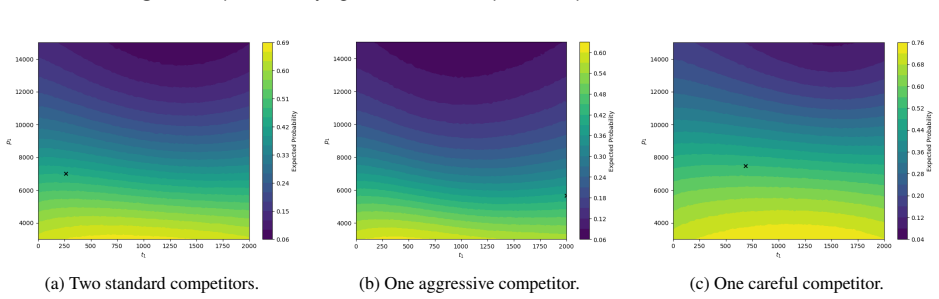
The central claim is that a company choosing launch features $\mathbf{x}_1$ should maximize its expected utility $\psi(\mathbf{x}_1) = \sum_{j=0}^{n} \binom{n}{j} \pi(\mathbf{x}_1)^j (1-\pi(\mathbf{x}_1))^{n-j} \, u_1(j\,p_1 - c_1)$, where the per-buyer purchase probability $\pi(\mathbf{x}_1)$ comes from a random-utility or multinomial-logit model that averages over buyer utility weights and competitors' random decisions. In the software case, with a non-homogeneous Poisson process for bugs and the cost model $c_1(t) = c_{11} t + c_{21} e_1(t) + c_{31}[e_1(T)-e_1(t)]$, the optimum is $(t_1^*, p_1^*) = (283,\,8333)$ with expected profit about 2.84 million when competitors are level-0, and $(263,\,7000)$ with lower profit when they are modeled as expected-utility maximizers. The paper argues this yields more realistic market-response predictions than standard game-theoretic treatments because it avoids common knowledge of competitors' utilities.
Load-bearing premise
The load-bearing premise is that real buyers choose as a CARA utility function with weights $\mathrm{Dir}(1,2,1)$ and risk aversion $\mathrm{Ga}(5,1)$ predicts; if buyers follow brand loyalty, social influence, or non-expected-utility rules, the recommended launch time and price could be materially suboptimal.
Editorial extensions
If this is right
- Firms using the framework obtain a contingency pricing curve $p_1^*(t_1)$: the optimal price for every possible release date, so a forced early or late launch still has a recommended price.
- Modeling competitors as strategic rather than passive lowers the optimal expected profit in the example from about 2.84 million to 2.28 million and changes the recommended price, showing that ignoring rival rationality overstates the value of a launch plan.
- When buyers can purchase several products under a budget, the optimal launch becomes earlier ($t_1^* = 101$ days), because buyer utility maximization rewards early availability.
- The framework extends to heterogeneous buyer segments by mixing binomial models across segments or using a hierarchical buyer-type model.
Reading between the lines
- The same machinery could be reused for other launch levers, such as marketing spend or post-launch support level, by widening the feature vector; the paper's examples only vary time, price, and quality.
- The closeness of the brute-force and Bayesian-optimization optima suggests the expected-utility surface is fairly flat, so a manager may prefer a set of near-optimal decisions over a point recommendation; the paper reports this visually but does not formalize it.
- The judgmental priors on buyer weights and risk aversion could be calibrated from stated-choice or real purchase data; a calibration step would test whether the computed optima survive under data-driven priors.
- Extending the level-0/level-1 hierarchy to deeper levels of strategic reasoning about competitors would connect the framework to experimental game theory; the paper stops at level-1 competitors.
Editorial analysis
A structured set of objections, weighed in public.
Referee Report
Summary. The paper proposes an adversarial risk analysis (ARA) framework to support product launch decisions, extending prior single-buyer software release work to multiple buyers, multiple competitors, and multiple purchase decisions. The supported company maximizes expected utility over launch timing and price, buyers choose according to a random-utility/MNL model with a parametric CARA utility, and competitors are modeled as uncertain expected-utility maximizers. The framework is illustrated on two software launch cases: a single-purchase setting with a binomial sales model, and a multiple-purchase setting in which buyers solve knapsack problems under budget constraints. Computations use Monte Carlo estimation with Bayesian optimization, simulated annealing, and brute-force grid search. Code and hyperparameter specifications are provided in a public repository.
Significance. If taken as a decision-support template, the paper is a useful methodological contribution: it extends ARA to a realistic product-launch setting, provides explicit Monte Carlo algorithms, publishes reproducible code, and includes sensitivity analyses over buyer risk aversion and post-release costs. The strategic-competitor implementation, however, does not match the ARA argmax model defined in Section 2, and the experiments are entirely synthetic with hand-picked priors, so the empirical illustrations support the framework only as a proof of concept, not as a validated practical tool.
major comments (3)
- [Section 3.4 vs. Section 2] The model in Section 2 defines each competitor's decision as X_i = argmax_{x_i in X_i} Psi(x_i), obtained by sampling the random ingredients and solving the resulting optimization. Section 3.4 instead states that competitors' launching decisions are 'random variables with probability density functions proportional to their expected utilities and sampled through MC.' These are different models: the former is expected-utility maximization under the ARA posterior, while the latter is a quantal-response/Luce stochastic choice rule that assigns positive probability to every suboptimal decision and whose mode need not equal the argmax. Consequently, the level-2 results in Section 3.4 (t1*=263, p1*=7000, expected profit 2,282,981) and the comparisons in Figures 7 and 8 do not follow from the adversarial model the paper advertises. The paper should either implement the Section 2 argmax sampling for competitors or explicitly reframe Section 3.4 as a separate stochastic-choice sensitivity model and justify that approximation.
- [Section 4] Section 4 states that with a budget distribution h(b), the purchase probability pi(t1,p1) = integral Prob(z1=1|b) h(b) db 'recovers a binomial purchase model.' With n i.i.d. budgets b_k, the purchase indicators are independent Bernoulli with different probabilities pi(b_k), so the total number of sales is Poisson-binomial (or a mixture over budgets), not Bin(n, pi). The Monte Carlo algorithm in Algorithm 2 does not rely on the binomial simplification, but the modeling claim in the text is incorrect as stated and should be corrected.
- [Section 3.3, Table 1] The three optimization methods return materially different optima: Bayesian optimization gives (t1*, p1*) = (356, 8162), simulated annealing gives (759, 7711), and brute force gives (283, 8333), with SA's expected profit about 2% below the brute-force value. No convergence diagnostics or repeated restarts are reported for BO and SA. Given the flat expected utility surface shown in Figure 3b, the paper should either report a set of near-optimal decisions or a robustness region, and should verify that the stochastic optimizers converge to the brute-force region with additional calls, before presenting a single point as 'the optimal decision.'
minor comments (5)
- [Figure 3b] The caption reports 'optimal price p1* = 9788', but Table 1 and the text give p1* = 8333 or 8162; this inconsistency should be fixed.
- [Algorithm 1, lines 9-11] The reuse of the symbol u_j for both the CARA utilities and their differences u_j - u_1 makes the algorithm harder to follow; using delta_j = u_j - u_1 would clarify the MNL computation.
- [Section 3.3] The paper introduces 'level-1' and 'level-2' adversary terminology informally; the relationship between Stahl-Wilson levels and the ARA treatment in Section 3.4 should be stated more precisely.
- [Equation (4)] Equation (4) writes the MNL probability with a linear weighted-additive utility exp(sum lambda_j o_j), while the implemented model in Algorithm 1 uses the CARA utility of Eq. (9). The notation should be reconciled.
- [Appendix A, item 4] The description of 'strategic level-1 adversaries' gives Beta distributions for release times and prices, but Section 3.4 says competitor decisions are sampled proportionally to expected utility; the interaction between these prior distributions and the utility-proportional sampling is not specified and should be clarified for reproducibility.
Circularity Check
No circularity; the Section 3.4 competitor implementation is a quantal-response mismatch, not a circular reduction.
full rationale
The paper's derivation chain is not circular. Section 2 defines the supported company's objective as maximizing expected utility psi(x1) = sum_j C(n,j) pi(x1)^j (1-pi)^(n-j) u1(j p1 - c1), with pi(x1) estimated either by Monte Carlo over random utilities and competitor decisions (Eq. 3) or by the MNL model (Eq. 4). Section 3.3 instantiates this with an explicitly stated CARA buyer utility (Eq. 9), Dir(1,2,1) and Ga(5,1) priors, and NHPP bug-count parameters sourced from Okumoto-Goel and Zeephongsekul-Chiera data; the optimal decisions (t1*=283, p1*=8333) are then computed by brute-force and Bayesian optimization over the resulting expected-utility surface. No parameter is fitted to the target decision, and no equation defines the output as an input. The self-citations (Soyer et al. 2025; Banks et al. 2015; Gonzalez-Ortega et al. 2018) are contextual or provide the utility form explicitly; the NHPP priors are externally grounded. The main caveat is Section 3.4: 'the competitors' launching decisions are modeled as random variables with probability density functions proportional to their expected utilities and sampled through MC,' which is a quantal-response/Luce assumption, not the argmax ARA model X_i = argmax Psi(x_i) defined in Section 2. This is an internal modeling inconsistency and a correctness risk for the level-2 results (t1*=263, p1*=7000), but it is not circularity: the competitor distribution is an input assumption, and the supported company's decision is computed from it, not equivalent to it by construction.
Assumptions & free parameters
free parameters (9)
- c11 (test cost per unit time) =
200 (scaled by 1000)
- c21 (cost per fault during testing) =
1000
- c31 (cost per fault after release) =
5000
- Dirichlet prior for buyer utility weights =
Dir(1,2,1)
- Gamma prior for buyer risk aversion rho =
Ga(5,1), mean 5
- Number of potential buyers n =
1000
- Buyer budget distribution in multi-purchase case =
U[10000,20000]
- Competitor priors in level-0 model =
T_j ~ U[0,2000], P_j ~ U[3000,15000], a_tilde ~ Gamma(1.638,0.610), c_tilde ~ Beta(2.019,0.394)
- Strategic competitor priors in level-1 model =
Beta(a,b) with (2,5) or (5,2) for time and price
assumptions (6)
- domain assumption Buyers maximize expected utility with random utilities.
- domain assumption The multinomial logit (Plackett-Luce) model is an appropriate discrete choice model.
- domain assumption Software failures follow a non-homogeneous Poisson process with a power-law mean function.
- domain assumption Purchasing decisions are independent across buyers.
- ad hoc to paper Competitors' decisions are sampled from distributions proportional to their expected utilities.
- domain assumption The company has probabilistic beliefs about competitors' utilities and decisions, without common knowledge.
Cite this review
Pith. "Pith review of Supporting product launching decisions with adversarial risk analysis." pith.science (2026). https://pith.science/paper/PJ556EA2
@misc{pith2026250524771,
  author       = {Pith},
  title        = {Pith review of: Supporting product launching decisions with adversarial risk analysis},
  year         = {2026},
  howpublished = {\url{https://pith.science/paper/PJ556EA2}},
  note         = {Machine review of arXiv:2505.24771}
}
read the original abstract
In a world of utility-driven marketing, each company acts as an adversary to other contenders, with all having competing interests. A major challenge for companies launching a new product is that, despite testing, flaws in their product can remain, potentially risking a loss in market share. However, delayed launch decisions can lead to losing first-mover advantages. Furthermore, each company generally has incomplete information on the launch strategy and the product quality of competing brands. From a buyer's perspective, along with the price, customers need to make their buying decisions based on noisy signals, e.g.\ regarding the quality of competing brands. This paper proposes how to support product launch decisions by a company in the presence of several competitors and multiple buyers, with the aid of adversarial risk analysis methods. We illustrate applications in two software launch cases that require deciding about timing, pricing, and quality, referring to single and multiple product purchases.
Figures


Figures from the paper (6 more)



Reference graph
Works this paper leans on
-
[1]
write newline
" write newline "" before.all 'output.state := FUNCTION n.dashify 't := "" t empty not t #1 #1 substring "-" = t #1 #2 substring "--" = not "--" * t #2 global.max substring 't := t #1 #1 substring "-" = "-" * t #2 global.max substring 't := while if t #1 #1 substring * t #2 global.max substring 't := if while FUNCTION word.in bbl.in ":" * " " * FUNCTION f...
-
[2]
author Assaf, A.G. , author Bu, R. , author Tsionas, M.G. , year 2020 . title A B ayesian approach to continuous type principal-agent problems . journal European Journal of Operational Research volume 280 , pages 1188--1192
work page 2020
-
[3]
author Au, T.C. , author Banks, D. , author Guo, Y. , year 2021 . title Numerical solution of asymmetric auctions . journal Decision Analysis volume 18 , pages 321--334
work page 2021
-
[4]
author Ay, A. , author Landon, J. , author Ruggeri, F. , author Soyer, R. , year 2023 . title A latent-factor self-exciting point process for software failures . journal Naval Research Logistics (NRL) volume 70 , pages 584--600
work page 2023
-
[5]
author Banks, D. , author Gallego, V. , author Naveiro, R. , author Ríos Insua, D. , year 2022 . title Adversarial risk analysis: An overview . journal WIREs Computational Statistics volume 14 , pages e1530
work page 2022
-
[6]
author Banks, D.L. , author Rios, J.M. , author Rios Insua, D. , year 2015 . title Adversarial Risk Analysis . publisher CRC Press
work page 2015
-
[7]
author Cacchiani, V. , author Iori, M. , author Locatelli, A. , author Martello, S. , year 2022 . title Knapsack problems—an overview of recent advances. P art II : M ultiple, multidimensional, and quadratic knapsack problems . journal Computers & Operations Research volume 143 , pages 105693
work page 2022
-
[8]
author Calantone, R.J. , author Di Benedetto, C.A. , year 2007 . title Clustering product launches by price and launch strategy . journal Journal of Business & Industrial Marketing volume 22 , pages 4--19
work page 2007
Show all 45 references
-
[9]
, author Ross, S.M
author Chen, K. , author Ross, S.M. , year 2014 . title An adaptive stochastic knapsack problem . journal European Journal of Operational Research volume 239 , pages 625--635
2014
-
[10]
, year 2001
author Chung, K.L. , year 2001 . title A Course in Probability Theory . publisher Academic Press
2001
-
[11]
, author Rios Insua, D.R
author Couce-Vieira, A. , author Rios Insua, D.R. , author Kosgodagan, A. , year 2020 . title Assessing and forecasting cybersecurity impacts . journal Decision Analysis volume 17 , pages 356--374
2020
-
[12]
, author Ben-Akiva, M
author De Palma, A. , author Ben-Akiva, M. , author Brownstone, D. , author Holt, C. , author Magnac, T. , author McFadden, D. , author Moffatt, P. , author Picard, N. , author Train, K. , author Wakker, P. , author Walker, J. , year 2008 . title Risk, uncertainty and discrete...
2008
-
[13]
, author Ma, B
author Deng, L. , author Ma, B. , year 2015 . title Application of adversarial risk analysis model in pricing strategies with remanufacturing . journal Jour. Indust. Eng. Mgt. volume 8 , pages 1--20
2015
-
[14]
, author Keane, M.P
author Erdem, T. , author Keane, M.P. , year 1996 . title Decision-making under uncertainty: Capturing dynamic brand choice processes in turbulent consumer goods markets . journal Mark- Sc. volume 15 , pages 1--20
1996
-
[15]
, author Rios Insua, D
author French, S. , author Rios Insua, D. , year 2000 . title Statistical Decision Theory . publisher Wiley
2000
-
[16]
, author Karp, L.S
author Golan, A. , author Karp, L.S. , author Perloff, J.M. , year 2000 . title Estimating C oke's and P epsi's price and advertising strategies . journal Journal of Business & Economic Statistics volume 18 , pages 398--409
2000
-
[17]
, author Rios, J
author Gomez, Y. , author Rios, J. , author Insua, D.R. , author Vila, J. , year 2025 . title Forecasting adversarial actions using judgment decomposition-recomposition . journal Int. Journ. Forecast. volume 41 , pages 76--91
2025
-
[18]
, author Radovic, V
author Gonz \'a lez-Ortega, J. , author Radovic, V. , author Rios Insua, D. , year 2018 . title Utility elicitation , in: booktitle Elicitation: The science and art of structuring judgement . publisher Springer , pp. pages 241--264
2018
-
[19]
, year 2020
author Gramacy, R.B. , year 2020 . title Surrogates: Gaussian process modeling, design, and optimization for the applied sciences . publisher CRC Press
2020
-
[20]
, author Gelman, A
author Hoffman, M.D. , author Gelman, A. , year 2014 . title The no- U -turn sampler: A daptively setting path lengths in H amiltonian M onte C arlo . journal Jour. Mach. Learn. Res. volume 15 , pages 1593--1623
2014
-
[21]
, author Karray, S
author Jafarzadeh , A. , author Karray, S. , author Azad, N. , year 2023 . title Price and quality competition while envisioning a quality-related product recall . journal Eur. Jour. Oper. Res. volume 311 , pages 486--501
2023
-
[22]
, author Du, T.C.t
author Li, F. , author Du, T.C.t. , author Wei, Y. , year 2019 . title Offensive pricing strategies for online platforms . journal International Journal of Production Economics volume 216 , pages 287--304
2019
-
[23]
, author Xiao, Q
author Li, H. , author Xiao, Q. , author Peng, T. , year 2023 . title Optimal pricing strategy of new products and remanufactured products considering consumers’ switching purchase behavior . journal Sustainability volume 15 , pages 5246
2023
-
[24]
, author Zhou, Y.W
author Lin, X. , author Zhou, Y.W. , author Xie, W. , author Zhong, Y. , author Cao, B. , year 2020 . title Pricing and product-bundling strategies for e-commerce platforms with competition . journal Eur. Jour. Oper. Res. volume 283 , pages 1026--1039
2020
-
[25]
, year 1959
author Luce, R.D. , year 1959 . title Individual Choice Behavior . volume volume 4 . publisher Wiley New York
1959
-
[26]
, author Chou, M.C
author Lyu, G. , author Chou, M.C. , author Teo, C.P. , author Zheng, Z. , author Zhong, Y. , year 2022 . title Stochastic knapsack revisited: The service level perspective . journal Operations Research volume 70 , pages 729--747
2022
-
[27]
, year 1973
author McFadden, D. , year 1973 . title Conditional logit analysis of qualitative choice behavior , in: booktitle P. Zarembka (Ed.), Frontiers in Econometrics. . publisher New York: Academic Press , pp. pages 2373--2375
1973
-
[28]
, author Hoshino, T
author Miyazaki, K. , author Hoshino, T. , author B \"o ckenholt, U. , year 2021 . title Dynamic two stage modeling for category-level and brand-level purchases using potential outcome approach with B ayes inference . journal Journal of Business & Economic Statistics volume 39...
2021
-
[29]
, author Goel, A.L
author Okumoto, K. , author Goel, A.L. , year 1979 . title Optimum release time for software systems based on reliability and cost criteria . journal Journal of Systems and Software volume 1 , pages 315--318
1979
-
[30]
, author Fong, D.K
author Pammer, S.E. , author Fong, D.K. , author Arnold, S.F. , year 2000 . title Forecasting the penetration of a new product—a B ayesian approach . journal Journal Business & Economic Statistics volume 18 , pages 428--435
2000
-
[31]
, year 1975
author Plackett, R.L. , year 1975 . title The analysis of permutations . journal Journal of the Royal Statistical Society. Series C (Applied Statistics) volume 24 , pages 193--202
1975
-
[32]
, year 2007
author Poulsen, A.U. , year 2007 . title Information and endogenous first-mover advantages in the ultimatum game: An evolutionary approach . journal Journ. Econ. Behav. & Organ. volume 64 , pages 129--143
2007
-
[33]
, year 2022
author Powell, W.B. , year 2022 . title Reinforcement Learning and Stochastic Optimization: A Unified Framework for Sequential Decisions . publisher Wiley
2022
-
[34]
, author Naveiro, R
author Rasines, D.G. , author Naveiro, R. , author Insua, D.R. , author Santana, S.R. , year 2024 . title Personalized pricing decisions through adversarial risk analysis . journal Int. Trans. Op. Res
2024
-
[35]
, author Ruggeri, F
author Rios Insua, D. , author Ruggeri, F. , author Wiper, M. , year 2012 . title Bayesian Analysis of Stochastic Process Models . publisher Wiley
2012
-
[36]
, author Soyer, R
author Ruggeri, F. , author Soyer, R. , year 2018 . title Decision models for software testing , in: editor Kenett, R. , editor Ruggeri, F. , editor Faltin, F. (Eds.), booktitle Analytic Methods in Systems and Software Testing . publisher John Wiley & Sons , address Chichester...
2018
-
[37]
, author Ruggeri, F
author Soyer, R. , author Ruggeri, F. , author Rios Insua, D. , author Pierce, C. , author Guevara, C. , year 2025 . title An adversarial risk analysis framework for software release decision support . journal Risk Analysis , pages 1--23
2025
-
[38]
, author Wilson, P.W
author Stahl, D.O. , author Wilson, P.W. , year 1995 . title On players' models of other players: Theory and experimental evidence . journal Games and Economic Behavior volume 10 , pages 218--254
1995
-
[39]
, author Akhavizadegan, F
author Taleizadeh, A.A. , author Akhavizadegan, F. , author Ansarifar, J. , year 2019 . title Pricing and quality level decisions of substitutable products in online and traditional selling channels: game-theoretical approaches . journal Int. Trans. Oper. Res. volume 26 , page...
2019
-
[40]
, year 2003
author Train, K. , year 2003 . title Discrete Choice Models with Simulation . publisher Cambridge U.P
2003
-
[41]
, author Song, H
author Wang, L. , author Song, H. , author Wang, Y. , year 2017 . title Pricing and service decisions of complementary products in a dual-channel supply chain . journal Comp. Ind. Engin. volume 105 , pages 223--233
2017
-
[42]
, author Ke, C
author Wang, R. , author Ke, C. , author Cui, S. , year 2022 . title Product price, quality, and service decisions under consumer choice models . journal Manuf. & Serv. Oper. Manag. volume 24 , pages 430--447
2022
-
[43]
, author Zhao, J
author Wei, J. , author Zhao, J. , author Li, Y. , year 2013 . title Pricing decisions for complementary products with firms' different market powers . journal European Journal of Operational Research volume 224 , pages 507--519
2013
-
[44]
, author Lai, J.Y
author Wu, C.H. , author Lai, J.Y. , year 2019 . title Dynamic pricing and competitive time-to-market strategy of new product launch under a multistage duopoly . journal Eur. Jour. Oper. Res. volume 277 , pages 138--152
2019
-
[45]
, author Chiera, C
author Zeephongsekul, P. , author Chiera, C. , year 1995 . title Optimal software release policy based on a two-person game of timing . journal Journal of Applied Probability volume 32 , pages 470--481
1995
Reviewed August 7, 2026 · model on record in the stance chip above.
Discussion (0). Sign in to comment.