REVIEW 2 major objections 4 minor 55 references
Context is Gold to find the Gold Passage: Evaluating and Training Contextual Document Embeddings
T0 review · 2 major / 4 minor · reviewed 2026-08-07 · deepseek-v4-flash
Pith's one-line read Chunk embeddings that can see the whole document beat independent chunk embeddings on context-dependent retrieval, and a cheap contrastive post-training method, InSeNT, delivers most of the gain.
desk verdict The paper delivers a genuinely useful benchmark for context-dependent retrieval and a cheap, effective training method, but the 'no sacrifice' claim is overstated and the training/evaluation split overlap needs to be checked. read the letter →
The pith
A machine-rendered reading of the paper's core claim, the machinery that carries it, and where it could break.
The reading
What carries the argument
Late chunking, extended by the InSeNT objective. Late chunking runs the entire document through the encoder in one forward pass and average-pools token representations over each chunk's span, letting chunk embeddings see the rest of the document before pooling. InSeNT trains this with a weighted InfoNCE loss that combines standard in-batch negatives from other documents with “in-sequence” negatives drawn from other chunks of the same document; $\lambda_{\text{seq}}$ controls the mix, and the same loss extends to late-interaction models by substituting ColBERT's MaxSim for the dot product. The in-sequence term is what prevents all chunks of a document from collapsing into one indistinguishable representation.
What would settle it
Re-run the ConTEB evaluation on MLDR, NarrativeQA, and SQuAD using held-out splits that are provably disjoint from the InSeNT training set and compare nDCG@10; if the in-domain gains shrink to near the non-contextual baseline, the headline improvements come from train/evaluation overlap rather than from context propagation.
Extended reading notes
Core claim
The central claim is that chunk-level retrieval embeddings should be computed with access to the whole source document, and that this can be trained for efficiently. The paper shows that standard single-vector and late-interaction embedders fail on ConTEB's context-dependent tasks (e.g., Insurance nDCG@10 of 12.4 for ModernBERT-Large vs. 100.0 after InSeNT), while untrained late chunking alone already helps on controlled tasks. InSeNT adds same-document chunks as hard negatives to a contrastive objective, so each chunk absorbs document-level information while staying distinguishable from its neighbors. The authors report that this post-training costs about one H100 GPU hour per epoch, preserves NanoBEIR non-contextual performance, and makes retrieval more robust to poor chunking and larger corpora.
Load-bearing premise
The load-bearing premise is that the ConTEB evaluation sets for MLDR, NarrativeQA, and SQuAD are disjoint from the training splits used to train InSeNT; the paper does not state which splits ConTEB evaluates, so if any query-chunk pair appears in both, the reported in-domain gains would be inflated.
Editorial extensions
If this is right
- On ConTEB's controlled tasks, context-aware retrieval can jump from near-random to near-perfect: Insurance goes from 12.4 to 100.0 nDCG@10 for ModernBERT-Large with InSeNT.
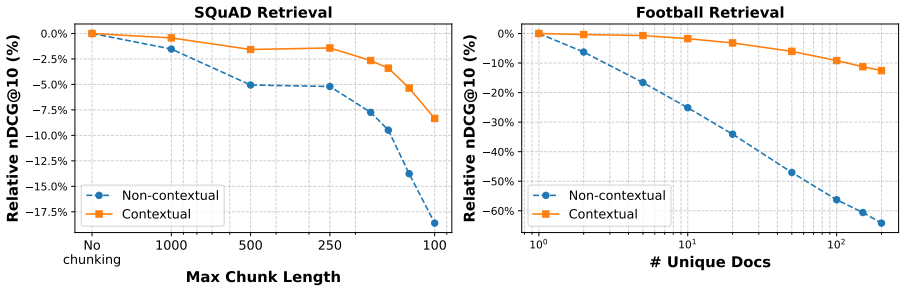
- InSeNT-trained chunk embeddings tolerate much smaller, less self-contained chunks without the usual retrieval collapse.
- Contextual chunk embeddings degrade more gracefully as the corpus grows with many similar documents, a common industrial condition.
- The method adds almost no indexing cost (about 15 ms per document for ModernBERT-Large + InSeNT) and avoids the 120x slowdown of LLM-based contextual retrieval.
- Short-context retrieval on NanoBEIR is not sacrificed when hyperparameters are tuned ($\lambda_{\text{seq}} = 0.1$).
Reading between the lines
- Editorial extension: if chunk embeddings reliably inherit document context, then chunking strategy itself becomes less critical, and systems could use much smaller chunks to improve downstream answer granularity.
- Editorial extension: the in-sequence negative principle should transfer to decoder-based long-context embedders, where whole-book encoding could make context propagation even stronger; the paper names this as future work.
- Editorial extension: one testable consequence is that InSeNT should help most on corpora full of templated documents that differ by a few key fields; the robustness-to-corpus-size result suggests this, but it is not measured directly.
Editorial analysis
A structured set of objections, weighed in public.
Referee Report
Summary. The paper introduces ConTEB, a benchmark for evaluating whether text embedding models exploit document-wide context when encoding chunks, and InSeNT, a contrastive post-training objective that combines in-batch and in-sequence negatives with late chunking. On ConTEB, InSeNT substantially improves nDCG@10 over the late-chunking baseline for ModernBERT and ModernColBERT, with the largest gains on the controlled Football/Geography/Insurance tasks. The paper also reports ablations on the in-sequence weight, chunking robustness, and corpus scaling, and it releases the benchmark, models, and training data.
Significance. If the results hold, the paper makes a useful contribution: it provides a public benchmark for context-aware chunk retrieval and a cheap post-training procedure that improves contextualization without the inference cost of LLM-based reformulation. The release of all artifacts, the clear ablation isolating the role of in-sequence vs. in-batch negatives, and the demonstration that concatenated short documents do not substitute for organic long documents are concrete strengths. The main claims rest on two points that need verification: split disjointness between training and evaluation, and the statement that InSeNT improves retrieval 'without sacrificing base model performance.'
major comments (2)
- [§3.3 and Table 1] The paper does not establish that the ConTEB evaluation sets for MLDR, NarrativeQA, and SQuAD are disjoint from the InSeNT training data. Section 3.3 states that the released training set includes the training splits of MLDR and NarrativeQA and that SQuAD chunks are concatenated, without restricting SQuAD to a non-training split; Table 1 lists MLDR, NarrativeQA, and SQuAD among the in-domain ConTEB tasks; and the evaluation section never states which original splits are used. If any evaluation documents or query-chunk pairs appear in the training data, the reported in-domain gains (e.g., MLDR 78.4 to 88.7, SQuAD 73.4 to 80.9, NarrativeQA 77.9 to 81.3) are inflated and would propagate to the headline average. Please state the evaluation split for each dataset explicitly and, since the artifacts are released, provide an overlap check between training and evaluation instances.
- [Abstract and §5, Table 2] The abstract claims InSeNT improves retrieval 'without sacrificing base model performance,' but the NanoBEIR column of Table 2 shows ModernBERT Large dropping from 63.2 to 60.4 and ModernColBERT dropping from 67.7 to 59.2 after InSeNT training. The 'Short-Context Performance' paragraph in §5 asserts that 'careful hyperparameter tuning enables our best model to maintain strong performance,' but no confidence intervals or significance tests are given, so a 2.8-point drop (and an 8.5-point drop for the ColBERT variant) cannot be claimed to be non-significant. Please either soften the claim to acknowledge a measurable NanoBEIR degradation or provide statistical evidence that the difference is within noise.
minor comments (4)
- [References] References are duplicated: Warner et al. 2024a and 2024b are the same paper, Nussbaum et al. 2024 and 2025 share the same title, and Zhong et al. 2025a and 2025b are duplicates. Please consolidate these entries.
- [§3.2] The 'Sabotage' step uses LLM-reformulated paragraphs and LLM-generated questions for the controlled tasks, so the conclusion that 'state-of-the-art embedding models struggle' should be framed as a property of the constructed benchmark rather than a universal deficiency of non-contextual encoders.
- [Figure 4 (left)] The x-axis label 'Max Chunk Length' with a 'No chunking' category is unclear; please specify how the 'no chunking' condition is constructed and how relative nDCG@10 is computed.
- [Appendix C.3] The observation that naively feeding documents longer than 8,192 tokens to ModernBERT outperforms the sliding-window approach is surprising; please provide implementation details (e.g., truncation, position embeddings) given that the base model was trained with an 8,192-token context.
Circularity Check
No significant circularity: ConTEB is an explicitly constructed context stress test and InSeNT's central gains are supported by out-of-domain tasks and an external non-regression benchmark; the in-domain split-disjointness caveat is a data-provenance risk, not a demonstrated circular step.
full rationale
The paper's derivation chain is self-contained: InSeNT is a contrastive post-training objective defined in Equation 1, trained on a released dataset (Section 3.3) on top of pretrained embedders, and evaluated on ConTEB plus NanoBEIR. The ConTEB controlled tasks are openly constructed to require context: Section 3.2's 'Sabotage' stage reformulates chunks to 'remove explicit mentions of the original document's theme' and 'explicitly enforc[e] the need for context.' Therefore, the observation that non-contextual models struggle on those tasks is a property of the deliberately designed stress test rather than a discovered law; however, the paper presents this as a benchmark design choice, not as a prediction derived from a fitted parameter. The central contribution—InSeNT outperforming untrained late chunking and a same-data non-contextual training baseline—is not forced by construction: the non-contextual ModernBERT model trained on the same data does not improve over the untrained baseline, and the largest gains occur on out-of-domain controlled tasks (Football 19.1 to 63.9, Insurance 12.4 to 100.0). NanoBEIR provides an external non-regression check. Self-citations are incidental (e.g., Macé et al. 2025 as the ESG data source, Faysse et al. 2025 as future work) and do not carry the load-bearing argument. One caveat is data provenance: Section 3.3 says the training set 'includes the training splits of MLDR and NarrativeQA' and also 'concatenate[s] SQuAD chunks,' while Table 1 lists MLDR, NarrativeQA, and SQuAD as in-domain ConTEB tasks, and the paper never explicitly states that the evaluation splits are disjoint from the training data. This is a potential leakage or validity risk, but because the paper text does not exhibit an actual query-chunk overlap between training and evaluation, it is not counted as circularity under the hard-evidence rule.
Assumptions & free parameters
free parameters (2)
- λseq =
0.1
- temperature τ
assumptions (4)
- domain assumption Late chunking propagates document-level context to chunk representations through a single forward pass over the concatenated document.
- domain assumption Using chunks from the same document as hard negatives in contrastive training makes representations both contextual and specific.
- domain assumption GPT-4o-generated queries and paragraph rephrasings are valid, unbiased supervision for context-dependent retrieval.
- ad hoc to paper The ConTEB evaluation splits for MLDR, NarrativeQA, and SQuAD are disjoint from the training splits used for InSeNT.
Cite this review
Pith. "Pith review of Context is Gold to find the Gold Passage: Evaluating and Training Contextual Document Embeddings." pith.science (2026). https://pith.science/paper/BU55T2XD
@misc{pith2026250524782,
  author       = {Pith},
  title        = {Pith review of: Context is Gold to find the Gold Passage: Evaluating and Training Contextual Document Embeddings},
  year         = {2026},
  howpublished = {\url{https://pith.science/paper/BU55T2XD}},
  note         = {Machine review of arXiv:2505.24782}
}
read the original abstract
A limitation of modern document retrieval embedding methods is that they typically encode passages (chunks) from the same documents independently, often overlooking crucial contextual information from the rest of the document that could greatly improve individual chunk representations. In this work, we introduce ConTEB (Context-aware Text Embedding Benchmark), a benchmark designed to evaluate retrieval models on their ability to leverage document-wide context. Our results show that state-of-the-art embedding models struggle in retrieval scenarios where context is required. To address this limitation, we propose InSeNT (In-sequence Negative Training), a novel contrastive post-training approach which combined with late chunking pooling enhances contextual representation learning while preserving computational efficiency. Our method significantly improves retrieval quality on ConTEB without sacrificing base model performance. We further find chunks embedded with our method are more robust to suboptimal chunking strategies and larger retrieval corpus sizes. We open-source all artifacts at https://github.com/illuin-tech/contextual-embeddings.
Figures


Figures from the paper (3 more)


Reference graph
Works this paper leans on
-
[1]
online" 'onlinestring :=
ENTRY address archivePrefix author booktitle chapter edition editor eid eprint eprinttype howpublished institution journal key month note number organization pages publisher school series title type volume year doi pubmed url lastchecked label extra.label sort.label short.list INTEGERS output.state before.all mid.sentence after.sentence after.block STRING...
-
[2]
write newline
" write newline "" before.all 'output.state := FUNCTION n.dashify 't := "" t empty not t #1 #1 substring "-" = t #1 #2 substring "--" = not "--" * t #2 global.max substring 't := t #1 #1 substring "-" = "-" * t #2 global.max substring 't := while if t #1 #1 substring * t #2 global.max substring 't := if while FUNCTION word.in bbl.in capitalize " " * FUNCT...
-
[3]
Zeyuan Allen-Zhu . 2024. ICML 2024 Tutorial: Physics of Language Models . Project page: https://physics.allen-zhu.com/
work page 2024
-
[4]
Anthropic. 2024. https://www.anthropic.com/news/contextual-retrieval Introducing contextual retrieval . Accessed: 2025-02-10
work page 2024
-
[5]
Akari Asai, Zeqiu Wu, Yizhong Wang, Avirup Sil, and Hannaneh Hajishirzi. 2023. https://arxiv.org/abs/2310.11511 Self-rag: Learning to retrieve, generate, and critique through self-reflection . Preprint, arXiv:2310.11511
arXiv 2023
-
[6]
Nicolas Boizard, Hippolyte Gisserot-Boukhlef, Duarte M. Alves, André Martins, Ayoub Hammal, Caio Corro, Céline Hudelot, Emmanuel Malherbe, Etienne Malaboeuf, Fanny Jourdan, Gabriel Hautreux, João Alves, Kevin El-Haddad, Manuel Faysse, Maxime Peyrard, Nuno M. Guerreiro, Patrick Fernandes, Ricardo Rei, and Pierre Colombo. 2025. https://arxiv.org/abs/2503.05...
arXiv 2025
-
[7]
Antoine Chaffin. 2025 a . https://huggingface.co/lightonai/GTE-ModernColBERT-v1 Gte-moderncolbert
work page 2025
-
[8]
Antoine Chaffin. 2025 b . https://huggingface.co/lightonai/modernbert-embed-large Modernbert-embed-large
work page 2025
Show all 55 references
-
[9]
Antoine Chaffin and Raphaël Sourty. 2024. https://github.com/lightonai/pylate Pylate: Flexible training and retrieval for late interaction models
2024
-
[10]
Harrison Chase. 2022. https://github.com/langchain-ai/langchain LangChain
2022
- [11]
-
[12]
Darren Edge, Ha Trinh, Newman Cheng, Joshua Bradley, Alex Chao, Apurva Mody, Steven Truitt, and Jonathan Larson. 2024. https://arxiv.org/abs/2404.16130 From local to global: A graph rag approach to query-focused summarization . Preprint, arXiv:2404.16130
2024 arXiv
-
[13]
Manuel Faysse, Hugues Sibille, Tony Wu, Bilel Omrani, Gautier Viaud, Céline Hudelot, and Pierre Colombo. 2025. https://arxiv.org/abs/2407.01449 Colpali: Efficient document retrieval with vision language models . Preprint, arXiv:2407.01449
2025 arXiv
-
[14]
Gemini Team , Petko Georgiev, Ving Ian Lei, Ryan Burnell, Libin Bai, Anmol Gulati, Garrett Tanzer, Damien Vincent, Zhufeng Pan, Shibo Wang, Soroosh Mariooryad, Yifan Ding, Xinyang Geng, Fred Alcober, Roy Frostig, Mark Omernick, Lexi Walker, Cosmin Paduraru, Christina Sorokin, ...
2024 arXiv
-
[15]
Hippolyte Gisserot-Boukhlef, Manuel Faysse, Emmanuel Malherbe, Céline Hudelot, and Pierre Colombo. 2024. https://arxiv.org/abs/2402.12997 Towards trustworthy reranking: A simple yet effective abstention mechanism . Preprint, arXiv:2402.12997
2024 arXiv
-
[16]
Michael Günther, Isabelle Mohr, Daniel James Williams, Bo Wang, and Han Xiao. 2024. https://arxiv.org/abs/2409.04701 Late chunking: Contextual chunk embeddings using long-context embedding models . Preprint, arXiv:2409.04701
2024 arXiv
- [17]
-
[18]
Ziyan Jiang, Xueguang Ma, and Wenhu Chen. 2024. https://arxiv.org/abs/2406.15319 Longrag: Enhancing retrieval-augmented generation with long-context llms . Preprint, arXiv:2406.15319
2024 arXiv
- [19]
- [20]
-
[21]
Tomáš Kočiský, Jonathan Schwarz, Phil Blunsom, Chris Dyer, Karl Moritz Hermann, Gábor Melis, and Edward Grefenstette. 2017. https://arxiv.org/abs/1712.07040 The narrativeqa reading comprehension challenge . Preprint, arXiv:1712.07040
2017 arXiv
-
[22]
Chankyu Lee, Rajarshi Roy, Mengyao Xu, Jonathan Raiman, Mohammad Shoeybi, Bryan Catanzaro, and Wei Ping. 2024. https://arxiv.org/abs/2405.17428 Nv-embed: Improved techniques for training llms as generalist embedding models . Preprint, arXiv:2405.17428
2024 arXiv
- [23]
-
[24]
Zehan Li, Xin Zhang, Yanzhao Zhang, Dingkun Long, Pengjun Xie, and Meishan Zhang. 2023. https://arxiv.org/abs/2308.03281 Towards general text embeddings with multi-stage contrastive learning . Preprint, arXiv:2308.03281
2023 arXiv
-
[25]
Jerry Liu. 2022. https://doi.org/10.5281/zenodo.1234 LlamaIndex
2022 doi
-
[26]
Xueguang Ma, Sheng-Chieh Lin, Minghan Li, Wenhu Chen, and Jimmy Lin. 2024. https://arxiv.org/abs/2406.11251 Unifying multimodal retrieval via document screenshot embedding . Preprint, arXiv:2406.11251
2024 arXiv
-
[27]
Quentin Macé, António Loison, and Manuel Faysse. 2025. https://arxiv.org/abs/2505.17166 Vidore benchmark v2: Raising the bar for visual retrieval . Preprint, arXiv:2505.17166
2025
-
[28]
Timo M \"o ller, Anthony Reina, Raghavan Jayakumar, and Malte Pietsch. 2020. https://aclanthology.org/2020.nlpcovid19-acl.18/ COVID-QA : A question answering dataset for COVID -19 . In Proceedings of the 1st Workshop on NLP for COVID-19 at ACL 2020 , Online. Association for Co...
2020
-
[29]
Morris and Alexander M
John X. Morris and Alexander M. Rush. 2024. https://arxiv.org/abs/2410.02525 Contextual document embeddings . Preprint, arXiv:2410.02525
2024 arXiv
- [30]
-
[31]
Zhao, Yi Luan, Keith B
Jianmo Ni, Chen Qu, Jing Lu, Zhuyun Dai, Gustavo Hernández Ábrego, Ji Ma, Vincent Y. Zhao, Yi Luan, Keith B. Hall, Ming-Wei Chang, and Yinfei Yang. 2021. https://arxiv.org/abs/2112.07899 Large dual encoders are generalizable retrievers . Preprint, arXiv:2112.07899
2021 arXiv
-
[33]
Morris, Brandon Duderstadt, and Andriy Mulyar
Zach Nussbaum, John X. Morris, Brandon Duderstadt, and Andriy Mulyar. 2025. https://arxiv.org/abs/2402.01613 Nomic embed: Training a reproducible long context text embedder . Preprint, arXiv:2402.01613
2025 arXiv
- [34]
-
[35]
Mykhailo Poliakov and Nadiya Shvai. 2024. https://arxiv.org/abs/2406.13213 Multi-meta-rag: Improving rag for multi-hop queries using database filtering with llm-extracted metadata . Preprint, arXiv:2406.13213
2024 arXiv
-
[36]
Hongjin Qian, Zheng Liu, Kelong Mao, Yujia Zhou, and Zhicheng Dou. 2024. https://arxiv.org/abs/2402.09760 Grounding language model with chunking-free in-context retrieval . Preprint, arXiv:2402.09760
2024 arXiv
-
[37]
Pranav Rajpurkar, Jian Zhang, Konstantin Lopyrev, and Percy Liang. 2016. https://doi.org/10.18653/v1/D16-1264 SQ u AD : 100,000+ questions for machine comprehension of text . In Proceedings of the 2016 Conference on Empirical Methods in Natural Language Processing, pages 2383-...
2016 doi
- [38]
-
[39]
Robertson, Steve Walker, Susan Jones, Micheline Hancock-Beaulieu, and Mike Gatford
Stephen E. Robertson, Steve Walker, Susan Jones, Micheline Hancock-Beaulieu, and Mike Gatford. 1994. http://trec.nist.gov/pubs/trec3/papers/city.ps.gz Okapi at TREC -3 . In Proceedings of The Third Text REtrieval Conference , TREC 1994, Gaithersburg , Maryland , USA , November...
1994
-
[40]
Fu, Simran Arora, Neel Guha, and Christopher Ré
Jon Saad-Falcon, Daniel Y. Fu, Simran Arora, Neel Guha, and Christopher Ré. 2024. https://arxiv.org/abs/2402.07440 Benchmarking and building long-context retrieval models with loco and m2-bert . Preprint, arXiv:2402.07440
2024 arXiv
-
[41]
Parth Sarthi, Salman Abdullah, Aditi Tuli, Shubh Khanna, Anna Goldie, and Christopher D. Manning. 2024. https://arxiv.org/abs/2401.18059 Raptor: Recursive abstractive processing for tree-organized retrieval . Preprint, arXiv:2401.18059
2024 arXiv
- [42]
-
[43]
Nandan Thakur, Jimmy Lin, Sam Havens, Michael Carbin, Omar Khattab, and Andrew Drozdov. 2025. https://arxiv.org/abs/2504.13128 Freshstack: Building realistic benchmarks for evaluating retrieval on technical documents . Preprint, arXiv:2504.13128
2025 arXiv
- [44]
-
[45]
Harsh Trivedi, Niranjan Balasubramanian, Tushar Khot, and Ashish Sabharwal. 2023. https://arxiv.org/abs/2212.10509 Interleaving retrieval with chain-of-thought reasoning for knowledge-intensive multi-step questions . Preprint, arXiv:2212.10509
2023 arXiv
-
[46]
Ke Wang, Nikolaos Dimitriadis, Alessandro Favero, Guillermo Ortiz-Jimenez, Francois Fleuret, and Pascal Frossard. 2025. https://arxiv.org/abs/2410.17146 Lines: Post-training layer scaling prevents forgetting and enhances model merging . Preprint, arXiv:2410.17146
2025 arXiv
- [47]
-
[48]
Liang Wang, Nan Yang, Xiaolong Huang, Linjun Yang, Rangan Majumder, and Furu Wei. 2024. https://arxiv.org/abs/2401.00368 Improving text embeddings with large language models . Preprint, arXiv:2401.00368
2024 arXiv
-
[50]
Benjamin Warner, Antoine Chaffin, Benjamin Clavié, Orion Weller, Oskar Hallström, Said Taghadouini, Alexis Gallagher, Raja Biswas, Faisal Ladhak, Tom Aarsen, Nathan Cooper, Griffin Adams, Jeremy Howard, and Iacopo Poli. 2024 b . https://arxiv.org/abs/2412.13663 Smarter, better...
2024 arXiv
-
[51]
Wenhan Xiong, Xiang Lorraine Li, Srini Iyer, Jingfei Du, Patrick Lewis, William Yang Wang, Yashar Mehdad, Wen tau Yih, Sebastian Riedel, Douwe Kiela, and Barlas Oğuz. 2021. https://arxiv.org/abs/2009.12756 Answering complex open-domain questions with multi-hop dense retrieval ...
2021 arXiv
-
[52]
Peng Xu, Wei Ping, Xianchao Wu, Lawrence McAfee, Chen Zhu, Zihan Liu, Sandeep Subramanian, Evelina Bakhturina, Mohammad Shoeybi, and Bryan Catanzaro. 2024. https://arxiv.org/abs/2310.03025 Retrieval meets long context large language models . Preprint, arXiv:2310.03025
2024 arXiv
-
[53]
An Yang, Bowen Yu, Chengyuan Li, Dayiheng Liu, Fei Huang, Haoyan Huang, Jiandong Jiang, Jianhong Tu, Jianwei Zhang, Jingren Zhou, Junyang Lin, Kai Dang, Kexin Yang, Le Yu, Mei Li, Minmin Sun, Qin Zhu, Rui Men, Tao He, and 9 others. 2025. https://arxiv.org/abs/2501.15383 Qwen2....
2025 arXiv
-
[54]
Xin Zhang, Yanzhao Zhang, Dingkun Long, Wen Xie, Ziqi Dai, Jialong Tang, Huan Lin, Baosong Yang, Pengjun Xie, Fei Huang, and 1 others. 2024. mgte: Generalized long-context text representation and reranking models for multilingual text retrieval. In Proceedings of the 2024 Conf...
2024
-
[56]
Zijie Zhong, Hanwen Liu, Xiaoya Cui, Xiaofan Zhang, and Zengchang Qin. 2025 b . https://arxiv.org/abs/2406.00456 Mix-of-granularity: Optimize the chunking granularity for retrieval-augmented generation . Preprint, arXiv:2406.00456
2025 arXiv
-
[57]
Yang Zhou, Hongyi Liu, Zhuoming Chen, Yuandong Tian, and Beidi Chen. 2025. https://arxiv.org/abs/2502.05252 Gsm-infinite: How do your llms behave over infinitely increasing context length and reasoning complexity? Preprint, arXiv:2502.05252
2025 arXiv
-
[58]
Dawei Zhu, Liang Wang, Nan Yang, Yifan Song, Wenhao Wu, Furu Wei, and Sujian Li. 2024. https://arxiv.org/abs/2404.12096 Longembed: Extending embedding models for long context retrieval . Preprint, arXiv:2404.12096
2024 arXiv
Reviewed August 7, 2026 · model on record in the stance chip above.
Discussion (0). Sign in to comment.