REVIEW 3 major objections 7 minor 38 references
AFIRE: Accurate and Fast Image Reconstruction Algorithm for Geometric-inconsistent Multispectral CT
T0 review · 3 major / 7 minor · reviewed 2026-08-07 · deepseek-v4-flash
Pith's one-line read The paper claims geometric-inconsistent multispectral CT can be solved by a simplified Newton iteration whose Jacobian at zero factorizes into projection matrices and a tiny 2×2 matrix, with a convergence proof.
desk verdict Nice factorization-based simplified Newton method for geometric-inconsistent spectral CT, but the convergence theorem's key contraction condition is never checked for the experiments it claims to confirm. read the letter →
The pith
A machine-rendered reading of the paper's core claim, the machinery that carries it, and where it could break.
The reading
What carries the argument
The carrying object is the identity $\nabla K(\hat f) = -P\otimes\phi$, where $\otimes$ denotes block multiplication: the $Q\times D$ matrix $\phi$ is applied to the $D$ basis-image updates after each per-spectrum projection matrix $P_q$ has acted on the residual. The matrix $\phi$ is defined by $\phi_d^{(q)} = (\hat w^{(q)})^T b_d$, i.e., the spectrum-weighted average of the mass-attenuation vector $b_d$ at the special point, making it a $Q\times D$ matrix (size $2\times2$ in the dual-energy tests). The actual iteration (29) applies an approximate inverse $P^{+}$ to each spectrum's residual and then mixes the results with the small inverse $\phi^{-1}$, so a single outer step costs about one filtered back-projection per spectrum. The convergence argument is carried by a uniform bound $\tilde\eta$ on how far the per-ray weight vector $w_j^{(q)}(f)$ can depart from $\hat w^{(q)}$, combined with the scaled condition number $\kappa_F(P\otimes\phi)$ to control the resulting perturbation of the Jacobian.
What would settle it
Estimate $\tilde\eta$ by maximizing $\bigl|b_d^T(w_j^{(q)}(f)-\hat w^{(q)})\bigr|/\bigl|b_d^T \hat w^{(q)}\bigr|$ over rays, unit-simplex weights, and $d$, and evaluate $\kappa_F(P\otimes\phi)$ for the actual $P$ built from the two inconsistent parallel-beam geometries. If $\gamma = \tilde\eta\,\kappa_F(P\otimes\phi)\ge 1$, or if the FBP-based residual bound (34) is violated at the reported iteration counts, then the hypotheses of Theorem 2 do not hold for the experiments that are used to demonstrate convergence.
Extended reading notes
Core claim
The central discovery is a factorization of the Jacobian of the discrete forward map at a point whose ray integrals are constant: $\nabla K(\hat f) = -P\otimes\phi$ (Eq. (26)), where $P = \operatorname{diag}(P_1,\ldots,P_Q)$ is the block-diagonal matrix of the projection matrices of the $Q$ spectra and $\phi$ is the small $Q\times D$ matrix with entries $\phi_d^{(q)} = (\hat w^{(q)})^T b_d$ (Eq. (25)). Because $\phi$ is tiny, the inverse of the Jacobian is effectively the per-spectrum inverse of the projections followed by a $D\times D$ matrix multiplication. This yields the simplified Newton iteration $f^{k+1} = f^k - \phi^{-1}\otimes P^{+}(g - K(f^k))$, where $P^{+}$ is any sufficiently accurate approximate inverse such as filtered back-projection. The paper proves global convergence to the unique solution of the discrete system when the approximate-inverse residual satisfies (34) and the contraction factor $\gamma = \tilde\eta\,\kappa_F(P\otimes\phi)$ is below one, and it reports numerical convergence in the tested DECT geometries within tens of iterations.
Load-bearing premise
The proof for the inconsistent case rests on the discrete theorem, which assumes an unquantified bound on how much the per-ray energy weights change and that this change times the scaled condition number of the block system stays below one; neither is checked for the test geometries.
Editorial extensions
If this is right
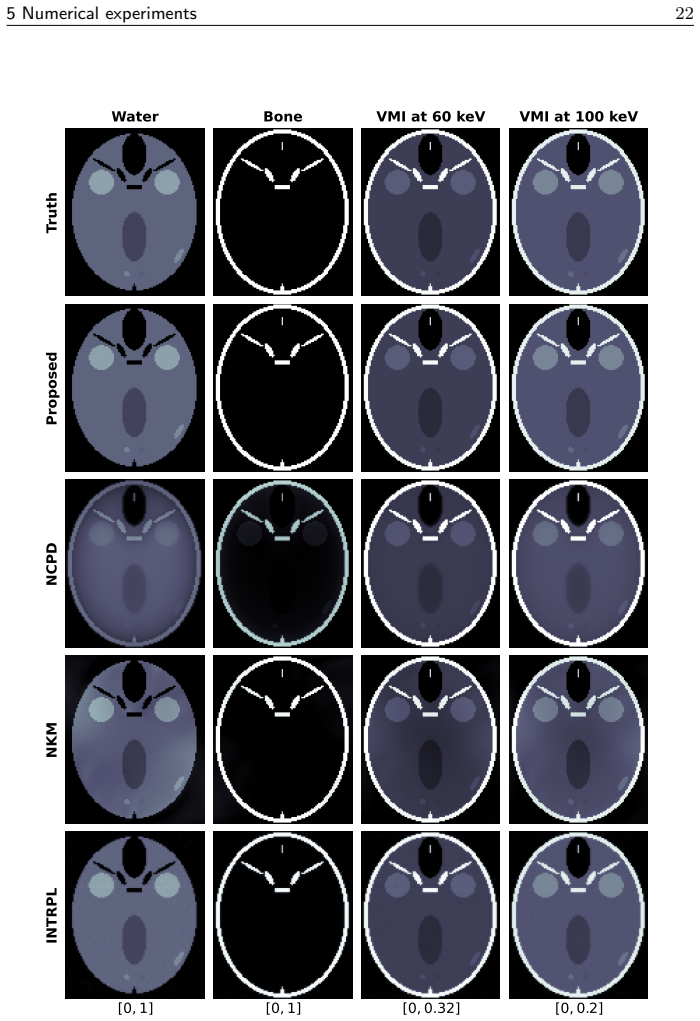
- In completely geometric-inconsistent dual-energy CT, AFIRE reconstructs the water and bone basis images to high accuracy in under 50 noiseless iterations and under 15 noisy iterations, while NCPD, NKM, IFBP, and INTRPL lag behind or diverge.
- Each outer iteration costs essentially one approximate projection inversion per spectrum plus a $2\times2$ mixing step, so the algorithm combines the speed of analytic FBP with the accuracy of an iterative one-step method.
- Theorem 2 guarantees convergence to the unique solution when $\gamma = \tilde\eta\,\kappa_F(P\otimes\phi) < 1$ and the approximate-inverse residual obeys the bound in (34); Corollary 1 covers the exact-inverse iteration (27).
- The algorithm is not sensitive to the choice of the special point: three random choices of the constants $\{C_d^{(q)}\}$ give nearly identical convergence in the reported experiments, so no explicit knowledge of an image $\hat f$ is needed.
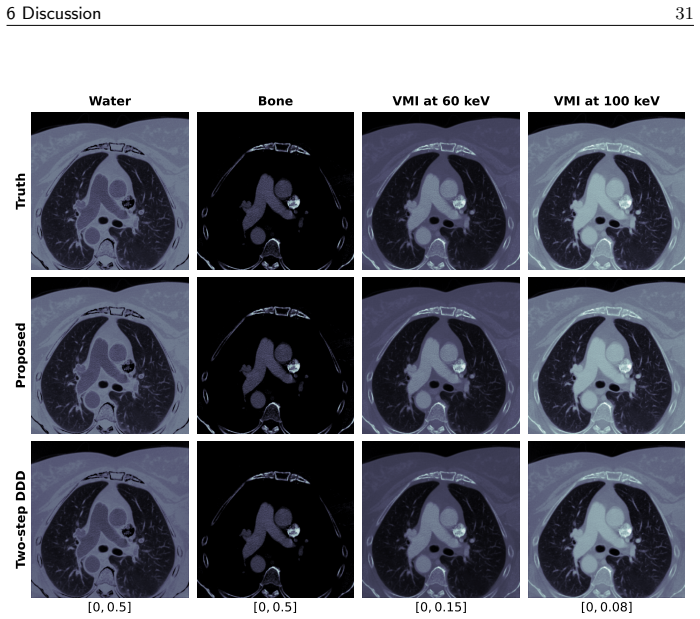
- The same iteration solves the geometric-consistent case and outperforms the two-step DDD benchmark, and the module $P^{+}$ can be implemented by FBP, CG, or L-BFGS with a documented accuracy and efficiency trade-off.
Reading between the lines
- Editorial inference: because the factorization only needs $Q=D$ and the same constant-ray condition, the scheme should carry over to photon-counting or three-material decompositions by resizing $\phi$; for $Q>D$ one would naturally invert the small normal system in a least-squares sense.
- Editorial inference: the convergence hypotheses of Lemma 2 are never verified numerically; computing $\gamma = \tilde\eta\,\kappa_F(P\otimes\phi)$ for the reported 128$\times$128 and 256$\times$256 geometries would turn the proof into a testable prediction.
- Editorial inference: the continuous theorem (Theorem 1) assumes geometric consistency ($T_q^n=T_n$), so the proof for the motivating inconsistent regime rests entirely on the discrete argument; a continuous proof allowing $T_q^n\neq T_n$ would be needed to close that gap.
- Editorial inference: replacing $P^{+}$ with a regularized or learned reconstruction operator would adapt the same outer iteration to sparse-view or low-dose MSCT, since the convergence proof only requires the residual bound (34) to hold.
Editorial analysis
A structured set of objections, weighed in public.
Referee Report
Summary. The paper proposes AFIRE, a simplified Newton method for multispectral CT image reconstruction that is designed for scanning geometries that are inconsistent across different X-ray energy spectra. The core observation is that at special points such as the zero image the Jacobian of the nonlinear forward map factorizes as a block product of a diagonal operator of X-ray transforms and a small material/spectrum matrix, namely -P⊗φ in the discrete setting. This structure yields an iteration that requires only a small 2×2 matrix inversion and an approximate inversion of each projection matrix. The paper proves convergence for the continuous and discrete settings under uniform relative Lipschitz-type assumptions, and reports numerical experiments on simulated geometric-inconsistent dual-energy CT data showing fast convergence and improved accuracy over NCPD, NKM, IFBP, and INTRPL. Section 6 further demonstrates flexibility in the choice of the special point and of the approximate inverse, and extends the method to the geometric-consistent case.
Significance. If the convergence hypotheses were verified for the tested configurations, this would be a valuable contribution: the derivative factorization at zero is clean and correct, and the resulting algorithm is both conceptually simple and computationally attractive. The numerical results are consistent and show a clear advantage in speed and accuracy over existing methods. The paper also usefully identifies the algorithm as a framework with two adjustable modules, the special point and the approximate inverse. The main weakness is that the convergence theory is not connected to the experiments: the constants that control the discrete convergence theorem are never computed or bounded, and the continuous theorem explicitly assumes geometric consistency, so it does not cover the motivating inconsistent case. Closing this gap is necessary before the paper's central claim is fully supported.
major comments (3)
- [§4.2, Lemma 2 and Theorem 2, Eqs. (25)–(26), (33)–(34)] The convergence theorem for the discrete algorithm rests on an unquantified constant η̃ and on the approximate-inverse residual bound (34). The paper never computes or bounds η̃, κ_F(P⊗φ), γ, or ζ for the geometries in Sections 5.2 and 5.3. In particular, since ρ may be a vertex of the unit simplex, η̃ is at least max_{q,d,m} |b_dm/(b_d^T ŵ^q) − 1|, and κ_F(P⊗φ) is the ratio of the Frobenius norm to the minimum singular value of a 294,912×32,768 block matrix in the 128×128 experiment. Both quantities are plausibly large enough that the condition γ = η̃κ_F(P⊗φ) < 1 is not assured. Consequently, Theorem 2 does not, as written, certify the convergence reported in Figures 2 and 6, and the statement in Section 5.2 that the results confirm the convergence theory of Theorem 2 is unsupported. Please report numerical estimates of these constants for the actual spectra, MAC tables, and projection geometries, or replace the theorem with a condition that can be checked without computing spectral gaps of a huge ill-conditioned matrix.
- [§4.1, Lemma 1 and Theorem 1] Lemma 1 explicitly assumes T_n^q = T_n for all q, i.e., geometric consistency. Therefore Theorem 1's global convergence proof applies only to the geometric-consistent case, not to the geometric-inconsistent MSCT that motivates the paper. The continuous analysis cannot be used to justify Algorithm 1 for the stated problem; the discrete Theorem 2 is the only candidate covering the motivating case, and its hypotheses are unchecked as noted above. The paper should either extend the continuous proof to genuinely inconsistent sets T_n^q or revise the claims in Sections 4 and 7 to state clearly that the continuous convergence result requires geometric consistency.
- [§5.1 and Theorem 2, Eq. (34)] In the numerical experiments, P+ is implemented by FBP with a one-bandwidth Ram–Lak filter, and in Section 6 also by CG and L-BFGS. Theorem 2 requires the residual δ^k of the approximate inverse to satisfy ∥δ^k∥ ≤ ζ∥K(f^k)−g∥ with ζ < (1−γ)/(1+γ). No estimate of δ^k is given for FBP, or for CG and L-BFGS with their chosen inner-iteration counts, in the geometrically inconsistent full-scan setting. Without such an estimate, the convergence theorem does not cover the actual algorithm whose performance is reported. At minimum, the authors should state this as an explicit assumption and discuss how it could be validated numerically, or prove a version of the theorem that does not require a global ζ.
minor comments (7)
- [§3.1.2, Algorithm 1 line 5 and §3.2.2, Algorithm 2 line 5, Eq. (28)] The displayed update rules contain a spurious minus sign before the f^k term; the correct update from Eqs. (17) and (27) is f^{k+1} = f^k − (inverse Jacobian)(g − K(f^k)). Please fix the sign in both algorithms.
- [§3.2.2, Eq. (26)] The symbol ⊗ is used for a nonstandard block multiplication between P and φ and should be defined explicitly to avoid confusion with the usual Kronecker product, which has different block layout conventions.
- [§4.2, Lemma 2] Lemma 2 assumes that P has full column rank, but this rank condition is not verified for the rectangular projection matrices arising in the inconsistent geometries of Section 5. Please state how it is checked or argue it from the full-scan view coverage.
- [§5.3] The description of the noisy data is insufficient: it is not clear whether Gaussian noise is added to the line integrals before or after the logarithm, what noise level corresponds to 34.3 dB, and how many noise realizations are used. Please specify the exact generation procedure.
- [§5 and §6] The paper would benefit from a data and code availability statement, since the spectra, MAC tables, phantoms, and implementations of the compared methods are not released, making the numerical results difficult to reproduce.
- [§2.2 and §5] The term 'mildly full scan' is used in the abstract and Section 5 but is not defined until the experimental setup; please define it formally at first use.
- [§7, Conclusion] The sentence claiming this is the first literature to use derivative-structure-based algorithms for geometric-inconsistent MSCT is hard to verify and should be softened or supported by a more thorough literature search.
Circularity Check
No significant circularity: the AFIRE update is derived directly from the forward model (spectra and MAC tables), the convergence proof is a genuine contraction argument, and the unverified hypotheses in Section 4 are soundness gaps rather than circular reductions.
full rationale
The core derivation of AFIRE is self-contained. The Jacobian factorization at the zero image is computed from the forward model: equation (10) gives the Gâteaux derivative of the continuous map, and equation (26) writes the discrete Jacobian as -P ⊗ φ with φ defined in equation (25) directly from the energy spectra and MAC tables. The iteration (27)/(29) is the standard simplified/inexact Newton update; no parameter is fitted to projection data, and no predicted quantity is defined in terms of the algorithm's output. The convergence analysis in Section 4 is a genuine contraction proof: Lemma 2 states a Lipschitz-type assumption on the data model, and Theorem 2 derives uniqueness and convergence from the contraction factor γ < 1 and the residual bound (34). Those hypotheses—η̃, κF(P ⊗ φ), and ζ—are not numerically verified for the Section 5 geometries, and Lemma 1 assumes geometric consistency (Tn_q = Tn) so Theorem 1 does not cover the motivating inconsistent case; these are soundness/verification gaps, not circular reductions. The self-citations [16]-[18] are used only as background and comparison material, not as load-bearing support for the AFIRE derivation or its convergence result.
Assumptions & free parameters
assumptions (6)
- standard math X-ray transform P_q from H^{-1/2}_0(Omega) to L^2(T^q_n) is invertible when T^q_n meets every equatorial circle (Natterer-Wubbeling Theorem 2.11).
- standard math The forward map K is Frechet differentiable and the mean value theorem applies in the chosen Sobolev spaces.
- domain assumption Q=D, i.e., number of spectra equals number of basis images, and the discrete projection matrices P_q are full-column-rank or invertible in the square case.
- ad hoc to paper There exists a uniform eta such that |integral (rho-Phi_hat) b_d| <= eta |integral Phi_hat b_d| for every normalized spectrum rho, and eta kappa_F(phi) < 1.
- ad hoc to paper There exists a uniform eta-tilde such that |b_d^T what^q - b_d^T rho| < eta-tilde |b_d^T what^q| for every rho in the unit simplex, and gamma = eta-tilde kappa_F(P⊗phi) < 1.
- ad hoc to paper The chosen approximate inverse P+ (FBP, CG, or L-BFGS) produces residuals delta^k satisfying ||delta^k|| <= zeta ||K(f^k)-g|| with zeta < (1-gamma)/(1+gamma).
Cite this review
Pith. "Pith review of AFIRE: Accurate and Fast Image Reconstruction Algorithm for Geometric-inconsistent Multispectral CT." pith.science (2026). https://pith.science/paper/B6CJYZTA
@misc{pith2026250524793,
  author       = {Pith},
  title        = {Pith review of: AFIRE: Accurate and Fast Image Reconstruction Algorithm for Geometric-inconsistent Multispectral CT},
  year         = {2026},
  howpublished = {\url{https://pith.science/paper/B6CJYZTA}},
  note         = {Machine review of arXiv:2505.24793}
}
read the original abstract
For nonlinear multispectral computed tomography (CT), accurate and fast image reconstruction is challenging when the scanning geometries under different X-ray energy spectra are inconsistent or mismatched. Motivated by this, we propose an Accurate and Fast Image REconstruction (AFIRE) algorithm to address such problems in the case of mildly full scan. From the continuous (resp. discrete) setting, we discover that the derivative operator (gradient) of the involved nonlinear mapping at some special points, for example, at zero, can be represented as a composition (block multiplication) of a diagonal operator (matrix) composed of X-ray transforms (projection matrices) and a very small-scale matrix. Based on these insights, the AFIRE algorithm is proposed by leveraging the simplified Newton method. Under proper conditions, we establish the convergence theory of the proposed algorithm. Furthermore, numerical experiments are also carried out to verify that the proposed algorithm can accurately and effectively reconstruct the basis images in completely geometric-inconsistent dual-energy CT with noiseless and noisy projection data. Particularly, the proposed algorithm significantly outperforms some state-of-the-art methods in terms of accuracy and efficiency. Finally, the flexibility and extensibility of the proposed algorithm are also demonstrated.
Figures


Figures from the paper (13 more)




Reference graph
Works this paper leans on
- [1]
-
[2]
H. Alkadhi, A. Euler, D. Maintz, and D. Sahani, editors. Spectral Imag- ing: Dual-Energy, Multi-Energy and Photon-Counting CT . Springer Cham, Cham, 2022
work page 2022
-
[3]
R. E. Alvarez. Invertibility of the dual energy x-ray data transform.Medical Physics, 46:93–103, 2019
work page 2019
-
[4]
R. E. Alvarez and A. Macovski. Energy-selective reconstructions in X-ray computerized tomography. Phys. Med. Biol. , 21(5):733–744, 1976
work page 1976
- [5]
-
[6]
R. F. Barber, E. Y. Sidky, T. G. Schmidt, and X. Pan. An algorithm for constrained one-step inversion of spectral CT data. Physics in Medicine & Biology, 61(10):3784–3818, 2016
work page 2016
-
[7]
T. Buzug. Computed Tomography: From Photon Statistics to Modern Cone-Beam CT. Springer Berlin, Heidelberg, Berlin, Heidelberg, 2008
work page 2008
-
[8]
C. Cai, T. Rodet, S. Legoupil, and A. Mohammad-Djafari. A full-spectral Bayesian reconstruction approach based on the material decomposition model applied in dual-energy computed tomography. Medical physics , 40(11):111916, 2013
work page 2013
Show all 38 references
-
[9]
B. Chen, Z. Zhang, E. Y. Sidky, D. Xia, and X. Pan. Image reconstruc- tion and scan configurations enabled by optimization-based algorithms in multispectral CT. Phys. Med. Biol. , 62:8763–8793, 2017
2017
-
[10]
B. Chen, Z. Zhang, D. Xia, E. Sidky, and X. Pan. Non-convex primal-dual algorithm for image reconstruction in spectral CT. Computerized Medical Imaging and Graphics , 87:101821, 2021
2021
-
[11]
C. Chen, R. Wang, C. Bajaj, and O. ¨Oktem. An efficient algorithm to com- pute the X-ray transform. International Journal of Computer Mathematics, 99(7):1325–1343, 2022
2022
-
[12]
Deuflhard
P. Deuflhard. Newton Methods for Nonlinear Problems: Affine Invariance and Adaptive Algorithms . Springer, Berlin, Heidelberg, 2011
2011
-
[13]
Y. Ding, E. Clarkson, and A. Ashok. Invertibility of multi-energy X-ray transform. Medical Physics, 48(10):5959–5973, 2021. A Appendix 38
2021
-
[14]
Dr´ abek and J
P. Dr´ abek and J. Milota. Methods of nonlinear analysis: Applications to differential equations. Birkh¨ auser Basel, second edition, 01 2007
2007
-
[15]
I. A. Elbakri and J. A. Fessler. Statistical image reconstruction for polyener- getic X-ray computed tomography. IEEE transactions on medical imaging , 21(2):89–99, 2002
2002
-
[16]
Gao and C
Y. Gao and C. Chen. Convergence Analysis of Nonlinear Kaczmarz Method for Systems of Nonlinear Equations with Componentwise Convex Mapping. SIAM Journal on Imaging Sciences , 18(1):120–151, 2025
2025
-
[17]
Y. Gao, X. Pan, and C. Chen. An extended primal-dual algorithm frame- work for nonconvex problems: application to image reconstruction in spec- tral CT. Inverse Problems, 38(8):085011, 2022
2022
-
[18]
Y. Gao, X. Pan, and C. Chen. Analysis of Solution Existence, Uniqueness, and Stability of Discrete Basis Sinograms in Multispectral CT. Journal of Mathematical Imaging and Vision , 66(4):741–757, 2024
2024
-
[19]
Greffier, N
J. Greffier, N. Villani, D. Defez, D. Dabli, and S. Si-Mohamed. Spectral CT imaging: Technical principles of dual-energy CT and multi-energy photon- counting CT. Diagnostic and Interventional Imaging, 104(4):167–177, 2023
2023
-
[20]
G. N. Hounsfield. Computerized transverse axial scanning (tomography): Part 1. Description of system. Br. J. Radiol. , 46:1016–1022, 1973
1973
-
[21]
J. Hsieh. Computed tomography: principles, design, artifacts, and recent advances. SPIE Press, Bellingham, Washington, third edition, 2015
2015
-
[22]
J. H. Hubbell and S. M. Seltzer. Tables of X-ray mass attenuation coeffi- cients and mass energy-absorption coefficients 1 keV to 20 MeV for elements Z= 1 to 92 and 48 additional substances of dosimetric interest. Technical report, National Inst. of Standards and Technology-PL...
1995
-
[23]
Kaltenbacher, A
B. Kaltenbacher, A. Neubauer, and O. Scherzer. Iterative regularization methods for nonlinear ill-posed problems . Walter de Gruyter, Berlin, 2008
2008
-
[24]
Leuschner, M
J. Leuschner, M. Schmidt, D. O. Baguer, and P. Maass. LoDoPaB-CT, a benchmark dataset for low-dose computed tomography reconstruction. Scientific Data , 8(1):109, 2021
2021
-
[25]
Z. Levine. Nonuniqueness in dual-energy CT. Medical Physics, 44(9):e202– e206, 2017
2017
-
[26]
M. Li, Y. Zhao, and P. Zhang. Accurate Iterative FBP Reconstruction Method for Material Decomposition of Dual Energy CT. IEEE Transac- tions on Medical Imaging , 38(3):802–812, 2019. A Appendix 39
2019
-
[27]
Long and J
Y. Long and J. A. Fessler. Multi-Material Decomposition Using Statistical Image Reconstruction for Spectral CT. IEEE Transactions on Medical Imaging, 33(8):1614–1626, 2014
2014
-
[28]
Macovski, R
A. Macovski, R. E. Alvarez, J. L.-H. Chan, J. P. Stonestrom, and L. M. Zatz. Energy dependent reconstruction in X-ray computerized tomography. Comput. Biol. Med. , 6:325–336, 1976
1976
-
[29]
McCollough, S
C. McCollough, S. Leng, L. Yu, and J. Fletcher. Dual- and Multi-Energy CT: Principles, Technical Approaches, and Clinical Applications. Radiol- ogy, 276(3):637–653, 2015
2015
-
[30]
Mechlem, S
K. Mechlem, S. Ehn, T. Sellerer, E. Braig, D. M¨ unzel, F. Pfeiffer, and P. B. No¨ el. Joint statistical iterative material image reconstruction for spectral computed tomography using a semi-empirical forward model. IEEE trans- actions on medical imaging , 37(1):68–80, 2018
2018
-
[31]
Natterer
F. Natterer. The Mathematics of Computerized Tomography . Society for Industrial and Applied Mathematics, Philadelphia, PA, 2001
2001
-
[32]
Natterer and F
F. Natterer and F. W¨ ubbeling. Mathematical Methods in Image Recon- struction. SIAM, Philadelphia, PA, 2001
2001
-
[33]
J. M. Ortega and W. C. Rheinboldt. Iterative Solution of Nonlinear Equa- tions in Several Variables . SIAM, Philadelphia, PA, 2000
2000
-
[34]
Philippe
D. Philippe. SpectrumGUI. https://sourceforge.net/projects/ spectrumgui/, 2015
2015
-
[35]
L. A. Shepp and J. B. Kruskal. Computerized Tomography: The New Medical X-Ray Technology. American Mathematical Monthly , 85(6):420– 439, 1978
1978
-
[36]
Zhang, J.-B
R. Zhang, J.-B. Thibault, C. Bouman, K. Sauer, and J. Hsieh. Model-based iterative reconstruction for dual-energy X-ray CT using a joint quadratic likelihood model. IEEE transactions on medical imaging , 33(1):117–134, 2014
2014
-
[37]
Y. Zhao, X. Zhao, and P. Zhang. An extended algebraic reconstruction technique (E-ART) for dual spectral CT. IEEE Transactions on Medical Imaging, 34(3):761–768, 2015
2015
-
[38]
Zou and M
Y. Zou and M. D. Silver. Analysis of Fast kV-switching in Dual Energy CT using a Pre-reconstruction Decomposition Technique. In J. Hsieh and E. Samei, editors, Medical Imaging 2008: Physics of Medical Imaging , vol- ume 6913, page 691313. SPIE, 2008
2008
Reviewed August 7, 2026 · model on record in the stance chip above.
Discussion (0). Sign in to comment.