REVIEW 4 major objections 4 minor 105 references
Simulating High-Velocity Clouds in the Observational Plane: An Initial Study with the Smith Cloud
T0 review · 4 major / 4 minor · reviewed 2026-08-07 · deepseek-v4-flash
Pith's one-line read The Smith Cloud is most consistent with a cloud that is growing as it falls through the hot Milky Way halo, and the growth physics is turbulent radiative mixing.
desk verdict A useful observational-plane pipeline for HVC simulations, but the central TRML claim is undercut by resolution dependence and a tuned column density. read the letter →
The pith
A machine-rendered reading of the paper's core claim, the machinery that carries it, and where it could break.
The reading
What carries the argument
The load-bearing objects are a suite of four 3D wind-tunnel simulations of a cool cloud in a hot wind, with radiative cooling at solar or half-solar metallicity and one adiabatic control, plus a mock-observation pipeline that projects the simulated cubes into position-position-velocity space with the same beam convolution, noise, spectral smoothing, and sigma-clipping as the GALFA-HI data. The central named mechanism is the turbulent radiative mixing layer (TRML), the boundary layer where hot wind gas and cool cloud gas mix and the mixture cools fast enough to be captured by the cloud. On top of this, the paper uses two statistics: the projected first-order velocity structure function, the mean absolute line-of-sight velocity difference between pixel pairs as a function of separation, and the normalized autocovariance function of HI column density, which measures how column-density fluctuations correlate across scales. The argumentative work is done by comparing these statistics between observations and simulations at successive cloud-crushing times, where the TRML cloud is the one whose evolution tracks the observations.
What would settle it
Run the same mock-observation pipeline on a wind-tunnel simulation that includes the Milky Way's gravitational acceleration for a cloud near 3 kpc falling at roughly 70 km/s; if that simulation reproduces the Smith Cloud's observed column-density/velocity correlation and large-scale autocovariance better than the no-gravity TRML run, the paper's central identification fails.
Extended reading notes
Core claim
On its own terms, the paper's claim is that, given the observed mass and half-solar metallicity of the Smith Cloud, the initial conditions of the simulations are tightly constrained, and among the four runs the one that survives and grows via a turbulent radiative mixing layer (TRML) is the best match to the observations. That cloud, simulation C, reproduces the observed correlation between HI column density and velocity dispersion, the column-density range, and the small-scale projected velocity structure function, especially when viewed at angles of 30-60 degrees rather than transverse to the wind. The paper is explicit that the match is partial: the simulations do not reproduce the Smith Cloud's correlation between column density and line-of-sight velocity, its velocity-versus-dispersion morphology, or the large-scale autocovariance of column density. Still, the authors conclude that TRML-mediated cooling, the physics that lets the cloud gain mass from the hot wind, is likely the reason the Smith Cloud has survived to be observed near the disk.
Load-bearing premise
The comparison depends on modelling the Smith Cloud as a single spherical cloud with no initial velocity in a uniform wind, and on omitting gravity even though the real cloud lies only about 3 kpc from the Galactic plane and is already falling at roughly 70 km/s.
Editorial extensions
If this is right
- Because the growing TRML cloud (simulation C) is the best match, the Smith Cloud is likely gaining mass from the hot halo rather than merely being eroded while it falls.
- Projected velocity structure functions work as a two-scale diagnostic: small separations trace internal turbulence, while large separations trace bulk velocity and viewing angle, so reproducing a cloud's VSF constrains its orientation and evolutionary stage.
- The correlation between column density and velocity dispersion is reproduced by the simulations and is therefore a safe observational target, whereas the velocity-versus-velocity-dispersion correlation best discriminates between growing and destroyed clouds.
- The large-scale autocovariance of HI column density is a demanding probe, and matching it will require either larger initial clouds or less idealized initial structure than a uniform sphere.
Reading between the lines
- If TRML growth is really happening, the Smith Cloud's mass should be increasing over its infall time, and a measurable prediction is that the tail should show enrichment in metals from hot-halo gas mixed into the cloud.
- The paper's failure to reproduce the large-scale ACF might be fixed by initializing clouds with the velocity gradients that infall would produce, and such gradients might also generate the column-density/velocity correlation that none of the current runs recover.
- A direct next test would apply the same VSF-plus-ACF pipeline to other well-resolved HVCs with known distances, such as the Magellanic Stream, where differing infall geometry could separate true TRML signatures from line-of-sight projection effects.
Editorial analysis
A structured set of objections, weighed in public.
Referee Report
Summary. The paper presents an initial comparison between four Enzo-E wind-tunnel simulations of cool clouds and GALFA-HI observations of the Smith Cloud, using identical analysis of spectral moment maps, projected first-order velocity structure functions (VSFs), and normalized autocovariance functions (ACFs) of HI column density. The simulations vary thermal pressure, metallicity, radius, cooling treatment, and density contrast, and the mock observations include beam convolution, noise, sigma clipping, and variations in viewing angle and distance. The paper finds that no simulation matches all observational probes, identifies simulation C, which grows via turbulent radiative mixing layer (TRML) entrainment, as the best overall match, and interprets this as evidence that TRML-mediated cooling is highly relevant to the Smith Cloud and HVCs generally.
Significance. If the comparison holds, this is a valuable step toward testing cloud-wind survival criteria in the observational plane: it applies consistent mock-observation techniques to a well-studied HVC and proposes projected VSF and ACF as potential diagnostics of cloud growth or destruction. The paper is commendably honest about its failures, including the large-scale ACF discrepancy and the unreproduced velocity correlations, and it includes a resolution investigation in Appendix A. However, the central inference rests on a qualitative best-match ranking, a column-density normalization that is partly an input, and a VSF that Appendix A shows to be resolution-dependent at the resolution used for the main runs. These issues need to be addressed before the TRML claim is fully supported.
major comments (4)
- [Section 3 and Section 5.1.2] The reported match of simulation C to the observed NHI distribution is not an independent success. The authors state that the relation N_cl ∝ n_cl^(2/3) motivated choosing p/kB = 5×10^3 K cm^-3 so that the initial column density would be higher by a factor of about 4 and closer to the Smith Cloud. The later statement that simulation C replicates the observed NHI values should therefore be framed as a consistency check on the assumed pressure and density rather than as evidence favoring simulation C over A or B; the paper should make this explicit when using the NHI agreement to support the TRML conclusion.
- [Section 4.2, Section 5.1.3, and Appendix A] The VSF-based identification of simulation C as the best TRML-growing match is not converged. All main simulations are run at R_cl/Δx = 16 (Table 1), yet Figures A2 and A4 show that for the same wind-tunnel setup the projected first-order VSF shifts upward at small ℓ and changes shape as R_cl/Δx increases from 4 to 32/64, with the Appendix text stating that low-resolution runs do not properly resolve the turbulent scales probed by the VSF. Because the small-separation VSF agreement is a principal reason C is declared the best match, a resolution test for the Smith Cloud models is needed; without it, the headline claim may rest on a numerical artifact rather than a physical statement about HVCs.
- [Section 5.1 and Section 5.1.3] The designation of simulation C as the 'best match' is made without a quantitative figure of merit. The paper compares four simulations against several joint moment distributions and two scale-dependent statistics and states that C is the closest match, but no criterion is specified for weighting the VSF, ACF, and moment-space agreements, and simulations A and C are acknowledged to be close overall in different metrics. A defined ranking metric, or at least a transparent per-probe score, is required to make the central claim reproducible and to prevent the TRML interpretation from depending on an informal judgment.
- [Section 5.4 and Figures 4 and 6] The omission of gravity is a load-bearing caveat for the central claim, not merely a future improvement. The Smith Cloud is about 3 kpc from the Galactic plane and is observed falling at v_z ~ 70 km/s; the paper itself notes that gravitational acceleration may drive the v_LSR and velocity-dispersion correlations that none of the simulations reproduce. Since the ranking of the simulations is dominated by partial agreement and the velocity-space statistics are the main failures, a test with an external gravitational acceleration, or a correspondingly weakened conclusion, is needed before the results can be read as evidence that TRML entrainment is the key physics for this cloud.
minor comments (4)
- [Section 6, item (i)] 'Statical measures' should be 'statistical measures'.
- [Section 5.1.3] The text refers to the 'VCF' where the velocity structure function (VSF) is meant; this typo appears in the sentence describing the small-scale turbulence and large-scale motions.
- [Figure 7 caption] The caption mentions a grey vertical line as a reference at ℓ = 0.5 degrees, but the shaded grey region and the resolution limit are described inconsistently with the text; please clarify the meaning of the shaded region in the caption.
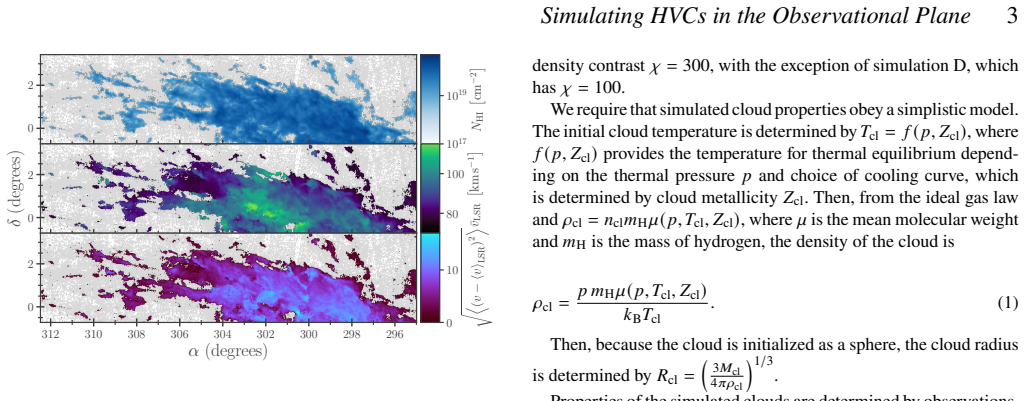
- [Section 2 and Figure 1] Because the GALFA-HI declination coverage omits part of the Smith Cloud head, it would aid the reader if Figure 1 marked the boundary of the missing region rather than only discussing it in Section 5.4.
Circularity Check
Column-density match of simulation C is partly constructed from observed N_HI; central TRML claim retains independent content.
-
fitted input called prediction
[Section 3 (Simulations); see also Section 5.1.2]
"Finding that simulations A and B produced lower column densities (N_cl) than the Smith Cloud prompted us to run simulation C. The relation N_cl ∝ n^{2/3}_cl (from R_cl ∝ n^{-1/3}_cl and N_cl ∼ R_cl n_cl) motivated our choice of conditions. We initialized simulation C with p/k_B = 5×10^3 K cm^-3, T_cl = 4430 K, and R_cl = 169 pc to maintain mass and metallicity values similar to observations, while producing column densities that are higher by a factor of ≈4."
The observed Smith Cloud column density is put directly into the initial conditions: the paper uses N_cl ∝ n_cl^{2/3} (with R_cl ∝ n_cl^{-1/3} and N_cl ∼ R_cl n_cl) to choose p/k_B and R_cl so that simulation C starts with column densities higher by ≈4, i.e. closer to the observed Smith Cloud.
full rationale
The paper's main methodological content—projecting simulations into the observational plane and comparing VSF and ACF statistics—does not reduce to its inputs. The VSF and ACF are computed from the full simulation cubes independently of the observed Smith Cloud values, and the central claim that TRML growth is the best match is supported by the VSF/ACF comparisons, the evolution of the column-density–velocity-dispersion correlation, and the contrast with the no-cooling run D. The one genuine circular step is the tuning of simulation C's initial pressure/radius from the observed column-density scaling relation, which 'predicts' the observed N_HI distribution by construction. That tuned input does not, however, invalidate the other diagnostics, so the overall circularity is partial rather than total. The resolution caveat raised in Appendix A (VSF not converged) is a numerical robustness concern, not a circularity.
Assumptions & free parameters
free parameters (1)
- Cloud thermal pressure p/kB (simulations A through D) =
10^3 K cm^-3 for A and B; 5x10^3 K cm^-3 for C and D
assumptions (5)
- domain assumption The Smith Cloud can be represented as a uniform, spherical, pressure-confined cloud with no initial velocity in a uniform laminar wind.
- domain assumption Optically thin radiative cooling in ionization equilibrium with the z=0 Haardt and Madau UV background, with no self-shielding, and with cooling shut off for T greater than 0.6 T_w.
- domain assumption Gravity, magnetic fields, and cosmic rays are negligible for the evolution and observational statistics.
- ad hoc to paper Resolution R_cl/Delta x = 16 is adequate for the turbulence statistics compared.
- domain assumption The observed velocity window 75 to 130 km/s captures the Smith Cloud without significant contamination.
Cite this review
Pith. "Pith review of Simulating High-Velocity Clouds in the Observational Plane: An Initial Study with the Smith Cloud." pith.science (2026). https://pith.science/paper/2TLYJP6B
@misc{pith2026250600111,
  author       = {Pith},
  title        = {Pith review of: Simulating High-Velocity Clouds in the Observational Plane: An Initial Study with the Smith Cloud},
  year         = {2026},
  howpublished = {\url{https://pith.science/paper/2TLYJP6B}},
  note         = {Machine review of arXiv:2506.00111}
}
abstract
High-velocity clouds (HVCs) may fuel future star formation in the Milky Way, but they must first survive their passage through the hot halo. While recent work has improved our understanding of the survival criterion for cloud-wind interactions, few observational comparisons exist that test this criterion. We therefore present an initial comparison of simulations with the Smith Cloud (SC; $d=$ 12.4 kpc, $l, b = 40^{\circ}, -13^{\circ}$) as mapped with the GALFA-HI survey. We use the Smith Cloud's observed properties to motivate simulations of comparable clouds in wind tunnel simulations with Enzo-E, an MHD code. For both observations and simulations, we generate moment maps, characterize turbulence through a projected first-order velocity structure function (VSF), and do the same for HI column density with a normalized autocovariance function. We explore how initial cloud conditions (such as radius, metallicity, thermal pressure, viewing angle, and distance) affect these statistics, demonstrating that the small-scale VSF is sensitive to cloud turbulence while large scales depend on cloud bulk velocity and viewing angle. We find that some simulations reproduce key observational features (particularly the correlation between column density and velocity dispersion) but none match all observational probes at the same time (the large scales of the column density autocovariance is particularly challenging). We find that the simulated cloud (cloud C) showing growth via a turbulent radiative mixing layer (TRML) is the best match, implying the importance of TRML-mediated cooling for Milky Way HVCs. We conclude by suggesting improvements for simulations to better match observed HVCs.
Figures


Figures from the paper (9 more)


Reference graph
Works this paper leans on
-
[1]
Abruzzo M. W., Bryan G. L., Fielding D. B., 2022, @doi [Astrophys. J.] 10.3847/1538-4357/ac3c48 , 925, 199
-
[2]
Abruzzo M. W., Fielding D. B., Bryan G. L., 2023, @doi [ArXiv eprints] https://ui.adsabs.harvard.edu/link_gateway/2023arXiv230703228A/doi:10.48550/arXiv.2307.03228
-
[3]
Abruzzo M. W., Fielding D. B., Bryan G. L., 2024, @doi [Astrophys. J.] 10.3847/1538-4357/ad1e51 , 966, 181
-
[4]
Armillotta L., Fraternali F., Marinacci F., 2016, @doi [Mon. Not. R. Astron. Soc.] 10.1093/mnras/stw1930 , 462, 4157
-
[5]
Balbus S., McKee C. F., 1982, @doi [Astrophys. J.] https://ui.adsabs.harvard.edu/link_gateway/1982ApJ...252..529B/doi:10.1086/159581 , 252, 529
doi:10.1086/159581 1982
-
[6]
Astrophys.] 10.1051/0004-6361/200811259 , 503, 483
Ben Bekhti N., Richter P., Winkel B., Kenn F., Westmeier T., 2009, @doi [Astron. Astrophys.] 10.1051/0004-6361/200811259 , 503, 483
-
[7]
L., 2012, in BW-XSEDE'12 Proc
Bordner J., Norman M. L., 2012, in BW-XSEDE'12 Proc. Extrem. Scaling Work.. Champaign, IL, pp 1--11
2012
-
[8]
Computational Cosmology and Astrophysics on Adaptive Meshes using Charm++
Bordner J., Norman M. L., 2018, @doi [ArXiv eprints] https://ui.adsabs.harvard.edu/link_gateway/2018arXiv181001319B/doi:10.48550/arXiv.1810.01319
work page Pith review arXiv doi:10.48550/arxiv.1810.01319 2018
Show all 105 references
- [9]
-
[10]
L., et al., 2014, @doi [Astrophys
Bryan G. L., et al., 2014, @doi [Astrophys. Journal, Suppl. Ser.] 10.1088/0067-0049/211/2/19 , 211
2014 doi
-
[11]
J.] 10.3847/1538-4357/ac752b , 933, 120
Bustard C., Gronke M., 2022, @doi [Astrophys. J.] 10.3847/1538-4357/ac752b , 933, 120
2022 doi
-
[12]
S., Fielding D
Butsky I. S., Fielding D. B., Hayward C. C., Hummels C. B., Quinn T. R., Werk J. K., 2020, @doi [Astrophys. J.] 10.3847/1538-4357/abbad2 , 903, 77
2020 doi
-
[13]
Chen Z., Peng Oh S., 2024, @doi [Mon. Not. R. Astron. Soc.] https://doi.org/10.1093/mnras/stae1113 , 530, 4032
2024 doi
-
[14]
C., et al., 2023a, @doi [Mon
Chen M. C., et al., 2023a, @doi [Mon. Not. R. Astron. Soc.] 10.1093/mnras/stac3193 , 518, 2354
-
[16]
J.] 10.1086/321427 , 554, 1044
Chiappini C., Matteucci F., Romano D., 2001, @doi [Astrophys. J.] 10.1086/321427 , 554, 1044
2001 doi
-
[17]
Astrophys.] 10.1051/0004-6361:20031192 , 410, 257
Chiappini C., Matteucci F., Meynet G., 2003, @doi [Astron. Astrophys.] 10.1051/0004-6361:20031192 , 410, 257
2003 doi
-
[18]
A., Ib \' a \ n ez-Mej \' i a J
Chira R. A., Ib \' a \ n ez-Mej \' i a J. C., Mac Low M. M., Henning T., 2019, @doi [Astron. Astrophys.] 10.1051/0004-6361/201833970 , 630, 1
2019 doi
-
[19]
S., 2011, @doi [Astron
Chomiuk L., Povich M. S., 2011, @doi [Astron. J.] 10.1088/0004-6256/142/6/197 , 142
2011 doi
-
[20]
L., Bicknell G
Cooper J. L., Bicknell G. V., Sutherland R. S., Bland-Hawthorn J., 2009, @doi [Astrophys. J.] 10.1088/0004-637X/703/1/330 , 703, 330
2009 doi
-
[21]
Das S., Mathur S., Nicastro F., Krongold Y., 2019, @doi [Astrophys. J. Lett.] 10.3847/2041-8213/ab3b09 , 882, L23
2019 doi
-
[22]
J.] 10.3847/1538-4357/ac0e8e , 918, 83
Das S., Mathur S., Gupta A., Krongold Y., 2021, @doi [Astrophys. J.] 10.3847/1538-4357/ac0e8e , 918, 83
2021 doi
-
[23]
H., Appleby S., 2019, @doi [Mon
Dav \' e R., Angl \' e s-Alc \' a zar D., Narayanan D., Li Q., Rafieferantsoa M. H., Appleby S., 2019, @doi [Mon. Not. R. Astron. Soc.] 10.1093/mnras/stz937 , 486, 2827
2019 doi
-
[24]
J., Pfrommer C., 2008, @doi [Astrophys
Dursi L. J., Pfrommer C., 2008, @doi [Astrophys. J.] 10.1086/529371 , 677, 993
2008 doi
-
[25]
J.] 10.3847/1538-4357/aca27d , 941, 162
Elia D., et al., 2022, @doi [Astrophys. J.] 10.3847/1538-4357/aca27d , 941, 162
2022 doi
- [26]
-
[27]
J., Gronke M., Planck M., M D.-G., 2022, @doi [Mon
Farber R. J., Gronke M., Planck M., M D.-G., 2022, @doi [Mon. Not. R. Astron. Soc.] https://ui.adsabs.harvard.edu/link_gateway/2022MNRAS.510..551F/doi:10.1093/mnras/stab3412 , 510, 551
2022 doi
-
[28]
Federrath C., 2013, @doi [Mon. Not. R. Astron. Soc.] 10.1093/mnras/stt1644 , 436, 1245
2013 doi
-
[29]
B., Ostriker E
Fielding D. B., Ostriker E. C., Bryan G. L., Jermyn A. S., 2020, @doi [Astrophys. J. Lett.] 10.3847/2041-8213/ab8d2c , 894, L24
2020 doi
-
[30]
J., et al., 2014, @doi [Astrophys
Fox A. J., et al., 2014, @doi [Astrophys. J.] 10.1088/0004-637X/787/2/147 , 787
2014 doi
-
[31]
J., et al., 2016, @doi [Astrophys
Fox A. J., et al., 2016, @doi [Astrophys. J. Lett.] 10.3847/2041-8205/816/1/l11 , 816, L11
2016 doi
-
[32]
J., Richter P., Ashley T., Heckman T
Fox A. J., Richter P., Ashley T., Heckman T. M., Lehner N., Werk J. K., Bordoloi R., Peeples M. S., 2019, @doi [Astrophys. J.] 10.3847/1538-4357/ab40ad , 884, 53
2019 doi
-
[33]
Kolmogorov
Frisch U., 1995, Turbulence: The legacy of A.N. Kolmogorov . Cambridge University Press., Cambridge
1995
-
[34]
J.] 10.1088/0004-6256/137/1/266 , 137, 266
Fuchs B., Jahrei H., Flynn C., 2009, @doi [Astron. J.] 10.1088/0004-6256/137/1/266 , 137, 266
2009 doi
-
[35]
L., 2016, @doi [Astrophys
Galyardt J., Shelton R. L., 2016, @doi [Astrophys. J. Lett.] 10.3847/2041-8205/816/1/l18 , 816, L18
2016 doi
-
[36]
P., 2018, @doi [Mon
Gronke M., Oh S. P., 2018, @doi [Mon. Not. R. Astron. Soc. Lett.] 10.1093/mnrasl/sly131 , 480, L111
2018 doi
-
[37]
P., 2020a, @doi [Mon
Gronke M., Oh S. P., 2020a, @doi [Mon. Not. R. Astron. Soc.] 10.1093/mnras/stz3332 , 492, 1970
1970 doi
-
[38]
P., 2020b, @doi [Mon
Gronke M., Oh S. P., 2020b, @doi [Mon. Not. R. Astron. Soc. Lett.] 10.1093/mnrasl/slaa033 , 494, L27
-
[39]
P., Ji S., Norman C., 2022, @doi [Mon
Gronke M., Oh S. P., Ji S., Norman C., 2022, @doi [Mon. Not. R. Astron. Soc.] https://ui.adsabs.harvard.edu/link_gateway/2022MNRAS.511..859G/doi:10.1093/mnras/stab3351 , 511, 859
2022 doi
-
[40]
J.] 10.3847/1538-4357/abdbb6 , 909, 164
Gupta A., Kingsbury J., Mathur S., Das S., Galeazzi M., Krongold Y., Nicastro F., 2021, @doi [Astrophys. J.] 10.3847/1538-4357/abdbb6 , 909, 164
2021 doi
-
[41]
Ha T., Li Y., Xu S., Kounkel M., Li H., 2021, @doi [Astrophys. J. Lett.] 10.3847/2041-8213/abd8c9 , 907, L40
2021 doi
-
[42]
J.] 10.1088/0004-637X/746/2/125 , 746
Haardt F., Madau P., 2012, @doi [Astrophys. J.] 10.1088/0004-637X/746/2/125 , 746
2012 doi
-
[43]
E., 2009, @doi [Astrophys
Heitsch F., Putman M. E., 2009, @doi [Astrophys. J.] 10.1088/0004-637X/698/2/1485 , 698, 1485
2009 doi
-
[44]
E., Peek J
Heitsch F., Bartell B., Clark S. E., Peek J. E., Cheng D., Putman M., 2016, @doi [Mon. Not. R. Astron. Soc. Lett.] 10.1093/mnrasl/slw124 , 462, L46
2016 doi
-
[45]
A., Shull J
Heitsch F., Marchal A., Miville-Desch \^ e nes M. A., Shull J. M., Fox A. J., 2022, @doi [Mon. Not. R. Astron. Soc.] 10.1093/mnras/stab3266 , 509, 4515
2022 doi
-
[46]
B., Gritton J
Henley D. B., Gritton J. A., Shelton R. L., 2017, @doi [Astrophys. J.] 10.3847/1538-4357/aa5df7 , 837, 82
2017 doi
-
[47]
J., Gronke M., 2024, @doi [Mon
Hidalgo-Pineda F., Farber R. J., Gronke M., 2024, @doi [Mon. Not. R. Astron. Soc.] https://doi.org/10.3847/1538-4357/acc73f , 527, 135
2024 doi
-
[48]
S., Haffner L
Hill A. S., Haffner L. M., Reynolds R. J., 2009, @doi [Astrophys. J.] 10.1088/0004-637X/703/2/1832 , 703, 1832
2009 doi
-
[49]
E., Kim D
Holm-hansen C., Putman M. E., Kim D. A., 2025, @doi [Mon. Not. R. Astron. Soc.] https://ui.adsabs.harvard.edu/link_gateway/2025MNRAS.536.3507H/doi:10.1093/mnras/stae2801 , 536, 3507
2025 doi
-
[50]
M., McClure-Griffiths N
Hopkins A. M., McClure-Griffiths N. M., Gaensler B. M., 2008, @doi [Astrophys. J.] 10.1086/590494 , 682, L13
2008 doi
-
[51]
H., Putman M
Hsu W. H., Putman M. E., Heitsch F., Stanimirovi \' c S., Peek J. E., Clark S. E., 2011, @doi [Astron. J.] 10.1088/0004-6256/141/2/57 , 141
2011 doi
-
[52]
S., 2022, @doi [Mon
Hu Y., Federrath C., Xu S., Mathew S. S., 2022, @doi [Mon. Not. R. Astron. Soc.] 10.1093/mnras/stac972 , 513, 2100
2022 doi
-
[53]
D., 2007, @doi [Comput
Hunter J. D., 2007, @doi [Comput. Sci. Eng.] https://doi.org/10.1109/MCSE.2007.55 , 9, 90
2007 doi
-
[54]
P., Masterson P., 2019, @doi [Mon
Ji S., Oh S. P., Masterson P., 2019, @doi [Mon. Not. R. Astron. Soc.] 10.1093/mnras/stz1248 , 487, 737
2019 doi
-
[55]
R., Bryan G
Joung M. R., Bryan G. L., Putman M. E., 2012, @doi [Astrophys. J.] 10.1088/0004-637X/745/2/148 , 745
2012 doi
-
[56]
Kanjilal V., Dutta A., Sharma P., 2021, @doi [Mon. Not. R. Astron. Soc.] 10.1093/mnras/staa3610 , 501, 1143
2021 doi
-
[57]
C., Evans N
Kennicutt R. C., Evans N. J., 2012, @doi [Annu. Rev. Astron. Astrophys.] 10.1146/annurev-astro-081811-125610 , 50, 531
2012 doi
-
[58]
F., Colella P., 1994, @doi [Astrophys
Klein R., McKee C. F., Colella P., 1994, @doi [Astrophys. J.] https://ui.adsabs.harvard.edu/link_gateway/1994ApJ...420..213K/doi:10.1086/173554 , 420, 213
1994 doi
-
[59]
B., Tinsley B., Caldwell N., 1980, @doi [Astrophys
Larson R. B., Tinsley B., Caldwell N., 1980, @doi [Astrophys. J.] https://ui.adsabs.harvard.edu/link_gateway/1980ApJ...237..692L/doi:10.1086/157917 , 237, 692
1980 doi
-
[60]
C., Marasco A., Fraternali F., 2022, @doi [Mon
Lehner N., Howk J. C., Marasco A., Fraternali F., 2022, @doi [Mon. Not. R. Astron. Soc.] https://doi.org/10.1093/mnras/stac987 , 513, 3228
2022 doi
-
[61]
F., Squire J., Hummels C., 2020a, @doi [Mon
Li Z., Hopkins P. F., Squire J., Hummels C., 2020a, @doi [Mon. Not. R. Astron. Soc.] 10.1093/mnras/stz3567 , 492, 1841
-
[62]
Li Y., et al., 2020b, @doi [Astrophys. J. Lett.] 10.3847/2041-8213/ab65c7 , 889, L1
-
[63]
G., 2023, @doi [Mon
Li Y., Luo R., Fossati M., Sun M., J P., Occhialini F. G., 2023, @doi [Mon. Not. R. Astron. Soc.] https://doi.org/10.1093/mnras/stad874 , 521, 4785
2023 doi
-
[64]
C., Newman J
Licquia T. C., Newman J. A., 2015, @doi [Astrophys. J.] 10.1088/0004-637X/806/1/96 , 806, 96
2015 doi
-
[65]
J., Benjamin R
Lockman F. J., Benjamin R. A., Heroux A. J., Langston G. I., 2008, @doi [Astrophys. J.] 10.1086/588838 , 679, L21
2008 doi
-
[66]
H., Bullock J
Maller A. H., Bullock J. S., 2004, @doi [Mon. Not. R. Astron. Soc.] 10.1111/j.1365-2966.2004.08349.x , 355, 694
2004
-
[67]
Marinacci F., Binney J., Fraternali F., Nipoti C., Ciotti L., Londrillo P., 2010, @doi [Mon. Not. R. Astron. Soc.] 10.1111/j.1365-2966.2010.16352.x , 404, 1464
2010
-
[68]
M., Madigan A
McCourt M., O'Leary R. M., Madigan A. M., Quataert E., 2015, @doi [Mon. Not. R. Astron. Soc.] 10.1093/mnras/stv355 , 449, 2
2015 doi
-
[69]
F., Cowie L
McKee C. F., Cowie L. L., 1977, @doi [Astrophys. J.] https://ui.adsabs.harvard.edu/link_gateway/1977ApJ...215..213M/doi:10.1086/155350 , 215, 213
1977 doi
-
[70]
H., Lockman F
Minter A. H., Lockman F. J., Balashev S. A., Ford H. A., 2024, @doi [Astrophys. J.] 10.3847/1538-4357/ad343d , 966, 76
2024 doi
-
[71]
Mohapatra R., Jetti M., Sharma P., Federrath C., 2022, @doi [Mon. Not. R. Astron. Soc.] 10.1093/mnras/stab3429 , 510, 2327
2022 doi
-
[72]
J.] 10.1088/0004-637X/707/2/1642 , 707, 1642
Nichols M., Bland-Hawthorn J., 2009, @doi [Astrophys. J.] 10.1088/0004-637X/707/2/1642 , 707, 1642
2009 doi
-
[73]
R., Castaneda H
O'Dell C. R., Castaneda H. O., 1987, @doi [Astrophys. J.] https://ui.adsabs.harvard.edu/link_gateway/1987ApJ...317..686O/doi:10.1086/165314 , 317, 686
1987 doi
-
[74]
H., 1969, @doi [Nature] 10.1038/2241158a0 , 224, 1158
Oort J. H., 1969, @doi [Nature] 10.1038/2241158a0 , 224, 1158
1969 doi
-
[75]
M., 2002, @doi [Astron
Ossenkopf V., Low M. M., 2002, @doi [Astron. Astrophys.] 10.1051/0004-6361:20020629 , 390, 307
2002 doi
-
[76]
Peek J. E. G., Putman M. E., McKee C. F., Heiles C., Stanimirovi \' c S., 2007, @doi [Astrophys. J.] 10.1086/510189 , 656, 907
2007 doi
-
[77]
Peek J. E. G., et al., 2018, @doi [Astrophys. J. Suppl. Ser.] 10.3847/1538-4365/aa91d3 , 234, 2
2018 doi
-
[78]
Pillepich A., et al., 2018, @doi [Mon. Not. R. Astron. Soc.] 10.1093/mnras/stx2656 , 473, 4077
2018 doi
-
[79]
E., Bland-Hawthorn J., Veilleux S., Gibson B
Putman M. E., Bland-Hawthorn J., Veilleux S., Gibson B. K., Freeman K. C., Maloney P. R., 2003, @doi [Astrophys. J.] https://ui.adsabs.harvard.edu/link_gateway/2003ApJ...597..948P/doi:10.1086/378555 , 597, 948
2003 doi
-
[80]
E., Peek J
Putman M. E., Peek J. E., Joung M. R., 2012, @doi [Annu. Rev. Astron. Astrophys.] 10.1146/annurev-astro-081811-125612 , 50, 491
2012 doi
-
[81]
J.] 10.1086/322866 , 555, L95
Quilis V., Moore B., 2001, @doi [Astrophys. J.] 10.1086/322866 , 555, L95
2001 doi
-
[82]
Rennehan D., 2021, @doi [Mon. Not. R. Astron. Soc.] 10.1093/mnras/stab1813 , 506, 2836
2021 doi
-
[83]
M., Schneider E
Richie H. M., Schneider E. E., Abruzzo M. W., Torrey P., 2024, @doi [Astrophys. J.] https://ui.adsabs.harvard.edu/link_gateway/2024ApJ...974...81R/doi:10.3847/1538-4357/ad6a1c , 974, 81
2024 doi
-
[84]
P., Whitney B
Robitaille T. P., Whitney B. A., 2010, @doi [Astrophys. J. Lett.] 10.1088/2041-8205/710/1/L11 , 710, 11
2010 doi
-
[85]
Sander B., Hensler G., 2021, @doi [Mon. Not. R. Astron. Soc.] 10.1093/mnras/staa3952 , 501, 5330
2021 doi
-
[86]
J.] 10.1088/0004-637X/805/2/158 , 805, 158
Scannapieco E., Br \" u ggen M., 2015, @doi [Astrophys. J.] 10.1088/0004-637X/805/2/158 , 805, 158
2015 doi
-
[87]
E., Robertson B
Schneider E. E., Robertson B. E., 2017, @doi [Astrophys. J.] 10.3847/1538-4357/834/2/144 , 834, 144
2017 doi
-
[88]
R., et al., 2003, @doi [Astrophys
Sembach K. R., et al., 2003, @doi [Astrophys. J. Suppl. Ser.] 10.1086/346231 , 146, 165
2003 doi
-
[89]
Smith G., 1963, @doi [Bull. Astron. Institutes Netherlands] https://ui.adsabs.harvard.edu/abs/1963BAN....17..203S/abstract , 17, 203
1963
-
[90]
D., et al., 2017, @doi [Mon
Smith B. D., et al., 2017, @doi [Mon. Not. R. Astron. Soc.] 10.1093/mnras/stw3291 , 466, 2217
2017 doi
-
[91]
Sparre M., Pfrommer C., Vogelsberger M., 2019, @doi [Mon. Not. R. Astron. Soc.] 10.1093/mnras/sty3063 , 482, 5401
2019 doi
-
[92]
Sparre M., Pfrommer C., Ehlert K., 2020, @doi [Mon. Not. R. Astron. Soc.] 10.1093/mnras/staa3177 , 499, 4261
2020 doi
-
[93]
J.] 10.1086/508800 , 653, 1210
Stanimirovi \' c S., et al., 2006, @doi [Astrophys. J.] 10.1086/508800 , 653, 1210
2006 doi
-
[94]
V., Baker A
Stark D. V., Baker A. D., Kannappan S. J., 2015, @doi [Mon. Not. R. Astron. Soc.] 10.1093/mnras/stu2182 , 446, 1855
2015 doi
-
[95]
Tan B., Peng Oh S., Gronke M., 2021, @doi [Mon. Not. R. Astron. Soc.] 10.1093/mnras/stab053 , 502, 3179
2021 doi
-
[96]
P., Gronke M., 2023, @doi [Mon
Tan B., Oh S. P., Gronke M., 2023, @doi [Mon. Not. R. Astron. Soc.] https://ui.adsabs.harvard.edu/link_gateway/2023MNRAS.520.2571T/doi:10.1093/mnras/stad236 , 520, 2571
2023 doi
-
[97]
J., Smith B
Turk M. J., Smith B. D., Oishi J. S., Skory S., Skillman S. W., Abel T., Norman M. L., 2011, @doi [Astrophys. Journal, Suppl. Ser.] 10.1088/0067-0049/192/1/9 , 192
2011 doi
-
[98]
C., Varoquaux G., 2011, @doi [Comput
Van Der Walt S., Colbert S. C., Varoquaux G., 2011, @doi [Comput. Sci. Eng.] 10.1109/MCSE.2011.37 , 13, 22
2011 doi
-
[99]
Methods] 10.1038/s41592-019-0686-2 , 17, 261
Virtanen P., et al., 2020, @doi [Nat. Methods] 10.1038/s41592-019-0686-2 , 17, 261
2020 doi
-
[100]
P., van Woerden H., 1997, @doi [Annu
Wakker B. P., van Woerden H., 1997, @doi [Annu. Rev. Astron. Astrophys.] https://ui.adsabs.harvard.edu/link_gateway/1997ARA&A..35..217W/doi:10.1146/annurev.astro.35.1.217 , 35, 217
1997 doi
-
[101]
P., Oosterloo T
Wakker B. P., Oosterloo T. A., Putman M. E., 2002, @doi [Astron. J.] 10.1086/339478 , 123, 1953
2002 doi
-
[102]
P., York D
Wakker B. P., York D. G., Wilhelm R., Barentine J. C., Richter P., Beers T. C., Ivezi \' c Z ., Howk J. C., 2008, @doi [Astrophys. J.] 10.1086/523845 , 672, 298
2008 doi
-
[103]
Xu S., 2020, @doi [Mon. Not. R. Astron. Soc.] 10.1093/mnras/stz3092 , 492, 1044
2020 doi
-
[104]
A., Quataert E., Murray N., 2017, @doi [Mon
Zhang D., Thompson T. A., Quataert E., Murray N., 2017, @doi [Mon. Not. R. Astron. Soc.] 10.1093/mnras/stx822 , 468, 4801
2017 doi
-
[105]
von Hoerner S., 1951, @doi [Zeitschrift f \" u r Astrophys.] https://ui.adsabs.harvard.edu/abs/1951ZA.....30...17V/abstract , 30, 17
1951
-
[106]
write newline
" write newline "" before.all 'output.state := FUNCTION fin.entry write newline FUNCTION new.block output.state before.all = 'skip after.block 'output.state := if FUNCTION new.sentence output.state after.block = 'skip output.state before.all = 'skip after.sentence 'output.stat...
Reviewed August 7, 2026 · model on record in the stance chip above.
Discussion (0). Sign in to comment.