REVIEW 3 major objections 5 minor 39 references
STARS-assisted Near-field ISAC: Sensor Deployment and Beamforming Design
T0 review · 3 major / 5 minor · reviewed 2026-08-07 · deepseek-v4-flash
Pith's one-line read The paper claims that a closed-form squared position error bound, derived from a diagonal Fisher information approximation, lets near-field STARS-assisted ISAC systems be designed for both sensing accuracy and sensor deployment cost.
desk verdict Solid near-field ISAC architecture, but Proposition 1's diagonal-FIM proof rests on an invalid trace inequality and needs repair before the analytical claims hold. read the letter →
The pith
A machine-rendered reading of the paper's core claim, the machinery that carries it, and where it could break.
The reading
What carries the argument
The load-bearing object is the squared position error bound of Proposition 1, obtained by transforming the polar-coordinate Fisher information matrix to Cartesian coordinates through the matrix $T$. The bound is assembled from three correlation factors, $a(\mathbf{R}_{\bar{X}_r})$, $b(\mathbf{R}_{\bar{X}_r}, \mathbf{v}_{t,i})$, and $c(\mathbf{R}_{\bar{X}_r})$, which couple the beamforming covariance matrix to the transmit steering vector and to the integer symmetry vectors $\mathbf{v}_{r,1}, \mathbf{v}_{r,2}, \mathbf{v}_{t,1}, \mathbf{v}_{t,2}$, together with sums of powers of sensor indices. These factors make the dependence on sensor interval $d_s$ and sensor number $M_r$ explicit, and the claimed diagonal form of the FIM is what permits the closed-form expression.
What would settle it
Compute the exact Fisher information matrix from Eq. (16) numerically, without assuming the off-diagonal terms vanish, for a range of target angles and distances; if the normalized off-diagonal entries are not close to zero, or if inverting the full FIM gives an SPEB noticeably below the closed form of Proposition 1, the paper's core approximation is falsified.
Extended reading notes
Core claim
The central discovery is Proposition 1, a closed-form SPEB expression for the sensing-at-STARS near-field ISAC system. In the paper's derivation, the symmetry of the uniformly linear STAR and sensor arrays makes the angle-distance cross-terms of the Fisher information matrix vanish, leaving a diagonal FIM; the SPEB then separates into two terms governed by correlation factors between the echo covariance and the transmit steering-vector outer products. The paper claims this expression closely tracks the exact numerical SPEB, and that optimizing it produces the best sensing performance at the lowest sensor deployment cost among the tested schemes. It further claims that, under a stated condition on the beamforming correlation factors, the optimal sensor interval makes the sensor aperture exactly equal to the STAR aperture.
Load-bearing premise
The load-bearing step is the claim that the off-diagonal entries of the Fisher information matrix vanish; the proof of that step uses a matrix trace inequality that does not generally hold, so the derived closed-form bound may be only an approximation with unknown error.
Editorial extensions
If this is right
- The SPEB expression gives a direct design rule: for fixed beamforming, increasing the number of sensors or the sensor interval improves sensing accuracy, with sensor count having a larger effect than STAR element count.
- When the beamforming correlation factors satisfy the condition in Proposition 2, the optimal sensor interval is achieved by matching the sensor aperture to the STAR aperture, which is a simple deployment prescription.
- Because near-field wavefronts carry distance information in their phase, the sensing function can operate with narrowband signals rather than relying on wideband subcarriers for range resolution.
- The proposed alternating optimization is claimed to converge to a stationary point of the weighted SPEB-plus-cost problem and to outperform random sensor deployment, reflecting-only RIS, and joint-beam-only ISAC baselines in both SPEB and cost.
- The diagonal-FIM approximation implies that angle and distance estimation can be analyzed and optimized separately in this configuration.
Reading between the lines
- If the diagonal-FIM approximation survives exact numerical checks, the same closed-form machinery should extend to planar sensor layouts on STARS, where two angular coordinates plus distance would replace the single azimuth angle treated here.
- The questionable trace inequality in Appendix A means the bound's advertised accuracy should be re-derived or re-proven before using it as a strict lower bound; the paper's simulations only show closeness at the tested operating points.
- One testable extension is to replace the approximate SPEB in the optimization with a numerically inverted full FIM and compare the resulting sensor deployments; if deployments differ materially, the approximation is driving the design conclusions rather than the physics.
- The deployment-cost trade-off formulation suggests a natural benchmark question: given a fixed hardware budget, how much sensing accuracy is lost by using the cheapest layout that still satisfies the communication rate constraint—something the paper's weighted cost function could answer parametrically.
Editorial analysis
A structured set of objections, weighed in public.
Referee Report
Summary. The manuscript proposes a STARS-assisted near-field ISAC architecture in which sensing antennas are co-located on the STARS, and derives a squared position error bound (SPEB) whose closed form is claimed to expose how the SPEB depends on the sensor interval, the number of sensors, and the active/passive beamforming. A weighted SPEB-plus-deployment-cost problem is formulated, then solved by alternating optimization: a successive convex approximation / geometric programming block for sensor deployment and a penalty-based SDR/SCA block for beamforming. Numerical simulations compare the proposed SPEB with an existing numerical SPEB and with ML/MUSIC estimates, and compare the proposed algorithms against three benchmarks.
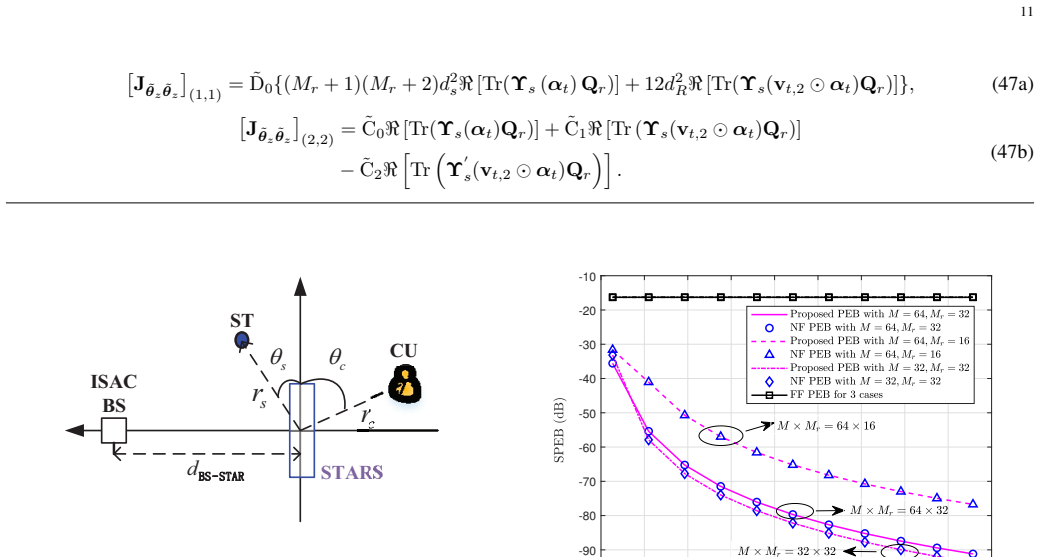
Significance. If the main derivation is correct, the paper offers a useful engineering result: an explicit, interpretable SPEB formula for near-field sensing with a STARS-mounted array, together with a deployment-aware optimization framework that appears to outperform fixed-deployment benchmarks. The paper also includes concrete algorithmic machinery (SCA, GP approximation, SDR with rank-one recovery, penalty methods) and Monte Carlo comparisons against classical estimators, which are valuable even if the final claim is only approximate. The central theoretical claim, however, is the diagonality of the Fisher information matrix in Proposition 1, and the current proof of that claim has a gap; the numerical validation cannot by itself quantify the approximation error over the parameter range used in the deployment optimization.
major comments (3)
- [Appendix A, Eq. (51)] The proof that the off-diagonal FIM entries vanish uses the inequality |Tr(AB)| ≤ Tr(A)Tr(B) with A = diag(v_{t,1}) and B = R_{\bar X_r} \bar A_t. This inequality is not valid for arbitrary square matrices; in the form used, it requires both matrices to be positive semidefinite, whereas diag(v_{t,1}) has negative entries. Indeed, Tr(diag(v_{t,1}) R_{\bar X_r} \bar A_t) = α_t^H diag(v_{t,1}) R_{\bar X_r} α_t, which is not identically zero for a generic PSD R_{\bar X_r}; for example, with M=3, v=[-1,0,1], α_t=1, and R=diag(1,0.5,1), the value is 0.5. Therefore the off-diagonal entries [J_γ]_{12} and [J_γ]_{21} are not proven to vanish, and the diagonal SPEB expression in Proposition 1, Eqs. (20)-(21), is an unquantified approximation. Since Section III-A optimizes the sensor interval using these diagonal forms, this gap is load-bearing.
- [Eq. (21b)] The expression for [J_{tilde η}]_{2,2} contains a negative first term proportional to -c(R_{\bar X_r}), while any entry of a valid Fisher information matrix must be nonnegative. As written, for parameter choices where c(R_{\bar X_r}) > 0, this diagonal entry can become negative, which is inconsistent with the definition in Eq. (16). The subsequent substitution in Section III-A, Eq. (25b), assumes this term has a fixed sign (C_1 > 0) and therefore builds the sensor-deployment optimization on an expression that may not be a valid FIM. The authors should either prove a sign property for c(R_{\bar X_r}) under the model constraints, or revise Eq. (21b) and the optimization that uses it.
- [Section III-A, constraint (24b)] As printed, the feasible set for \tilde d_s is given by M^2 d_R^2/4 ≤ \tilde d_s ≤ M^2 d_R^2/M_r^2. For any M_r > 2, the upper bound M^2 d_R^2/M_r^2 is strictly smaller than the lower bound M^2 d_R^2/4, so the subproblem (24) is infeasible and Proposition 2's closed-form solution \tilde d_s^* = (M d_R/M_r)^2 lies outside the stated feasible set. This appears to be a typographical error in the lower bound or in the aperture constraint (23b), but as written it invalidates the sensor-interval optimization. Please correct the bounds and re-examine the monotonicity argument in Appendix B if the bounds change.
minor comments (5)
- [Abstract] The phrase 'a cost function minimization problem, a cost function minimization problem is formulated' is duplicated and should be reduced to a single clause.
- [Section II-C] There is a typo, 'amzith angle', which should be 'azimuth angle'.
- [Section III-A, Eq. (24b)] Even after correcting the bound issue, the notation \tilde d_s = d_s^2 and the subsequent inequality (24b) should be stated with explicit division bars, since the current rendering makes the intended fractions ambiguous.
- [Fig. 7] The caption states a comparison of 'RMSE/root SPEB' but the text does not define how the root SPEB is computed from Eq. (20); please add the definition or a reference.
- [Eq. (14) and Appendix A] The notation for the trace is inconsistent: the main text uses 'tr' in Eq. (14) and 'Tr' elsewhere. Please unify.
Circularity Check
No significant circularity: the SPEB derivation is first-principles and validated against an external numerical benchmark.
full rationale
The central derivation (Proposition 1, Eqs. (20)-(21), Appendix A) starts from the signal model and FIM definition and algebraically manipulates steering-vector symmetries; no fitted parameter is inserted into the SPEB expression and then re-extracted as a prediction. The sensor-deployment and beamforming optimizations use the same expression as the objective, so they inherit its validity but do not define it circularly. The only overlapping-author references that could raise a self-citation concern are [26], used as an exact/numerical SPEB benchmark, and [36], used for a standard rank-one SDR recovery theorem. Neither injects the present conclusion as a premise: [26] is an independent published numerical computation and the comparison is an external validation, not a calibration or fit, and [36] is a general theorem not derived from this system. Note that Appendix A's proof that the off-diagonal FIM entries vanish invokes |Tr(AB)| <= Tr(A)Tr(B) for arbitrary matrices and applies it to a non-PSD diag(v_{t,1}) matrix; that is a genuine correctness/mathematical-support defect, but it is not circularity because the diagonal-FIM claim is not equivalent to an input by construction. The paper's self-citations are therefore non-load-bearing, and the derivation chain is self-contained apart from the separately reviewable mathematical error.
Assumptions & free parameters
assumptions (4)
- domain assumption Interference at the sensors is perfectly eliminated via offline training or successive interference cancellation.
- domain assumption Perfect CSI for H_BR and g_c is available at the BS.
- standard math The near-field steering vector uses a second-order Taylor expansion for the propagation distance.
- ad hoc to paper The inequality |Tr(AB)| ≤ Tr(A)Tr(B) holds for all square matrices A and B.
Cite this review
Pith. "Pith review of STARS-assisted Near-field ISAC: Sensor Deployment and Beamforming Design." pith.science (2026). https://pith.science/paper/FA6AHDLE
@misc{pith2026250600192,
  author       = {Pith},
  title        = {Pith review of: STARS-assisted Near-field ISAC: Sensor Deployment and Beamforming Design},
  year         = {2026},
  howpublished = {\url{https://pith.science/paper/FA6AHDLE}},
  note         = {Machine review of arXiv:2506.00192}
}
read the original abstract
A simultaneously transmitting and reflecting surface (STARS) assisted near-field (NF) integrated sensing and communication (ISAC) framework is proposed, where the radio sensors are installed on the STARS to directly conduct the distance-domain sensing by exploiting the characteristic spherical wavefront. A new squared position error bound (SPEB) expression is derived to reveal the dependence on beamforming (BF) design and sensor deployment. To balance the trade-off between the SPEB and the sensor deployment cost, a cost function minimization problem, a cost function minimization problem is formulated to jointly optimize the sensor deployment, the active and passive BF, subject to communication and power consumption constraints. For the sensor deployment optimization, a joint sensor deployment algorithm is proposed by invoking the successive convex approximation. Under a specific relationship between the sensor numbers and BF design, we derive the optimal sensor interval in a closed-form expression. For the joint BF optimization, a penalty-based method is invoked. Simulation results validated that the derived SPEB expression is close to the exact SPEB, which reveals the Fisher information Matrix of position estimation in NF can be approximated as a diagonal matrix. Furthermore, the proposed algorithms achieve the best SPEB performance than the benchmark schemes accompanying the lowest deployment cost.
Figures


Figures from the paper (3 more)


Reference graph
Works this paper leans on
-
[1]
Near-field ISAC for a RIS-assisted system,
N. Xue, X. Mu, Y . Chen, and Y . Liu, “Near-field ISAC for a RIS-assisted system,” in Proc. IEEE Global Commun. Conf. (GLOBECOM) , 2024, accepted
work page 2024
-
[2]
A vision of 6G wireless systems: Applications, trends, technologies, and open research problems,
W. Saad, M. Bennis, and M. Chen, “A vision of 6G wireless systems: Applications, trends, technologies, and open research problems,” IEEE Network, vol. 34, no. 3, pp. 134–142, May. 2019
work page 2019
-
[3]
M. Xu, W. C. Ng, W. Y . B. Lim, J. Kang, Z. Xiong, D. Niyato, Q. Yang, X. Shen, and C. Miao, “A full dive into realizing the edge- enabled metaverse: Visions, enabling technologies, and challenges,” IEEE Commun. Surv. & Tut. , vol. 25, no. 1, pp. 656–700, 1st Quart. 2023
work page 2023
-
[4]
MU-MIMO commu- nications with MIMO radar: From co-existence to joint transmission,
F. Liu, C. Masouros, A. Li, H. Sun, and L. Hanzo, “MU-MIMO commu- nications with MIMO radar: From co-existence to joint transmission,” IEEE Trans. Wireless Commun. , vol. 17, no. 4, pp. 2755–2770, Apr. 2018
2018
-
[5]
Joint radar and communication design: Applications, state-of-the-art, and the road ahead,
F. Liu, C. Masouros, A. P. Petropulu, H. Griffiths, and L. Hanzo, “Joint radar and communication design: Applications, state-of-the-art, and the road ahead,” IEEE Trans. Commun., vol. 68, no. 6, pp. 3834–3862, Jun. 2020
work page 2020
-
[6]
Intelligent reflecting surface-aided wireless communications: A tutorial,
Q. Wu, S. Zhang, B. Zheng, C. You, and R. Zhang, “Intelligent reflecting surface-aided wireless communications: A tutorial,” IEEE Trans. Commun., vol. 69, no. 5, pp. 3313–3351, May. 2021
work page 2021
-
[7]
Intelligent reflecting surface enhanced wireless network via joint active and passive beamforming,
Q. Wu and R. Zhang, “Intelligent reflecting surface enhanced wireless network via joint active and passive beamforming,” IEEE Trans. Wire- less Commun., vol. 18, no. 11, pp. 5394–5409, 2019
work page 2019
-
[8]
STAR: Simultaneous transmission and reflection for 360 coverage by intelligent surfaces,
Y . Liu, X. Mu, J. Xu, R. Schober, Y . Hao, H. V . Poor, and L. Hanzo, “STAR: Simultaneous transmission and reflection for 360 coverage by intelligent surfaces,” IEEE Wireless Commun., vol. 28, no. 6, pp. 102– 109, 2021
work page 2021
Show all 39 references
-
[9]
Near-field MIMO communications for 6G: Fundamentals, Challenges, Potentials, and Future Directions,
M. Cui, Z. Wu, Y . Lu, X. Wei, and L. Dai, “Near-field MIMO communications for 6G: Fundamentals, Challenges, Potentials, and Future Directions,” IEEE Communs. Mag. , vol. 61, no. 1, pp. 40–46, 2023
2023
-
[10]
Reconfigurable intelligent surface- aided near-field communications for 6G: Opportunities and challenges,
X. Mu, J. Xu, Y . Liu, and L. Hanzo, “Reconfigurable intelligent surface- aided near-field communications for 6G: Opportunities and challenges,” IEEE Veh. Technol. Mag., vol. 19, no. 1, pp. 65–74, Mar. 2024
2024
-
[11]
Near- field communications: A tutorial review,
Y . Liu, Z. Wang, J. Xu, C. Ouyang, X. Mu, and R. Schober, “Near- field communications: A tutorial review,” IEEE Open J. Commun. Soc. , vol. 4, pp. 1999–2049, Aug. 2023
1999
-
[12]
Target sensing with intelligent reflecting surface: Architecture and performance,
X. Shao, C. You, W. Ma, X. Chen, and R. Zhang, “Target sensing with intelligent reflecting surface: Architecture and performance,” IEEE J. Sel. Areas Commun. , vol. 40, no. 7, pp. 2070–2084, Jul. 2022
2022
-
[13]
RIS-assisted communication radar coexistence: Joint beamforming design and analysis,
Y . He, Y . Cai, H. Mao, and G. Yu, “RIS-assisted communication radar coexistence: Joint beamforming design and analysis,” IEEE J. Sel. Areas. Commun., vol. 40, no. 7, pp. 2131–2145, Jul. 2022
2022
-
[14]
STARS enabled integrated sensing and communications,
Z. Wang, X. Mu, and Y . Liu, “STARS enabled integrated sensing and communications,” IEEE Trans. Wireless Commun., vol. 22, no. 10, pp. 6750–6765, Oct. 2023
2023
-
[15]
Near-field coherent radar sensing using a massive mimo communication testbed,
A. Sakhnini, S. De Bast, M. Guenach, A. Bourdoux, H. Sahli, and S. Pollin, “Near-field coherent radar sensing using a massive mimo communication testbed,” IEEE Trans. Wireless Commun., vol. 21, no. 8, pp. 6256–6270, Feb. 2022
2022
-
[16]
Near-field integrated sensing and com- munication with extremely large-scale antenna array,
H. Hua, J. Xu, and R. Zhang, “Near-field integrated sensing and com- munication with extremely large-scale antenna array,” arXiv preprint arXiv:2407.17237, 2024. 15
2024 arXiv
-
[17]
Ris-assisted integrated sensing and communications: A subspace rotation approach: Invited paper,
X. Meng, F. Liu, S. Lu, S. P. Chepuri, and C. Masouros, “Ris-assisted integrated sensing and communications: A subspace rotation approach: Invited paper,” in 2023 IEEE Radar Conference (RadarConf23) , 2023, pp. 1–6
2023
-
[18]
STAR-RISs: Simultaneous transmitting and reflecting reconfigurable intelligent surfaces,
J. Xu, Y . Liu, X. Mu, and O. A. Dobre, “STAR-RISs: Simultaneous transmitting and reflecting reconfigurable intelligent surfaces,” IEEE Commun. Lett., vol. 25, no. 9, pp. 3134–3138, Sept. 2021
2021
-
[19]
Simultaneously transmitting and reflecting surfaces for ubiquitous next-generation multiple access in 6G and beyond,
X. Mu, J. Xu, Z. Wang, and N. Al-Dhahir, “Simultaneously transmitting and reflecting surfaces for ubiquitous next-generation multiple access in 6G and beyond,” Proc. IEEE, vol. 112, no. 9, pp. 1346–1371, Sept. 2024
2024
-
[20]
NOMA-assisted full space STAR- RIS-ISAC,
N. Xue, X. Mu, Y . Liu, and Y . Chen, “NOMA-assisted full space STAR- RIS-ISAC,” IEEE Trans. Wireless Commun. , vol. 23, no. 8, pp. 8954– 8968, Aug. 2024
2024
-
[21]
Conditional and unconditional Cram´er–Rao bounds for near-field localization in bistatic mimo radar systems,
L. Khamidullina, I. Podkurkov, and M. Haardt, “Conditional and unconditional Cram´er–Rao bounds for near-field localization in bistatic mimo radar systems,” IEEE Trans. Signal Process. , vol. 69, pp. 3220– 3234, May. 2021
2021
-
[22]
RIS-aided joint localization and synchronization with a single-antenna receiver: Beamforming design and low-complexity esti- mation,
A. Fascista, M. F. Keskin, A. Coluccia, H. Wymeersch, and G. Seco- Granados, “RIS-aided joint localization and synchronization with a single-antenna receiver: Beamforming design and low-complexity esti- mation,” IEEE J. Sel. Topics Signal Process. , vol. 16, no. 5, pp. 1141– 1...
2022
-
[23]
Near-field 3D localization via MIMO radar: Cram ´er–rao bound analysis and estimator design,
H. Hua, J. Xu, and Y . C. Eldar, “Near-field 3D localization via MIMO radar: Cram ´er–rao bound analysis and estimator design,” IEEE Trans. Signal Process. (Early Access) , pp. 1–16, 2024
2024
-
[24]
Reconfigurable intelligent surface for near field communications: Beamforming and sensing,
Y . Jiang, F. Gao, M. Jian, S. Zhang, and W. Zhang, “Reconfigurable intelligent surface for near field communications: Beamforming and sensing,” IEEE Trans. Wireless Commun. , vol. 22, no. 5, pp. 3447– 3459, May 2023
2023
-
[25]
Multiple access for near-field communications: SDMA or LDMA?
Z. Wu and L. Dai, “Multiple access for near-field communications: SDMA or LDMA?” IEEE J. Sel. Areas Commun. , vol. 41, no. 6, pp. 1918–1935, May. 2023
1918
-
[26]
Near-field integrated sensing and communications,
Z. Wang, X. Mu, and Y . Liu, “Near-field integrated sensing and communications,” IEEE Commun. Lett. , vol. 27, no. 8, pp. 2048–2052, May. 2023
2023
-
[27]
STARS-ISAC: How many sensors do we need?
Z. Zhang, Y . Liu, Z. Wang, and J. Chen, “STARS-ISAC: How many sensors do we need?” IEEE Trans. Wireless Commun. , vol. 23, no. 2, pp. 1085–1099, Feb. 2024
2024
-
[28]
Near-field rainbow: Wideband beam training for XL-MIMO,
M. Cui, L. Dai, Z. Wang, S. Zhou, and N. Ge, “Near-field rainbow: Wideband beam training for XL-MIMO,” IEEE Trans. Wireless Com- mun., vol. 22, no. 6, pp. 3899–3912, Nov. 2023
2023
-
[29]
Channel estimation for near-field XL-RIS-aided mmwave hybrid beamforming architectures,
S. Yang, W. Lyu, Z. Hu, Z. Zhang, and C. Yuen, “Channel estimation for near-field XL-RIS-aided mmwave hybrid beamforming architectures,” IEEE Trans. Veh. Technol., vol. 72, no. 8, pp. 11 029–11 034, 2023
2023
-
[30]
Near-field channel estimation for extremely large-scale reconfigurable intelligent surface (XL-RIS)-aided wideband mmwave systems,
S. Yang, C. Xie, W. Lyu, B. Ning, Z. Zhang, and C. Yuen, “Near-field channel estimation for extremely large-scale reconfigurable intelligent surface (XL-RIS)-aided wideband mmwave systems,” IEEE J. Sel. Areas Commun., vol. 42, no. 6, pp. 1567–1582, Jun. 2024
2024
-
[31]
S. M. Kay, Fundamentals of statistical signal processing: estimation theory. Prentice-Hall, Inc., 1993
1993
-
[32]
CRB minimization for RIS-aided mmwave integrated sensing and communications,
W. Lyu, S. Yang, Y . Xiu, Y . Li, H. He, C. Yuen, and Z. Zhang, “CRB minimization for RIS-aided mmwave integrated sensing and communications,” IEEE Internet Things J. , vol. 11, no. 10, pp. 18 381– 18 393, May. 2024
2024
-
[33]
CVX: Matlab software for disciplined convex programming, version 2.1,
M. Grant and S. Boyd, “CVX: Matlab software for disciplined convex programming, version 2.1,” http://cvxr.com/cvx, Mar. 2014
2014
-
[34]
Online optimal control for wireless cooperative transmission by ambient RF powered sensors,
T. Liu, X. Qu, and W. Tan, “Online optimal control for wireless cooperative transmission by ambient RF powered sensors,” IEEE Trans. Wireless Commun., vol. 19, no. 9, pp. 6007–6019, Sept. 2020
2020
-
[35]
S. Boyd, S. P. Boyd, and L. Vandenberghe, Convex optimization . Cambridge university press, 2004
2004
-
[36]
Joint transmit beamforming for multiuser MIMO communications and MIMO radar,
X. Liu, T. Huang, N. Shlezinger, Y . Liu, J. Zhou, and Y . C. Eldar, “Joint transmit beamforming for multiuser MIMO communications and MIMO radar,” IEEE Trans. Signal Process. , vol. 68, pp. 3929–3944, Jun. 2020
2020
-
[37]
Penalty dual decomposition method for non- smooth nonconvex optimization-part I: Algorithms and convergence analysis,
Q. Shi and M. Hong, “Penalty dual decomposition method for non- smooth nonconvex optimization-part I: Algorithms and convergence analysis,” IEEE Trans. Signal Process. , vol. 68, pp. 4108–4122, 2020
2020
-
[38]
Cram ´er–Rao bound optimization for joint radar-communication beamforming,
F. Liu, Y .-F. Liu, A. Li, C. Masouros, and Y . C. Eldar, “Cram ´er–Rao bound optimization for joint radar-communication beamforming,” IEEE Trans. Signal Process., vol. 70, pp. 240–253, Dec. 2022
2022
-
[39]
Trace and the sum of elements of a matrix
J. K. Merikoski, “Trace and the sum of elements of a matrix.” LINEAR ALGEBRA APPLIC., vol. 60, pp. 177–186, 1984
1984
Reviewed August 7, 2026 · model on record in the stance chip above.
Discussion (0). Sign in to comment.