REVIEW 6 major objections 6 minor 34 references
The Impact of Uniform Circular Array on Near-field ISAC
T0 review · 6 major / 6 minor · reviewed 2026-08-07 · deepseek-v4-flash
Pith's one-line read A circular antenna array nearly makes angle and distance estimation independent in near-field integrated sensing and communication.
desk verdict The UCA near-field CRB analysis is a legitimate new contribution, but the VQF beamforming algorithm rests on an algebraic error in Lemma 2 that invalidates the claimed SPEB optimality and the performance comparisons against SDR. read the letter →
The pith
A machine-rendered reading of the paper's core claim, the machinery that carries it, and where it could break.
The reading
What carries the argument
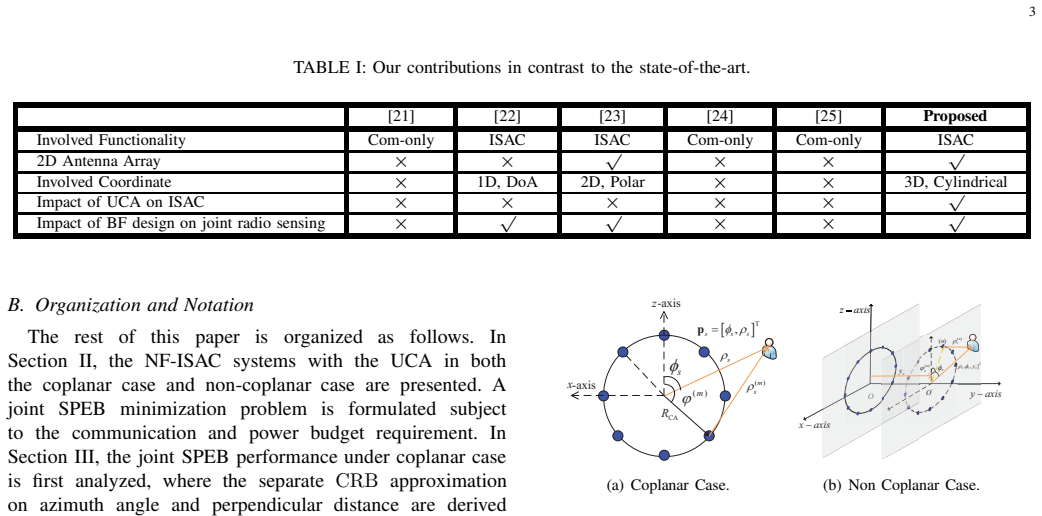
The load-bearing object is the Fisher information matrix $J_\gamma$ of the estimated parameter vector $\gamma = [\rho_s, \varphi_s, y_s, \alpha_s]$, built from UCA steering vectors under the uniform spherical wavefront model—a model in which each antenna's phase depends on both the target's angle and its distance, not just the angle. Rotational symmetry of the circular array makes the cross-term sums of trigonometric functions vanish, and replacing discrete antenna sums with integrals (valid when $N_r$ and $N_t$ are much larger than $2\pi$) turns the Fisher matrix into an approximately diagonal (coplanar) or block-diagonal (non-coplanar) matrix. That structure reduces the squared position error bound to a weighted sum of scalar Rayleigh quotients such as $|\mathbf{h}_s^H \mathbf{w}|^2$ and $|\tilde{\boldsymbol{\alpha}}_\rho^H \mathbf{w}|^2$, and the vector-based quadratic transformation solves the resulting sum-of-ratios problem as a sequence of convex updates with $O(N_t^2)$ complexity.
What would settle it
Compute the exact Fisher information matrix numerically for a small UCA—say $N_t = N_r = 8$ with a coplanar target at $\rho_s$ close to $R_{CA}$—using the exact steering vectors and no integral replacement, and check the size of the off-diagonal entries relative to the diagonal ones; if they are not negligible, the closed-form CRB expressions and the decoupled SPEB minimization would fail for small arrays. The same comparison for a non-coplanar target would test whether the $(2,3)$ coupling block is truly negligible.
Extended reading notes
Core claim
Under the uniform spherical wavefront model—a model in which steering-vector phases depend on both angle and distance, not just angle—the Fisher information matrix of a near-field UCA sensing target is approximately diagonal when the target lies in the plane of the circular array (Proposition 1), and approximately block diagonal when the target is outside that plane (Proposition 4). The diagonal form yields closed-form CRB expressions for the azimuth angle and the perpendicular distance, while the block form yields separate CRBs for the three cylindrical coordinates with the perpendicular-distance and signed-distance parameters left coupled. The paper turns these structures into beamforming designs: a closed-form beam is derived for the angle-only CRB, and a vector-based quadratic transformation converts the joint squared-position-error-bound minimization into a sequence of convex problems whose solutions lie in low-dimensional spans of projected steering vectors. The reported numerics validate the diagonal and block-diagonal approximations and show the proposed algorithm beating a semidefinite-relaxation baseline in both precision and runtime.
Load-bearing premise
The closed-form CRBs and the diagonal/block-diagonal Fisher-matrix structure depend on replacing sums over discrete antenna elements with integrals, which requires the numbers of transmit and receive antennas to be much larger than $2\pi$, and on the exact rotational symmetry of the array so that cross-term sums vanish; the paper also excludes targets lying along the array's normal direction in the non-coplanar case.
Editorial extensions
If this is right
- For a coplanar target, angle and distance estimation are nearly independent under near-field UCA sensing, so the joint squared position error bound can be evaluated coordinate by coordinate instead of by inverting a full Fisher matrix.
- UCA-based positioning beamforming reduces to maximizing a few scalar inner products, so the transmit beam can be designed in $O(N_t^2)$ time rather than through matrix-lifting semidefinite relaxation.
- In the simulated settings, a UCA gives the coplanar sensing target an SPEB gain of roughly 15–20 dB over a uniform planar array with comparable aperture, which would favor circular geometries when the target's angle is unknown or varies.
- For non-coplanar targets, the coupling between perpendicular distance and signed distance must be retained, but it does not destroy the low-complexity structure; the extended VQF algorithm handles it with the same vector-based updates.
- Because the approximate Fisher matrix is supported only for large arrays, the closed-form bounds are asymptotic design tools rather than exact small-array guarantees.
Reading between the lines
- The same rotational-symmetry argument could extend to multi-target localization, where each target contributes its own projected steering vectors and the SPEB becomes a sum of target-specific Rayleigh quotients; the paper only treats a single target.
- The integral-approximation condition suggests the closed-form CRBs will degrade smoothly with array size, so a practical minimum-antenna rule (for example, $N_l$ larger than about $2\pi$ times a safety factor) could be calibrated numerically; the paper does not specify such a rule.
- If the diagonal-Fisher claim survives at moderate array sizes, joint maximum-likelihood estimation of angle and distance could be replaced by two separate scalar estimators with negligible performance loss, which is testable with an actual estimator and is not implemented in the paper.
Editorial analysis
A structured set of objections, weighed in public.
Referee Report
Summary. The manuscript studies a uniform circular array (UCA) based near-field integrated sensing and communication (ISAC) system and derives approximate Cramér–Rao bound (CRB) and squared position error bound (SPEB) expressions for a sensing target located either in the plane of the UCA (coplanar case) or outside it (non-coplanar case). It then formulates a beamforming problem that minimizes the joint SPEB subject to a communication rate constraint and a power budget. For the coplanar case the paper proposes a closed-form solution for the angle CRB and a low-complexity vector-based quadratic transformation (VQF) algorithm; for the non-coplanar case it proposes an SDR approach and an extended VQF algorithm. Numerical results compare the proposed algorithms with SDR and uniform planar array baselines and report better SPEB performance and lower complexity.
Significance. If the results were correct, the paper would provide tractable closed-form CRB approximations for UCA-based near-field ISAC and a low-complexity beamforming algorithm with better precision than SDR. The manuscript has clear strengths: it uses an analytic uniform spherical wavefront model, derives explicit approximate expressions such as (10) and (31), reports numerical validation of those approximations against computed FIMs, and gives a complexity analysis. However, the central algorithmic claims rest on algebraic reductions that are not valid for arbitrary beamformers. The equivalence between the original SPEB objective and the VQF objective is not established, and the CRB formulas used as objectives ignore the amplitude parameters in the FIM. These are load-bearing issues rather than presentation concerns.
major comments (6)
- [Section III.C.1, Lemma 2 and Eq. (23)] The reduction Tr(Rx ˙A^H_{1,φ} ˙A_{1,φ}) ≈ |h_s^H w|² is not valid for arbitrary w. From (8), with Rx = ww^H, the trace equals (4π²N_r/λ_c²)(A|u^H w|² + |v^H w|²), where u = α_{t,1}, v = α_{t,1}⊙v_{t,1}, and A = ‖v_{r,1}‖². The proposed h_s = √A u + v gives h_s h_s^H = A uu^H + vv^H + √A(uv^H + vu^H), so the trace of ww^H h_s h_s^H contains the extra cross term 2√A Re{(u^Hw)(v^Hw)^*}. The observation that u^H v ≈ 0 does not make this cross term vanish for general w; for example, w = (u+v)/‖u+v‖ yields a nonzero cross term. Consequently the VQF objective (23), the projected-vector construction (19), and the equivalence claimed in Proposition 3 are not equivalent to the SPEB problem (17). The same structure is reused in Lemma 4 and in (35)–(37), so the non-coplanar VQF algorithm is affected as well.
- [Section III.C.2, Proposition 3 and Eq. (24)] The quadratic transformation in (24) is algebraically inconsistent with the ratio being minimized. For a term [T]_11/|h_s^H w|², the standard quadratic transform introduces the surrogate 2y√([T]_11) − y²|h_s^H w|², whose maximizer over y is √([T]_11)/|h_s^H w| and whose maximum equals the original ratio. The paper instead writes 1/[2y√(|h_s^H w|²) − y²[T]_11] and updates y* = √(|h_s^H w|²[T]_11) in (26). Substituting this y* gives a value proportional to |h_s^H w|²/[T]_11, which is the reciprocal ratio, not the original term. Thus (24) is not equivalent to (17), and the convergence and optimality claims for Algorithm 1 and its non-coplanar extension via (37)–(39) are unsupported.
- [Section III.A Eq. (7) and Section IV.A Eq. (30)] The CRB formulas use diagonal entries of the 4×4 FIM Jγ without accounting for the complex amplitude α_s. Since γ = [ps^T, Re(α_s), Im(α_s)]^T, the position CRB is the Schur complement J_ps − J_ps,α J_αα^{-1} J_α,ps, not merely the diagonal blocks. The paper does not show that the amplitude–position cross terms J_ps,α vanish for the beamformers produced by the optimization; the proof of Proposition 1 addresses position–position cross terms such as v_{l,1}⊙v_{l,2}, but not the amplitude block. For arbitrary w these cross terms need not be small. The SPEB values minimized in (17), (23), (32), and (37) are therefore not established as true CRBs for the optimized w.
- [Section IV.A Eq. (30a)] Equation (30a) is inconsistent with the block-diagonal structure in (29). If Jps has the form diag(a,B) with B = [[b,c],[c*,d]], then [Jps^{-1}]_{11} = 1/a and [Jps^{-1}]_{22} = d/(bd−|c|²). The correction term shown in (30a), −[Jps]_{23}[Jps]_{23}^H/([Jps]_{11}[Jps]_{22}[Jps]_{33}), has the wrong denominator and is attached to the wrong diagonal entry. This formula should be corrected before the non-coplanar CRB results can be used.
- [Section III.A, Eqs. (13), (A.1), (B.1)] The closed-form CRBs and the diagonal/block-diagonal FIM structure rest on replacing discrete sums over antenna elements by integrals under conditions stated as N_r ≫ 2π and, in (13), 'δ ≫ 1' where δ = 2π/N_r should read δ ≪ 1. No error bound or parameter regime is provided, and the numerical validation only explores N_t = 256 with N_r ≥ 20. Since these CRBs are used as the objectives of the optimization problems, the approximation error should be quantified or an explicit validity range given before the closed-form expressions (10), (31), and the block-diagonal approximation (29) can be relied on for moderate array sizes.
- [Section III.C.1, Proposition 2] The closed-form solution (21) is asserted by reference to [30, Theorem 1] without a proof. Because the present problem involves a UCA near-field model, a projected vector h_s, and a specific communication constraint, the paper should verify explicitly that the hypotheses of [30, Theorem 1] hold here; a citation alone is insufficient for a claimed closed-form solution, particularly when the preceding rank-one reduction in Lemma 2 is invalid.
minor comments (6)
- [Section II.B] The phrase 'Without loss of generosity' should read 'Without loss of generality.'
- [Introduction, Section I.B] The organization paragraph states 'In Section III, the joint SPEB performance under the non-coplanar case is analyzed,' but the non-coplanar analysis is presented in Section IV; the section references should be corrected.
- [Section II.C] The phrase 'achievable date rate' should read 'achievable data rate.'
- [Section III.A, Eq. (14b)] Lemma 1 states properties of v_{l,2} for a general index l, but (14b) uses N_r in both cases; this should likely be N_l to apply to both transmit and receive steering vectors.
- [Section III.C.1, Eq. (21)] The constant Γ_c appears in (21) but is not defined in the manuscript; it should be related to the communication requirement \bar R_min or \bar γ_min introduced elsewhere.
- [Section III.A, Eq. (13)] The condition accompanying the integral approximation should read δ ≪ 1 (equivalently N_r ≫ 2π), not 'δ ≫ 1' as written.
Circularity Check
No circular derivation found: CRB/SPEB expressions are derived from the USW model via Slepian–Bangs and validated against the exact numerical FIM; the closed-form beamformer comes from an external theorem [30]; self-citations [1], [12] are minor and non-load-bearing, while the skeptic's Lemma 2/Lemma 4 objection is a correctness issue, not circularity.
full rationale
The paper's claimed derivation chain is self-contained against external results rather than self-referential. In Section III.A, the CRB expressions (7) and (10) are computed from the USW steering model (1) via the Slepian–Bangs formula (2) and integral identities from [27]; the FIM-diagonalization claim rests on the rotational-symmetry estimates (13) and Appendix A, with no parameter fitted to any simulation output. Figures 2 and 3 validate the approximate closed forms against the exact discrete-sum FIM, which is genuine approximation validation, not prediction from fitted inputs. The closed-form beamformer (21) in Proposition 2 is imported from [30, Theorem 1] (Liu, Liu, Li, Masouros, Eldar, IEEE TSP 2022), an external published theorem by a different group, and the Proposition 3 equivalence is the standard quadratic transform of [29]; neither is a self-citation carrying the load. The self-citations are minor: [1] is the companion ICC 2025 workshop paper noted in the header, and [12] (Wang, Mu, Liu) serves as motivation and as the source of the simulation benchmark ('The numerical results of the benchmark scheme are obtained as [12, 30] under the UCA,' Section V.A); neither determines the CRB or VQF optimality claims. The skeptic's Lemma 2/Lemma 4 attack — that Tr(Rx ˙A_{1,φ}^H ˙A_{1,φ}) reduces to |h_s^H w|^2 only if the matrix-valued cross terms vanish for every w, which the scalar sum ‖v_{t,1}‖_1 ≈ 0 does not imply — is an algebraic-validity objection to an asserted equivalence, not a circularity: the VQF objective (23) is not defined to be the SPEB; the paper attempts (with questionable algebra) to prove their equality. Footnote 1's exclusion of the normal-direction target, and the unproven treatment of the amplitude parameter in (7)/(30), are modeling and correctness limitations that do not make any result equal to its input by construction. No circular step can be exhibited by quotation, so the score stays in the 0–2 non-circular zone, reflecting only the presence of non-load-bearing self-citations.
Assumptions & free parameters
assumptions (5)
- domain assumption The uniform spherical wavefront (USW) model approximates each element-to-target propagation distance by r_m - r_s, so the phase depends on angle and distance.
- domain assumption Discrete summations over circular antenna elements can be replaced by integrals with error small when N_r and N_t are much larger than 2π.
- domain assumption The FIM cross terms vanish because sums of sine and cosine functions over the periodic circular array are zero.
- standard math The Slepian-Bangs formula (2) correctly gives the FIM for the complex Gaussian observation model.
- ad hoc to paper Proposition 2, whose proof is deferred to [30, Theorem 1], is valid for the present problem.
Cite this review
Pith. "Pith review of The Impact of Uniform Circular Array on Near-field ISAC." pith.science (2026). https://pith.science/paper/VO6RQHXH
@misc{pith2026250600211,
  author       = {Pith},
  title        = {Pith review of: The Impact of Uniform Circular Array on Near-field ISAC},
  year         = {2026},
  howpublished = {\url{https://pith.science/paper/VO6RQHXH}},
  note         = {Machine review of arXiv:2506.00211}
}
read the original abstract
A novel uniform circular array (UCA) based near-field (NF) integrated sensing and communication (ISAC) framework is proposed, where the Cylindrical coordinate is invoked to evaluate the joint positioning performance. The joint squared position error bound (SPEB) of the sensing target (ST) is derived for the coplanar and non-coplanar cases. For the coplanar case, where the ST is located in the coplanar region of the UCA, the approximate Cram{\'e}r-Rao bound (CRB) expressions for the separate angle and distance estimation are given by exploiting the uniform spherical wavefront model. A SPEB minimization problem is formulated with the constraints of communication requirement and power budget, where the closed-form solution to minimize the CRB of the angle is derived. Inspired by the close-form expression, a low complexity vector-based quadratic transformation (VQF) algorithm is proposed by invoking the Rayleigh quotient. For the non-coplanar case, where the ST is located beyond the coplanar region of the UCA, the separate CRBs over three-dimensional coordinates and the joint SPEB approximations are derived. To minimize the SPEB performance, the semi-definite relaxation (SDR) method and extended low-complexity VQF algorithm are proposed. Numerical results validated that i) the Fisher Information Matrix about angle and distance in NF propagation can be approximated as a diagonal matrix with the trinity loss; ii) Compared with the uniform planar array, the UCA achieve better positioning performance when ST located in the coplanar of the antenna array; and iii) the proposed VQF algorithms reach higher solution precision than conventional SDR algorithm with much less computation complexity.
Figures


Figures from the paper (5 more)


Reference graph
Works this paper leans on
-
[30]
Cr am´ er–Rao bound optimization for joint radar-communication beamfor ming,
F. Liu, Y .-F. Liu, A. Li, C. Masouros, and Y . C. Eldar, “Cr am´ er–Rao bound optimization for joint radar-communication beamfor ming,” IEEE Trans. Signal Process. , vol. 70, pp. 240–253, Dec. 2022
work page 2022
-
[12]
Near-field integrated sensin g and communications,
Z. Wang, X. Mu, and Y . Liu, “Near-field integrated sensin g and communications,” IEEE Commun. Lett. , vol. 27, no. 8, pp. 2048–2052, May. 2023
work page 2023
-
[1]
The circular antenna ar ray framework for near-field radio sensing,
N. Xue, X. Mu, Y . Chen, and Y . Liu, “The circular antenna ar ray framework for near-field radio sensing,” in Proc. IEEE Inter . Conf. Commun. (ICC) W orkshop, 2025, accepted
work page 2025
-
[2]
Role of sensing and computer vision in 6G wirele ss communications,
S. Kim, J. Moon, J. Kim, Y . Ahn, D. Kim, S. Kim, K. Shim, and B. Shim, “Role of sensing and computer vision in 6G wirele ss communications,” IEEE Wireless Commun. , vol. 31, no. 5, pp. 264– 271, Oct. 2024
work page 2024
-
[3]
A vision of 6G wireless sy stems: Applications, trends, technologies, and open research pro blems,
W. Saad, M. Bennis, and M. Chen, “A vision of 6G wireless sy stems: Applications, trends, technologies, and open research pro blems,” IEEE Network, vol. 34, no. 3, pp. 134–142, May. 2019
work page 2019
-
[4]
M. Xu, W. C. Ng, W. Y . B. Lim, J. Kang, Z. Xiong, D. Niyato, Q. Y ang, X. Shen, and C. Miao, “A full dive into realizing the e dge- enabled metaverse: Visions, enabling technologies, and ch allenges,” IEEE Commun. Surv. & Tut. , vol. 25, no. 1, pp. 656–700, 1st Quart. 2023
work page 2023
-
[5]
The roadmap to 6g: Ai empowered wireless networks,
K. B. Letaief, W. Chen, Y . Shi, J. Zhang, and Y .-J. A. Zhang , “The roadmap to 6g: Ai empowered wireless networks,” IEEE Commun. Mag., vol. 57, no. 8, pp. 84–90, 2019
work page 2019
-
[6]
Target sensi ng with intelligent reflecting surface: Architecture and performa nce,
X. Shao, C. Y ou, W. Ma, X. Chen, and R. Zhang, “Target sensi ng with intelligent reflecting surface: Architecture and performa nce,” IEEE J. Sel. Areas Commun. , vol. 40, no. 7, pp. 2070–2084, Jul. 2022
work page 2022
Show all 34 references
-
[7]
Ne ar- field communications: A tutorial review,
Y . Liu, Z. Wang, J. Xu, C. Ouyang, X. Mu, and R. Schober, “Ne ar- field communications: A tutorial review,” IEEE Open J. Commun. Soc. , vol. 4, pp. 1999–2049, Aug. 2023
1999
-
[8]
Multiple access for near-field communic ations: SDMA or LDMA?
Z. Wu and L. Dai, “Multiple access for near-field communic ations: SDMA or LDMA?” IEEE J. Sel. Areas Commun. , vol. 41, no. 6, pp. 1918–1935, May. 2023
1918
-
[9]
Beam focusing for near-field multiuser MIMO communica tions,
H. Zhang, N. Shlezinger, F. Guidi, D. Dardari, M. F. Imani , and Y . C. El- dar, “Beam focusing for near-field multiuser MIMO communica tions,” IEEE Trans. Wireless Commun. , vol. 21, no. 9, pp. 7476–7490, Sept. 2022
2022
-
[10]
RIS-aided joint localization and synchronizat ion with a single-antenna receiver: Beamforming design and low-comp lexity esti- mation,
A. Fascista, M. F. Keskin, A. Coluccia, H. Wymeersch, an d G. Seco- Granados, “RIS-aided joint localization and synchronizat ion with a single-antenna receiver: Beamforming design and low-comp lexity esti- mation,” IEEE J. Sel. Topics Signal Process. , vol. 16, no. 5, pp. 1141...
2022
-
[11]
Near-field 3D localizatio n via MIMO radar: Cram´ er–rao bound analysis and estimator design,
H. Hua, J. Xu, and Y . C. Eldar, “Near-field 3D localizatio n via MIMO radar: Cram´ er–rao bound analysis and estimator design,” IEEE Trans. Signal Process. , vol. 72, pp. 3879–3895, Aug. 2024
2024
-
[13]
Near-field in tegrated sensing, positioning, and communication: A downlink and up link frame- work,
H. Li, Z. Wang, X. Mu, P . Zhiwen, and Y . Liu, “Near-field in tegrated sensing, positioning, and communication: A downlink and up link frame- work,” IEEE J. Sel. Areas Commun., vol. 42, no. 9, pp. 2196–2212, Sept. 2024
2024
-
[14]
Mode ling and analysis of Near-Field ISAC,
B. Zhao, C. Ouyang, Y . Liu, X. Zhang, and H. V . Poor, “Mode ling and analysis of Near-Field ISAC,” IEEE J. Sel. Topics Signal Process. , vol. 18, no. 4, pp. 678–693, May. 2024
2024
-
[15]
Near-field integrated sensi ng and com- munication with extremely large-scale antenna array,
H. Hua, J. Xu, and R. Zhang, “Near-field integrated sensi ng and com- munication with extremely large-scale antenna array,” arXiv preprint arXiv:2407.17237, 2024
2024 arXiv
-
[16]
Enabling more users to benefit f rom near-field communications: From linear to circular array,
Z. Wu, M. Cui, and L. Dai, “Enabling more users to benefit f rom near-field communications: From linear to circular array,” IEEE Trans. Wireless Commun., vol. 23, no. 4, pp. 3735–3748, 2024
2024
-
[17]
Antenna array topologies for mmwave ma ssive mimo systems: Spectral efficiency analysis,
W. Tan and S. Ma, “Antenna array topologies for mmwave ma ssive mimo systems: Spectral efficiency analysis,” IEEE Trans. V eh. Technol., vol. 71, no. 12, pp. 12 901–12 915, 2022
2022
-
[18]
Near-field beam train ing in THz communications: The merits of uniform circular array,
Y . Xie, B. Ning, L. Li, and Z. Chen, “Near-field beam train ing in THz communications: The merits of uniform circular array,” IEEE Wireless Commun. Lett. , vol. 12, no. 4, pp. 575–579, April. 2023
2023
-
[19]
Design and analysis of LoS-MIMO systems with uniform circular arrays,
Y . Jeon, G.-T. Gil, and Y . H. Lee, “Design and analysis of LoS-MIMO systems with uniform circular arrays,” IEEE Trans. Wireless Commun. , vol. 20, no. 7, pp. 4527–4540, Jul. 2021
2021
-
[20]
Eigenstructure techniqu es for 2-d angle estimation with uniform circular arrays,
C. Mathews and M. Zoltowski, “Eigenstructure techniqu es for 2-d angle estimation with uniform circular arrays,” IEEE Trans. Signal Process. , vol. 42, no. 9, pp. 2395–2407, Sept. 1994
1994
-
[21]
Near-field multi user communications based on sparse arrays,
K. Chen, C. Qi, G. Y . Li, and O. A. Dobre, “Near-field multi user communications based on sparse arrays,” IEEE J. Sel. Topics Signal Process., vol. 18, no. 4, pp. 619–632, May. 2024
2024
-
[22]
An tenna selection with beam squint compensation for integrated sen sing and communications,
A. M. Elbir, A. Abdallah, A. Celik, and A. M. Eltawil, “An tenna selection with beam squint compensation for integrated sen sing and communications,” IEEE J. Sel. Topics Signal Process. , vol. 18, no. 5, pp. 857–870, Jul. 2024
2024
-
[23]
Wideban d near-field integrated sensing and communication with spars e transceiver design,
X. Wang, W. Zhai, X. Wang, M. G. Amin, and K. Cai, “Wideban d near-field integrated sensing and communication with spars e transceiver design,” IEEE J. Sel. Topics Signal Process., vol. 18, no. 4, pp. 662–677, May 2024
2024
-
[24]
Multi-user modular XL-MIMO communications: Near-field beam focusing pattern a nd user grouping,
X. Li, Z. Dong, Y . Zeng, S. Jin, and R. Zhang, “Multi-user modular XL-MIMO communications: Near-field beam focusing pattern a nd user grouping,” IEEE Trans. Wireless Commun. , pp. 1–1, 2024
2024
-
[25]
Enhancing spatial multiplexing and interference suppres sion for near- and far-field communications with sparse MIMO,
H. Wang, C. Feng, Y . Zeng, S. Jin, C. Y uen, B. Clerckx, and R. Zhang, “Enhancing spatial multiplexing and interference suppres sion for near- and far-field communications with sparse MIMO,” arXiv preprint arXiv:2408.01956, 2024
2024 arXiv
-
[26]
A theoretical foundation of network localization and navigation,
M. Z. Win, Y . Shen, and W. Dai, “A theoretical foundation of network localization and navigation,” Proc. IEEE , vol. 106, no. 7, pp. 1136– 1165, Jul. 2018
2018
-
[27]
I. S. Gradshteyn and I. M. Ryzhik, Table of integrals, series, and products. Academic press, 2014
2014
-
[28]
On nonlinear fractional programming,
W. Dinkelbach, “On nonlinear fractional programming, ” Management science, vol. 13, no. 7, pp. 492–498, 1967
1967
-
[29]
Fractional programming for communic ation systems—part I: Power control and beamforming,
K. Shen and W. Y u, “Fractional programming for communic ation systems—part I: Power control and beamforming,” IEEE Trans. Signal Process., vol. 66, no. 10, pp. 2616–2630, 2018
2018
-
[31]
CVX: Matlab software for discipli ned convex programming, version 2.1,
M. Grant and S. Boyd, “CVX: Matlab software for discipli ned convex programming, version 2.1,” http://cvxr.com/cvx, Mar. 201 4
-
[32]
Interior point polynomial time method s in convex programming,
A. Nemirovski, “Interior point polynomial time method s in convex programming,” Lecture notes, vol. 42, no. 16, pp. 3215–3224, 2004
2004
-
[33]
Sem idefinite relaxation of quadratic optimization problems,
Z.-Q. Luo, W.-K. Ma, A. M.-C. So, Y . Y e, and S. Zhang, “Sem idefinite relaxation of quadratic optimization problems,” IEEE Signal Process. Mag., vol. 27, no. 3, pp. 20–34, 2010
2010
-
[34]
A. J. Laub, Matrix analysis for scientists and engineers . Siam, 2005, vol. 91
2005
Reviewed August 7, 2026 · model on record in the stance chip above.
Discussion (0). Sign in to comment.