REVIEW 4 major objections 4 minor 84 references
Stellar populations in STARFORGE II: Comparison with observations
T0 review · 4 major / 4 minor · reviewed 2026-08-07 · deepseek-v4-flash
Pith's one-line read Observational biases can inflate the virial parameter of stellar associations by a factor of ten.
desk verdict A useful, mostly sound quantification of Gaia biases on young association properties, but the group-identification step is done before biases are applied, so the quoted bias factors describe known groups rather than groups recovered from a real Gaia catalog. read the letter →
The pith
A machine-rendered reading of the paper's core claim, the machinery that carries it, and where it could break.
The reading
What carries the argument
The central machinery is a synthetic-observation pipeline applied to STARFORGE groups: each simulated group is placed at a chosen distance, filtered through PARSEC isochrones with Gaia magnitude limits (roughly 3 to 20.7), stripped of unresolved binaries closer than 1 arcsecond and wide binaries within 10,000 AU, hit with a 15% random source-loss rate, and resampled 100 times to build percentile error bars. The virial parameter, defined as $\alpha_{\rm vir} = 5 R_h \sigma_{1d}^2/(G M_{\rm tot})$, is the quantity that carries the argument; the pipeline shows that the correlated biases in $M_{\rm tot}$ and $R_h$ inflate $\alpha_{\rm vir}$ by up to a factor of ten, while the traceback age is computed by linearly extrapolating the median mutual distance between stars back to its minimum.
What would settle it
Measure the actual census of missing luminous members in a Gaia-selected association such as CFN using a deep, spatially complete survey that recovers saturated and unresolved massive stars. If the true missing mass is small, the claimed factor-of-ten virial inflation would not apply to real groups; alternatively, compute traceback ages for a sample of associations with independently confirmed virial parameters above 2 and compare with photometric ages — if the errors exceed 20%, the accuracy threshold fails.
Extended reading notes
Core claim
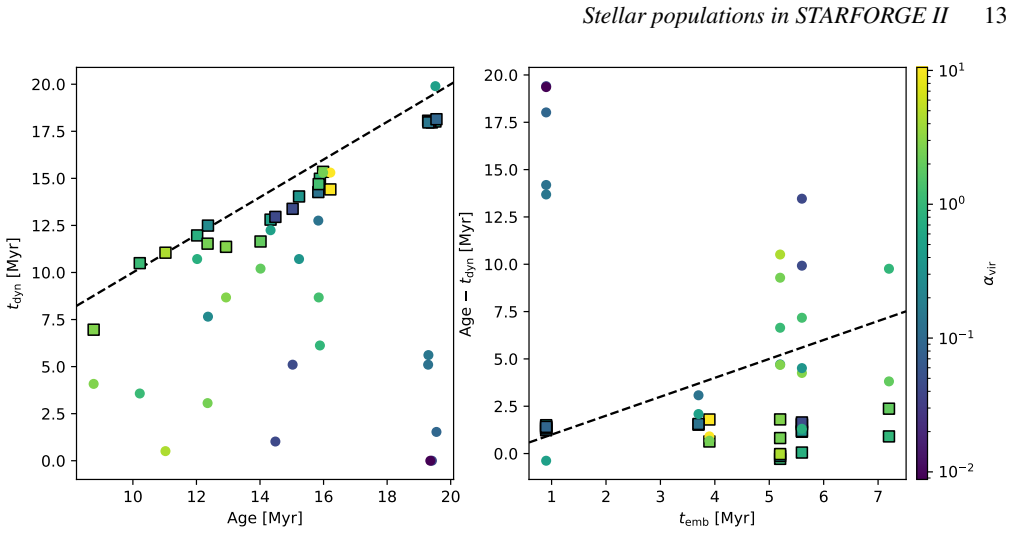
In the paper's own terms, the discovery is that the standard quantities used to characterize observed stellar associations — total mass, half-mass radius, and velocity dispersion — are differentially corrupted by observational incompleteness, and these corruption patterns combine to systematically inflate the virial parameter by up to an order of magnitude. Masses are always underestimated because bright massive stars saturate in Gaia and faint members fall below its detection limit; radii of small groups are overestimated because poor sampling spreads the measured distribution; velocity dispersion is the least affected. Since the virial parameter enters as $\alpha_{\rm vir} = 5 R_h \sigma_{1d}^2/(G M_{\rm tot})$, the net effect is a large upward bias. Therefore an observed association that looks unbound may actually contain loosely bound stars whose slow expansion skews traceback ages. The authors establish that for groups with true virial parameters above 2, linear traceback of stellar motions recovers the expansion age within 20%, but the observational inflation of the virial parameter makes it hard to know whether a given group actually meets that condition.
Load-bearing premise
The load-bearing premise is that STARFORGE simulations represent typical Milky Way giant molecular clouds and that the synthetic-observation recipe captures the dominant Gaia biases; if either fails, the error magnitudes, the tenfold virial inflation, and the traceback accuracy threshold do not transfer to real associations.
Editorial extensions
If this is right
- For groups with true mass below about 100 $M_\odot$, recovered masses fall between 20% and 90% of the true value, and half-mass radii can be overestimated by up to a factor of ten.
- Velocity dispersion is the most trustworthy observable, with relative errors below about 20% for all groups and below 5% for the most massive ones.
- Kinematic traceback ages are accurate to within 20% only for associations whose true virial parameter exceeds 2; because observed virial parameters can be inflated tenfold, a high observed value is not enough to justify trusting a traceback age.
- Four of the seven Cepheus Far North subgroups have analogues in the STARFORGE simulations, indicating CFN formed in a low-density, typical Galactic-cloud environment without preferential massive-star placement in groups.
- There is no correlation between the stellar-dynamical age difference and the duration of the embedded phase, because star formation continues while the cloud disperses.
Reading between the lines
- If the tenfold virial inflation holds for real Gaia-discovered associations, then many systems currently classified as unbound expanding associations may in fact retain a significant fraction of loosely bound stars, and their expansion ages derived from traceback would be systematically too young.
- A natural test is to re-measure group masses with infrared or deep optical surveys that recover saturated massive stars; if recovered masses rise substantially, the virial-inflation bias is present in real data, and traceback studies should require an independent boundness check.
- The omission of reddening and radial-velocity incompleteness from the bias recipe suggests the real error budget for field associations could be even larger; including them would likely strengthen the paper's qualitative conclusions rather than reverse them.
- The CFN result that massive stars are not preferentially in groups may reflect genuine low-density formation rather than bias, but a deeper census of CFN's high-mass end would settle whether the contrast with simulations is real.
Editorial analysis
A structured set of objections, weighed in public.
Referee Report
Summary. This paper uses the STARFORGE MHD simulation suite, post-processed with 200 Myr N-body integrations, to build synthetic observations of young stellar groups. After identifying groups with HDBSCAN on the unbiased simulation data, the authors apply observational biases: Gaia magnitude limits and saturation, unresolved and wide binary cuts, a 15% source-loss rate, and distance-dependent resampling. They measure how inferred total mass, half-mass radius, and velocity dispersion deviate from true values, finding up to 100% errors in mass and radius for groups below ~100 Msun, and a systematic upward bias in the virial parameter that can reach a factor of ten. They compare the resulting synthetic properties to the Cepheus Far North (CFN) association and match four of its seven subgroups. Finally, they test linear kinematic traceback ages against the true dynamical age from the simulations, reporting that traceback is accurate to within 20% only when the true virial parameter exceeds about 2, and that observational biases can erase the relation between traceback error and virial parameter. They also find no correlation between the dynamical-age minus stellar-age difference and the embedded-phase duration.
Significance. If the results hold, the paper has a direct and important implication for Gaia-era studies of young associations: observed virial parameters and traceback ages can be substantially biased, so associations that appear unbound may not be suitable for traceback dating. The Monte Carlo synthetic observation procedure is clearly specified, and the central error curves are emergent outputs of the simulations rather than parameters tuned to match observed associations. The comparison with CFN is concrete and falsifiable, and the finding that massive stars are preferentially missing from the observed group mass is a useful caution for mass-based dynamical state estimates. The main limitations are that the bias model is incomplete, the group-finding step is not part of the synthetic observation loop, and a few load-bearing analysis choices (matching threshold, exclusion of Bx100) are not tested for sensitivity. These issues are addressable in a revision.
major comments (4)
- [§2.4, §2.7, Figs. 4 and 8] The group-finding step is not part of the synthetic observation loop. HDBSCAN is run on the unbiased simulation data, and only afterwards are the biases of §2.7 applied; the manuscript states this explicitly at the end of §2.4. Real Gaia associations are the output of clustering algorithms applied to the biased catalog, as the paper notes for SPYGLASS in §2.7.1. Because mass, half-mass radius, velocity dispersion, virial parameter, and traceback ages are all membership-conditional quantities, the factor-of-ten virial inflation in Figure 4 and the 20% traceback accuracy threshold in Figure 8 describe the bias of a known group, not the bias of groups that would be detected in a Gaia-like survey. Selection effects could make detected groups preferentially complete or preferentially incomplete, and interloper contamination is not included. The authors should rerun HDBSCAN on the synthetic observed samples and repeat the measurements, or at minimum quantify detection completeness and membership contamination as a function of true group properties.
- [§3.3, Fig. 8] The Bx100 model is excluded from the traceback-virial analysis because late-forming stars contaminate the traced trajectories. This exclusion matters for the central traceback claim: Bx100 is the model with the longest star formation duration, and the statement that traceback errors fall below 20% for alpha_vir > 2 is obtained only after removing this model. If similar contamination occurs in real associations, the threshold will not transfer. Please provide an observable criterion for identifying this contamination (for example, a proxy based on age spread or the fraction of stars formed after expansion begins), or show how the Figure 8 relation changes when Bx100 is included.
- [§2.7.2, Eq. (3), §3.2] The matching criterion D <= 0.6 is introduced without justification or sensitivity analysis. The statement that four of seven CFN groups have good matches, and the conclusion that no single simulation reproduces most CFN groups, depend on this threshold. Changing the threshold to 0.4 or 0.8 would likely change which CFN groups are matched. Please justify the threshold, for example by comparing the D distribution of true analogue pairs with that of random pairs, or report the number of matches as a function of D.
- [§2.7, §4] The bias model omits reddening and radial-velocity incompleteness. The Discussion acknowledges these omissions, but the abstract and conclusions quote quantitative error magnitudes (up to 100% in mass, factor-of-ten virial inflation, 20% traceback threshold) without stating that these are lower limits or conditional on the included bias set. Since only a small fraction of Gaia sources have radial velocities with km/s-level uncertainties, the velocity dispersion and traceback measurements in real samples are made on a much smaller and kinematically selected subset, which can plausibly change the traceback error distribution in Figure 8. Please add a simple bracketing test, for example a reddening screen and an RV-only subsample, so that the reader can see how much the quoted error bars and thresholds could grow.
minor comments (4)
- [Table 1 and §2.6] The column labels t_dyn and t*_dyn appear reversed relative to the text: §2.6 defines t*_dyn as the best-case estimate using all members and t_dyn as the estimate after observational biases, but Table 1 reports error bars on t*_dyn and no error bars on t_dyn, suggesting the columns are swapped.
- [§1, §2.3, §4, Fig. 1, Fig. 3] There are several typos: 'the the' in the Introduction, 'realty' in §2.3, 'viral' instead of 'virial' in the Discussion, 'Biasses' in the Figure 1 caption, and 'afactoroften' in the Figure 3 caption.
- [§2.6] The definition of t_dyn,true as the time when the median mutual distance is minimized with at least 50% of members present is reasonable but should be tested for sensitivity to the 50% threshold; the traceback accuracy claim depends on this specific definition.
- [Fig. 6 caption] The caption says 'Side panels shows the distribution of groups from different models ... (R3 and alpha1)', but all six models appear to be shown; please clarify the wording.
Circularity Check
No significant circularity: the bias amplitudes, virial-inflation factor, and traceback threshold are emergent outputs of simulation experiments, not fitted or self-citing reductions.
full rationale
The paper's central quantitative claims—measurement uncertainties up to 100%, virial-parameter overestimation by up to a factor ten, and traceback accuracy within 20% only for alpha_vir > 2—are produced by applying a fixed observational bias recipe (Section 2.7) to STARFORGE/N-body groups and comparing biased to true values. No equation in the paper defines an output quantity in terms of the target conclusion, and no parameter is fitted to reproduce CFN or any observed traceback result. The CFN comparison in Section 3.2 is an analogue search, not a prediction derived from the same data. The heavy reliance on prior same-group work (STARFORGE, Farias et al. 2023, SPYGLASS/Kerr et al. 2021, 2022) supplies simulation initial conditions, the group-finding method, and the measured 15% source-loss rate; these are external inputs with stated assumptions rather than conclusions that reduce to self-citation. The paper itself flags limitations that matter for transferability but not circularity: Section 2.4 explicitly states 'we performed the identification of groups with HDBSCAN directly on the simulation data. After the groups are well defined, we apply observational biases in order to compare them with observations,' so synthetic observed groups inherit true membership; and Section 4 acknowledges omitted reddening and radial-velocity incompleteness, noting 'the effects we include here are general.' These are validity caveats about whether the bias factors apply to real Gaia catalogs, not instances where the derivation is equivalent to its inputs by construction.
Assumptions & free parameters
free parameters (5)
- Unresolved binary angular separation threshold =
1 arcsec
- Wide binary separation cutoff =
10,000 AU
- Source loss rate =
15%
- Gaia magnitude limits =
3 to 20.7 mag
- Matching distance threshold D =
D <= 0.6
assumptions (4)
- domain assumption STARFORGE initial conditions and feedback model represent typical Milky Way giant molecular clouds and their stellar populations.
- domain assumption The synthetic observation recipe captures the dominant Gaia selection biases.
- ad hoc to paper The true dynamical age can be defined as the time when the median mutual distance is minimized with at least 50% of members present.
- ad hoc to paper The eccentricity correction for close binaries drawn from a uniform distribution is a valid approximation.
Cite this review
Pith. "Pith review of Stellar populations in STARFORGE II: Comparison with observations." pith.science (2026). https://pith.science/paper/YPM4SUXP
@misc{pith2026250600240,
  author       = {Pith},
  title        = {Pith review of: Stellar populations in STARFORGE II: Comparison with observations},
  year         = {2026},
  howpublished = {\url{https://pith.science/paper/YPM4SUXP}},
  note         = {Machine review of arXiv:2506.00240}
}
read the original abstract
Recent studies suggest that most star-forming regions in our Galaxy form stellar associations rather than bound clusters. We analyse models from the STARFORGE simulation suite, a set of magneto-hydrodynamical simulations that include all key stellar feedback and radiative processes following star formation through cloud dispersal. We create synthetic observations by introducing observational biases such as random spurious measurements, unresolved binaries, and photometric sensitivity. These biases affect the measurement of the group mass, size, and velocity dispersion, introducing uncertainties of up to 100%, with accuracy improving as the number of system members increases. Furthermore, models favouring the formation of groups around massive stars were the most affected by observational biases, as massive stars contribute a larger fraction of the group mass and are often missing from astrometric surveys like Gaia. We compare the simulations to the Cepheus Far North (CFN) region, and show that CFN groups may have formed in a low-density environment similar to those modelled in STARFORGE but with massive stars not located preferentially in groups. We also question the effectiveness of the kinematic traceback method, showing that it is accurate within 20% only for certain associations with actual virial parameters above 2. However, observational biases can artificially raise the virial parameter by up to a factor ten, making it difficult to evaluate the reliability of the traceback age. Additionally, since stars continue to form during the dispersal of the parent cloud, we find no relation between the stellar-dynamical age difference and the length of the embedded phase.
Figures


Figures from the paper (6 more)


Reference graph
Works this paper leans on
-
[1]
Cambridge University Press
Aarseth S., 2003, Gravitational N-Body Simulations . Cambridge University Press
2003
-
[2]
Rev.] 10.1007/s11214-020-00690-x , 216
Adamo A., et al., 2020, @doi [Space Sci. Rev.] 10.1007/s11214-020-00690-x , 216
-
[3]
Adams F. C., 2000, @doi [Astrophys. J.] 10.1086/317052 , 542, 964
doi:10.1086/317052 2000
-
[4]
Astrophys.] 10.1051/0004-6361/201425481 , 577, A42
Baraffe I., Homeier D., Allard F., Chabrier G., 2015, @doi [Astron. Astrophys.] 10.1051/0004-6361/201425481 , 577, A42
-
[5]
Baumgardt H., Kroupa P., 2007, @doi [Mon. Not. R. Astron. Soc.] 10.1111/j.1365-2966.2007.12209.x , 380, 1589
arXiv 2007
-
[6]
Bertoldi F., McKee C. F., 1992, @doi [Astrophys. J.] 10.1086/171638 , 395, 140
doi:10.1086/171638 1992
-
[7]
Princeton, NJ, Princeton University Press, 1987, 747 p
Binney J., Tremaine S., 1987, Galactic dynamics . Princeton, NJ, Princeton University Press, 1987, 747 p
1987
-
[8]
Astrophys.] 10.1051/0004-6361/201834321 , 621, A86
Brandeker A., Cataldi G., 2019, @doi [Astron. Astrophys.] 10.1051/0004-6361/201834321 , 621, A86
Show all 84 references
-
[10]
Brown A. G. A., et al., 2018, @doi [Astron. Astrophys.] 10.1051/0004-6361/201833051 , 616, A1
2018 doi
-
[11]
Campello R. J. G. B., Moulavi D., Sander J., 2013, in Pei J. Tseng V. Cao L. Motoda H. eds, , Vol. 7819 LNAI, Adv. Knowl. Discov. Data Mining. PAKDD 2013. Lect. Notes Comput. Sci.. Springer, Berlin, Heidelberg, pp 160--172, @doi 10.1007/978-3-642-37456-2_14 , http://link.sprin...
2013 doi
-
[12]
Astrophys.] 10.1051/0004-6361/201834957 , 626, A17
Cantat-Gaudin T., et al., 2019, @doi [Astron. Astrophys.] 10.1051/0004-6361/201834957 , 626, A17
2019 doi
-
[13]
50 Years Later
Chabrier G., 2005, in Corbelli E., Palla F., Zinnecker H., eds, , Initial Mass Funct. 50 Years Later. Springer Netherlands, Dordrecht, pp 41--50, @doi 10.1007/978-1-4020-3407-7_5 , http://link.springer.com/10.1007/978-1-4020-3407-7 \_ 5
2005 doi
-
[14]
A., De Grijs R., Glushkova E
Chemel A. A., De Grijs R., Glushkova E. V., Dambis A. K., 2022, @doi [Mon. Not. R. Astron. Soc.] 10.1093/mnras/stac1780 , 515, 4359
2022 doi
-
[15]
R., McLeod A
Chevance M., Krumholz M. R., McLeod A. F., Ostriker E. C., Rosolowsky E. W., Sternberg A., 2023, in Inutsuka S.-i. Aikawa Y. Muto T. Tomida K. Tamura M. eds, Protostars Planets VII. Astronomical Society of the Pacific Conference Series, San Francisco, California, USA, p. 1 ( @...
-
[16]
J.] 10.3847/1538-4357/acb4eb , 946, 6
Couture D., Gagn \' e J., Doyon R., 2023, @doi [Astrophys. J.] 10.3847/1538-4357/acb4eb , 946, 6
2023 doi
-
[17]
D., Ireland M
Crundall T. D., Ireland M. J., Krumholz M. R., Federrath C., Žerjal M., Hansen J. T., 2019, @doi [Monthly Notices of the Royal Astronomical Society] 10.1093/mnras/stz2376 , 489, 3625
2019 doi
-
[18]
J.] 10.3847/1538-4357/aa7a5b , 845, 105
Da Rio N., et al., 2017, @doi [Astrophys. J.] 10.3847/1538-4357/aa7a5b , 845, 105
2017 doi
-
[20]
E., Ercolano B., Bonnell I
Dale J. E., Ercolano B., Bonnell I. A., 2013, @doi [Mon. Not. R. Astron. Soc.] 10.1093/mnras/stt236 , 431, 1062
2013 doi
-
[21]
Dinnbier F., Walch S., 2020, @doi [Mon. Not. R. Astron. Soc.] 10.1093/mnras/staa2560 , 499, 748
2020 doi
-
[22]
I., 2022, @doi [Astron
Dinnbier F., Kroupa P., Anderson R. I., 2022, @doi [Astron. Astrophys.] 10.1051/0004-6361/202142082 , 660, 1
2022 doi
-
[23]
T., 2010, Physics of the interstellar and intergalactic medium
Draine B. T., 2010, Physics of the interstellar and intergalactic medium . Princeton University Press, Princeton, NJ, @doi 10.2307/j.ctvcm4hzr , https://www.degruyter.com/document/doi/10.1515/9781400839087/html
2010 doi
-
[24]
Ducourant C., Teixeira R., Galli P. A. B., Le Campion J. F., Krone-Martins A., Zuckerman B., Chauvin G., Song I., 2014, @doi [Astron. Astrophys.] 10.1051/0004-6361/201322075 , 563, A121
2014 doi
-
[25]
P., Smith R., Fellhauer M., Goodwin S., Candlish G
Farias J. P., Smith R., Fellhauer M., Goodwin S., Candlish G. N., Bla \ n a M., Dominguez R., 2015, @doi [Mon. Not. R. Astron. Soc.] 10.1093/mnras/stv790 , 450, 2451
2015 doi
-
[26]
P., et al., 2018, @doi [Mon
Farias J. P., et al., 2018, @doi [Mon. Not. R. Astron. Soc.] 10.1093/mnras/sty597 , 476, 5341
2018 doi
-
[27]
P., Offner S
Farias J. P., Offner S. S. R., Grudi \' c M. Y., Guszejnov D., Rosen A. L., 2023, @doi [Mon. Not. R. Astron. Soc.] 10.1093/mnras/stad3609 , 527, 6732
2023 doi
-
[28]
S., Hattori K., Wang L., Hirai Y., Kumamoto J., Shimajiri Y., Saitoh T
Fujii M. S., Hattori K., Wang L., Hirai Y., Kumamoto J., Shimajiri Y., Saitoh T. R., 2022, @doi [Mon. Not. R. Astron. Soc.] 10.1093/mnras/stac808 , 514, 43
2022 doi
-
[29]
A., Miret-Roig N., Bouy H., Olivares J., Barrado D., 2023, @doi [Mon
Galli P. A., Miret-Roig N., Bouy H., Olivares J., Barrado D., 2023, @doi [Mon. Not. R. Astron. Soc.] 10.1093/mnras/stad520 , 520, 6245
2023 doi
-
[30]
A., 2018, @doi [Publ
Gouliermis D. A., 2018, @doi [Publ. Astron. Soc. Pacific] 10.1088/1538-3873/AAC1FD , 130
2018 doi
-
[31]
Y., Guszejnov D., Hopkins P
Grudi \' c M. Y., Guszejnov D., Hopkins P. F., Offner S. S. R., Faucher-Gigu \` e re C.-A., 2021, @doi [Mon. Not. R. Astron. Soc.] 10.1093/mnras/stab1347 , 506, 2199
2021 doi
-
[32]
Y., Guszejnov D., Offner S
Grudi \' c M. Y., Guszejnov D., Offner S. S. R., Rosen A. L., Raju A. N., Faucher-Gigu \` e re C.-A., Hopkins P. F., 2022, @doi [Mon. Not. R. Astron. Soc.] 10.1093/mnras/stac526 , 512, 216
2022 doi
-
[33]
Y., Offner S
Grudic M. Y., Offner S. S. R., Guszejnov D., Faucher-Gigu \`e re C.-A., Hopkins P. F., 2023, @doi [The Open Journal of Astrophysics] 10.21105/astro.2307.00052 , https://ui.adsabs.harvard.edu/abs/2023OJAp....6E..48G 6, 48
2023 arXiv
-
[34]
Y., Hopkins P
Guszejnov D., Grudi \' c M. Y., Hopkins P. F., Offner S. S. R., Faucher-Gigu \` e re C.-A. A., 2021, @doi [Mon. Not. R. Astron. Soc.] 10.1093/mnras/stab278 , 502, 3646
2021 doi
-
[35]
Guszejnov D., Markey C., Offner S. S. R., Grudi \' c M. Y., Faucher-Gigu \` e re C.-A. A. C. D., Rosen A. L., Hopkins P. F., 2022a, @doi [Mon. Not. R. Astron. Soc.] 10.1093/mnras/stac1737 , 515, 167
-
[36]
Y., Offner S
Guszejnov D., Grudi \' c M. Y., Offner S. S. R., Faucher-Gigu \` e re C.-A., Hopkins P. F., Rosen A. L., 2022b, @doi [Mon. Not. R. Astron. Soc.] 10.1093/mnras/stac2060 , 515, 4929
-
[37]
Haid S., Walch S., Seifried D., Wünsch R., Dinnbier F., Naab T., 2018, @doi [Monthly Notices of the Royal Astronomical Society] 10.1093/mnras/sty1315 , 478, 4799
2018 doi
-
[38]
G., 1980, @doi [Astrophys
Hills J. G., 1980, @doi [Astrophys. J.] 10.1086/157703 , 235, 986
1980 doi
-
[39]
Hoogerwerf R., de Bruijne J. H. J., de Zeeuw P. T., 2000, @doi [Astrophys. J.] 10.1086/317315 , 544, L133
2000 doi
-
[40]
F., 2015, @doi [Mon
Hopkins P. F., 2015, @doi [Mon. Not. R. Astron. Soc.] 10.1093/mnras/stv195 , 450, 53
2015 doi
-
[41]
F., 2016, @doi [Mon
Hopkins P. F., 2016, @doi [Mon. Not. R. Astron. Soc.] 10.1093/mnras/stw1578 , 462, 576
2016 doi
-
[42]
F., et al., 2023, @doi [Mon
Hopkins P. F., et al., 2023, @doi [Mon. Not. R. Astron. Soc.] 10.1093/mnras/stac3489 , 519, 3154
2023 doi
-
[43]
Kerr R. M. P., Rizzuto A. C., Kraus A. L., Offner S. S. R., 2021, @doi [Astrophys. J.] 10.3847/1538-4357/ac0251 , 917, 23
2021 doi
-
[44]
L., Murphy S
Kerr R., Kraus A. L., Murphy S. J., Krolikowski D. M., Offner S. S. R., Tofflemire B. M., Rizzuto A. C., 2022, @doi [Astrophys. J.] 10.3847/1538-4357/ac9b45 , 941, 49
2022 doi
-
[45]
V., Piskunov A
Kharchenko N. V., Piskunov A. E., Schilbach E., R \" o ser S., Scholz R.-D., 2013, @doi [Astron. Astrophys.] 10.1051/0004-6361/201322302 , 558, A53
2013 doi
-
[46]
C., 2011, @doi [ ] 10.1088/0004-637X/727/2/64 , https://ui.adsabs.harvard.edu/abs/2011ApJ...727...64K 727, 64
Kirk H., Myers P. C., 2011, @doi [ ] 10.1088/0004-637X/727/2/64 , https://ui.adsabs.harvard.edu/abs/2011ApJ...727...64K 727, 64
2011 doi
-
[47]
C., 2012, @doi [ ] 10.1088/0004-637X/745/2/131 , https://ui.adsabs.harvard.edu/abs/2012ApJ...745..131K 745, 131
Kirk H., Myers P. C., 2012, @doi [ ] 10.1088/0004-637X/745/2/131 , https://ui.adsabs.harvard.edu/abs/2012ApJ...745..131K 745, 131
2012 doi
-
[48]
Krause M. G. H., et al., 2020, @doi [Sp. Sci Rev] 10.1007/s11214-020-00689-4 , 216, 64
2020 doi
-
[49]
M., Kraus A
Krolikowski D. M., Kraus A. L., Rizzuto A. C., 2021, @doi [Astron. J.] 10.3847/1538-3881/ac0632 , 162, 110
2021 doi
-
[50]
Kroupa P., Aarseth S., Hurley J., 2001, @doi [Mon. Not. R. Astron. Soc.] 10.1046/j.1365-8711.2001.04050.x , 321, 699
2001
-
[51]
M., 2012, @doi [Mon
Kruijssen J. M., 2012, @doi [Mon. Not. R. Astron. Soc.] 10.1111/j.1365-2966.2012.21923.x , 426, 3008
2012
-
[52]
R., McKee C
Krumholz M. R., McKee C. F., 2020, @doi [Mon. Not. R. Astron. Soc.] 10.1093/mnras/staa659 , 494, 624
2020 doi
-
[53]
A., Hillenbrand L
Kuhn M. A., Hillenbrand L. A., Sills A., Feigelson E. D., Getman K. V., 2019, @doi [Astrophys. J.] 10.3847/1538-4357/aaef8c , 870, 32
2019 doi
-
[54]
J., Lada E
Lada C. J., Lada E. A., 2003, @doi [Annu. Rev. Astron. Astrophys.] 10.1146/annurev.astro.41.011802.094844 , 41, 57
2003 arXiv
-
[55]
B., 1981, @doi [Mon
Larson R. B., 1981, @doi [Mon. Not. R. Astron. Soc.] 10.1093/mnras/194.4.809 , 194, 809
1981 doi
-
[56]
Malzer C., Baum M., 2020, in 2020 IEEE Int. Conf. Multisens. Fusion Integr. Intell. Syst.. IEEE, New York, NY, pp 223--228, @doi 10.1109/MFI49285.2020.9235263
2020
-
[57]
Open Source Softw.] 10.21105/joss.00205 , 2, 205
McInnes L., Healy J., Astels S., 2017, @doi [J. Open Source Softw.] 10.21105/joss.00205 , 2, 205
2017 doi
-
[58]
Astrophys.] 10.1051/0004-6361/201731976 , 615, A51
Miret-Roig N., Antoja T., Romero-G \' o mez M., Figueras F., 2018, @doi [Astron. Astrophys.] 10.1051/0004-6361/201731976 , 615, A51
2018 doi
-
[59]
Astrophys.] 10.1051/0004-6361/202038765 , 642, A179
Miret-Roig N., et al., 2020, @doi [Astron. Astrophys.] 10.1051/0004-6361/202038765 , 642, A179
2020 doi
-
[60]
Miret-Roig N., B. Galli P. A., Olivares J., Bouy H., Barrado D., 2022, @doi [Astronomy and Astrophysics] 10.1051/0004-6361/202244709
2022 doi
-
[61]
Astron.] 10.1038/s41550-023-02132-4 , 8, 216
Miret-Roig N., Alves J., Barrado D., Burkert A., Ratzenb \" o ck S., Konietzka R., 2024, @doi [Nat. Astron.] 10.1038/s41550-023-02132-4 , 8, 216
2024 doi
-
[62]
R., 2010, @doi [Mon
Moeckel N., Bate M. R., 2010, @doi [Mon. Not. R. Astron. Soc.] 10.1111/j.1365-2966.2010.16347.x , 404, 721
2010
-
[63]
C., Spitzer, L
Mouschovias T. C., Spitzer, L. J., 1976, @doi [Astrophys. J.] 10.1086/154835 , 210, 326
1976 doi
-
[64]
Murray D., Goyal S., Chang P., 2018, @doi [Mon. Not. R. Astron. Soc.] 10.1093/mnras/stx3153 , 475, 1023
2018 doi
-
[65]
Nakamura F., Li Z. Z.-Y. Z. Z.-Y., 2007, @doi [Astrophys. J.] 10.1086/517515 , 662, 395
2007 doi
-
[66]
Offner S. S. R., Chaban J., 2017, @doi [ ] 10.3847/1538-4357/aa8996 , https://ui.adsabs.harvard.edu/abs/2017ApJ...847..104O 847, 104
2017 doi
-
[67]
Offner S. S. R., Klein R. I., McKee C. F., Krumholz M. R., 2009, @doi [Astrophys. J.] 10.1088/0004-637X/703/1/131 , 703, 131
2009 doi
-
[68]
R., Moe M., Kratter K
Offner S. R., Moe M., Kratter K. M., Sadavoy S. I., Jensen E. E. L. N., Eric L. N. N Tobin J. J. J. J., 2023, in Inutsuka S., Aikawa Y., Muto T., Tomida K., Tamura M., eds, Astronomical Society of the Pacific Conference Series Vol. 534, Protostars Planets VII. Astronomical Soc...
-
[69]
Astrophys.] 10.1051/0004-6361/201628233 , 590
Oh S., Kroupa P., 2016, @doi [Astron. Astrophys.] 10.1051/0004-6361/201628233 , 590
2016 doi
-
[70]
Pelkonen V.-M., Miret-Roig N., Padoan P., 2024, @doi [Astronomy & Astrophysics] 10.1051/0004-6361/202348611 , 683, A165
2024 doi
-
[71]
Astrophys.] 10.1051/0004-6361/201321362 , 555, A135
Pfalzner S., Kaczmarek T., 2013, @doi [Astron. Astrophys.] 10.1051/0004-6361/201321362 , 555, A135
2013 doi
-
[72]
T., Portegies Zwart S
Pijloo J. T., Portegies Zwart S. F., Alexander P. E. R., Gieles M., Larsen S. S., Groot P. J., Devecchi B., 2015, @doi [Mon. Not. R. Astron. Soc.] 10.1093/mnras/stv1546 , 453, 605
2015 doi
-
[73]
J.] 10.3847/1538-4357/ac9cd7 , 940, 159
Plotnikova A., Carraro G., Villanova S., Ortolani S., 2022, @doi [Astrophys. J.] 10.3847/1538-4357/ac9cd7 , 940, 159
2022 doi
-
[74]
M., Mart \' i n-Pintado J., Jim \' e nez-Serra I., Rodr \' i guez-Franco A., 2013, @doi [Astron
Rivilla V. M., Mart \' i n-Pintado J., Jim \' e nez-Serra I., Rodr \' i guez-Franco A., 2013, @doi [Astron. Astrophys.] 10.1051/0004-6361/201117487 , 554, A48
2013 doi
-
[75]
C., Ireland M
Rizzuto A. C., Ireland M. J., Robertson J. G., 2011, @doi [Mon. Not. R. Astron. Soc.] 10.1111/j.1365-2966.2011.19256.x , 416, 3108
2011
-
[76]
Smith R., Goodwin S., Fellhauer M., Assmann P., 2013, @doi [Mon. Not. R. Astron. Soc.] 10.1093/mnras/sts106 , 428, 1303
2013 doi
-
[77]
Springel V., 2005, @doi [Mon. Not. R. Astron. Soc.] 10.1111/J.1365-2966.2005.09655.X , 364, 1105
2005
-
[78]
L., 2021, @doi [Astrophys
Sullivan K., Kraus A. L., 2021, @doi [Astrophys. J.] 10.3847/1538-4357/abf044 , 912, 137
2021 doi
-
[79]
E., Corbin T
Urban S. E., Corbin T. E., Wycoff G. L., Martin J. C., Jackson E. S., Zacharias M. I., Hall D. M., 1998, @doi [Astron. J.] 10.1086/300264 , 115, 1212
1998 doi
-
[80]
Astrophys.] 10.1051/0004-6361/202141838 , 655, A71
Wang L., Jerabkova T., 2021, @doi [Astron. Astrophys.] 10.1051/0004-6361/202141838 , 655, A71
2021 doi
-
[81]
Wang L., Spurzem R., Aarseth S., Nitadori K., Berczik P., Kouwenhoven M. B. N., Naab T., 2015, @doi [MNRAS] 10.1093/mnras/stv817 , 450, 4070
2015 doi
-
[82]
L., Diederik Kruijssen J
Ward J. L., Diederik Kruijssen J. M., Rix H. W., 2020, @doi [Mon. Not. R. Astron. Soc.] 10.1093/MNRAS/STAA1056 , 495, 663
2020 doi
-
[83]
J., 2020, @doi [New Astron
Wright N. J., 2020, @doi [New Astron. Rev.] 10.1016/j.newar.2020.101549 , 90
2020
-
[84]
Wright N., 2024, @doi [Monthly Notices of the Royal Astronomical Society] 10.1093/mnras/stae1806 , 533, 705
2024 doi
-
[85]
J., Parker R
Wright N. J., Parker R. J., 2019, @doi [Mon. Not. R. Astron. Soc.] 10.1093/mnras/stz2303 , 489, 2694
2019 doi
-
[86]
J., Goodwin S., Jeffries R
Wright N. J., Goodwin S., Jeffries R. D., Kounkel M., Zari E., 2023, in Inutsuka S.-i. Aikawa Y. Muto T. Tomida K. Tamura M. eds, Protostars Planets VII. Astronomical Society of the Pacific Conference Series, San Francisco, California, USA, p. 129 ( @eprint arXiv 2203.10007 ),...
2023 arXiv
Reviewed August 7, 2026 · model on record in the stance chip above.
Discussion (0). Sign in to comment.