REVIEW 4 major objections 5 minor 12 references
Physics-based Generative Models for Geometrically Consistent and Interpretable Wireless Channel Synthesis
T0 review · 4 major / 5 minor · reviewed 2026-08-07 · deepseek-v4-flash
Pith's one-line read This paper proposes a generative model that synthesizes wireless channel matrices as sparse linear combinations of a discretized array-response dictionary, guaranteeing physically valid multipath channels and yielding interpretable path…
desk verdict Smart dictionary-based linearization of the PPGC model, but the interpretability claim breaks because real-valued W cannot represent complex path gains. read the letter →
The pith
A machine-rendered reading of the paper's core claim, the machinery that carries it, and where it could break.
The reading
What carries the argument
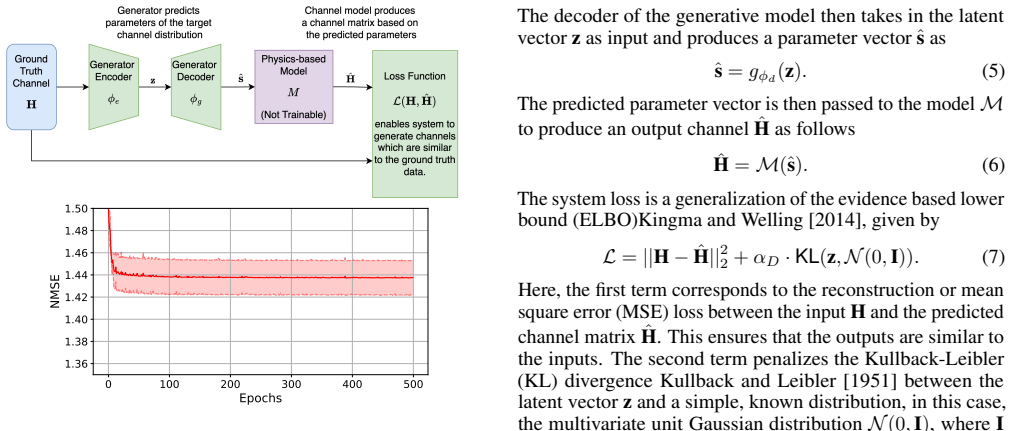
The central object is the array response dictionary $D$, an $R\times R$ grid whose $(i,j)$ entry is the outer product of the receive steering vector at angle $\theta_i$ and the conjugate transmit steering vector at angle $\theta_j$. The generator predicts a gain matrix $W$, and the channel is the weighted sum $H = \sum_{i,j} W_{i,j} D_{i,j}$. This replaces the non-convex map from path parameters to channels with a linear map, so gradients flow smoothly through the VAE; the $\ell^1$ penalty on $W$ keeps the solution sparse, and sparsity is what makes the non-zero entries interpretable as the gains and angles of individual multipath components.
What would settle it
Take a channel generated from a known ground truth with off-grid angles and complex gains, encode it through the learned model, and compare the reconstructed channel and extracted parameters against the ground truth; if the reconstruction error stays large no matter how finely the resolution $R$ is increased, or if the extracted angles always snap to the nearest grid point while true gains have non-trivial phases, the central claim that $W$ faithfully represents the target distribution fails. A simpler check is to compute the dictionary representation error for a single path at an angle between two grid points as $R$ grows; if the error does not vanish, the guaranteed-validity claim holds but the fidelity claim does not.
Extended reading notes
Core claim
The paper's central claim is that a channel matrix $H$ can be generated by $H = \sum_{i,j} W_{i,j} D_{i,j}$, where $D$ is a precomputed dictionary of outer products $a_r(\theta_i) a_t(\theta_j)^H$ at discretized arrival and departure angles, and $W$ is a sparse gain matrix output by a variational-autoencoder decoder. This linearizes the physics-based model $M(s)$, removing the sinusoidal non-convexities that stall gradient-based training when the model predicts path parameters directly. With sparsity enforced by an $\ell^1$ penalty, each non-zero $W_{i,j}$ corresponds to one physical path's gain, and its dictionary index gives that path's angles. The paper reports that on ray-tracing and user-defined mmWave datasets, the distribution of generated channels is closer to the true distribution, up to four times in 2-Wasserstein distance, than prior generative baselines, and that compression models trained on its synthetic data transfer to real data.
Load-bearing premise
The load-bearing assumption is that a fixed grid of 64 angles together with a real-valued gain matrix can adequately express the true complex-valued channels, including paths whose angles fall between grid points, and no error bound or phase-correction mechanism is provided for that discretization.
Editorial extensions
If this is right
- Downstream channel compression and estimation models can be trained on synthetic data from this pipeline instead of expensive over-the-air measurements, with the cross-evaluation results indicating the synthetic distribution is close enough to transfer.
- The sparse gain matrix $W$ doubles as an interpretable summary: reading its non-zero entries gives the number of paths, their angles of arrival and departure, and their gains, without any labeled metadata.
- Because the generation process does not depend on a preset number of paths $P$, the same trained pipeline adapts to environments with more or fewer multipath components by letting the sparsity term balance reconstruction accuracy.
- Higher antenna counts sharpen the angular resolution that $W$ can represent, so the method's benefit grows as systems move to larger arrays; increasing the dictionary resolution only helps once the antennas can resolve the finer angles.
Reading between the lines
- The dictionary formulation is effectively sparse coding of the channel in a physics-based basis; one natural extension is to make the dictionary continuous or learnable so off-grid angles are recovered exactly instead of approximated by the nearest grid cell.
- The paper's real-valued $W$ cannot represent the phase of a path gain, which in the physical model is complex; allowing complex gains would likely improve fidelity on channels with rich phase structure.
- The same dictionary idea should carry over to three-dimensional channels by replacing the one-dimensional angle grid with a two-dimensional grid over azimuth and elevation, at the cost of an $R^4$ dictionary.
- Because the method recovers parameter distributions without labels, it could be used as an unsupervised channel-sounding tool that estimates the angular spread of a scenario directly from raw channel matrices.
Editorial analysis
A structured set of objections, weighed in public.
Referee Report
Summary. The paper proposes a physics-informed generative model for mmWave MIMO channel synthesis. To avoid the non-convex optimization landscape of the parametric geometric channel model, the authors replace the nonlinear PPGC mapping in Eq. (1) with a linear dictionary model in Eq. (9), where the channel is a weighted sum of steering-vector outer products at discretized angles. A VAE is trained to output a real-valued sparse gain matrix W under a reconstruction loss, a KL term, and an L1 sparsity penalty. The authors claim the generated channels are guaranteed valid multipath channels and that the nonzero entries of W are interpretable as physical path gains and angles. Experiments on DeepMIMO, RemCom, and user-defined datasets report improved 2-Wasserstein distances and MMDs relative to CGAN, DUNet, and CVAE baselines, and improved downstream compression cross-evaluation NMSE values. The central empirical claim of improved distribution fidelity is supported by the tables, but several representational and validation gaps affect the interpretability and guaranteed-validity claims.
Significance. If the representational issues are resolved, the dictionary-based linearization of a geometric channel model inside a generative pipeline is a useful idea: it offers smooth gradients, a parametric interpretable latent structure, and a direct route to generate channel matrices that are physically structured rather than unconstrained tensors. The paper also ships code, uses standard public datasets (DeepMIMO, RemCom), and reports comparisons against three prior generative baselines, which aids reproducibility. The practical value depends on whether the learned W can truthfully represent the underlying path parameters; as written, that link is not demonstrated to the standard the claims require.
major comments (4)
- [Sec. 3.3, Remark 1] Remark 1 states that for a suitably high dictionary resolution R, any channel H can be approximated by Eq. (9) with P nonzero values of W, and that each nonzero Wi,j then equals the gain of one physical path. This equivalence is not correct for complex path gains. The physical model in Eq. (1) has path gains gp that are not restricted to be real in the text, while Eq. (9) uses a real-valued W. A single complex gain g = |g| exp(j phi) has two real degrees of freedom, and the dictionary atoms Di,j are fixed complex matrices; a single real coefficient Wi,j cannot apply the phase rotation phi. Representing one complex-gain path requires at least two dictionary atoms, so P nonzero W entries do not correspond to P paths. The authors should either explicitly restrict the model to real positive path gains (which is what their experiments sample) and state that restriction, or extend the dictionary to complex coefficients and rework the one-nonzero-per-path claim. As written, the central interpretability assertion is algebraically unsupported.
- [Sec. 3.3 / Sec. 4] The paper provides no analysis of the representation error introduced by the finite dictionary with R = 64. Eq. (9) can exactly represent only channels whose angles lie on the discrete grid and whose gains are real; the DeepMIMO, Boston, ASU, and Indoor datasets contain off-grid continuous angles from ray tracing. The claim that 'any channel can be approximated for suitably high R' is not an error bound, and the paper does not report reconstruction error (e.g., NMSE on held-out channels) as a function of R. This matters because the 'guaranteed geometrically consistent' claim is strong: Eq. (9) always produces a valid discrete-multipath channel, but that channel may differ substantially from the physical scenario in the data. Please add a quantitative representation-error analysis or an explicit statement that the reported Wasserstein distances include an uncontrolled discretization error, and report held-out reconstruction NMSE versus R.
- [Sec. 4.1 / Sec. 4.6] The interpretability claim that nonzero entries of W identify individual paths with their gains and angles is not validated experimentally. Fig. 4 shows histograms of recovered angles, but the paper never reports the sparsity level of the learned W (i.e., the number of nonzero entries), nor per-path gain errors, nor a comparison between the number of nonzeros and the true number of paths P. Fig. 5(c) explicitly refers to 'the number of non-zero values in the gain matrix W' but does not plot or tabulate it. Without these measurements, the assertion that the model 'extracts insights related to the environment' and that W entries correspond to physical paths remains unverified even in the user-defined dataset where ground truth is known. Please report sparsity statistics, angle and gain recovery errors, and the effective number of paths detected versus P.
- [Sec. 4.2 / Table 2 / Fig. 5] All quantitative results are based on single training runs without error bars or multiple seeds. The stochastic nature of VAE training and the sensitivity of Wasserstein/MMD estimators mean that the reported margins (e.g., BS10 2-Wasserstein 0.656 versus 1.632 for CGAN) could be accompanied by seed-to-seed variation. The central empirical claim of improved distribution fidelity would be considerably stronger with mean and standard deviation over at least five seeds for every entry in Table 2, Table 1, and Fig. 5. This is standard practice for generative-model comparisons and should be added.
minor comments (5)
- [Sec. 3.4, Eq. (11) and Sec. 3.5, Eq. (14)] The double summation uses the index i in both sums; the second sum should be over j. Please correct the indices in Eqs. (11) and (14).
- [Sec. 4.2] The statement that 'the channels generated by our method are closer to the distribution of true channels than those generated by the ChannelGAN baseline by up to 4x' should specify the dataset and the baseline entry; the visible Table 2 ratios vary between approximately 2x and 3.9x depending on the dataset and baseline.
- [Algorithm 1] In the Training block, line 3 says 'Obtain gain matrix W from H using (4) and (10)'; please make explicit that the encoder produces the variational posterior, z is sampled via the reparameterization trick, and the decoder then outputs W.
- [Sec. 4.6] The notation for additional paths, e.g., 'θa_p ∼ U(0.4,0.8)/θa_p ∼ U(0.1,0.3)', is ambiguous; clarify which distribution corresponds to the angle of arrival and which to the angle of departure.
- [Sec. 4] The 'CVAE' baseline is introduced in the text as 'a VAE version of CSINet' but is not described; please provide a citation or a one-sentence description of its architecture and how it differs from a standard conditional VAE.
Circularity Check
No significant circularity: the linearized dictionary model is a fixed forward map, W is learned from channel reconstruction and evaluated against external benchmarks, and self-citations are not load-bearing.
full rationale
The claimed derivation is not circular. The physical model (Eq. 1) and the dictionary linearization (Eqs. 8-9) are fixed forward maps; the gain matrix W is learned by the VAE through the reconstruction loss in Eq. (12), which penalizes ||H - \hat{H}||_2^2 on input channel data, and the trained decoder is evaluated against held-out DeepMIMO ray-traced channels and a user-defined dataset (Tables 1-2, Fig. 4). None of the quantities reported as predictions — angular distributions, 2-Wasserstein distances, MMD, downstream compression NMSE — are constants fitted to the same data used to define them; the evaluation data are external to the fitted W. The paper's self-citations (Sant et al. 2022, Sant and Rao 2024, Kumar et al. 2024) are contextual related-work mentions and do not bear the load of the central claim. The finite-resolution dictionary and the real-valued W in Eq. (9) do make Remark 1's equivalence with complex path gains in Eq. (1) mathematically questionable, and the off-grid representation error is unquantified; those are correctness and validity concerns, not instances of the paper's outputs reducing to its inputs by construction. No load-bearing step is defined in terms of the quantity it purports to predict, so the circularity score is 0.
Assumptions & free parameters
free parameters (4)
- Dictionary resolution R =
64
- Latent dimension Z =
64
- KL loss coefficient alpha_D =
not reported
- Sparsity coefficient alpha_S =
not reported
assumptions (4)
- domain assumption The mmWave channel is accurately represented as a sum of P multipath components with steering vectors (PPGC model).
- domain assumption The discretized array response dictionary D at resolution R spans or approximates the channels in the target distribution.
- domain assumption The VAE decoder can learn a mapping from N(0,I) to the distribution of sparse gain matrices W.
- domain assumption The L1 penalty yields a sparse W whose non-zero entries correspond to physical propagation paths.
Cite this review
Pith. "Pith review of Physics-based Generative Models for Geometrically Consistent and Interpretable Wireless Channel Synthesis." pith.science (2026). https://pith.science/paper/F653HHS3
@misc{pith2026250600374,
  author       = {Pith},
  title        = {Pith review of: Physics-based Generative Models for Geometrically Consistent and Interpretable Wireless Channel Synthesis},
  year         = {2026},
  howpublished = {\url{https://pith.science/paper/F653HHS3}},
  note         = {Machine review of arXiv:2506.00374}
}
read the original abstract
In recent years, machine learning (ML) methods have become increasingly popular in wireless communication systems for several applications. A critical bottleneck for designing ML systems for wireless communications is the availability of realistic wireless channel datasets, which are extremely resource-intensive to produce. To this end, the generation of realistic wireless channels plays a key role in the subsequent design of effective ML algorithms for wireless communication systems. Generative models have been proposed to synthesize channel matrices, but outputs produced by such methods may not correspond to geometrically viable channels and do not provide any insight into the scenario being generated. In this work, we aim to address both these issues by integrating established parametric, physics-based geometric channel (PPGC) modeling frameworks with generative methods to produce realistic channel matrices with interpretable representations in the parameter domain. We show that generative models converge to prohibitively suboptimal stationary points when learning the underlying prior directly over the parameters due to the non-convex PPGC model. To address this limitation, we propose a linearized reformulation of the problem to ensure smooth gradient flow during generative model training, while also providing insights into the underlying physical environment. We evaluate our model against prior baselines by comparing the generated, scenario-specific samples in terms of the 2-Wasserstein distance and through its utility when used for downstream compression tasks.
Figures


Figures from the paper (2 more)


Reference graph
Works this paper leans on
-
[6]
Auto-encoding varia- tional bayes
Diederik P Kingma and Max Welling. Auto-encoding varia- tional bayes. arXiv preprint arXiv:1312.6114,
-
[11]
Generative diffusion models for radio wireless channel modelling and sampling
Ushnish Sengupta, Chinkuo Jao, Alberto Bernacchia, Sattar Vakili, and Da-shan Shiu. Generative diffusion models for radio wireless channel modelling and sampling. In GLOBECOM 2023 - 2023 IEEE Global Commun. Conf. , pages 4779–4784,
work page 2023
-
[12]
Generative-adversarial- network-based wireless channel modeling: Challenges and opportunities
Yang Yang, Yang Li, Wuxiong Zhang, Fei Qin, Pengcheng Zhu, and Cheng-Xiang Wang. Generative-adversarial- network-based wireless channel modeling: Challenges and opportunities. IEEE Commun. Mag., 57(3):22–27, 2019
work page 2019
-
[1951]
Channel parameter estimation in wireless communica- tion: A deep learning perspective
Satyam Kumar, Akshay Malhotra, and Shahab Hamidi-Rad. Channel parameter estimation in wireless communica- tion: A deep learning perspective. In 2024 IEEE Inter. Conf. on Mach. Learn. for Communication and Networking (ICMLCN), pages 511–516,
work page 2024
-
[2007]
Yaqi Hu, Mingsheng Yin, William Xia, Sundeep Rangan, and Marco Mezzavilla. Multi-frequency channel modeling for millimeter wave and thz wireless communication via generative adversarial networks. In 2022 56th Asilomar Conf. on Signals, Systems, and Computers, pages 670–676,
work page 2022
-
[2010]
Ly V Nguyen, Duy HN Nguyen, and A Lee Swindlehurst
Omnipress. Ly V Nguyen, Duy HN Nguyen, and A Lee Swindlehurst. Dnn-based detectors for massive mimo systems with low- resolution adcs. In ICC 2021-IEEE Inter. Conf. on Commun., pages 1–6. IEEE,
work page 2021
-
[2015]
AUAI Press. Antonio Forenza, David J. Love, and Robert W. Heath. Simpli- fied spatial correlation models for clustered mimo channels with different array configurations. IEEE Trans. on Vehicu- lar Tech., 56(4):1924–1934,
work page 1924
- [2019]
Show all 12 references
-
[2021]
So- riaga
Tribhuvanesh Orekondy, Arash Behboodi, and Joseph B. So- riaga. Mimo-gan: Generative mimo channel modeling. In ICC 2022 - IEEE Inter. Conf. on Commun. , pages 5322– 5328,
2022
-
[2022]
A guide to con- volution arithmetic for deep learning
Vincent Dumoulin and Francesco Visin. A guide to con- volution arithmetic for deep learning. arXiv preprint arXiv:1603.07285,
-
[2023]
Rappaport
Shihao Ju, Yunchou Xing, Ojas Kanhere, and Theodore S. Rappaport. Sub-terahertz channel measurements and char- acterization in a factory building. In ICC 2022 - IEEE Inter. Conf. on Commun., pages 2882–2887,
2022
-
[2024]
Deep se- quential beamformer learning for multipath channels in mmwave communication systems
Aditya Sant, Afshin Abdi, and Joseph Soriaga. Deep se- quential beamformer learning for multipath channels in mmwave communication systems. In ICASSP 2022-2022 IEEE Inter. Conf. on Acoustics, Speech and Signal Process- ing (ICASSP), pages 5198–5202. IEEE,
2022
Reviewed August 7, 2026 · model on record in the stance chip above.
Discussion (0). Sign in to comment.