REVIEW 3 major objections 5 minor 79 references
RPRA-ADD: Forgery Trace Enhancement-Driven Audio Deepfake Detection
T0 review · 3 major / 5 minor · reviewed 2026-08-07 · deepseek-v4-flash
Pith's one-line read The paper claims that audio deepfakes can be reliably detected by a masked-autoencoder reconstruction model trained only to reconstruct genuine audio, and that the resulting reconstruction-error signal, sharpened by two auxiliary losses…
desk verdict A worthwhile incremental extension of the group's own GFL-FAD work with a genuinely useful 3x3 cross-domain study, but the FTFA equation is a no-op as written and the headline numbers were tuned on the test sets. read the letter →
The pith
A machine-rendered reading of the paper's core claim, the machinery that carries it, and where it could break.
The reading
What carries the argument
The load-bearing object is the reconstruction error matrix: the absolute difference between unmasked input patches and their reconstructed counterparts. GARL forces the decoder to approximate genuine audio, MDEL enlarges real-fake separation in multi-stage feature spaces, and FTFA turns the error matrix into softmax attention weights. The reconstruction error is the common currency: GARL creates it, MDEL amplifies its downstream effects, and FTFA steers the classifier toward it.
What would settle it
Train the same RPRA-ADD pipeline with GARL and MDEL, then measure the reconstruction error distribution on a held-out set of very high-fidelity fakes generated by a model trained on the same real corpus. If the mean reconstruction error of the fakes is within one standard deviation of the real samples, the reconstruction-discrepancy mechanism has lost its discriminative power and the reported cross-domain gains would not transfer to that forgery class.
Extended reading notes
Core claim
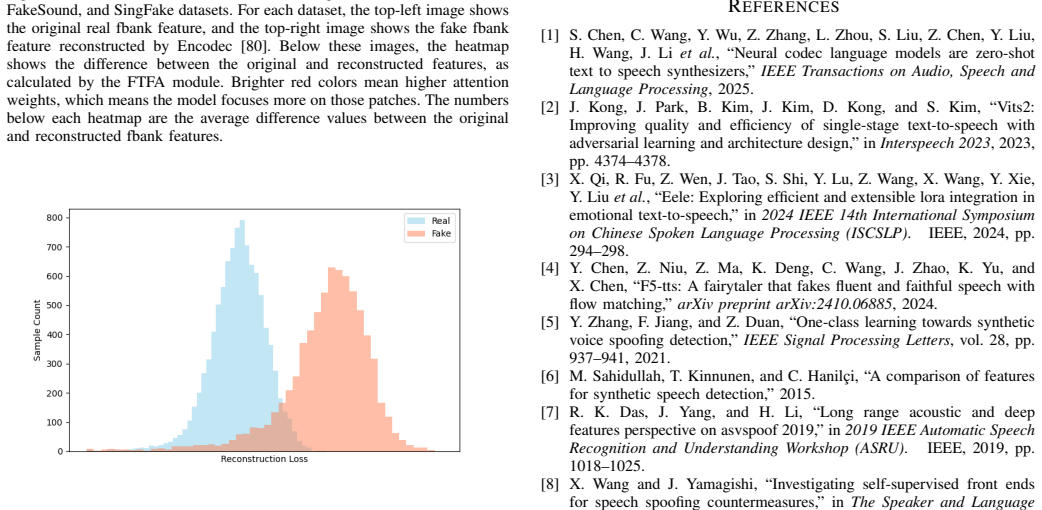
The paper's central claim is that reconstruction discrepancy is a generalizable forgery marker: a masked autoencoder constrained to reconstruct only genuine audio will reconstruct fake audio poorly, and directing attention to the patches with the largest reconstruction error makes the detector focus on exactly the regions where forgery artifacts live. Three components realize this: the Genuine Audio Reconstruction Loss (GARL), which applies the reconstruction objective only to real samples; the Multi-stage Dispersed Enhancement Loss (MDEL), which makes real embeddings compact and pushes fake embeddings apart in the decoder feature space; and Fake Trace Focused Attention (FTFA), which converts per-patch reconstruction differences into attention weights. The authors report this yields an EER of 0.20% on ASVspoof 2019 LA and 1.19% on ASVspoof 2021 LA when trained on 19LA, state-of-the-art accuracy on FakeSound subsets, the lowest EER on CodecFake A3 among compared methods, and the best average EER in a 3x3 cross-domain protocol across speech, sound, and singing.
Load-bearing premise
The method assumes that a model trained to reconstruct only genuine audio will reconstruct fake audio noticeably worse, so that the gap can serve as the forgery signal.
Editorial extensions
If this is right
- If trained on ASVspoof 2019 LA alone, the model carries a 0.20% EER on 19LA and a 1.19% EER on the codec-distorted 21LA test set, indicating the reconstruction marker survives channel degradation.
- In the 3x3 cross-domain protocol, RPRA-ADD reports the best average EER for speech-trained (21.19%), singing-trained (22.75%), and sound-trained (34.10%) setups, so the approach translates across audio categories more effectively than SSL-feature baselines.
- On FakeSound, the method reaches 100% accuracy on Test-Easy, 86.4% on Test-Hard, and 76.1% on Test-Zeroshot, with the zero-shot number suggesting robustness to an unseen text-to-audio generator.
- Ablations show the complete GLFP dual-stream module and the 4-layer MDEL configuration are needed for the best cross-domain averages; removing the local perception stream hurts sound-domain accuracy by 13.34 points.
- FTFA attention weights concentrate on active voice and singing segments and suppress silent frames, which the authors tie to previous evidence that silence trimming degrades spoofing detectors.
Reading between the lines
- If the reconstruction-error distributions shown in the paper are stable across corpora, a threshold-only detector that never sees fake audio at inference time is a natural extension; the paper trains with fake labels for MDEL and classification, so this remains an inference.
- Because MDEL deliberately leaves fake samples unclustered, the method should stay robust to new generators; the converse risk is that an unseen real-audio distribution such as a new language, microphone, or codec could shift the real manifold and produce false alarms.
- The large speech-to-sound gap on CodecFake A3 (29.9% EER) suggests the reconstruction marker alone does not yet bridge maximally different audio domains; joint training on diverse genuine audio could be a testable route beyond the paper's claims.
Editorial analysis
A structured set of objections, weighed in public.
Referee Report
Summary. The manuscript proposes RPRA-ADD, an audio deepfake detection framework built on an AudioMAE encoder-decoder with three main components: a Genuine Audio Reconstruction Loss (GARL) applied to real samples, a Global-Local Forgery Perception (GLFP) module, a Multi-stage Dispersed Enhancement Loss (MDEL), and a Fake Trace Focused Attention (FTFA) module whose output feeds an AASIST classifier. The paper reports in-domain state-of-the-art results on ASVspoof2019 LA (EER 0.20%), ASVspoof2021 LA (EER 1.19%), FakeSound, and CodecFake, plus a 3x3 cross-domain evaluation across Speech, Singing, and Sound, and includes ablations for GLFP, MDEL layer configurations, and loss weights.
Significance. If the central claims were supported, the paper would make a useful contribution by showing that reconstruction-based training on genuine audio can transfer to unseen forgery techniques and across diverse audio domains. The work is evaluated on public benchmarks, includes systematic ablations, and presents visual evidence of a reconstruction-error gap between real and fake samples. However, two load-bearing issues currently block acceptance: the FTFA equation as written cannot implement the claimed per-patch localization, and several headline numbers are produced by selecting hyperparameters and layer counts directly on the test sets. The 'over 20%' performance claim is also not supported by the tables across the stated four benchmarks. The approach is promising, but the evidence as presented is not yet sufficient.
major comments (3)
- [Section III-D, Eq. (8)] The attention weight w_i is defined as softmax of (1/N) * sum_j |x_j - xhat_j|, which is a scalar independent of the patch index i. Consequently w_i is identical for every patch (softmax of a constant equals 1), so the equation cannot implement the claimed localization of forgery traces, nor can it explain the attention maps in Fig. 3 that concentrate on high-energy speech segments. Please replace Eq. (8) with a per-patch function of |x_i - xhat_i| (e.g., softmax over the patch dimension) or, if a global scalar is intended, revise the localization and visualization claims accordingly.
- [Section V.C.2 and V.C.4] MDEL layer count and the loss weights lambda_1 and lambda_2 are selected on the test sets: Section V.C.2 states that the 4-layer configuration is chosen by the lowest AVG on '19LA, SingFake, and FakeSound test sets', and Section V.C.4 selects lambda_1=0.01, lambda_2=0.1 using the same procedure. The final results in Tables II, V, and VIII are then reported for this configuration on those same test sets. This makes the reported EER/ACC values and the cross-domain AVG numbers optimistic upper bounds rather than unbiased generalization estimates. Please use a validation split disjoint from all test sets (or a nested selection procedure) for any hyperparameter or architecture choice, and then report test-set results only once.
- [Abstract and Tables II-VI] The abstract and introduction claim 'state-of-the-art performance on 4 benchmark datasets ... achieving over 20% performance improvement'. The tables support this only for ASVspoof2019 LA (0.20% vs 0.25%, a 20% relative improvement) and ASVspoof2021 LA (1.19% vs 2.96%, about 60% relative improvement). For FakeSound, the zero-shot improvement over EAT is 0.761 vs 0.720, about 5.7% relative; for CodecFake, 29.9% vs 31.8%, about 6% relative. The blanket 'over 20% on four benchmark datasets' claim is therefore not supported by the reported numbers. Please restate the quantitative claims per dataset with explicit baselines and remove the global over-20% statement.
minor comments (5)
- [Section V.A, Table V] The text says the FakeSound evaluation uses the F1 score, but Table V reports Accuracy; please align the text and table.
- [Section V.C.2] The 4-layer configuration is described as 'every three layers' but the listed layers are 4, 8, 12, and 16, which is every four layers; please correct the wording.
- [Section III-A, Eq. (1)] Notation is inconsistent: X is defined as a set of N patches x_i in R^{C x N}, but Eq. (1) uses x_i as if it were an individual audio sample and N_R as a number of genuine samples; please clarify whether the reconstruction loss is over samples or patches.
- [Section V.C.4] The claimed 'improved by 8.0% and 24.0%' for lambda_2 changes lacks a baseline value and the corresponding table row; please report the explicit AVG values for lambda_2=0, 0.01, and 0.1.
- [References] There are duplicate references for the same work: [17] and [25], [13] and [22], and [28]/[35]/[37]; please consolidate them.
Circularity Check
Reported SOTA numbers are partly a selected-best over test-set-tuned hyperparameters; the core reconstruction architecture is not definitionally circular.
-
fitted input called prediction
[Section V.C.2 (Table X) and Section V.C.4 (Table XI); final comparisons in Tables II, III, V, VI, VIII]
"To determine the optimal configuration for MDEL, we conducted training on the 19LA dataset and performed ablation experiments on the 19LA, SingFake, and FakeSound test sets, as shown in Table X. ... In Table XI, we explore the hyperparameters of GARL and MDEL. In the experiments, we set λ1 and λ2 to 0.01 and 0.1, respectively."
The MDEL layer count (4) and loss weights (λ1=0.01, λ2=0.1) are selected as the lowest-AVG configuration on the 19LA, SingFake, and FakeSound test sets, and the same selected configuration is then reported as the SOTA result on those exact benchmarks. With 6 layer configurations and 6 weight combinations considered, the best of the grid is a selected maximum, so the reported 'over 20% performance improvement' is an optimistic selected-best estimate rather than an unbiased prediction from a fixed model. The headline comparisons therefore reduce in part to fitting configuration choices to the evaluation labels; only component ablations that do not use the same test-set selection remain independent evidence.
full rationale
No definitional equivalence was found in the core architecture: GARL (Eq. 1) measures reconstruction error on genuine samples, MDEL (Eq. 7) is a contrastive regularizer, FTFA (Eq. 8) is a discrepancy-weighted attention, and the reported EER is measured on test sets not used for training. The self-citations to GFL-FAD, CodecFake, and related group work are frequent but not load-bearing: they provide baselines and prior MAE-based design, while AudioMAE and AASIST are externally published components and no uniqueness theorem is invoked. The one significant circularity-like issue is the test-set-driven selection of MDEL configuration and loss weights, which makes the headline benchmark numbers a fitted-best result rather than an unbiased generalization estimate. This affects every headline quantitative claim but does not make the mechanism itself equivalent to the metric, so the paper is partially circular in reporting, not definitionally circular.
Assumptions & free parameters
free parameters (5)
- lambda_1 (GARL weight) =
0.01
- lambda_2 (MDEL weight) =
0.1
- margin m =
not reported
- scale s_a =
not reported
- MDEL layer count =
4
assumptions (5)
- standard math DWT and IDWT provide an invertible decomposition of features into frequency subbands.
- domain assumption Genuine audio can be reconstructed with low error by a model trained with GARL on real samples, while fake audio cannot.
- domain assumption Fake samples in a batch are diverse enough that no intra-class compactness constraint is needed for them.
- domain assumption Silent regions carry no useful forgery information, so attention should concentrate on voiced time-frequency regions.
- domain assumption AudioMAE pre-trained representations span speech, sound, and singing domains with transferable acoustic structure.
Cite this review
Pith. "Pith review of RPRA-ADD: Forgery Trace Enhancement-Driven Audio Deepfake Detection." pith.science (2026). https://pith.science/paper/H2L7NEIL
@misc{pith2026250600375,
  author       = {Pith},
  title        = {Pith review of: RPRA-ADD: Forgery Trace Enhancement-Driven Audio Deepfake Detection},
  year         = {2026},
  howpublished = {\url{https://pith.science/paper/H2L7NEIL}},
  note         = {Machine review of arXiv:2506.00375}
}
read the original abstract
Existing methods for deepfake audio detection have demonstrated some effectiveness. However, they still face challenges in generalizing to new forgery techniques and evolving attack patterns. This limitation mainly arises because the models rely heavily on the distribution of the training data and fail to learn a decision boundary that captures the essential characteristics of forgeries. Additionally, relying solely on a classification loss makes it difficult to capture the intrinsic differences between real and fake audio. In this paper, we propose the RPRA-ADD, an integrated Reconstruction-Perception-Reinforcement-Attention networks based forgery trace enhancement-driven robust audio deepfake detection framework. First, we propose a Global-Local Forgery Perception (GLFP) module for enhancing the acoustic perception capacity of forgery traces. To significantly reinforce the feature space distribution differences between real and fake audio, the Multi-stage Dispersed Enhancement Loss (MDEL) is designed, which implements a dispersal strategy in multi-stage feature spaces. Furthermore, in order to enhance feature awareness towards forgery traces, the Fake Trace Focused Attention (FTFA) mechanism is introduced to adjust attention weights dynamically according to the reconstruction discrepancy matrix. Visualization experiments not only demonstrate that FTFA improves attention to voice segments, but also enhance the generalization capability. Experimental results demonstrate that the proposed method achieves state-of-the-art performance on 4 benchmark datasets, including ASVspoof2019, ASVspoof2021, CodecFake, and FakeSound, achieving over 20% performance improvement. In addition, it outperforms existing methods in rigorous 3*3 cross-domain evaluations across Speech, Sound, and Singing, demonstrating strong generalization capability across diverse audio domains.
Figures


Figures from the paper (1 more)
Reference graph
Works this paper leans on
-
[33]
Genuine-focused learning using mask autoencoder for generalized fake audio detection,
X. Wang, R. Fu, Z. Wen, Z. Wang, Y . Xie, Y . Liu, J. Tao, X. Liu, Y . Li, X. Qi, Y . Lu, and S. Shi, “Genuine-focused learning using mask autoencoder for generalized fake audio detection,” inInterspeech 2024, 2024, pp. 4848–4852
work page 2024
-
[1]
Neural codec language models are zero-shot text to speech synthesizers,
S. Chen, C. Wang, Y . Wu, Z. Zhang, L. Zhou, S. Liu, Z. Chen, Y . Liu, H. Wang, J. Liet al., “Neural codec language models are zero-shot text to speech synthesizers,”IEEE Transactions on Audio, Speech and Language Processing, 2025
work page 2025
-
[2]
J. Kong, J. Park, B. Kim, J. Kim, D. Kong, and S. Kim, “Vits2: Improving quality and efficiency of single-stage text-to-speech with adversarial learning and architecture design,” inInterspeech 2023, 2023, pp. 4374–4378
work page 2023
-
[3]
Eele: Exploring efficient and extensible lora integration in emotional text-to-speech,
X. Qi, R. Fu, Z. Wen, J. Tao, S. Shi, Y . Lu, Z. Wang, X. Wang, Y . Xie, Y . Liuet al., “Eele: Exploring efficient and extensible lora integration in emotional text-to-speech,” in2024 IEEE 14th International Symposium on Chinese Spoken Language Processing (ISCSLP). IEEE, 2024, pp. 294–298
work page 2024
-
[4]
F5-tts: A fairytaler that fakes fluent and faithful speech with flow matching,
Y . Chen, Z. Niu, Z. Ma, K. Deng, C. Wang, J. Zhao, K. Yu, and X. Chen, “F5-tts: A fairytaler that fakes fluent and faithful speech with flow matching,”arXiv preprint arXiv:2410.06885, 2024
arXiv 2024
-
[5]
One-class learning towards synthetic voice spoofing detection,
Y . Zhang, F. Jiang, and Z. Duan, “One-class learning towards synthetic voice spoofing detection,”IEEE Signal Processing Letters, vol. 28, pp. 937–941, 2021
work page 2021
-
[6]
A comparison of features for synthetic speech detection,
M. Sahidullah, T. Kinnunen, and C. Hanilc ¸i, “A comparison of features for synthetic speech detection,” 2015
work page 2015
-
[7]
Long range acoustic and deep features perspective on asvspoof 2019,
R. K. Das, J. Yang, and H. Li, “Long range acoustic and deep features perspective on asvspoof 2019,” in2019 IEEE Automatic Speech Recognition and Understanding Workshop (ASRU). IEEE, 2019, pp. 1018–1025
work page 2019
Show all 79 references
-
[9]
Audio deepfake detection: A survey,
J. Yi, C. Wang, J. Tao, X. Zhang, C. Y . Zhang, and Y . Zhao, “Audio deepfake detection: A survey,”arXiv preprint arXiv:2308.14970, 2023
2023 arXiv
-
[10]
A comparative study on recent neural spoofing countermeasures for synthetic speech detection,
X. Wang and J. Yamagishi, “A comparative study on recent neural spoofing countermeasures for synthetic speech detection,”Interspeech 2021, 2021
2021
-
[11]
Attention-based convolutional neural network for asv spoofing detection
H. Ling, L. Huang, J. Huang, B. Zhang, and P. Li, “Attention-based convolutional neural network for asv spoofing detection.” inInterspeech, 2021, pp. 4289–4293
2021
-
[12]
Channel-Wise Gated Res2Net: Towards Robust Detection of Synthetic Speech Attacks,
X. Li, X. Wu, H. Lu, X. Liu, and H. Meng, “Channel-Wise Gated Res2Net: Towards Robust Detection of Synthetic Speech Attacks,” in Proc. Interspeech 2021, 2021, pp. 4314–4318
2021
-
[14]
Raw differentiable architecture search for speech deepfake and spoofing detection,
W. Ge, J. Patino, M. Todisco, and N. Evans, “Raw differentiable architecture search for speech deepfake and spoofing detection,” in ASVSPOOF 2021, Automatic Speaker Verification and Spoofing Coun- termeasures Challenge. ISCA, 2021, pp. 22–28
2021
-
[15]
Towards end-to-end synthetic speech detection,
G. Hua, A. B. J. Teoh, and H. Zhang, “Towards end-to-end synthetic speech detection,”IEEE Signal Processing Letters, vol. 28, pp. 1265– 1269, 2021
2021
-
[16]
Generalized fake audio detection via deep stable learning,
Z. Wang, R. Fu, Z. Wen, Y . Xie, Y . Liu, X. Wang, X. Liu, Y . Li, J. Tao, X. Qi, Y . Lu, and S. Shi, “Generalized fake audio detection via deep stable learning,” inInterspeech 2024, 2024, pp. 4773–4777. JOURNAL OF LATEX CLASS FILES, VOL. XX, NO. XX, DECEMBER XXXX 11
2024
-
[17]
End-to-end spectro-temporal graph attention networks for speaker ver- ification anti-spoofing and speech deepfake detection,
H. Tak, J. weon Jung, J. Patino, M. Kamble, M. Todisco, and N. Evans, “End-to-end spectro-temporal graph attention networks for speaker ver- ification anti-spoofing and speech deepfake detection,” inProc. 2021 Edition of the Automatic Speaker Verification and Spoofing Counter-...
2021
-
[18]
Robust Audio Anti-Spoofing with Fusion-Reconstruction Learning on Multi- Order Spectrograms,
P. Wen, K. Hu, W. Yue, S. Zhang, W. Zhou, and Z. Wang, “Robust Audio Anti-Spoofing with Fusion-Reconstruction Learning on Multi- Order Spectrograms,” inProc. INTERSPEECH 2023, 2023, pp. 271– 275
2023
-
[19]
Aasist: Audio anti-spoofing using integrated spectro-temporal graph attention networks,
J.-w. Jung, H.-S. Heo, H. Tak, H.-j. Shim, J. S. Chung, B.-J. Lee, H.-J. Yu, and N. Evans, “Aasist: Audio anti-spoofing using integrated spectro-temporal graph attention networks,” inICASSP 2022-2022 IEEE International Conference on Acoustics, Speech and Signal Processing (ICA...
2022
-
[20]
Graph-based spectro- temporal dependency modeling for anti-spoofing,
F. Chen, S. Deng, T. Zheng, Y . He, and J. Han, “Graph-based spectro- temporal dependency modeling for anti-spoofing,” inICASSP 2023- 2023 IEEE International Conference on Acoustics, Speech and Signal Processing (ICASSP). IEEE, 2023, pp. 1–5
2023
-
[21]
Discriminative frequency information learning for end-to-end speech anti-spoofing,
B. Huang, S. Cui, J. Huang, and X. Kang, “Discriminative frequency information learning for end-to-end speech anti-spoofing,”IEEE Signal Processing Letters, vol. 30, pp. 185–189, 2023
2023
-
[22]
Audio deepfake detection based on a combination of f0 information and real plus imaginary spectrogram features,
J. Xue, C. Fan, Z. Lv, J. Tao, J. Yi, C. Zheng, Z. Wen, M. Yuan, and S. Shao, “Audio deepfake detection based on a combination of f0 information and real plus imaginary spectrogram features,” inProceed- ings of the 1st International Workshop on Deepfake Detection for Audio Mul...
2022
-
[23]
Frame-to-utterance convergence: A spectra-temporal approach for unified spoofing detection,
A. Khan, K. M. Malik, and S. Nawaz, “Frame-to-utterance convergence: A spectra-temporal approach for unified spoofing detection,” inICASSP 2024-2024 IEEE International Conference on Acoustics, Speech and Signal Processing (ICASSP). IEEE, 2024, pp. 10 761–10 765
2024
-
[24]
Speaker recognition from raw waveform with sincnet,
M. Ravanelli and Y . Bengio, “Speaker recognition from raw waveform with sincnet,” in2018 IEEE spoken language technology workshop (SLT). IEEE, 2018, pp. 1021–1028
2018
-
[25]
End-to-end spectro-temporal graph attention networks for speaker ver- ification anti-spoofing and speech deepfake detection,
H. Tak, J.-W. Jung, J. Patino, M. Kamble, M. Todisco, and N. Evans, “End-to-end spectro-temporal graph attention networks for speaker ver- ification anti-spoofing and speech deepfake detection,” inASVSPOOF 2021, Automatic Speaker Verification and Spoofing Countermeasures Chall...
2021
-
[26]
End-to-end anti-spoofing with rawnet2,
H. Tak, J. Patino, M. Todisco, A. Nautsch, N. Evans, and A. Larcher, “End-to-end anti-spoofing with rawnet2,” inICASSP 2021-2021 IEEE International Conference on Acoustics, Speech and Signal Processing (ICASSP). IEEE, 2021, pp. 6369–6373
2021
-
[27]
V oice deepfake detection using the self-supervised pre-training model hubert,
L. Li, T. Lu, X. Ma, M. Yuan, and D. Wan, “V oice deepfake detection using the self-supervised pre-training model hubert,”Applied Sciences, vol. 13, no. 14, p. 8488, 2023
2023
-
[28]
Investigating Self-Supervised Front Ends for Speech Spoofing Countermeasures,
X. Wang and J. Yamagishi, “Investigating Self-Supervised Front Ends for Speech Spoofing Countermeasures,” inProc. The Speaker and Language Recognition Workshop (Odyssey 2022), 2022, pp. 100–106
2022
-
[29]
Wavlm: Large-scale self-supervised pre- training for full stack speech processing,
S. Chen, C. Wang, Z. Chen, Y . Wu, S. Liu, Z. Chen, J. Li, N. Kanda, T. Yoshioka, X. Xiaoet al., “Wavlm: Large-scale self-supervised pre- training for full stack speech processing,”IEEE Journal of Selected Topics in Signal Processing, vol. 16, no. 6, pp. 1505–1518, 2022
2022
-
[30]
Anti-Spoofing Using Transfer Learning with Variational Information Bottleneck,
Y . Eom, Y . Lee, J. S. Um, and H. R. Kim, “Anti-Spoofing Using Transfer Learning with Variational Information Bottleneck,” inProc. Interspeech 2022, 2022, pp. 3568–3572
2022
-
[31]
Representation Selective Self-distillation and wav2vec 2.0 Feature Exploration for Spoof-aware Speaker Verification,
J. W. Lee, E. Kim, J. Koo, and K. Lee, “Representation Selective Self-distillation and wav2vec 2.0 Feature Exploration for Spoof-aware Speaker Verification,” inProc. Interspeech 2022, 2022, pp. 2898–2902
2022
-
[32]
Ftdkd: Frequency- time domain knowledge distillation for low-quality compressed audio deepfake detection,
B. Wang, Y . Tang, F. Wei, Z. Ba, and K. Ren, “Ftdkd: Frequency- time domain knowledge distillation for low-quality compressed audio deepfake detection,”IEEE/ACM Transactions on Audio, Speech, and Language Processing, vol. 32, pp. 4905–4918, 2024
2024
-
[34]
The codecfake dataset and countermeasures for the universally detection of deepfake audio,
Y . Xie, Y . Lu, R. Fu, Z. Wen, Z. Wang, J. Tao, X. Qi, X. Wang, Y . Liu, H. Chenget al., “The codecfake dataset and countermeasures for the universally detection of deepfake audio,”IEEE Transactions on Audio, Speech and Language Processing, 2025
2025
-
[35]
Investigating self-supervised front ends for speech spoofing countermeasures,
X. Wang and J. Yamagishi, “Investigating self-supervised front ends for speech spoofing countermeasures,” inThe Speaker and Language Recognition Workshop (Odyssey 2022). ISCA, 2022
2022
-
[36]
Audio deepfake detection with self-supervised wavlm and multi-fusion attentive classi- fier,
Y . Guo, H. Huang, X. Chen, H. Zhao, and Y . Wang, “Audio deepfake detection with self-supervised wavlm and multi-fusion attentive classi- fier,” inICASSP 2024-2024 IEEE International Conference on Acoustics, Speech and Signal Processing (ICASSP). IEEE, 2024, pp. 12 702– 12 706
2024
-
[37]
Investigating self-supervised front ends for speech spoofing countermeasures,
X. Wang and J. Yamagishi, “Investigating self-supervised front ends for speech spoofing countermeasures,” inThe Speaker and Language Recognition Workshop (Odyssey 2022), 2022, pp. 100–106
2022
-
[38]
Fully automated end-to-end fake audio detection,
C. Wang, J. Yi, J. Tao, H. Sun, X. Chen, Z. Tian, H. Ma, C. Fan, and R. Fu, “Fully automated end-to-end fake audio detection,” in Proceedings of the 1st International Workshop on Deepfake Detection for Audio Multimedia, 2022, pp. 27–33
2022
-
[39]
Ssast: Self-supervised audio spectrogram transformer,
Y . Gong, C.-I. Lai, Y .-A. Chung, and J. Glass, “Ssast: Self-supervised audio spectrogram transformer,” inProceedings of the AAAI Conference on Artificial Intelligence, vol. 36, no. 10, 2022, pp. 10 699–10 709
2022
-
[40]
Attentive merging of hidden embeddings from pre-trained speech model for anti-spoofing detection,
Z. Pan, T. Liu, H. B. Sailor, and Q. Wang, “Attentive merging of hidden embeddings from pre-trained speech model for anti-spoofing detection,” Proc. INTERSPEECH 2024, 2024
2024
-
[41]
Spoofed training data for speech spoofing countermeasure can be efficiently created using neural vocoders,
X. Wang and J. Yamagishi, “Spoofed training data for speech spoofing countermeasure can be efficiently created using neural vocoders,” in ICASSP 2023-2023 IEEE International Conference on Acoustics, Speech and Signal Processing (ICASSP). IEEE, 2023, pp. 1–5
2023
-
[42]
Automatic speaker verification spoofing and deepfake detection using wav2vec 2.0 and data augmentation,
H. Tak, M. Todisco, X. Wang, J. weon Jung, J. Yamagishi, and N. Evans, “Automatic speaker verification spoofing and deepfake detection using wav2vec 2.0 and data augmentation,” inProc. The Speaker and Lan- guage Recognition Workshop (Odyssey 2022), 2022, pp. 112–119
2022
-
[43]
Mixture of experts fusion for fake audio detection using frozen wav2vec 2.0,
Z. Wang, R. Fu, Z. Wen, J. Tao, X. Wang, Y . Xie, X. Qi, S. Shi, Y . Lu, Y . Liuet al., “Mixture of experts fusion for fake audio detection using frozen wav2vec 2.0,” inICASSP 2025-2025 IEEE International Conference on Acoustics, Speech and Signal Processing (ICASSP). IEEE, 20...
2025
-
[44]
Partially- connected differentiable architecture search for deepfake and spoofing detection,
W. Ge, M. Panariello, J. Patino, M. Todisco, and N. Evans, “Partially- connected differentiable architecture search for deepfake and spoofing detection,” inInterspeech 2021. ISCA, 2021, pp. 4319–4323
2021
-
[45]
Comparison of parametric representations for monosyllabic word recognition in continuously spoken sentences,
S. Davis and P. Mermelstein, “Comparison of parametric representations for monosyllabic word recognition in continuously spoken sentences,” IEEE transactions on acoustics, speech, and signal processing, vol. 28, no. 4, pp. 357–366, 1980
1980
-
[46]
Design, analysis and experimental eval- uation of block based transformation in mfcc computation for speaker recognition,
M. Sahidullah and G. Saha, “Design, analysis and experimental eval- uation of block based transformation in mfcc computation for speaker recognition,”Speech communication, vol. 54, no. 4, pp. 543–565, 2012
2012
-
[47]
Known-unknown data augmentation strategies for detection of logical access, physical access and speech deepfake attacks: Asvspoof 2021,
R. K. Das, “Known-unknown data augmentation strategies for detection of logical access, physical access and speech deepfake attacks: Asvspoof 2021,”Proc. 2021 Edition of the Automatic Speaker Verification and Spoofing Countermeasures Challenge, pp. 29–36, 2021
2021
-
[48]
Leaf: A learnable frontend for audio classification,
N. Zeghidour, O. Teboul, F. de Chaumont Quitry, and M. Tagliasacchi, “Leaf: A learnable frontend for audio classification,”ICLR, 2021
2021
-
[49]
Siamese network with wav2vec feature for spoofing speech detection
Y . Xie, Z. Zhang, and Y . Yang, “Siamese network with wav2vec feature for spoofing speech detection.” inInterspeech, 2021, pp. 4269–4273
2021
-
[50]
The vicomtech audio deepfake detection system based on wav2vec2 for the 2022 add challenge,
J. M. Mart ´ın-Do˜nas and A. ´Alvarez, “The vicomtech audio deepfake detection system based on wav2vec2 for the 2022 add challenge,” in ICASSP 2022-2022 IEEE International Conference on Acoustics, Speech and Signal Processing (ICASSP). IEEE, 2022, pp. 9241–9245
2022
-
[51]
Detec- tion of cross-dataset fake audio based on prosodic and pronunciation features,
C. Wang, J. Yi, J. Tao, C. Y . Zhang, S. Zhang, and X. Chen, “Detec- tion of cross-dataset fake audio based on prosodic and pronunciation features,” inInterspeech 2023, 2023, pp. 3844–3848
2023
-
[52]
Fakesound: Deepfake general audio detection,
Z. Xie, B. Li, X. Xu, Z. Liang, K. Yu, and M. Wu, “Fakesound: Deepfake general audio detection,” inInterspeech 2024, 2024, pp. 112–116
2024
-
[53]
Eat: Self- supervised pre-training with efficient audio transformer,
W. Chen, Y . Liang, Z. Ma, Z. Zheng, and X. Chen, “Eat: Self- supervised pre-training with efficient audio transformer,”arXiv preprint arXiv:2401.03497, 2024
2024 arXiv
-
[54]
Audiogen: Textually guided audio generation,
F. Kreuk, G. Synnaeve, A. Polyak, U. Singer, A. D ´efossez, J. Copet, D. Parikh, Y . Taigman, and Y . Adi, “Audiogen: Textually guided audio generation,”arXiv preprint arXiv:2209.15352, 2022
2022 arXiv
-
[55]
Audiocaps: Generating captions for audios in the wild,
C. D. Kim, B. Kim, H. Lee, and G. Kim, “Audiocaps: Generating captions for audios in the wild,” inProceedings of the 2019 Conference of the North American Chapter of the Association for Computational Linguistics: Human Language Technologies, Volume 1 (Long and Short Papers), 2...
2019
-
[56]
Xls-r: Self-supervised cross-lingual speech representation learning at scale,
A. Babu, C. Wang, A. Tjandra, K. Lakhotia, Q. Xu, N. Goyal, K. Singh, P. von Platen, Y . Saraf, J. Pino, A. Baevski, A. Conneau, and M. Auli, “Xls-r: Self-supervised cross-lingual speech representation learning at scale,” inInterspeech 2022, 2022, pp. 2278–2282
2022
-
[57]
End-to-end wireframe parsing,
Y . Zhou, H. Qi, and Y . Ma, “End-to-end wireframe parsing,” inICCV 2019, 2019
2019
-
[58]
Fsd: An initial chinese dataset for fake song detection,
Y . Xie, J. Zhou, X. Lu, Z. Jiang, Y . Yang, H. Cheng, and L. Ye, “Fsd: An initial chinese dataset for fake song detection,” inICASSP 2024 - 2024 IEEE International Conference on Acoustics, Speech and Signal Processing (ICASSP), 2024, pp. 4605–4609. JOURNAL OF LATEX CLASS FILE...
2024
-
[59]
Singfake: Singing voice deepfake detection,
Y . Zang, Y . Zhang, M. Heydari, and Z. Duan, “Singfake: Singing voice deepfake detection,” inProc. IEEE International Conference on Acoustics, Speech and Signal Processing (ICASSP). IEEE, 2024, pp. 1–5
2024
-
[60]
Masked au- toencoders are scalable vision learners,
K. He, X. Chen, S. Xie, Y . Li, P. Doll ´ar, and R. Girshick, “Masked au- toencoders are scalable vision learners,” inProceedings of the IEEE/CVF conference on computer vision and pattern recognition, 2022, pp. 16 000–16 009
2022
-
[61]
Instructional mask autoencoder: A scalable learner for hyperspectral image classification,
W. Kong, B. Liu, X. Bi, J. Pei, and Z. Chen, “Instructional mask autoencoder: A scalable learner for hyperspectral image classification,” IEEE Journal of Selected Topics in Applied Earth Observations and Remote Sensing, vol. 17, pp. 1348–1362, 2023
2023
-
[62]
Ss-mae: Spatial–spectral masked autoencoder for multisource remote sensing image classifica- tion,
J. Lin, F. Gao, X. Shi, J. Dong, and Q. Du, “Ss-mae: Spatial–spectral masked autoencoder for multisource remote sensing image classifica- tion,”IEEE Transactions on Geoscience and Remote Sensing, vol. 61, pp. 1–14, 2023
2023
-
[63]
Mae-yolov8-based small object detection of green crisp plum in real complex orchard environments,
Q. Liu, J. Lv, and C. Zhang, “Mae-yolov8-based small object detection of green crisp plum in real complex orchard environments,”Computers and Electronics in Agriculture, vol. 226, p. 109458, 2024
2024
-
[64]
Pimae: Point cloud and image interactive masked autoencoders for 3d object detection,
A. Chen, K. Zhang, R. Zhang, Z. Wang, Y . Lu, Y . Guo, and S. Zhang, “Pimae: Point cloud and image interactive masked autoencoders for 3d object detection,” inProceedings of the IEEE/CVF Conference on Computer Vision and Pattern Recognition, 2023, pp. 5291–5301
2023
-
[65]
Graph-guided masked autoencoder for process anomaly detection,
M. Jia, D. Xu, T. Yang, Y . Yao, and Y . Liu, “Graph-guided masked autoencoder for process anomaly detection,”Process Safety and Envi- ronmental Protection, vol. 186, pp. 1345–1357, 2024
2024
-
[66]
Maeday: Mae for few-and zero-shot anomaly- detection,
E. Schwartz, A. Arbelle, L. Karlinsky, S. Harary, F. Scheidegger, S. Doveh, and R. Giryes, “Maeday: Mae for few-and zero-shot anomaly- detection,”Computer Vision and Image Understanding, vol. 241, p. 103958, 2024
2024
-
[67]
Dfrec: Deepfake identity recovery based on identity-aware masked autoencoder,
P. Yu, H. Gao, Z. Huang, Z. Xia, and C.-H. Chang, “Dfrec: Deepfake identity recovery based on identity-aware masked autoencoder,”arXiv preprint arXiv:2412.07260, 2024
2024 arXiv
-
[68]
Partial reconstruction error for deepfake detection,
Y . Zhang, Z. Meng, B. Peng, J. Dong, B. Chu, and W. Wang, “Partial reconstruction error for deepfake detection,” inICASSP 2025 - 2025 IEEE International Conference on Acoustics, Speech and Signal Pro- cessing (ICASSP), 2025, pp. 1–5
2025
-
[69]
Exploring self-supervised vision transformers for deepfake detection: A comparative analysis,
H. H. Nguyen, J. Yamagishi, and I. Echizen, “Exploring self-supervised vision transformers for deepfake detection: A comparative analysis,” in 2024 IEEE International Joint Conference on Biometrics (IJCB). IEEE, 2024, pp. 1–10
2024
-
[70]
Ancogen: Analysis, control and generation of speech with a masked autoencoder,
S. Sadok, S. Leglaive, L. Girin, G. Richard, and X. Alameda-Pineda, “Ancogen: Analysis, control and generation of speech with a masked autoencoder,” inICASSP 2025-2025 IEEE International Conference on Acoustics, Speech and Signal Processing (ICASSP). IEEE, 2025, pp. 1–5
2025
-
[71]
Audio super- resolution with robust speech representation learning of masked au- toencoder,
S.-B. Kim, S.-H. Lee, H.-Y . Choi, and S.-W. Lee, “Audio super- resolution with robust speech representation learning of masked au- toencoder,”IEEE/ACM Transactions on Audio, Speech, and Language Processing, vol. 32, pp. 1012–1022, 2024
2024
-
[72]
Transformer models improve the acoustic recognition of buzz-pollinating bee species,
A. I. S. Ferreira, N. F. F. da Silva, F. N. Mesquita, T. C. Rosa, S. L. Buchmann, and J. N. Mesquita-Neto, “Transformer models improve the acoustic recognition of buzz-pollinating bee species,”Ecological Informatics, p. 103010, 2025
2025
-
[73]
A vector quantized masked autoencoder for speech emotion recognition,
S. Sadok, S. Leglaive, and R. S ´eguier, “A vector quantized masked autoencoder for speech emotion recognition,” in2023 IEEE Interna- tional conference on acoustics, speech, and signal processing workshops (ICASSPW). IEEE, 2023, pp. 1–5
2023
-
[74]
Masked autoencoders that listen,
P.-Y . Huang, H. Xu, J. Li, A. Baevski, M. Auli, W. Galuba, F. Metze, and C. Feichtenhofer, “Masked autoencoders that listen,”Advances in Neural Information Processing Systems, vol. 35, pp. 28 708–28 720, 2022
2022
-
[75]
Asvspoof 2019: Future horizons in spoofed and fake audio detection,
M. Todisco, X. Wang, V . Vestman, M. Sahidullah, H. Delgado, A. Nautsch, J. Yamagishi, N. Evans, T. Kinnunen, and K. A. Lee, “Asvspoof 2019: Future horizons in spoofed and fake audio detection,” inINTERSPEECH 2019-20th Annual Conference of the International Speech Communicatio...
2019
-
[76]
Asvspoof 2021: accelerating progress in spoofed and deepfake speech detection,
J. Yamagishi, X. Wang, M. Todisco, M. Sahidullah, J. Patino, A. Nautsch, X. Liu, K. A. Lee, T. Kinnunen, N. Evanset al., “Asvspoof 2021: accelerating progress in spoofed and deepfake speech detection,” inASVspoof 2021 Workshop-Automatic Speaker Verification and Spoof- ing Cout...
2021
-
[77]
Tandem assessment of spoofing countermeasures and automatic speaker verifi- cation: Fundamentals,
T. Kinnunen, H. Delgado, N. Evans, K. A. Lee, V . Vestman, A. Nautsch, M. Todisco, X. Wang, M. Sahidullah, J. Yamagishiet al., “Tandem assessment of spoofing countermeasures and automatic speaker verifi- cation: Fundamentals,”IEEE/ACM Transactions on Audio, Speech, and Languag...
2020
-
[78]
Rawboost: A raw data boosting and augmentation method applied to automatic speaker verification anti-spoofing,
H. Tak, M. Kamble, J. Patino, M. Todisco, and N. Evans, “Rawboost: A raw data boosting and augmentation method applied to automatic speaker verification anti-spoofing,” inICASSP 2022-2022 IEEE In- ternational Conference on Acoustics, Speech and Signal Processing (ICASSP). IEEE...
2022
-
[79]
Towards attention-based contrastive learning for audio spoof detection,
C. Goel, S. Koppisetti, B. Colman, A. Shahriyari, and G. Bharaj, “Towards attention-based contrastive learning for audio spoof detection,” inInterspeech 2023, 2023, pp. 2758–2762
2023
-
[80]
High fidelity neural audio compression,
A. D ´efossez, J. Copet, G. Synnaeve, and Y . Adi, “High fidelity neural audio compression,”Transactions on Machine Learning Research
-
[81]
Generalizable speech spoofing detection against silence trimming with data augmentation and multi- task meta-learning,
L. Wang, L. Yu, Y . Zhang, and H. Xie, “Generalizable speech spoofing detection against silence trimming with data augmentation and multi- task meta-learning,”IEEE/ACM Transactions on Audio, Speech, and Language Processing, vol. 32, pp. 3296–3310, 2024
2024
Reviewed August 7, 2026 · model on record in the stance chip above.
Discussion (0). Sign in to comment.