REVIEW 3 major objections 5 minor 62 references
Spectral Hardening Reveals Afterglow Emergence in Long-Duration Fast X-ray Transients: A Case Study of GRB 250404A/EP250404a
T0 review · 3 major / 5 minor · reviewed 2026-08-07 · deepseek-v4-flash
Pith's one-line read The paper establishes that the X-ray spectral hardening seen after T0+255 s in GRB 250404A/EP250404a marks the emergence of the external-shock afterglow, implying that the soft X-ray prompt phase lasted about 300 s, more than three times…
desk verdict A careful case study with a genuinely new soft-hard-flat spectral pattern, but the afterglow interpretation needs a direct two-component fit before the criterion is adopted. read the letter →
The pith
A machine-rendered reading of the paper's core claim, the machinery that carries it, and where it could break.
The reading
What carries the argument
The carrying mechanism is the time-resolved X-ray spectral index $\alpha_{\rm X}$, measured from absorbed power-law fits, and its soft-hard-flat evolution: it softens during the fading prompt tail, hardens after $T_0+255$ s, and plateaus near $\alpha_{\rm X}\approx -2$. This pattern is the diagnostic of afterglow emergence. The confirming machinery is a forward-shock plus reverse-shock afterglow model—the forward shock being the blast wave driven into the circumburst medium, the reverse shock the wave propagating back through the ejecta—fit jointly to X-ray, optical, and near-infrared light curves, with three extinction correction factors for the blue bands.
What would settle it
If the hardening were an artifact of evolving absorption or a spectral break in the prompt tail rather than afterglow onset, then a second fast X-ray transient showing the same soft-hard-flat pattern would be expected to lack the accompanying 1 keV and optical rise peaking near T0 + 1000 s; observing such an event, or re-fitting the same data with a time-dependent intrinsic absorption model and finding that the hardening disappears, would falsify the central claim.
Extended reading notes
Core claim
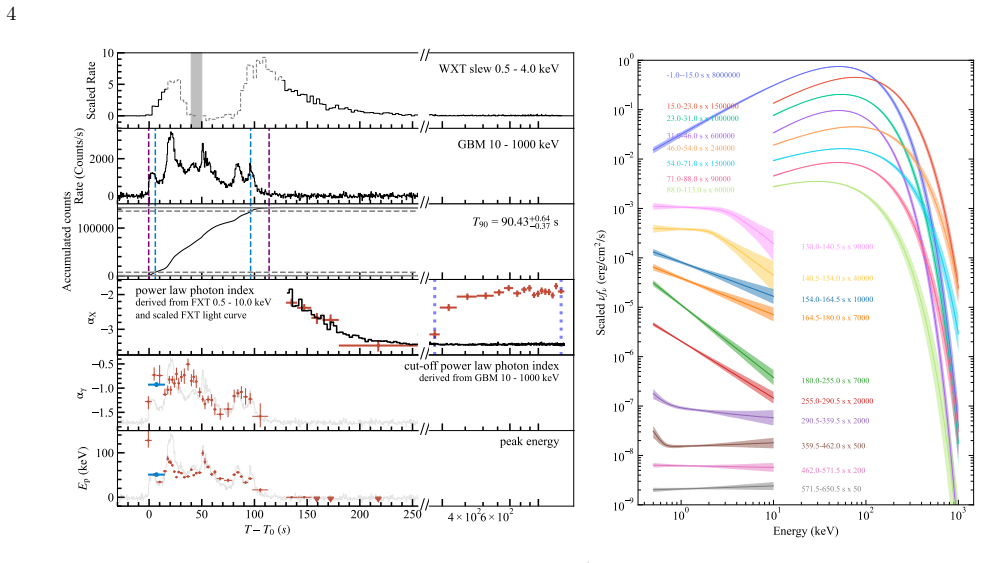
The central claim is that in GRB 250404A/EP250404a the evolution of the X-ray spectral index—initial softening during the prompt tail, evident hardening after T0+255 s, and a plateau near -2—traces the transition from prompt emission to afterglow. The hardening coincides with a sharp rise in the 1 keV flux and in the early optical bands, peaking near T0+1000 s, which the authors attribute to a reverse-shock component added to the forward-shock emission. A Bayesian fit of the forward-shock plus reverse-shock model to the multiwavelength light curves reproduces the data only when both shock components are included and requires host-galaxy extinction correction factors in the blue u, v, and g bands. On this basis the paper concludes that the second spectral component emerging after T0+255 s is the external-shock afterglow, and that the prompt phase in soft X-rays lasted about 300 s.
Load-bearing premise
The afterglow interpretation rests on whether a simplified forward-shock plus reverse-shock model, with approximate jet dynamics and three fitted blue-band extinction corrections, really describes the multiwavelength data; if those model choices are wrong, the broadband fit would not independently confirm the spectral hardening as afterglow onset, and the inferred ~300 s prompt duration would lose its main support.
Editorial extensions
If this is right
- The soft X-ray prompt phase of GRB 250404A/EP250404a lasted roughly 300 s, more than three times the 90.43 s gamma-ray T90, after which the afterglow dominated the X-ray emission.
- The soft-hard-flat pattern in $\alpha_{\rm X}$ can be used to identify afterglow emergence even when no gamma-ray counterpart is detected and no temporal break is present in the X-ray light curve.
- The 1 keV flux and optical bands rise sharply after the hardening, peaking near $T_0+1000$ s, consistent with a reverse-shock component superimposed on the forward-shock emission.
- The transition from prompt to afterglow can take at least four forms—smooth spectral transition with a break, hardening with smooth decay, hardening with a break, or smooth decay—depending on the relative strength and timing of the two components.
Reading between the lines
- If the soft-hard-flat pattern generalizes across the growing sample of fast X-ray transients, the ratio of X-ray prompt duration to gamma-ray T90 (here about 3.3) could be measured statistically, revealing how often soft X-ray emission outlasts gamma-ray activity.
- The criterion could be applied to fast X-ray transients with no gamma-ray detection: a soft-hard-flat spectral index sequence would identify them as GRB-like and estimate their X-ray prompt duration, a test the paper's Case II scenario makes possible.
- The fitted blue-band extinction corrections, which exceed standard Milky Way, Small Magellanic Cloud, and Large Magellanic Cloud extinction laws, suggest significant host-galaxy extinction at z = 1.88; extending the same fitting approach to a sample could map dust properties in the host galaxies of this GRB subclass.
Editorial analysis
A structured set of objections, weighed in public.
Referee Report
Summary. This Letter presents a multiwavelength study of GRB 250404A/EP250404a, a fast X-ray transient detected by EP/WXT, EP/FXT, and Fermi/GBM. Time-resolved X-ray spectroscopy reveals a spectral index that softens until about T0+255 s and then hardens to a plateau near αX ~ -2, accompanied by a rise at 1 keV and in the optical bands. The authors model the X-ray, optical, and near-infrared light curves with forward- and reverse-shock afterglow components using PyFRS, including three per-band extinction correction factors for the blue bands, and find that the FS+RS model with corrections is preferred. From the hardening epoch they infer that the soft X-ray prompt phase lasted about 300 s, more than three times the gamma-ray T90=90.43 s, and they propose the soft-hard-flat spectral evolution as a diagnostic of afterglow emergence in long-duration fast X-ray transients.
Significance. The manuscript is a careful case study with unusually early multiwavelength coverage: the X-ray spectral fits use BIC model comparison, pileup and WXT slew issues are disclosed with quantitative analysis based on FXT data, and the NH,int degeneracy is explicitly examined in Figure 4. The public fitting tools (bayspec, PyFRS) and the detailed photometric tables make the analysis largely reproducible. If the interpretation holds, the soft-hard-flat spectral pattern would offer a practical criterion for recognizing afterglow emergence in EP fast X-ray transients even without gamma-ray detections or obvious temporal breaks. The principal caveat is that the confirmation of a new afterglow component is model-dependent and would benefit from the additional tests described below.
major comments (3)
- [Sec. 3.2 / Table A2 / Fig. 4] The time-resolved spectral indices are obtained with NH,int fixed to two values, with the switch imposed exactly at the claimed hardening epoch: NH,int1 = 3.73e22 cm^-2 before T0+255 s and NH,int2 = 6.39e21 cm^-2 afterward (Table A2, Fig. 4). Since NH,int and photon index are degenerate in the 0.5-10 keV band, this two-step absorption treatment can in principle create a spurious hardening at the switch time. The free-NH test in Fig. 4 does not fully settle this because the per-bin NH,int values are poorly constrained and the 'fixed' points still assume the two-step model. I request a demonstration that the hardening persists when a single NH,int (or a smoothly varying NH,int) is used for all time bins, or when the spectral index is marginalized over NH,int in each bin.
- [Sec. 3.3 / Table 2] The identification of the post-255 s component with the external-shock afterglow rests on a PyFRS FS+RS fit with 12 physical parameters plus three free per-band extinction correction factors (log f_u, log f_v, log f_g), and footnote 33 notes that the dynamics are approximate. The three correction factors act as arbitrary flux offsets for the blue bands where the early rise is observed, so the BIC preference for FS+RS* does not by itself confirm that a new physical component appears. A less flexible test—fixing the extinction to a physical law with a small number of parameters, or fitting only the red/NIR bands and then checking whether the predicted X-ray spectral evolution matches—would make the confirmation substantially stronger. Without such a test, the claim that the hardening 'confirms' afterglow emergence is overstated.
- [Sec. 3.2 / Sec. 4 Case II] The X-ray data during the hardening phase are fitted with a single PL or SBPL model (Table A2, T0+255 to ~600 s); no two-component 'prompt + afterglow' spectral decomposition is performed, even though Sec. 4 Case II describes exactly that decomposition as the way to disentangle the components. The observation is therefore consistent with a single spectral component whose slope changes, rather than with the emergence of a second, harder component. Fitting the hardening-phase spectra with two power laws (prompt plus afterglow) and showing a BIC preference for two components would directly test the central claim and solidify the inferred ~300 s prompt duration.
minor comments (5)
- [Fig. 1] Figure 1 is extremely dense; the panel showing αX and the WXT slew interval would benefit from clearer labels and a legend.
- [Sec. 2.1 / Sec. 2.3.1] Section 2.1 contains a typo ('90% cofidence') and Section 2.3.1 contains a duplicated article ('the the Alhambra Faint Object Spectrograph').
- [Table 1] Table 1 lists two values of intrinsic NH without indicating their time ranges; please add a note that NH,int1 and NH,int2 correspond to before and after T0+255 s.
- [Appendix B] The Appendix B table sequence repeats 'Table B3. Continued' after the Table B4 header, making the table boundaries unclear; please reformat.
- [Sec. 4] The inferred prompt duration of '~300 s' should be defined precisely (e.g., as the endpoint of the prompt-dominated interval) and reconciled with the 255 s hardening onset.
Circularity Check
No significant circularity: the spectral hardening and prompt duration are read off independent X-ray data, and the afterglow identification rests on a standard public model fit rather than on an assumption that is its own conclusion.
full rationale
The paper's derivation chain is observationally grounded and not circular in any load-bearing step. The spectral softening followed by hardening is measured directly from time-resolved EP/FXT spectra (Table A2), with an explicit check that the adopted switch of intrinsic absorption column density does not drive the trend (Figure 4). The claim that the hardening marks afterglow emergence is supported by fitting a public, standard FS+RS model (PyFRS) to independent optical, near-infrared, and late-time X-ray data; although the model is flexible and the fit is not a substitute for the two-component X-ray spectral decomposition the paper itself recommends in Case II of Section 4, that is a model-dependence/correctness limitation, not circularity. The inferred prompt duration of about 300 s is read off the observed spectral hardening epoch and the plateau at alpha_X approximately -2, so the output is a direct interpretation of an independent observable rather than a quantity fitted into the same data and then renamed a prediction. The three extinction correction factors log f_u, log f_v, and log f_g are fitted to the blue-band data, and the statement that the derived factors are consistent with the SEDs is a post-fit consistency check, not an independent confirmation carrying the central claim. Self-citations to PyFRS and to standard afterglow references cite public code and textbook results, not an unverified uniqueness theorem invoked to forbid alternatives. No equation or fitted parameter is equivalent by construction to the paper's headline conclusions, so there is no significant circularity.
Assumptions & free parameters
free parameters (16)
- log E_k,iso =
55.38 erg
- log Gamma_0 =
2.33
- theta_jet =
7.39 deg
- logn18 =
-0.42
- p_f =
2.59
- log epsilon_e,f =
-1.27
- log epsilon_B,f =
-6.29
- p_r =
2.77
- log epsilon_e,r =
-0.35
- log epsilon_B,r =
-4.32
- log v =
-0.87
- log f_u =
-1.09
- log f_v =
-0.58
- log f_g =
-0.20
- NH,int1 =
3.73e22 cm^-2
- NH,int2 =
6.39e21 cm^-2
assumptions (4)
- domain assumption The external-shock synchrotron afterglow model (forward and reverse shocks) correctly describes the multiwavelength emission after T0+255 s.
- domain assumption The jet is a top-hat jet in the thin-shell regime, with approximate dynamics from Huang et al. (2000) and Kobayashi (2000).
- domain assumption The redshift z = 1.88 derived from absorption lines in the GMG-2.4m spectrum is correct.
- domain assumption The X-ray afterglow spectrum is a single power law with photon index around -2 after the spectral plateau.
Cite this review
Pith. "Pith review of Spectral Hardening Reveals Afterglow Emergence in Long-Duration Fast X-ray Transients: A Case Study of GRB 250404A/EP250404a." pith.science (2026). https://pith.science/paper/WS7JUNC6
@misc{pith2026250600435,
  author       = {Pith},
  title        = {Pith review of: Spectral Hardening Reveals Afterglow Emergence in Long-Duration Fast X-ray Transients: A Case Study of GRB 250404A/EP250404a},
  year         = {2026},
  howpublished = {\url{https://pith.science/paper/WS7JUNC6}},
  note         = {Machine review of arXiv:2506.00435}
}
abstract
The prompt emission and afterglow phases of gamma-ray bursts (GRBs) have been extensively studied, yet the transition between these two phases remains inadequately characterized due to limited multiwavelength observational coverage. Among the recent growing samples of fast X-ray transients observed by Einstein Probe (EP), a subgroup of GRBs are captured with long-duration X-ray emission, potentially containing featured evolution from prompt emission to the afterglow phase. In this Letter, we present a detailed analysis of GRB 250404A/EP250404a, a bright fast X-ray transient detected simultaneously by EP and the Fermi Gamma-ray Burst Monitor in X-rays and gamma rays. Its continuous X-ray emission reveals a long-duration tail, accompanied by distinct spectral evolution manifested by the spectral index $\alpha_{\rm X}$ with an initial softening, followed by an evident hardening, eventually reaching a plateau at the value of $\sim$ -2. Early optical and near-infrared observations enable broadband modeling with forward- and reverse-shock components, confirming that the X-ray hardening signals the emergence of the external-shock afterglow. From this spectral hardening we infer that the prompt phase in soft X-rays lasted $\sim300\;\mathrm{s}$, which is more than 3 times longer than the gamma-ray $T_{90}$. This well-tracked soft-hard-flat spectral pattern provides a clear indication of afterglow emergence from the fading prompt emission and offers a practical criterion for identifying a distinct population of GRBs among fast X-ray transients, even when the detection of the gamma-ray counterpart or obvious temporal break is absent.
Figures


Figures from the paper (2 more)


Reference graph
Works this paper leans on
-
[1]
, " * write output.state after.block = add.period write newline
ENTRY address archivePrefix author booktitle chapter doi edition editor eprint howpublished institution journal key month number organization pages publisher school series title misctitle type volume year version url label extra.label sort.label short.list INTEGERS output.state before.all mid.sentence after.sentence after.block FUNCTION init.state.consts ...
-
[2]
write newline
" write newline "" before.all 'output.state := FUNCTION format.url url empty "" new.block "" url * "" * if FUNCTION format.eprint eprint empty "" archivePrefix empty "" archivePrefix "arXiv" = new.block " " eprint * " " * new.block " " eprint * " " * if if if FUNCTION format.doi doi empty "" " " doi * " " * if FUNCTION format.pid doi empty eprint empty ur...
-
[3]
thebibliography [1] 20pt to REFERENCES 6pt =0pt \@twocolumntrue 12pt -12pt 10pt plus 3pt =0pt =0pt =1pt plus 1pt =0pt =0pt -12pt =13pt plus 1pt =20pt =13pt plus 1pt \@M =10000 =-1.0em =0pt =0pt 0pt =0pt =1.0em @enumiv\@empty 10000 10000 `\.\@m \@noitemerr \@latex@warning Empty `thebibliography' environment \@ifnextchar \@reference \@latexerr Missing key o...
arXiv 2017
-
[4]
Amati , L., Frontera , F., Tavani , M., et al. 2002, title Intrinsic spectra and energetics of BeppoSAX Gamma-Ray Bursts with known redshifts , , 390, 81, 10.1051/0004-6361:20020722
-
[5]
Buchner , J., Georgakakis , A., Nandra , K., et al. 2014, title X-ray spectral modelling of the AGN obscuring region in the CDFS: Bayesian model selection and catalogue , , 564, A125, 10.1051/0004-6361/201322971
-
[6]
Campana , S., Lazzati , D., Perna , R., Grazia Bernardini , M., & Nava , L. 2021, title The variable absorption in the X-ray spectrum of GRB 190114C , , 649, A135, 10.1051/0004-6361/202140439
-
[7]
Campana , S., Lazzati , D., Ripamonti , E., et al. 2007, title A Metal-rich Molecular Cloud Surrounds GRB 050904 at Redshift 6.3 , , 654, L17, 10.1086/510719
-
[8]
Chen , X., Kumar , B., Er , X., et al. 2024, title Early-phase Simultaneous Multiband Observations of the Type II Supernova SN 2024ggi with Mephisto , , 971, L2, 10.3847/2041-8213/ad62f7
Show all 62 references
-
[9]
2020, title Status of the follow-up x-ray telescope onboard the Einstein Probe satellite , in Society of Photo-Optical Instrumentation Engineers (SPIE) Conference Series, Vol
Chen , Y., Cui , W., Han , D., et al. 2020, title Status of the follow-up x-ray telescope onboard the Einstein Probe satellite , in Society of Photo-Optical Instrumentation Engineers (SPIE) Conference Series, Vol. 11444, Space Telescopes and Instrumentation 2020: Ultraviolet t...
2020 doi
-
[10]
2025, title Ground Calibration Result of the Wide-field X-ray Telescope (WXT) onboard the Einstein Probe , arXiv e-prints, arXiv:2505.18939, 10.48550/arXiv.2505.18939
Cheng , H., Zhang , C., Ling , Z., et al. 2025, title Ground Calibration Result of the Wide-field X-ray Telescope (WXT) onboard the Einstein Probe , arXiv e-prints, arXiv:2505.18939, 10.48550/arXiv.2505.18939
-
[11]
Dermer , C. D. 2004, title Curvature Effects in Gamma-Ray Burst Colliding Shells , , 614, 284, 10.1086/426532
2004 doi
-
[12]
2025, title Multiwavelength Analysis of GRB 250101A: From Gamma-ray Prompt Emission to Optical Afterglow , arXiv e-prints, arXiv:2503.15805, 10.48550/arXiv.2503.15805
Du , G., Cheng , Y., Yang , Y.-P., et al. 2025, title Multiwavelength Analysis of GRB 250101A: From Gamma-ray Prompt Emission to Optical Afterglow , arXiv e-prints, arXiv:2503.15805, 10.48550/arXiv.2503.15805
-
[13]
E., Madras , C
Fenimore , E. E., Madras , C. D., & Nayakshin , S. 1996, title Expanding Relativistic Shells and Gamma-Ray Burst Temporal Structure , , 473, 998, 10.1086/178210
1996 doi
-
[14]
2025, title GRB 250404A: Fermi GBM Final Real-time Localization , GRB Coordinates Network, 40050, 1
Fermi GBM Team . 2025, title GRB 250404A: Fermi GBM Final Real-time Localization , GRB Coordinates Network, 40050, 1
2025
-
[15]
Fitzpatrick , E. L. 1999, title Correcting for the Effects of Interstellar Extinction , , 111, 63, 10.1086/316293
1999 doi
-
[16]
2013, title A complete reference of the analytical synchrotron external shock models of gamma-ray bursts , , 57, 141, 10.1016/j.newar.2013.10.001
Gao , H., Lei , W.-H., Zou , Y.-C., Wu , X.-F., & Zhang , B. 2013, title A complete reference of the analytical synchrotron external shock models of gamma-ray bursts , , 57, 141, 10.1016/j.newar.2013.10.001
2013 doi
-
[17]
2021, title Evolution patterns of the peak energy in the GRB prompt emission , , 656, A134, 10.1051/0004-6361/202141647
Gao , H.-X., Geng , J.-J., & Huang , Y.-F. 2021, title Evolution patterns of the peak energy in the GRB prompt emission , , 656, A134, 10.1051/0004-6361/202141647
2021 doi
-
[18]
V., Mazets , E
Golenetskii , S. V., Mazets , E. P., Aptekar , R. L., & Ilinskii , V. N. 1983, title Correlation between luminosity and temperature in -ray burst sources , , 306, 451, 10.1038/306451a0
1983 doi
-
[19]
W., Liu , Q
Hu , J. W., Liu , Q. C., Zhang , B. B., et al. 2025, title EP250404a: Einstein Probe detection of an X-ray transient , GRB Coordinates Network, 40051, 1
2025
-
[20]
F., Gou , L
Huang , Y. F., Gou , L. J., Dai , Z. G., & Lu , T. 2000, title Overall Evolution of Jetted Gamma-Ray Burst Ejecta , , 543, 90, 10.1086/317076
2000 doi
-
[21]
Q., Zhu , Z
Jiang , S. Q., Zhu , Z. P., An , J., et al. 2025, title EP250404a: Nanshan/HMT optical counterpart detection , GRB Coordinates Network, 40052, 1
2025
- [22]
-
[23]
2000, title Light Curves of Gamma-Ray Burst Optical Flashes , , 545, 807, 10.1086/317869
Kobayashi , S. 2000, title Light Curves of Gamma-Ray Burst Optical Flashes , , 545, 807, 10.1086/317869
2000 doi
-
[24]
A., Fishman , G
Kouveliotou , C., Meegan , C. A., Fishman , G. J., et al. 1993, title Identification of Two Classes of Gamma-Ray Bursts , , 413, L101, 10.1086/186969
1993 doi
-
[25]
2000, title Afterglow Emission from Naked Gamma-Ray Bursts , , 541, L51, 10.1086/312905
Kumar , P., & Panaitescu , A. 2000, title Afterglow Emission from Naked Gamma-Ray Bursts , , 541, L51, 10.1086/312905
2000 doi
-
[26]
2002, title Determining the location of gamma-ray bursts through the evolution of their soft X-ray absorption , , 330, 383, 10.1046/j.1365-8711.2002.05064.x
Lazzati , D., & Perna , R. 2002, title Determining the location of gamma-ray bursts through the evolution of their soft X-ray absorption , , 330, 383, 10.1046/j.1365-8711.2002.05064.x
2002
-
[27]
2003, title Time-dependent photoionization in a dusty medium - III
Lazzati , D., & Perna , R. 2003, title Time-dependent photoionization in a dusty medium - III. The effect of dust on the photoionization of metals , , 340, 694, 10.1046/j.1365-8711.2003.06334.x
2003
-
[28]
2016, title IGR J12580+0134: The First Tidal Disruption Event with an Off-beam Relativistic Jet , , 816, 20, 10.3847/0004-637X/816/1/20
Lei , W.-H., Yuan , Q., Zhang , B., & Wang , D. 2016, title IGR J12580+0134: The First Tidal Disruption Event with an Off-beam Relativistic Jet , , 816, 20, 10.3847/0004-637X/816/1/20
2016 doi
-
[29]
2025, title Soft X-ray prompt emission from the high-redshift gamma-ray burst EP240315a , Nature Astronomy, 9, 564, 10.1038/s41550-024-02449-8
Liu , Y., Sun , H., Xu , D., et al. 2025, title Soft X-ray prompt emission from the high-redshift gamma-ray burst EP240315a , Nature Astronomy, 9, 564, 10.1038/s41550-024-02449-8
2025 doi
-
[30]
Medvedev , M. V. 2006, title The Theory of Spectral Evolution of the Gamma-Ray Burst Prompt Emission , , 637, 869, 10.1086/498697
2006 doi
-
[31]
N., et al
Meegan, C., Lichti, G., Bhat, P. N., et al. 2009, title THE FERMI GAMMA-RAY BURST MONITOR, The Astrophysical Journal, 702, 791, 10.1088/0004-637X/702/1/791
2009 doi
-
[32]
M \'e sz \'a ros , P., & Rees , M. J. 1997, title Optical and Long-Wavelength Afterglow from Gamma-Ray Bursts , , 476, 232, 10.1086/303625
1997 doi
-
[33]
2025, title GRB 250404A: Fermi GBM Detection , GRB Coordinates Network, 40067, 1
Mukherjee , O., Meegan , C., & Fermi Gamma-ray Burst Monitor Team . 2025, title GRB 250404A: Fermi GBM Detection , GRB Coordinates Network, 40067, 1
2025
-
[34]
2013, title Afterglow emission in gamma-ray bursts - I
Nava , L., Sironi , L., Ghisellini , G., Celotti , A., & Ghirlanda , G. 2013, title Afterglow emission in gamma-ray bursts - I. Pair-enriched ambient medium and radiative blast waves , , 433, 2107, 10.1093/mnras/stt872
2013 doi
-
[35]
Observatories, N. O. A., & community, T. I. 2025, IRAF, v2.18.1 Zenodo, 10.5281/zenodo.15187343
2025 doi
-
[36]
Paczynski , B., & Rhoads , J. E. 1993, title Radio Transients from Gamma-Ray Bursters , , 418, L5, 10.1086/187102
1993 doi
-
[37]
1994, title Neutrino Bursts from Gamma-Ray Bursts , , 427, 708, 10.1086/174178
Paczynski , B., & Xu , G. 1994, title Neutrino Bursts from Gamma-Ray Bursts , , 427, 708, 10.1086/174178
1994 doi
-
[38]
2003, title Time-dependent Photoionization in a Dusty Medium
Perna , R., Lazzati , D., & Fiore , F. 2003, title Time-dependent Photoionization in a Dusty Medium. II. Evolution of Dust Distributions and Optical Opacities , , 585, 775, 10.1086/346109
2003 doi
-
[39]
J., & Meszaros , P
Rees , M. J., & Meszaros , P. 1994, title Unsteady Outflow Models for Cosmological Gamma-Ray Bursts , , 430, L93, 10.1086/187446
1994 doi
-
[40]
1997, title Cosmological gamma-ray bursts: internal versus external shocks , , 287, 110, 10.1093/mnras/287.1.110
Sari , R., & Piran , T. 1997, title Cosmological gamma-ray bursts: internal versus external shocks , , 287, 110, 10.1093/mnras/287.1.110
1997 doi
-
[41]
1998, title Spectra and Light Curves of Gamma-Ray Burst Afterglows , , 497, L17, 10.1086/311269
Sari , R., Piran , T., & Narayan , R. 1998, title Spectra and Light Curves of Gamma-Ray Burst Afterglows , , 497, L17, 10.1086/311269
1998 doi
-
[42]
F., & Finkbeiner , D
Schlafly , E. F., & Finkbeiner , D. P. 2011, title Measuring Reddening with Sloan Digital Sky Survey Stellar Spectra and Recalibrating SFD , , 737, 103, 10.1088/0004-637X/737/2/103
2011 doi
-
[43]
1978, title Estimating the Dimension of a Model , The Annals of Statistics, 6, 461 , 10.1214/aos/1176344136
Schwarz, G. 1978, title Estimating the Dimension of a Model , The Annals of Statistics, 6, 461 , 10.1214/aos/1176344136
1978
-
[44]
1986, title The IRAF Data Reduction and Analysis System , in Society of Photo-Optical Instrumentation Engineers (SPIE) Conference Series, Vol
Tody , D. 1986, title The IRAF Data Reduction and Analysis System , in Society of Photo-Optical Instrumentation Engineers (SPIE) Conference Series, Vol. 627, Instrumentation in astronomy VI, ed. D. L. Crawford , 733, 10.1117/12.968154
1986 doi
-
[45]
1993, title IRAF in the Nineties , in Astronomical Society of the Pacific Conference Series, Vol
Tody , D. 1993, title IRAF in the Nineties , in Astronomical Society of the Pacific Conference Series, Vol. 52, Astronomical Data Analysis Software and Systems II, ed. R. J. Hanisch , R. J. V. Brissenden , & J. Barnes , 173
1993
-
[46]
2019, title Lijiang 2.4-meter Telescope and its instruments , Research in Astronomy and Astrophysics, 19, 149, 10.1088/1674-4527/19/10/149
Wang , C.-J., Bai , J.-M., Fan , Y.-F., et al. 2019, title Lijiang 2.4-meter Telescope and its instruments , Research in Astronomy and Astrophysics, 19, 149, 10.1088/1674-4527/19/10/149
2019 doi
-
[47]
2000, title On the Absorption of X-Rays in the Interstellar Medium , , 542, 914, 10.1086/317016
Wilms , J., Allen , A., & McCray , R. 2000, title On the Absorption of X-Rays in the Interstellar Medium , , 542, 914, 10.1086/317016
2000 doi
-
[48]
2020, title Astronomical Site Monitoring System at Lijiang Observatory , Research in Astronomy and Astrophysics, 20, 149, 10.1088/1674-4527/20/9/149
Xin , Y.-X., Bai , J.-M., Lun , B.-L., et al. 2020, title Astronomical Site Monitoring System at Lijiang Observatory , Research in Astronomy and Astrophysics, 20, 149, 10.1088/1674-4527/20/9/149
2020 doi
-
[49]
2022, title A long-duration gamma-ray burst with a peculiar origin , , 612, 232, 10.1038/s41586-022-05403-8
Yang , J., Ai , S., Zhang , B.-B., et al. 2022, title A long-duration gamma-ray burst with a peculiar origin , , 612, 232, 10.1038/s41586-022-05403-8
2022 doi
-
[50]
2023, title Synchrotron Radiation Dominates the Extremely Bright GRB 221009A , , 947, L11, 10.3847/2041-8213/acc84b
Yang , J., Zhao , X.-H., Yan , Z., et al. 2023, title Synchrotron Radiation Dominates the Extremely Bright GRB 221009A , , 947, L11, 10.3847/2041-8213/acc84b
2023 doi
-
[51]
2024, title Multiband Simultaneous Photometry of Type II SN 2023ixf with Mephisto and the Twin 50 cm Telescopes , , 969, 126, 10.3847/1538-4357/ad4be3
Yang , Y.-P., Liu , X., Pan , Y., et al. 2024, title Multiband Simultaneous Photometry of Type II SN 2023ixf with Mephisto and the Twin 50 cm Telescopes , , 969, 126, 10.3847/1538-4357/ad4be3
2024 doi
-
[52]
Yin , Y. H. I., Hu , J. W., Hua , Y. L., et al. 2025, title EP250404a: refined analysis of the EP-WXT and EP-FXT observations , GRB Coordinates Network, 40085, 1
2025
-
[53]
I., Zhang , B.-B., Yang , J., et al
Yin , Y.-H. I., Zhang , B.-B., Yang , J., et al. 2024, title Triggering the Untriggered: The First Einstein Probe-detected Gamma-Ray Burst 240219A and Its Implications , , 975, L27, 10.3847/2041-8213/ad8652
2024 doi
-
[54]
2022, title The Einstein Probe Mission , in Handbook of X-ray and Gamma-ray Astrophysics (Springer Singapore), 86, 10.1007/978-981-16-4544-0_151-1
Yuan , W., Zhang , C., Chen , Y., & Ling , Z. 2022, title The Einstein Probe Mission , in Handbook of X-ray and Gamma-ray Astrophysics (Springer Singapore), 86, 10.1007/978-981-16-4544-0_151-1
2022 doi
-
[55]
2025, title Science objectives of the Einstein Probe mission, Science China Physics, Mechanics & Astronomy, 68, 239501, 10.1007/s11433-024-2600-3
Yuan, W., Dai, L., Feng, H., et al. 2025, title Science objectives of the Einstein Probe mission, Science China Physics, Mechanics & Astronomy, 68, 239501, 10.1007/s11433-024-2600-3
2025 doi
-
[56]
2014, title Gamma-Ray Burst Prompt Emission , International Journal of Modern Physics D, 23, 1430002, 10.1142/S021827181430002X
Zhang , B. 2014, title Gamma-Ray Burst Prompt Emission , International Journal of Modern Physics D, 23, 1430002, 10.1142/S021827181430002X
2014 doi
-
[57]
2018, The Physics of Gamma-Ray Bursts (Cambridge University Press), 10.1017/9781139226530
Zhang , B. 2018, The Physics of Gamma-Ray Bursts (Cambridge University Press), 10.1017/9781139226530
2018 doi
-
[58]
Z., Dyks , J., et al
Zhang , B., Fan , Y. Z., Dyks , J., et al. 2006, title Physical Processes Shaping Gamma-Ray Burst X-Ray Afterglow Light Curves: Theoretical Implications from the Swift X-Ray Telescope Observations , , 642, 354, 10.1086/500723
2006 doi
-
[59]
2005, title Gamma-Ray Burst Early Afterglows: Reverse Shock Emission from an Arbitrarily Magnetized Ejecta , , 628, 315, 10.1086/429787
Zhang , B., & Kobayashi , S. 2005, title Gamma-Ray Burst Early Afterglows: Reverse Shock Emission from an Arbitrarily Magnetized Ejecta , , 628, 315, 10.1086/429787
2005 doi
-
[60]
2003, title Gamma-Ray Burst Early Optical Afterglows: Implications for the Initial Lorentz Factor and the Central Engine , , 595, 950, 10.1086/377363
Zhang , B., Kobayashi , S., & M \'e sz \'a ros , P. 2003, title Gamma-Ray Burst Early Optical Afterglows: Implications for the Initial Lorentz Factor and the Central Engine , , 595, 950, 10.1086/377363
2003 doi
-
[61]
2011, title A Comprehensive Analysis of Fermi Gamma-ray Burst Data
Zhang , B.-B., Zhang , B., Liang , E.-W., et al. 2011, title A Comprehensive Analysis of Fermi Gamma-ray Burst Data. I. Spectral Components and the Possible Physical Origins of LAT/GBM GRBs , , 730, 141, 10.1088/0004-637X/730/2/141
2011 doi
-
[62]
Zhu , Z.-P., Xu , D., Fynbo , J. P. U., et al. 2023, title Photometric and Spectroscopic Observations of GRB 190106A: Emission from Reverse and Forward Shocks with Late-time Energy Injection , , 948, 30, 10.3847/1538-4357/acbd96
2023 doi
Reviewed August 7, 2026 · model on record in the stance chip above.
Discussion (0). Sign in to comment.