REVIEW 3 major objections 5 minor 63 references
Cold pools, Breezes, and Monsoons: Propagating Convection over New Guinea
T0 review · 3 major / 5 minor · reviewed 2026-08-07 · deepseek-v4-flash
Pith's one-line read New Guinea's diurnal storms form in two modes—a daytime ridge-to-coast band and a nighttime over-ocean band—and the nighttime band is carried by a cold-pool-strengthened land breeze with moist patches at its front.
desk verdict A solid climatological two-mode result for New Guinea carries a plausible but single-case mechanistic story; referee it, but expect heavy revision. read the letter →
The pith
A machine-rendered reading of the paper's core claim, the machinery that carries it, and where it could break.
The reading
What carries the argument
The central object is the hybrid land breeze: a coastal density current (a near-surface flow of negatively buoyant air that spreads under gravity) formed when the nocturnal, radiatively driven land breeze merges with convectively generated cold pools that thicken it and raise its gust-front speed. Moist patches at its front—localized bands of high water vapor and moist static energy over the warm ocean—are the specific feature that makes the mechanism work, because they provide the buoyant, high-moisture air from which new cells are triggered. The paper diagnoses these flows with density potential temperature $\theta_\rho$ to mark negatively buoyant air, with moist static energy and column-integrated liquid water to distinguish cold pools from pure breezes, and with the gravity-current speed relation $U \approx 0.6\sqrt{g h (\theta_{\rho,e}-\theta_\rho)/\theta_{\rho,e}}$ to connect the density-current structure to the observed propagation speeds.
What would settle it
Fly or sail instrumented transects across the nocturnal land-breeze front 50–200 km off New Guinea's northeast coast: if there is no moist patch (elevated water vapor and moist static energy) co-located with the gust front and newly forming cells, the regeneration mechanism is not operating. Alternatively, run the same 2-km configuration over multiple Februarys with evaporative cooling disabled: if the over-ocean mode persists in any case where the control run propagates it hundreds of kilometers offshore, the attribution to cold pools collapses.
Extended reading notes
Core claim
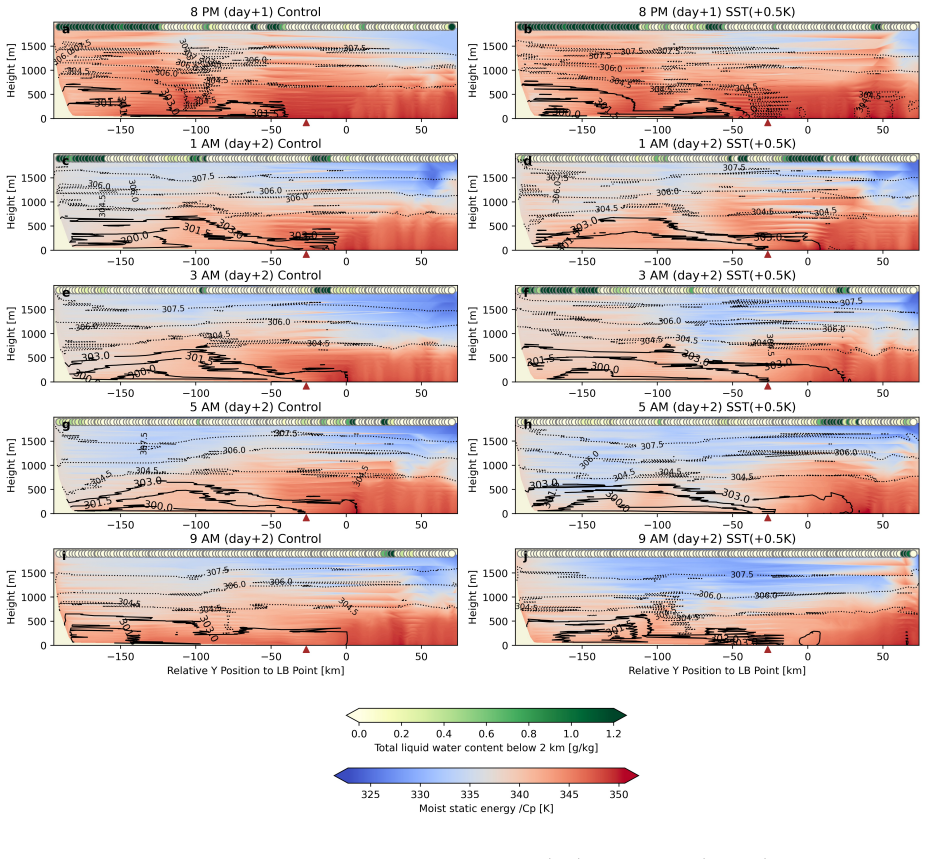
On the paper's own terms, the discovery is that diurnal offshore propagation over New Guinea has two separable modes with a distinct spatial gap, and that the gap plus the offshore regeneration are produced by a three-stage interaction of density currents. The first mode starts over the central ridge in the early afternoon and moves toward the coast at roughly 6–11 m s$^{-1}$, but it dissipates about 100 km inland because the afternoon sea breeze has advected cool, stable marine air into the boundary layer. After sunset the wind reverses, and a nocturnal land breeze—a shallow density current of order 250 m deep—forms; where it merges with residual convective cold pools, it becomes a deeper hybrid land breeze reaching roughly 600 m thickness and gust-front speeds of 4.5–7.2 m s$^{-1}$. Along its front over the warm ocean, the hybrid breeze develops moist patches, regions of anomalously high water vapor and moist static energy, and these patches, together with moisture convergence from the cross-equatorial monsoon, regenerate precipitation as the second mode, which then propagates 200–600 km offshore and can leapfrog from one cold pool to the next. The paper concludes that cold pools, hybrid land breezes, and their moist patches—not gravity waves—are the forcing mechanisms that allow second-mode convection to persist overnight and travel far from the coastline.
Load-bearing premise
The whole mechanism hangs on the assumption that one three-day WRF simulation of a single February 2010 event—and its companion run with evaporative cooling disabled—faithfully represents how cold pools and land breezes behave in the climatological two-mode pattern.
Editorial extensions
If this is right
- If the paper is right, the observed ~100 km rainfall gap is a predictably produced feature of sea-breeze trapping, so models that get sea-breeze timing wrong will also misplace the gap and the coastward jump.
- Disabling evaporative cooling removes the long offshore convection, meaning cold pools are load-bearing for the over-ocean mode rather than a secondary modulation.
- A modest uniform SST increase of 0.5 K intensifies the second mode's updrafts and broadens its moist patches, so warm ocean waters act as a control on how far offshore the night convection can reach.
- The 200–600 km offshore propagation can be explained by density currents alone, so gravity-wave mechanisms are not required to account for long-range diurnal offshore convection in this setting.
- Forecast and climate models over the Maritime Continent should prioritize boundary-layer processes—cold pools, land and sea breezes, and moist patches—when trying to capture the diurnal cycle of coastal rainfall.
Reading between the lines
- Editorial inference: the two-mode jump and the ~100 km gap should also appear along other mountainous tropical coasts whose ridge-to-coast distance and sea-breeze timing resemble New Guinea's, such as the western coast of Sumatra; the gap size should scale with island width and the timing of the sea breeze.
- Editorial inference: the moist patches at the land-breeze front are a directly testable observable—airborne water-vapor lidar or microwave radiometer transects crossing the front 50–200 km offshore should see a narrow positive water-vapor anomaly co-located with the gust front and with new cells.
- Editorial inference: the paper's SST sensitivity implies a colder-SST experiment would be a clean test of the mechanism, with the prediction that the over-ocean mode weakens or disappears entirely rather than merely slowing.
- Editorial inference: because the paper links El Niño years to shorter offshore reach and La Niña years to longer reach, the hybrid-land-breeze mechanism implies that interannual SST and boundary-layer moisture variations should shift the climatological 200–600 km propagation distances by tens of kilometers.
Editorial analysis
A structured set of objections, weighed in public.
Referee Report
Summary. The paper uses 21 years of GPM IMERG precipitation data and a 2-km WRF simulation of 19–22 February 2010, together with two sensitivity experiments, to characterize diurnal convective offshore propagation from New Guinea. It identifies a ridge-to-coast first mode and an over-ocean second mode separated by a roughly 100 km gap, and proposes that a 'hybrid land breeze' — the nocturnal land breeze strengthened by cold pools — produces moist patches and sustains the second mode 200–600 km offshore. It also argues that gravity waves are unlikely to be the primary mechanism and that regional monsoonal flow and SST modulate the propagation.
Significance. If the causal attribution holds, the paper offers a concrete, testable alternative to gravity-wave explanations for far offshore diurnal propagation and provides a process-level account for Maritime Continent rainfall. Its strengths include a 21-year climatology, clearly defined topography-aligned and coastline-aligned coordinate systems, two perturbation experiments, and publicly available data and scripts. However, the mechanism is currently supported by only one multi-day case and one microphysics perturbation, so the significance is conditional rather than established.
major comments (3)
- [§3.2, §4.5] The central mechanistic claim is under-supported by the case selection. Section 3.2 describes the 19–22 February 2010 event as a long-range case whose >600-km MCS 'do[es] not occur regularly with the diurnal cycle', and Section 4.5 states that El Niño winters, including February 2010, display shorter offshore propagation; the climatological second mode in Figure 3c typically extends only 200–350 km. Since the hybrid-land-breeze/cold-pool mechanism is diagnosed from this single extreme event, the paper does not establish that the same mechanism operates in the common shorter events. The control run's known bias toward earlier land convection and more organized precipitation (Section 3.2) further means the simulated gap is partly a model feature. I recommend a multi-case or composite analysis over several February events, or a conditional composite stratified by offshore propagation distance, with the Figure 9–12 diagnostics repeated for a 200–350-km event.
- [§2.2, §3.3.1, Figure 8] The Cold Pool Experiment does not cleanly isolate cold pools. Disabling evaporative cooling in WSM6 while retaining evaporation removes the latent cooling that drives downdrafts and cold pools, but it also permits evaporation to moisten the air without cooling it, which changes CAPE, downdraft intensity, and all subsequent convective organization. The control-vs-experiment contrasts in Figure 8 and the statement in Section 3.3.1 that removing evaporative cooling 'completely eliminates the offshore convection' therefore mix cold-pool removal with other microphysical feedbacks. A cleaner experimental design would restore an equivalent heat source, remove only the gust-front lifting or cold-pool outflow component, or compare with an independent microphysics scheme.
- [§4.1, §5] The dismissal of gravity waves is not yet decisive. The evidence in Section 4.1 is that the precipitation propagates at about 4 m/s while the gravity-wave signatures move at 9–18 m/s, and that the wave pattern shows little SST sensitivity. Neither observation rules out a gravity-wave preconditioning role: a wave can destabilize the lower troposphere and trigger convection while the precipitation lags behind the wave, and the SST sensitivity test probes the convective response, not the causal influence of the waves. A more direct test is needed, such as lag-correlation between the wave phase and initiation locations, phase-speed filtering of the wave field, or an idealized experiment with convectively forced gravity waves suppressed.
minor comments (5)
- [Figures 5–6] The Figure 5 caption gives 9.7 km while the text (Sections 3.2 and 4.1) states 9.6 km; also the Figure 6 caption refers to 'three modes' while the text describes two modes and a jump — please harmonize these numbers and terms.
- [Throughout] Typographical and formatting artifacts remain, including 'T able 1', 'W R F', 'M¯ anoa', 'T orri' in the header, and 'precipitation-drive downdrafts' in Section 3.3.3. The term 'two-and-a-half-variable framework' in Section 2.3 is introduced without explanation.
- [Table 1, Eq. (4)] The empirical coefficient C = 0.6 in Eq. (4) is presented without justification or reference; since the reported speeds scale linearly with C, a sensitivity statement or citation is needed.
- [§2.2] Section 2.2 states that other cases were also simulated, but no list or summary is given; please provide a table of simulated periods and key outcomes, or remove the claim.
- [§3.3.3, §4.5] The 'monsoonal head' concept is invoked before a quantitative definition; please define it using measurable fields (e.g., θρ anomaly, depth, and convergence) or clearly label it as a schematic interpretation.
Circularity Check
No significant circularity: claims rest on forward WRF experiments and GPM climatology, not on fitted targets or self-citation chains.
full rationale
The paper's central claims (two diurnal modes, a ~100 km gap, and a hybrid land breeze strengthened by cold pools sustaining offshore propagation) are derived from GPM climatology and a forward WRF control run, with causal attribution tested by a cold-pool-removal experiment and an SST+0.5 K perturbation. These are forward model experiments, not fits to a target result. The Benjamin speed estimates in Table 1 use height and density potential temperature diagnosed from the same simulation and are compared with that simulation's winds; they are internal consistency diagnostics rather than independent predictions. This does not constitute circular derivation, because Eq. (4) is an independent physical relation and the paper's main evidence is the sensitivity experiment, not the Table 1 consistency check. Self-citations such as Tang et al. (2024) and Torri & Kuang (2016) are background for moist-patch physics and are not load-bearing: the hybrid-land-breeze hypothesis is tested within the paper itself. The paper explicitly flags its main external-validity limits: Section 3.2 states that >600 km MCSs 'do not occur regularly with the diurnal cycle,' and Section 4.5 notes that El Niño winters such as February 2010 'display shorter propagation from the northeastern coastline.' These are representativeness and generalizability concerns, not circularity. No step in the claimed derivation chain reduces to its own inputs by construction.
Assumptions & free parameters
free parameters (4)
- C in Benjamin density-current speed (Eq. 4) =
0.6
- Land-breeze depth h_LB =
250 m
- Cold-pool depth h_CP =
1000 m
- Density potential temperature values for Table 1 =
303 vs 304.5 K (land breeze); 301.5 vs 306 K (cold pool)
assumptions (6)
- domain assumption IMERG/GPM precipitation estimates accurately capture the diurnal timing and offshore extent of convective rainfall at 0.1 degree and 30-minute resolution.
- domain assumption ERA5 reanalysis provides adequate initial and lateral boundary conditions and reproduces the cross-equatorial monsoon structure that modulates convection.
- domain assumption The WRF 2 km configuration with WSM6, YSU, RRTMG, Noah-MP and no cumulus scheme can reproduce cold pools and land breezes accurately enough for causal attribution.
- domain assumption Benjamin's gravity-current formula with C=0.6 applies to tropical coastal density currents and gives reliable speed estimates.
- ad hoc to paper Disabling evaporative cooling in the cold-pool experiment isolates cold-pool effects while leaving other processes unchanged.
- ad hoc to paper The cross-equatorial monsoon can be treated as a large-scale density current with a coherent 'monsoonal head' interacting with boundary-layer currents.
invented entities (2)
-
Hybrid land breeze (land breeze strengthened by embedded and residual cold pools)
-
Monsoonal head
Cite this review
Pith. "Pith review of Cold pools, Breezes, and Monsoons: Propagating Convection over New Guinea." pith.science (2026). https://pith.science/paper/ZRJTEQOC
@misc{pith2026250600473,
  author       = {Pith},
  title        = {Pith review of: Cold pools, Breezes, and Monsoons: Propagating Convection over New Guinea},
  year         = {2026},
  howpublished = {\url{https://pith.science/paper/ZRJTEQOC}},
  note         = {Machine review of arXiv:2506.00473}
}
read the original abstract
The diurnal cycle of precipitation near New Guinea involves intricate land-ocean-atmosphere interactions, posing substantial challenges for tropical weather and climate simulations. Using over two decades of GPM satellite observations and convection-permitting Weather Research and Forecasting simulations, this study examines the physical mechanisms governing the pronounced offshore propagation of diurnal convection over New Guinea. We identify two distinct convective propagation modes: (a) a "ridge-to-coast" mode originated over elevated terrain and migrating toward the coastline, and (b) an "over-ocean" mode initiated near the coast, separated by a spatial gap of approximately 100 km. Our findings highlight the critical role of multi-scale thermally driven flow in shaping boundary-layer dynamics over warm ocean waters. Specifically, the afternoon sea-breeze front advects cooler air onshore, stabilizing the lower atmosphere and interrupting the continuous propagation of the first mode. At night, the hybrid land breeze (LB), strengthened by cold pools, generates offshore moist patches that facilitate the convective regeneration and propagation of the second mode. These offshore convective systems interact with monsoonal background winds, sustaining precipitation well beyond 200~600 km from the coast. Sensitivity experiments indicate that even a modest increase in sea surface temperature can enhance convective intensity and extend offshore propagation. These results shed light on the mechanisms that enable diurnal offshore convection to persist overnight and propagate far from the coastline, highlighting the importance of moist-boundary-layer density currents and offering insights for improving precipitation forecasts and global model performance over the Maritime Continent.
Figures


Figures from the paper (11 more)




Reference graph
Works this paper leans on
-
[1]
benjamin1968 APACrefauthors Benjamin, T B. APACrefauthors \ 1968 . Gravity currents and related phenomena Gravity currents and related phenomena . Journal of fluid mechanics 31 2 209--248
work page 1968
-
[2]
chang2004 APACrefauthors Chang, C. , Wang, Z. , Ju, J. \ Li, T. APACrefauthors \ 2004 . On the relationship between western maritime continent monsoon rainfall and ENSO during northern winter On the relationship between western maritime continent monsoon rainfall and enso during northern winter . Journal of Climate 17 3 665--672
work page 2004
-
[3]
coppin2019flat APACrefauthors Coppin, D. \ Bellon, G. APACrefauthors \ 2019 1 . Physical mechanisms controlling the offshore propagation of convection in the tropics: 1. Flat island Physical mechanisms controlling the offshore propagation of convection in the tropics: 1. flat island . Journal of Advances in Modeling Earth Systems 11 9 3042--3056
work page 2019
-
[4]
coppin2019topo APACrefauthors Coppin, D. \ Bellon, G. APACrefauthors \ 2019 2 . Physical mechanisms controlling the offshore propagation of convection in the tropics: 2. Influence of topography Physical mechanisms controlling the offshore propagation of convection in the tropics: 2. influence of topography . Journal of Advances in Modeling Earth Systems 1...
work page 2019
-
[5]
emanuel1994book APACrefauthors Emanuel, K A. APACrefauthors \ 1994 . Atmospheric convection Atmospheric convection . Oxford university press
work page 1994
-
[6]
chen2008 APACrefauthors Esteban, M A. \ Chen, Y L. APACrefauthors \ 2008 . The impact of trade wind strength on precipitation over the windward side of the island of Hawaii The impact of trade wind strength on precipitation over the windward side of the island of hawaii . Monthly Weather Review 136 3 913--928
work page 2008
-
[7]
fang2022global APACrefauthors Fang, J. \ Du, Y. APACrefauthors \ 2022 . A global survey of diurnal offshore propagation of rainfall A global survey of diurnal offshore propagation of rainfall . Nature Communications 13 1 7437
work page 2022
-
[8]
grant2016 APACrefauthors Grant, L D. \ van den Heever, S C. APACrefauthors \ 2016 . Cold pool dissipation Cold pool dissipation . Journal of Geophysical Research: Atmospheres 121 3 1138--1155
work page 2016
Show all 63 references
-
[9]
, Lane, T
hassim2016diurnal APACrefauthors Hassim, M. , Lane, T. \ Grabowski, W. APACrefauthors \ 2016 . The diurnal cycle of rainfall over New Guinea in convection-permitting WRF simulations The diurnal cycle of rainfall over new guinea in convection-permitting wrf simulations . Atmosp...
2016
-
[10]
, Bell, B
hersbach2020 APACrefauthors Hersbach, H. , Bell, B. , Berrisford, P. , Hirahara, S. , Hor \'a nyi, A. , Mu \ n oz-Sabater, J. others APACrefauthors \ 2020 . The ERA5 global reanalysis The era5 global reanalysis . Quarterly journal of the royal meteorological society 146 730 1999--2049
2020
-
[11]
\ Lim, J O J
hong2006WSM6 APACrefauthors Hong, S Y. \ Lim, J O J. APACrefauthors \ 2006 . The WRF single-moment 6-class microphysics scheme (WSM6) The wrf single-moment 6-class microphysics scheme (wsm6) . Asia-Pacific Journal of Atmospheric Sciences 42 2 129--151
2006
-
[12]
, Noh, Y
hong2006 APACrefauthors Hong, S Y. , Noh, Y. \ Dudhia, J. APACrefauthors \ 2006 . A new vertical diffusion package with an explicit treatment of entrainment processes A new vertical diffusion package with an explicit treatment of entrainment processes . Monthly weather review ...
2006
-
[13]
, Geotis, S G
houze1981monsoonOP APACrefauthors Houze Jr, R A. , Geotis, S G. , Marks Jr, F D. \ West, A K. APACrefauthors \ 1981 . Winter monsoon convection in the vicinity of north Borneo. Part I: Structure and time variation of the clouds and precipitation Winter monsoon convection in th...
1981
-
[14]
, Chen, Y L
hsiao2021 APACrefauthors Hsiao, F. , Chen, Y L. , Van Nguyen, H. , Hitzl, D E. \ Ballard, R. APACrefauthors \ 2021 . Effects of trade wind strength on airflow and cloudiness over Oahu Effects of trade wind strength on airflow and cloudiness over oahu . Monthly Weather Review 1...
2021
-
[15]
\ Chen, X
XC2025longdisOP APACrefauthors Hu, J. \ Chen, X. APACrefauthors \ 2025 . Mechanisms behind the long-distance diurnal offshore precipitation propagation in northwestern South America Mechanisms behind the long-distance diurnal offshore precipitation propagation in northwestern ...
2025
-
[16]
, Bolvin, D
huffman2019 APACrefauthors Huffman, G J. , Bolvin, D. , Braithwaite, D. , Hsu, K. , Joyce, R. , Kidd, C. others APACrefauthors \ 2019 . NASA global precipitation measurement (GPM) integrated multi-satellite retrievals for GPM (IMERG). Algorithm Theoretical Basis Document (ATBD...
2019
-
[17]
, Delamere, J S
iacono2008 APACrefauthors Iacono, M J. , Delamere, J S. , Mlawer, E J. , Shephard, M W. , Clough, S A. \ Collins, W D. APACrefauthors \ 2008 . Radiative forcing by long-lived greenhouse gases: Calculations with the AER radiative transfer models Radiative forcing by long-lived ...
2008
-
[18]
jiang2018 APACrefauthors Jiang, L. \ Li, T. APACrefauthors \ 2018 . Why rainfall response to El Ni \ n o over Maritime Continent is weaker and non-uniform in boreal winter than in boreal summer Why rainfall response to el ni \ n o over maritime continent is weaker and non-unif...
2018
-
[19]
\ Wang, B
kikuchi2008mc APACrefauthors Kikuchi, K. \ Wang, B. APACrefauthors \ 2008 . Diurnal precipitation regimes in the global tropics Diurnal precipitation regimes in the global tropics . Journal of Climate 21 11 2680--2696
2008
-
[20]
\ Romps, D M
14vaporring APACrefauthors Langhans, W. \ Romps, D M. APACrefauthors \ 2015 09 . The origin of water vapor rings in tropical oceanic cold pools The origin of water vapor rings in tropical oceanic cold pools . Geophysical Research Letters 42 18 7825--7834 . APACrefURL https://d...
2015 doi
-
[21]
, Zhang, C
ling2019MCbarrier APACrefauthors Ling, J. , Zhang, C. , Joyce, R. , Xie, P p. \ Chen, G. APACrefauthors \ 2019 . Possible role of the diurnal cycle in land convection in the barrier effect on the MJO by the Maritime Continent Possible role of the diurnal cycle in land convecti...
2019
-
[22]
\ Moncrieff, M W
liu2000DC APACrefauthors Liu, C. \ Moncrieff, M W. APACrefauthors \ 2000 . Simulated density currents in idealized stratified environments Simulated density currents in idealized stratified environments . Monthly Weather Review 128 5 1420--1437
2000
-
[23]
\ Moncrieff, M W
liu2017 APACrefauthors Liu, C. \ Moncrieff, M W. APACrefauthors \ 2017 . Shear-parallel mesoscale convective systems in a moist low-inhibition mei-yu front environment Shear-parallel mesoscale convective systems in a moist low-inhibition mei-yu front environment . Journal of t...
2017
-
[24]
, Vincent, C L
lopez2023 APACrefauthors Lopez-Bravo, C. , Vincent, C L. , Huang, Y. \ Lane, T P. APACrefauthors \ 2023 . A case study of a West Sumatra squall line using satellite observations A case study of a west sumatra squall line using satellite observations . Monthly Weather Review 15...
2023
-
[25]
, Matthews, A J
love2011 APACrefauthors Love, B S. , Matthews, A J. \ Lister, G M. APACrefauthors \ 2011 . The diurnal cycle of precipitation over the Maritime Continent in a high-resolution atmospheric model The diurnal cycle of precipitation over the maritime continent in a high-resolution ...
2011
-
[26]
, Warner, T T
mapes2003GWop APACrefauthors Mapes, B E. , Warner, T T. \ Xu, M. APACrefauthors \ 2003 . Diurnal patterns of rainfall in northwestern South America. Part III: Diurnal gravity waves and nocturnal convection offshore Diurnal patterns of rainfall in northwestern south america. pa...
2003
-
[27]
, Keig, G
mcalpine1983NG APACrefauthors McAlpine, J R. , Keig, G. \ Falls, R. APACrefauthors \ 1983 . Climate of Papua New Guinea. Climate of papua new guinea. CSIRO
1983
-
[28]
, Keim, B
miller2003SB APACrefauthors Miller, S. , Keim, B. , Talbot, R. \ Mao, H. APACrefauthors \ 2003 . Sea breeze: Structure, forecasting, and impacts Sea breeze: Structure, forecasting, and impacts . Reviews of geophysics 41 3
2003
-
[29]
, Jun-Ichi, H
mori2004 APACrefauthors Mori, S. , Jun-Ichi, H. , Tauhid, Y I. , Yamanaka, M D. , Okamoto, N. , Murata, F. Sribimawati, T. APACrefauthors \ 2004 . Diurnal land--sea rainfall peak migration over Sumatera Island, Indonesian Maritime Continent, observed by TRMM satellite and inte...
2004
-
[30]
, Ruppert, J
Najarian2025 APACrefauthors Najarian, H. , Ruppert, J. \ Sakaeda, N. APACrefauthors \ 2025 . The influence of cloud-radiative interactions on the diurnal cycle over the maritime continent The influence of cloud-radiative interactions on the diurnal cycle over the maritime cont...
2025
-
[31]
\ Slingo, J
neale2003MC APACrefauthors Neale, R. \ Slingo, J. APACrefauthors \ 2003 . The Maritime Continent and its role in the global climate: A GCM study The maritime continent and its role in the global climate: A gcm study . Journal of Climate 16 5 834--848
2003
-
[32]
\ Zipser, E J
nesbitt2003 APACrefauthors Nesbitt, S W. \ Zipser, E J. APACrefauthors \ 2003 . The diurnal cycle of rainfall and convective intensity according to three years of TRMM measurements The diurnal cycle of rainfall and convective intensity according to three years of trmm measurem...
2003
-
[33]
, Yang, Z L
niu2011 APACrefauthors Niu, G Y. , Yang, Z L. , Mitchell, K E. , Chen, F. , Ek, M B. , Barlage, M. others APACrefauthors \ 2011 . The community Noah land surface model with multiparameterization options (Noah-MP): 1. Model description and evaluation with local-scale measuremen...
2011
-
[34]
, Schumacher, C
north2025 APACrefauthors North, R. , Schumacher, C. , Epifanio, C C. , Deranadyan, G. , Putra, A W. \ Adiyasa, A. APACrefauthors \ 2025 . The Land--Sea Breeze Circulation over the West Coast of Sumatra The land--sea breeze circulation over the west coast of sumatra . Monthly W...
2025
-
[35]
, Birch, C E
peatman2023 APACrefauthors Peatman, S C. , Birch, C E. , Schwendike, J. , Marsham, J H. , Dearden, C. , Webster, S. Matthews, A J. APACrefauthors \ 2023 . The role of density currents and gravity waves in the offshore propagation of convection over Sumatra The role of density ...
2023
-
[36]
, Birch, C E
peatman2025 APACrefauthors Peatman, S C. , Birch, C E. , Schwendike, J. , Marsham, J H. , Howard, E. , Woolnough, S J. Matthews, A J. APACrefauthors \ 2025 . Physical controls on the variability of offshore propagation of convection from Sumatra Physical controls on the variab...
2025
-
[37]
, Matthews, A J
peatman2014MC APACrefauthors Peatman, S C. , Matthews, A J. \ Stevens, D P. APACrefauthors \ 2014 . Propagation of the Madden--Julian Oscillation through the Maritime Continent and scale interaction with the diurnal cycle of precipitation Propagation of the madden--julian osci...
2014
-
[38]
, Schwendike, J
peatman2021ensomjo APACrefauthors Peatman, S C. , Schwendike, J. , Birch, C E. , Marsham, J H. , Matthews, A J. \ Yang, G Y. APACrefauthors \ 2021 . A local-to-large scale view of Maritime Continent rainfall: Control by ENSO, MJO, and equatorial waves A local-to-large scale vi...
2021
-
[39]
\ Chen, X
XC2024GWmonsoon APACrefauthors Peng, C H. \ Chen, X. APACrefauthors \ 2024 . Monsoonal MCS Initiation, Rainfall, and Diurnal Gravity Waves over the Bay of Bengal: Observation and a Linear Model Monsoonal mcs initiation, rainfall, and diurnal gravity waves over the bay of benga...
2024
-
[40]
APACrefauthors \ 1983
rotunno1983linear APACrefauthors Rotunno, R. APACrefauthors \ 1983 . On the linear theory of the land and sea breeze On the linear theory of the land and sea breeze . Journal of the Atmospheric Sciences 40 8 1999--2009
1983
-
[41]
, Chen, X
ruppert2020convGW APACrefauthors Ruppert, J H. , Chen, X. \ Zhang, F. APACrefauthors \ 2020 . Convectively forced diurnal gravity waves in the Maritime Continent Convectively forced diurnal gravity waves in the maritime continent . Journal of the Atmospheric Sciences 77 3 1119--1136
2020
-
[42]
\ Zhang, F
ruppert2019diurnalGW APACrefauthors Ruppert, J H. \ Zhang, F. APACrefauthors \ 2019 . Diurnal forcing and phase locking of gravity waves in the Maritime Continent Diurnal forcing and phase locking of gravity waves in the maritime continent . Journal of the Atmospheric Sciences...
2019
-
[43]
, Kiladis, G
sakaeda2017 APACrefauthors Sakaeda, N. , Kiladis, G. \ Dias, J. APACrefauthors \ 2017 . The diurnal cycle of tropical cloudiness and rainfall associated with the Madden--Julian oscillation The diurnal cycle of tropical cloudiness and rainfall associated with the madden--julian...
2017
-
[44]
\ Hohenegger, C
schlemmer2016 APACrefauthors Schlemmer, L. \ Hohenegger, C. APACrefauthors \ 2016 . Modifications of the atmospheric moisture field as a result of cold-pool dynamics Modifications of the atmospheric moisture field as a result of cold-pool dynamics . Quarterly Journal of the Ro...
2016 doi
-
[45]
, Klemp, J B
skamarock2019WRFV4 APACrefauthors Skamarock, W C. , Klemp, J B. , Dudhia, J. , Gill, D O. , Liu, Z. , Berner, J. others APACrefauthors \ 2019 . A description of the advanced research WRF model version 4 A description of the advanced research wrf model version 4 . National Cent...
2019
-
[46]
stoddard2024 APACrefauthors Stoddard, J. \ Pu, Z. APACrefauthors \ 2024 . Multi-scale interactions associated with two offshore rainfall events near the west coast of Sumatra Multi-scale interactions associated with two offshore rainfall events near the west coast of sumatra ....
2024
-
[47]
Cold pools, Breezes, and Monsoons: Propagating Convection over New Guinea
Tang2025Data APACrefauthors Tang, M. APACrefauthors \ 2025 . [Dataset] Data and scripts for "Cold pools, Breezes, and Monsoons: Propagating Convection over New Guinea". [dataset] data and scripts for "cold pools, breezes, and monsoons: Propagating convection over new guinea". ...
2025 doi
-
[48]
, Torri, G
tang2024 APACrefauthors Tang, M. , Torri, G. \ Sakaeda, N. APACrefauthors \ 2024 . The role of cold pools in modulating convective organization during the MJO The role of cold pools in modulating convective organization during the mjo . Geophysical Research Letters 51 13 e2023GL108050
2024
-
[49]
APACrefauthors \ 2001
tompkins2001 APACrefauthors Tompkins, A M. APACrefauthors \ 2001 . Organization of tropical convection in low vertical wind shears: The role of cold pools Organization of tropical convection in low vertical wind shears: The role of cold pools . Journal of the Atmospheric Scien...
2001
-
[50]
, Casallas, A
tompkins2025 APACrefauthors Tompkins, A M. , Casallas, A. \ De Vera, M V. APACrefauthors \ 2025 . Drivers of mesoscale convective aggregation and spatial humidity variability in the tropical western Pacific Drivers of mesoscale convective aggregation and spatial humidity varia...
2025
-
[51]
\ Kuang, Z
torri2016MP APACrefauthors Torri, G. \ Kuang, Z. APACrefauthors \ 2016 . Rain evaporation and moist patches in tropical boundary layers Rain evaporation and moist patches in tropical boundary layers . Geophysical Research Letters 43 18 9895--9902
2016
-
[52]
, Kuang, Z
torri2015 APACrefauthors Torri, G. , Kuang, Z. \ Tian, Y. APACrefauthors \ 2015 . Mechanisms for convection triggering by cold pools Mechanisms for convection triggering by cold pools . Geophysical Research Letters 42 6 1943--1950
2015
-
[53]
\ Lane, T P
vincent2016NGmjo APACrefauthors Vincent, C L. \ Lane, T P. APACrefauthors \ 2016 . Evolution of the diurnal precipitation cycle with the passage of a Madden--Julian oscillation event through the Maritime Continent Evolution of the diurnal precipitation cycle with the passage o...
2016
-
[54]
\ Lane, T P
vincent2017 APACrefauthors Vincent, C L. \ Lane, T P. APACrefauthors \ 2017 . A 10-year austral summer climatology of observed and modeled intraseasonal, mesoscale, and diurnal variations over the Maritime Continent A 10-year austral summer climatology of observed and modeled ...
2017
-
[55]
APACrefauthors \ 2006
wang2006MS APACrefauthors Wang, B. APACrefauthors \ 2006 . The asian monsoon The asian monsoon . Springer Science & Business Media
2006
-
[56]
wang2000 APACrefauthors Wang, B. , Wu, R. \ Fu, X. APACrefauthors \ 2000 . Pacific--East Asian teleconnection: how does ENSO affect East Asian climate? Pacific--east asian teleconnection: how does enso affect east asian climate? Journal of climate 13 9 1517--1536
2000
-
[57]
\ Zhang, Q
wang2002 APACrefauthors Wang, B. \ Zhang, Q. APACrefauthors \ 2002 . Pacific--east Asian teleconnection. Part II: How the Philippine Sea anomalous anticyclone is established during El Nino development Pacific--east asian teleconnection. part ii: How the philippine sea anomalou...
2002
-
[58]
\ Sobel, A H
wang2017island APACrefauthors Wang, S. \ Sobel, A H. APACrefauthors \ 2017 . Factors controlling rain on small tropical islands: Diurnal cycle, large-scale wind speed, and topography Factors controlling rain on small tropical islands: Diurnal cycle, large-scale wind speed, and...
2017
-
[59]
, Mapes, B E
warner2003 APACrefauthors Warner, T T. , Mapes, B E. \ Xu, M. APACrefauthors \ 2003 . Diurnal patterns of rainfall in northwestern South America. Part II: Model simulations Diurnal patterns of rainfall in northwestern south america. part ii: Model simulations . Monthly Weather...
2003
-
[60]
, Hara, M
wu2009monsoonOP APACrefauthors Wu, P. , Hara, M. , Hamada, J i. , Yamanaka, M D. \ Kimura, F. APACrefauthors \ 2009 . Why a large amount of rain falls over the sea in the vicinity of western Sumatra Island during nighttime Why a large amount of rain falls over the sea in the v...
2009
-
[61]
\ Slingo, J
yang2001 APACrefauthors Yang, G Y. \ Slingo, J. APACrefauthors \ 2001 . The diurnal cycle in the tropics The diurnal cycle in the tropics . Monthly Weather Review 129 4 784--801
2001
-
[62]
, Mori, S
yokoi2017 APACrefauthors Yokoi, S. , Mori, S. , Katsumata, M. , Geng, B. , Yasunaga, K. , Syamsudin, F. Yoneyama, K. APACrefauthors \ 2017 . Diurnal cycle of precipitation observed in the western coastal area of Sumatra Island: Offshore preconditioning by gravity waves Diurnal...
2017
-
[63]
\ Wang, Y
zhou2006NGtopoGW APACrefauthors Zhou, L. \ Wang, Y. APACrefauthors \ 2006 . Tropical Rainfall Measuring Mission observation and regional model study of precipitation diurnal cycle in the New Guinean region Tropical rainfall measuring mission observation and regional model stud...
2006
Reviewed August 7, 2026 · model on record in the stance chip above.
Discussion (0). Sign in to comment.