REVIEW 3 major objections 4 minor 26 references
Lie point symmetries of the biharmonic heat equation on surfaces of revolution
T0 review · 3 major / 4 minor · reviewed 2026-08-07 · deepseek-v4-flash
Pith's one-line read The biharmonic heat equation on a surface of revolution admits exactly the same Lie point symmetries as the harmonic heat equation on that surface.
desk verdict The paper's classification of biharmonic symmetries on surfaces of revolution is undone by its own cylinder algebra, which contradicts the claimed equality with the harmonic heat equation. read the letter →
The pith
A machine-rendered reading of the paper's core claim, the machinery that carries it, and where it could break.
The reading
What carries the argument
The load-bearing object is the fourth prolongation $X^{[4]}$ of the infinitesimal generator $X = \xi\,\partial_x + \phi\,\partial_y + \tau\,\partial_t + \zeta\,\partial_u$, applied through the invariance condition $X^{[4]}(u_t - L^2 u)=0$. This condition and the structure of $L$ reduce to a system of determining equations labelled e1--e14 for $\xi$, $\phi$, $\tau$, $\zeta$, and the profile $f(x)$. The decisive simplification is that the system forces the constraint $f'' + (f')^2 = \eta$, whose constant $\eta$ shares its sign with the Gaussian curvature $K = -w''/w'$ of the surface of revolution; the cases $\eta=0$, $\eta>0$, $\eta<0$ then select the symmetry-extending profiles, namely linear (flat surfaces), exponential or hyperbolic (negative curvature), and trigonometric (positive curvature) forms of $f$. The symmetry algebras consist of the minimal translations and scaling together with additional vector fields whose coefficients are built from these profiles.
What would settle it
A concrete check is to compute the fourth-order determining equations for a generic profile $f(x)$ with a symbolic differentiator and see whether any constraint beyond e1--e14 appears; finding an extra constraint would break the claimed completeness. A second check is the cylinder case: substitute $f(x)=\ln\beta$ into (6) and verify directly that the generator $\partial_x$, which the paper lists as $X_5$, satisfies the invariance condition; if it fails, the cylinder algebra and the equality claim are wrong.
Extended reading notes
Core claim
The discovery is a structural coincidence between a second-order and a fourth-order diffusion operator on the same geometry. Starting from the metric $g = dx^2 + e^{2f(x)}dy^2$, the paper forms the Laplace operator $L = f'(x)\partial_x + \partial_x^2 + e^{-2f(x)}\partial_y^2$ and applies the classical Lie invariance criterion to $u_t = L^2 u$. After deriving a system of determining equations, it splits the cases according to whether the infinitesimal coefficient $\xi_y$ vanishes; for a generic profile this yields the minimal algebra spanned by $\partial_y$, $\partial_t$, $u\partial_u$, and the infinite family $G(x,y,t)\partial_u$, while special profiles produce enlarged algebras. In each special case the biharmonic equation's symmetry generators coincide with those obtained for $u_t = L u$ on the same surface, and the paper asserts that the two equations therefore have identical Lie point symmetry algebras for every surface of revolution. These symmetries are then used to reduce the PDE to ordinary differential equations, and explicit five-parameter solutions are exhibited for the cylinder ($K=0$), the pseudosphere ($K<0$), and the paraboloid ($K>0$).
Load-bearing premise
The classification and the equality claim rest on the unverified assertion that the determining equations e1--e14 are the complete and correctly simplified translation of the invariance condition (9); if any equation is missing or mis-simplified, the case split and the matching with the harmonic heat equation's algebras are incomplete.
Editorial extensions
If this is right
- If the symmetry equality holds, every invariant coordinate system found for the harmonic heat equation on a surface of revolution remains valid for the biharmonic heat equation on the same surface.
- For a generic profile the biharmonic heat equation admits only the minimal point symmetries, so no additional point symmetry can be invoked to produce a nontrivial closed-form reduction beyond those generated by translations, scaling, and the infinite u-gauge.
- For the cylinder, plane, cone, pseudosphere, sphere-type, spindle, bulge, and paraboloid surfaces, the listed extended generators give explicit transformations that map solutions to solutions.
- The similarity reductions turn the fourth-order PDE into ordinary differential equations, and the five-parameter solutions (62)--(64) are exact invariant solutions for the zero-, negative-, and positive-curvature examples.
Reading between the lines
- A natural test of the claimed equivalence, not performed in the paper, is to feed generic profiles $f$ into a symbolic integrator and compare the determining equations of $u_t = L^2 u$ with the published harmonic case; if any extra constraint on $f$ appears, the equality would fail in exactly that class.
- The mechanism suggests a broader principle worth testing: if $L$ is the Laplace operator on a fixed surface, the point symmetry algebra of $u_t = P(L)u$ may coincide with that of $u_t = L u$ for any constant-coefficient polynomial $P$, not just $P(z)=z^2$.
- Because the classification is organized by the sign of the Gaussian curvature rather than by the order of the operator, the result points toward a geometric reading of symmetry algebras on a fixed surface: the profile families that enlarge the algebra are precisely those satisfying the Riccati constraint $f'' + (f')^2 = \text{constant}$.
- The explicit invariant solutions could serve as ready-made benchmarks for numerical methods targeting fourth-order heat flow on curved surfaces, since they are exact on three geometrically distinct examples.
Editorial analysis
A structured set of objections, weighed in public.
Referee Report
Summary. The paper applies the classical Lie symmetry method to the biharmonic heat equation u_t = (f'(x)∂_x + ∂_xx + e^{-2f(x)}∂_yy)^2 u on a surface of revolution with metric dx^2 + e^{2f(x)}dy^2. It claims a complete classification of Lie point symmetries for this equation and asserts that the biharmonic heat equation admits the same Lie point symmetries as the harmonic heat equation on the same surface. The paper then uses the computed symmetries to perform similarity reductions and constructs explicit solutions for cylinder, pseudosphere/tractoid, and paraboloid surfaces.
Significance. Credit is due for the explicit solutions in Examples 4.1–4.3, which are concrete and appear to satisfy the reduced ODE (57) on direct substitution, and the paper does not fit parameters to data. If the equality claim were correct, the paper would identify a striking structural coincidence between harmonic and biharmonic heat flow on surfaces. However, the central equality claim is contradicted by the paper's own flat-cylinder algebra: the scaling generator X7 in Eq. (32) has weights 1/4 in x and y, which is the natural scaling of a fourth-order parabolic equation, not of the harmonic heat equation. In addition, the determining system e1–e14 is asserted without derivation or completeness proof, and the Gaussian curvature formula in Theorem 2.1 is incorrect. The significance of the paper as a symmetry classification is therefore currently low, and the main theorem cannot be accepted without major revision or replacement.
major comments (3)
- [§3.2.1, Eq. (32)] The abstract and the Conclusion claim that the biharmonic heat equation on a surface of revolution admits the same Lie point symmetries as the harmonic heat equation on the same surface. This is contradicted by the paper's own cylinder algebra. For f(x)=ln β, Eq. (6) is u_t=(∂_xx + β^{-2}∂_yy)^2 u, and the listed generator X7 = (1/4)x∂_x + (1/4)y∂_y + t∂_t is exactly the fourth-order parabolic scaling symmetry (x,y scale as t^{1/4}). The harmonic heat equation on the same surface is u_t=(∂_xx + β^{-2}∂_yy)u; under the flow of X7, u_t scales as λ^{-1} while u_xx scales as λ^{-1/2}, so X7 is not a symmetry of the harmonic equation. Its scaling generator is t∂_t + (1/2)(x∂_x + y∂_y) (up to a possible u-weight). Since the two scaling generators are different, the claimed equality of symmetry algebras is false. The comparison with the algebras of [16] cannot be checked because [16]'s generators are not reproduced in the manuscript.
- [§3, e1–e14] The system e1–e14 is asserted to follow from the invariance condition (9), but no derivation is given: the fourth prolongation is displayed only in abstract form in Eq. (10), and the intermediate expressions that lead to e1–e14 are absent. The entire case split in Sections 3.1 and 3.2, and therefore the completeness of the classification, rests on the correctness and completeness of this system. The paper needs either a full derivation of the determining equations or an independent machine-checkable verification, together with a statement of which parts of the system were used to eliminate each symmetry component.
- [Theorem 2.1, Eq. (2)] The Gaussian curvature formula K = -w''/w' is incorrect for a unit-speed surface of revolution X=(v(x), w(x) cos y, w(x) sin y) with v'^2 + w'^2 = 1; the standard formula is K = -w''/w. The manuscript is internally inconsistent about which formula is used: Eq. (22) has the sign of +w''/w, the pseudosphere case in §3.2.2 uses K = -β3^2 = -w''/w for w=β4 e^{β3x}, and the sphere-type case in §3.2.3 uses K = β6^{-2} rather than the stated K = β6^2. Consequently, the curvature-based classification of surfaces (positive, negative, zero Gaussian curvature) in §3.1.2 and §3.2 is not reliable and must be corrected.
minor comments (4)
- [Examples 4.3] The example is titled 'constant positive Gaussian curvature (paraboloid)', but for f(x)=1/2 ln x the curvature is K = 1/(2x), which is positive but not constant. The constant-positive-curvature surfaces of §3.2.3 are the sphere, spindle, and bulge types, not the paraboloid.
- [§3.2.2, Case 1] There is a sign inconsistency: after obtaining f(x)=β3 x+C and w(x)=β4 e^{β3x}, the profile curve is written with w=β4 e^{-β3x}. This needs to be reconciled, as it affects the pseudosphere/tractoid identification and the claimed symmetry generators (35).
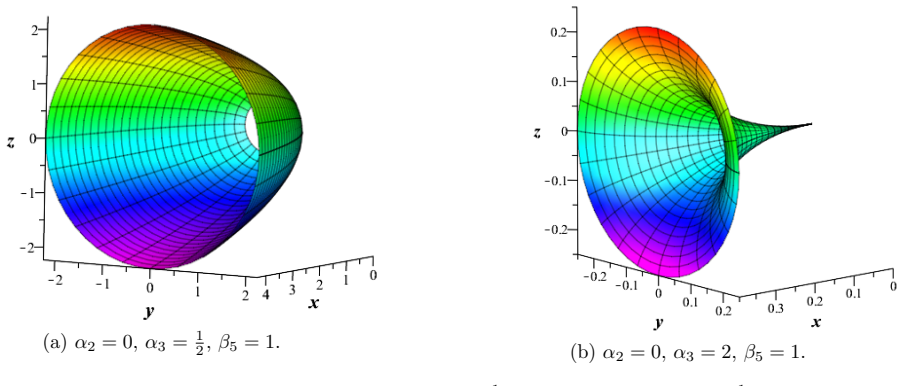
- [Figures and notation] Several figure captions use parameter names that do not match the surrounding text (e.g., Figure 2 lists α2, α3, β5 for the pseudosphere, whose derivation uses β3, β4; Figures 6 and 7 list β6=0 although β6>0). The sentence in §3.2.1 'where β4 and β4 are arbitrary constants' should read β3 and β4.
- [References] Reference [2] has a garbled author string, and reference [16], on which the equality claim depends, is a master's thesis that is not widely accessible; the relevant symmetry algebras from [16] should be reproduced or summarized in the manuscript.
Circularity Check
No significant circularity: the biharmonic symmetry classification is derived from an invariance condition, not from the harmonic results it compares against.
full rationale
The paper's derivation chain starts from the invariance criterion (9) and the claimed determining system e1–e14; no fitted parameter, target result, or harmonic-heat symmetry is used as an input to this computation. The abstract's equality claim is a comparison with [16], but [16] is cited as external prior work (including a coauthor's thesis), not as a premise in the derivation of the biharmonic generators. The admitted generators (e.g., X7 in (32)) are derived from the biharmonic determining equations and are not constructed to match [16]. The unshown reduction to e1–e14 is an omitted computational proof rather than a circular step. Similarly, the exact solutions in Section 4 are obtained by substituting explicit ansätze into reduced equations and solving; they are not fits of the quantities they purport to predict. Therefore, while the equality with the harmonic algebra and the completeness of the classification remain unverified (and the flat-cylinder scaling X7 appears inconsistent with the harmonic scaling), these are correctness/verification concerns, not cases where a claimed result is equivalent to its inputs by definition or by self-citation.
Assumptions & free parameters
free parameters (1)
- η =
β7^{-2} (η>0) or -β6^{-2} (η<0)
assumptions (4)
- standard math Classical Lie point symmetry algorithm and prolongation formulas are correct and applicable.
- domain assumption The surface is a regular surface of revolution with unit-speed profile and w=e^{f(x)}>0.
- domain assumption The biharmonic heat equation is ut = L^2u exactly as in (6).
- ad hoc to paper The system e1-e14 is a complete simplification of the invariance condition (9).
Cite this review
Pith. "Pith review of Lie point symmetries of the biharmonic heat equation on surfaces of revolution." pith.science (2026). https://pith.science/paper/H3XEPFPY
@misc{pith2026250600672,
  author       = {Pith},
  title        = {Pith review of: Lie point symmetries of the biharmonic heat equation on surfaces of revolution},
  year         = {2026},
  howpublished = {\url{https://pith.science/paper/H3XEPFPY}},
  note         = {Machine review of arXiv:2506.00672}
}
read the original abstract
This paper uses Lie symmetry analysis to investigate the biharmonic heat equation on a generalized surface of revolution. We classify the Lie point symmetries associated with this equation, allowing for the identification of surfaces and the corresponding infinitesimal generators. In a significant move, we demonstrate that the biharmonic heat equation on a surface of revolution admits the same Lie symmetries as the harmonic heat equation on the same surface, highlighting a profound structural relationship between the two equations. Utilizing these symmetry groups, we derive similarity reductions that yield invariant forms of the equation and facilitate the construction of exact solutions. Finally, we provide certain examples illustrating precise solutions on the related surfaces with positive, negative, and zero Gaussian curvatures, demonstrating the versatility of the approach. This work contributes to the understanding of biharmonic heat equations on symmetric surfaces.
Figures


Figures from the paper (5 more)


Reference graph
Works this paper leans on
-
[16]
K. Mpungu. Symmetry analysis of heat and wave equations on surfaces of revolution. Master’s thesis, King Fahd University of Petroleum and Minerals (Saudi Arabia), 2012
work page 2012
- [1]
-
[2]
A. A. S. A. A. N. R. N. M. M. O. A. A. A. A.F., Aljohani. Groundwater pollution equation: Lie’s symmetry analysis and numerical consideration. Partial Differential Equations in Applied Mathematics, 11:100861, 2023
work page 2023
-
[3]
H. Azad, M. Mustafa, and M. Ziad. Group classification, optimal system and optimal reductions of a class of klein gordon equations. Communications in Nonlinear Science and Numerical Simulation , 15(5):1132–1147, 2010
work page 2010
-
[4]
H. Azad and M. T. Mustafa. Symmetry analysis of wave equation on sphere. J. Math. Anal. Appl. , 333(2):1180–1188, 2007
work page 2007
-
[5]
G. K. Batchelor. An introduction to fluid dynamics . Cambridge university press, 2000
work page 2000
-
[6]
M. Bertalmio, G. Sapiro, V. Caselles, and C. Ballester. Image inpainting. In Proceedings of the 27th annual conference on Computer graphics and interactive techniques , pages 417–424, 2000
work page 2000
-
[7]
G. Bluman and S. Anco. Symmetry and integration methods for differential equations , volume 154. Springer Science & Business Media, 2008
work page 2008
Show all 26 references
-
[8]
J. G. David. Introduction to electrodynamics. Cambridge University Press, 2023
2023
-
[9]
M. C. Delfour and J.-P. Zol´ esio.Shapes and geometries: metrics, analysis, differential calculus, and optimization. SIAM, 2011
2011
-
[10]
J. D. Foley, A. Van Dam, S. K. Feiner, J. F. Hughes, and R. L. Phillips. Introduction to computer graphics, volume 55. Addison-Wesley Reading, 1994
1994
-
[11]
B. J. Hamrock, B. J. Schmid, and B. O. Jacobson. Fundamentals of fluid film lubrication , volume
-
[12]
N. H. Ibragimov. CRC handbook of Lie group analysis of differential equations , volume 3. CRC press, 1995
1995
-
[13]
Inoguchi et al
J.-I. Inoguchi et al. Biharmonic curves in minkowski 3-space. International Journal of Mathematics and Mathematical Sciences , 2003:1365–1368, 2003
2003
-
[14]
Y. F. Jicheng Yu. Lie symmetries, power series solutions and conservation laws of (2+1)-dimensional nonlinear fractional fokas system. Quantum Studies: Mathematics and Foundations , 12(1), 2025
2025
-
[15]
R. L. Mott. Machine elements in mechanical design . Pearson Educaci´ on, 2004
2004
-
[17]
Mpungu and M
K. Mpungu and M. N. Aminu. On complete group classification of time fractional systems evolution differential equation with a constant delay. Fundamental Journal of Mathematics and Applications , 6(1):12–23, 2023
2023
-
[18]
Mpungu and A
K. Mpungu and A. M. Nass. Symmetry analysis of time fractional convection-reaction-diffusion equation with a delay. Results in Nonlinear Analysis , 2(3):113–124. 19
-
[19]
A. M. Nass and K. Mpungu. Lie symmetry reductions and integrability of approximated small delay stochastic differential equations. Afrika Matematika , 32(1-2):199–209, 2021
2021
-
[20]
A. M. Nass, K. Mpungu, and R. I. Nuruddeen. Group classification of space-time fractional nonlinear poisson equation. Mathematical Communications, 24(2):221–233, 2019
2019
-
[21]
L. V. Ovsiannikov. Group analysis of differential equations . Academic press, 2014
2014
-
[22]
M. N. ¨Ozı¸ sık.Heat conduction. John Wiley & Sons, 1993
1993
-
[23]
R. C.-S. M.-P. Piu. Biharmonic curves on a surface. Rendiconti di Matematica, Serie VII, 21:143–157, 2001
2001
-
[24]
Timoshenko, S
S. Timoshenko, S. Woinowsky-Krieger, et al. Theory of plates and shells , volume 2. McGraw-hill New York, 1959
1959
-
[25]
D. L. Turcotte and G. Schubert. Geodynamics. Cambridge university press, 2002
2002
-
[26]
J. Y. Yapeng Shi, Yuqiang Feng. Lie symmetry analysis, optimal system, conservation laws, and exact solutions for the variable-coefficient higher-order boussinesq-burgers system. Modern Physics Letters A, 2550018, 2025. 20
2025
Reviewed August 7, 2026 · model on record in the stance chip above.
Discussion (0). Sign in to comment.