REVIEW 2 major objections 5 minor 52 references
On the oscillatory dynamics of a Saffman--Taylor finger with a bubble at its tip
T0 review · 2 major / 5 minor · reviewed 2026-08-07 · deepseek-v4-flash
Pith's one-line read The paper shows that a bubble-tipped Saffman-Taylor finger begins to oscillate exactly when the bubble's in-plane tip curvature drops to match the finger's tip curvature, because the equality removes the axial pressure gradient that had…
desk verdict A careful experimental mapping of finger-bubble oscillations with a convincing geometric criterion, but the proposed pressure mechanism needs stronger support. read the letter →
The pith
A machine-rendered reading of the paper's core claim, the machinery that carries it, and where it could break.
The reading
What carries the argument
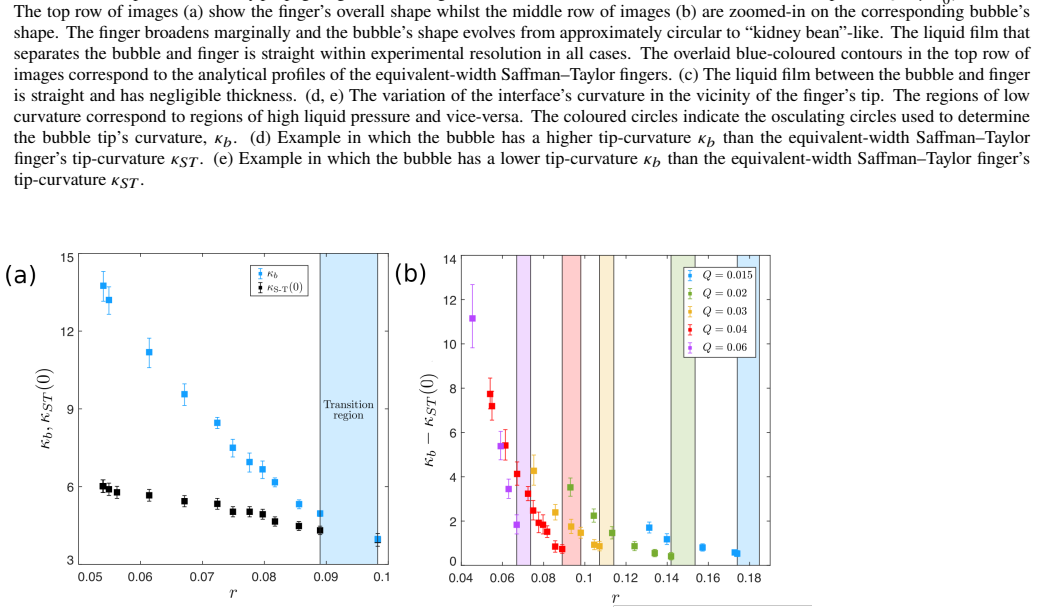
The load-bearing object is the equality of two in-plane curvatures, $\kappa_b = \kappa_{ST}(0;\lambda)$, where $\kappa_b$ is the curvature of the bubble tip (inverse radius of its osculating circle) and $\kappa_{ST}(0;\lambda)$ is the curvature at the tip of the equivalent-width Saffman-Taylor finger, given by $\kappa_{ST}(0;\lambda) = |(\lambda-1)\pi/(2\lambda^2)|$ from the analytical profile $x(y;\lambda) = F(\lambda)\pi^{-1}\ln((1+\cos(\pi y/\lambda))/2)$. The paper uses this equality as the empirical stability boundary: for smaller bubbles the bubble tip is more curved, a pressure minimum exists at the bubble tip, and the finger is stable; when the curvatures match, the axial pressure gradient across the bubble vanishes and lateral perturbations are no longer damped. The different restoral timescales of the finger and the bubble then convert the neutral lateral response into sustained oscillation, with the phase portrait in the $(y,\mathrm{d}y/\mathrm{d}t)$ plane indicating a supercritical Hopf bifurcation.
What would settle it
Measure or simulate the full three-dimensional film thickness above and below the finger and bubble as the bubble size, flow rate, and lateral displacement vary across the narrowing-to-oscillation transition; if the out-of-plane curvature changes measurably at the onset condition, or if a fully depth-resolved computation finds oscillations starting when the in-plane curvatures are clearly unequal, the curvature-equality criterion is not the causal mechanism.
Extended reading notes
Core claim
The central claim is that the steadily propagating narrowed finger loses stability when the in-plane curvature of the bubble's tip, $\kappa_b$, falls to equality with the in-plane curvature of the finger tip, $\kappa_{ST}(0;\lambda)$. The authors measure $\kappa_b$ from the osculating circle of the bubble tip and compute $\kappa_{ST}(0;\lambda)$ by differentiating the analytical Saffman-Taylor profile fitted to the finger. They find that this curvature equality holds at the onset of oscillation for every flow rate investigated. Their physical interpretation is that the bubble tip is the location of minimum pressure when it is more curved than the finger tip; that pressure minimum drives the finger forward and keeps it centred. Once the curvatures are equal, the axial pressure gradient across the bubble disappears, so a lateral displacement of the finger-bubble pair is no longer stabilised, and the different timescales on which the finger and bubble return to the centreline sustain a periodic oscillation.
Load-bearing premise
The argument assumes that the liquid films above and below the finger and bubble have constant thickness, so the out-of-plane curvature is constant and changes in fluid pressure can be read directly from the measured in-plane curvature of the interfaces.
Editorial extensions
If this is right
- At fixed flow rate, the critical bubble size for the onset of oscillations is set by a geometric condition rather than by a purely dynamical threshold, so the shape of the bubble tip can be used to predict stability.
- The two measured transition curves obey power-law scalings, $Q \sim r^{-3/2}$ for the narrowed-to-oscillatory transition and $Q \sim r^{-5/2}$ for the oscillatory-to-compound transition, indicating how the critical bubble radius shifts with flow rate.
- The phase portrait's closed loops are consistent with a supercritical Hopf bifurcation, so the steady narrowed finger loses stability at a critical pair of control parameters and a stable limit cycle emerges.
- The disordered meandering at high flow rates is attributed to transient exploration of unstable periodic states, so the same periodic states that are stable at lower flow rates may organise the irregular dynamics at higher flow rates.
- Because the liquid films play a negligible role, two-dimensional depth-averaged models should be sufficient to capture the finger-bubble instability, opening the way to direct numerical tests of the curvature criterion.
Reading between the lines
- The curvature-equality criterion may be generic: any localised tip perturbation that reduces the in-plane curvature of the tip (a rigid obstacle, a groove, an elastic wall) could trigger the same loss of axial pressure gradient and the same kind of oscillation.
- If the mechanism is correct, one testable extension is to impose a bubble of prescribed curvature (for example by changing bubble volume or channel depth) and predict the oscillation threshold a priori from the Saffman-Taylor tip curvature alone.
- The disordered-dynamics interpretation implies that unstable periodic orbits might be detected in experimental time series by recurrence or close-return analysis; finding such orbits in the unperturbed single-finger case would generalise the authors' hypothesis beyond bubble-perturbed fingers.
- A two-dimensional numerical model could compute the base-state finger and bubble shapes and locate the Hopf bifurcation; if the bifurcation point coincides with the curvature-equality condition to numerical precision, the geometric criterion becomes a predictive tool rather than a post hoc fit.
Editorial analysis
A structured set of objections, weighed in public.
Referee Report
Summary. The manuscript reports an experimental study of a Saffman–Taylor finger with a small air bubble placed at its tip in a Hele-Shaw channel. The authors systematically vary the dimensionless flow rate and bubble size across more than two hundred experiments and construct a phase diagram with three broad regimes: steadily propagating narrowed fingers, oscillatory fingers, and steadily propagating compound fingers, with disordered dynamics appearing at the highest flow rates. The central claim is that, at fixed flow rate, the onset of oscillations occurs when the in-plane curvature of the bubble tip becomes smaller than or equal to the in-plane curvature of the finger tip; the authors argue that this curvature equality removes the axial pressure gradient across the bubble and renders the finger susceptible to lateral perturbations, with sustained oscillations arising from different restoral timescales of the finger and bubble. The paper also presents scaling arguments for the transition boundaries and interprets the high-flow-rate disordered dynamics as transient exploration of unstable periodic states.
Significance. If the proposed curvature-matching criterion is correct, it provides a remarkably simple geometric condition for the onset of oscillations in a classical viscous-fingering system and may help connect periodic dynamics to disordered fingering through unstable periodic states. The strengths of the paper are its large, systematic experimental dataset; the carefully constructed phase diagram; the direct measurement of bubble and finger tip curvatures from images, with the criterion checked at five flow rates and reported transition bands; and the use of the analytical Saffman–Taylor finger shape for comparison. The criterion is falsifiable and could be tested in other fluids and geometries. However, the physical mechanism—that in-plane curvature equality implies a vanishing axial pressure gradient—rests on an unverified assumption about constant out-of-plane curvature at the bubble tip, and the paper provides no stability calculation or quantitative timescale analysis. The empirical part is strong, but the causal claim is not fully established.
major comments (2)
- [Section III B 1] The inference that equality of the in-plane tip curvatures removes the axial pressure gradient across the bubble rests on the assumption that the out-of-plane curvature is the same at the bubble tip and the finger tip. The support cited, the global mean film-thickness curve in Fig. 4 and the observation that 0.06 ≤ h ≤ 0.07 for Ca ∈ [0.09, 0.12], applies to the finger alone and does not establish the local meniscus geometry at the bubble tip, which is a confined cap separated from the finger by a thin film and may have a different out-of-plane contribution. If the out-of-plane curvatures differ, equal in-plane curvatures do not imply equal capillary pressures, so the proposed causal mechanism is not established. I recommend either providing direct (e.g., side-view) measurements of the out-of-plane curvature at both tips, or presenting the curvature equality as an empirical onset criterion and the pressure-gradient mechanism as a conjecture.
- [Section III B 1 and Section IV] The paper asserts that the vanishing axial pressure gradient renders the finger susceptible to lateral perturbations and that differing restoral timescales sustain oscillations, but no stability calculation, reduced model, or quantitative timescale estimate is provided. The data show a robust empirical correlation between the curvature crossing and the onset of oscillations at five flow rates, but they do not demonstrate that this geometric condition is the bifurcation point rather than a correlate of bubble size; the authors themselves note in Sec. III B 2 that "Precisely what sets this threshold is not clear" and in Sec. IV that the unstable-periodic-state interpretation is "purely speculative." A linear stability analysis of a two-dimensional model, or a quantitative test of the lateral response as a function of κ_b − κ_ST(0), would be needed to substantiate the causal mechanism.
minor comments (5)
- [Section III B and Fig. 12] The fitted power-law exponents for the two transition boundaries are not reported; please provide the exponents with uncertainties and residuals so the reader can judge the agreement with the proposed −3/2 and −5/2 scalings.
- [Section II B, Eq. (1)] The empirical film-thickness correlation is presented without uncertainty on the prefactor and exponent; a statement of the fitting range and confidence would be useful.
- [Section III B 1] There is a typo: "Saffman–Tayor" should be "Saffman–Taylor."
- [Fig. 10(e)] The phase portrait is shown for a single flow rate; please indicate whether the same qualitative picture is observed at other flow rates in which periodic oscillations occur.
- [General] The paper would benefit from a data-availability statement, as the full phase-diagram data and the Supplemental Material movies are described but not archived.
Circularity Check
No circularity: the curvature-onset criterion is measured directly from experiments and not constructed from fitted inputs or load-bearing self-citations.
full rationale
The central claim is an empirical geometric criterion for the onset of oscillations: the bubble-tip curvature, measured directly from images via an osculating circle, becomes equal to the equivalent-width Saffman-Taylor finger-tip curvature computed from Eq. (3) using the independently measured finger width. These two quantities are obtained separately and are not fitted to the observed transition; the transition regions in Fig. 15 are shaded between the last steady and first oscillatory data points, so the convergence is not imposed by construction. The finger-tip curvature is an analytic proxy (Eqs. 2-3) validated against experimental profiles in Fig. 5, so no parameter fitted to the onset is being renamed as a prediction. The scaling relations in Fig. 12 are explicitly presented as consistency checks, and the paper states that these scalings do not explain what sets the critical bubble radius, so they are not load-bearing for the mechanism. The pressure-gradient interpretation rests on the assumption that out-of-plane curvature is approximately constant because the liquid films are thin and nearly uniform; this is a physical approximation that could be challenged on correctness grounds, but it is not equivalent to the target result and is not imported through a self-citation. Self-citations to earlier work by the same group provide experimental context and apparatus details, while the central criterion is established by new data in the present paper. No step in the claimed derivation reduces by construction to its own inputs, so no circularity is found.
Assumptions & free parameters
free parameters (2)
- Power-law transition fit exponents and prefactors =
Q ~ r^{-1.5} and Q ~ r^{-2.5} as linear fits in Fig. 12
- Film-thickness correlation constants =
0.19 and 1.88 in Eq. (1)
assumptions (4)
- domain assumption Fluid pressure can be inferred from in-plane curvature because out-of-plane curvature is constant (constant thin-film thickness).
- domain assumption The analytical Saffman-Taylor/Pitts finger shape, Eq. (2), describes the finger interface behind the bubble.
- domain assumption Quasi-two-dimensional Hele-Shaw description with negligible inertial and three-dimensional effects for the oscillatory mechanism.
- domain assumption The thin liquid film between the finger and bubble persists without coalescence for Q >= 0.02, and its interface is flat.
Cite this review
Pith. "Pith review of On the oscillatory dynamics of a Saffman--Taylor finger with a bubble at its tip." pith.science (2026). https://pith.science/paper/QJ5CBSOF
@misc{pith2026250600761,
  author       = {Pith},
  title        = {Pith review of: On the oscillatory dynamics of a Saffman--Taylor finger with a bubble at its tip},
  year         = {2026},
  howpublished = {\url{https://pith.science/paper/QJ5CBSOF}},
  note         = {Machine review of arXiv:2506.00761}
}
read the original abstract
The complex behaviour of air-liquid interfaces driven into Hele-Shaw channels at high speeds could arise from oscillatory dynamics; yet, both the physical and dynamical mechanisms that lead to interfacial oscillations remain unclear. We extend the experiments by Couder \textit{et. al.} (\textit{Phys. Rev. A}, vol. 34, 1986, p. 5175) to present a systematic investigation of the dynamics that result when a small air bubble is placed at the tip of a steadily propagating air finger in a Hele-Shaw channel. The system can exhibit steady and oscillatory behaviour, and we show that these different behaviours each occur in well-defined regions of the phase space defined by flow rate and bubble size. For sufficiently large flow rates, periodic finger oscillations give way to disordered dynamics characterised by an irregular meandering of the finger's tip. We demonstrate that at a fixed flow rate, the oscillations commence when the bubble size is increased sufficiently so that the decreased in-plane curvature of the bubble tip matches the in-plane curvature of the finger tip. The equality between the two in-plane curvatures causes the axial pressure gradient across the bubble, which drives the finger, to vanish, thus rendering the finger susceptible to lateral perturbations. Differing timescales for finger and bubble restoral under perturbation allow sustained oscillations to develop in the finger-bubble system. The oscillations cease when the bubble is sufficiently large that it can act as the tip of a compound finger. The disordered dynamics at high flow rates are consistent with the transient exploration of unstable periodic states, which suggests that similar dynamics may underlie the observed disordered dynamics in viscous fingering.
Figures


Figures from the paper (15 more)




Reference graph
Works this paper leans on
-
[1]
The bubble’s size is parametrised in terms of a dimensionless radius 𝑟 = 2 √︁ 𝐴∗/𝜋/𝑊∗, where𝐴∗ is the projected area measured in-flow through image analysis, and we note that this differs from the stationary projected area due to three-dimensional (thin-film) and compressional effects [18]. B. The Saffman–Taylor finger The two plots in Fig. 3 show (a) the...
-
[2]
Steadily propagating fingers In Fig. 7 there are two simply connected regions, which we have coloured in green and blue, of steadily propagating fingers. The fingers in these two regions both propagate symmetrically about the channel’s centreline, but the fingers in the blue-coloured region, henceforth termed “steadily propagating narrowed”, are character...
-
[3]
Oscillating fingers For𝑄≤ 0.0125±0.0005, the system transitions directly between steadily propagating narrowed fingers and steadily propagating compound fingers. However, for higher flow rates, the two regions of steadily propagating fingers are separated by the region of intermediate sized bubbles, coloured red in Fig. 7, in which the finger’s tip oscill...
-
[4]
Relative finger width and dimensionless speed The two plots in Fig. 11 show the finger’s (a) relative width𝜆 =𝜆∗/𝑊∗ and (b) dimensionless speed𝑈 =𝑈∗/𝑈∗ 0 as functions of the bubble’s size at𝑄 =𝜇𝑈∗ 0/𝜎 = 0.04, and they are qualitatively representative of all investigated flow rates. As the bubble width increases, the finger width increases and the finger s...
-
[5]
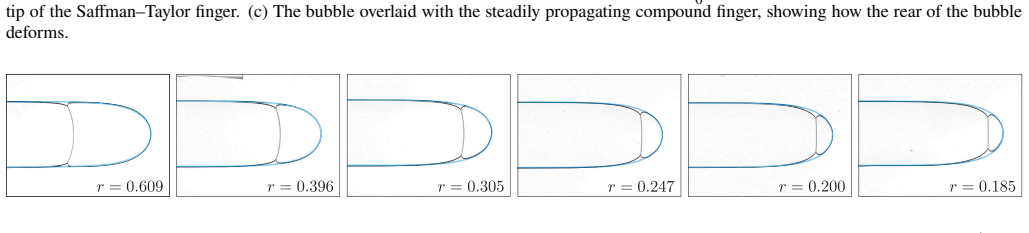
Narrowed to oscillatory transition We start with the steadily propagating fingers resulting from the smallest bubbles and increase the bubble’s size until the finger oscillates. The sequence of images in Fig. 14 show the steadily propagating narrowed fingers and enlargements of the corresponding bubble shapes as the bubble’s size increases at 𝑄 = 𝜇𝑈∗ 0/𝜎 ...
-
[6]
Oscillatory to compound transition We investigate the transition to oscillatory dynamics for larger bubbles by starting with the largest bubbles and progressively decreasing the bubble’s size until the finger oscillates, see Fig. 17. In the compound fingers, all bubbles adopt the shape of the tip of a single Saffman–Taylor finger. This means that the bubb...
-
[7]
Arn´eodo, A., Couder, Y., Grasseau, G., Hakim, V. & Rabaud, M.1989 Uncovering the analytical Saffman–Taylor finger in unstable viscous fingering and diffusion-limited aggregation. Phys. Rev. Lett. 63, 984–987. 16
work page 1989
-
[8]
Beeson-Jones, T. H. & Woods, A. W.2019 Evidence for a universal saturation profile for radial viscous fingers.Sci. Rep. 9, 7780
work page 2019
Show all 52 references
-
[9]
1986 Stability of viscous fingering
Bensimon, D. 1986 Stability of viscous fingering. Phys. Rev. A 33, 1302–1308
1986
-
[10]
& Nagel, S.2014 Fingering versus stability in the limit of zero interfacial tension
Bischofberger, I., Ramachandran, R. & Nagel, S.2014 Fingering versus stability in the limit of zero interfacial tension. Nat. Comm. 5, 5265
2014
-
[11]
B., Short, K
Budanur, N. B., Short, K. Y., Farazmand, M., Willis, A. P. & Cvitanovi ´c, P. 2017 Relative periodic orbits form the backbone of turbulent pipe flow. J. Fluid Mech. 833, 274–301
2017
-
[12]
Chen, Jing-Den 1989 Growth of radial viscous fingers in a Hele-Shaw cell. J. Fluid Mech. 201, 223–242
1989
-
[13]
Ben, Bonn, D
Chevalier, C., Amar, M. Ben, Bonn, D. & Lindner, A.2006 Inertial effects on Saffman–Taylor viscous fingering. J. Fluid Mech. 552, 83–97
2006
-
[14]
& Cl´ement, E
Chevalier, C., Lindner, A. & Cl´ement, E. 2007 Destabilization of a Saffman-Taylor fingerlike pattern in a granular suspension. Phys. Rev. Lett. 99, 174501
2007
-
[15]
& Dombre, T.1989 Selection in the anomalous Saffman-Taylor fingers induced by a bubble.Phys
Combescot, R. & Dombre, T.1989 Selection in the anomalous Saffman-Taylor fingers induced by a bubble.Phys. Rev. A39, 3525–3535
1989
-
[16]
2003 Viscous fingering as an archetype for growth patterns
Couder, Y. 2003 Viscous fingering as an archetype for growth patterns. In Perspectives in Fluid Dynamics: A Collective Introduction to Current Research (ed. G.K. Batchelor, H.K. Moffatt & M.G. Worster), chap. 2, pp. 53–98. Cambridge University Press
2003
-
[17]
& Rabaud, M
Couder, Y., G´erard, N. & Rabaud, M. 1986 Narrow fingers in the Saffman–Taylor instability.Phys. Rev. A 34 (6), 5175–5178
1986
-
[18]
& Juel, A
Cuttle, C., Pihler-Puzovi´c, D. & Juel, A. 2020 Dynamics of front propagation in a compliant channel. J. Fluid Mech. 886, A20
2020
-
[19]
& Gibson, J
Cvitanovi´c, P. & Gibson, J. F. 2010 Geometry of the turbulence in wall-bounded shear flows: periodic orbits. Phys. Scr 2010 (T142), 014007
2010
-
[20]
O., Alvarez-Lacalle, E., Carvalho, M
Dias, E. O., Alvarez-Lacalle, E., Carvalho, M. S. & Miranda, J. A. 2012 Minimization of viscous fluid fingering: A variational scheme for optimal flow rates. Phys. Rev. Lett. 109, 144502
2012
-
[21]
Duguet, Y., Pringle, C. C. T. & Kerswell, R. R.2008 Relative periodic orbits in transitional pipe flow.Phys. Fluids 20 (11), 114102
2008
-
[22]
& Schneider, T
Eckhardt, B., Faisst, H., Schmiegel, A. & Schneider, T. M.2008 Dynamical systems and the transition to turbulence in linearly stable shear flows. Proc. R. Soc. A 366 (1868), 1297–1315
2008
-
[23]
V., Cuttle, C., Pihler-Puzovi´c, D., Hazel, A
Fontana, J. V., Cuttle, C., Pihler-Puzovi´c, D., Hazel, A. L. & Juel, A.2024 Peeling fingers in an elastic Hele-Shaw channel.J. Fluid Mech. 985, A1
2024
-
[24]
S., Le Lay, G., Lemoult, G., Thompson, A
Gaillard, A., Keeler, J. S., Le Lay, G., Lemoult, G., Thompson, A. B., Hazel, A. L. & Juel, A.2021 The life and fate of a bubble in a geometrically perturbed Hele-Shaw channel. J. Fluid Mech. 914, A34
2021
-
[25]
P.J., McCue, S
Gardiner, B. P.J., McCue, S. W. & Moroney, T. J. 2015 Discrete families of Saffman–Taylor fingers with exotic shapes. Results in Physics 5, 103–104
2015
-
[26]
L., Pailha, M., Cox, S
Hazel, A. L., Pailha, M., Cox, S. J. & Juel, A. 2013 Multiple states of finger propagation in partially occluded tubes. Phys. Fluids 25 (6), 062106
2013
-
[27]
Hong, D. C. & Langer, J. S. 1987 Pattern selection and tip perturbations in the saffman-taylor problem. Phys. Rev. A 36, 2325–2332
1987
-
[28]
& Heil, M
Juel, A., Pihler-Puzovi´c, D. & Heil, M. 2018 Instabilities in blistering. Annu. Rev. Fluid Mech. 50, 691–714
2018
-
[29]
& van Veen, L.2012 The significance of simple invariant solutions in turbulent flows
Kawahara, G., Uhlmann, M. & van Veen, L.2012 The significance of simple invariant solutions in turbulent flows. Annu. Rev. Fluid Mech. 44 (1), 203–225
2012
-
[30]
& Juel, A
Keeler, J., Thompson, A., Lemoult, G., Hazel, A. & Juel, A. 2019 The influence of invariant solutions on the transient behaviour of an air bubble in a Hele-Shaw channel. Proc. R. Soc. A 475
2019
-
[31]
& Homsy, G
Kopf-Sill, Anne R. & Homsy, G. M. 1988 Nonlinear unstable viscous fingers in Hele–Shaw flows. I. Experiments. Phys. Fluids 31 (2), 242–249
1988
-
[32]
& Couder, Y
Lajeunesse, E. & Couder, Y. 2000 On the tip-splitting instability of viscous fingers. J. Fluid Mech. 419, 125–149
2000
-
[33]
Lawless, J., Hazel, A. L. & Juel, A. 2024 Periodic dynamics in viscous fingering. Proc. R. Soc. A 480, 20240164
2024
-
[34]
& Pihler-Puzovi´c’, D
Lawless, J., Juel, A. & Pihler-Puzovi´c’, D. 2025 Nonlinear dynamics of viscous fingering. Physica D 476, 134631
2025
-
[35]
S., Gaillard, A., Hazel, A
Lawless, J., Keeler, J. S., Gaillard, A., Hazel, A. L. & Juel, A. 2022 The unpredictable nature of bubble evolution. Sci. Rep. 12, 20752
2022
-
[36]
Mathiesen, J., Procaccia, I., Swinney, H. L. & Thrasher, M.2006 The universality class of diffusion-limited aggregation and viscous fingering. EPL 76, 257–263
2006
-
[37]
McCloud, K. V. & Maher, J. V.1995 Pattern selection in an anisotropic Hele-Shaw cell. Phys. Rev. E 51, 1184–1190
1995
-
[38]
& Jerome, J.2022 Bubble rise in a Hele-Shaw cell: bridging the gap between viscous and inertial regimes
Monnet, B., Madec, C., Vidal, V., Joubaud, S. & Jerome, J.2022 Bubble rise in a Hele-Shaw cell: bridging the gap between viscous and inertial regimes. J. Fluid Mech. 942, R3
2022
-
[39]
L., Glendinning, P
Pailha, M., Hazel, A. L., Glendinning, P. & Juel, A.2012 Oscillatory bubbles induced by geometrical constraint. Phys. Fluids 24 (2), 021702
2012
-
[40]
Park, C. W. & Homsy, G. M.1985 The instability of long fingers in Hele–Shaw flows.Phys. Fluids 28 (6), 1583–1585
1985
-
[41]
1981 Radial fingering in a Hele-Shaw cell
Paterson, L. 1981 Radial fingering in a Hele-Shaw cell. J. Fluid Mech. 113, 513–529
1981
-
[42]
1980 Penetration of fluid into a Hele–Shaw cell: the Saffman–Taylor experiment
Pitts, E. 1980 Penetration of fluid into a Hele–Shaw cell: the Saffman–Taylor experiment. J. Fluid Mech. 97 (1), 53–64
1980
-
[43]
& Gerard, N.1988 Dynamics and stability of anomalous Saffman–Taylor fingers
Rabaud, M., Couder, Y. & Gerard, N.1988 Dynamics and stability of anomalous Saffman–Taylor fingers. Phys. Rev. A 37, 935–947
1988
-
[44]
1982 The fingering problem in a Hele-Shaw cell
Romero, L. 1982 The fingering problem in a Hele-Shaw cell. PhD thesis, California Institute of Technology
1982
-
[45]
Saffman, P. G. & Taylor, G. I. 1958 The penetration of a fluid into a porous medium or Hele–Shaw cell containing a more viscous liquid. Proc. R. Soc. A. 245, 312 – 329
1958
-
[46]
Suri, B., Kageorge, L., Grigoriev, R. O. & Schatz, M. F.2020 Capturing turbulent dynamics and statistics in experiments with unstable periodic orbits. Phys. Rev. Lett. 125, 064501
2020
-
[47]
& Libchaber, A.1987 An experimental study of the Saffman-Taylor instability.J
Tabeling, P., Zocchi, G. & Libchaber, A.1987 An experimental study of the Saffman-Taylor instability.J. Fluid Mech. 177, 67–82
1987
-
[48]
& Couder, Y
Thom´e, H., Combescot, R. & Couder, Y. 1990 Controlling singularities in the complex plane: Experiments in real space. Phys. Rev. A 41, 5739–5742
1990
-
[49]
Vanden-Broeck, J.-M.1983 Fingers in a hele–shaw cell with surface tension. Phys. Fluids 26 (8), 2033–2034. 17
1983
-
[50]
& Liu, Z.H.1998 Study of the relationship between fractal dimension and viscosity ratio for viscous fingering with a modified dla model
Zhang, J.H. & Liu, Z.H.1998 Study of the relationship between fractal dimension and viscosity ratio for viscous fingering with a modified dla model. J. Petroleum Sci. Eng. 21 (1), 123–128
1998
-
[51]
Zheng, Zhong, Kim, Hyoungsoo & Stone, Howard A.2015 Controlling viscous fingering using time-dependent strategies. Phys. Rev. Lett. 115, 174501
2015
-
[52]
E., Libchaber, A
Zocchi, G., Shaw, B. E., Libchaber, A. & Kadanoff, L. P. 1987 Finger narrowing under local perturbations in the Saffman-Taylor problem. Phys. Rev. A 36, 1894–1900
1987
Reviewed August 7, 2026 · model on record in the stance chip above.
Discussion (0). Sign in to comment.