REVIEW 2 major objections 6 minor 1 cited by
VecFlow: A High-Performance Vector Data Management System for Filtered-Search on GPUs
T0 review · 2 major / 6 minor · reviewed 2026-08-07 · deepseek-v4-flash
Pith's one-line read VecFlow, a GPU vector search system, claims it can answer filtered approximate nearest neighbor queries at 5 million queries per second at 90% recall by indexing labels rather than only vectors.
desk verdict A solid, well-engineered GPU filtered-ANNS system with a genuinely new index design; the headline SIFT result is credible, but the recall metric needs clarification on sparse-label queries before the long-tail results can be trusted. read the letter →
The pith
A machine-rendered reading of the paper's core claim, the machinery that carries it, and where it could break.
The reading
What carries the argument
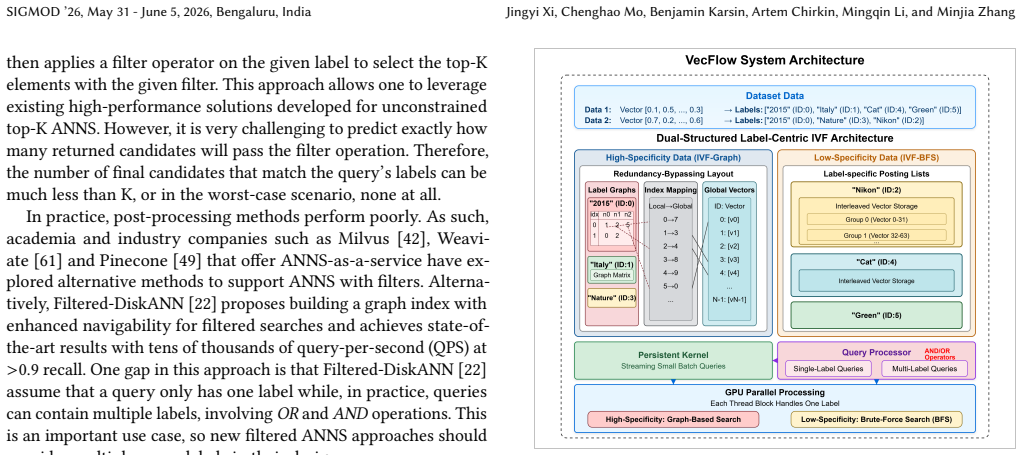
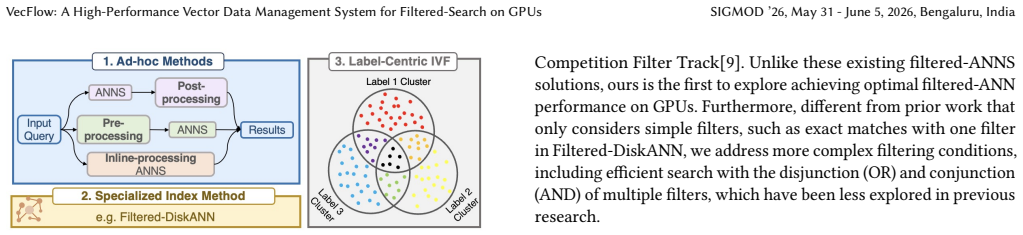
The load-bearing object is the dual-structured label-centric IVF index. For each label the index stores a posting list of data-point IDs; a specificity threshold T splits these lists into a high-specificity partition, searched with per-label CAGRA-style graphs, and a low-specificity partition, searched with brute-force scans. The high-specificity graphs are stitched into one compacted graph with a local-to-global ID mapping so that all labels share a single vector array rather than duplicating vectors; the low-specificity lists use an interleaved vector layout so warps issue coalesced 128-bit loads. A persistent kernel with atomic ring buffers carries small batches without repeated kernel launches, and a predicate function over per-point sorted label arrays verifies AND conditions during graph traversal and before brute-force distance computation.
What would settle it
Recompute the reported QPS-vs-recall curves using only queries whose filtered ground-truth set has at least K = 10 points, and separately report the fraction of queries excluded for having fewer matches. If VecFlow's 5M QPS at 90% recall on SIFT-1M or 2.6M on YFCC-10M depends on including queries with fewer than 10 valid answers, the comparison against Filtered-DiskANN and the GPU baselines is not apples-to-apples.
Extended reading notes
Core claim
On its own terms, VecFlow's discovery is that the long-tailed label distributions of real filtered-search workloads make a dual index more efficient than any single graph. Labels are classified by specificity, the fraction of the dataset carrying the label. High-specificity labels are searched through per-label GPU graphs that are compacted into one continuous graph and share a single global copy of the vectors, using a local-to-global mapping to eliminate replicated storage; low-specificity labels are searched by brute force over an interleaved memory layout that maximizes coalesced bandwidth. The paper reports 5M QPS at 90% recall on SIFT-1M, 2.6M QPS on YFCC-10M, about 3M QPS on DEEP-50M, and 150K QPS on WIKI-1M with AND predicates, and states that VecFlow can reach above 99% recall where CAGRA-based GPU baselines stop near 80%.
Load-bearing premise
The load-bearing premise is that the reported recall of 90% is well-defined for every query: the recall formula divides by K = 10, which assumes each query's filtered ground truth contains at least 10 matching points, yet the paper never states how queries with fewer than 10 filtered matches are counted or excluded on datasets like YFCC-10M with 200K labels and WIKI-1M AND queries.
Editorial extensions
If this is right
- Filtered approximate nearest neighbor search reaches million-query-per-second throughput on a single GPU for datasets up to tens of millions of vectors, a regime previously reserved for unconstrained search.
- Multi-label AND queries can be answered by searching the rarest label's posting list and verifying the remaining labels, so cost scales with the smallest matching class rather than the whole dataset.
- Small online batches become GPU-efficient because the persistent kernel removes per-batch launch overhead, which matters for interactive serving workloads.
- The redundancy-bypassing layout keeps index memory close to that of a single unfiltered graph even when points carry many labels, removing the main obstacle to label-centric IVF on memory-limited GPUs.
Reading between the lines
- The paper does not explore it, but if these throughput numbers generalize, filtered search could be fused into retrieval pipelines as a single GPU operator, replacing the common pre-filter-then-search cascade and removing the need to guess candidate list sizes.
- Not claimed by the paper: the specificity threshold T is effectively a tunable crossover point between graph traversal and brute force, and the same profiling-driven split might extend to other hardware or to dynamic label distributions.
- A natural stress test the paper does not run is K larger than 10 and streams of label updates, since the recall metric and static indexes are defined for fixed K and offline construction.
Editorial analysis
A structured set of objections, weighed in public.
Referee Report
Summary. VecFlow is a GPU-resident vector data management system for filtered approximate nearest neighbor search. The paper proposes a label-centric inverted-file index that separates labels into high-specificity and low-specificity groups, using a CAGRA-style graph index for the former and a brute-force scan with an interleaved memory layout for the latter. It adds a redundancy-bypassing layout to avoid replicating vectors across label-specific graphs, a persistent-kernel mechanism for small query batches, and specialized handling of multi-label OR/AND predicates. Experiments on SIFT-1M, YFCC-10M, WIKI-1M, and DEEP-50M report up to 5 million QPS at 90% recall on SIFT-1M, with claims of up to 135x speedup over Filtered-DiskANN and better recall than GPU-based CAGRA baselines.
Significance. If the results hold, VecFlow is an important contribution: it is one of the first systems to make filtered ANNS practical at million-query-per-second scale on GPUs, and it directly addresses a workload that CPU-oriented systems such as Filtered-DiskANN handle poorly. The paper is unusually complete in its system-oriented contributions: an open-source implementation is promised, the index layout and kernels are described in sufficient detail to be reproducible, and the evaluation covers multiple datasets, multiple GPUs, small-batch latency, memory footprint, and index construction time. The central algorithmic idea of separating high- and low-specificity labels and choosing graph search versus brute-force scan on that basis is well motivated and supported by the ablation in Fig. 4 and Fig. 15. However, the recall metric used for the headline QPS claims is not well-defined for queries whose filtered ground truth contains fewer than K points, and this ambiguity affects the YFCC and WIKI results that are needed to demonstrate the long-tail regime the paper motivates.
major comments (2)
- [§3, Eq. (1); §5.2] Eq. (1) defines recall as |A_topK ∩ GT_topK| / K, which assumes every query's filtered ground-truth set has exactly K elements. The manuscript never states how queries whose label set has fewer than K matching points are handled, although such queries are inevitable in the evaluated workloads: YFCC-10M has 200K labels with mean posting-list size 540 (§4.2.4), and §5.2 explicitly says that WIKI-1M two-label intersections are 'extremely small' and that the CAGRA baselines return 'nearly 0 recall' for them. If such queries are included in the average, the maximum achievable recall is |GT_topK|/K < 1, so a reported 90% recall is mathematically impossible unless the evaluation drops or pads these queries; if it drops or pads them, the query workload changes and the QPS comparison against Filtered-DiskANN, IVF2, FAISS, and CAGRA is not apples-to-apples. The paper must specify the exact policy for degenerate queries (drop, pad, or cap the denominator at |GT_topK|), apply the same policy to all baselines, and report the fraction of affected queries per dataset.
- [§5.2, Fig. 15] The headline QPS figures are obtained after selecting the specificity threshold T (e.g., T=2000 in §5.2) and the CAGRA itopk per dataset, but the manuscript does not report the tuning procedure, the grid searched, or any measure of run-to-run variance. Fig. 15 shows that QPS on YFCC varies substantially with T, so the reader cannot tell whether the reported 5M QPS at 90% recall is a best-case value selected after tuning or a representative operating point. Please report the tuning protocol (e.g., grid ranges, selection criterion) and state whether the reported numbers are best-of-N, median, or mean over multiple runs, ideally with error bars on the QPS-vs-recall curves.
minor comments (6)
- [§4.2.4] The memory analysis uses 'GB' for what appear to be binary gibibytes (GiB), which makes the example numbers confusing (76.8 GB appears as 71.53). Please use consistent units throughout.
- [§5.2, Fig. 9] The curves for CAGRA-Post and CAGRA-Inline are difficult to distinguish in grayscale; consider using distinct markers or line styles to improve readability.
- [§5.1, §5.2] The paper states that experiments run on A100 and GH200, and Fig. 17 reports GH200, but it is not stated explicitly that all other figures use the A100 40GB GPU. Please state this in the testbed description.
- [§5.2] The WIKI-1M paragraph says FAISS 'achieves high recall by performing BFS for almost every query' while the CAGRA methods 'achieve nearly 0 recall'; providing the actual recall values or curve endpoints would make the comparison more concrete.
- [References] Reference [8] lacks a publication year and venue; please complete the citation.
- [§4.2.3] The phrase 'avoid synchronization at all costs' should be 'avoid synchronization overhead' to be precise.
Circularity Check
No circularity found: VecFlow's QPS and recall are measured against brute-force ground truth and external baselines; tunable parameters are standard hyperparameter selection, not fitted predictions.
full rationale
I found no circular step in VecFlow's derivation chain. The headline QPS@90% recall figures are empirical results computed against exact brute-force ground truth (Eq. 1) and compared with independent baselines (Filtered-DiskANN, FAISS, IVF2, CAGRA variants); recall is not derived from a fitted parameter. The specificity threshold T of Eq. 2 is an auto-tuned routing hyperparameter (Sec. 4.1.2, 'determined through offline profiling ... and auto-tuning'), and Fig. 15 shows performance as T varies; tuning T to maximize throughput is standard hyperparameter selection, not a construction that forces the reported recall. CAGRA and cuVS are used as both building blocks and baselines, but they are external, code-reproducible implementations, and the NVIDIA affiliation of some co-authors does not make the evaluation circular. The one flagged concern is a correctness/comparability issue rather than circularity: Eq. 1 divides by K and assumes every query has exactly K filtered ground-truth neighbors, but the paper never states how YFCC/WIKI queries with fewer than K matches are handled, which can affect whether the reported 90% recall is well-defined; this does not reduce the system's claimed performance to its inputs.
Assumptions & free parameters
free parameters (3)
- Specificity threshold T =
2000
- CAGRA itopk (search width) =
varying (e.g., 32 default)
- Graph out-degree R' =
16
assumptions (3)
- domain assumption Label distributions in real filtered-ANNS workloads are long-tailed (few frequent, many rare labels).
- domain assumption A graph index's traversal overhead (CAGRA) makes it less efficient than brute-force for posting lists below size T.
- ad hoc to paper The filtered ground-truth set for every evaluated query contains at least K=10 points.
Cite this review
Pith. "Pith review of VecFlow: A High-Performance Vector Data Management System for Filtered-Search on GPUs." pith.science (2026). https://pith.science/paper/7TCDNWXJ
@misc{pith2026250600812,
  author       = {Pith},
  title        = {Pith review of: VecFlow: A High-Performance Vector Data Management System for Filtered-Search on GPUs},
  year         = {2026},
  howpublished = {\url{https://pith.science/paper/7TCDNWXJ}},
  note         = {Machine review of arXiv:2506.00812}
}
read the original abstract
Vector search and database systems have become a keystone component in many AI applications. While many prior research has investigated how to accelerate the performance of generic vector search, emerging AI applications require running more sophisticated vector queries efficiently, such as vector search with attribute filters. Unfortunately, recent filtered-ANNS solutions are primarily designed for CPUs, with few exploration and limited performance of filtered-ANNS that take advantage of the massive parallelism offered by GPUs. In this paper, we present VecFlow, a novel high-performance vector filtered search system that achieves unprecedented high throughput and recall while obtaining low latency for filtered-ANNS on GPUs. We propose a novel label-centric indexing and search algorithm that significantly improves the selectivity of ANNS with filters. In addition to algorithmic level optimization, we provide architectural-aware optimization for VecFlow's functional modules, effectively supporting both small batch and large batch queries, and single-label and multi-label query processing. Experimental results on NVIDIA A100 GPU over several public available datasets validate that VecFlow achieves 5 million QPS for recall 90%, outperforming state-of-the-art CPU-based solutions such as Filtered-DiskANN by up to 135 times. Alternatively, VecFlow can easily extend its support to high recall 99% regime, whereas strong GPU-based baselines plateau at around 80% recall. The source code is available at https://github.com/Supercomputing-System-AI-Lab/VecFlow.
Figures

Figures from the paper (12 more)


Forward citations
Cited by 1 Pith paper
-
ANNLib: A Development Framework for Efficient Approximate Nearest Neighbor Search
A modular ANNS framework decouples search algorithms from graph storage, delivering filtered search, dynamic updates, and snapshot queries at performance close to that of specialized systems.
Reference graph
Works this paper leans on
-
[1]
pgvector: Open-source vector similarity search for Postgres
Accessed: 04-13-2025. pgvector: Open-source vector similarity search for Postgres. https://github.com/pgvector/pgvector
work page 2025
-
[2]
RAPIDS AI. 2025. cuVS. https://github.com/rapidsai/cuvs. Accessed: 2025-01-18
work page 2025
-
[3]
Bruce Croft
Mohammad Aliannejadi, Hamed Zamani, Fabio Crestani, and W. Bruce Croft
-
[4]
Alexandr Andoni, Piotr Indyk, and Ilya Razenshteyn. 2018. Approximate Nearest Neighbor Search in High Dimensions. arXiv preprint arXiv:1806.09823 (2018)
arXiv 2018
-
[5]
Norbert Beckmann, Hans-Peter Kriegel, Ralf Schneider, and Bernhard Seeger
-
[6]
Ben Landrum and Magdalen Dobson Manohar and Mazin Karjikar and Lax- man Dhulipala . 2024. IVF2: Fusing Classic and Spatial Inverted Indices for Fast Filtered ANNS. https://big-ann-benchmarks .com/neurips23_slides/ IVF_2_filter_Ben.pdf
work page 2024
-
[7]
Jon Louis Bentley. 1975. Multidimensional Binary Search Trees Used for Associa- tive Searching. Commun. ACM 18, 9 (Sept. 1975), 509–517
work page 1975
-
[8]
Philip A Bernstein, Siddharth Gollapudi, Suryansh Gupta, Ravishankar Krish- naswamy, Sepideh Mahabadi, Sandeep Silwal, Gopal R Srinivasa, Varun Suriya- narayana, Jakub Tarnawski, Haiyang Xu, et al. [n. d.]. Graph-based algorithms for nearest neighbor search with multiple filters. ([n. d.])
Show all 76 references
-
[9]
Big-ANN. [n. d.]. NeurIPS’23 Competition Track: Big-ANN. https://big-ann- benchmarks.com/neurips23.html. Accessed: 2024
2024
-
[10]
Cheng Chen, Chenzhe Jin, Yunan Zhang, Sasha Podolsky, Chun Wu, Szu-Po Wang, Eric Hanson, Zhou Sun, Robert Walzer, and Jianguo Wang. 2024. SingleStore-V: An Integrated Vector Database System in SingleStore. Proc. VLDB Endow. 17, 12 (Aug. 2024), 3772–3785. https://doi .org/10.14...
2024
-
[11]
Qi Chen, Haidong Wang, Mingqin Li, Gang Ren, Scarlett Li, Jeffery Zhu, Jason Li, Chuanjie Liu, Lintao Zhang, and Jingdong Wang. 2018. SPTAG: A library for fast approximate nearest neighbor search . https://github .com/Microsoft/SPTAG
2018
-
[12]
Wei Chen, Jincai Chen, Fuhao Zou, Yuan-Fang Li, Ping Lu, Qiang Wang, and Wei Zhao. 2019. Vector and line quantization for billion-scale similarity search on GPUs. Future Gener. Comput. Syst. 99 (2019), 295–307
2019
-
[13]
Muthukrishnan
Graham Cormode and S. Muthukrishnan. 2005. An improved data stream sum- mary: the count-min sketch and its applications. Journal of Algorithms 55, 1 (2005), 58–75. https://doi .org/10.1016/j.jalgor.2003.12.001
2005 doi
-
[14]
Bruce Croft
Mostafa Dehghani, Hamed Zamani, Aliaksei Severyn, Jaap Kamps, and W. Bruce Croft. 2017. Neural Ranking Models with Weak Supervision. InSIGIR 2017. 65–74
2017
-
[15]
Wei Dong, Charikar Moses, and Kai Li. 2011. Efficient k-nearest neighbor graph construction for generic similarity measures. In Proceedings of the 20th International Conference on World Wide Web (Hyderabad, India) (WWW ’11) . Association for Computing Machinery, New York, NY, ...
2011
- [16]
-
[17]
Jian Fang, Yvo TB Mulder, Jan Hidders, Jinho Lee, and H Peter Hofstee. 2020. In-memory database acceleration on FPGAs: a survey. The VLDB Journal 29 (2020), 33–59
2020
-
[18]
Cong Fu, Chao Xiang, Changxu Wang, and Deng Cai. 2019. Fast Approximate Nearest Neighbor Search with the Navigating Spreading-out Graph. In VLDB’19
2019
-
[19]
Gibbons, Yossi Matias, and Avi Silberschatz
Sumit Ganguly, Phillip B. Gibbons, Yossi Matias, and Avi Silberschatz. 1996. Bifocal sampling for skew-resistant join size estimation. SIGMOD Rec. 25, 2 (June 1996), 271–281. https://doi .org/10.1145/235968.233340
1996
-
[20]
Tiezheng Ge, Kaiming He, Qifa Ke, and Jian Sun. 2013. Optimized Product Quantization for Approximate Nearest Neighbor Search. In CVPR 2013
2013
-
[21]
Aristides Gionis, Piotr Indyk, and Rajeev Motwani. 1999. Similarity Search in High Dimensions via Hashing. In VLDB’99. 518–529
1999
-
[22]
Siddharth Gollapudi, Neel Karia, Varun Sivashankar, Ravishankar Krishnaswamy, Nikit Begwani, Swapnil Raz, Yiyong Lin, Yin Zhang, Neelam Mahapatro, Premku- mar Srinivasan, et al. 2023. Filtered-diskann: Graph algorithms for approximate nearest neighbor search with filters. In P...
2023
-
[23]
Google. 2022. Go beyond the search box: Introducing multisearch. https:// blog.google/products/search/multisearch/. Accessed: 2025
2022
-
[24]
Fabian Groh, Lukas Ruppert, Patrick Wieschollek, and Hendrik P. A. Lensch
-
[25]
Bruce Croft
Jiafeng Guo, Yixing Fan, Qingyao Ai, and W. Bruce Croft. 2016. A Deep Relevance Matching Model for Ad-hoc Retrieval. In CIKM 2016. 55–64
2016
-
[26]
Neha Gupta. 2021. Introduction to hardware accelerator systems for artificial intelligence and machine learning. In Advances in Computers. Vol. 122. Elsevier, 1–21
2021
-
[27]
Po-Sen Huang, Xiaodong He, Jianfeng Gao, Li Deng, Alex Acero, and Larry Heck. 2013. Learning deep structured semantic models for web search using clickthrough data. In CIKM ’13. 2333–2338
2013
-
[28]
HuggingFace. 2025. WikiANN dataset. https://huggingface.co/2024annonymous/ wiki-ann
2025
-
[29]
Suhas Jayaram Subramanya, Fnu Devvrit, Harsha Vardhan Simhadri, Ravishankar Krishnawamy, and Rohan Kadekodi. 2019. Diskann: Fast accurate billion-point nearest neighbor search on a single node. Advances in Neural Information Pro- cessing Systems 32 (2019)
2019
-
[30]
Herve Jegou, Matthijs Douze, and Cordelia Schmid. 2011. In Product Quantization for Nearest Neighbor Search. TPAMI 2011
2011
-
[31]
Jeff Johnson, Matthijs Douze, and Hervé Jégou. 2017. Billion-scale similarity search with GPUs. CoRR abs/1702.08734 (2017). arXiv: http://arxiv .org/abs/ 1702.08734
2017 arXiv
-
[32]
Avrithis
Yannis Kalantidis and Yannis S. Avrithis. 2014. Locally Optimized Product Quan- tization for Approximate Nearest Neighbor Search. In CVPR 2014. 2329–2336
2014
-
[33]
Aditya Kanade, Petros Maniatis, Gogul Balakrishnan, and Kensen Shi. 2020. Learning and Evaluating Contextual Embedding of Source Code. In Proceedings of the 37th International Conference on Machine Learning, ICML 2020, 13-18 July 2020, Virtual Event (Proceedings of Machine Lea...
2020
-
[34]
Victor Lempitsky. 2012. The Inverted Multi-index. In CVPR ’12. 3069–3076
2012
-
[35]
Patrick Lewis, Ethan Perez, Aleksandra Piktus, Fabio Petroni, Vladimir Karpukhin, Naman Goyal, Heinrich Küttler, Mike Lewis, Wen-tau Yih, Tim Rocktäschel, Sebastian Riedel, and Douwe Kiela. 2020. Retrieval-augmented generation for knowledge-intensive NLP tasks. InProceedings o...
2020
-
[36]
Junnan Li, Dongxu Li, Caiming Xiong, and Steven C. H. Hoi. 2022. BLIP: Bootstrap- ping Language-Image Pre-training for Unified Vision-Language Understanding and Generation. In International Conference on Machine Learning, ICML 2022, 17- 23 July 2022, Baltimore, Maryland, USA (...
2022
-
[37]
Wen Li, Ying Zhang, Yifang Sun, Wei Wang, Mingjie Li, Wenjie Zhang, and Xuemin Lin. 2020. Approximate Nearest Neighbor Search on High Dimensional Data – Experiments, Analyses, and Improvement. IEEE Transactions on Knowl- edge and Data Engineering 32, 8 (2020), 1475–1488. https...
2020
-
[38]
Yinhan Liu, Myle Ott, Naman Goyal, Jingfei Du, Mandar Joshi, Danqi Chen, Omer Levy, Mike Lewis, Luke Zettlemoyer, and Veselin Stoyanov. 2019. RoBERTa: A Robustly Optimized BERT Pretraining Approach. CoRR abs/1907.11692 (2019)
2019 arXiv
-
[39]
LongChain. [n. d.]. LongChain: Build context-aware reasoning applications. https://github.com/langchain-ai/langchain. Accessed: 2025
2025
-
[40]
Malkov and D
Yury A. Malkov and D. A. Yashunin. 2016. Efficient and robust approximate nearest neighbor search using Hierarchical Navigable Small World graphs. CoRR arXiv preprint abs/1603.09320 (2016)
2016 arXiv
-
[41]
Corrado, and Jeffrey Dean
Tomas Mikolov, Ilya Sutskever, Kai Chen, Gregory S. Corrado, and Jeffrey Dean
-
[42]
Milvus-io. 2022. Milvus-docs: Conduct a hybrid search. https://github .com/ milvus-io/milvus-docs/blob/v2.1.x/site/en/userGuide/search/hybridsearch.md. Accessed: 2025
2022
-
[43]
Bhaskar Mitra, Fernando Diaz, and Nick Craswell. 2017. Learning to Match using Local and Distributed Representations of Text for Web Search. InWWW 2017
2017
-
[44]
Marius Muja and David G. Lowe. 2014. Scalable Nearest Neighbor Algorithms for High Dimensional Data. TPAMI 2014 36, 11 (2014), 2227–2240
2014
-
[45]
Mohammad Norouzi and David J. Fleet. 2013. Cartesian K-Means. In CVPR 2013
2013
-
[46]
Nolet, Ray Wang, Tamas B
Hiroyuki Ootomo, Akira Naruse, Corey J. Nolet, Ray Wang, Tamas B. Fehér, and Y. Wang. 2023. CAGRA: Highly Parallel Graph Construction and Approximate Nearest Neighbor Search for GPUs. 2024 IEEE 40th International Conference on Data Engineering (ICDE) (2023), 4236–4247
2023
-
[47]
James Jie Pan, Jianguo Wang, and Guoliang Li. 2024. Survey of vector database management systems. VLDB J. 33, 5 (2024), 1591–1615
2024
-
[48]
Liana Patel, Peter Kraft, Carlos Guestrin, and Matei Zaharia. 2024. ACORN: Per- formant and Predicate-Agnostic Search Over Vector Embeddings and Structured Data. Proc. ACM Manag. Data 2, 3 (2024), 120
2024
-
[49]
Pinecone Systems
Inc. Pinecone Systems. 2024. Overview. https://docs.pinecone.io/docs/overview. Accessed: 2025
2024
-
[50]
Alec Radford, Jong Wook Kim, Chris Hallacy, Aditya Ramesh, Gabriel Goh, Sandhini Agarwal, Girish Sastry, Amanda Askell, Pamela Mishkin, Jack Clark, Gretchen Krueger, and Ilya Sutskever. 2021. Learning Transferable Visual Models From Natural Language Supervision. In Proceedings...
2021
-
[51]
Jie Ren, Minjia Zhang, and Dong Li. 2020. HM-ANN: Efficient Billion-Point Nearest Neighbor Search on Heterogeneous Memory. In Advances in Neural Information Processing Systems 33: Annual Conference on Neural Information Processing Systems 2020, NeurIPS 2020, December 6-12, 202...
2020
-
[52]
Harshit Sharma and Anmol Sharma. 2024. A Comprehensive Overview of GPU Accelerated Databases. arXiv preprint arXiv:2406.13831 (2024)
2024 arXiv
-
[53]
Harsha Simhadri. 2025. Big ANN Benchmarks. https://github .com/harsha- simhadri/big-ann-benchmarks. Accessed: 2025-01-18
2025
-
[54]
Harsha Vardhan Simhadri, Martin Aumüller, Amir Ingber, Matthijs Douze, George Williams, Magdalen Dobson Manohar, Dmitry Baranchuk, Edo Liberty, Frank Liu, Ben Landrum, et al. 2024. Results of the Big ANN: NeurIPS’23 competition. arXiv preprint arXiv:2409.17424 (2024)
2024 arXiv
-
[55]
Aditi Singh, Suhas Jayaram Subramanya, Ravishankar Krishnaswamy, and Har- sha Vardhan Simhadri. 2021. FreshDiskANN: A Fast and Accurate Graph-Based ANN Index for Streaming Similarity Search. CoRR abs/2105.09613 (2021)
2021 arXiv
-
[56]
Shamma, Gerald Friedland, Benjamin Elizalde, Karl Ni, Douglas Poland, Damian Borth, and Li-Jia Li
Bart Thomee, David A. Shamma, Gerald Friedland, Benjamin Elizalde, Karl Ni, Douglas Poland, Damian Borth, and Li-Jia Li. 2016. YFCC100M: the new data in multimedia research. Commun. ACM 59, 2 (2016), 64–73
2016
-
[57]
Karthik V., Saim Khan, Somesh Singh, Harsha Vardhan Simhadri, and Jyothi Vedurada. 2024. BANG: Billion-Scale Approximate Nearest Neighbor Search using a Single GPU. arXiv: [cs.DC] https://arxiv .org/abs/2401.11324
2024 arXiv
-
[58]
Christophe Van Gysel, Maarten de Rijke, and Evangelos Kanoulas. 2016. Learning Latent Vector Spaces for Product Search. In CIKM ’16. 165–174
2016
-
[59]
Mengzhao Wang, Lingwei Lv, Xiaoliang Xu, Yuxiang Wang, Qiang Yue, and Jiongkang Ni. 2023. An Efficient and Robust Framework for Approximate Nearest Neighbor Search with Attribute Constraint. In Advances in Neural Information Processing Systems 36: Annual Conference on Neural I...
2023
-
[60]
Mengzhao Wang, Xiaoliang Xu, Qiang Yue, and Yuxiang Wang. 2021. A com- prehensive survey and experimental comparison of graph-based approximate nearest neighbor search. arXiv preprint arXiv:2101.12631 (2021)
2021 arXiv
-
[61]
Weaviate. 2022. Weaviate Documentation: Filters. https://weaviate.io/developers/ weaviate/current/graphql-references/filters.html. Accessed: 2025
2022
-
[62]
Chuangxian Wei, Bin Wu, Sheng Wang, Renjie Lou, Chaoqun Zhan, Feifei Li, and Yuanzhe Cai. 2020. AnalyticDB-V: a hybrid analytical engine towards query fusion for structured and unstructured data.Proc. VLDB Endow. 13, 12 (Aug. 2020), 3152–3165. https://doi .org/10.14778/3415478.3415541
2020
-
[63]
Wen Yang, Tao Li, Gai Fang, and Hong Wei. 2020. PASE: PostgreSQL Ultra-High- Dimensional Approximate Nearest Neighbor Search Extension. In Proceedings of the 2020 ACM SIGMOD International Conference on Management of Data (Portland, OR, USA) (SIGMOD ’20). Association for Comput...
2020
-
[64]
Lei Yu, Karl Moritz Hermann, Phil Blunsom, and Stephen Pulman. 2014. Deep Learning for Answer Sentence Selection. CoRR abs/1412.1632 (2014)
2014 arXiv
-
[65]
Yuanhang Yu, Dong Wen, Ying Zhang, Lu Qin, Wenjie Zhang, and Xuemin Lin
-
[66]
Hamed Zamani, Bhaskar Mitra, Xia Song, Nick Craswell, and Saurabh Tiwary
-
[67]
Qianxi Zhang, Shuotao Xu, Qi Chen, Guoxin Sui, Jiadong Xie, Zhizhen Cai, Yaoqi Chen, Yinxuan He, Yuqing Yang, Fan Yang, Mao Yang, and Lidong Zhou
-
[68]
Zili Zhang, Fangyue Liu, Gang Huang, Xuanzhe Liu, and Xin Jin. 2024. Fast Vector Query Processing for Large Datasets Beyond{GPU} Memory with Re- ordered Pipelining. In 21st USENIX Symposium on Networked Systems Design and Implementation (NSDI 24). 23–40
2024
-
[69]
Weijie Zhao, Shulong Tan, and Ping Li. 2020. SONG: Approximate Nearest Neigh- bor Search on GPU. In 36th IEEE International Conference on Data Engineering, ICDE 2020, Dallas, TX, USA, April 20-24, 2020 . IEEE, 1033–1044
2020
-
[72]
In WSDM ’18
Neural Ranking Models with Multiple Document Fields. In WSDM ’18
-
[74]
In 17th USENIX Symposium on Operating Systems Design and Implementation (OSDI 23)
VBASE: Unifying Online Vector Similarity Search and Relational Queries via Relaxed Monotonicity. In 17th USENIX Symposium on Operating Systems Design and Implementation (OSDI 23). USENIX Association, Boston, MA, 377–395. https://www.usenix.org/conference/osdi23/presentation/zh...
-
[1990]
In SIGMOD 1990
The R*-Tree: An Efficient and Robust Access Method for Points and Rect- angles. In SIGMOD 1990. 322–331
1990
-
[2013]
In Advances in Neural Information Processing Systems 26: 27th Annual Conference on Neural Information Processing Systems 2013
Distributed Representations of Words and Phrases and their Composi- tionality. In Advances in Neural Information Processing Systems 26: 27th Annual Conference on Neural Information Processing Systems 2013 . 3111–3119
2013
-
[2018]
In SIGIR 2018
Target Apps Selection: Towards a Unified Search Framework for Mobile Devices. In SIGIR 2018. 215–224
2018
-
[2022]
In 38th IEEE International Conference on Data Engineering, ICDE 2022, Kuala Lumpur, Malaysia, May 9-12, 2022
GPU-accelerated Proximity Graph Approximate Nearest Neighbor Search and Construction. In 38th IEEE International Conference on Data Engineering, ICDE 2022, Kuala Lumpur, Malaysia, May 9-12, 2022 . IEEE, 552–564
2022
-
[2023]
IEEE Transactions on Big Data 9, 1 (2023), 267–279
GGNN: Graph-Based GPU Nearest Neighbor Search. IEEE Transactions on Big Data 9, 1 (2023), 267–279. https://doi .org/10.1109/TBDATA.2022.3161156
2023
Reviewed August 7, 2026 · model on record in the stance chip above.
Discussion (0). Sign in to comment.