REVIEW 3 major objections 4 minor 42 references
Multiple-order differential imaging based on two types of topological singularity in one dimensional photonic crystals
T0 review · 3 major / 4 minor · reviewed 2026-08-07 · deepseek-v4-flash
Pith's one-line read One crystal delivers first- to fourth-order optical differentiation by exploiting the topological singularities of a 1D photonic crystal.
desk verdict The normal-incidence higher-order claims don't match the paper's own transfer function; the oblique-incidence results are the part worth taking seriously. read the letter →
The pith
A machine-rendered reading of the paper's core claim, the machinery that carries it, and where it could break.
The reading
What carries the argument
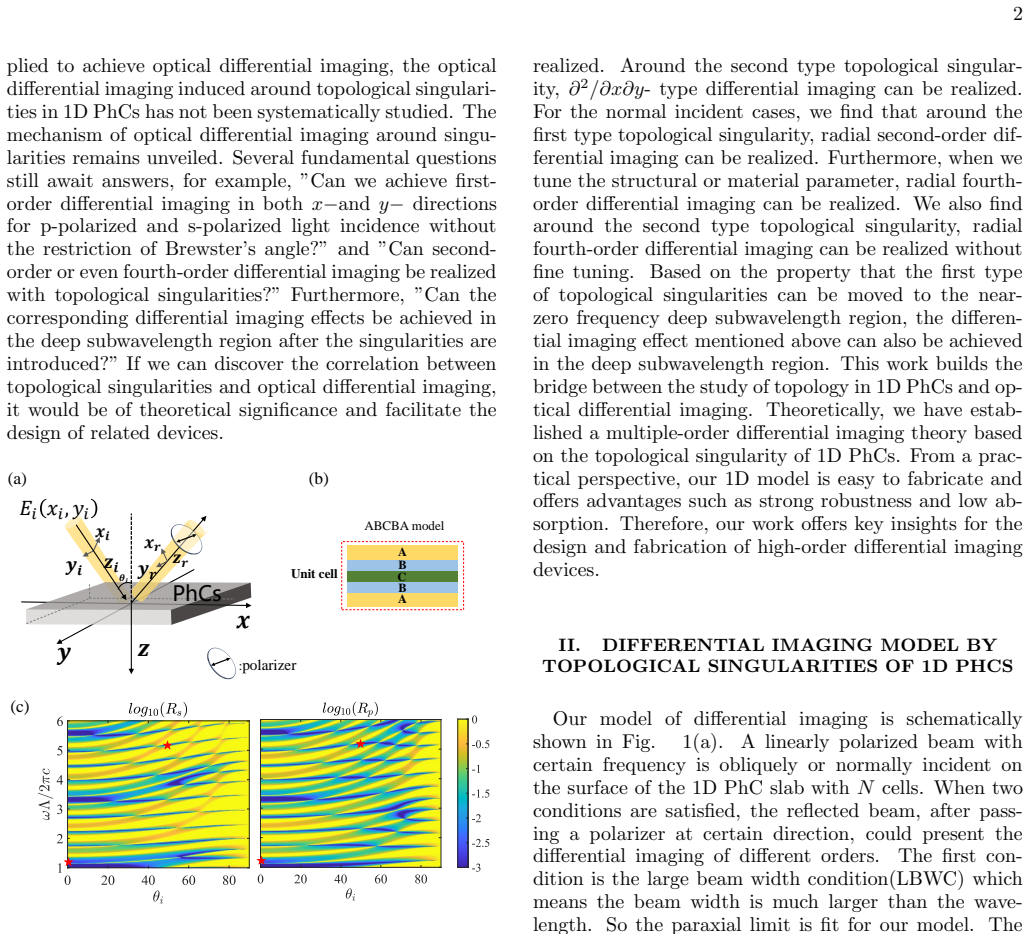
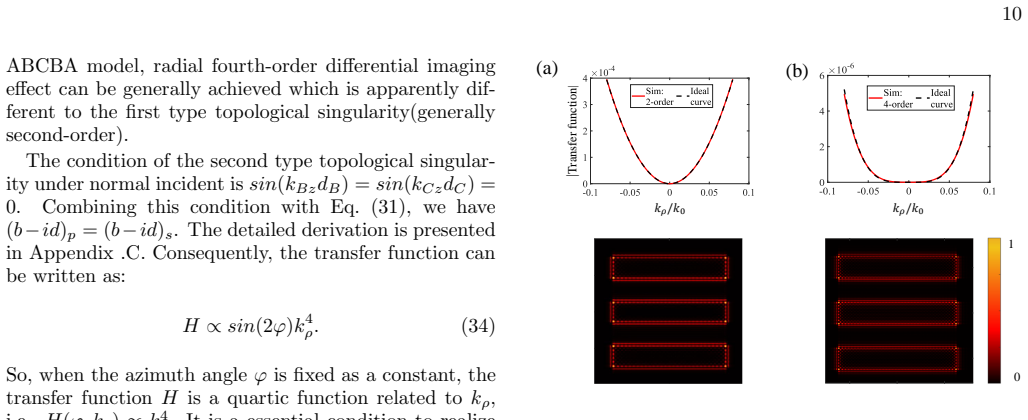
The load-bearing object is the optical transfer function $H(k_x,k_y) = \mathbf{e}_r^\dagger M^\dagger R(k_x,k_y) M \mathbf{e}_i$, expanded in the paraxial small-wavevector limit around the central wavevector of a topological singularity. Topological singularities are the zero-scattering points of the one-dimensional photonic crystal—frequencies and wavevectors at which the reflection coefficient vanishes and the Bloch phase carries a $\pi$ Zak-phase jump. Around these points, $H$ becomes a monomial in $k_x$, $k_y$, or $k_\rho$ whose degree is the order of differentiation: $k_x$ or $k_y$ for first order, $k_x k_y$ for the mixed second-order operator, $k_\rho^2$ for radial second order, and $k_\rho^4$ for radial fourth order. The key algebraic cancellation is that at a second-type singularity, defined by $\sin(k_{Bz}d_B)=\sin(k_{Cz}d_C)=0$, the coefficients $(b-id)_p$ and $(b-id)_s$ are equal, killing the $k_\rho^2$ term; at a first-type singularity this equality can be restored by tuning the refractive index $n_B$.
What would settle it
At the second-type singularity used for the normal-incidence experiment ($\omega\Lambda/2\pi c = 1.111$, azimuthal angle $\varphi = 45^\circ$), numerically evaluate the transfer function $H(\varphi,k_\rho)$ from the transfer-matrix method for $k_\rho$ from 0 to $0.24 k_0$. If the low-$k_\rho$ fit requires a quadratic term, $H \approx C_1 k_\rho^2 + C_4 k_\rho^4$ with $C_1$ measurably nonzero, the fourth-order claim is false; alternatively, image a sharp edge with the same parameters and count the intensity peaks, where four central peaks confirm fourth order and two confirm second order.
Extended reading notes
Core claim
The central discovery is that the two kinds of zero-scattering points, the topological singularities of an ABCBA photonic crystal, act as sources of spatial differentiation, with the derivative order determined by which singularity the incident beam sits on. Near a first-type singularity the reflection coefficient vanishes for one polarization, and the transfer function reduces to a term linear in the transverse wavevector, giving first-order edge detection in either the x or y direction. Near a second-type singularity both p- and s-reflection coefficients vanish simultaneously, and the cross term produces $H \propto k_x k_y$, i.e., the $\partial^2/\partial x\partial y$ operator. Under normal incidence rotational symmetry forces the expansion to contain only even powers of the radial wavevector $k_\rho$; the first-type singularity gives $H \propto k_\rho^2$, while the second-type singularity cancels the leading $k_\rho^2$ coefficient so that $H \propto k_\rho^4$. The same cancellation can be forced at a first-type singularity by tuning the refractive index of layer B, and because the first-type singularity can be moved to near-zero frequency, the same differentiation laws hold at wavelengths more than twenty unit cells.
Load-bearing premise
The normal-incidence fourth-order results depend on an exact algebraic cancellation between the p- and s-polarization expansion coefficients of the transfer matrix at the singularity; the paper asserts this equality can be proven but does not display the calculation, and if the two coefficients are not exactly equal the leading $k_\rho^2$ term returns and the fourth-order imaging claim collapses.
Editorial extensions
If this is right
- A single 1D photonic crystal slab can be switched between first-order, mixed-second-order, and fourth-order differentiation by changing frequency, incidence angle, and polarizer orientation.
- Edge detection in the deep subwavelength regime becomes possible because the first-type singularity can be shifted to wavelengths longer than twenty unit cells, where effective-medium theory breaks down.
- Because the singularity condition is topological, the differentiation order and the edge-detection response are robust against small structural perturbations that do not close the band gap.
- The same mechanism applies to the simpler ABA structure, since the second-type singularity degenerates to the known ABA singularity and still yields both the mixed second-order and the radial fourth-order operations.
- The transfer-function expansion supplies a design rule for arbitrary even-order radial differentiation: cancelling successive coefficients in the $k_\rho^{2n}$ series would select higher even orders in the same stack.
Reading between the lines
- Extending the expansion logic, a singularity that cancels both the $k_\rho^2$ and $k_\rho^4$ coefficients would give radial sixth-order differentiation; the paper does not pursue this, but the same transfer-function machinery would apply.
- The mixed $\partial^2/\partial x\partial y$ operation at a second-type singularity suggests that anisotropic edge and corner kernels could be engineered in the same slab by choosing the polarizer azimuth, a consequence the paper only partially exploits.
- A direct experimental test would be to image a sharp edge or a star chart with the proposed ABCBA stack and compare the intensity profile's peak count (one, two, or four peaks) against the predicted derivative order at each singularity.
- If the coefficient equality at the second-type singularity fails at finite cell number $N$, the fourth-order normal-incidence claim would degrade to second order; checking the transfer function's small-$k_\rho$ behavior as a function of $N$ would settle this.
Editorial analysis
A structured set of objections, weighed in public.
Referee Report
Summary. The manuscript proposes that one-dimensional ABCBA photonic crystals host two types of topological singularities (zero-reflection points) that can implement multiple-order optical differential imaging. For oblique incidence, the first type of singularity is claimed to support first-order differential imaging in both x and y, and the second type is claimed to support ∂²/∂x∂y differentiation. For normal incidence, the authors claim that the first type supports radial second-order and, after parameter tuning, radial fourth-order differential imaging, while the second type supports radial fourth-order imaging without tuning. They further claim all these effects can be shifted to the deep subwavelength region. The derivations use transfer-matrix expansions near the singularities, with transfer functions expressed as polynomials in kx, ky, or kρ, and the claims are backed by numerical transfer-matrix simulations of Gaussian beams and rectangular images.
Significance. If the central claims were correct, the work would be significant: it would demonstrate a single, simple, one-dimensional photonic crystal acting as a switchable multi-order optical differentiator, with topological robustness and deep-subwavelength operation. The oblique-incidence results (first-order x/y differentiation and ∂²/∂x∂y differentiation) appear internally consistent and are supported by the transfer-matrix simulations; those parts have clear value. The paper also correctly identifies the unusual perfect-transmission property of topological singularities and connects it to differential imaging, which is a useful conceptual step. However, the headline claims for normal incidence—radial second- and fourth-order isotropic differentiation—are not supported by the manuscript's own equations, and the unproved coefficient cancellations in Appendix C are load-bearing. Because the normal-incidence higher-order claims constitute a major part of the paper's novelty, the overall significance as presented is substantially undermined.
major comments (3)
- [Section IV A, Eqs. (20), (22), (23)] The transfer function for normal incidence explicitly contains the factor sin(2φ): H(φ,kρ) = sin(2φ)(rp−rs)/2, as stated in Eq. (20). The subsequent text, after expanding rp−rs, writes H in Eq. (22) as [sin(2φ)/2] C1 kρ². This is not an isotropic radial function of kρ; it depends on azimuth. In real space, the operator corresponding to sin(2φ)kρ² is 2 ∂²/∂x∂y, not a radial Laplacian, and sin(2φ)kρ⁴ corresponds to 2 ∂²/∂x∂y ∇², not a radial fourth-order operator. The argument that one may set φ to a constant for all plane-wave components is not physically implementable: a 2D image is decomposed over all azimuthal directions, and a static polarizer selects one global polarization, not one azimuth per Fourier component. Consequently, the claimed 'radial second-order' and 'radial fourth-order' differential imaging in Sections IV B and IV C are not derived from the given equations. The numerical outputs in Fig. 5(d)–(f), which show edge responses rather than corner responses, are in apparent contradiction with the sin(2φ) factor; this discrepancy needs to be resolved before the normal-incidence claims can be accepted.
- [Appendix C, Eqs. (C5), (C6), (C9)] The key algebraic relations that distinguish the two types of singularities and enable the kρ⁴ behavior are merely asserted with the phrase 'we can prove,' without showing the proof. Specifically, Eq. (C5) states that the second derivatives of Es and Ep with respect to kρ² are unequal at the first-type singularity, and Eq. (C9) states that (b−id)s = (b−id)p at the second-type singularity. These relations are load-bearing: the cancellation of the k² term in Eq. (31), which is essential for fourth-order behavior, relies entirely on them. The manuscript must include the actual derivations, or at least a rigorous and complete proof, rather than deferring with 'we can prove.' Additionally, the definitions of Es and Ep in Eqs. (C3)–(C4) and their connection to (b−id) in Eq. (C2) are introduced without derivation, so the logical chain from the transfer-matrix elements to the transfer function is incomplete.
- [Eq. (30) and surrounding text] The expression for the reflection coefficient of an N-cell slab, rs(p) = β[(b−id)s(p)kρ² + (c−ie)s(p)kρ⁴]/(a+f)^N, is stated without derivation. Since the transfer matrix of N cells is the N-th power of the unit-cell matrix, both the numerator and denominator would generally be polynomials involving products of the expansion coefficients; the factorization into a single coefficient β and a denominator raised to the N-th power is not obvious. This formula is the basis for the normal-incidence transfer function in Eq. (31), so its validity must be demonstrated explicitly. The derivation should show how β and the scaling with N arise, and clarify whether the formula is exact or an approximation in the small-kρ limit.
minor comments (4)
- [Abstract and Introduction] The abstract contains grammatical errors, e.g., 'The differential imaging have garnered' and 'incidences , We'. These should be corrected. There is also an inconsistent comma after 'normal incidences'.
- [Section IV B and IV C] The text has incomplete citations in two places: 'the theory of second-order differential imaging[? ]' and 'the theory of fourth-order differential imaging[? ]'. Please provide the appropriate references.
- [Appendix B] The sentence 'The cell of 1D ABA-kind PhC is depicted in Fig .(7(a)' has a formatting error (extra period and inappropriate parentheses). Also, the reference to 'Fig .(7(a)' should be simply 'Fig. 7(a)'.
- [Eq. (10)] The first-order expansion of rp and rs contains terms with k0/kx, which appear singular in the limit kx → 0. The derivation should clarify the region of validity and whether the singularity is removed by the combination with the zeroth-order terms.
Circularity Check
No significant circularity: the differential imaging orders are derived from Taylor expansions of the reflection coefficients and independently confirmed by transfer-matrix numerics; self-citations to the authors' prior singularity theory provide provenance but are not the sole load-bearing support.
full rationale
The main derivation chain is self-contained against the paper's own equations. For oblique incidence, Eq. (10) follows from Taylor expanding the reflection coefficients in the transfer function; at a first-type singularity rs0=0 gives H ∝ kx (Eq. 11) and with a crossed polarizer H ∝ ky (Eq. 13); at a second-type singularity rp0=rs0=0 gives H ∝ kxky (Eq. 15). These are first-principles expansions, not fits. The numerical transfer functions are computed by the transfer matrix method (TMM), and the ideal linear/quadratic/quartic curves are fits to those numerical results after the fact, not fitted parameters used to generate the predictions. For normal incidence, Eq. (20) gives H = sin(2φ)(rp−rs)/2, and the Taylor expansion Eq. (21) gives the kρ² scaling. The paper then states 'when the azimuth angle φ is fixed as a constant, the transfer function H is a quadratic function related to kρ' and calls this radial second-order imaging. For a 2D image, φ varies across Fourier components, so a static polarizer cannot fix φ for all wavevectors; the leading real-space operator is ∂²/∂x∂y, not an isotropic radial Laplacian. This is a physical correctness problem in the normal-incidence radial claims, but it is not circularity: the kρ² dependence is derived rather than assumed, and the imaging simulations use the actual TMM response rather than the fitted curve. Appendix C asserts the coefficient equalities (b−id)s ≠ (b−id)p and (b−id)s = (b−id)p with the phrase 'we can prove' but omits the calculation; this is an omitted proof or rigor gap, not a circular step. The paper leans on the authors' prior singularity theory (Refs. 25, 30, 33, 34, 36) for the definition, classification, and deep-subwavelength shifting of topological singularities. However, Appendix A rederives the zero-scattering property from the transfer-matrix/Bloch formalism, and the current TMM results stand independently of those citations. Thus the self-citation is provenance rather than load-bearing circular support, and the central claims retain independent content. Overall circularity is minor, consistent with a score of 2.
Assumptions & free parameters
free parameters (3)
- Main ABCBA cell parameters =
dA=0.4Λ, dB=0.3Λ, dC=0.3Λ, nA=1, nB=1.5, nC=3
- Deep-subwavelength cell parameters =
εA=2.1, εB=3.24, εC=1.44, dA=0.2Λ, dB=0.295Λ
- Tuned parameters for fourth-order first-type singularity =
nB=1.615 (Section IV B); dB=0.2985Λ (Section IV D)
assumptions (4)
- domain assumption Paraxial large-beam-width approximation: the beam width is much larger than the wavelength, so kx and ky are small compared with k0.
- domain assumption Near-singularity condition: the incident frequency and parallel wavevector match a topological singularity of the semi-infinite photonic crystal.
- domain assumption In-plane rotational symmetry: rp and rs depend only on k-rho squared, giving even-order expansions in Eq. (21).
- ad hoc to paper Unproved coefficient relations in Appendix C: the second derivatives of Es and Ep with respect to k-rho-squared are unequal at the first type singularity, and (b minus i d) for p equals (b minus i d) for s at the second type singularity.
Cite this review
Pith. "Pith review of Multiple-order differential imaging based on two types of topological singularity in one dimensional photonic crystals." pith.science (2026). https://pith.science/paper/LF3IYK5E
@misc{pith2026250601026,
  author       = {Pith},
  title        = {Pith review of: Multiple-order differential imaging based on two types of topological singularity in one dimensional photonic crystals},
  year         = {2026},
  howpublished = {\url{https://pith.science/paper/LF3IYK5E}},
  note         = {Machine review of arXiv:2506.01026}
}
abstract
The differential imaging have garnered significant attention owing to its boundary detection capabilities in image processing. However, to date, there has been scant research investigating the relationship between the differential imaging effect and the topological properties of a one dimensional(1D) system. In this work, we systematically investigate the multiple-order differential imaging based on two types of topological singularity in 1D photonic crystals(PhCs). For both oblique and normal incidences , We conduct a detailed investigation of differential imaging effect. For the oblique incident cases, the first type topological singularities support first-order differential imaging in both x and y directions. Meanwhile, based on the second type topological singularities, $\partial^2 /\partial x \partial y$-type differential imaging can be achieved. For the normal incident cases, the first type topological singularities can support radial second-order and fourth-order differential imaging and the second type topological singularities can support radial fourth-order differential imaging without the need for fine tuning of the structural parameters. We further demonstrates the realization of these differential imaging effects in the deep subwavelength region by shifting the first type topological singularities into this region. This research connects the topological properties of PhCs with optical differential imaging, paving the way for the development of multiple-order differential imaging devices with improved robustness and functionality.
Figures


Figures from the paper (4 more)



Reference graph
Works this paper leans on
-
[1]
(31), we have (b − id)p = (b − id)s
Combining this condition with Eq. (31), we have (b − id)p = (b − id)s. The detailed derivation is presented in Appendix .C. Consequently, the transfer function can be written as: H ∝ sin(2φ)k4 ρ. (34) So, when the azimuth angle φ is fixed as a constant, the transfer function H is a quartic function related to kρ, i.e., H(φ, kρ) ∝ k4 ρ. It is a essential c...
-
[2]
C. Li, X. Zhang, J. Li, T. Fang, and X. Dong, The chal- lenges of modern computing and new opportunities for optics, PhotoniX 2, 1 (2021)
work page 2021
-
[3]
Z. Wang, G. Hu, X. Wang, X. Ding, K. Zhang, H. Li, S. N. Burokur, Q. Wu, J. Liu, J. Tan, et al., Single-layer spatial analog meta-processor for imaging processing, Na- ture communications 13, 2188 (2022)
work page 2022
-
[4]
W. Fu, D. Zhao, Z. Li, S. Liu, C. Tian, and K. Huang, Ultracompact meta-imagers for arbitrary all-optical con- volution, Light: Science & Applications 11, 62 (2022)
work page 2022
-
[5]
L. Wan, D. Pan, T. Feng, W. Liu, and A. A. Potapov, A review of dielectric optical metasurfaces for spatial differ- entiation and edge detection, Frontiers of Optoelectronics 14, 187 (2021)
work page 2021
-
[6]
H. Tang, E. Wu, Q. Ma, D. Gallagher, G. Perera, and T. Zhuang, Mri brain image segmentation by multi- resolution edge detection and region selection, Comput- erized Medical Imaging and Graphics 24, 349 (2000)
work page 2000
- [7]
-
[8]
T. Zhu, Y. Lou, Y. Zhou, J. Zhang, J. Huang, Y. Li, H. Luo, S. Wen, S. Zhu, Q. Gong, et al., Generalized spatial differentiation from the spin hall effect of light and its application in image processing of edge detection, Physical Review Applied 11, 034043 (2019)
work page 2019
Show all 42 references
-
[9]
D. Xu, S. He, J. Zhou, S. Chen, S. Wen, and H. Luo, Optical analog computing of two-dimensional spatial dif- ferentiation based on the brewster effect, Optics Letters 45, 6867 (2020)
2020
-
[10]
W. Xu, X. Ling, D. Xu, S. Chen, S. Wen, and H. Luo, En- hanced optical spatial differential operations via strong spin-orbit interactions in an anisotropic epsilon-near-zero slab, Physical Review A 104, 053513 (2021)
2021
-
[11]
D. Xia, Y. Wang, and Q. Zhi, Tunable optical differential operation based on the cross-polarization effect at the optical interface, Optics Express 29, 31891 (2021)
2021
-
[12]
C. Mi, W. Song, X. Cai, C. Yang, Y. Song, and X. Mi, Tunable optical spatial differentiation in the photonic spin hall effect, Optics Express 28, 30222 (2020)
2020
-
[13]
D. Xu, S. He, J. Zhou, S. Chen, S. Wen, and H. Luo, Goos–h¨ anchen effect enabled optical differential opera- tion and image edge detection, Applied Physics Letters 116 (2020)
2020
-
[14]
Y. Deng, W. Xu, W. Zhang, Q. Yang, D. Xu, and H. Luo, Rotational photonic spin hall effect on twisted bi- layer metasurfaces, Optics Communications 560, 130480 (2024)
2024
-
[15]
Z. Wen, W. Xu, Y. Zhang, T. Jiang, and Z. Luo, Tunable optical spatial differential operation via photonic spin hall effect in a weyl semimetal, Optics Express 32, 10022 (2024)
2024
-
[16]
C. Guo, M. Xiao, M. Minkov, Y. Shi, and S. Fan, Pho- tonic crystal slab laplace operator for image differentia- tion, Optica 5, 251 (2018)
2018
-
[17]
T. Zhu, C. Guo, J. Huang, H. Wang, M. Orenstein, Z. Ruan, and S. Fan, Topological optical differentiator, Nature communications 12, 680 (2021)
2021
-
[18]
Y. Zhou, H. Zheng, I. I. Kravchenko, and J. Valentine, Flat optics for image differentiation, Nature Photonics 14, 316 (2020)
2020
-
[19]
Zhang, M
F. Zhang, M. Pu, X. Li, P. Gao, X. Ma, J. Luo, H. Yu, and X. Luo, All-dielectric metasurfaces for simultane- ous giant circular asymmetric transmission and wave- front shaping based on asymmetric photonic spin–orbit interactions, Advanced Functional Materials27, 1704295 (2017)
2017
-
[20]
D. Pan, L. Wan, M. Ouyang, W. Zhang, A. A. Potapov, W. Liu, Z. Liang, T. Feng, and Z. Li, Laplace meta- surfaces for optical analog computing based on quasi- bound states in the continuum, Photonics Research 9, 1758 (2021)
2021
-
[21]
M. Deng, M. Cotrufo, J. Wang, J. Dong, Z. Ruan, A. Al` u, and L. Chen, Broadband angular spectrum differentia- tion using dielectric metasurfaces, Nature Communica- tions 15, 2237 (2024)
2024
-
[22]
Y. Liu, M. Huang, Q. Chen, and D. Zhang, Single pla- nar photonic chip with tailored angular transmission for multiple-order analog spatial differentiator, Nature Com- munications 13, 7944 (2022)
2022
-
[23]
M. Z. Hasan and C. L. Kane, Colloquium: topological insulators, Reviews of modern physics 82, 3045 (2010)
2010
-
[24]
Shen, Topological insulators, Vol
S.-Q. Shen, Topological insulators, Vol. 174 (Springer, 14 2012)
2012
-
[25]
L. Lu, J. D. Joannopoulos, and M. Soljaˇ ci´ c, Topological photonics, Nature photonics 8, 821 (2014)
2014
-
[26]
M. Xiao, Z. Zhang, and C. T. Chan, Surface impedance and bulk band geometric phases in one-dimensional sys- tems, Physical Review X 4, 021017 (2014)
2014
-
[27]
Bansil, H
A. Bansil, H. Lin, and T. Das, Colloquium: Topologi- cal band theory, Reviews of Modern Physics 88, 021004 (2016)
2016
-
[28]
C.-K. Chiu, J. C. Teo, A. P. Schnyder, and S. Ryu, Classi- fication of topological quantum matter with symmetries, Reviews of Modern Physics 88, 035005 (2016)
2016
-
[29]
A. B. Khanikaev and G. Shvets, Two-dimensional topo- logical photonics, Nature photonics 11, 763 (2017)
2017
-
[30]
H. Wang, S. K. Gupta, B. Xie, and M. Lu, Topological photonic crystals: a review, Frontiers of Optoelectronics 13, 50 (2020)
2020
-
[31]
Xiong, Y
L. Xiong, Y. Zhang, and X. Jiang, Resonance and topo- logical singularity near and beyond zero frequency for waves: model, theory, and effects, Photonics Research 9, 2024 (2021)
2021
-
[32]
J. K. Asb´ oth and H. Obuse, Bulk-boundary correspon- dence for chiral symmetric quantum walks, Physical Re- view B—Condensed Matter and Materials Physics 88, 121406 (2013)
2013
-
[33]
Batra and G
N. Batra and G. Sheet, Understanding basic concepts of topological insulators through su-schrieffer-heeger (ssh) model, arXiv preprint arXiv:1906.08435 (2019)
2019 arXiv
-
[34]
Q. Li, Y. Zhang, and X. Jiang, Two classes of singulari- ties and novel topology in a specially designed synthetic photonic crystals, Optics express 27, 4956 (2019)
2019
-
[35]
Li and X
Q. Li and X. Jiang, Singularity induced topological tran- sition of different dimensions in one synthetic photonic system, Optics Communications 440, 32 (2019)
2019
-
[36]
Y. Liu, L. Xiong, and X. Jiang, The evolution of topo- logical singularities between real-and complex-frequency domains and the engineering of photonic bands for her- mitian and non-hermitian photonic crystals, New Journal of Physics 24, 123042 (2023)
2023
-
[37]
Y. Liu, X. Wang, Y. Li, H. Zhang, X. Wang, Z. Lai, and X. Jiang, Dual-polarization huge photonic spin hall shift and super-subwavelength detecting based on topological singularities in 1d photonic crystals, Laser & Photonics Reviews , 2400973
-
[38]
Y. Shou, Y. Wang, L. Miao, S. Chen, and H. Luo, Re- alization of all-optical higher-order spatial differentiators based on cascaded operations, Optics Letters 47, 5981 (2022)
2022
-
[39]
Y. Tu, Y. Liang, R. Li, Z. Xiong, H. Wu, Y. Ren, Z. Liu, and T. Liu, Inverse design of pancharatnam-berry phase optical elements for all-optical multiple-order spatial dif- ferentiation, Optics & Laser Technology 183, 112314 (2025)
2025
-
[40]
O. Y. Long, C. Guo, H. Wang, and S. Fan, Isotropic topological second-order spatial differentiator operating in transmission mode, Optics Letters 46, 3247 (2021)
2021
-
[41]
Yariv and P
A. Yariv and P. Yeh, Optical waves in crystal propagation and control of laser radiation, (1983)
1983
-
[42]
Markos and C
P. Markos and C. M. Soukoulis, Wave propagation: from electrons to photonic crystals and left-handed materials, in Wave Propagation(Princeton University Press, 2008)
2008
Reviewed August 7, 2026 · model on record in the stance chip above.
Discussion (0). Sign in to comment.