REVIEW 4 major objections 4 minor 33 references
Scalable Association of Users in CF-mMIMO: A Synergy of Communication, Sensing, and JCAS
T0 review · 4 major / 4 minor · reviewed 2026-08-07 · deepseek-v4-flash
Pith's one-line read A scalable user-association scheme for cell-free massive MIMO selects the right access points for communication, sensing, and joint users, and is shown to cut interference and runtime while improving error and detection performance.
desk verdict A sensible service-aware association scheme undermined by shaky derivations and an unsupported scalability claim; worth fixing, not citing yet. read the letter →
The pith
A machine-rendered reading of the paper's core claim, the machinery that carries it, and where it could break.
The reading
What carries the argument
The load-bearing object is the binary association matrix $\mathbf{A}=\{a_{lk}\}$ chosen by the optimization in Eq. (11): maximize $\sum_l \sum_k S_{lk} R_{lk} a_{lk}$ subject to per-AP pilot limit $\tau_p$, per-UE AP limit $X$, and the masking rule $a_{lk}=0$ whenever $M_{lk}=0$. The matrices $S$ and $R$ carry, respectively, the service-appropriate link quality (SNR, SCNR, or a weighted joint metric) and the normalized AP priorities. AP masking is the sparsifier: by pruning weak links it shrinks the variable count of the MILP, which is what the paper leans on for its near-linear complexity claim. The same masking also removes cluttered links, which is how the scheme improves detection in sensing.
What would settle it
Run the proposed scheme on random dense deployments with increasing L and K while setting the masking threshold low enough that most links survive, and record the solver's CPU time; if runtime grows superlinearly with L and K instead of tracking O(L+K), the scalability claim fails in that regime.
Extended reading notes
Core claim
The central claim is that a three-stage association pipeline can make CF-mMIMO scalable while improving both communication and sensing. First, each AP masks every link whose received power falls below a threshold, discarding weak and interference-prone links. Second, each AP computes a service-appropriate link-quality value—SNR for communication users, SCNR for sensing users, and a weighted SNR/SCNR combination for JCAS users—and normalizes these values into priorities. Third, the CPU solves a binary mixed-integer linear program that maximizes the sum of weighted link qualities subject to each AP serving at most $\tau_p$ users, each user connecting to at most $X$ APs, and masked links being forced to zero. Against the unscalable baseline where every AP serves every user, the scheme is shown by analysis and Monte Carlo simulation to reduce interference and runtime while improving SER and probability of detection.
Load-bearing premise
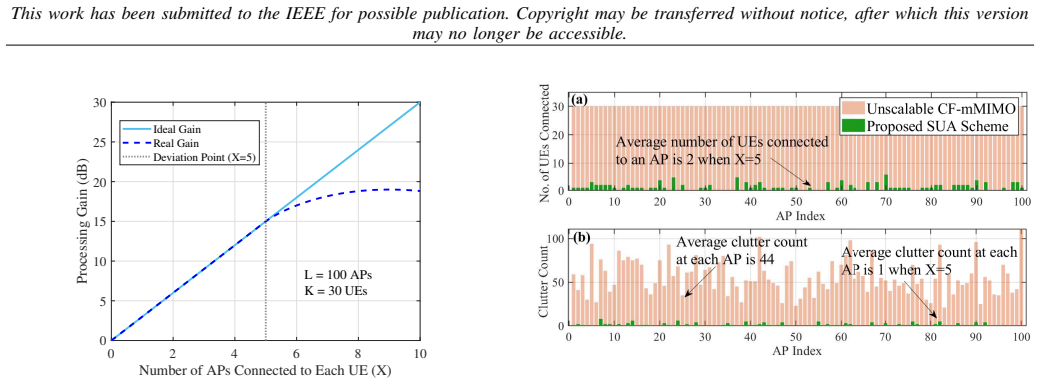
The scalability claim rests on the unproven assertion that after AP masking removes weak links, the remaining binary optimization problem can be solved in near-linear time O(L+K); if the masked problem is not sparse, the branch-and-bound solver's exponential worst case dominates and the 'scalable' label collapses.
Editorial extensions
If this is right
- Cell-free massive MIMO can serve communication, sensing, and JCAS users in the same network without requiring every AP to serve every user, removing a known scalability bottleneck.
- Association runtime drops by about 59% in the reported 100-AP, 30-UE setup, so reassociation can keep up with dynamic network conditions.
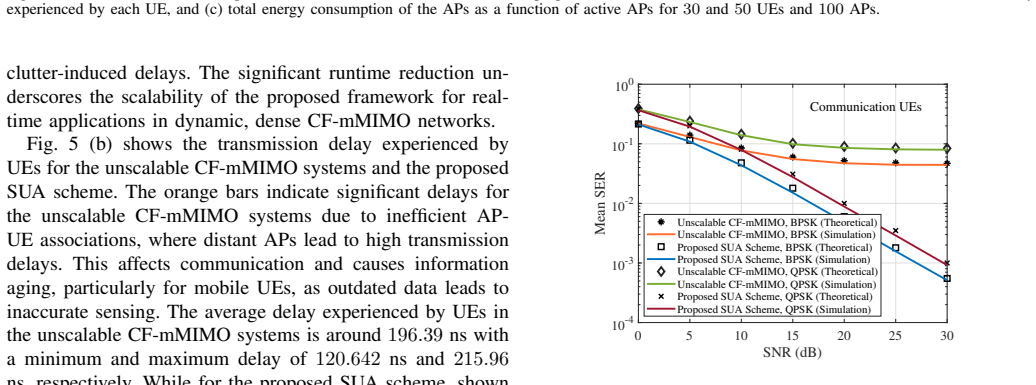
- Symbol error rate improves for both communication and JCAS users, and probability of detection improves for sensing and JCAS users, relative to the unscalable baseline.
- AP energy consumption falls because only the necessary APs stay active, with the savings growing as the number of users increases.
- The derived SER and probability-of-detection expressions provide analytic benchmarks for future CF-mMIMO association schemes that mix communication and sensing.
Reading between the lines
- If the claimed O(L+K) complexity is meant to hold generally, the masked problem must stay sparse; in deployments where most links pass the masking threshold, branch-and-bound's exponential worst case would resurface, so the scalability claim needs a sparsity guard.
- The same masking–prioritization–optimization pipeline could be carried over to mobile users, but the static block-fading assumptions in the SER and detection derivations would have to be reworked; the paper lists mobility as future work.
- A direct stress test is to sweep the masking threshold downward and the clutter density upward until the runtime benefit over the all-AP baseline vanishes; that maps the regime in which the word 'scalable' is actually earned.
Editorial analysis
A structured set of objections, weighed in public.
Referee Report
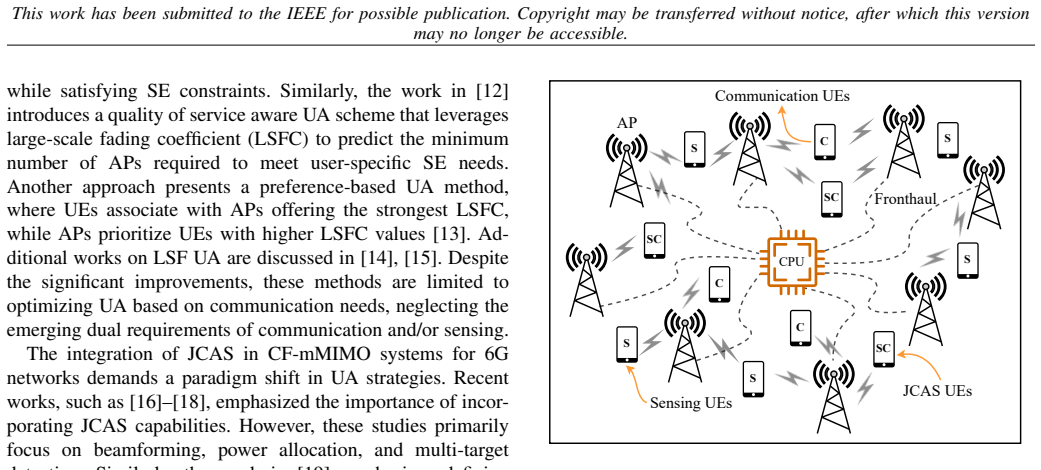
Summary. The manuscript proposes a scalable user association (SUA) scheme for cell-free massive MIMO with heterogeneous UEs (communication, sensing, and JCAS). The scheme operates in three stages: RSSI-based AP masking (Eq. (6)), per-AP link-quality evaluation and priority ranking (Eqs. (7)-(10)), and a centralized binary linear program (Eq. (11)) that maximizes weighted link quality subject to AP pilot capacity, a per-UE AP limit X, and masking decisions. The authors claim that AP masking reduces the optimization complexity to O(L+K), and they derive closed-form expressions for symbol error rate (Eq. (25)) and probability of detection (Eq. (34)). Simulations with L=100 APs and K=30 UEs compare SUA with an 'unscalable' CF-mMIMO baseline in which every AP serves every UE, reporting improved SER, detection probability, runtime, delay, and energy consumption.
Significance. The problem addressed is relevant: user association in CF-mMIMO that explicitly accounts for communication, sensing, and JCAS requirements is an important and timely direction, and the paper formulates it as a weighted link-selection problem with heterogeneous service metrics. The attempt to include complexity analysis and closed-form SER/Pd derivations is a strength in framing. However, the central 'scalable' claim is not established: the O(L+K) complexity assertion in Section III-D is unproven and is in tension with the stated use of branch-and-bound. Moreover, the SER derivation contains an internal inconsistency between Eq. (14) and Eq. (22) and a dimensionally inconsistent Q-function argument in Eq. (15), while the GLRT derivation in Section IV-B contains a sign error. These issues are load-bearing because the paper's title, abstract, and conclusions rest on the scalability claim and on the theoretical performance expressions. The ideas are potentially salvageable, but the manuscript in its current form does not provide a sound basis for its central claims.
major comments (4)
- [Section III-D and Eq. (11)] The complexity claim is not supported. The paper states that after AP masking the optimization in Eq. (11) has complexity O(psi*(L*K)+L+K), which is then approximated as O(L+K), but no proof, algorithm, or measurement of psi is provided. Eq. (11) is a binary MILP solved by branch-and-bound, whose worst-case complexity is exponential in the number of variables. The paper does not show that the constraint matrix is totally unimodular, nor does it identify a polynomial-time exact algorithm, nor does it report psi or a scaling study. Because the word 'scalable' is central to the title and abstract and the runtime advantage in Fig. 5(a) is a single configuration, this is a load-bearing gap. The authors should either prove a polynomial complexity bound for their solver, identify a concrete algorithm with such a bound, or replace the scalability claim with an empirically supported statement based on scaling experiments.
- [Section IV-A, Eqs. (14) and (22)] The definitions of the error-term constant are inconsistent. In Eq. (14), the total covariance matrix Sigma is computed as (sigma^2 + sigma^2 X K / tau_p) I_N, so b^2 = sigma^2 X K / tau_p. In Eq. (22), however, the same quantity is written as c^2 = sigma^2 K / (tau_p X), which differs by a factor X^2 from b^2. Since both expressions are substituted into the same SER derivation without a change of model, the closed-form SER in Eq. (25) is not a consistent consequence of the preceding equations. The authors need to reconcile these definitions or re-derive the covariance and the resulting SER expression.
- [Section IV-A, Eq. (15)] The Q-function argument in Eq. (15) is dimensionally inconsistent. Eq. (13) has Q( ||delta||^2 / sqrt(2 delta^H Sigma delta) ). Substituting Sigma = (sigma^2 + b^2) I_N yields Q( ||delta|| / sqrt(2(sigma^2+b^2)) ), not Q( ||delta||^2 / [2(sigma^2+b^2)] ) as written. As stated, the numerator has units of squared amplitude while the denominator has units of variance, and the subsequent expressions in Eqs. (22) and (25) inherit this problem. The theoretical SER curves labeled 'Theoretical' in Figs. 6 and 7 are therefore not justified by the derivation as written.
- [Section IV-B, Eqs. (29)-(30)] The GLRT derivation is internally inconsistent. The text writes the log-likelihood ratio as ln Lambda = -y^H Sigma^{-1} y + (y - Phi s)^H Sigma^{-1} (y - Phi s), but then obtains ln Lambda = 2 Re{y^H Sigma^{-1} Phi s} - (Phi s)^H Sigma^{-1} (Phi s). Expanding the written expression gives -2 Re{y^H Sigma^{-1} Phi s} + (Phi s)^H Sigma^{-1} (Phi s), so the sign of the matched-filter term is flipped in the derivation. Since the final detection statistic and Pd expression depend on the sign of this term, the derivation as written cannot be followed even though Eq. (34) resembles the standard Marcum-Q form. The authors should correct the algebra or remove the intermediate claim.
minor comments (4)
- [Section V-B, Fig. 5(a)] The runtime comparison is reported for a single network size (L=100, K=30). A scaling study over L and K is needed to support the claim of computational savings, especially given the unproven O(L+K) complexity.
- [Section V, baseline selection] The comparison is only against the 'unscalable' all-AP-to-all-UE baseline. It would be informative to compare with an existing scalable user-centric association scheme (e.g., refs. [7] or [10]) to show the added value of the SUA optimization.
- [Section IV-A, Eq. (18)] The text says f_gamma(gamma) is a sum of exponential variables, but the MGF in Eq. (18) is written as a product over l,n. The distributional assumptions and the transition from the stated sum to the product form should be clarified.
- [Section IV-B, Eq. (34)] The factor 2 in P_d = P(Lambda > 2 eta | H1) is introduced without explanation; please clarify how the threshold scaling follows from the test statistic in Eq. (30).
Circularity Check
No significant circularity: the SER and Pd expressions are derived from the stated model, and the questionable O(L+K) complexity claim is an unsupported assertion rather than a self-referential reduction.
full rationale
The claimed derivations do not reduce to their inputs by construction. The SER analysis (Eqs. (13)-(25)) starts from a standard ML-detector PEP and MMSE channel-estimation model, then substitutes the SUA-specific assumption that only high-SNR masked links remain; the resulting expression is validated in simulation with the same system model, which is self-consistency, not circularity. The Pd derivation (Eqs. (26)-(34)) likewise follows a GLRT/Rayleigh-Rician detection model and expresses Pd in terms of SCNR and P_FA; no fitted parameter is renamed as a prediction. The main weakness is Section III-D, where the binary MILP of Eq. (11) is asserted to have complexity O(psi*L*K + L + K) and then approximated as O(L+K) based on the unquantified claim that psi << 1 for large L and K. That is an unproven complexity assertion (branch-and-bound has worst-case exponential behavior), and the single runtime point in Fig. 5(a) does not test it; however, an unsupported or false claim is not circularity under the review criteria, because it is not an equation or fitted value equivalent to its own output. The only self-citation, [29], is used to label a MILP and is not load-bearing for the paper's results. No uniqueness theorem or prior ansatz is imported from the authors' own work. The comparison baseline (all APs serving all UEs) is weak but is a validity concern, not a circular step.
Assumptions & free parameters
free parameters (3)
- X (max APs per UE) =
5
- P_threshold (AP masking threshold) =
-65 dBm
- w_c and w_s (JCAS weights) =
w_c=0.4, w_s=0.6
assumptions (3)
- domain assumption Correlated Rayleigh fading and MMSE channel estimation with orthogonal pilots
- domain assumption Monostatic sensing model with clutter return and known clutter plus noise covariance Sigma = sigma_c^2 I + sigma_n^2 I
- ad hoc to paper High-SNR and sparse-association approximations in the SER derivation
Cite this review
Pith. "Pith review of Scalable Association of Users in CF-mMIMO: A Synergy of Communication, Sensing, and JCAS." pith.science (2026). https://pith.science/paper/UUHPSOAI
@misc{pith2026250601060,
  author       = {Pith},
  title        = {Pith review of: Scalable Association of Users in CF-mMIMO: A Synergy of Communication, Sensing, and JCAS},
  year         = {2026},
  howpublished = {\url{https://pith.science/paper/UUHPSOAI}},
  note         = {Machine review of arXiv:2506.01060}
}
read the original abstract
Cell-free massive multiple-input multiple-output (CF-mMIMO) is a key enabler for the sixth generation (6G) networks, offering unprecedented spectral efficiency and ubiquitous coverage. In CF-mMIMO systems, the association of user equipments (UEs) to access points (APs) is a critical challenge, as it directly impacts network scalability, interference management, and overall system performance. Conventional association methods primarily focus on optimizing communication performance. However, with the emergence of sensing and joint communication and sensing (JCAS) requirements, conventional approaches become insufficient. To address this challenge, we propose a scalable user association (SUA) scheme for CF-mMIMO networks, considering heterogeneous UE requirements. Designed to enhance the performance of both sensing and communication, the proposed SUA scheme aims to ensure network scalability. This is achieved by dynamically assigning APs to UEs based on their specific service requirements (communication, sensing, or JCAS), while considering link quality, interference mitigation, and network-related constraints. Specifically, the proposed SUA scheme employs AP masking, link prioritization, and an optimization-based association mechanism to select the most suitable APs for each UE. Simulations show that, compared to conventional CF-mMIMO methods, the proposed SUA scheme significantly reduces interference and computational runtime, while improving the symbol error rate for communication and the probability of detection for sensing.
Figures

Figures from the paper (5 more)



Reference graph
Works this paper leans on
-
[1]
Joint radar sensing, location, and communication resources optimization in 6G network,
H. Zhanget al., “Joint radar sensing, location, and communication resources optimization in 6G network,”IEEE Journal on Selected Areas in Communications, vol. 42, no. 9, pp. 2369–2379, 2024
work page 2024
-
[2]
Cell-free massive MIMO versus small cells,
H. Q. Ngoet al., “Cell-free massive MIMO versus small cells,”IEEE Trans. Wireless Commun., vol. 16, pp. 1834–1850, 2017
work page 2017
-
[3]
Multistatic radar distribution geometry effects on parameter estimation accuracy,
D. Dhulashia and M. Ritchie, “Multistatic radar distribution geometry effects on parameter estimation accuracy,”IET Radar, Sonar & Naviga- tion, vol. 18, pp. 7–22, 2024
work page 2024
-
[4]
Precoding and power optimization in cell-free mas- sive MIMO systems,
E. Nayebiet al., “Precoding and power optimization in cell-free mas- sive MIMO systems,”IEEE Transactions on Wireless Communications, vol. 16, pp. 4445–4459, 2017
work page 2017
-
[5]
Making cell-free massive MIMO competitive with MMSE processing and centralized implementation,
E. Bj ¨ornson and L. Sanguinetti, “Making cell-free massive MIMO competitive with MMSE processing and centralized implementation,” IEEE Trans. Wireless Commun., vol. 19, pp. 77–90, 2020
work page 2020
-
[6]
Performance analysis and power control of cell-free massive MIMO systems with hardware impairments,
J. Zhanget al., “Performance analysis and power control of cell-free massive MIMO systems with hardware impairments,”IEEE Access, vol. 6, pp. 55 302–55 314, 2018
work page 2018
-
[7]
Scalable cell-free massive MIMO systems,
E. Bj ¨ornsonet al., “Scalable cell-free massive MIMO systems,”IEEE Transactions on Communications, vol. 68, pp. 4247–4261, 2020
work page 2020
-
[8]
Structured massive access for scalable cell-free massive MIMO systems,
S. Chenet al., “Structured massive access for scalable cell-free massive MIMO systems,”IEEE Journal on Selected Areas in Communications, vol. 39, pp. 1086–1100, 2020
work page 2020
Show all 33 references
-
[9]
Joint BS-user association, power allocation, and user-side interference cancellation in cell-free heterogeneous networks,
A. Liu and V . K. Lau, “Joint BS-user association, power allocation, and user-side interference cancellation in cell-free heterogeneous networks,” IEEE Trans. Signal Process., vol. 65, pp. 335–345, 2016
2016
-
[10]
Cell-free massive MIMO: User-centric approach,
S. Buzzi and C. D’Andrea, “Cell-free massive MIMO: User-centric approach,”IEEE Wireless Commun. Lett., vol. 6, pp. 706–709, 2017
2017
-
[11]
A novel user association and power control algorithm for cell-free massive MIMO,
V . Rachuri and G. Berardinelli, “A novel user association and power control algorithm for cell-free massive MIMO,” inIEEE MeditCom, 2024, pp. 281–286
2024
-
[12]
A probabilistic QoS-aware user association in cell-free massive MIMO for industry 4.0,
V . Rachuriet al., “A probabilistic QoS-aware user association in cell-free massive MIMO for industry 4.0,” inIEEE WCNC, 2024, pp. 1–6
2024
-
[13]
Access point-user association and auction algorithm-based pilot assignment schemes for cell-free massive MIMO systems,
M. Sarker and A. O. Fapojuwo, “Access point-user association and auction algorithm-based pilot assignment schemes for cell-free massive MIMO systems,”IEEE Syst. J., vol. 17, pp. 4301–4312, 2023
2023
-
[14]
Learning-assisted user clustering in cell-free massive MIMO-NOMA networks,
Q. N. Leet al., “Learning-assisted user clustering in cell-free massive MIMO-NOMA networks,”IEEE Transactions on Vehicular Technology, vol. 70, pp. 12 872–12 887, 2021
2021
-
[15]
Performance optimization on cell-free massive MIMO- aided URLLC systems with user grouping,
B. Chonget al., “Performance optimization on cell-free massive MIMO- aided URLLC systems with user grouping,”IEEE Transactions on Wireless Communications, 2024
2024
-
[16]
Cell-free ISAC MIMO systems: Joint sensing and communication beamforming,
U. Demirhan and A. Alkhateeb, “Cell-free ISAC MIMO systems: Joint sensing and communication beamforming,”IEEE Transactions on Communications (Early Access), pp. 1–15, 2024
2024
-
[17]
Learning beamforming in cell-free massive MIMO ISAC systems,
U. Demirhanet al., “Learning beamforming in cell-free massive MIMO ISAC systems,” inIEEE 25th SPAWC, 2024, pp. 326–330
2024
-
[18]
Scalability and implementation aspects of cell-free massive MIMO for ISAC,
S. Buzziet al., “Scalability and implementation aspects of cell-free massive MIMO for ISAC,” inIEEE 19th ISWCS, 2024, pp. 1–6
2024
-
[19]
Communication-sensing region for cell-free massive MIMO ISAC systems,
W. Maoet al., “Communication-sensing region for cell-free massive MIMO ISAC systems,”IEEE Trans. Wireless Commun., 2024
2024
-
[20]
Power allocation for joint communication and sensing in cell-free massive MIMO,
Z. Behdadet al., “Power allocation for joint communication and sensing in cell-free massive MIMO,” inIEEE Global Communications Conference, 2022, pp. 4081–4086
2022
-
[21]
Cell-free massive multiple-input multiple-output challenges and opportunities: A survey,
M. Ajmalet al., “Cell-free massive multiple-input multiple-output challenges and opportunities: A survey,”ICT Express, vol. 10, pp. 194– 212, 2024
2024
-
[22]
Cell-free massive MIMO technology and applications in 6G,
J. Kassamet al., “Cell-free massive MIMO technology and applications in 6G,”Massive MIMO for Future Wireless Communication Systems: Technology and Applications, pp. 95–122, 2025
2025
-
[23]
Foundations of user-centric cell-free massive MIMO,
¨O. T. Demiret al., “Foundations of user-centric cell-free massive MIMO,”Found. Trends Signal Process., vol. 14, pp. 162–472, 2021
2021
-
[24]
Robust beamforming design for dual-function radar- communication system,
B. Liaoet al., “Robust beamforming design for dual-function radar- communication system,”IEEE Transactions on Vehicular Technology, vol. 72, pp. 7508–7516, 2023
2023
-
[25]
An improved Wi-Fi RSSI-based indoor localization approach using deep randomized neural network,
V . Tilwariet al., “An improved Wi-Fi RSSI-based indoor localization approach using deep randomized neural network,”IEEE Transactions on Vehicular Technology, vol. 73, pp. 18 593–18 604, 2024
2024
-
[26]
Log distance path loss model: Application and improvement for sub 5 GHz rural fixed wireless networks,
Z. El Khaledet al., “Log distance path loss model: Application and improvement for sub 5 GHz rural fixed wireless networks,”IEEE Access, vol. 10, pp. 52 020–52 029, 2022
2022
-
[27]
Estimating distances via received signal strength and connectivity in wireless sensor networks,
Q. Miaoet al., “Estimating distances via received signal strength and connectivity in wireless sensor networks,”Wireless Networks, vol. 26, pp. 971–982, 2020
2020
-
[28]
Integrated radar-communication waveform design for multi-transmit in clutter,
H. Wanget al., “Integrated radar-communication waveform design for multi-transmit in clutter,”IEEE Aerosp. Electron. Syst. Mag., pp. 1–15, 2025
2025
-
[29]
Scalable learning-based heterogeneous multi-band multi-user cooperative spectrum sensing for distributed IoT systems,
A. Gharibet al., “Scalable learning-based heterogeneous multi-band multi-user cooperative spectrum sensing for distributed IoT systems,” IEEE Open J. Commun. Soc., vol. 1, pp. 1066–1083, 2020
2020
-
[30]
Generalized space time block coded spatial modulation for open-loop massive MIMO downlink communication systems,
L. Xiaoet al., “Generalized space time block coded spatial modulation for open-loop massive MIMO downlink communication systems,”IEEE Trans. Commun., vol. 68, pp. 6858–6871, 2020
2020
-
[31]
Joint compressive single target detec- tion and parameter estimation in radar without signal reconstruction,
A. Hariri and M. Babaie-Zadeh, “Joint compressive single target detec- tion and parameter estimation in radar without signal reconstruction,” IET Radar Sonar Nav., vol. 9, pp. 948–955, 2015
2015
-
[32]
MIMO radar detection in non-gaussian and hetero- geneous clutter,
C. Y . Chonget al., “MIMO radar detection in non-gaussian and hetero- geneous clutter,”IEEE Journal of selected topics in signal processing, vol. 4, pp. 115–126, 2010
2010
-
[33]
Further advancements for E-UTRA physical layer aspects,
M. Hoshinoet al., “Further advancements for E-UTRA physical layer aspects,”IEICE Trans. Commun, vol. 94, pp. 3346–3353, 2011
2011
Reviewed August 7, 2026 · model on record in the stance chip above.
Discussion (0). Sign in to comment.