REVIEW 2 major objections 3 minor 41 references
Big Steps in Higher-Order Mathematical Operational Semantics
T0 review · 2 major / 3 minor · reviewed 2026-08-07 · deepseek-v4-flash
Pith's one-line read A categorical proof now establishes when small-step and big-step operational semantics coincide.
desk verdict The main theorem is real and likely correct, but the paper never closes the gap between its omega-continuous monad hypothesis and the deterministic examples run with T = Id. read the letter →
The pith
A machine-rendered reading of the paper's core claim, the machinery that carries it, and where it could break.
The reading
What carries the argument
The machinery is four interlocking categorical objects. (1) A separated abstract HO-GSOS law partitions the signature into value formers $\Sigma_v$ and computation formers $\Sigma_c$, and the behaviour into a value-behaviour part $D$ and a computation part given by a strong monad $T$; this makes the object of closed terms decompose into values plus computations and lets multi-step transitions be defined over the computation part. (2) Strong separation (Definition 3.6) is a commutativity condition on the computation-rule transformation $\rho_c$: it requires that rules with at least one computation premise have the conclusion shape of a patience rule, so that evaluation is transparent to internal reductions. (3) $\omega$-continuous monads and $\omega$-continuous distributive laws $\chi$ supply least fixed points, so both the multi-step semantics $\hat{\beta}$ and the big-step semantics $\hat{\zeta}$ are defined as Kleene fixpoints. (4) The translation (17) converts a separated small-step law into an abstract big-step SOS law $\xi$, and Theorem 5.4 proves the two resulting fixed-point semantics coincide on computations.
What would settle it
Take the call-by-value specification from Section 6.4 rewritten with auxiliary operators, and compute both the multi-step semantics $\hat{\beta}$ and the canonical big-step semantics $\hat{\zeta}$ for the term $(\mathit{II})(\mathit{II})$; the theorem predicts $\hat{\zeta}((\mathit{II})(\mathit{II})) = \hat{\beta}((\mathit{II})(\mathit{II}))$ and that both give the same value only if the rewriting recovers the original multi-step relation, so a mismatch would falsify Theorem 5.4. More generally, a computer search over finite rule sets that satisfy strong separation but yield $\hat{\zeta} \neq \hat{\beta}$ would settle the theorem's scope.
Extended reading notes
Core claim
On the paper's own terms, the central claim is Theorem 5.4: for every strongly separated abstract HO-GSOS law with an $\omega$-continuous distributive law, the canonical big-step semantics $\hat{\zeta}$ equals the multi-step small-step semantics $\hat{\beta}$ on the computation part. The equality is the abstract form of $t \Downarrow v \iff t \to^{\ast} v \wedge v\downarrow$, and it is established by mutual inequality of least fixed points. The paper also extends the result to languages with variable binders (Theorem 7.3) by reworking the value-forming rules with pointed strength and substitution tensors, obtaining as an instance the call-by-name $\lambda$-calculus. The abstraction isolates, for the first time, a single sufficient condition — strong separation — under which the small-step relation is compatible with evaluation, so the derived big-step rules faithfully execute the strategy that the small-step rules encode.
Load-bearing premise
Strong separation is the load-bearing assumption: without the commutativity condition on rules with computation premises, the derived big-step semantics can diverge from multi-step reduction, as the paper's Example 2.1 shows.
Editorial extensions
If this is right
- For any language whose small-step rules fit the strongly separated format, the equivalence $t \Downarrow v \iff t \to^{\ast} v \wedge v\downarrow$ is now obtained by theorem rather than by hand; the paper demonstrates this for extended combinatory logic, typed combinatory logic, PCF-style recursion and conditionals, nondeterministic choice, and parallel composition.
- The translation automatically produces big-step rules from small-step rules; the generated rules have the standard judgement shape $t \Downarrow v$, with values forced to be those terms built from value formers.
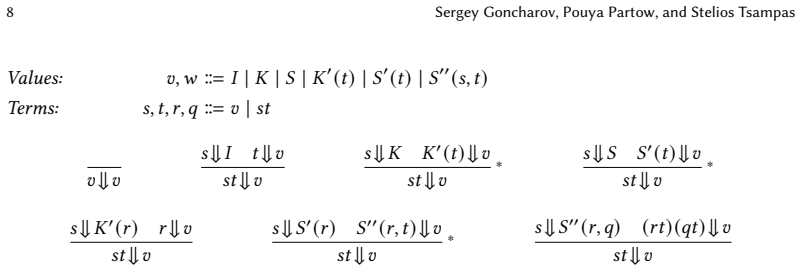
- Call-by-value can be accommodated, but only after rewriting the small-step system with auxiliary composition operators; the resulting big-step semantics matches the original call-by-value multi-step behaviour.
- The lambda calculus with binders is covered via a presheaf category with a substitution tensor: the abstract equivalence is re-proven in that setting (Theorem 7.3), yielding the usual big-step rules for call-by-name $\lambda$-calculus.
- Because the equivalence is parametric in syntax and behaviour, the same proof infrastructure applies to other effects captured by $\omega$-continuous monads, with nondeterminism (powerset monad) and partiality as the paper's running examples.
Reading between the lines
- The strong separation condition is effectively a 'no surprises' constraint on rule formats: the paper itself notes its resemblance to cool formats and patience rules; a practical upshot is that language designers who want the equivalence theorem can use it as a checklist and can repair violations by adding auxiliary operators, as done for call-by-value.
- The parametric proof suggests a testable recipe for new language features: encode the feature as value and computation formers, check strong separation, and the equivalence follows without a bespoke argument; a natural next test is probabilistic or weighted semantics, where a quantitative monad would replace the powerset monad.
- An implicit consequence is that failures of $\left(\star\right)$ are diagnosable: a separated but not strongly separated specification (such as Example 2.1) provably cannot admit any big-step semantics satisfying the equivalence, so the condition pinpoints why a rule set is too fine-grained for big-step reasoning.
- The call-by-value treatment suggests a general principle: a big-step semantics over the original signature may not exist, but a definitional extension with auxiliary operators can restore it — connecting the abstract framework to pretty-big-step semantics, as the paper notes.
Editorial analysis
A structured set of objections, weighed in public.
Referee Report
Summary. The paper develops a categorical framework for deriving big-step operational semantics from small-step operational semantics in higher-order mathematical operational semantics. It introduces separated abstract HO-GSOS laws (Definition 3.1), a strong-separation condition (Definition 3.6), and an abstract notion of big-step SOS (Definition 4.1), together with a construction translating a small-step law into a big-step law. The main result, Theorem 5.4, states that for strongly separated abstract HO-GSOS laws with an omega-continuous distributive law, the canonical big-step semantics zeta_hat equals the multi-step small-step semantics beta_hat. The paper presents case studies for typed combinatory logic, recursion and conditionals, nondeterminism and parallelism, call-by-value, and the lambda calculus with binders, and includes Haskell implementations of several examples and proofs in the appendix.
Significance. If the main theorem and its instantiations are fully justified, this is a valuable contribution: it provides a single abstract account of the equivalence between small-step and big-step operational semantics, going beyond syntax-driven translations and covering a wide range of language features. The paper is careful to state hypotheses, gives a counterexample (Example 2.1) showing that strong separation is genuinely needed, and provides detailed appendix proofs for the central lemmas. The Haskell implementation is a useful companion artifact. The main weakness is the gap between the omega-continuity hypothesis of Theorem 5.4 and the deterministic case studies, which are formulated with the identity monad; this gap is repairable but currently affects the scope claims.
major comments (2)
- [Section 5, Theorem 5.4; Sections 6.1, 6.2, 6.4] Theorem 5.4 assumes an omega-continuous monad T, as stated at the beginning of Section 5 and needed for the least-fixpoint definitions in (19) and (20). However, the deterministic case studies in Sections 6.1, 6.2, and 6.4 are presented with T = Id, which the paper itself notes is not omega-continuous. Proposition 3.11 is cited as a way to lift a deterministic law to a powerset-valued law, but the paper never proves the required conservative-extension lemma: for every term t, the lifted semantics should satisfy zeta_hat(t) = {v} exactly when t evaluates to v and beta_hat(t) = {v} exactly when t reduces to the value v, and be empty otherwise. Without such a lemma, Theorem 5.4 applies only to the powerset-lifted versions of these examples, not to the deterministic semantics the paper claims to cover.
- [Section 6.4, call-by-value] The paragraph claiming that 'for terms in the original signature (without G# and ) we obtain the same big-step semantics as in (25)' and the subsequent claim that the two variants of the small-step semantics are equivalent in multi-step behaviour are stated without proof. This equivalence is load-bearing for the call-by-value case study, because the auxiliary operators G# and are introduced precisely to satisfy strong separation while recovering the original multi-step relation. A proof or at least a precise statement of this example-level equivalence should be provided.
minor comments (3)
- [Section 6.4, rule display] The displayed rules for the call-by-value small-step semantics run together in the text; the rules (a), (b), and (c) should be separated clearly, and each rule should be labelled consistently so that the later references to (a1) and (a2) are easy to follow.
- [Section 7, Theorem 7.3] The statement of Theorem 7.3 says the proof 'remains essentially unchanged' from that of Theorem 5.4; since the definition of zeta_hat is modified in Section 7.3, it would help the reader to spell out at least the one place where Proposition 7.2 is substituted for Proposition 5.3 and to verify that strong separation still yields the analogue of Lemma 5.1 in the pointed-strength setting.
- [Proposition 3.11] The factorization condition in Proposition 3.11 is stated abstractly, and the verification in Remark 3.12 covers only the powerset monad. A brief explanation of how the partiality monad or other omega-continuous monads would satisfy this condition would make the proposition's range of applicability clearer.
Circularity Check
No circularity: Theorem 5.4 proves the equality of two separately defined least fixpoints; strong separation is an explicit hypothesis, not a renamed version of the conclusion.
full rationale
The central claim is Theorem 5.4, asserting ζ̂ = β̂. These are not the same object by construction: ζ̂ is the least fixpoint (19) of a functional built from the derived big-step transformation ξ (17), while β̂ is the least fixpoint (20) built from the small-step operational model γc. The proof in Section 5 proceeds by mutual inequalities, using Lemmas 5.1 and 5.2, and neither lemma assumes the equality. Strong separation (Definition 3.6) is an explicit structural hypothesis on the small-step law; its role is to make the two approximating chains comparable, and Example 2.1 shows that without it the desired equivalence can fail, so the condition is not a disguised form of the theorem. The big-step rules are derived from the small-step law rather than fitted to the expected answer, and the equality is proved, not postulated. Self-citations to [21] supply the prior abstract HO-GSOS framework and the standard operational model, but the equivalence result and its proof are developed in this paper; Proposition 2.2 is proved in the appendix rather than merely imported. The noted gap concerning ω-continuity of the identity monad and the conservative-extension status of Proposition 3.11 is a scope or verification concern about how the deterministic examples instantiate the theorem, not a circularity in the abstract derivation. Therefore the derivation chain is self-contained and no circular step is exhibited.
Assumptions & free parameters
assumptions (7)
- standard math The ambient category C is distributive, with finite products and coproducts interacting via the canonical isomorphism.
- domain assumption The monad T is strong and ω-continuous, i.e., its Kleisli category is enriched over pointed ω-cpos with continuous strength and copairing.
- domain assumption The separated HO-GSOS law consists of ρv: ΣvX → D(X, Σ*X), ρc: Σc(X×B(X,Y),X) → TΣ*(X+Y), dinatural in X and natural in Y, and a distributive law χ: Σc(TX,Y) → TΣc(X,Y).
- standard math Assumption 3.4: the morphisms Σc(inl,id) are complemented, with a natural coproduct decomposition Θ(X,Y,Z) → Σc(X+Y,Z).
- ad hoc to paper Strong separation condition (Definition 3.6): a commutativity diagram constraining ρc on rules with at least one computation-premise, involving Θ, χ, and copairing.
- domain assumption The distributive law χ is ω-continuous.
- domain assumption For the binder extension, C is closed monoidal and the signature Σ'v + ΣcΔ has pointed strength, yielding a monoid structure on the initial algebra μΣ.
Cite this review
Pith. "Pith review of Big Steps in Higher-Order Mathematical Operational Semantics." pith.science (2026). https://pith.science/paper/ZKI6TTRI
@misc{pith2026250601076,
  author       = {Pith},
  title        = {Pith review of: Big Steps in Higher-Order Mathematical Operational Semantics},
  year         = {2026},
  howpublished = {\url{https://pith.science/paper/ZKI6TTRI}},
  note         = {Machine review of arXiv:2506.01076}
}
read the original abstract
Small-step and big-step operational semantics are two fundamental styles of structural operational semantics (SOS), extensively used in practice. The former one is more fine-grained and is usually regarded as primitive, as it only defines a one-step reduction relation between a given program and its direct descendant under an ambient evaluation strategy. The latter one implements, in a self-contained manner, such a strategy directly by relating a program to the net result of the evaluation process. The agreement between these two styles of semantics is one of the key pillars in operational reasoning on programs; however, such agreement is typically proven from scratch every time on a case-by-case basis. A general, abstract mathematical argument behind this agreement is up till now missing. We cope with this issue within the framework of higher-order mathematical operational semantics by providing an abstract categorical notion of big-step SOS, complementing the existing notion of abstract higher-order GSOS. Moreover, we introduce a general construction for deriving the former from the latter, and prove an abstract equivalence result between the two.
Figures


Figures from the paper (3 more)


Reference graph
Works this paper leans on
- [1]
-
[2]
Thorsten Altenkirch, Nils Danielsson, and Nicolai Kraus. 2017. Partiality, Revisited - The Partiality Monad as a Quotient Inductive-Inductive Type. In Foundations of Software Science and Computation Structures, FOSSACS 2017 (LNCS, Vol. 10203), Javier Esparza and Andrzej Murawski (Eds.). 534–549
work page 2017
-
[3]
Guillaume Ambal, Alan Schmitt, and Sergueï Lenglet. 2020. Automatic Transformation of a Big-Step Skeletal Semantics into Small-Step. Ph. D. Dissertation. Inria Rennes-Bretagne Atlantique
work page 2020
-
[4]
Steve Awodey. 2010. Category Theory (2nd ed.). Oxford University Press, Inc., New York, NY, USA
work page 2010
-
[5]
Casper Bach Poulsen and Peter D. Mosses. 2014. Deriving Pretty-Big-Step Semantics from Small-Step Semantics. In Proceedings of the 23rd European Symposium on Programming Languages and Systems - Volume 8410 . Springer-Verlag, Berlin, Heidelberg, 270–289. doi:10.1007/978-3-642-54833-8_15
- [6]
-
[7]
Bard Bloom. 1995. Structural Operational Semantics for Weak Bisimulations. Theor. Comput. Sci. 146, 1&2 (1995), 25–68. doi:10.1016/0304-3975(94)00152-9
-
[8]
Venanzio Capretta. 2005. General recursion via coinductive types. Log. Meth. Comput. Sci. 1, 2 (2005)
work page 2005
Show all 41 references
-
[9]
James Chapman, Tarmo Uustalu, and Niccolò Veltri. 2015. Quotienting the Delay Monad by Weak Bisimilarity. In Theoretical Aspects of Computing, ICTAC 2015 (LNCS, Vol. 9399) . Springer, 110–125
2015
-
[10]
Arthur Charguéraud. 2013. Pretty-Big-Step Semantics. In Programming Languages and Systems, Matthias Felleisen and Philippa Gardner (Eds.). Springer Berlin Heidelberg, Berlin, Heidelberg, 41–60
2013
-
[11]
Ştefan Ciobâcă. 2013. From Small-Step Semantics to Big-Step Semantics, Automatically. In Integrated Formal Methods, Einar Broch Johnsen and Luigia Petre (Eds.). Springer Berlin Heidelberg, Berlin, Heidelberg, 347–361
2013
-
[12]
H. B. Curry. 1930. Grundlagen der Kombinatorischen Logik. Am. J. Math. 52, 3 (1930), 509–536. http://www.jstor.org/ stable/2370619
1930
-
[13]
Nils Anders Danielsson. 2012. Operational semantics using the partiality monad. In Proceedings of the 17th ACM SIGPLAN International Conference on Functional Programming (ICFP 2012) . Association for Computing Machinery, New York, NY, USA, 127–138. doi:10.1145/2364527.2364546
2012
-
[14]
Deliguoro and A
U. Deliguoro and A. Piperno. 1995. Nondeterministic Extensions of Untyped𝜆-Calculus. Information and Computation 122, 2 (1995), 149–177. doi:10.1006/inco.1995.1145
1995
-
[15]
Mariangiola Dezani-Ciancaglini, Ugo de’Liguoro, and Adolfo Piperno. 1998. A Filter Model for Concurrent Lambda- Calculus. SIAM J. Comput. 27, 5 (1998), 1376–1419. doi:10.1137/S0097539794275860
1998 doi
-
[16]
Marcelo P. Fiore. 2008. Second-Order and Dependently-Sorted Abstract Syntax. In 23d Annual IEEE Symposium on Logic in Computer Science (LICS 2008) . IEEE Computer Society, 57–68. doi:10.1109/LICS.2008.38
2008 doi
-
[17]
Fiore, Gordon D
Marcelo P. Fiore, Gordon D. Plotkin, and Daniele Turi. 1999. Abstract Syntax and Variable Binding. In14th Annual IEEE Symposium on Logic in Computer Science (LICS 1999) . IEEE Computer Society, 193–202. doi:10.1109/LICS.1999.782615
1999
-
[18]
Gallagher, Manuel Hermenegildo, Bishoksan Kafle, Maximiliano Klemen, Pedro López García, and José Morales
John P. Gallagher, Manuel Hermenegildo, Bishoksan Kafle, Maximiliano Klemen, Pedro López García, and José Morales
-
[19]
Sergey Goncharov. 2021. Uniform Elgot Iteration in Foundations. In 48th International Colloquium on Automata, Languages, and Programming (ICALP 2021) (LIPIcs, Vol. 198) , Nikhil Bansal, Emanuela Merelli, and James Worrell (Eds.). Schloss Dagstuhl – Leibniz-Zentrum für Informat...
2021
-
[20]
Sergey Goncharov, Stefan Milius, Lutz Schröder, Stelios Tsampas, and Henning Urbat. 2022. Stateful Structural Operational Semantics. In 7th International Conference on Formal Structures for Computation and Deduction, FSCD’22 (LIPIcs, Vol. 228), Amy P. Felty (Ed.). Schloss Dags...
2022 doi
-
[21]
Sergey Goncharov, Stefan Milius, Lutz Schröder, Stelios Tsampas, and Henning Urbat. 2023. Towards a Higher-Order Mathematical Operational Semantics. Proc. ACM Program. Lang. 7, POPL (2023), 632–658. doi:10.1145/3571215
2023 doi
-
[22]
Sergey Goncharov, Alessio Santamaria, Lutz Schröder, Stelios Tsampas, and Henning Urbat. 2024. Logical Predicates in Higher-Order Mathematical Operational Semantics. In Foundations of Software Science and Computation Structures , Naoki Kobayashi and James Worrell (Eds.). Sprin...
2024
-
[23]
Sergey Goncharov, Lutz Schröder, Christoph Rauch, and Julian Jakob. 2018. Unguarded Recursion on Coinductive Resumptions. Log. Methods Comput. Sci. 14, 3 (2018)
2018
-
[24]
Andrew D. Gordon. 1999. Bisimilarity as a Theory of Functional Programming. Theor. Comput. Sci. 228, 1-2 (1999), 5–47. doi:10.1016/S0304-3975(98)00353-3
1999 doi
-
[25]
Ichiro Hasuo, Bart Jacobs, and Ana Sokolova. 2007. Generic Trace Semantics via Coinduction. Logical Methods in Computer Science 3, 4 (2007). doi:10.2168/LMCS-3(4:11)2007 28 Sergey Goncharov, Pouya Partow, and Stelios Tsampas
2007 doi
-
[26]
Roger Hindley and Jonathan P
J. Roger Hindley and Jonathan P. Seldin. 2008. Lambda-Calculus and Combinators: An Introduction (2 ed.). Cambridge University Press. doi:10.1017/CBO9780511809835
2008 doi
-
[27]
André Hirschowitz, Tom Hirschowitz, Ambroise Lafont, and Marco Maggesi. 2022. Variable binding and substitution for (nameless) dummies. In 25th International Conference on Foundations of Software Science and Computation Structures (FOSSACS 2022) (LNCS, Vol. 13242). Springer, 3...
2022 doi
-
[28]
Anders Kock. 1972. Strong Functors and Monoidal Monads. Archiv der Mathematik 23, 1 (1972), 113–120
1972
-
[29]
Ugo Dal Lago and Margherita Zorzi. 2012. Probabilistic operational semantics for the lambda calculus. RAIRO - Theoretical Informatics and Applications - Informatique Théorique et Applications 46, 3 (2012), 413–450. doi:10.1051/ita/ 2012012
2012 doi
-
[30]
James Laird. 2016. Weighted Relational Models for Mobility. In 1st International Conference on Formal Structures for Computation and Deduction (FSCD 2016) (Leibniz International Proceedings in Informatics (LIPIcs), Vol. 52) , Delia Kesner and Brigitte Pientka (Eds.). Schloss D...
2016 doi
-
[31]
Mac Lane
S. Mac Lane. 1978. Categories for the Working Mathematician (2 ed.). Graduate Texts in Mathematics, Vol. 5. Springer. http://link.springer.com/10.1007/978-1-4757-4721-8
1978 doi
-
[32]
John McCarthy. 1959. A Basis for a Mathematical Theory of Computation. In Computer Programming and Formal Systems, P. Braffort and D. Hirschberg (Eds.). Studies in Logic and the Foundations of Mathematics, Vol. 26. Elsevier, 33–70. doi:10.1016/S0049-237X(09)70099-0
1959 doi
-
[33]
Mitchell
John C. Mitchell. 1996. Foundations for programming languages . MIT Press
1996
-
[34]
Eugenio Moggi. 1991. Notions of Computation and Monads. Inf. Comput. 93, 1 (1991), 55–92. doi:10.1016/0890- 5401(91)90052-4
1991 doi
-
[35]
Myreen, Ramana Kumar, and Yong Kiam Tan
Scott Owens, Magnus O. Myreen, Ramana Kumar, and Yong Kiam Tan. 2016. Functional Big-Step Semantics. In Proceedings of the 25th European Symposium on Programming Languages and Systems - Volume 9632 . Springer-Verlag, Berlin, Heidelberg, 589–615. doi:10.1007/978-3-662-49498-1_23
2016 doi
-
[36]
Stelios Tsampas, Christian Williams, Andreas Nuyts, Dominique Devriese, and Frank Piessens. 2021. Abstract Congruence Criteria for Weak Bisimilarity. In 46th International Symposium on Mathematical Foundations of Computer Science, MFCS’21 (LIPIcs, Vol. 202), Filippo Bonchi and...
2021 doi
-
[37]
Daniele Turi and Gordon D. Plotkin. 1997. Towards a Mathematical Operational Semantics. In 12th Annual IEEE Symposium on Logic in Computer Science (LICS 1997) . 280–291. doi:10.1109/LICS.1997.614955
1997
-
[38]
Henning Urbat, Stelios Tsampas, Sergey Goncharov, Stefan Milius, and Lutz Schröder. 2023. Weak Similarity in Higher-Order Mathematical Operational Semantics. In 2023 38th Annual ACM/IEEE Symposium on Logic in Computer Science (LICS). 1–13. doi:10.1109/LICS56636.2023.10175706
2023
-
[39]
Tarmo Uustalu. 2013. Coinductive big-step semantics for concurrency. Electronic Proceedings in Theoretical Computer Science, EPTCS 137 (2013), 63–78
2013
-
[40]
van Glabbeek
Rob J. van Glabbeek. 2011. On cool congruence formats for weak bisimulations. Theor. Comput. Sci. 412, 28 (2011), 3283–3302. doi:10.1016/j.tcs.2011.02.036 Big Steps in Higher-Order Mathematical Operational Semantics 29 A OMITTED PROOFS A.1 Proof of Proposition 2.2 We have the ...
2011 doi
-
[2020]
In Electronic Proceedings in Theoretical Computer Science, EPTCS , Vol
From big-step to small-step semantics and back with interpreter specialisation. In Electronic Proceedings in Theoretical Computer Science, EPTCS , Vol. 320. Open Publishing Association, 50–64. doi:10.4204/EPTCS.320.4
Reviewed August 7, 2026 · model on record in the stance chip above.
Discussion (0). Sign in to comment.