REVIEW 3 major objections 4 minor 69 references
A large magneto-optical trap of cadmium atoms loaded from a cryogenic buffer gas beam
T0 review · 3 major / 4 minor · reviewed 2026-08-07 · deepseek-v4-flash
Pith's one-line read A magneto-optical trap loaded from a pulsed cryogenic helium buffer gas beam captures about 11 million cadmium atoms in 10 ms on a 229 nm transition, beating the photoionization losses that have limited deep-ultraviolet magneto-optical…
desk verdict A real experimental advance in DUV laser cooling that deserves a serious referee, with the central atom-number claim being conservative and the main weak point being an unresolved 3-sigma spread in the photoionization cross-section extractions. read the letter →
The pith
A machine-rendered reading of the paper's core claim, the machinery that carries it, and where it could break.
The reading
What carries the argument
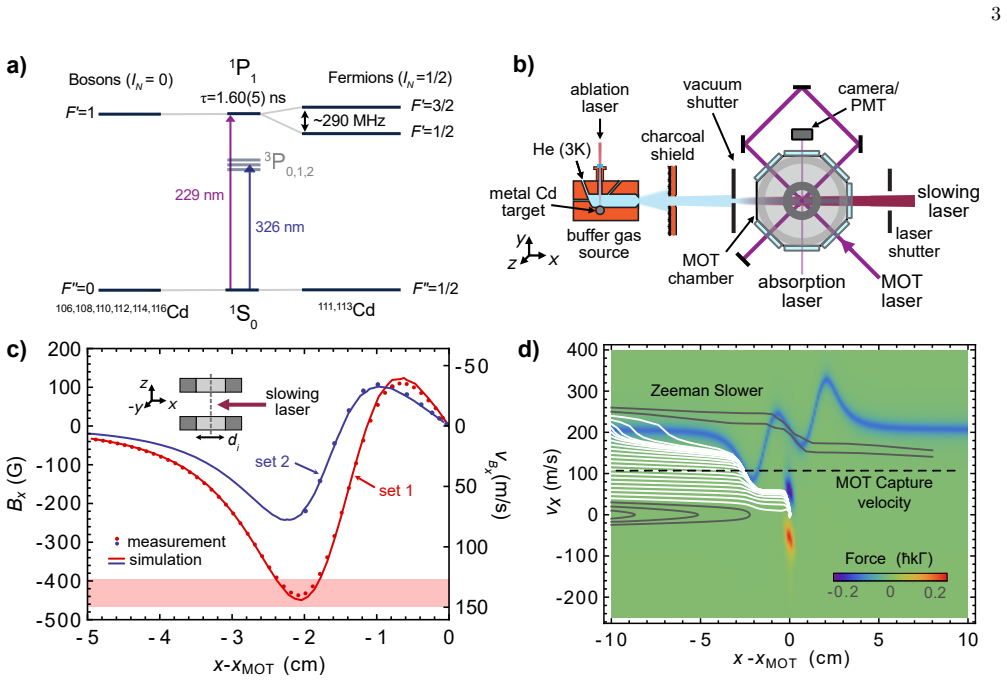
The object that carries the argument is the $^1S_0 \to {}^1P_1$ transition at 229 nm — the shortest-wavelength MOT transition built to date — whose 1.60(5) ns excited-state lifetime produces a very large radiation-pressure force and a wide 99.7 MHz linewidth. The second ingredient is the cryogenic buffer gas beam: a roughly 1 ms pulse of atoms moving near 130 m/s with a 60 m/s spread, which delivers atoms into the trap's capture window instead of building a lossy background vapor. The trap's permanent-magnet quadrupole field doubles as a Zeeman slower — a magnetic ramp that keeps decelerating atoms in resonance with the counter-propagating slowing light — covering about 140 m/s of velocity change within 5 cm. The quantitative engine is the two-photon ionization loss model $A_{\mathrm{ion}} = I\,\sigma_{\mathrm{ion}}\,\rho_{ee}/\hbar\omega$, which separates light-induced loss from background-gas loss and yields the absolute photoionization cross-section; the switched-detuning protocol then lowers the excited-state fraction $\rho_{ee}$ after loading, lengthening the MOT lifetime while preserving the fast loading rate.
What would settle it
Measure the scattering rate per atom directly in the operating MOT — for example, by imaging fluorescence from a cloud of known atom number with independently calibrated collection efficiency — and compare it with the rate predicted from the measured beam power and profile. If the intensity the atoms actually sample is several times below the inferred 2.2 W/cm$^{2}$, as the trap-frequency data hint, then the fitted photoionization cross-section and the stated peak density must be revised downward by the same factor, while the $1.1\times 10^{7}$ atoms in 10 ms would remain.
Extended reading notes
Core claim
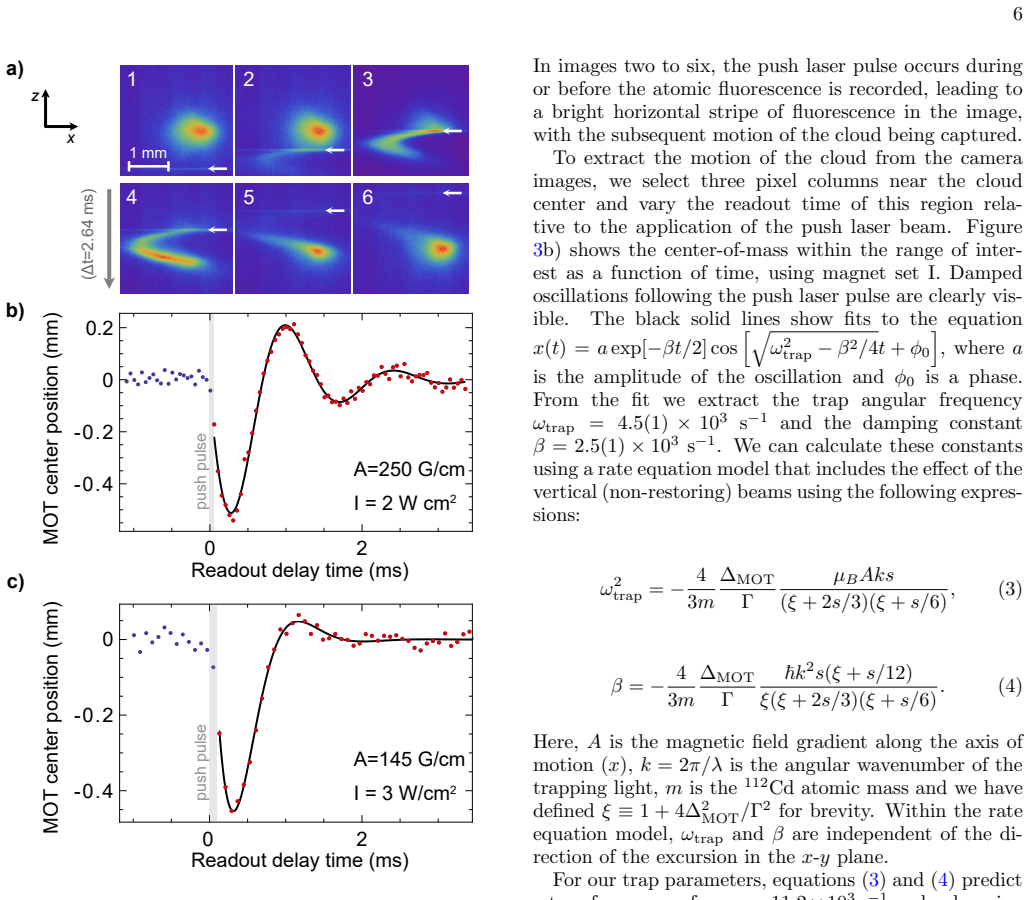
The central claim is that a pulsed buffer gas beam removes the trade-off that has choked deep-ultraviolet MOTs: thermal-vapor loading is slow, and slow loading is fatal when the cooling light itself ionizes the atoms. By firing a short, cold pulse of atoms moving near 130 m/s from a 3 K helium buffer gas source, the authors capture up to $1.1(2)\times 10^{7}$ $^{112}$Cd atoms in 10 ms — a loading rate over $10^{9}$ s$^{-1}$ — reaching a peak density of $2.5\times 10^{11}$ cm$^{-3}$ and a phase-space density of $2\times 10^{-9}$. The same quadrupole field that traps the atoms slows the incoming beam, because the broad linewidth ($\Gamma/2\pi = 99.7$ MHz) and strong force at 229 nm make a separate Zeeman slower unnecessary. From fluorescence, absorption imaging, and trap-oscillation measurements the authors extract the trap frequency, the damping constant, and the absolute photoionization cross-section of the $^1P_1$ state, and they reproduce the loading behavior with isotope-resolved trajectory simulations. The demonstration establishes that species with severe loss channels in their main cooling cycle can still reach high-density MOTs when the loading is fast enough.
Load-bearing premise
The quantitative results assume that the atoms feel the trapping-light intensity inferred from beam-power and profile measurements, but the paper's own trap-oscillation and fluorescence data indicate that the atoms actually see a lower average intensity; if so, the quoted density, phase-space density, and fitted photoionization cross-section are overestimates, while the rapid loading of roughly $10^{7}$ atoms would still stand.
Editorial extensions
If this is right
- Loading rates above $10^{9}$ s$^{-1}$ produce a full cadmium MOT in 10 ms, roughly a hundred times faster than thermal-vapor-loaded cadmium MOTs, shortening experimental cycles substantially.
- The quadrupole field doubling as the Zeeman slower keeps the combined trap-and-slowing assembly at about 0.2 liters and gives a capture velocity above 200 m/s without any separate slower magnet.
- Stepping the trapping-light detuning from $-1.5\Gamma$ to $-2\Gamma$ immediately after each pulse banks 3.5 times more atoms than a single pulse, making multi-pulse accumulation practical.
- With a temperature near 6.3 mK, a density of $2.5\times 10^{11}$ cm$^{-3}$, and a phase-space density of $2\times 10^{-9}$, the MOT is ready for transfer into a second-stage narrow-line MOT at 326 nm, the established route toward a cadmium optical lattice clock.
- The cryogenic-beam-plus-deep-UV recipe is the paper's stated foundation for trapping polar AlF molecules, which share cadmium's deep-UV cooling transition and comparable radiation-pressure forces.
Reading between the lines
- The switched-detuning scheme generalizes to any MOT whose cooling transition doubles as a loss channel: load briefly near resonance for maximal scattering, then detune to shrink the excited-state fraction; molecular MOTs with limited photon budgets, such as AlF, are the most direct beneficiaries.
- Because the measured ratio $\omega_{\mathrm{trap}}^{2}/\beta$ is nearly independent of laser intensity and detuning, it can serve future deep-UV MOTs as a built-in calibration observable that does not require knowing the absolute intensity.
- The two independent determinations of the cadmium $^1P_1$ photoionization cross-section differ by roughly three standard deviations, indicating that intensity calibration rather than counting statistics currently limits such measurements; a standardized beam-overlap calibration could tighten them.
- The absorption-based atom number is explicitly a lower bound, so an isotope-enriched target and a higher-repetition-rate ablation source — upgrades the authors name — could plausibly push the trapped atom number well beyond the quoted $1.1\times 10^{7}$.
Editorial analysis
A structured set of objections, weighed in public.
Referee Report
Summary. This paper reports a magneto-optical trap of cadmium atoms on the 229 nm 1S0→1P1 transition, loaded from a pulsed cryogenic helium buffer-gas beam. The central results are up to 1.1(2)×10^7 112Cd atoms captured in 10 ms, a peak density of 2.5×10^11 cm^-3, a phase-space density of 2×10^-9, and a loading rate exceeding 10^9 s^-1, roughly two orders of magnitude faster than previous thermal-vapor-loaded Cd MOTs. The authors also report measurements of the MOT trap frequency and damping constant, two independent determinations of the absolute photoionization cross-section of the 1P1 state, and a switched-detuning accumulation scheme that increases the final number by a factor of 1.6 relative to fixed detuning and by 3.5 relative to single-pulse loading. A subset of the measurements was reproduced on a second, nearly identical apparatus at Imperial College London, and pyLCP trajectory simulations are used to interpret the Zeeman-slower-assisted capture and isotope-dependent loading.
Significance. If the results hold, this is a significant experimental advance: it demonstrates that a cryogenic buffer-gas beam can load a deep-UV MOT of a species with a strong two-photon ionization loss channel, using a compact integrated Zeeman slower and a switched-detuning strategy to accumulate multiple pulses. The paper has important strengths. The atom-number measurement is based on absorption imaging with the resonant cross-section and neglect of line-broadening, so the quoted 1.1(2)×10^7 is explicitly a lower bound; this protects the central loading-rate claim. The switched-detuning gain is a direct comparative observation that does not depend on the photoionization cross-section. The independent partial reproduction at ICL and the use of an open-source simulation code add credibility. The quantitative photoionization characterization is, however, not yet on the same footing as the core loading demonstration: the two cross-section determinations disagree by about 3σ, and the trap-frequency measurements used to support the intensity calibration are made with large-amplitude oscillations and are therefore not directly comparable to the small-oscillation Doppler theory.
major comments (3)
- [Section III C, Table II] The two independent extractions of the 1P1 photoionization cross-section, 0.2(2)×10^-16 cm² (beam-loaded, FHI) and 0.8(2)×10^-16 cm² (dispenser-loaded, ICL), disagree by about 3σ, and the beam-loaded value is consistent with zero at the 1σ level. The abstract states that the absolute photoionization cross-section has been determined, and the conclusion states that photoionization losses have been characterized, but as presented the data constrain σ_ion only weakly and the two experiments are not mutually consistent under the model of Eq. (5). I ask the authors to reconcile these values explicitly, for example by identifying and propagating a common systematic model for the intensity actually seen by the atoms and for the spatial averaging in ρ_ee, or by quoting the result as a range or upper bound with the dominant systematics. Without this, the quantitative loss characterization is not established.
- [Section III B, Eqs. (3)-(4)] The measured trap frequency and damping constant are extracted from center-of-mass oscillations following kicks of 3–5 m/s, which produce excursions of order 1 mm for ω_trap ≈ 4.5×10^3 s^-1. In the 145–250 G/cm gradient and with 3.5 mm 1/e² beams, the atoms therefore sample substantially position-dependent magnetic fields and laser intensity during the oscillation. Equations (3)–(4) describe small-amplitude motion at the trap center, so the factors of 2.5 and 6 in Table I do not by themselves quantify the effective intensity correction at the trap center. Since Section III C invokes this discrepancy as evidence that 'atoms experience a lower average intensity than inferred from beam profile and power measurements,' the authors should either support that inference with a small-amplitude oscillation measurement or with a model that accounts for the position dependence of the scattering rate along the observed trajectory. The good agreement of the intensity-insensitive ratio ω_trap²/β is encouraging but does not fix the absolute scale.
- [Abstract and Section II] The abstract states that the setup 'yielding a capture velocity exceeding 200 m/s' as a result of this work, but this value comes from the pyLCP trajectory simulations in Section II (Fig. 1d), not from a direct velocity measurement. The simulated capture velocity depends on the assumed forward velocity distribution (mean 130 m/s, FWHM 60 m/s), the assumed transverse velocity profile, and the ad hoc 1.5 mrad slower-beam misalignment, none of which is independently characterized in the manuscript. The loading enhancement with the slower laser is a direct observation, but the specific capture-velocity claim should be presented as a simulation prediction (as it is in Section II) rather than as an experimental result, or supported by a velocity-selective or time-of-flight measurement.
minor comments (4)
- [Section III C] The text refers to 'Figure 4a)' when describing the MOT number and lifetime versus detuning, but the relevant panel is Figure 5a.
- [Section II] The phrase 'bored i' appears to be a typographical error for the inner bore diameter d_i of the permanent magnets.
- [Abstract] The abstract should distinguish more clearly between measured quantities and simulation predictions; in particular, the capture-velocity statement needs the same qualification as the main text.
- [Section III A] It would be helpful to state explicitly in the caption of Figure 2a that the fluorescence-based estimate N_MOT = 1.2×10^6 relies on the assumed peak intensity and scattering model, since the text makes this clear but the caption does not.
Circularity Check
No significant circularity: the MOT loading demonstration, trap dynamics, density and phase-space-density numbers are independent measurements, and the self-citations supply only measured inputs and comparisons rather than load-bearing justifications.
full rationale
The central claims are direct experimental observations, not reductions of inputs to outputs. The atom number N_MOT = 1.1(2)x10^7 is obtained from an absorption image using the resonant cross-section, with the paper explicitly noting that neglected broadening 'set[s] a lower bound to N_MOT' (Section III A); this conservative construction cannot manufacture a larger number from assumptions. The peak density and phase-space density follow from N, the measured cloud size, and T = m*omega_trap^2*<x^2>/k_B, where omega_trap = 4.5(1)x10^3 s^-1 is independently fit from damped center-of-mass oscillations and <x^2> from the images; equipartition is a standard external relation, not a fitted ansatz. The Doppler-theory comparison in Section III B is unforced: equations (3) and (4) predict omega_trap = 11.2x10^3 s^-1 and beta = 16.0x10^3 s^-1, which 'significantly exceed the experimentally observed ones,' and the paper reports this discrepancy instead of adjusting parameters to force agreement. The intensity-insensitive ratio omega_trap^2/beta is a genuine, unadjusted cross-check (theory 7.9x10^3 s^-1, experiment 8.1(5)x10^3 s^-1), not a fitted coincidence. The photoionization cross-section is a fit to loss-rate data using equation (5), presented as a measurement with honest systematic-error discussion; the paper explicitly acknowledges that the two extractions 'differ by approximately three standard deviations' (Table II) and compares them against the external result of Brickman et al. [20], so the fitted quantity is not renamed as a prediction nor used to force the central claim. The capture velocity exceeding 200 m/s is a pyLCP simulation output that 'qualitatively reproduce[s] the experimental observations'; it is not used retroactively to set experimental parameters. Self-citations ([30], [33], [32], [70]) supply measured isotope shifts, the 1P1 lifetime, and beam-brightness comparisons; Ref. [33] is an external published measurement with stated uncertainties and does not contain the present target results, so per the review rules it counts as real evidence rather than circular support. The intensity-calibration concern raised by the reader is a systematic-uncertainty issue, not circularity: the paper states that 'atoms experience a lower average intensity than inferred from beam profile and power measurements' but does not then re-derive the same measured trap frequencies or cross-sections from that adjusted intensity.
Assumptions & free parameters
free parameters (3)
- Photoionization cross-section sigma_ion (Cd 1P1) =
0.2(2) x 10^-16 cm^2 (beam-loaded); 0.8(2) x 10^-16 cm^2 (dispenser-loaded)
- Buffer gas beam forward velocity distribution (mean, FWHM) =
mean = 130 m/s, FWHM = 60 m/s
- Transverse velocity width and slower-beam misalignment =
top-hat range 14 m/s; angle 1.5 mrad
assumptions (3)
- domain assumption Doppler MOT rate-equation model with effective two-level parameters (Gamma_eff = 3Gamma/2, s_eff = 2s/3)
- domain assumption The intersystem decay 1P1 -> 3Pj is negligible
- domain assumption Background gas collision loss rate A0 is independent of MOT parameters
Cite this review
Pith. "Pith review of A large magneto-optical trap of cadmium atoms loaded from a cryogenic buffer gas beam." pith.science (2026). https://pith.science/paper/7UOWYHTN
@misc{pith2026250601180,
  author       = {Pith},
  title        = {Pith review of: A large magneto-optical trap of cadmium atoms loaded from a cryogenic buffer gas beam},
  year         = {2026},
  howpublished = {\url{https://pith.science/paper/7UOWYHTN}},
  note         = {Machine review of arXiv:2506.01180}
}
abstract
We demonstrate rapid loading of a magneto-optical trap (MOT) of cadmium atoms from a pulsed cryogenic helium buffer gas beam, overcoming strong photoionization losses. Using the $ ^1S_0 \rightarrow{} ^1P_1 $ transition at 229 nm, we capture up to $ 1.1(2) \times 10^7$ $^{112}$Cd atoms in 10 ms, achieving a peak density of $2.5 \times 10^{11}$cm$^{-3}$ and a phase-space density of $ 2 \times 10^{-9} $. The large scattering force in the deep ultraviolet enables Zeeman slowing within 5 cm of the trap, yielding a capture velocity exceeding 200 m/s. We measure the MOT trap frequency and damping constant, and determine the absolute photoionization cross section of the $^1P_1 $ state. Photoionization losses are mitigated via dynamic detuning of the trapping light's frequency, allowing efficient accumulation of multiple atomic pulses. Our results demonstrate the benefits of deep-UV (DUV) transitions and cryogenic beams for loading high-density MOTs, especially for species with significant loss channels in their main cooling cycle. The cadmium MOT provides a robust testbed that benchmarks our DUV laser cooling system and establishes the foundation for trapping and cooling polar AlF molecules, which share many optical and structural properties with Cd.
Figures

Figures from the paper (2 more)


Reference graph
Works this paper leans on
-
[1]
A. D. Ludlow, M. M. Boyd, J. Ye, E. Peik, and P. O. Schmidt, Optical atomic clocks, Rev. Mod. Phys.87, 637 (2015)
2015
-
[2]
Boulder Atomic Clock Optical Network (BACON) Col- laboration*, K. Beloy, M. I. Bodine, T. Bothwell, S. M. Brewer, S. L. Bromley, J.-S. Chen, J.-D. Deschˆ enes, S. A. Diddams, R. J. Fasano, T. M. Fortier, Y. S. Hassan, D. B. Hume, D. Kedar, C. J. Kennedy, I. Khader, A. Koepke, D. R. Leibrandt, H. Leopardi, A. D. Ludlow, W. F. McGrew, W. R. Milner, N. R. Ne...
work page 2021
-
[3]
J. J. McFerran, L. Yi, S. Mejri, S. Di Manno, W. Zhang, J. Gu´ ena, Y. Le Coq, and S. Bize, Erratum: Neutral atom frequency reference in the deep ultraviolet with fractional uncertainty = 5.7×10 −15 phys. rev. lett. 108, 183004 (2012), Physical Review Letters115, 219901 (2015)
work page 2012
- [4]
-
[5]
F. Ruschewitz, J. L. Peng, H. Hinderth¨ ur, N. Schaffrath, K. Sengstock, and W. Ertmer, Sub-kilohertz optical spec- troscopy with a time domain atom interferometer, Phys. Rev. Lett.80, 3173 (1998)
work page 1998
-
[6]
Poli, F.-Y
N. Poli, F.-Y. Wang, M. G. Tarallo, A. Alberti, M. Prevedelli, and G. M. Tino, Precision measurement of gravity with cold atoms in an optical lattice and com- parison with a classical gravimeter, Phys. Rev. Lett.106, 038501 (2011)
2011
-
[7]
M. Abe, P. Adamson, M. Borcean, D. Bortoletto, K. Bridges, S. P. Carman, S. Chattopadhyay, J. Cole- 10 man, N. M. Curfman, K. DeRose, T. Deshpande, S. Di- mopoulos, C. J. Foot, J. C. Frisch, B. E. Garber, S. Geer, V. Gibson, J. Glick, P. W. Graham, S. R. Hahn, R. Harnik, L. Hawkins, S. Hindley, J. M. Hogan, Y. Jiang, M. A. Kasevich, R. J. Kellett, M. Kibu...
work page 2021
-
[8]
G. M. Tino, Testing gravity with cold atom interferom- etry: results and prospects, Quantum Science and Tech- nology6, 024014 (2021)
work page 2021
Show all 69 references
-
[10]
A. J. Daley, M. M. Boyd, J. Ye, and P. Zoller, Quantum computing with alkaline-earth-metal atoms, Phys. Rev. Lett.101, 170504 (2008)
2008
-
[11]
A. V. Gorshkov, M. Hermele, V. Gurarie, C. Xu, P. S. Julienne, J. Ye, P. Zoller, E. Demler, M. D. Lukin, and A. M. Rey, Two-orbital SU(N) magnetism with ultracold alkaline-earth atoms, Nature Physics6, 289 (2010)
2010
-
[12]
A. J. Daley, Quantum computing and quantum simula- tion with group-II atoms, Quantum Information Process- ing10, 865 (2011)
2011
-
[13]
Pagano, F
G. Pagano, F. Scazza, and M. Foss-Feig, Fast and Scalable Quantum Information Processing with Two- Electron Atoms in Optical Tweezer Arrays, Advanced Quantum Technologies2, 1800067 (2019)
2019
-
[14]
I. S. Madjarov, J. P. Covey, A. L. Shaw, J. Choi, A. Kale, A. Cooper, H. Pichler, V. Schkolnik, J. R. Williams, and M. Endres, High-fidelity entanglement and detection of alkaline-earth Rydberg atoms, Nature Physics16, 857 (2020)
2020
-
[15]
Bloch, J
I. Bloch, J. Dalibard, and S. Nascimb` ene, Quantum sim- ulations with ultracold quantum gases, Nature Physics 8, 267 (2012)
2012
-
[16]
Sch¨ afer, T
F. Sch¨ afer, T. Fukuhara, S. Sugawa, Y. Takasu, and Y. Takahashi, Tools for quantum simulation with ultra- cold atoms in optical lattices, Nature Reviews Physics2, 411 (2020)
2020
-
[17]
J. C. Berengut, D. Budker, C. Delaunay, V. V. Flam- baum, C. Frugiuele, E. Fuchs, C. Grojean, R. Harnik, R. Ozeri, G. Perez, and Y. Soreq, Probing new long- range interactions by isotope shift spectroscopy, Phys. Rev. Lett.120, 091801 (2018)
2018
-
[18]
M. S. Safronova, D. Budker, D. DeMille, D. F. J. Kimball, A. Derevianko, and C. W. Clark, Search for new physics with atoms and molecules, Rev. Mod. Phys.90, 025008 (2018)
2018
-
[19]
B¨ uki, D
M. B¨ uki, D. R¨ oser, and S. Stellmer, Frequency- quintupled laser at 308 nm for atomic physics applica- tions, Appl. Opt.60, 9915 (2021)
2021
-
[20]
Brickman, M.-S
K.-A. Brickman, M.-S. Chang, M. Acton, A. Chew, D. Matsukevich, P. C. Haljan, V. S. Bagnato, and C. Monroe, Magneto-optical trapping of cadmium, Phys. Rev. A76, 043411 (2007)
2007
-
[21]
Kaneda, J
Y. Kaneda, J. M. Yarborough, Y. Merzlyak, A. Ya- maguchi, K. Hayashida, N. Ohmae, and H. Katori, Continuous-wave, single-frequency 229 nm laser source for laser cooling of cadmium atoms, Opt. Lett.41, 705 (2016)
2016
-
[22]
Schussheim and K
D. Schussheim and K. Gibble, Laser system to laser-cool and trap cadmium: towards a cadmium optical lattice clock, inFrontiers in Optics / Laser Science(Optica Publishing Group, 2018) p. LTh1F.2
2018
-
[23]
Yamaguchi, M
A. Yamaguchi, M. S. Safronova, K. Gibble, and H. Ka- tori, Narrow-line cooling and determination of the magic wavelength of Cd, Phys. Rev. Lett.123, 113201 (2019)
2019
-
[24]
J. N. Tinsley, S. Bandarupally, J.-P. Penttinen, S. Man- zoor, S. Ranta, L. Salvi, M. Guina, and N. Poli, Watt- level blue light for precision spectroscopy, laser cooling and trapping of strontium and cadmium atoms, Opt. Ex- press29, 25462 (2021)
2021
-
[25]
J. N. Tinsley, S. Bandarupally, M. Chiarotti, S. Manzoor, L. Salvi, and N. Poli, Prospects for a simultaneous atom interferometer with ultracold cadmium and strontium for fundamental physics tests, inOptical and Quantum Sens- ing and Precision Metrology II, Vol. 12016, edited ...
2022
-
[26]
Bandarupally, J
S. Bandarupally, J. N. Tinsley, M. Chiarotti, and N. Poli, Design and simulation of a source of cold cadmium for atom interferometry, Journal of Physics B: Atomic, Molecular and Optical Physics56, 185301 (2023)
2023
-
[27]
Gibble, Laser-cooling Cadmium Bosons and Fermions with Near Ultraviolet Triplet Excitations, Journal of Physics: Conference Series2889, 012006 (2024)
K. Gibble, Laser-cooling Cadmium Bosons and Fermions with Near Ultraviolet Triplet Excitations, Journal of Physics: Conference Series2889, 012006 (2024)
2024
-
[28]
Lavigne, T
Q. Lavigne, T. Groh, and S. Stellmer, Magneto-optical trapping of mercury at high phase-space density, Phys. Rev. A105, 033106 (2022)
2022
-
[29]
V. A. Dzuba and A. Derevianko, Blackbody radiation shift for the 1S0 −3 P0 optical clock transition in zinc and cadmium atoms, Journal of Physics B: Atomic, Molecular and Optical Physics52, 215005 (2019)
2019
-
[30]
Ohayon, S
B. Ohayon, S. Hofs¨ ass, J. E. Padilla-Castillo, S. C. Wright, G. Meijer, S. Truppe, K. Gibble, and B. K. Sahoo, Isotope shifts in cadmium as a sensitive probe for physics beyond the standard model, New Journal of Physics24, 123040 (2022)
2022
-
[31]
Truppe, S
S. Truppe, S. Marx, S. Kray, M. Doppelbauer, S. Hofs¨ ass, H. C. Schewe, N. Walter, J. P´ erez-R ´ ıos, B. G. Sar- takov, and G. Meijer, Spectroscopic characterization of aluminum monofluoride with relevance to laser cooling and trapping, Phys. Rev. A100, 052513 (2019)
2019
-
[32]
Hofs¨ ass, M
S. Hofs¨ ass, M. Doppelbauer, S. Wright, S. Kray, B. Sar- takov, J. P´ erez-R ´ ıos, G. Meijer, and S. Truppe, Optical cycling of AlF molecules, New Journal of Physics23, 075001 (2021)
2021
-
[33]
Hofs¨ ass, J
S. Hofs¨ ass, J. E. Padilla-Castillo, S. C. Wright, S. Kray, R. Thomas, B. G. Sartakov, B. Ohayon, G. Meijer, and S. Truppe, High-resolution isotope-shift spectroscopy of Cd I, Phys. Rev. Res.5, 013043 (2023)
2023
-
[34]
Kuwamoto, K
T. Kuwamoto, K. Honda, Y. Takahashi, and T. Yabuzaki, Magneto-optical trapping of Yb atoms using an intercombination transition, Physical Review A 60, R745 (1999)
1999
-
[35]
Hemmerling, G
B. Hemmerling, G. K. Drayna, E. Chae, A. Ravi, and J. M. Doyle, Buffer gas loaded magneto-optical traps for Yb, Tm, Er and Ho, New Journal of Physics16, 063070 (2014)
2014
-
[36]
J. J. McClelland and J. L. Hanssen, Laser cooling without repumping: A magneto-optical trap for erbium atoms, 11 Phys. Rev. Lett.96, 143005 (2006)
2006
-
[37]
C. C. Bradley, J. J. McClelland, W. R. Anderson, and R. J. Celotta, Magneto-optical trapping of chromium atoms, Phys. Rev. A61, 053407 (2000)
2000
-
[38]
J. Miao, J. Hostetter, G. Stratis, and M. Saffman, Magneto-optical trapping of holmium atoms, Phys. Rev. A89, 041401 (2014)
2014
-
[39]
Sukachev, A
D. Sukachev, A. Sokolov, K. Chebakov, A. Akimov, S. Kanorsky, N. Kolachevsky, and V. Sorokin, Magneto- optical trap for thulium atoms, Phys. Rev. A82, 011405 (2010)
2010
-
[40]
M. Lu, S. H. Youn, and B. L. Lev, Trapping ultracold dysprosium: A highly magnetic gas for dipolar physics, Phys. Rev. Lett.104, 063001 (2010)
2010
-
[41]
Eustice, K
S. Eustice, K. Cassella, and D. Stamper-Kurn, Laser cooling of transition-metal atoms, Phys. Rev. A102, 053327 (2020)
2020
-
[42]
Barry, D
J. Barry, D. McCarron, E. Norrgard, M. Steinecker, and D. DeMille, Magneto-optical trapping of a diatomic molecule, Nature512, 286 (2014)
2014
-
[43]
Truppe, H
S. Truppe, H. Williams, M. Hambach, L. Caldwell, N. Fitch, E. Hinds, B. Sauer, and M. Tarbutt, Molecules cooled below the doppler limit, Nature Physics13, 1173 (2017)
2017
-
[44]
Anderegg, B
L. Anderegg, B. L. Augenbraun, E. Chae, B. Hemmer- ling, N. R. Hutzler, A. Ravi, A. Collopy, J. Ye, W. Ket- terle, and J. M. Doyle, Radio frequency magneto-optical trapping of CaF with high density, Phys. Rev. Lett.119, 103201 (2017)
2017
-
[45]
A. L. Collopy, S. Ding, Y. Wu, I. A. Finneran, L. An- deregg, B. L. Augenbraun, J. M. Doyle, and J. Ye, 3D magneto-optical trap of yttrium monoxide, Phys. Rev. Lett.121, 213201 (2018)
2018
-
[46]
Z. D. Lasner, A. Frenett, H. Sawaoka, L. Anderegg, B. Augenbraun, H. Lampson, M. Li, A. Lunstad, J. Mango, A. Nasir, T. Ono, T. Sakamoto, and J. M. Doyle, Magneto-optical trapping of a heavy polyatomic molecule for precision measurement, Phys. Rev. Lett. 134, 083401 (2025)
2025
-
[47]
N. B. Vilas, C. Hallas, L. Anderegg, P. Robichaud, A. Winnicki, D. Mitra, and J. M. Doyle, Magneto- optical trapping and sub-doppler cooling of a polyatomic molecule, Nature606, 70 (2022)
2022
-
[48]
Z. Zeng, S. Deng, S. Yang, and B. Yan, Three- dimensional magneto-optical trapping of barium monofluoride, Phys. Rev. Lett.133, 143404 (2024)
2024
-
[49]
N. R. Hutzler, H.-I. Lu, and J. M. Doyle, The buffer gas beam: An intense, cold, and slow source for atoms and molecules, Chemical Reviews112, 4803 (2012), pMID: 22571401
2012
-
[50]
Truppe, M
S. Truppe, M. Hambach, S. M. Skoff, N. E. Bulleid, J. S. Bumby, R. J. Hendricks, E. A. Hinds, B. E. Sauer, and M. R. Tarbutt, A buffer gas beam source for short, in- tense and slow molecular pulses, Journal of Modern Op- tics65, 648 (2018)
2018
-
[51]
Eckel, D
S. Eckel, D. S. Barker, E. B. Norrgard, and J. Scher- schligt, Pylcp: A python package for computing laser cooling physics, Computer Physics Communications270, 108166 (2022)
2022
-
[52]
Gr¨ unert and A
J. Gr¨ unert and A. Hemmerich, Sub-doppler magneto- optical trap for calcium, Phys. Rev. A65, 041401 (2002)
2002
-
[53]
F. Y. Loo, A. Brusch, S. Sauge, M. Allegrini, E. Ari- mondo, N. Andersen, and J. W. Thomsen, Investigations of a two-level atom in a magneto-optical trap using mag- nesium, Journal of Optics B: Quantum and Semiclassical Optics6, 81 (2003)
2003
-
[54]
X. Xu, T. H. Loftus, M. J. Smith, J. L. Hall, A. Gal- lagher, and J. Ye, Dynamics in a two-level atom magneto- optical trap, Phys. Rev. A66, 011401 (2002)
2002
-
[55]
Kohns, P
P. Kohns, P. Buch, W. S¨ uptitz, C. Csambal, and W. Ert- mer, On-line measurement of sub-doppler temperatures in a rb magneto-optical trap-by-trap centre oscillations, Europhysics Letters22, 517 (1993)
1993
-
[56]
D. N. Madsen and J. W. Thomsen, Measurement of ab- solute photo-ionization cross sections using magnesium magneto-optical traps, Journal of Physics B: Atomic, Molecular and Optical Physics35, 2173 (2002)
2002
-
[57]
J. C. Shaw and D. J. McCarron, Bright, continuous beams of cold free radicals, Phys. Rev. A102, 041302 (2020)
2020
-
[58]
Madsen, P
D. Madsen, P. Yu, S. Balslev, and J. Thomsen, Gener- ation of 99-mW continuous-wave 285-nm radiation for magneto-optical trapping of Mg atoms, Applied Physics B: Lasers and Optics75, 835 (2002)
2002
-
[59]
Riedmann, H
M. Riedmann, H. Kelkar, T. W¨ ubbena, A. Pape, A. Ku- losa, K. Zipfel, D. Fim, S. R¨ uhmann, J. Friebe, W. Ert- mer, and E. Rasel, Beating the density limit by contin- uously loading a dipole trap from millikelvin-hot magne- sium atoms, Physical Review A86, 043416 (2012)
2012
-
[60]
E. A. Curtis, C. W. Oates, and L. Hollberg, Quenched narrow-line laser cooling of 40 Ca to near the photon recoil limit, Physical Review A64, 031403 (2001)
2001
-
[61]
Binnewies, G
T. Binnewies, G. Wilpers, U. Sterr, F. Riehle, J. Helm- cke, T. E. Mehlst¨ aubler, E. M. Rasel, and W. Ertmer, Doppler Cooling and Trapping on Forbidden Transitions, Physical Review Letters87, 123002 (2001)
2001
-
[62]
Gr¨ unert and A
J. Gr¨ unert and A. Hemmerich, Sub-Doppler magneto- optical trap for calcium, Physical Review A65, 041401 (2002)
2002
-
[63]
Katori, T
H. Katori, T. Ido, Y. Isoya, and M. Kuwata-Gonokami, Magneto-Optical Trapping and Cooling of Strontium Atoms down to the Photon Recoil Temperature, Phys- ical Review Letters82, 1116 (1999)
1999
-
[64]
Courtillot, A
I. Courtillot, A. Quessada, R. P. Kovacich, J.-J. Zondy, A. Landragin, A. Clairon, and P. Lemonde, Efficient cool- ing and trapping of strontium atoms, Optics Letters28, 468 (2003)
2003
-
[65]
Nosske, L
I. Nosske, L. Couturier, F. Hu, C. Tan, C. Qiao, J. Blume, Y. H. Jiang, P. Chen, and M. Weidem¨ uller, Two-dimensional magneto-optical trap as a source for cold strontium atoms, Physical Review A96, 053415 (2017)
2017
-
[66]
Honda, Y
K. Honda, Y. Takahashi, T. Kuwamoto, M. Fujimoto, K. Toyoda, K. Ishikawa, and T. Yabuzaki, Magneto- optical trapping of Yb atoms and a limit on the branch- ing ratio of the 1P1 state, Physical Review A59, R934 (1999)
1999
-
[67]
Letellier, ´A
H. Letellier, ´A. Mitchell Galv˜ ao De Melo, A. Dorne, and R. Kaiser, Loading of a large Yb MOT on the 1S0 →1P1 transition, Review of Scientific Instruments94, 123203 (2023)
2023
-
[68]
Hachisu, K
H. Hachisu, K. Miyagishi, S. G. Porsev, A. Derevianko, V. D. Ovsiannikov, V. G. Pal’chikov, M. Takamoto, and H. Katori, Trapping of Neutral Mercury Atoms and Prospects for Optical Lattice Clocks, Physical Review Letters100, 053001 (2008)
2008
-
[69]
Petersen, R
M. Petersen, R. Chicireanu, S. T. Dawkins, D. V. Mag- 12 alh˜ aes, C. Mandache, Y. Le Coq, A. Clairon, and S. Bize, Doppler-Free Spectroscopy of the 1S0−3P0 Optical Clock Transition in Laser-Cooled Fermionic Isotopes of Neutral Mercury, Physical Review Letters101, 183004 (2008)
2008
-
[70]
S. C. Wright, M. Doppelbauer, S. Hofs¨ ass, H. Chris- tian Schewe, B. Sartakov, G. Meijer, and S. Truppe, Cryogenic buffer gas beams of AlF, CaF, MgF, YbF, Al, Ca, Yb and NO – a comparison, Molecular Physics121, e2146541 (2023)
2023
Reviewed August 7, 2026 · model on record in the stance chip above.
Discussion (0). Sign in to comment.