REVIEW 2 major objections 5 minor 2 cited by
Testing the Young FRB Progenitor Hypothesis: A Crossmatch of Catalog-1 CHIME Bursts with Historic Local Universe Supernovae
T0 review · 2 major / 5 minor · reviewed 2026-08-07 · deepseek-v4-flash
Pith's one-line read No statistically significant FRB–supernova link found; one candidate survives all checks
desk verdict Solid null cross-match of CHIME FRBs against local supernovae; the beta constraint is model-dependent but the redshift-integral objection does not hold up on close reading. read the letter →
The pith
A machine-rendered reading of the paper's core claim, the machinery that carries it, and where it could break.
The reading
What carries the argument
The load-bearing object is a galaxy-integrated FRB-rate model expressed as a frequency ratio, Equation D6: $R(\nu_a)/R(\nu_b) = (\nu_a/\nu_b)^{-\Gamma}$ times the ratio of integrals over active lifetime of $t^{-\beta}\exp[-\tau_{ff}(t,\nu)]$. The free-free transparency timescale, $t_{ff} \approx 77.6\,\mathrm{yr}\,(\nu/600\,\mathrm{MHz})^{-0.42}(E/10^{51}\,\mathrm{erg})^{-1/2}(M_{ej}/10\,M_\odot)^{9/10}(T_e/10^4\,\mathrm{K})^{-0.26}(f_{ion}/0.1)^{2/5}$, sets how long the expanding supernova ejecta block CHIME-band radio emission; the model then converts the observed ratio of low- to high-frequency all-sky rates into constraints on the decay index $\beta$ of magnetar burst activity and the intrinsic spectral index $\Gamma$. A second key mechanism is the DM and scattering cross-match test: the scattering time $\tau$ gives a $95\%$ upper limit on host DM through $\tau(\nu) \simeq 48.0\,\mathrm{ns}\, A_\tau \tilde{F} G_{\mathrm{scatt}} (1+z)^{-3}\nu^{-4} DM_{\mathrm{host}}^2$, which combined with a log-normal host DM prior (median $82\,\mathrm{pc\,cm^{-3}}$, $\sigma=0.8$) and an IGM contribution, decides whether a positional overlap is physically plausible.
What would settle it
A single CHIME-burst detection from a position localized to sub-arcsecond accuracy that coincides within $\lesssim 10\,\mathrm{pc}$ of a historical core-collapse supernova younger than about 100 years would directly contradict the paper's conclusion that no statistically significant young FRB-CCSN association exists. Conversely, measuring a rate ratio $R(1.4\,\mathrm{GHz})/R(0.6\,\mathrm{GHz})$ above about 1.5 at the same fluence threshold would violate the model's prediction given the adopted spectral index and would require a flatter decay index or a different free-free scaling.
Extended reading notes
Core claim
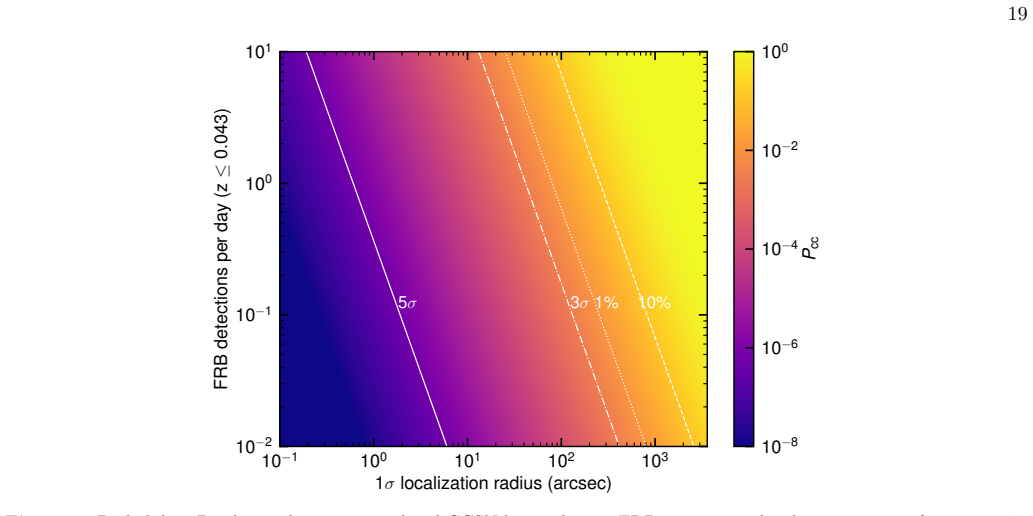
The central claim is that a systematic cross-match between 886 spectroscopically classified local core-collapse supernovae ($z \leq 0.043$) and 241 CHIME/FRB Catalog-1 bursts produces no statistically significant association: the four positional overlaps have a chance probability $P \gtrsim 0.96$, and only FRB 20190412B with SN 2009gi satisfies the additional DM-budget and scattering-time criteria. The paper further claims that, treating all 886 CCSN sight lines as non-detections, the $1\sigma$ Poisson upper limits on burst rate at these sites are $\lesssim 10^{-3.5}\,h^{-1}$ at a fiducial energy of $10^{39}$ erg, well below the episodic rates of hyperactive repeaters. Finally, using a model where FRB rate decays as $r(t)\propto t^{-\beta}$, an intrinsic spectrum $F_\nu \propto \nu^{-\Gamma}$, and free-free opacity $\tau_{ff}\propto \nu^{-2.1} t^{-5}$, the observed ratio $R(1.4\,\mathrm{GHz})/R(0.6\,\mathrm{GHz}) = 0.71\pm0.16$ (stat) $^{+0.24}_{-0.15}$ (sys) requires $1.5 \lesssim \beta \lesssim 8.5$ when combined with the tight spectral-index measurement $\Gamma = 2.29 \pm 0.29$.
Load-bearing premise
The free-free transparency timescale assumes homogeneous, single-temperature, constantly expanding ejecta, and the paper states that clumping, temperature, ionization, and shock physics can change $t_{ff}$ by factors of several; the derived $\beta$ constraints and the viability of the FRB 20190412B-SN 2009gi candidate both depend on this scaling.
Editorial extensions
If this is right
- If the cross-match result holds, no evidence exists that any Catalog-1 CHIME burst came from a historic local supernova; the four matches are fully consistent with chance.
- If only FRB 20190412B with SN 2009gi survives as a candidate, then targeted high-resolution localization and broadband follow-up of that pair is the immediate next observational step.
- If the burst-rate upper limits are correct, hyperactive repeating FRB sources must be rare among ordinary CCSN remnants unless their activity is suppressed by beaming, intermittency, or residual free-free absorption.
- If the rate-ratio model is correct, reproducing the CHIME/CRAFT rate ratio forces a steep secular decline in magnetar burst rate with age, $1.5 \lesssim \beta \lesssim 8.5$, which brackets the simple dipole spin-down expectation and points to rapid magnetospheric evolution.
- If the free-free transparency timescale were much shorter than nominal, FRBs could be seen from very young SNe, implying dilute paths, clumping, or anisotropic ejecta.
Reading between the lines
- The authors leave implicit that the same rate-ratio framework can be applied to other frequency pairs, such as CHIME/FRB versus future high-frequency surveys, which would strengthen or break the $\beta$ constraint without needing new spectral-index measurements.
- The DM prior choice of median $82\,\mathrm{pc\,cm^{-3}}$ and $\sigma=0.8$ is the quietest assumption in the paper: a broader host DM distribution would shift the $500\,\mathrm{pc\,cm^{-3}}$ cutoff and change both the FRB sample size and the fate of the one surviving candidate.
- The finding that no compact VLASS source is seen at the four matched SN sites is a direct, testable prediction for the young-magnetar nebula picture: a 10-year-ago explosion lacking a compact radio nebula disfavors the magnetar-wind-nebula interpretation for that location.
- The paper's cautionary example of FRB 20250316A suggests that even $\sim10''$ localization can mislead, so the field should treat all current FRB-SN matches as provisional until sub-arcsecond positions exist.
Editorial analysis
A structured set of objections, weighed in public.
Referee Report
Summary. This paper cross-matches 886 spectroscopically classified core-collapse supernovae within 200 Mpc against 241 apparently non-repeating CHIME/FRB Catalog-1 bursts using 90% localization regions, an excess-DM cutoff of 500 pc cm^-3, and scattering-time consistency checks. The authors find four positional overlaps, all consistent with chance (Monte Carlo and analytic estimates give P >= 0.96), leaving FRB 20190412B and SN 2009gi as the only pair passing the DM and scattering self-consistency tests. They further search for compact VLASS counterparts at all supernova positions, find none, and derive Poisson upper limits on burst rates at CCSN sites. Finally, using a galaxy-integrated rate model with free-free opacity, an intrinsic spectral index, and a secular burst-rate decay r(t) ~ t^-beta, they claim that the CHIME/CRAFT all-sky rate ratio requires a steep decay index 1.5 <= beta <= 8.5 when combined with Gamma = 2.29 +/- 0.29.
Significance. If the cross-match null result stands, it is a valuable, carefully executed test of the young-FRB progenitor hypothesis: it provides the first systematic accounting of chance coincidences between historic CCSNe and CHIME localizations, identifies a specific follow-up candidate, and places quantitative upper limits on burst activity at CCSN sites. The use of two independent chance-coincidence estimates, refined localizations from baseband and intensity maps, and a clear DM/scattering screening procedure are genuine strengths. The rate-ratio model in Section 5 and Appendix D is potentially useful, but as written it is not yet an established constraint on beta because the derivation omits the cosmological redshift integration that the all-sky data require; the stated 1.5 <= beta <= 8.5 range should therefore be treated as provisional pending a corrected calculation.
major comments (2)
- [Section 5 and Appendix D, Eq. (D6)] The claimed constraint 1.5 <= beta <= 8.5 is not established by the calculation as written. Equation (D6) is a per-galaxy expression integrated only over magnetar age t for a single galaxy at z=0, but the CHIME/CRAFT ratio R(1.4 GHz)/R(0.6 GHz) = 0.71 is an all-sky ratio over a population extending to z ~ 0.5-1. A correct calculation must integrate over source redshift: the free-free optical depth should be evaluated at the emitted frequency (1+z)nu, the energy threshold entering the incomplete-gamma term depends on luminosity distance, and time dilation shifts the age integral. Because exp[-tau_ff(t,(1+z)nu)] depends on frequency through (1+z)nu, the redshift integral does not factor out, so the ratio of the two redshift-weighted integrals is not equal to Eq. (D6). The sentence in Appendix D claiming that the incomplete-gamma ratio is approximately unity even after accounting for redshift evolution of E_min is not justified by the cited reference. Please replace Eq. (D6) with a full cosmological calculation and re-derive the allowed beta range.
- [Section 4.1 and Eq. (1)] The beta constraint from Section 5 inherits the homogeneous-ejecta transparency model of Eq. (1). The paper itself correctly emphasizes that clumping, temperature evolution, ionization state, and shock physics can change t_ff by factors of several, and that t_ff for an individual supernova may differ markedly from the homogeneous value. Since Eq. (D6) uses tau_ff proportional to nu^-2.1 t^-5 with fixed ejecta parameters, the allowed band in Figure 5 is directly sensitive to these uncertainties. A factor-of-two or factor-of-three change in t_ff at 600 MHz can shift the inferred beta interval substantially, so the claim of a steep decline in burst rate needs a quantitative propagation of the Eq. (1) parameter uncertainties into the plotted band.
minor comments (5)
- [Figure 5 and Section 5] The symbol for the spectral index appears as a placeholder box ("□") in the figure caption and axis labels, and the sentence "However, flat Future refinement..." is incomplete. Please fix these typographical issues.
- [Appendix D] The same symbol Gamma is used for the intrinsic spectral index and for the incomplete gamma function Gamma(s,x); this is confusing and should be changed (e.g., use Gamma_inc or Q(s,x) for the incomplete gamma function).
- [Appendix C] The phrase "which can separately by different line-styles" should read "which can be distinguished by different line styles."
- [Section 3] The Monte Carlo and analytic chance-coincidence estimates place artificial supernovae uniformly over the CHIME field of view, while the real CCSN sample is clustered and weighted by the CHIME exposure map. The conclusion is robust because the observed four overlaps are below the expected 8.47, but a null test that reshuffles the actual SN host positions or samples from the exposure map would strengthen the quantitative chance assessment.
- [Appendix A] The text says "96% credible region" in one place and "95% credible region" in another; please make the credibility level consistent throughout.
Circularity Check
No circularity: the cross-match is an external statistical test and the rate-ratio constraint inverts an independent physical model, not a fitted input.
full rationale
The paper's main null result (four positional overlaps, P>=0.96) is a Monte Carlo and Poisson comparison of CHIME/FRB localization footprints against SAI/HECATE CCSN positions; no parameter fitted in this paper enters the coincidence probability, so this claim is self-contained against external catalogs. The survival of FRB 20190412B-SN 2009gi as a candidate is an internal consistency check using the measured scattering time and DM budget, not a circular prediction. The rate-ratio constraint in Section 5 and Appendix D is also not circular: Equation D6 is a derived ratio in which the unknown normalizations (R_m, r_0, E_*) cancel, and the observed R(1.4 GHz)/R(0.6 GHz) = 0.71 is an external input. The decay index beta is the output of inverting Eq. D6 given independent spectral-index measurements (Shin et al. 2023, Cui et al. 2025); it is not equal by construction to any fitted parameter. The t_ff scaling in Eq. 1 is taken from prior work by one of the authors, but it is a stated physical assumption with its own caveats and does not contain the target beta constraint; the paper explicitly warns that clumping, temperature, ionization, and shock physics can change t_ff by factors of several. The use of Bhardwaj et al. (2024a) for the tau-to-DM conversion is grounded in externally published formalism (Cordes et al. 2022; Ocker et al. 2022), so this self-citation is not the load-bearing evidence. The possible omission of a full redshift integral in Eq. D6 is a modeling/completeness concern for the quoted beta interval, but it is not a circular reduction of the derivation to its own inputs.
Assumptions & free parameters
free parameters (5)
- host DM log-normal parameters (median 82 pc cm^-3, sigma 0.8) =
median 82, sigma 0.8
- DM_MW,halo = 50 pc cm^-3 =
50 pc cm^-3
- T_active = 10^5 yr =
10^5 yr
- f_NS = 0.8, f_mag = 0.2 =
0.8 and 0.2
- Ejecta parameters in Eq. 1 (E, M_ej, T_e, f_ion) =
fiducial values E=1e51 erg, M_ej=10 Msun, T_e=1e4 K, f_ion=0.1
assumptions (5)
- domain assumption The CHIME/FRB Catalog-1 localizations are correctly described by the 90% confidence regions used.
- standard math The Macquart et al. (2020) semi-analytical relation provides an unbiased estimate of the IGM DM contribution at z <= 0.043.
- domain assumption The scattering time of CHIME bursts is dominated by the host galaxy plasma and follows the Cordes et al. (2022) formalism with A_tau=1 and G_scatt=1.
- domain assumption The free-free optical depth scales as tau_ff proportional to nu^-2.1 t^-5 for homogeneous ejecta (Eq. 1 and Appendix D).
- domain assumption The CHIME and CRAFT surveys sample the same burst population with identical fluence thresholds after scaling, and intrinsic spectral index Gamma is a single power law.
invented entities (1)
-
None
Cite this review
Pith. "Pith review of Testing the Young FRB Progenitor Hypothesis: A Crossmatch of Catalog-1 CHIME Bursts with Historic Local Universe Supernovae." pith.science (2026). https://pith.science/paper/BJRQGGL2
@misc{pith2026250601238,
  author       = {Pith},
  title        = {Pith review of: Testing the Young FRB Progenitor Hypothesis: A Crossmatch of Catalog-1 CHIME Bursts with Historic Local Universe Supernovae},
  year         = {2026},
  howpublished = {\url{https://pith.science/paper/BJRQGGL2}},
  note         = {Machine review of arXiv:2506.01238}
}
abstract
Fast radio bursts (FRBs) are among the most energetic and enigmatic transients in the radio sky, with mounting evidence suggesting newborn, highly magnetized neutron stars formed in core-collapse supernovae (CCSNe) as their sources. A definitive spatial association between an FRB and a historic CCSN would confirm this link and tightly constrain young neutron star source models. Here we report on the first systematic cross-matching of 886 spectroscopically classified CCSNe in the local Universe (z $\leq$ 0.043) against 241 CHIME/FRB Catalog 1 events, applying rigorous spatial, dispersion measure (DM), and scattering time (${\tau}$) criteria. We identify four positional overlaps, all consistent with chance alignment; however, one pair, FRB 20190412B-SN 2009gi, also satisfies independent host-DM and ${\tau}$ constraints, making it a promising candidate for targeted follow-up. Next, we search for compact (persistent or transient) radio emission at all matched supernova sites using multi-epoch VLASS data and detect none. Treating every CCSN sight line as a non-detection, we derive Poisson upper limits on the FRB burst rate at these locations, which lie well below the rates observed for the most active repeaters unless their activity is heavily suppressed by beaming, intermittency, or residual free-free absorption. We then develop a galaxy-integrated FRB-rate model that incorporates an intrinsic spectral index, secular magnetar-activity decay, and frequency-dependent free-free opacity. Applying this formalism to existing FRB data shows that reproducing the observed CHIME/CRAFT all-sky rate ratio requires a steep decline in magnetar burst rates with age. Finally, our work underscores the necessity of sub-arcsecond localizations and multiwavelength follow-up to definitively test the young neutron star source hypothesis.
Figures


Figures from the paper (5 more)


Forward citations
Cited by 2 Pith papers
-
Constraining the Origin of FRB 20121102A's Persistent Radio Source with Long-Term Radio Observations
Seven years of radio monitoring show FRB 20121102A's persistent source is stable at 213 ± 4 µJy with variability consistent with interstellar scintillation, disfavoring young magnetar nebula models.
-
Constraining the Faint-End Slope of the FRB Energy Function Using CHIME/FRB Catalog-1 and Local Volume Galaxies
No CHIME/FRB Catalog-1 burst is associated with 495 local volume galaxies, yielding a 95% upper limit gamma < 2.3 on the faint-end slope of the FRB energy function down to ~3e34 erg.
Reference graph
Works this paper leans on
-
[1]
, " * write output.state after.block = add.period write newline
ENTRY address archivePrefix author booktitle chapter doi edition editor eprint howpublished institution journal key month number organization pages publisher school series title misctitle type volume year version url label extra.label sort.label short.list INTEGERS output.state before.all mid.sentence after.sentence after.block FUNCTION init.state.consts ...
-
[2]
write newline
" write newline "" before.all 'output.state := FUNCTION format.url url empty "" new.block "" url * "" * if FUNCTION format.eprint eprint empty "" archivePrefix empty "" archivePrefix "arXiv" = new.block " " eprint * " " * new.block " " eprint * " " * if if if FUNCTION format.doi doi empty "" " " doi * " " * if FUNCTION format.pid doi empty eprint empty ur...
-
[3]
thebibliography [1] 20pt to REFERENCES 6pt =0pt -12pt 10pt plus 3pt =0pt =0pt =1pt plus 1pt =0pt =0pt -12pt =13pt plus 1pt =20pt =13pt plus 1pt \@M =10000 =-1.0em =0pt =0pt 0pt =0pt =1.0em @enumiv\@empty 10000 10000 `\.\@m \@noitemerr \@latex@warning Empty `thebibliography' environment \@ifnextchar \@reference \@latexerr Missing key on reference command E...
arXiv 2021
-
[4]
CHIME/FRB Collaboration , Amiri , M., Andersen , B. C., et al. 2025, arXiv e-prints, arXiv:2504.05192, 10.48550/arXiv.2504.05192
-
[5]
2019, arXiv e-prints, arXiv:1902.05569, 10.48550/arXiv.1902.05569
Akeson , R., Armus , L., Bachelet , E., et al. 2019, arXiv e-prints, arXiv:1902.05569, 10.48550/arXiv.1902.05569
-
[6]
Arcodia , R., Bauer , F. E., Cenko , S. B., et al. 2024, Universe, 10, 316, 10.3390/universe10080316
-
[7]
Astropy Collaboration , Price-Whelan , A. M., Lim , P. L., et al. 2022, , 935, 167, 10.3847/1538-4357/ac7c74
-
[8]
Beloborodov , A. M. 2017, , 843, L26, 10.3847/2041-8213/aa78f3
Show all 127 references
- [9]
-
[10]
2019, , 487, 1426, 10.1093/mnras/stz1391
Beniamini , P., Hotokezaka , K., van der Horst , A., & Kouveliotou , C. 2019, , 487, 1426, 10.1093/mnras/stz1391
2019 doi
-
[11]
E., Aggarwal , K., et al
Bhandari , S., Heintz , K. E., Aggarwal , K., et al. 2022, , 163, 69, 10.3847/1538-3881/ac3aec
2022 doi
-
[12]
2024 a , , 634, 1065, 10.1038/s41586-024-08065-w
Bhardwaj , M., Lee , J., & Ji , K. 2024 a , , 634, 1065, 10.1038/s41586-024-08065-w
2024 doi
-
[13]
2024 b , , 977, 122, 10.3847/1538-4357/ad9023
Bhardwaj , M., Palmese , A., Maga \ n a Hernandez , I., D'Emilio , V., & Morisaki , S. 2024 b , , 977, 122, 10.3847/1538-4357/ad9023
2024 doi
-
[14]
Y., Michilli , D., et al
Bhardwaj , M., Kirichenko , A. Y., Michilli , D., et al. 2021 a , , 919, L24, 10.3847/2041-8213/ac223b
2021 doi
-
[15]
M., Kaspi , V
Bhardwaj , M., Gaensler , B. M., Kaspi , V. M., et al. 2021 b , , 910, L18, 10.3847/2041-8213/abeaa6
2021 doi
-
[16]
Y., et al
Bhardwaj , M., Michilli , D., Kirichenko , A. Y., et al. 2024 c , , 971, L51, 10.3847/2041-8213/ad64d1
2024 doi
-
[17]
2024, arXiv e-prints, arXiv:2412.19358, 10.48550/arXiv.2412.19358
Bhattacharya , M., Murase , K., & Kashiyama , K. 2024, arXiv e-prints, arXiv:2412.19358, 10.48550/arXiv.2412.19358
2024 doi
- [18]
-
[19]
F., & Bartel , N
Bietenholz , M. F., & Bartel , N. 2017, , 851, 124, 10.3847/1538-4357/aa98d9
2017 doi
-
[20]
D., Ravi , V., Belov , K
Bochenek , C. D., Ravi , V., Belov , K. V., et al. 2020, , 587, 59, 10.1038/s41586-020-2872-x
2020 doi
-
[21]
D., Ravi , V., & Dong , D
Bochenek , C. D., Ravi , V., & Dong , D. 2021, , 907, L31, 10.3847/2041-8213/abd634
2021 doi
-
[22]
2008, Central Bureau Electronic Telegrams, 1239, 1
Boles , T. 2008, Central Bureau Electronic Telegrams, 1239, 1
2008
-
[23]
M., Filipovi \'c , M
Bozzetto , L. M., Filipovi \'c , M. D., Vukoti \'c , B., et al. 2017, , 230, 2, 10.3847/1538-4365/aa653c
2017 doi
-
[24]
2024, , 632, 1014, 10.1038/s41586-024-07782-6
Bruni , G., Piro , L., Yang , Y.-P., et al. 2024, , 632, 1014, 10.1038/s41586-024-07782-6
2024 doi
-
[25]
P., et al
Bruni , G., Piro , L., Yang , Y. P., et al. 2025, , 695, L12, 10.1051/0004-6361/202453233
2025 doi
-
[26]
2021, , 589, 29, 10.1038/s41586-020-03059-w
Burrows , A., & Vartanyan , D. 2021, , 589, 29, 10.1038/s41586-020-03059-w
2021 doi
- [27]
-
[28]
J., Wharton , R
Chatterjee , S., Law , C. J., Wharton , R. S., et al. 2017, , 541, 58, 10.1038/nature20797
2017 doi
-
[29]
2018, , 863, 48, 10.3847/1538-4357/aad188
CHIME/FRB Collaboration , Amiri , M., Bandura , K., et al. 2018, , 863, 48, 10.3847/1538-4357/aad188
2018 doi
-
[30]
C., Bandura , K., et al
CHIME/FRB Collaboration , Andersen , B. C., Bandura , K., et al. 2019, , 885, L24, 10.3847/2041-8213/ab4a80
2019 doi
-
[31]
C., et al
CHIME/FRB Collaboration , : , Andersen , B. C., et al. 2020 a , arXiv e-prints, arXiv:2005.10324. 2005.10324
2020 arXiv
-
[32]
C., et al
CHIME/FRB Collaboration , Amiri , M., Andersen , B. C., et al. 2020 b , , 582, 351, 10.1038/s41586-020-2398-2
2020 doi
- [33]
-
[34]
2023 a , , 264, 53, 10.3847/1538-4365/acb54c
---. 2023 a , , 264, 53, 10.3847/1538-4365/acb54c
2023 doi
-
[35]
C., Bandura , K., et al
CHIME/FRB Collaboration , Andersen , B. C., Bandura , K., et al. 2023 b , , 947, 83, 10.3847/1538-4357/acc6c1
2023 doi
-
[36]
C., et al
CHIME/FRB Collaboration , Amiri , M., Andersen , B. C., et al. 2024, , 969, 145, 10.3847/1538-4357/ad464b
2024 doi
-
[37]
A., et al
Collette , A., Kluyver , T., Caswell , T. A., et al. 2023, h5py/h5py: 3.8.0 , 3.8.0, Zenodo, 10.5281/zenodo.7560547
2023 doi
-
[38]
M., Bhardwaj , M., Gaensler , B
Cook , A. M., Bhardwaj , M., Gaensler , B. M., et al. 2023, , 946, 58, 10.3847/1538-4357/acbbd0
2023 doi
- [39]
-
[40]
M., Ocker , S
Cordes , J. M., Ocker , S. K., & Chatterjee , S. 2022, , 931, 88, 10.3847/1538-4357/ac6873
2022 doi
-
[41]
2025, Nature Astronomy, 9, 36, 10.1038/s41550-024-02416-3
Cruise , M., Guainazzi , M., Aird , J., et al. 2025, Nature Astronomy, 9, 36, 10.1038/s41550-024-02416-3
2025 doi
-
[42]
W., Li , D., & Zhang , C.-m
Cui , X.-h., James , C. W., Li , D., & Zhang , C.-m. 2025, , 982, 158, 10.3847/1538-4357/adbbcb
2025 doi
-
[43]
2022, in Astrophysics and Space Science Library, Vol
Dall'Osso , S., & Stella , L. 2022, in Astrophysics and Space Science Library, Vol. 465, Astrophysics and Space Science Library, ed. S. Bhattacharyya , A. Papitto , & D. Bhattacharya , 245--280, 10.1007/978-3-030-85198-9_8
2022 doi
-
[44]
E., Hall , P
Dewdney , P. E., Hall , P. J., Schilizzi , R. T., & Lazio , T. J. L. W. 2009, IEEE Proceedings, 97, 1482, 10.1109/JPROC.2009.2021005
2009
-
[45]
2019, in Canadian Long Range Plan for Astronomy and Astrophysics White Papers, Vol
Di Francesco , J., Chalmers , D., Denman , N., et al. 2019, in Canadian Long Range Plan for Astronomy and Astrophysics White Papers, Vol. 2020, 32, 10.5281/zenodo.3765763
2019 doi
-
[46]
2015, , 23, 3, 10.1007/s00159-015-0083-5
Dubner , G., & Giacani , E. 2015, , 23, 3, 10.1007/s00159-015-0083-5
2015 doi
-
[47]
2025, , 979, L22, 10.3847/2041-8213/ad9de2
Eftekhari , T., Dong , Y., Fong , W., et al. 2025, , 979, L22, 10.3847/2041-8213/ad9de2
2025 doi
-
[48]
Filippenko , A. V. 1997, , 35, 309, 10.1146/annurev.astro.35.1.309
1997 doi
-
[49]
C., Bhardwaj , M., et al
Fonseca , E., Andersen , B. C., Bhardwaj , M., et al. 2020, , 891, L6, 10.3847/2041-8213/ab7208
2020 doi
-
[50]
Garrett, J. D. 2021, garrettj403/SciencePlots , 1.0.9, Zenodo, 10.5281/zenodo.4106649
2021 doi
- [51]
-
[52]
C., Fong , W.-f., Kilpatrick , C
Gordon , A. C., Fong , W.-f., Kilpatrick , C. D., et al. 2023, , 954, 80, 10.3847/1538-4357/ace5aa
2023 doi
-
[53]
Green , D. A. 2019, Journal of Astrophysics and Astronomy, 40, 36, 10.1007/s12036-019-9601-6
2019 doi
- [54]
-
[55]
M., Bianco , F
Hambleton , K. M., Bianco , F. B., Street , R., et al. 2023, , 135, 105002, 10.1088/1538-3873/acdb9a
2023 doi
-
[56]
R., Millman , K
Harris , C. R., Millman , K. J., van der Walt , S. J., et al. 2020, , 585, 357, 10.1038/s41586-020-2649-2
2020 doi
-
[57]
L., Woosley , S
Heger , A., Fryer , C. L., Woosley , S. E., Langer , N., & Hartmann , D. H. 2003, , 591, 288, 10.1086/375341
2003 doi
-
[58]
2025, arXiv e-prints, arXiv:2504.08038, 10.48550/arXiv.2504.08038
Horowicz , A., & Margalit , B. 2025, arXiv e-prints, arXiv:2504.08038, 10.48550/arXiv.2504.08038
2025 doi
-
[59]
Hunter , J. D. 2007, Computing in Science and Engineering, 9, 90, 10.1109/MCSE.2007.55
2007 doi
-
[60]
L., Drout , M
Ibik , A. L., Drout , M. R., Gaensler , B. M., et al. 2024, , 961, 99, 10.3847/1538-4357/ad0893
2024 doi
-
[61]
M., Tyson , J
Ivezi \'c , Z ., Kahn , S. M., Tyson , J. A., et al. 2019, , 873, 111, 10.3847/1538-4357/ab042c
2019 doi
-
[62]
James , C. W. 2023, , 40, e057, 10.1017/pasa.2023.51
2023 doi
-
[63]
2022, , 602, 585, 10.1038/s41586-021-04354-w
Kirsten , F., Marcote , B., Nimmo , K., et al. 2022, , 602, 585, 10.1038/s41586-021-04354-w
2022 doi
-
[64]
O., Mao, S
Kovacs, T. O., Mao, S. A., Basu, A., et al. 2024, Astronomy & Astrophysics, 690, A47, 10.1051/0004-6361/202347459
2024 doi
-
[65]
J., et al
Kovlakas , K., Zezas , A., Andrews , J. J., et al. 2021, , 506, 1896, 10.1093/mnras/stab1799
2021 doi
-
[66]
2017, , 468, 2726, 10.1093/mnras/stx665
Kumar , P., Lu , W., & Bhattacharya , M. 2017, , 468, 2726, 10.1093/mnras/stx665
2017 doi
-
[67]
A., Chandler , C
Lacy , M., Baum , S. A., Chandler , C. J., et al. 2020, , 132, 035001, 10.1088/1538-3873/ab63eb
2020 doi
-
[68]
2024, , 967, L44, 10.3847/2041-8213/ad4ae8
Lan , H.-T., Zhao , Z.-Y., Wei , Y.-J., & Wang , F.-Y. 2024, , 967, L44, 10.3847/2041-8213/ad4ae8
2024 doi
-
[69]
E., Andersen , B
Lanman , A. E., Andersen , B. C., Chawla , P., et al. 2022, , 927, 59, 10.3847/1538-4357/ac4bc7
2022 doi
-
[70]
2025, The Astronomer's Telegram, 17086, 1
Leung , C., & CHIME/FRB Collaboration . 2025, The Astronomer's Telegram, 17086, 1
2025
-
[71]
2022, , 134, 094106, 10.1088/1538-3873/ac8f71
Lin , H.-H., Lin , K.-y., Li , C.-T., et al. 2022, , 134, 094106, 10.1088/1538-3873/ac8f71
2022 doi
-
[72]
2024, , 975, 75, 10.3847/1538-4357/ad779d
Lin , H.-H., Scholz , P., Ng , C., et al. 2024, , 975, 75, 10.3847/1538-4357/ad779d
2024 doi
-
[73]
R., Bailes , M., McLaughlin , M
Lorimer , D. R., Bailes , M., McLaughlin , M. A., Narkevic , D. J., & Crawford , F. 2007, Science, 318, 777, 10.1126/science.1147532
2007 doi
- [74]
-
[75]
2014, , 442, L9, 10.1093/mnrasl/slu046
Lyubarsky , Y. 2014, , 442, L9, 10.1093/mnrasl/slu046
2014 doi
- [76]
-
[77]
X., McQuinn, M., et al
Macquart, J.-P., Prochaska, J. X., McQuinn, M., et al. 2020, Nature, 581, 391, 10.1038/s41586-020-2288-8
2020 doi
-
[78]
P., Shannon , R
Macquart , J. P., Shannon , R. M., Bannister , K. W., et al. 2019, , 872, L19, 10.3847/2041-8213/ab03d6
2019 doi
-
[79]
P., Keane , E., Grainge , K., et al
Macquart , J. P., Keane , E., Grainge , K., et al. 2015, in Advancing Astrophysics with the Square Kilometre Array (AASKA14), 55, 10.22323/1.215.0055
2015 doi
-
[80]
Madison , D., Li , W., & Filippenko , A. V. 2008, Central Bureau Electronic Telegrams, 1239, 2
2008
-
[81]
Marcote , B., Paragi , Z., Hessels , J. W. T., et al. 2017, , 834, L8, 10.3847/2041-8213/834/2/L8
2017 doi
-
[82]
Marcote , B., Nimmo , K., Hessels , J. W. T., et al. 2020, , 577, 190, 10.1038/s41586-019-1866-z
2020 doi
-
[83]
Margalit , B., Beniamini , P., Sridhar , N., & Metzger , B. D. 2020, , 899, L27, 10.3847/2041-8213/abac57
2020 doi
-
[84]
Margalit , B., Berger , E., & Metzger , B. D. 2019, , 886, 110, 10.3847/1538-4357/ab4c31
2019 doi
-
[85]
Margalit , B., & Metzger , B. D. 2018, , 868, L4, 10.3847/2041-8213/aaedad
2018 doi
-
[86]
D., Berger , E., et al
Margalit , B., Metzger , B. D., Berger , E., et al. 2018, , 481, 2407, 10.1093/mnras/sty2417
2018 doi
-
[87]
2022, The Astronomer's Telegram, 15679, 1
McKinven , R., & CHIME/FRB Collaboration . 2022, The Astronomer's Telegram, 15679, 1
2022
-
[88]
D., Berger , E., & Margalit , B
Metzger , B. D., Berger , E., & Margalit , B. 2017, , 841, 14, 10.3847/1538-4357/aa633d
2017 doi
-
[89]
D., Margalit , B., & Sironi , L
Metzger , B. D., Margalit , B., & Sironi , L. 2019, , 485, 4091, 10.1093/mnras/stz700
2019 doi
-
[90]
2023, , 950, 134, 10.3847/1538-4357/accf89
Michilli , D., Bhardwaj , M., Brar , C., et al. 2023, , 950, 134, 10.3847/1538-4357/accf89
2023 doi
- [91]
-
[92]
Neustadt , J. M. M., Kochanek , C. S., Stanek , K. Z., et al. 2021, , 508, 516, 10.1093/mnras/stab2605
2021 doi
-
[93]
B., Bandura , K., Bucher , M
Newburgh , L. B., Bandura , K., Bucher , M. A., et al. 2016, in Society of Photo-Optical Instrumentation Engineers (SPIE) Conference Series, Vol. 9906, Ground-based and Airborne Telescopes VI, ed. H. J. Hall , R. Gilmozzi , & H. K. Marshall , 99065X, 10.1117/12.2234286
2016 doi
-
[94]
2025, The Astronomer's Telegram, 17081, 1
Ng , M., & CHIME/FRB Collaboration . 2025, The Astronomer's Telegram, 17081, 1
2025
-
[95]
Nicholl , M., Williams , P. K. G., Berger , E., et al. 2017, , 843, 84, 10.3847/1538-4357/aa794d
2017 doi
-
[96]
H., Aggarwal , K., Li , D., et al
Niu , C. H., Aggarwal , K., Li , D., et al. 2022, , 606, 873, 10.1038/s41586-022-04755-5
2022 doi
-
[97]
K., Cordes , J
Ocker , S. K., Cordes , J. M., Chatterjee , S., & Gorsuch , M. R. 2022, , 934, 71, 10.3847/1538-4357/ac75ba
2022 doi
-
[98]
L., Navasardyan , H., et al
Pastorello , A., Pumo , M. L., Navasardyan , H., et al. 2012, , 537, A141, 10.1051/0004-6361/201118112
2012 doi
-
[99]
Piro , A. L. 2016, , 824, L32, 10.3847/2041-8205/824/2/L32
2016 doi
-
[100]
L., & Gaensler , B
Piro , A. L., & Gaensler , B. M. 2018, , 861, 150, 10.3847/1538-4357/aac9bc
2018 doi
-
[101]
2020, , 641, A6, 10.1051/0004-6361/201833910
Planck Collaboration , Aghanim , N., Akrami , Y., et al. 2020, , 641, A6, 10.1051/0004-6361/201833910
2020 doi
-
[102]
J., & Mazzali , P
Prentice , S. J., & Mazzali , P. A. 2017, , 469, 2672, 10.1093/mnras/stx980
2017 doi
-
[103]
2019, Nature Astronomy, 3, 928, 10.1038/s41550-019-0831-y
Ravi , V. 2019, Nature Astronomy, 3, 928, 10.1038/s41550-019-0831-y
2019 doi
-
[104]
K., Badenes , C., Chomiuk , L., Caprioli , D., & Huizenga , D
Sarbadhicary , S. K., Badenes , C., Chomiuk , L., Caprioli , D., & Huizenga , D. 2019, , 487, 5813, 10.1093/mnras/stz1490
2019 doi
- [105]
-
[106]
2025, , 979, L21, 10.3847/2041-8213/ad9ddc
Shah , V., Shin , K., Leung , C., et al. 2025, , 979, L21, 10.3847/2041-8213/ad9ddc
2025 doi
-
[107]
M., Macquart , J
Shannon , R. M., Macquart , J. P., Bannister , K. W., et al. 2018, , 562, 386, 10.1038/s41586-018-0588-y
2018 doi
-
[108]
2023, , 950, 175, 10.3847/1538-4357/accf1d
Sharma , K., Somalwar , J., Law , C., et al. 2023, , 950, 175, 10.3847/1538-4357/accf1d
2023 doi
-
[109]
2024, , 635, 61, 10.1038/s41586-024-08074-9
Sharma , K., Ravi , V., Connor , L., et al. 2024, , 635, 61, 10.1038/s41586-024-08074-9
2024 doi
-
[110]
W., Bhardwaj , M., et al
Shin , K., Masui , K. W., Bhardwaj , M., et al. 2023, , 944, 105, 10.3847/1538-4357/acaf06
2023 doi
- [111]
-
[112]
G., Scholz , P., Hessels , J
Spitler , L. G., Scholz , P., Hessels , J. W. T., et al. 2016, , 531, 202, 10.1038/nature17168
2016 doi
-
[113]
E., Brown , J
Sukhbold , T., Ertl , T., Woosley , S. E., Brown , J. M., & Janka , H. T. 2016, , 821, 38, 10.3847/0004-637X/821/1/38
2016 doi
-
[114]
2014, , 792, 135, 10.1088/0004-637X/792/2/135
Taylor , M., Cinabro , D., Dilday , B., et al. 2014, , 792, 135, 10.1088/0004-637X/792/2/135
2014 doi
-
[115]
R., Clark , B
Thompson , A. R., Clark , B. G., Wade , C. M., & Napier , P. J. 1980, , 44, 151, 10.1086/190688
1980 doi
-
[116]
2013, Science, 341, 53, 10.1126/science.1236789
Thornton , D., Stappers , B., Bailes , M., et al. 2013, Science, 341, 53, 10.1126/science.1236789
2013 doi
-
[117]
Y., Pavlyuk , N
Tsvetkov , D. Y., Pavlyuk , N. N., & Bartunov , O. S. 2004, Astronomy Letters, 30, 729, 10.1134/1.1819491
2004 doi
-
[118]
2007, in American Institute of Physics Conference Series, Vol
Turatto , M., Benetti , S., & Pastorello , A. 2007, in American Institute of Physics Conference Series, Vol. 937, Supernova 1987A: 20 Years After: Supernovae and Gamma-Ray Bursters, ed. S. Immler , K. Weiler , & R. McCray (AIP), 187--197, 10.1063/1.3682902
2007 doi
-
[119]
2019, in Canadian Long Range Plan for Astronomy and Astrophysics White Papers, Vol
Vanderlinde , K., Liu , A., Gaensler , B., et al. 2019, in Canadian Long Range Plan for Astronomy and Astrophysics White Papers, Vol. 2020, 28, 10.5281/zenodo.3765414
2019 doi
-
[120]
2012, , 20, 49, 10.1007/s00159-011-0049-1
Vink , J. 2012, , 20, 49, 10.1007/s00159-011-0049-1
2012 doi
-
[121]
2020, Physics and Evolution of Supernova Remnants (Springer), 10.1007/978-3-030-55231-2
---. 2020, Physics and Evolution of Supernova Remnants (Springer), 10.1007/978-3-030-55231-2
2020 doi
-
[122]
W., Gupta , V., et al
Wang , Z., Bannister , K. W., Gupta , V., et al. 2025, , 42, e005, 10.1017/pasa.2024.107
2025 doi
- [123]
-
[124]
M., Manchester, R
Yao, J. M., Manchester, R. N., & Wang, N. 2017, The Astrophysical Journal, 835, 29, 10.3847/1538-4357/835/1/29
2017 doi
-
[125]
2020, Transient Name Server AstroNote, 70, 1
Yaron , O., Ofek , E., Gal-Yam , A., & Sass , A. 2020, Transient Name Server AstroNote, 70, 1
2020
-
[126]
2023, Reviews of Modern Physics, 95, 035005, 10.1103/RevModPhys.95.035005
Zhang , B. 2023, Reviews of Modern Physics, 95, 035005, 10.1103/RevModPhys.95.035005
2023 doi
-
[127]
2020, healpy: Python wrapper for HEALPix
Zonca , A., Singer , L., Lenz , D., et al. 2020, healpy: Python wrapper for HEALPix
2020
Reviewed August 7, 2026 · model on record in the stance chip above.
Discussion (0). Sign in to comment.