REVIEW 3 major objections 5 minor 58 references
Fast SSVEP Detection Using a Calibration-Free EEG Decoding Framework
T0 review · 3 major / 5 minor · reviewed 2026-08-07 · deepseek-v4-flash
Pith's one-line read A compact calibration-free decoder claims faster, smaller, and more accurate SSVEP detection on short EEG signals.
desk verdict Solid cross-subject SSVEP results, but the 'trainable' threshold in the denoising module isn't trainable as specified. read the letter →
The pith
A machine-rendered reading of the paper's core claim, the machinery that carries it, and where it could break.
The reading
What carries the argument
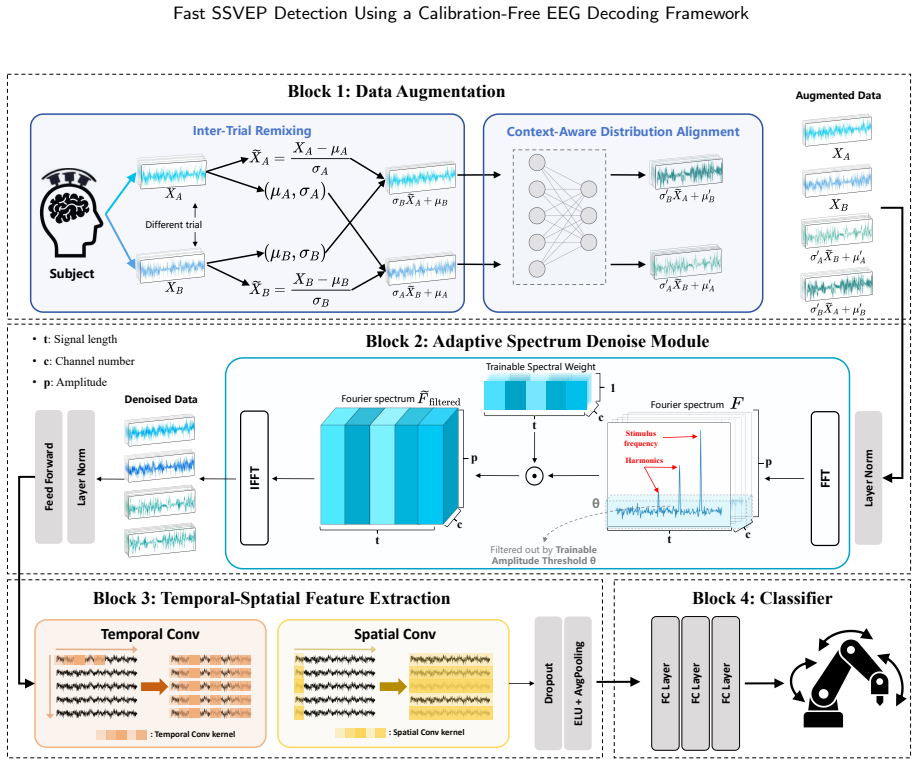
The machinery is the Adaptive Spectrum Denoise Module working on the power spectrum. The module takes the FFT of a trial, normalizes the power spectrum by its median, and zeros out frequency bins whose normalized power falls below a trainable threshold $\theta$ (Eq. 6); a trainable spectral-weight vector then reweights the surviving bins (Eq. 7), and an IFFT reconstructs a cleaned time-domain signal. Around this sits the data-augmentation block: Inter-Trial Remixing swaps per-trial means and standard deviations between two training trials, and Context-Aware Distribution Alignment rescales those statistics through channel-wise linear attention. Feature extraction uses two 1D convolutions (temporal and spatial) followed by ELU and average pooling, and classification uses three fully connected layers; the module's per-sample cost is linear in signal length apart from the FFT/IFFT's $O(n \log n)$.
What would settle it
Compute the gradient of the training loss with respect to $\theta$ through the binary mask $(P_m[k] > \theta)$. If that gradient is identically zero, retrain the same framework with $\theta$ frozen at its initial value; if accuracy does not drop, the reported gains from the denoising module come from the spectral weighting or from the fixed threshold, not from adaptation.
Extended reading notes
Core claim
The central claim is that a compact neural framework can decode short SSVEP signals without any per-user calibration. The framework's design rests on two components: Inter-Trial Remixing & Context-Aware Distribution Alignment, which exchanges mean and standard deviation between trials during training and then recalibrates these statistics with a small attention mechanism, and the Adaptive Spectrum Denoise Module, which filters the Fourier spectrum by a trainable amplitude threshold and trainable spectral weighting before transforming back to the time domain. Evaluated with leave-one-subject-out validation on three public EEG datasets (a 40-class set, a noisy 40-class set, and a 12-class set), the authors report that the framework outperforms CCA, FBCCA, TRCA, TFF, and EEGConformer with statistical significance in the majority of short-signal conditions, with the largest gains at 0.3–0.5 s, and at 0.7 s it remains within roughly one percentage point of the best method, FBCCA. The efficiency claims are part of the central claim: at least 52.7% fewer parameters and 29.9% less CPU inference time than the compared deep models.
Load-bearing premise
The load-bearing premise is that the trainable amplitude threshold $\theta$ in Eq. (6) actually learns through the hard binary mask, even though the paper does not describe any differentiable relaxation or gradient approximation.
Editorial extensions
If this is right
- New users can be served immediately after training on other subjects, removing the calibration bottleneck that can require hundreds of trials for 40-class spellers.
- Short windows of 0.3–0.6 s become viable, enabling faster BCI responses and higher information transfer rates.
- The small model and low CPU inference time make the decoder suitable for embedded and mobile BCI systems.
- As signal length grows, the framework's speed advantage over transformer-based decoders widens because its frequency-domain operations stay near-linear.
Reading between the lines
- A direct test of the ASDM's adaptivity would be to inspect the learned $\theta$ across training runs: if it converges to the same value regardless of initialization or dataset, the 'adaptive' part is effectively a learned constant, and the module could be simplified to fixed hard-thresholding.
- The augmentation scheme, which exchanges and recalibrates per-trial statistics, is a generic cross-sample regularization; it should transfer to other EEG decoding tasks (motor imagery, emotion) where cross-subject variability is the main obstacle.
- Because the reported gains are largest at the shortest windows, the framework is best interpreted as a speed-and-efficiency play: the practical bottleneck it removes is the calibration session, not the per-window accuracy ceiling.
Editorial analysis
A structured set of objections, weighed in public.
Referee Report
Summary. This manuscript proposes a calibration-free deep learning framework for SSVEP classification on short EEG epochs. The pipeline consists of a two-step data augmentation scheme (Inter-Trial Remixing and Context-Aware Distribution Alignment), an Adaptive Spectrum Denoise Module (ASDM) that filters the Fourier spectrum with a trainable amplitude threshold and trainable spectral weights, a compact temporal/spatial CNN feature extractor, and a fully connected classifier. The method is evaluated with leave-one-subject-out cross-validation on the Benchmark, BETA, and Nakanishi datasets at signal lengths from 0.3 to 0.7 s, against CCA, FBCCA, TRCA, TFF, and EEGConformer. The authors report statistically significant accuracy gains in the majority of conditions, as well as smaller model size and faster CPU inference, and provide ablation studies for the ASDM and augmentation modules.
Significance. If the claims hold, the framework would be a useful calibration-free decoder for fast SSVEP, with a strong practical advantage in model size and inference speed. The evaluation has genuine strengths: three public datasets, leave-one-subject-out protocol, Wilcoxon signed-rank tests, and ablation experiments. The efficiency comparisons are measured on CPU with a fixed sample. However, the central technical novelty of the ASDM is under-specified: the trainable threshold in Eq. (6) is presented as learned, but no gradient path is described. This gap must be resolved before the ablation results can be interpreted as evidence for the adaptive threshold. The comparison set is also narrower than the wording 'existing methods' suggests.
major comments (3)
- [§2.3.1, Eq. (6)] The binary mask (P_m[k] > θ) has zero derivative with respect to θ almost everywhere, so ordinary backpropagation cannot update θ. The manuscript calls θ 'trainable' and shows a learning curve in Fig. 2(b), but it never specifies a straight-through estimator, a soft relaxation, or an alternative update rule. Without this, the 'adaptive' amplitude threshold is not demonstrably learned, and the ASDM gains in Tables 2–4 could be produced by the trainable spectral weights alone with θ fixed at its random initialization. Please either specify how gradients reach θ (e.g., a straight-through estimator) or revise the claims and ablation interpretation accordingly.
- [§3.3 and §3.4] The comparison set is limited to CCA, FBCCA, TRCA, TFF, and EEGConformer, while the Introduction discusses several more recent SSVEP-specific deep decoders (Guney et al., TRCA-Net, DDGCNN, EEG-Deformer). The abstract and conclusion claim superiority over 'existing methods' in the broad sense, but the evidence only covers this five-method set. Adding at least the recent SSVEP-specific deep baselines that are calibration-compatible, or tempering the wording, would make the claim proportionate.
- [§3.4, Table 1] The paper reports 75 Wilcoxon signed-rank tests (5 methods × 5 signal lengths × 3 datasets) without any correction for multiple comparisons. The phrase 'statistically significant accuracy advantages' is based on these uncorrected p-values. I would ask for either an FDR or Bonferroni correction, or a clear statement that the p-values are uncorrected and should be interpreted as exploratory. This is particularly relevant because several reported differences are near the p<0.05 boundary.
minor comments (5)
- [§3.4, Benchmark 0.3s] The sentence listing differences of 12.7%, 21.9%, and 23.6% is followed by confidence intervals that correspond to the reverse order (CCA, FBCCA, TRCA); please reorder or relabel the intervals.
- [§3.4, BETA 0.3s] The text says 'TFF and EEGConformer achieve 6.0%±5.6% and 8.9%±5.3% accuracy, with differences of 7.6% and 9.6% respectively'; the EEGConformer difference should be 4.7%, and the following confidence interval [4.0, 5.5] matches that value.
- [§3.5] The FBCCA inference-time ratio is reported as 325.3 times slower than the proposed method, but 3247.1 ms / 10.3 ms is approximately 315.3; please correct this arithmetic.
- [§3.4 and Figure 3] The paper reports standard deviations across subjects but not across random training seeds. Since the deep models are stochastic, a seed-stability statement or a small multi-seed experiment would strengthen the reported accuracy numbers.
- [Figure 2(b)] The learning curve of θ lacks axis labels and a description of which training run or dataset it comes from; because θ is central to the ASDM claim, this should be clarified.
Circularity Check
No significant circularity: the framework's claims rest on external benchmarks, held-out subjects, and measured efficiency, not on self-referential definitions or self-citation chains.
full rationale
The paper's central claims—classification accuracy, parameter count, and inference time—are all empirical results obtained on three public datasets (Benchmark, BETA, Nakanishi) using leave-one-subject-out evaluation. Accuracy numbers are measured against held-out subjects, and the efficiency figures are computed from the actual architecture and CPU timing experiments; none of these results are derived by construction from a fitted parameter or from a self-citation. The trainable amplitude threshold in Eq. (6) is a learnable parameter, but even if its gradient were zero as the skeptic notes, that would be an internal-consistency or optimization issue, not a circularity: the reported accuracy gains are not defined in terms of that threshold's fitted value. The data augmentation module is inspired by and cites CrossNorm/NormSelf [46], but it is presented as a contribution with external citation, not as an unsupported self-citation backbone. The paper does not invoke a uniqueness theorem from the authors' prior work, and no load-bearing step reduces an output to an input by definition. The limitation section explicitly acknowledges potential overfitting and the absence of real-time experiments, which further indicates that the authors are not presenting a self-validating derivation. Because the evaluation is self-contained against external benchmarks and the derivation chain is not definitionally circular, the appropriate score is 0.
Assumptions & free parameters
free parameters (3)
- Trainable amplitude threshold theta =
Converges to an optimal value during training; exact value not reported
- Trainable spectral weights M_f =
Learned vector; values not reported
- Context-Aware Distribution Alignment linear transforms f and g =
Learned Channel x Channel matrices; values not reported
assumptions (4)
- standard math FFT/IFFT and the standard definitions of DFT and power spectrum in Eqs. (1)-(5)
- domain assumption SSVEP amplitude is concentrated at the stimulation frequency and its harmonics
- domain assumption Task-relevant EEG features transfer across subjects, so a model trained on other subjects works for a new subject without calibration
- ad hoc to paper Gradients can flow through the hard binary mask even though Eq. (6) uses a comparison
Cite this review
Pith. "Pith review of Fast SSVEP Detection Using a Calibration-Free EEG Decoding Framework." pith.science (2026). https://pith.science/paper/ZNBJUWB4
@misc{pith2026250601284,
  author       = {Pith},
  title        = {Pith review of: Fast SSVEP Detection Using a Calibration-Free EEG Decoding Framework},
  year         = {2026},
  howpublished = {\url{https://pith.science/paper/ZNBJUWB4}},
  note         = {Machine review of arXiv:2506.01284}
}
read the original abstract
Steady-State Visual Evoked Potential is a brain response to visual stimuli flickering at constant frequencies. It is commonly used in brain-computer interfaces for direct brain-device communication due to their simplicity, minimal training data, and high information transfer rate. Traditional methods suffer from poor performance due to reliance on prior knowledge, while deep learning achieves higher accuracy but requires substantial high-quality training data for precise signal decoding. In this paper, we propose a calibration-free EEG signal decoding framework for fast SSVEP detection. Our framework integrates Inter-Trial Remixing & Context-Aware Distribution Alignment data augmentation for EEG signals and employs a compact architecture of small fully connected layers, effectively addressing the challenge of limited EEG data availability. Additionally, we propose an Adaptive Spectrum Denoise Module that operates in the frequency domain based on global features, requiring only linear complexity to reduce noise in EEG data and improve data quality. For calibration-free classification experiments on short EEG signals from three public datasets, our framework demonstrates statistically significant accuracy advantages(p<0.05) over existing methods in the majority of cases, while requiring at least 52.7% fewer parameters and 29.9% less inference time. By eliminating the need for user-specific calibration, this advancement significantly enhances the usability of BCI systems, accelerating their commercialization and widespread adoption in real-world applications.
Figures


Figures from the paper (3 more)


Reference graph
Works this paper leans on
-
[1]
Brain–computer interfaces in neurological rehabilitation.The Lancet Neurology, 7(11):1032–1043, 2008
Janis J Daly and Jonathan R Wolpaw. Brain–computer interfaces in neurological rehabilitation.The Lancet Neurology, 7(11):1032–1043, 2008
work page 2008
-
[2]
DezhongYao,YangsongZhang,TiejunLiu,PengXu,DiankunGong,JingLu,YangXia,ChengLuo,DaqingGuo,LiDong,etal. Bacomics: acomprehensivecrossareaoriginatinginthestudiesofvariousbrain–apparatusconversations.Cognitive Neurodynamics,14:425–442,2020
work page 2020
-
[3]
RezaAbiri,SoheilBorhani,EricWSellers,YangJiang,andXiaopengZhao. Acomprehensivereviewofeeg-basedbrain–computerinterface paradigms.Journal of neural engineering, 16(1):011001, 2019
work page 2019
-
[4]
Rui Na, Chun Hu, Ying Sun, Shuai Wang, Shuailei Zhang, Mingzhe Han, Wenhan Yin, Jun Zhang, Xinlei Chen, and Dezhi Zheng. An embedded lightweight ssvep-bci electric wheelchair with hybrid stimulator.Digital Signal Processing, 116:103101, 2021
work page 2021
-
[5]
VSakkalis,MKrana,CFarmaki,CBourazanis,DGaitatzis,andMPediaditis. Augmentedrealitydrivensteady-statevisualevokedpotentials for wheelchair navigation.IEEE Transactions on Neural Systems and Rehabilitation Engineering, 30:2960–2969, 2022
work page 2022
-
[6]
Ying Sun, Wenzheng Ding, Xiaolin Liu, Dezhi Zheng, Xinlei Chen, Qianxin Hui, Rui Na, Shuai Wang, and Shangchun Fan. Cross-subject fusion based on time-weighting canonical correlation analysis in ssvep-bcis.Measurement, 199:111524, 2022. C. Wang, J. Li et al.:Preprint submitted to ElsevierPage 13 of 15 Fast SSVEP Detection Using a Calibration-Free EEG Deco...
work page 2022
-
[7]
Tianyou Yu, Jun Xiao, Fangyi Wang, Rui Zhang, Zhenghui Gu, Andrzej Cichocki, and Yuanqing Li. Enhanced motor imagery training using a hybrid bci with feedback.IEEE Transactions on Biomedical Engineering, 62(7):1706–1717, 2015
work page 2015
-
[8]
RuiNa,DezhiZheng,YingSun,MingzheHan,ShuaiWang,ShuaileiZhang,QianxinHui,XinleiChen,JunZhang,andChunHu. Awearable low-powercollaborativesensingsystemforhigh-qualityssvep-bcisignalacquisition.IEEE Internet of Things Journal,9(10):7273–7285,2021
work page 2021
Show all 58 references
-
[9]
Cnn-based prognosis of bci rehabilitation using eeg from first session bci training.IEEE Transactions on Neural Systems and Rehabilitation Engineering, 29:1936–1943, 2021
Ping-Ju Lin, Tianyu Jia, Chong Li, Tianyi Li, Chao Qian, Zhibin Li, Yu Pan, and Linhong Ji. Cnn-based prognosis of bci rehabilitation using eeg from first session bci training.IEEE Transactions on Neural Systems and Rehabilitation Engineering, 29:1936–1943, 2021
1936
-
[10]
Bci for stroke rehabilitation: motor and beyond.Journal of neural engineering, 17(4): 041001, 2020
Ravikiran Mane, Tushar Chouhan, and Cuntai Guan. Bci for stroke rehabilitation: motor and beyond.Journal of neural engineering, 17(4): 041001, 2020
2020
-
[11]
Brain-computer interface for clinical purposes: Cognitive assessment and rehabilitation.BioMed research international, 2017(1):1695290, 2017
Laura Carelli, Federica Solca, Andrea Faini, Paolo Meriggi, Davide Sangalli, Pietro Cipresso, Giuseppe Riva, Nicola Ticozzi, Andrea Ciammola, Vincenzo Silani, et al. Brain-computer interface for clinical purposes: Cognitive assessment and rehabilitation.BioMed research interna...
2017
-
[12]
Multiple frequencies sequential coding for ssvep-based brain-computer interface.PloS one, 7(3):e29519, 2012
Yangsong Zhang, Peng Xu, Tiejun Liu, Jun Hu, Rui Zhang, and Dezhong Yao. Multiple frequencies sequential coding for ssvep-based brain-computer interface.PloS one, 7(3):e29519, 2012
2012
-
[13]
Toward exoskeleton control based on steady state visual evoked potentials
No-Sang Kwak, Klaus-Robert Müller, and Seong-Whan Lee. Toward exoskeleton control based on steady state visual evoked potentials. In 2014 International Winter Workshop on Brain-Computer Interface (BCI), pages 1–2. IEEE, 2014
2014
-
[14]
Brain-controlledadaptivelowerlimbexoskeletonfor rehabilitation of post-stroke paralyzed.Ieee Access, 7:132628–132648, 2019
PGVinoj,SunilJacob,VarunGMenon,SreejaRajesh,andMohammadRezaKhosravi. Brain-controlledadaptivelowerlimbexoskeletonfor rehabilitation of post-stroke paralyzed.Ieee Access, 7:132628–132648, 2019
2019
-
[15]
An emergency call system for patients in locked-in state using an ssvep-based brain switch.Psychophysiology, 54(11):1632–1643, 2017
Jeong-HwanLim,Yong-WookKim,Jun-HakLee,Kwang-OkAn,Han-JeongHwang,Ho-SeungCha,Chang-HeeHan,andChang-HwanIm. An emergency call system for patients in locked-in state using an ssvep-based brain switch.Psychophysiology, 54(11):1632–1643, 2017
2017
-
[16]
Evoked potentials and evoked magnetic fields in science and medicine.Human brain electrophysiology, pages 59–61, 1989
David Regan. Evoked potentials and evoked magnetic fields in science and medicine.Human brain electrophysiology, pages 59–61, 1989
1989
-
[17]
Frequencyrecognitionbasedoncanonicalcorrelationanalysisforssvep-based bcis.IEEE transactions on biomedical engineering, 53(12):2610–2614, 2006
ZhonglinLin,ChangshuiZhang,WeiWu,andXiaorongGao. Frequencyrecognitionbasedoncanonicalcorrelationanalysisforssvep-based bcis.IEEE transactions on biomedical engineering, 53(12):2610–2614, 2006
2006
-
[18]
Filterbankcanonicalcorrelationanalysisforimplementing a high-speed ssvep-based brain–computer interface.Journal of neural engineering, 12(4):046008, 2015
XiaogangChen,YijunWang,ShangkaiGao,Tzyy-PingJung,andXiaorongGao. Filterbankcanonicalcorrelationanalysisforimplementing a high-speed ssvep-based brain–computer interface.Journal of neural engineering, 12(4):046008, 2015
2015
-
[19]
Enhancing detection of ssveps for a high-speed brain speller using task-related component analysis.IEEE Transactions on Biomedical Engineering, 65(1):104–112, 2017
Masaki Nakanishi, Yijun Wang, Xiaogang Chen, Yu-Te Wang, Xiaorong Gao, and Tzyy-Ping Jung. Enhancing detection of ssveps for a high-speed brain speller using task-related component analysis.IEEE Transactions on Biomedical Engineering, 65(1):104–112, 2017
2017
-
[20]
Correlatedcomponentanalysisforenhancingtheperformanceofssvep-basedbrain-computerinterface.IEEE Transactions on Neural Systems and Rehabilitation Engineering, 26(5):948–956, 2018
Yangsong Zhang, Daqing Guo, Fali Li, Erwei Yin, Yu Zhang, Peiyang Li, Qibin Zhao, Toshihisa Tanaka, Dezhong Yao, and Peng Xu. Correlatedcomponentanalysisforenhancingtheperformanceofssvep-basedbrain-computerinterface.IEEE Transactions on Neural Systems and Rehabilitation Engine...
2018
-
[21]
Bingchuan Liu, Xiaogang Chen, Nanlin Shi, Yijun Wang, Shangkai Gao, and Xiaorong Gao. Improving the performance of individually calibrated ssvep-bci by task-discriminant component analysis.IEEE Transactions on Neural Systems and Rehabilitation Engineering, 29: 1998–2007, 2021
1998
-
[22]
An image is worth 16x16 words: Transformers for image recognition at scale.arXiv preprint arXiv:2010.11929, 2020
AlexeyDosovitskiy,LucasBeyer,AlexanderKolesnikov,DirkWeissenborn,XiaohuaZhai,ThomasUnterthiner,MostafaDehghani,Matthias Minderer, Georg Heigold, Sylvain Gelly, et al. An image is worth 16x16 words: Transformers for image recognition at scale.arXiv preprint arXiv:2010.11929, 2020
2010 arXiv
-
[23]
Depth anything: Unleashing the power of large- scale unlabeled data
Lihe Yang, Bingyi Kang, Zilong Huang, Xiaogang Xu, Jiashi Feng, and Hengshuang Zhao. Depth anything: Unleashing the power of large- scale unlabeled data. InProceedings of the IEEE/CVF Conference on Computer Vision and Pattern Recognition, pages 10371–10381, 2024
2024
-
[24]
Eventtracker:3dlocalizationandtrackingofhigh-speed objectwitheventanddepthfusion
XinyuLuo,HaoyangWang,CiyuRuan,ChenxinLiang,JingaoXu,andXinleiChen. Eventtracker:3dlocalizationandtrackingofhigh-speed objectwitheventanddepthfusion. InProceedings of the 30th Annual International Conference on Mobile Computing and Networking,pages 1974–1979, 2024
1974
-
[25]
Robust speech recognition via large-scale weak supervision
Alec Radford, Jong Wook Kim, Tao Xu, Greg Brockman, Christine McLeavey, and Ilya Sutskever. Robust speech recognition via large-scale weak supervision. InInternational conference on machine learning, pages 28492–28518. PMLR, 2023
2023
-
[26]
Deliversense: Efficient delivery drone scheduling for crowdsensing with deep reinforcement learning
Xuecheng Chen, Haoyang Wang, Zuxin Li, Wenbo Ding, Fan Dang, Chengye Wu, and Xinlei Chen. Deliversense: Efficient delivery drone scheduling for crowdsensing with deep reinforcement learning. InAdjunct proceedings of the 2022 ACM international joint conference on pervasive and ...
2022
-
[27]
YutakaMatsuo,YannLeCun,ManeeshSahani,DoinaPrecup,DavidSilver,MasashiSugiyama,EijiUchibe,andJunMorimoto.Deeplearning, reinforcement learning, and world models.Neural Networks, 152:267–275, 2022
2022
-
[28]
Schedulinguavswarmwithattention-basedgraph reinforcement learning for ground-to-air heterogeneous data communication
JiyuanRen,YanggangXu,ZuxinLi,ChaopengHong,Xiao-PingZhang,andXinleiChen. Schedulinguavswarmwithattention-basedgraph reinforcement learning for ground-to-air heterogeneous data communication. InAdjunct Proceedings of the 2023 ACM International Joint Conference on Pervasive and U...
2023
-
[29]
Urbanvideo-bench: Benchmarking vision-language models on embodied intelligence with video data in urban spaces.arXiv preprint arXiv:2503.06157, 2025
Baining Zhao, Jianjie Fang, Zichao Dai, Ziyou Wang, Jirong Zha, Weichen Zhang, Chen Gao, Yue Wang, Jinqiang Cui, Xinlei Chen, et al. Urbanvideo-bench: Benchmarking vision-language models on embodied intelligence with video data in urban spaces.arXiv preprint arXiv:2503.06157, 2025
2025
-
[30]
Llama: Open and efficient foundation language models.arXiv preprint arXiv:2302.13971, 2023
Hugo Touvron, Thibaut Lavril, Gautier Izacard, Xavier Martinet, Marie-Anne Lachaux, Timothée Lacroix, Baptiste Rozière, Naman Goyal, Eric Hambro, Faisal Azhar, et al. Llama: Open and efficient foundation language models.arXiv preprint arXiv:2302.13971, 2023
2023 arXiv
-
[31]
Embodiedcity: A benchmark platform for embodied agent in real-world city environment.arXiv preprint arXiv:2410.09604, 2024
ChenGao,BainingZhao,WeichenZhang,JinzhuMao,JunZhang,ZhihengZheng,FanhangMan,JianjieFang,ZileZhou,JinqiangCui,etal. Embodiedcity: A benchmark platform for embodied agent in real-world city environment.arXiv preprint arXiv:2410.09604, 2024
-
[32]
Ultra-high-frequency harmony: mmwave radar and event camera orchestrate accurate drone landing.arXiv preprint arXiv:2502.14992, 2025
Haoyang Wang, Jingao Xu, Xinyu Luo, Xuecheng Chen, Ting Zhang, Ruiyang Duan, Yunhao Liu, and Xinlei Chen. Ultra-high-frequency harmony: mmwave radar and event camera orchestrate accurate drone landing.arXiv preprint arXiv:2502.14992, 2025
2025 arXiv
-
[33]
Deep reinforcement learning based mobile robot navigation: A review.Tsinghua Science and Technology, 26(5): 674–691, 2021
Kai Zhu and Tao Zhang. Deep reinforcement learning based mobile robot navigation: A review.Tsinghua Science and Technology, 26(5): 674–691, 2021. C. Wang, J. Li et al.:Preprint submitted to ElsevierPage 14 of 15 Fast SSVEP Detection Using a Calibration-Free EEG Decoding Framework
2021
-
[34]
Drunkwalk: Collaborative and adaptive planning for navigation of micro-aerial sensor swarms
Xinlei Chen, Aveek Purohit, Carlos Ruiz Dominguez, Stefano Carpin, and Pei Zhang. Drunkwalk: Collaborative and adaptive planning for navigation of micro-aerial sensor swarms. InProceedings of the 13th ACM Conference on Embedded Networked Sensor Systems, pages 295–308, 2015
2015
-
[35]
Message-aware graph attention networks for large-scale multi-robot path planning
Qingbiao Li, Weizhe Lin, Zhe Liu, and Amanda Prorok. Message-aware graph attention networks for large-scale multi-robot path planning. IEEE Robotics and Automation Letters, 6(3):5533–5540, 2021
2021
-
[36]
Transformloc: Transforming mavs into mobile localization infrastructures in heterogeneous swarms
Haoyang Wang, Jingao Xu, Chenyu Zhao, Zihong Lu, Yuhan Cheng, Xuecheng Chen, Xiao-Ping Zhang, Yunhao Liu, and Xinlei Chen. Transformloc: Transforming mavs into mobile localization infrastructures in heterogeneous swarms. InIEEE INFOCOM 2024-IEEE Conference on Computer Communic...
2024
-
[37]
Eegnet: a compact convolutional neural network for eeg-based brain–computer interfaces.Journal of neural engineering, 15(5):056013, 2018
Vernon J Lawhern, Amelia J Solon, Nicholas R Waytowich, Stephen M Gordon, Chou P Hung, and Brent J Lance. Eegnet: a compact convolutional neural network for eeg-based brain–computer interfaces.Journal of neural engineering, 15(5):056013, 2018
2018
-
[38]
Compact convolutional neural networks for classification of asynchronous steady-state visual evoked potentials.Journal of neural engineering, 15 (6):066031, 2018
Nicholas Waytowich, Vernon J Lawhern, Javier O Garcia, Jennifer Cummings, Josef Faller, Paul Sajda, and Jean M Vettel. Compact convolutional neural networks for classification of asynchronous steady-state visual evoked potentials.Journal of neural engineering, 15 (6):066031, 2018
2018
-
[39]
A deep neural network for ssvep-based brain-computer interfaces.IEEE transactions on biomedical engineering, 69(2):932–944, 2021
Osman Berke Guney, Muhtasham Oblokulov, and Huseyin Ozkan. A deep neural network for ssvep-based brain-computer interfaces.IEEE transactions on biomedical engineering, 69(2):932–944, 2021
2021
-
[40]
Trca-net: using trca filters to boost the ssvep classification with convolutional neural network.Journal of Neural Engineering, 20(4):046005, 2023
Yang Deng, Qingyu Sun, Ce Wang, Yijun Wang, and S Kevin Zhou. Trca-net: using trca filters to boost the ssvep classification with convolutional neural network.Journal of Neural Engineering, 20(4):046005, 2023
2023
-
[41]
Dynamic decomposition graph convolutional neural network for ssvep-based brain–computer interface.Neural Networks, 172:106075, 2024
Shubin Zhang, Dong An, Jincun Liu, Jiannan Chen, Yaoguang Wei, and Fuchun Sun. Dynamic decomposition graph convolutional neural network for ssvep-based brain–computer interface.Neural Networks, 172:106075, 2024
2024
-
[42]
Tff-former: Temporal-frequency fusion transformer for zero-training decoding of two bci tasks
Xujin Li, Wei Wei, Shuang Qiu, and Huiguang He. Tff-former: Temporal-frequency fusion transformer for zero-training decoding of two bci tasks. InProceedings of the 30th ACM international conference on multimedia, pages 51–59, 2022
2022
-
[43]
Eeg conformer: Convolutional transformer for eeg decoding and visualization.IEEE Transactions on Neural Systems and Rehabilitation Engineering, 31:710–719, 2022
Yonghao Song, Qingqing Zheng, Bingchuan Liu, and Xiaorong Gao. Eeg conformer: Convolutional transformer for eeg decoding and visualization.IEEE Transactions on Neural Systems and Rehabilitation Engineering, 31:710–719, 2022
2022
-
[44]
Eeg-deformer: A dense convolutional transformer for brain-computer interfaces.IEEE Journal of Biomedical and Health Informatics, 2024
Yi Ding, Yong Li, Hao Sun, Rui Liu, Chengxuan Tong, Chenyu Liu, Xinliang Zhou, and Cuntai Guan. Eeg-deformer: A dense convolutional transformer for brain-computer interfaces.IEEE Journal of Biomedical and Health Informatics, 2024
2024
-
[45]
Hao-Teng Hsu, I-Hui Lee, Han-Ting Tsai, Hsiang-Chih Chang, Kuo-Kai Shyu, Chuan-Chih Hsu, Hsiao-Huang Chang, Ting-Kuang Yeh, Chun-Yen Chang, and Po-Lei Lee. Evaluate the feasibility of using frontal ssvep to implement an ssvep-based bci in young, elderly and als groups.IEEE Tra...
2015
-
[46]
Crossnormandselfnormforgeneralizationunderdistribution shifts
ZhiqiangTang,YunheGao,YiZhu,ZhiZhang,MuLi,andDimitrisN.Metaxas. Crossnormandselfnormforgeneralizationunderdistribution shifts. InProceedings of the IEEE/CVF International Conference on Computer Vision (ICCV), pages 52–61, October 2021
2021
-
[47]
Steady-state visual evoked potential (ssvep)-based communication: impact of harmonic frequency components.Journal of neural engineering, 2(4):123, 2005
Gernot R Müller-Putz, Reinhold Scherer, Christian Brauneis, and Gert Pfurtscheller. Steady-state visual evoked potential (ssvep)-based communication: impact of harmonic frequency components.Journal of neural engineering, 2(4):123, 2005
2005
-
[48]
Deep learning-based classification for brain-computer interfaces
John Thomas, Tomasz Maszczyk, Nishant Sinha, Tilmann Kluge, and Justin Dauwels. Deep learning-based classification for brain-computer interfaces. In2017 IEEE International Conference on Systems, Man, and Cybernetics (SMC), pages 234–239. IEEE, 2017
2017
-
[49]
A benchmark dataset for ssvep-based brain–computer interfaces.IEEE Transactions on Neural Systems and Rehabilitation Engineering, 25(10):1746–1752, 2016
Yijun Wang, Xiaogang Chen, Xiaorong Gao, and Shangkai Gao. A benchmark dataset for ssvep-based brain–computer interfaces.IEEE Transactions on Neural Systems and Rehabilitation Engineering, 25(10):1746–1752, 2016
2016
-
[50]
Beta: A large benchmark database toward ssvep-bci application.Frontiers in neuroscience, 14:544547, 2020
Bingchuan Liu, Xiaoshan Huang, Yijun Wang, Xiaogang Chen, and Xiaorong Gao. Beta: A large benchmark database toward ssvep-bci application.Frontiers in neuroscience, 14:544547, 2020
2020
-
[51]
A comparison study of canonical correlation analysis based methods for detecting steady-state visual evoked potentials.PloS one, 10(10):e0140703, 2015
Masaki Nakanishi, Yijun Wang, Yu-Te Wang, and Tzyy-Ping Jung. A comparison study of canonical correlation analysis based methods for detecting steady-state visual evoked potentials.PloS one, 10(10):e0140703, 2015
2015
-
[52]
Ddl: Empowering delivery drones with large-scale urban sensing capability.IEEE Journal of Selected Topics in Signal Processing, 2024
Xuecheng Chen, Haoyang Wang, Yuhan Cheng, Haohao Fu, Yuxuan Liu, Fan Dang, Yunhao Liu, Jinqiang Cui, and Xinlei Chen. Ddl: Empowering delivery drones with large-scale urban sensing capability.IEEE Journal of Selected Topics in Signal Processing, 2024
2024
-
[53]
Designofaneeg-baseddroneswarmcontrolsystemusingendogenous bci paradigms
Dae-HyeokLee,Ji-HoonJeong,Hyung-JuAhn,andSeong-WhanLee. Designofaneeg-baseddroneswarmcontrolsystemusingendogenous bci paradigms. In2021 9th International Winter Conference on Brain-Computer Interface (BCI), pages 1–5. IEEE, 2021
2021
-
[54]
Lvcp:Lidar-visiontightlycoupledcollaborativereal-timerelative positioning.arXiv preprint arXiv:2407.10782, 2024
ZhuozhuJian,QixuanLi,ShengtaoZheng,XueqianWang,andXinleiChen. Lvcp:Lidar-visiontightlycoupledcollaborativereal-timerelative positioning.arXiv preprint arXiv:2407.10782, 2024
2024 arXiv
-
[55]
Tacnet:task-awareelectroencephalogram classification for brain-computer interface through a novel temporal attention convolutional network
XiaolinLiu,QianxinHui,SusuXu,ShuaiWang,RuiNa,YingSun,XinleiChen,andDezhiZheng. Tacnet:task-awareelectroencephalogram classification for brain-computer interface through a novel temporal attention convolutional network. InAdjunct Proceedings of the 2021 ACM International Joint ...
2021
-
[56]
Eeg-inception: an accurate and robust end-to-end neural network for eeg-based motor imagery classification.Journal of Neural Engineering, 18(4):046014, 2021
Ce Zhang, Young-Keun Kim, and Azim Eskandarian. Eeg-inception: an accurate and robust end-to-end neural network for eeg-based motor imagery classification.Journal of Neural Engineering, 18(4):046014, 2021
2021
-
[57]
Tcacnet: Temporal and channel attention convolutional network for motor imagery classification of eeg-based bci.Information Processing & Management, 59(5):103001, 2022
Xiaolin Liu, Rongye Shi, Qianxin Hui, Susu Xu, Shuai Wang, Rui Na, Ying Sun, Wenbo Ding, Dezhi Zheng, and Xinlei Chen. Tcacnet: Temporal and channel attention convolutional network for motor imagery classification of eeg-based bci.Information Processing & Management, 59(5):103...
2022
-
[58]
Using motor imagery practice for improving motor performance–a review.Brain and cognition, 150:105705, 2021
Aija Marie Ladda, Florent Lebon, and Martin Lotze. Using motor imagery practice for improving motor performance–a review.Brain and cognition, 150:105705, 2021. C. Wang, J. Li et al.:Preprint submitted to ElsevierPage 15 of 15 Fast SSVEP Detection Using a Calibration-Free EEG D...
2021
Reviewed August 7, 2026 · model on record in the stance chip above.
Discussion (0). Sign in to comment.