REVIEW 3 major objections 5 minor 94 references
New insights into the cavitation erosion by bubble collapse at moderate stand-off distances
T0 review · 3 major / 5 minor · reviewed 2026-08-07 · deepseek-v4-flash
Pith's one-line read Severe cavitation erosion at moderate stand-off distances comes from shock-wave focusing in the second bubble collapse, not from first-cycle jet impact.
desk verdict Solid, visually rich study of bubble-collapse erosion with a useful new taxonomy; the central 'second-cycle shock, not jet' claim is well-supported qualitatively but the numerical pressure magnitudes need independent confirmation. read the letter →
The pith
A machine-rendered reading of the paper's core claim, the machinery that carries it, and where it could break.
The reading
What carries the argument
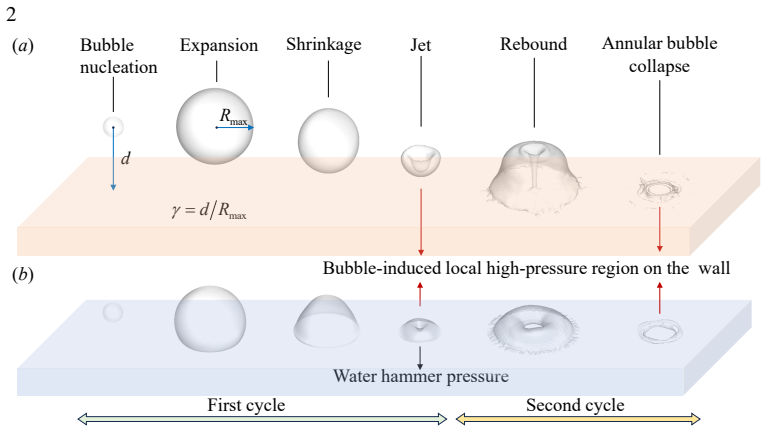
The load-bearing object is the toroidal bubble in its second oscillation cycle: the ring-shaped cavity left after the jet pierces the bubble and impacts the wall. The mechanism is circumferential asymmetric collapse, in which the thinner or more curved side of the ring collapses first and its outgoing shock wavefronts sweep around the ring, meeting opposing wavefronts head-on or superposing obliquely at one or two polar points to produce focused pressure loads. The paper shows that the initial non-spherical shape of the laser-induced bubble controls this asymmetry through two parameters, the aspect ratio defined as the mean of the two semi-axis lengths divided by the third, and the axial asymmetry ratio of the two ends of the spindle-shaped bubble. Larger aspect ratios create an elliptical jet tip through differences in added mass and inertial resistance during expansion, and the resulting variations in toroidal-bubble cross-section and centroid position determine whether the collapse is Bipolar-V, Bipolar-H, Monopolar, Annular, or one of the other modes.
What would settle it
Measure the wall pressure directly during the second-cycle collapse of a laser-induced bubble at a stand-off distance near 0.7 with an initially elliptical shape; if the recorded peak at the polar location is comparable to the first-cycle jet pressure of a few MPa rather than tens of MPa, the proposed shock-focusing mechanism cannot be the cause of the severe pits.
Extended reading notes
Core claim
The central discovery claimed is that severe cavitation erosion at moderate stand-off distances occurs in the second oscillation cycle, when the toroidal bubble collapses asymmetrically along its circumference. In the Bipolar and Monopolar collapse modes, the collapsing segments emit shock waves whose fronts collide head-on or superpose obliquely, concentrating pressure at discrete polar spots on the wall. The paper supports this with erosion experiments using repeated laser-induced bubble collapses, high-speed shadowgraphy and schlieren visualization, and three-dimensional simulations that reproduce the lip-shaped bubble and its circumferential pinch-off. The simulated wall pressure reaches 63 MPa in the Bipolar-V mode and 92 MPa for an initially elliptical bubble, compared with 3.6 MPa for the first-cycle jet and 11 MPa for the first toroidal collapse; the paper concludes that these second-cycle focused loads, not the first-cycle jet, explain the observed plastic deformation.
Load-bearing premise
The argument depends on the computed second-cycle wall-pressure peaks of 63 and 92 MPa faithfully representing what actually strikes the wall; the model is calibrated to the bubble radius and period, ignores heat and mass transfer, and the authors report about a 40 percent amplitude deviation from a reference simulation, so the pressure magnitude that carries the claim is not directly measured.
Editorial extensions
If this is right
- Erosion prediction at moderate stand-off distances should be built around second-cycle toroidal collapse and shock-focusing geometry rather than first-cycle jet impact.
- Initial bubble shape is a controlling parameter: increasing the aspect ratio beyond roughly 1.1 can raise the second-cycle wall pressure by more than a factor of three.
- The maximum erosion depth need not sit at the toroidal bubble's radius during the second collapse; in the Mini-Annular and Monopolar-II modes the deepest pits lie outside the ring, so pit-position measurements alone are not a reliable collapse diagnostic.
- The regime map in stand-off and aspect-ratio space ties each collapse mode to an erosion pattern, giving an experimental route to classify erosion damage from bubble geometry.
Reading between the lines
- If the pressure magnitudes hold, erosion-risk prediction should shift from tracking jet impact to tracking the initial shape of cavitation nuclei, because in real vortical or shear flows non-spherical nuclei could produce the same circumferential asymmetry and scattered deep pits far from the bubble's nominal footprint.
- The authors' reported 40 percent amplitude deviation from a reference simulation means the true focused loads could be higher or lower than 63 to 92 MPa; a hydrophone-validated measurement of the second-cycle wall pressure would turn the qualitative mechanism into a quantitative erosion criterion.
- A testable extension is to vary liquid temperature and ambient pressure: if thermal damping and phase change matter as much as the model's amplitude shortfall suggests, the Bipolar and Monopolar regime boundaries in the stand-off/aspect-ratio map should shift observably.
Editorial analysis
A structured set of objections, weighed in public.
Referee Report
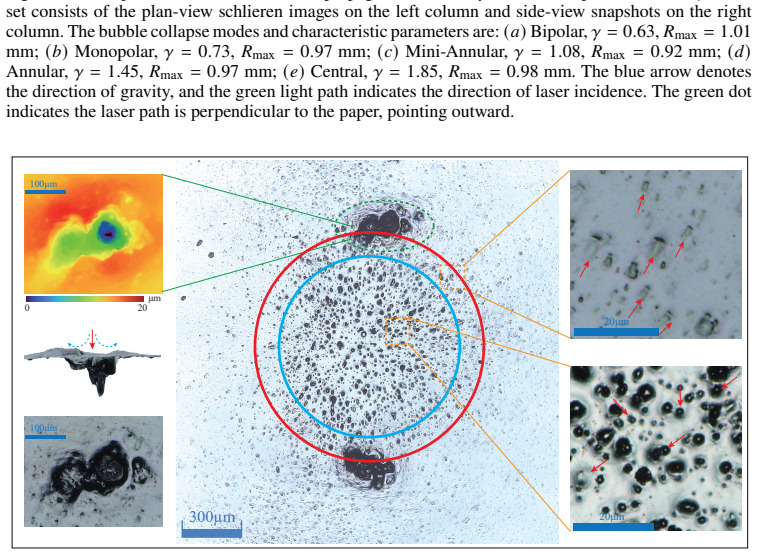
Summary. This paper presents an experimental and numerical study of cavitation erosion on aluminum samples caused by laser-induced bubbles at moderate stand-off distances (γ = 0.4–2.2). The authors identify five erosion patterns (Bipolar, Monopolar, Annular, Solar-Halo, Central) and correlate them with bubble collapse modes observed by high-speed schlieren and shadowgraphy. Their central claim is that severe erosion in this stand-off range arises from shock wave focusing during the circumferentially asymmetric collapse of the toroidal bubble in the second oscillation cycle, not from the first-cycle microjet. They support this with correlated imaging, erosion pit maps showing damage at the second-cycle collapse positions, and OpenFOAM simulations that reproduce the asymmetric collapse and yield wall pressures of 3.6 MPa (first-cycle jet), 11 MPa (first toroidal collapse), 63 MPa (Bipolar-V second cycle), and 92 MPa (initially elliptical bubble). The paper also provides a regime map of collapse modes in the γ–η space and a new image-based pit quantification method.
Significance. If the central claim holds, the paper makes a valuable contribution by clarifying the dominant erosion mechanism at moderate stand-off distances and by demonstrating the role of initial bubble non-sphericity in producing circumferentially asymmetric collapse. The experimental classification of five erosion patterns with corresponding collapse modes is thorough, and the use of plan-view schlieren imaging to capture shock wave focusing is a clear strength. The paper also ships publicly available code for pit analysis and provides a large corpus of experiments for the regime map. The principal weakness is that the quantitative pressure ordering underlying the mechanistic conclusion rests on simulations whose absolute peak pressures are not experimentally validated and whose modeling choices (attenuation coefficient, fixed liquid film) introduce uncertainty that is not fully assessed.
major comments (3)
- [§4.3 and Fig. 23] The central claim that severe erosion at moderate stand-off distances is caused by the second-cycle asymmetric collapse (Section 3.4) rests quantitatively on the simulated wall pressures of 3.6 MPa, 11 MPa, 63 MPa, and 92 MPa reported in Section 4.2 and Figure 23. The numerical model is calibrated only against the bubble radius and oscillation period (Section 2.3), and Section 4.3 acknowledges about 40% deviation in the peak pressure amplitude relative to the reference case of Rodriguez et al. (2022). A 40% uncertainty in the focused wall pressure directly affects the assertion that first-cycle loads are insufficient while second-cycle loads exceed the yield strength of aluminum. The authors should either validate the computed wall pressures experimentally (e.g., with a hydrophone or pressure-sensitive film) or provide a sensitivity analysis demonstrating that the ordering 3.6/11 MPa versus 63/92 MPa is robust to uncertainty in the attenuation coefficient and the neglected thermal effects.
- [§2.3 and §4.3] The no-slip wall with a persistent liquid film (alpha_1 = 1 at wall nodes) prevents direct jet-wall contact, and the paper reports that the jet impact pressure is attenuated by about 50% by a 10.6 μm water film. This film thickness is taken from a single case (gamma ≈ 0.72) and from Reuter & Kaiser (2019). Because the 3.6 MPa first-cycle jet pressure is a key term in the pressure comparison of Figure 23, the conclusion would be more robust if the sensitivity of that value to the film thickness were shown, and if the presence of the film were confirmed across the gamma range used in the comparison. Without this, the quantitative assessment of the first-cycle jet contribution remains an artifact of the boundary condition.
- [§3.2 and Fig. 9] The equivalent pit depth is computed from the quadratic relation h = -0.0004 R_pit^2 + 0.1244 R_pit + 0.031, which is said to have 'good predictive ability' but is presented without a goodness-of-fit statistic, confidence intervals, or residual analysis. Since this relation underlies the quantitative erosion volumes and radial depth profiles in Figures 7, 16, and 17, the authors should report the coefficient of determination (R^2) and the number of pits sampled; otherwise the quantitative erosion trends are not fully supported.
minor comments (5)
- [§4.3] The statement that elliptical initial bubbles produce 'up to three times that of spherical bubbles' is inconsistent with the same section's numbers (92 MPa vs 21 MPa, a ratio of about 4.4); please reconcile the wording.
- [§3.3] Typo: 'figiure 11c' should read 'figure 11(c)'.
- [Fig. 19 caption] The caption misspells 'Solar-Halo' as 'Soloar-Halo'.
- [§4.3] The reference to 'Rodriguez Jret al.' should be formatted as 'Rodriguez et al.'.
- [§3.5] The critical stand-off distances gamma_1 to gamma_4 in Figure 15 are introduced without stating the criterion used to determine them; please specify how these boundaries were extracted from the data.
Circularity Check
No significant circularity: the calibration inputs constrain bubble radius/period, not the erosion-mechanism conclusion.
full rationale
The paper's central claim is that severe erosion at moderate stand-off distances arises from circumferentially asymmetric collapse of the toroidal bubble in the second cycle, rather than from first-cycle jet impact. This claim is supported by three independent strands: direct erosion-pattern experiments on aluminium, high-speed shadowgraphy and schlieren imaging showing shock-wave focusing during second-cycle asymmetric collapse, and numerical simulations that reproduce the bubble morphology and wall-pressure ordering. The numerical inputs (P0 = 4800 bar, R0 = 0.055 Rmax, attenuation coefficient 0.34) are calibrated only against the measured bubble radius and oscillation period; the resulting wall pressures (3.6 MPa, 11 MPa, 63 MPa, 92 MPa) are emergent outputs, not fit targets. The quadratic pit-depth relation is a measurement conversion for estimating depths of small pits from their projected areas, and the Gaussian multi-peak radial fits are descriptive quantifications; neither encodes the mechanism conclusion. The acknowledged 40% peak-pressure deviation from Rodriguez et al. (2022) is a validation and accuracy limitation, not a circular reduction, because the error is stated against an external benchmark and does not by construction determine the relative ordering of first-cycle versus second-cycle loads. Self-citations and citations of prior solver and experimental work (CavBubbleFoam, film-thickness measurements, attenuation-coefficient precedents) provide external or independently validated support rather than importing the central conclusion. No load-bearing step reduces by construction to its own inputs, so the paper is not circular.
Assumptions & free parameters
free parameters (5)
- P0 (initial bubble pressure) =
4800 bar
- R0 (initial bubble radius) =
0.055 Rmax, about 29 micrometers
- Internal pressure attenuation coefficient =
0.34
- Pit depth-radius fit coefficients =
-0.0004, 0.1244, 0.031
- Mode transition stand-off distances gamma_1 to gamma_4 =
0.89, 1.25, 1.56, 1.85
assumptions (5)
- domain assumption The laser-induced bubble can be modeled as a high-pressure non-condensable gas governed by the Tait equation of state, with no heat or mass transfer.
- domain assumption The initial bubble shape is captured by two conjoined semi-ellipsoids with aspect ratio eta and axial asymmetry xi, measured from the first frame after plasma flash.
- domain assumption Shock waves emitted during bubble collapse can be approximated as spherical wavefronts propagating at the speed of sound, and the collapse velocity of the toroidal bubble equals this speed in the focusing schematic.
- domain assumption Pit depth can be inferred from the pit equivalent radius through a single fitted quadratic relationship for all pits on all samples.
- domain assumption The thin liquid film between bubble and wall is fixed by setting alpha_1 = 1 at wall nodes, as in Reuter and Ohl (2021).
Cite this review
Pith. "Pith review of New insights into the cavitation erosion by bubble collapse at moderate stand-off distances." pith.science (2026). https://pith.science/paper/T42A5M3C
@misc{pith2026250601286,
  author       = {Pith},
  title        = {Pith review of: New insights into the cavitation erosion by bubble collapse at moderate stand-off distances},
  year         = {2026},
  howpublished = {\url{https://pith.science/paper/T42A5M3C}},
  note         = {Machine review of arXiv:2506.01286}
}
abstract
Non-spherical bubble collapses near solid boundaries, generating water hammer pressures and shock waves, were recognized as key mechanisms for cavitation erosion. However, there is no agreement on local erosion patterns, and cavitation erosion damage lacks quantitative analysis. In our experiments, five distinct local erosion patterns were identified on aluminum sample surfaces, resulting from the collapse of laser-induced cavitation bubbles at moderate stand-off distances of $0.4\le\gamma\le2.2$, namely Bipolar, Monopolar, Annular, Solar-Halo, and Central. Among them, the Bipolar and Monopolar patterns exhibit the most severe cavitation erosion when the toroidal bubbles undergo asymmetrical collapse along the circumferential direction during the second cycle. Shadowgraphy visualization revealed that asymmetrical collapse caused shockwave focusing through head-on collision and oblique superposition of wavefronts. This led to the variations in toroidal bubble radii and the positions of maximum erosion depth not matching at certain stand-off distances. Both initial plasma asymmetry and bubble-wall stand-off distance were critical in determining circumferential asymmetrical collapse behaviors. At large initial aspect ratios, the elliptical jet tips form during the contraction process, resulting in the toroidal bubble collapsing from regions with smaller curvature radii, ultimately converging to the colliding point along the circumferential direction. Our three-dimensional simulations using OpenFOAM successfully reproduce the key features of circumferentially asymmetrical bubble collapse. This study provides new insights into the non-spherical near-wall bubble collapse dynamics and provides a foundation for developing predictive models for cavitation erosion.
Figures


Figures from the paper (21 more)




Reference graph
Works this paper leans on
-
[1]
, Hanke, S
Abedini, M. , Hanke, S. & Reuter, F. 2023 In situ measurement of cavitation damage from single bubble collapse using high-speed chronoamperometry . Ultrasonics Sonochemistry 92 , 106272
2023
-
[2]
Arabnejad, M. H. , Amini, A. , Farhat, M. & Bensow, R. E. 2020 Hydrodynamic mechanisms of aggressive collapse events in leading edge cavitation . Journal of Hydrodynamics 32 , 6--19
2020
-
[3]
Beig, S. A. , Aboulhasanzadeh, B. & Johnsen, E. 2018 Temperatures produced by inertially collapsing bubbles near rigid surfaces . Journal of Fluid Mechanics 852 , 105--125
2018
-
[4]
Blake, J. R. & Gibson, D. C. 1987 Cavitation bubbles near boundaries . Annual review of fluid mechanics 19 (1), 99--123
1987
-
[5]
Blake, J. R. , Taib, B. B. & Doherty, G. 1986 Transient cavities near boundaries. part 1. rigid boundary . Journal of Fluid Mechanics 170 , 479--497
1986
-
[6]
Brackbill, J. U. , Kothe, D. B. & Zemach, C. 1992 A continuum method for modeling surface tension . Journal of computational physics 100 (2), 335--354
1992
-
[7]
Brujan, E. A. , Keen, G. S. , Vogel, A. & Blake, J. R. 2002 The final stage of the collapse of a cavitation bubble close to a rigid boundary . Physics of fluids 14 (1), 85--92
2002
-
[8]
, Peng, X
Cao, Y. , Peng, X. X. , Yan, K. , Xu, L. & Shu, L. 2017 A qualitative study on the relationship between cavitation structure and erosion region around a 3d twisted hydrofoil by painting method. In Fifth International Symposium on Marine Propulsors\/ . Finland
2017
Show all 94 references
-
[9]
Chahine, G. L. & Hsiao, C.-T. 2015 Modelling cavitation erosion using fluid--material interaction simulations . Interface focus 5 (5), 20150016
2015
-
[10]
, Sirignano, W
Dabiri, S. , Sirignano, W. A. & Joseph, D. D. 2010 Interaction between a cavitation bubble and shear flow . Journal of fluid mechanics 651 , 93--116
2010
-
[11]
, Caillé, F
Duclaux, V. , Caillé, F. , Duez, C. , Ybert, C. , Bocquet, L. & Clanet, C. 2007 Dynamics of transient cavities . Journal of Fluid Mechanics 591 , 1--19
2007
-
[12]
, Bachert, B
Dular, M. , Bachert, B. , Stoffel, B. & S irok, B. 2004 Relationship between cavitation structures and cavitation damage . Wear 257 (11), 1176--1184
2004
-
[13]
, Delgosha, O
Dular, M. , Delgosha, O. C. & Petkovšek, M. 2013 Observations of cavitation erosion pit formation . Ultrasonics sonochemistry 20 (4), 1113--1120
2013
-
[14]
& Ohl, C
Dular, M. & Ohl, C. D. 2023 Bulk material influence on the aggressiveness of cavitation--questioning the microjet impact influence and suggesting a possible way to erosion mitigation . Wear 530 , 205061
2023
-
[15]
& Petkov s ek, M
Dular, M. & Petkov s ek, M. 2015 On the mechanisms of cavitation erosion--coupling high speed videos to damage patterns . Experimental Thermal and Fluid Science 68 , 359--370
2015
-
[16]
, Požar, T
Dular, M. , Požar, T. , Zevnik, J. & others 2019 High speed observation of damage created by a collapse of a single cavitation bubble . Wear 418 , 13--23
2019
-
[17]
, Bu mann, A
Fan, Y. , Bu mann, A. , Reuter, F. , Bao, H. , Adami, S. , Gordillo, J. M. , Adams, N. & Ohl, C. D. 2024 Amplification of supersonic microjets by resonant inertial cavitation-bubble pair . Physical Review Letters 132 (10), 104004
2024
-
[18]
, Mäkiharju, S
Ganesh, H. , Mäkiharju, S. A. & Ceccio, S. L. 2016 Bubbly shock propagation as a mechanism for sheet-to-cloud transition of partial cavities . Journal of Fluid Mechanics 802 , 37--78
2016
-
[19]
Gilmore, F. R. 1952 The growth or collapse of a spherical bubble in a viscous compressible liquid . Report No. 26-4
1952
-
[20]
, Yan, S
Han, L. , Yan, S. & Li, S. 2024 Theoretical investigation of spherical bubble dynamics in high mach number regimes . Journal of Marine Science and Application 23 (1), 39--48
2024
-
[21]
, Chahine, G
Hsiao, C.-T. , Chahine, G. L. & Ma, J. 2020 Dynamics of dispersed bubbly flow over a lifting surface: gas diffusion and bubble breakup effects . Ocean Engineering 213 , 107630
2020
-
[22]
, Alloncle, A.-P
Isselin, J.-C. , Alloncle, A.-P. & Autric, M. 1998 On laser induced single bubble near a solid boundary: contribution to the understanding of erosion phenomena . Journal of Applied physics 84 (10), 5766--5771
1998
-
[23]
& Colonius, T
Johnsen, E. & Colonius, T. 2009 Numerical simulations of non-spherical bubble collapse . Journal of fluid mechanics 629 , 231--262
2009
-
[24]
Keller, J. B. & Kolodner, I. I. 1956 Damping of underwater explosion bubble oscillations . Journal of applied physics 27 (10), 1152--1161
1956
-
[25]
Keller, J. B. & Miksis, M. 1980 Bubble oscillations of large amplitude . The Journal of the Acoustical Society of America 68 (2), 628--633
1980
-
[26]
, Lechner, C
Koch, M. , Lechner, C. , Reuter, F. , Köhler, K. , Mettin, R. & Lauterborn, W. 2016 Numerical modeling of laser generated cavitation bubbles with the finite volume and volume of fluid method, using openfoam . Computers & Fluids 126 , 71--90
2016
-
[27]
, Rosselló, J
Koch, M. , Rosselló, J. M. , Lechner, C. , Lauterborn, W. , Eisener, J. & Mettin, R. 2021 Theory-assisted optical ray tracing to extract cavitation-bubble shapes from experiment . Experiments in Fluids 62 , 1--19
2021
-
[28]
& Suvorov, L
Kornfeld, M. & Suvorov, L. 1944 On the destructive action of cavitation . Journal of Applied Physics 15 (6), 495--506
1944
-
[29]
& Kaiser, S
Kühlmann, J. & Kaiser, S. A. 2024 Single-bubble cavitation-induced pitting on technical alloys . Tribology Letters 72 (2), 55
2024
-
[30]
, Lopez de Arcaute y Lozano, C
Kühlmann, J. , Lopez de Arcaute y Lozano, C. , Hanke, S. & Kaiser, S. A. 2023 Correlation of laser-induced single bubbles with cavitation damage via in-situ imaging . Wear 522 , 204723
2023
-
[31]
1982 Cavitation bubble dynamics—new tools for an intricate problem
Lauterborn, W. 1982 Cavitation bubble dynamics—new tools for an intricate problem . In Mechanics and physics of bubbles in liquids\/ , pp. 165--178 . Springer
1982
-
[32]
& Bolle, H
Lauterborn, W. & Bolle, H. 1975 Experimental investigations of cavitation-bubble collapse in the neighbourhood of a solid boundary . Journal of Fluid Mechanics 72 (2), 391--399
1975
-
[33]
, Lauterborn, W
Lechner, C. , Lauterborn, W. , Koch, M. & Mettin, R. 2019 Fast, thin jets from bubbles expanding and collapsing in extreme vicinity to a solid boundary: A numerical study . Physical Review Fluids 4 (2), 021601
2019
-
[34]
, Lauterborn, W
Lechner, C. , Lauterborn, W. , Koch, M. & Mettin, R. 2020 Jet formation from bubbles near a solid boundary in a compressible liquid: Numerical study of distance dependence . Physical Review Fluids 5 (9), 093604
2020
-
[35]
, Han, R
Li, S. , Han, R. , Zhang, A. M. & Wang, Q. X. 2016 Analysis of pressure field generated by a collapsing bubble . Ocean Engineering 117 , 22--38
2016
-
[36]
, Prosperetti, A
Li, S. , Prosperetti, A. & van der Meer, D. 2020 Dynamics of a toroidal bubble on a cylinder surface with an application to geophysical exploration . International Journal of Multiphase Flow 129 , 103335
2020
-
[37]
, Saade, Y
Li, S. , Saade, Y. , van der Meer, D. & Lohse, D. 2021 Comparison of boundary integral and volume-of-fluid methods for compressible bubble dynamics . International journal of multiphase flow 145 , 103834
2021
-
[38]
, Zhao, Z
Li, S. , Zhao, Z. , Zhang, A.-M. & Han, R. 2024 Cavitation bubble dynamics inside a droplet suspended in a different host fluid . Journal of Fluid Mechanics 979 , A47
2024
-
[39]
, Linz, N
Liang, X.-X. , Linz, N. , Freidank, S. , Paltauf, G. & Vogel, A. 2022 Comprehensive analysis of spherical bubble oscillations and shock wave emission in laser-induced cavitation . Journal of Fluid Mechanics 940 , A5
2022
-
[40]
& Lauterborn, W
Lindau, O. & Lauterborn, W. 2003 Cinematographic observation of the collapse and rebound of a laser-produced cavitation bubble near a wall . Journal of Fluid Mechanics 479 , 327--348
2003
-
[41]
, Xiao, W
Liu, J. , Xiao, W. & Yao, X. 2024 Pressure characteristics of a nonspherical underwater explosion bubble in a compressible fluid . Physics of Fluids 36 (5), 057145
2024
-
[42]
Lozano, C. L. y , Kühlmann, J. , Kaiser, S. A. & Hanke, S. 2023 Observing early cavitation damage evolution from repeated laser-induced single bubbles on aluminium, austenitic steel and nickel-aluminium bronze . Wear 523 , 204862
2023
-
[43]
Mihatsch, M. S. , Schmidt, S. J. & Adams, N. A. 2015 Cavitation erosion prediction based on analysis of flow dynamics and impact load spectra . Physics of Fluids 27 (10), 103302
2015
-
[44]
Naude, C. F. & Ellis, A. T. 1961 On the mechanism of cavitation damage by nonhemispherical cavities collapsing in contact with a solid boundary . ASME. J. Basic Eng 83 (4), 648–656
1961
-
[45]
, Arora, M
Ohl, C.-D. , Arora, M. , Dijkink, R. , Janve, V. & Lohse, D. 2006 Surface cleaning from laser-induced cavitation bubbles . Applied physics letters 89 (7), 074102
2006
-
[46]
, Reese, H
Ohl, S.-W. , Reese, H. & Ohl, C.-D. 2024 Cavitation bubble collapse near a rigid wall with an oil layer . International Journal of Multiphase Flow 174 , 104761
2024
-
[47]
, Zevnik, J
Orthaber, U. , Zevnik, J. , Dular, M. & others 2020 Cavitation bubble collapse in a vicinity of a liquid-liquid interface--basic research into emulsification process . Ultrasonics sonochemistry 68 , 105224
2020
-
[48]
, Phan, T.-H
Park, S.-H. , Phan, T.-H. & Park, W.-G. 2022 Numerical investigation of laser-induced cavitation bubble dynamics near a rigid surface based on three-dimensional fully compressible model . International Journal of Heat and Mass Transfer 191 , 122853
2022
-
[49]
& Lauterborn, W
Philipp, A. & Lauterborn, W. 1998 Cavitation erosion by single laser-produced bubbles . Journal of fluid mechanics 361 , 75--116
1998
-
[50]
Plesset, M. S. 1954 On the stability of fluid flows with spherical symmetry . Journal of Applied Physics 25 (1), 96--98
1954
-
[51]
& Lezzi, A
Prosperetti, A. & Lezzi, A. 1986 Bubble dynamics in a compressible liquid. part 1. first-order theory . Journal of Fluid Mechanics 168 , 457--478
1986
-
[52]
Raman, K. A. , Rosselló, J. M. , Reese, H. & Ohl, C.-D. 2022 Microemulsification from single laser-induced cavitation bubbles . Journal of Fluid Mechanics 953 , A27
2022
-
[53]
on the pressure developed in a liquid during the collapse of a spherical cavity
Rayleigh, Lord 1917 Viii. on the pressure developed in a liquid during the collapse of a spherical cavity . The London, Edinburgh, and Dublin Philosophical Magazine and Journal of Science 34 (200), 94--98
1917
-
[54]
, Schädel, R
Reese, H. , Schädel, R. , Reuter, F. & Ohl, C.-D. 2022 Microscopic pumping of viscous liquids with single cavitation bubbles . Journal of Fluid Mechanics 944 , A17
2022
-
[55]
, Deiter, C
Reuter, F. , Deiter, C. & Ohl, C.-D. 2022 a\/ Cavitation erosion by shockwave self-focusing of a single bubble . Ultrasonics Sonochemistry 90 , 106131
2022
-
[56]
, Gonzalez-Avila, S
Reuter, F. , Gonzalez-Avila, S. R. , Mettin, R. & Ohl, C.-D. 2017 Flow fields and vortex dynamics of bubbles collapsing near a solid boundary . Physical Review Fluids 2 (6), 064202
2017
-
[57]
& Kaiser, S
Reuter, F. & Kaiser, S. A. 2019 High-speed film-thickness measurements between a collapsing cavitation bubble and a solid surface with total internal reflection shadowmetry . Physics of Fluids 31 (9), 097108
2019
-
[58]
& Ohl, C.-D
Reuter, F. & Ohl, C.-D. 2021 Supersonic needle-jet generation with single cavitation bubbles . Applied Physics Letters 118 (13), 134103
2021
-
[59]
, Zeng, Q
Reuter, F. , Zeng, Q. & Ohl, C. D. 2022 b\/ The rayleigh prolongation factor at small bubble to wall stand-off distances . Journal of Fluid Mechanics 944 , A11
2022
-
[60]
, Beig, S
Rodriguez Jr, M. , Beig, S. A. , Barbier, C. N. & Johnsen, E. 2022 Dynamics of an inertially collapsing gas bubble between two parallel, rigid walls . Journal of Fluid Mechanics 946 , A43
2022
-
[61]
Sagar, H. J. & Moctar, O. E. 2020 Dynamics of a cavitation bubble near a solid surface and the induced damage . Journal of Fluids and Structures 92 , 102799
2020
-
[62]
Shutler, N. D. & Mesler, R. B. 1965 A photographic study of the dynamics and damage capabilities of bubbles collapsing near solid boundaries . ASME. J. Basic Eng 87 (2), 511–517
1965
-
[63]
Sieber, A. B. , Preso, D. B. & Farhat, M. 2023 Cavitation bubble dynamics and microjet atomization near tissue-mimicking materials . Physics of Fluids 35 (2), 027101
2023
-
[64]
1912 Propeller erosion
Silberrad, D. 1912 Propeller erosion . Engineering 33 , 33--35
1912
-
[65]
, Enoki, M
Takata, T. , Enoki, M. , Chivavibul, P. , Matsui, A. & Kobayashi, Y. 2016 Effect of confinement layer on laser ablation and cavitation bubble during laser shock peening . Materials Transactions 57 (10), 1776--1783
2016
-
[66]
, Robinson, P
Tomita, Y. , Robinson, P. B. , Tong, R. P. & Blake, J. R. 2002 Growth and collapse of cavitation bubbles near a curved rigid boundary . Journal of Fluid Mechanics 466 , 259--283
2002
-
[67]
& Shima, A
Tomita, Y. & Shima, A. 1986 Mechanisms of impulsive pressure generation and damage pit formation by bubble collapse . Journal of Fluid Mechanics 169 , 535--564
1986
-
[68]
Tong, R. P. , Schiffers, W. P. , Shaw, S. J. , Blake, J. R. & Emmony, D. C. 1999 The role of ‘splashing’ in the collapse of a laser-generated cavity near a rigid boundary . Journal of Fluid Mechanics 380 , 339--361
1999
-
[69]
, Zhang, S
Tong, S.-Y. , Zhang, S. , Wang, S.-P. & Li, S. 2022 Characteristics of the bubble-induced pressure, force, and impulse on a rigid wall . Ocean Engineering 255 , 111484
2022
-
[70]
, Bryngelson, S
Trummler, T. , Bryngelson, S. H. , Schmidmayer, K. , Schmidt, S. J. , Colonius, T. & Adams, N. A. 2020 Near-surface dynamics of a gas bubble collapsing above a crevice . Journal of Fluid Mechanics 899 , A16
2020
-
[71]
, Lauterborn, W
Vogel, A. , Lauterborn, W. & Timm, R. 1989 Optical and acoustic investigations of the dynamics of laser-produced cavitation bubbles near a solid boundary . Journal of Fluid Mechanics 206 , 299--338
1989
-
[72]
2016 Local energy of a bubble system and its loss due to acoustic radiation
Wang, Q. 2016 Local energy of a bubble system and its loss due to acoustic radiation . Journal of Fluid Mechanics 797 , 201--230
2016
-
[73]
Wang, Q. X. , Yeo, K. S. , Khoo, B. C. & Lam, K. Y. 1996 Strong interaction between a buoyancy bubble and a free surface . Theoretical and Computational Fluid Dynamics 8 (1), 73--88
1996
-
[74]
, Cheng, H
Wang, Z. , Cheng, H. , Bensow, R. E. , Peng, X. & Ji, B. 2023 Numerical assessment of cavitation erosion risk on the delft twisted hydrofoil using a hybrid eulerian-lagrangian strategy . International Journal of Mechanical Sciences 259 , 108618
2023
-
[75]
, Yao, Z.-F
Wen, H.-G. , Yao, Z.-F. , Wu, Q. , Sun, Y.-R. , Yang, C.-X. & Zhong, Q. 2023 Investigation of cavitation erosion caused by laser-induced single bubble collapse near alloy coating surface . Journal of Hydrodynamics 35 , 876--886
2023
-
[76]
, Beig, S
White, W. , Beig, S. A. & Johnsen, E. 2023 Pressure fields produced by single-bubble collapse near a corner . Physical Review Fluids 8 (2), 023601
2023
-
[77]
, Xiong, C
Yang, Y. , Xiong, C. , Wang, S. & Zhang, A. 2025 Cavitation erosion risk on a hydrofoil using a multi-scale method . Physics of Fluids 37 (2), 027107
2025
-
[78]
Yang, Y. X. , Wang, Q. X. & Keat, T. S. 2013 Dynamic features of a laser-induced cavitation bubble near a solid boundary . Ultrasonics sonochemistry 20 (4), 1098--1103
2013
-
[79]
, Zhang, Y
Yin, J. , Zhang, Y. , Zhu, J. , Lv, L. & Tian, L. 2021 An experimental and numerical study on the dynamical behaviors of the rebound cavitation bubble near the solid wall . International Journal of Heat and Mass Transfer 177 , 121525
2021
-
[80]
YuAlfred, C. H. & others 2022 Ultrasound-mediated drug delivery: sonoporation mechanisms, biophysics, and critical factors . BME frontiers 2022 , 9807347
2022
-
[81]
Zeng, Q. , An, H. & Ohl, C.-D. 2022 Wall shear stress from jetting cavitation bubbles: Influence of the stand-off distance and liquid viscosity . Journal of Fluid Mechanics 932 , A14
2022
-
[82]
, Gonzalez-Avila, S
Zeng, Q. , Gonzalez-Avila, S. R. , Dijkink, R. , Koukouvinis, P. , Gavaises, M. & Ohl, C.-D. 2018 Wall shear stress from jetting cavitation bubbles . Journal of Fluid Mechanics 846 , 341--355
2018
-
[83]
Zhang, A.-M. , Li, S. & Cui, J. 2015 Study on splitting of a toroidal bubble near a rigid boundary . Physics of Fluids 27 (6), 062102
2015
-
[84]
, Li, S.-M
Zhang, A.-M. , Li, S.-M. , Cui, P. , Li, S. & Liu, Y.-L. 2023 A unified theory for bubble dynamics . Physics of Fluids 35 (3), 033323
2023
-
[85]
, Li, S.-M
Zhang, A.-M. , Li, S.-M. , Xu, R.-Z. , Pei, S.-C. , Li, S. & Liu, Y.-L. 2024 A theoretical model for compressible bubble dynamics considering phase transition and migration . Journal of Fluid Mechanics 999 , A58
2024
-
[86]
counterjet
Zhang, J. 2021 Effect of stand-off distance on “counterjet” and high impact pressure by a numerical study of laser-induced cavitation bubble near a wall . International Journal of Multiphase Flow 142 , 103706
2021
-
[87]
, Wang, S
Zhang, S. , Wang, S. P. & Zhang, A. M. 2016 Experimental study on the interaction between bubble and free surface using a high-voltage spark generator . Physics of Fluids 28 (3), 032109
2016
-
[88]
, Zhang, A.-M
Zhang, T. , Zhang, A.-M. , Zhang, S. , Long, S. , Han, R. , Liu, L. , Ohl, C.-D. & Li, S. 2025 Free-surface jetting driven by a cavitating vortex ring . Journal of Fluid Mechanics 1003 , A4
2025
-
[89]
& Prosperetti, A
Zhou, G. & Prosperetti, A. 2020 Modelling the thermal behaviour of gas bubbles . Journal of Fluid Mechanics 901 , R3
2020
-
[90]
, " * write output.state after.block = add.period write newline
ENTRY address author booktitle chapter edition editor howpublished institution journal key month note number organization pages publisher school series title type volume year eprint label extra.label sort.label short.list INTEGERS output.state before.all mid.sentence after.sen...
-
[91]
write newline
" write newline "" before.all 'output.state := FUNCTION n.dashify 't := "" t empty not t #1 #1 substring "-" = t #1 #2 substring "--" = not "--" * t #2 global.max substring 't := t #1 #1 substring "-" = "-" * t #2 global.max substring 't := while if t #1 #1 substring * t #2 gl...
-
[92]
@esa (Ref
\@ifclassloaded aguplus natbib The aguplus class already includes natbib coding, so you should not add it explicitly Type <Return> for now, but then later remove the command natbib from the document \@ifclassloaded nlinproc natbib The nlinproc class already includes natbib cod...
-
[93]
@stdbsttrue NAT@ctr \@lbibitem[ NAT@ctr ] \@lbibitem[#1]#2 \@extra@b@citeb \@ifundefined br@#2\@extra@b@citeb \@namedef br@#2 \@nameuse br@#2\@extra@b@citeb \@ifundefined b@#2\@extra@b@citeb @num @parse #2 [ @natanchorstart #2\@extra@b@citeb \@biblabel @num @natanchorend] @ifc...
-
[94]
counterjet
@open @close @open @close and [1] URL: #1 \@ifundefined chapter * \@mkboth \@ifundefined NAT@sectionbib * \@mkboth * \@mkboth\@gobbletwo \@ifclassloaded amsart * \@ifclassloaded amsbook * \@ifundefined bib@heading @heading NAT@ctr thebibliography [1] @ \@biblabel NAT@ctr \@bib...
1912
Reviewed August 7, 2026 · model on record in the stance chip above.
Discussion (0). Continue with ORCID to comment.