REVIEW 3 major objections 6 minor 21 references
Point Jacobi-type preconditioning and parameter tuning for Calderon-preconditioned Burton-Miller method in transmission problems
T0 review · 3 major / 6 minor · reviewed 2026-08-07 · deepseek-v4-flash
Pith's one-line read The paper derives explicit eigenvalue cluster points for the squared Calderon-preconditioned Burton-Miller operator and uses them to build a cheap point Jacobi preconditioner plus parameter tuning that keeps GMRES iteration counts low for…
desk verdict Useful extension of Calderon-preconditioned BM-BEM with a plausible but unproved spectral formula; solid numerics, worthwhile referee. read the letter →
The pith
A machine-rendered reading of the paper's core claim, the machinery that carries it, and where it could break.
The reading
What carries the argument
The load-bearing object is the squared Calderon-preconditioned Burton-Miller boundary integral operator $A^2$ and its eigenvalue cluster formula (14). Calderon's identities make $A^2$ equal to a block operator whose only non-compact part is diagonal with coefficients $\lambda_{i_b}$, plus a compact remainder $K$; the formula for $\lambda$ is what makes the rest of the construction possible. The point Jacobi-like preconditioner $M$ (16) multiplies each block by the reciprocal square root of the corresponding cluster point, so the preconditioned squared operator clusters at 1. The parameter patterns P1, P2, P3 and the normal-orientation search are the tuning machinery that brings the cluster points close before $M$ is applied, protecting against outlier eigenvalues that $M$ would otherwise amplify.
What would settle it
Compute the spectrum of the collocation-discretised matrix $A^2$ for, say, the concentric-spheres configuration with $\varepsilon=(1,0.1,10)$ at moderate $N$, and count the accumulation points away from the formula (14); if extra clusters or non-compact off-diagonal behaviour appear, the central identity fails. A simpler check: compare the GMRES iteration count with the prediction that all cluster points of $(AM^{-1})^2$ are at 1; systematic deviation with mesh refinement would falsify the claim.
Extended reading notes
Core claim
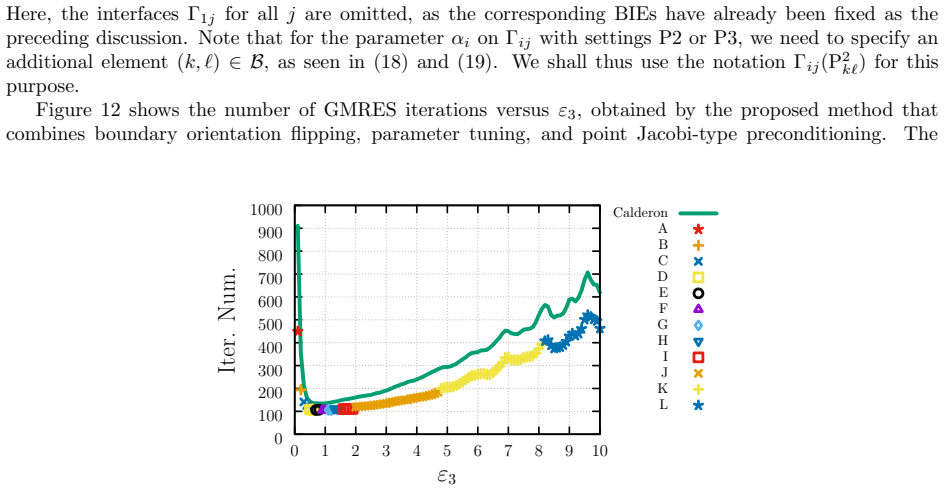
The paper's central claim is that the squared Calderon-preconditioned Burton-Miller integral operator $A^2$ for a multi-material transmission problem has at most $2N_B$ eigenvalue accumulation points, given explicitly by $\lambda_{i_b}=\alpha_1^2(1+\alpha_i\epsilon_j/\alpha_1)/4$ and $\lambda_{i_b+N_B}=\alpha_1^2((\alpha_i/\alpha_1)^2\epsilon_i^2+(\alpha_i/\alpha_1)\epsilon_j)/4$ (Eq. 14). Because these points are known in closed form, the authors construct a point Jacobi-type preconditioner $M=\mathrm{diag}(\sqrt{\lambda_1}I,\dots,\sqrt{\lambda_{2N_B}}I)$ that shifts all cluster points of $(AM^{-1})^2$ to 1. They further show that the choice $\alpha_i=\alpha_1/\epsilon_i$ merges the two families of cluster points into $N_B$ points, and they propose parameter patterns P1-P3 together with an exhaustive search over interface normal orientations to minimise the maximum ratio of cluster-point magnitudes. Numerical experiments on concentric spheres, cuboids with junctions, and a four-box composite scatterer show that the combined strategy substantially reduces GMRES iteration counts in high-contrast regimes.
Load-bearing premise
The claimed eigenvalue formula for the squared integral operator is asserted without proof; if the true spectrum has extra cluster points or non-compact off-diagonal blocks, the preconditioner and parameter tuning lose their theoretical basis.
Editorial extensions
If this is right
- If the spectral formula is correct, the point Jacobi preconditioner (16) costs only $O(N_B)$ storage and makes the squared preconditioned operator cluster at 1, giving GMRES iteration counts that barely grow with the number of boundary elements.
- The parameter patterns P1-P3 plus interface-orientation search give a concrete recipe for choosing the Burton-Miller coefficients in multi-material geometries, replacing the empirical choice $\alpha_i=\alpha_1/\varepsilon_i$.
- The method extends the original two-dimensional demonstration to three-dimensional problems, including geometries with junctions and corners, where the proposed combination outperforms both the original Calderon preconditioning and either strategy alone.
- The explicit cluster-point formulas also explain why extra Burton-Miller equations are needed: setting $\alpha_i=0$ would create a zero eigenvalue cluster and badly condition the system.
Reading between the lines
- Beyond the paper: a rigorous proof of the decomposition (13) would be needed to certify the formula (14) for non-smooth boundaries; the numerical evidence with cuboids is suggestive but not a proof.
- Beyond the paper: the same diagonal cluster-point preconditioner could be applied to other Calderon-preconditioned boundary integral formulations whose squared operators have known cluster points, such as PMCHWT-type formulations.
- Beyond the paper: the exhaustive search over normal orientations and P1/P2/P3 choices grows combinatorially with the number of interfaces, so a greedy heuristic would make the tuning practical for large multi-material meshes.
Editorial analysis
A structured set of objections, weighed in public.
Referee Report
Summary. The manuscript extends the Calderon-preconditioned Burton–Miller BEM of Matsumoto et al. to multi-material Helmholtz transmission problems with high material contrast. It states an analytical formula for the eigenvalue accumulation points of the squared integral operator A^2 (Eqs. (13)–(14)); based on this it introduces a point-Jacobi-type preconditioner M (Eq. (16)) and parameter/normal-direction tuning rules P1–P3 (Eqs. (17)–(19)) with an exhaustive-search algorithm. Numerical experiments on concentric spheres, cuboids with junctions, and a four-box composite scatterer show that the combined tuning and preconditioning reduces GMRES iterations in high-contrast settings.
Significance. If Eqs. (13)–(14) are correct, the contribution is practically significant: the preconditioner is diagonal and nearly free to apply, and the parameter tuning is a systematic way to reduce cluster spread without changing the discretization. The numerical study is fairly extensive and includes a benchmark with known analytical solution, geometries with corners and junctions, and a complex multi-box case; the authors also honestly document cases where preconditioning alone amplifies outlier eigenvalues (Figs. 9 and 10). The approach is not circular in the sense of fitting iteration counts, since the cluster points are computed from the operator coefficients. The main weakness is that the central spectral formula is not derived, and the optimality of the search over P1–P3 is not proved.
major comments (3)
- [§2.3, Eqs. (13)–(14)] This is the core theoretical result of the paper, but it is introduced only with "Through a detailed and rigorous calculation... we found". The block structure of A^2, the explicit values of λ_{i_b} and λ_{i_b+N_B}, and the compactness of K are asserted without proof. Every subsequent construction—the preconditioner M in (16), the parameter choices P1–P3 in (17)–(19), and the claim that (A M^{-1})^2 clusters at 1—depends on this formula. The numerical spectra in Appendix B are consistent with the predicted cluster points, but they cannot replace a derivation. Please supply a complete proof or a precise reference to a theorem with stated hypotheses; if the derivation is too long for the main text, an appendix is appropriate.
- [§4.1 (Figs. 6, 7) and §4.2 (Figs. 11, 12)] The formula (13)–(14) is applied to cuboid geometries with edges, corners, and junctions, but the compactness of K and the principal-operator calculation are standard only for smooth boundaries; no argument is given that the result extends to these non-smooth configurations. Since the good iteration counts for those cases are offered as evidence for the general method, the paper should either prove or cite an extension to Lipschitz/corner domains, or explicitly mark those experiments as empirical rather than theory-backed.
- [§3.2.1 and §3.2.3] Constraints C1 and C2 are introduced without justification, and Section 3.2.3 claims an exhaustive search over "all admissible combinations" of P1–P3 and normal orientations. The paper does not show that C1–C2 are necessary or sufficient for preserving exactly N_B cluster points, nor that the minimum maximum-ratio criterion over this finite list is the actual optimum over all possible α_i and orientations. If the search is a heuristic, that should be stated; if a theorem is intended, a proof is needed.
minor comments (6)
- [§2.3, Eq. (13)] The sentence "whose upper-triangular blocks are all zero operators" is misleading; the displayed matrix has a zero upper off-diagonal block but nonzero lower off-diagonal c_i I blocks. Please rephrase to "off-diagonal block" or "lower-triangular" as appropriate.
- [§1] "Fredoholm" should be "Fredholm".
- [§2.2] In the sentence "all αis red in (6)", "red" appears to be a typo for "used".
- [Appendix A, Eq. (A.1)] The term `−α1 ε2 S^2_{32} u32` should presumably act on `w32`, matching the other flux terms in (A.1)–(A.4); please check.
- [§4.2 and Table 2] The notation Γ_{ij}(P2_{kℓ}) is introduced only in the final example; define it earlier, near Eq. (17), so that Table 2 is readable.
- [Fig. 10] The caption should state the parameter values (ω=1, ε1=1, ε2=4, ε3=10, N=2880) rather than leaving them only in the text.
Circularity Check
No significant circularity: the cluster-point formula is an asserted analytical derivation, the preconditioner is constructed from it by design, and the numerical tests are external validation.
full rationale
The derivation chain is not circular. The paper's central new input is the spectral formula (14), introduced with the sentence "Through a detailed and rigorous calculation based on the integral equations (5) and (6), and Calderon's formula, we found that A2 assumes the following form." This is an unproved analytical assertion, but it is not fitted to the GMRES iteration counts or to the plotted spectra; the eigenvalue plots in Appendix B are presented as verification of the formula, not as the source of the formula. The point Jacobi-type preconditioner (16) is defined directly from the cluster points in (14), so the statement that (AM^{-1})^2 clusters at 1 is a consequence of the construction rather than a disguised reuse of measured data. The parameter settings P1, P2, and P3 are obtained by algebraically equating the components of (14), and the subsequent exhaustive search minimizes a maximum ratio computed from the same formula; again, the GMRES results are used only to test, not to determine, the parameters. The base BIE system (5)-(6) is taken from Matsumoto et al. [15], whose author list overlaps with the present paper, but the new formula (14) is not justified by citing [15]; it is asserted as the authors' own calculation. Thus the central claim does not reduce to a fitted parameter or to a self-citation chain. The missing proof of (13)-(14) is a real correctness risk, but it is not circularity.
Assumptions & free parameters
assumptions (4)
- standard math Calderon identities and compactness of products of layer potentials give A^2 = block-upper-triangular-plus-compact (Eq. 13) with the stated diagonal coefficients.
- domain assumption The collocation-discretized matrix inherits the continuous cluster points (14) closely enough for the preconditioner M in (16) to be effective.
- ad hoc to paper The constraints C1 and C2 in Section 3.2.1 define exactly the admissible parameter combinations for preserving N_B cluster points.
- domain assumption alpha1 = -i/k1 keeps the fictitious eigenvalues away from the real axis.
Cite this review
Pith. "Pith review of Point Jacobi-type preconditioning and parameter tuning for Calderon-preconditioned Burton-Miller method in transmission problems." pith.science (2026). https://pith.science/paper/OISUM3ZX
@misc{pith2026250601440,
  author       = {Pith},
  title        = {Pith review of: Point Jacobi-type preconditioning and parameter tuning for Calderon-preconditioned Burton-Miller method in transmission problems},
  year         = {2026},
  howpublished = {\url{https://pith.science/paper/OISUM3ZX}},
  note         = {Machine review of arXiv:2506.01440}
}
read the original abstract
It was recently demonstrated that the boundary element method based on the Burton-Miller formulation (BM-BEM), widely used for solving exterior problems, can be adapted to solve transmission problems efficiently. This approach utilises Calderon's identities to improve the spectral properties of the underlying integral operator. Consequently, most eigenvalues of the squared BEM coefficient matrix, i.e. the collocation-discretised version of the operator, cluster at a few points in the complex plane. When these clustering points are closely packed, the resulting linear system is well-conditioned and can be solved efficiently using the generalised minimal residual method with only a few iterations. However, when multiple materials with significantly different material constants are involved, some eigenvalues become separated, deteriorating the conditioning. To address this, we propose an enhanced Calderon-preconditioned BM-BEM with two strategies. First, we apply a preconditioning scheme inspired by the point Jacobi method. Second, we tune the Burton-Miller parameters to minimise the condition number of the coefficient matrix. Both strategies leverage a newly derived analytical expression for the eigenvalue clustering points of the relevant operator. Numerical experiments demonstrate that the proposed method, combining both strategies, is particularly effective for solving scattering problems involving composite penetrable materials with high contrast in material properties.
Figures


Figures from the paper (9 more)


Reference graph
Works this paper leans on
-
[15]
Y. Matsumoto, A. Yoshiki, H. Isakari, Calderon-preconditioned boundary integral equations of the Burton-Miller type for transmission problems, arXiv preprint arXiv:2312.12787 (2023)
work page Pith review arXiv 2023
-
[1]
I. Akduman, R. Kress, Direct and inverse scattering problems for inhomogeneous impedance cylinders of arbitrary shape, Radio Science 38 (3), iSBN: 0048-6604 Publisher: Wiley Online Library (2003)
work page 2003
- [2]
-
[3]
W. C. Chew, E. Michielssen, J. Song, J.-M. Jin, Fast and efficient algorithms in computational electromagnetics, Artech House, Inc., 2001
work page 2001
-
[4]
M¨ uller, Foundations of the mathematical theory of electromagnetic waves, Vol
C. M¨ uller, Foundations of the mathematical theory of electromagnetic waves, Vol. 155, Springer Science & Business Media, 2013
work page 2013
-
[5]
R. Kleinman, P. Martin, On single integral equations for the transmission problem of acoustics, SIAM Journal on Applied Mathematics 48 (2) (1988) 307–325, publisher: SIAM
work page 1988
-
[6]
M. Costabel, E. Stephan, A direct boundary integral equation method for transmission problems, Journal of mathematical analysis and applications 106 (2) (1985) 367–413
work page 1985
-
[7]
S. H. Christiansen, J.-C. N´ ed´ elec, Des pr´ econditionneurs pour la r´ esolution num´ erique des ´ equations int´ egrales de fronti` ere de l’acoustique, Comptes Rendus de l’Acad´ emie des Sciences-Series I-Mathematics 330 (7) (2000) 617–622
work page 2000
Show all 21 references
-
[8]
Antoine, Y
X. Antoine, Y. Boubendir, An integral preconditioner for solving the two-dimensional scattering transmission problem using integral equations, International Journal of Computer Mathematics 85 (10) (2008) 1473–1490, publisher: Taylor & Francis
2008
-
[9]
Niino, N
K. Niino, N. Nishimura, Preconditioning based on Calderon’s formulae for periodic fast multipole methods for Helmholtz’equation, Journal of Computational Physics 231 (1) (2012) 66–81, publisher: Elsevier
2012
-
[10]
Y. Saad, M. H. Schultz, GMRES: A generalized minimal residual algorithm for solving nonsymmetric linear systems, SIAM Journal on scientific and statistical computing 7 (3) (1986) 856–869, publisher: SIAM
1986
-
[11]
Misawa, K
R. Misawa, K. Niino, N. Nishimura, Boundary integral equations for calculating complex eigenvalues of transmission problems, SIAM Journal on Applied Mathematics 77 (2) (2017) 770–788, publisher: SIAM
2017
-
[12]
Claeys, R
X. Claeys, R. Hiptmair, E. Spindler, A second-kind galerkin boundary element method for scattering at composite objects, BIT Numerical Mathematics 55 (2015) 33–57
2015
-
[13]
Hiptmair, C
R. Hiptmair, C. Jerez-Hanckes, Multiple traces boundary integral formulation for Helmholtz transmission problems, Ad- vances in Computational Mathematics 37 (1) (2012) 39–91, publisher: Springer
2012
-
[14]
Burton, G
A. Burton, G. Miller, The application of integral equation methods to the numerical solution of some exterior boundary- value problems, Proceedings of the Royal Society of London. A. Mathematical and Physical Sciences 323 (1553) (1971) 201–210, publisher: The Royal Society London
1971
-
[16]
Zheng, H.-B
C.-J. Zheng, H.-B. Chen, H.-F. Gao, L. Du, Is the Burton–Miller formulation really free of fictitious eigenfrequencies?, Engineering Analysis with Boundary Elements 59 (2015) 43–51, publisher: Elsevier
2015
-
[17]
Tomoyasu, H
K. Tomoyasu, H. Kotani, H. Isakari, Calderon-preconditioned BEMs for frequency-differentiated boundary-value problems of Helmholtz’ equation, Transactions of Japan Society for Computational Methods in Engineering 24 (2024) 43–53
2024
-
[18]
L. Chen, H. Lian, Y. Xu, S. Li, Z. Liu, E. Atroshchenko, P. Kerfriden, Generalized isogeometric boundary element method for uncertainty analysis of time-harmonic wave propagation in infinite domains, Applied Mathematical Modelling 114 (2023) 360–378
2023
-
[19]
J. Kook, J. S. Jensen, S. Wang, Acoustical topology optimization of zwicker’s loudness with pad´ e approximation, Computer Methods in Applied Mechanics and Engineering 255 (2013) 40–66
2013
-
[20]
Nakamoto, H
K. Nakamoto, H. Isakari, T. Takahashi, T. Matsumoto, A fast topology optimisation for material-and geometry- independent cloaking devices with the BEM and the H-matrix method, arXiv preprint arXiv:1611.08072 (2016)
2016 arXiv
-
[21]
Isakari, K
H. Isakari, K. Kuriyama, S. Harada, T. Yamada, T. Takahashi, T. Matsumoto, A topology optimisation for three- dimensional acoustics with the level set method and the fast multipole boundary element method, Mechanical Engineering Journal 1 (4) (2014) CM0039–CM0039, publisher: T...
2014
Reviewed August 7, 2026 · model on record in the stance chip above.
Discussion (0). Sign in to comment.