REVIEW 4 major objections 7 minor 3 references
RS Sagittarii: Revealing the component spectra and the mass transfer
T0 review · 4 major / 7 minor · reviewed 2026-08-07 · deepseek-v4-flash
Pith's one-line read RS Sagittarii is a semi-detached Algol whose A0 III secondary fills its Roche lobe and transfers mass through L1 to a B3 V primary, with a circumprimary disk, an impact hot spot, and a distance of 418 ± 15 pc consistent with Gaia DR3.
desk verdict A careful single-system Algol study that delivers first precise parameters, but the spot-heavy light-curve model and a few internal slips mean the quoted precision should be treated with caution. read the letter →
The pith
A machine-rendered reading of the paper's core claim, the machinery that carries it, and where it could break.
The reading
What carries the argument
The load-bearing machinery is the coupling of spectral disentangling to a light-curve model. The disentangling code separates the two stellar spectra using Fourier disentangling, but it needs phase-dependent light contributions, which come from a Wilson-Devinney solution assuming a semi-detached configuration with a fixed primary temperature from the Q-method. The disentangled spectra are then fitted with non-LTE model atmospheres for the primary and LTE model atmospheres for the secondary, giving Teff, log g, and vsini. The r1-q diagram of Lubow and Shu and Peters classifies the expected mass-flow geometry (direct impact versus disk), and Hα difference spectra, built by subtracting the two stellar contributions, map the stream, disk, and hot spot in velocity and phase.
What would settle it
Measure the secondary star's radius independently from the eclipse light curve and from its high-resolution line profiles: if the radius and surface gravity do not match the Roche-lobe equipotential at q = 0.325 and P = 2.4157 d, the semi-detached configuration and the derived absolute parameters collapse.
Extended reading notes
Core claim
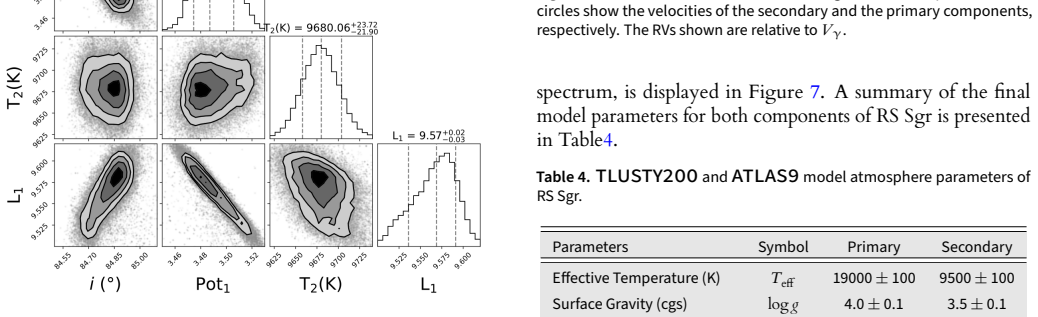
The central discovery is that RS Sgr is a Roche-lobe-overflowing Algol with well-determined, mutually consistent spectroscopic and photometric parameters. Spectral disentangling, seeded by the phase-dependent light contributions from the Wilson-Devinney solution, yields two clean component spectra; atmosphere fits give Teff,1 = 19000 ± 100 K, log g1 = 4.0, vsini1 = 115 km/s and Teff,2 = 9500 ± 100 K, log g2 = 3.5, vsini2 = 90 km/s. The simultaneous light-curve and radial-velocity solution then fixes masses of 8.85 and 2.88 solar masses, radii of 5.23 and 4.95 solar radii, and an inclination near 82.6°, placing the secondary exactly on its Roche equipotential. The Hα residuals are phase-dependent: redshifted absorption between phases 0.15–0.25 and 0.80–0.85 traces the L1 stream, an absorption co-moving with the primary at 0.75–0.85 traces accreting gas, and a hot spot at longitude 90° with a temperature factor of 1.15 accounts for photometric excess between phases 0.75 and 0.90. The resulting distance, 418 ± 15 pc, agrees with Gaia DR3, and the r1-q position (r1 ≈ 0.295, q ≈ 0.311) places the system in the direct-impact regime with a possible transient disk, consistent with a low-density circumprimary disk rather than a permanent accretion disk.
Load-bearing premise
The whole analysis assumes from the start that the cooler star exactly fills its gravitational boundary (Roche lobe) and that the hotter star has a temperature of 19000 K; if the light-curve model is biased, for example by the nine hand-adjusted cool spots used to fit the TESS residuals, the separated spectra and the temperatures derived from them inherit that bias.
Editorial extensions
If this is right
- RS Sgr now has a self-consistent set of absolute parameters (masses 8.85 and 2.88 $M_\odot$; radii 5.23 and 4.95 $R_\odot$; temperatures 19000 and 9700 K) that can be used to test theoretical models of Algol evolution.
- Because the secondary exactly fills its Roche lobe and the system is semi-detached, RS Sgr joins the well-characterized sample of short-period Algols for which mass-transfer geometry can be modeled.
- The Hα difference spectrograms provide a phase-resolved map of the mass flow: an L1 stream, an impact hot spot near phases 0.75–0.90, and a low-density circumprimary disk.
- The distance of 418 ± 15 pc, independently derived from the absolute parameters, agrees with Gaia DR3, so the physical scale of the system is secure.
- The primary's near-synchronous rotation (vsini ≈ 115 km/s versus a computed synchronous velocity of about 110 km/s) shows that ongoing accretion has not significantly spun up the mass gainer, matching expectations for short-period Algols.
Reading between the lines
- Editorial inference: the nine hand-adjusted cool spots used to fit the TESS residuals are ad hoc; a physically motivated stream/spot model, or a fit that marginalizes over spot parameters, could shift the secondary temperature by more than the quoted 100 K.
- Editorial inference: the paper's r1-q placement predicts a direct-impact geometry; time-resolved Doppler tomography of the primary's helium lines during phases 0.75–0.90 could directly image the hot spot and test that prediction.
- Editorial inference: because the absolute-parameter distance agrees with Gaia DR3, the same light-curve-plus-disentangling recipe could be applied to other short-period Algols as a distance and parallax cross-check.
- Editorial inference: the Hα absorption co-moving with the primary at phases 0.75–0.85 could also be self-absorption from a transient disk rather than the stream; a 3D radiative-transfer calculation of the proposed geometry would settle this.
Editorial analysis
A structured set of objections, weighed in public.
Referee Report
Summary. The paper re-analyzes archival high-resolution HERCULES spectra and multi-band photometry (Hipparcos, Johnson V, TESS) of the Algol-type binary RS Sgr. Using the KOREL spectral-disentangling code with light ratios from a Wilson-Devinney/PHOEBE light-curve model, the authors derive a spectroscopic orbit and then fit TLUSTY/ATLAS9 synthetic spectra to the disentangled component spectra. They report Teff,1=19000±100 K (B3 V) and Teff,2≈9500–9700 K (A0 III), masses 8.85/2.88 Msun, radii 5.23/4.95 Rsun, a semi-detached configuration with the secondary filling its Roche lobe, a mass-transfer stream, a circumprimary disk and hot spot, and a system distance of 418±15 pc that they compare with Gaia DR3 (436 pc). The light-curve model includes a hand-adjusted hot spot (HIP/V) and nine artificial cool spots (TESS), with MCMC applied only to the TESS data.
Significance. If the derived parameters are correct, the paper makes a valuable contribution: it would anchor a previously poorly characterized southern Algol with precise masses, radii, temperatures, and mass-transfer constraints, and the H-alpha residual analysis provides a useful map of the circumstellar material. The strengths include the use of established codes (KOREL, PHOEBE, TLUSTY, ATLAS9), the combination of independent photometric data sets, a tightly constrained spectroscopic orbit, and an explicit comparison with the Gaia distance. The main risk is that the central temperatures and classifications rest on disentangled spectra whose light ratios are set by a light-curve model with unquantified hand-adjusted spots and on an assumed Roche-lobe-filling geometry; both need sensitivity testing before the results can be considered robust.
major comments (4)
- [Section 3, Section 4, Table 3, Section 5] The light ratios used as fixed input to the KOREL disentangling in Section 3 are taken from the WD/PHOEBE solution in Section 4, whose TESS fit is obtained by adding nine hand-adjusted artificial cool spots to the primary and secondary (Table 3, temperature factors 0.36–0.65). Because the reported Teff, log g, and vsini values in Section 5 are measured from the KOREL-disentangled spectra, any systematic error in these spot-modulated light ratios propagates directly into the B3 V/A0 III classification and the absolute parameters in Table 5. The paper provides no sensitivity test, such as repeating the KOREL solution with the spot-free light ratios or with the light contributions treated as free parameters in KOREL, nor does it quantify the uncertainty in the spot parameters. This is a load-bearing gap and should be addressed before publication.
- [Section 4] Section 4 states that RS Sgr is semi-detached and that the secondary fills its Roche lobe, fixing its surface potential at Ω2=2.52; the mass-transfer geometry and the derived absolute radii therefore rest on this assumption rather than on a test. A comparison of the best fit with a detached or a differently configured model, or an independent estimate of the secondary's radius from the spectroscopically determined masses and the light-curve fraction, is needed to support the central claim that the secondary is currently transferring mass. As written, the conclusion that the secondary fills its Roche lobe is circular with respect to the model assumption.
- [Section 6] The distance of 418 ± 15 pc in Section 6 is not an independent verification: it is computed from the same fitted absolute magnitudes, bolometric corrections, light ratios, and the Q-method extinction that define the model, and then compared with the Gaia parallax. The agreement is a useful consistency check, but the text should describe it as such rather than as an independent verification, and the distance uncertainty should include the uncertainties in the adopted extinction and light ratios (including the spot parameters).
- [Section 4, Table 3] The MCMC uncertainty analysis is applied only to the TESS dataset, and the quoted errors in Table 3 and Table 5 do not include the hand-adjusted spot parameters or the uncertainties in the light ratios used in KOREL. Because the spot parameters are fixed while the other parameters are sampled, the formal errors on i, Teff,2, and the radii are conditional on an unquantified choice of spot parameters; at minimum this should be stated explicitly, and ideally the spot parameters should be varied or the sensitivity of the result to their values should be demonstrated.
minor comments (7)
- [Abstract, Table 1] The abstract states that 35 spectra were obtained, but Table 1 lists 33 rows; this discrepancy should be resolved.
- [Abstract, Section 2.2] The abstract quotes a resolving power of R ~ 48000, while Section 2.2 mentions selectable values of 41000 and 70000; the actual resolution used should be stated explicitly and consistently.
- [Table 5] In Table 5, the primary's absolute visual magnitude in the TESS column appears as +2.28, which is inconsistent with the other entries and with the derived distance; this is likely a missing minus sign and should be corrected.
- [Section 6, Table 5] The spectral-type estimates for the secondary from mass, radius, and temperature give B8.5 IV/B9 III, B3 IV/B4 III, and A0 III, respectively; the paper says these are 'approximately compatible', but they span several subtypes, so the adopted A0 III classification should be justified with an explicit discussion of the evolved Algol secondary.
- [Section 5] The quoted uncertainties in the atmosphere parameters (±100 K, ±0.1 dex) are identical to the grid step sizes, so the errors appear to reflect grid resolution rather than a full uncertainty analysis; the source of the error bars should be clarified.
- [Figure 11] The caption of Figure 11 states that red areas indicate increased residual absorption, which is inconsistent with the surrounding text describing both emission and absorption features; the color scale should be defined more carefully.
- [References] The reference list includes Paxton et al. (2010, 2013, 2015, 2018) MESA papers that are not cited in the text; these should be either used for the evolutionary discussion or removed.
Circularity Check
Photometric light ratios feed the KOREL spectra from which the 'spectroscopic' Teff are read, and TESS residuals are relabeled as circumstellar material.
-
fitted input called prediction
[Section 4 (light-curve solution feeding KOREL), Section 5 (atmospheric Teff), Section 8 (claimed independence)]
"Using this model, the phase-dependent light contributions of the individual components were determined for the 4900 Å (HIP band), 5500 Å (V band), and 7865 Å (TESS band) photometric passbands. These light contributions were subsequently adopted as input parameters in the KOREL code to reconstruct the disentangled spectra of the stellar components within the wavelength intervals described in Section 5."
The disentangled spectra, from which the paper reads Teff,1=19000 K and Teff,2=9500 K, are reconstructed using component flux ratios supplied by the WD/PHOEBE light-curve model. That same model fixes the primary temperature (initially 20000 K from the Q-method, later 19000 K) and assumes the secondary fills its Roche lobe. Thus the 'spectroscopic' temperatures are not independent of the photometric model: errors in the light ratios, including those from the nine ad hoc cool spots, propagate directly into the reconstructed continua and hence into the atmospheric fits. The conclusions' statement that photometric and spectroscopic parameters agree is therefore partly a consequence of the LC model having already shaped the spectra, not a fully independent cross-check.
-
renaming known result
[Section 4 (spot parameters of the TESS LC) and Section 7 (optical-depth map, Fig. 9)]
"The TESS LC was modelled by placing artificial cool spots—representing light-absorbing regions—on specific surface areas of the components. These are not physical spots but approximations used to model the observed light loss. The optical depth of the circumstellar material can be estimated using the relation τ = ln(I0/I), where I is the observed normalised flux and I0 is the synthetic (model) normalised flux."
The residual between the observed TESS light curve and the spot-free model is first absorbed by nine hand-tuned cool spots with temperature factors 0.45 (primary) and 0.36/0.65 (secondary), and then the same residual is presented in Fig. 9 as an empirical optical-depth map of 'circumstellar material'. Because the spot parameters are free, carry no uncertainties, and are explicitly described as non-physical approximations, the resulting material distribution is a relabeling of the fit residuals rather than an independent measurement of circumbinary absorption.
full rationale
The main documented circularity is the LC-to-KOREL-to-TeF loop: the component spectra used to determine the 'spectroscopic' effective temperatures are reconstructed with light contributions taken from the same WD/PHOEBE model that fixes the Roche-lobe-filling geometry and the primary temperature, so part of the B3 V/A0 III result is inherited from the photometric assumptions. A second, milder issue is that TESS residuals are parameterized with free cool spots and then the same residuals are re-expressed as an optical-depth distribution of circumstellar material. The score is not higher because the orbital parameters come from KOREL's RV disentangling, the Gaia DR3 parallax is genuinely external and the paper compares its 418 pc distance with it rather than claiming an independent prediction from it, and the H-alpha difference profiles are built from observed spectra rather than from the LC model. The paper does not rely on a load-bearing self-citation chain or a uniqueness theorem to force its conclusions, so the central claims retain substantial independent content despite the identified feedback paths.
Assumptions & free parameters
free parameters (15)
- Effective temperature of primary (Teff,1) =
19000 ± 100 K
- Effective temperature of secondary (Teff,2) =
9700 K (LC); 9500 ± 100 K (atmosphere)
- Surface gravity of primary (log g1) =
4.0 ± 0.1
- Surface gravity of secondary (log g2) =
3.5 ± 0.1
- Projected rotational velocity of primary (vsini1) =
115 ± 5 km/s
- Projected rotational velocity of secondary (vsini2) =
90 ± 5 km/s
- Orbital semi-amplitude K1 =
88.34 ± 0.13 km/s
- Orbital semi-amplitude K2 =
271.53 ± 0.13 km/s
- Mass ratio q =
0.325 ± 0.001
- Epoch T0 =
2452503.587 ± 0.003
- Orbital inclination i =
82.58° ± 0.24° (HIP/V); 82.829° ± 0.074° (TESS)
- Surface potential of primary Omega1 =
3.76 ± 0.07 (HIP/V); 3.487 ± 0.019 (TESS)
- Hot spot parameters on primary (HIP) =
longitude 90°, radius 20°, temperature factor 1.15
- Cool spot parameters on primary (TESS) =
7 spots with radii 5-6°, temperature factor 0.45
- Cool spot parameters on secondary (TESS) =
2 spots with radii 6° and 13°, temperature factors 0.36 and 0.65
assumptions (4)
- domain assumption RS Sgr is a semi-detached binary with the secondary exactly filling its Roche lobe.
- domain assumption Both components have solar chemical composition and radiation-dominated envelopes with albedo A=1 and gravity-darkening exponent g=1.
- domain assumption The reddening law ratio E(U-B)/E(B-V)=0.72 and the Q-method calibration yield E(B-V)=0.122.
- domain assumption The components rotate synchronously with the orbit (F=1).
invented entities (2)
-
Hot spot on the primary star
-
Artificial cool spots on the primary and secondary
Cite this review
Pith. "Pith review of RS Sagittarii: Revealing the component spectra and the mass transfer." pith.science (2026). https://pith.science/paper/4B4RS26K
@misc{pith2026250601516,
  author       = {Pith},
  title        = {Pith review of: RS Sagittarii: Revealing the component spectra and the mass transfer},
  year         = {2026},
  howpublished = {\url{https://pith.science/paper/4B4RS26K}},
  note         = {Machine review of arXiv:2506.01516}
}
read the original abstract
We present an analysis of high-resolution (R ~ 48000) spectroscopic and photometric data of RS Sgr, a short-period Algol-type binary system. For the first time, precise spectroscopic and absolute parameters of the system have been determined. The primary component is identified as a B3 main-sequence star with an effective temperature of 19000K, while the secondary is classified as an A0-type star with a temperature of 9700 K. The secondary appears to have recently evolved off the main sequence and currently fills its Roche lobe, transferring material through the inner Lagrangian point (L1) to the hotter primary component. The H{\alpha} emission and absorption features observed in the spectra are attributed to a combination of a low-density circumprimary disk, a gas stream originating from the secondary, and a hot spot formed at the impact site on the primary. The combined analysis of spectroscopic and photometric data yields a system distance of approximately 418 pc, which is consistent with the value derived from GAIA DR3 within the uncertainty limits.
Figures


Figures from the paper (8 more)



Reference graph
Works this paper leans on
-
[605]
https://doi.org/10.1086/150986. W olf, G. W., and J. T. Kern. 1983. A uvby, beta photometric survey of southern hemisphere eclipsing binary stars. ApJS 52 (August): 429–441. https://doi.org/10.1086/190876
doi:10.1086/150986 1983
-
[2006]
Analysis of δ Librae including Hipparcos astrometry. MNRAS 370, no. 4 (August): 1935–1945. https://doi.org/10.1111/j.1365- 2966.2006.10619.x. Bakış, V olkan, Zdenêk Mikulášek, Jan Janík, Miloslav Zejda, Efecan Tunç, Christian Nitschelm, Selçuk Bilir, Jiri Liška, and Hicran Bakış. 2019. Study of eclipsing binary and multiple systems in OB associations V: M...
arXiv 1935
-
[2015]
Journal of Astro- nomical Telescopes, Instruments, and Systems 1 (January): 014003
Transiting Exoplanet Survey Satellite (TESS). Journal of Astro- nomical Telescopes, Instruments, and Systems 1 (January): 014003. https: //doi.org/10.1117/1.JATIS.1.1.014003. Roberts, Alex W. 1895. Parallax of alpha centauri from meridian observations 1879-1881. Astronomische Nachrichten 139:177. Roberts, Alexander W. 1896. Orbit of rs sagittarii. The Ast...
Reviewed August 7, 2026 · model on record in the stance chip above.
Discussion (0). Sign in to comment.