REVIEW 3 major objections 6 minor 44 references
Non-archimedean periods for log Calabi-Yau surfaces
T0 review · 3 major / 6 minor · reviewed 2026-08-07 · deepseek-v4-flash
Pith's one-line read For log Calabi-Yau surfaces over $\mathbb{C}((t))$, the non-archimedean period map agrees with the algebraic period map, and the $K$-affine structure on the skeleton determines the surface.
desk verdict First real instance of the Kontsevich-Soibelman period conjecture for log CY surfaces, with a solid generic proof and a non-generic extension that is definitional rather than geometric. read the letter →
The pith
A machine-rendered reading of the paper's core claim, the machinery that carries it, and where it could break.
The reading
What carries the argument
The central machinery is the pair $(\mathrm{Sk}(U), \mathrm{Aff}_K)$: the essential skeleton of the log Calabi-Yau surface is the canonical piecewise-linear subspace of the Berkovich analytification (here homeomorphic to $\mathbb{R}^2$), and the $K$-affine structure $\mathrm{Aff}_K$ is the sheaf on the smooth locus obtained from the pushforward sheaf of invertible analytic functions modulo the kernel of a residue map, fitting an exact sequence $0 \to K^\times \to \mathrm{Aff}_K \to \check{\Lambda} \to 0$. It is constructed from a non-archimedean SYZ fibration $\rho: U^{\mathrm{an}} \to \mathrm{Sk}(U)$ that is an affinoid torus fibration away from singularities of focus-focus type, where the affine monodromy is a unipotent shear. The argument also relies on the explicit chart-by-chart computation of the monodromy of $\mathrm{Aff}_K$ around each singular vertex—the transition function $a \mapsto a/\mu$, $b \mapsto ab$—and on the tropical correspondence identifying $D^\perp$ with $H_1(\mathrm{Sk}(U), i_*\check{\Lambda})_{\mathrm{tf}}$ via simple tropical spokes and wings.
What would settle it
Compute the algebraic period and the formula of Theorem 6.8 for a Looijenga degeneration over $\mathbb{C}[[t]]$ in which two non-toric blowup centres on the same boundary component have the same reduction in the special fibre, so Assumption 3.23 fails and the SYZ fibration is not constructed; if the two values disagree, the analytic continuation argument of Section 6.5 cannot be salvaged. Alternatively, compute the monodromy of $\mathrm{Aff}_K$ around the singular vertex of such a degeneration and check whether it is $a \mapsto a/\mu$, $b \mapsto ab$ as in Proposition 5.28.
Extended reading notes
Core claim
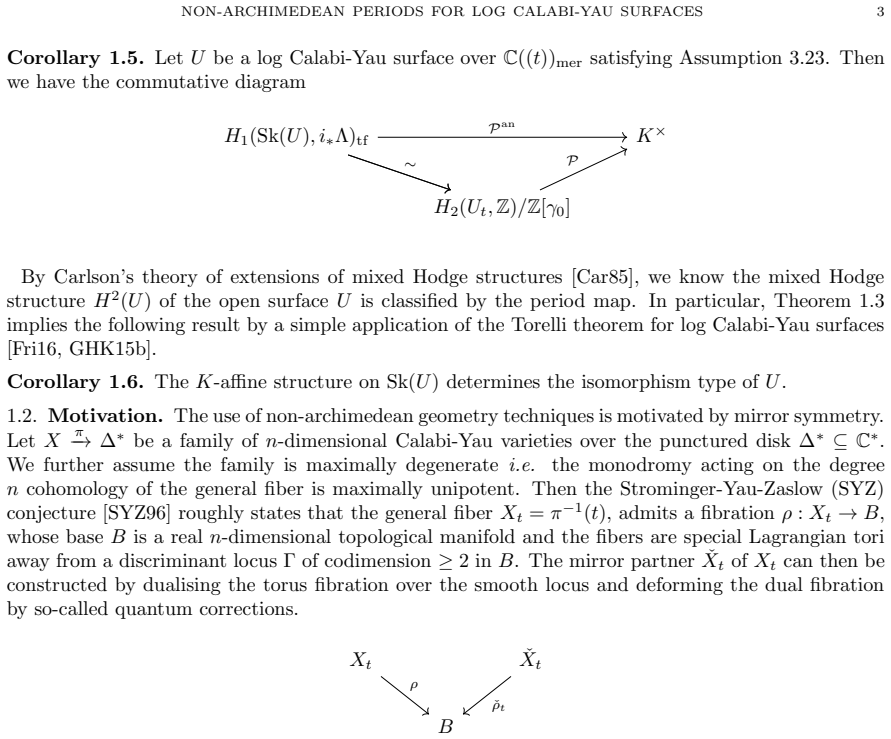
On the paper's own terms, the central discovery is Theorem 1.3 (with the refined statement Theorem 6.10): under Assumption 3.23, the pairing of the $K$-affine structure $[\mathrm{Aff}_K] \in H^1(\mathrm{Sk}(U)^{\mathrm{sm}}, \Lambda \otimes K^\times)$ with the torsion-free part of $H_1(\mathrm{Sk}(U), i_*\check{\Lambda})$ gives a map $P^{\mathrm{an}}$ that fits into a commutative square with the algebraic period map $P: D^\perp \to K^\times$, $L \mapsto L|_D$. The paper thereby establishes the first instance of Kontsevich-Soibelman's Conjecture 10 and derives that the $K$-affine structure determines the isomorphism type of $U$ (Corollary 1.6). The equality is checked on two families of generators of the tropical cycle group—simple tropical spokes and simple tropical wings—whose periods are products and quotients of the parameters $\mu^i_j$ recording the centres of non-toric blowups; these are exactly the values of the algebraic period map.
Load-bearing premise
The whole argument depends on the degeneration being generic in a precise sense: the special fibre must have the same combinatorial type as the general fibre, with every blowup centre distinct and specializing to a smooth boundary point. When blowup centres collide or land on nodes, the paper does not construct the fibration or the $K$-affine structure; it only extends the period formula by analytic continuation.
Editorial extensions
If this is right
- For every log Calabi-Yau surface satisfying Assumption 3.23, the non-archimedean period map $\langle \gamma, [\mathrm{Aff}_K]\rangle$ equals the algebraic period of the corresponding line bundle, so periods can be read off directly from the skeleton and its $K$-affine structure.
- The $K$-affine structure on the essential skeleton determines the isomorphism type of $U$, giving a reconstruction result in the spirit of SYZ mirror symmetry: the base of the non-archimedean fibration plus a refined affine structure carries the full isomorphism class.
- The comparison extends beyond generic pairs: by unique analytic continuation on the family of marked Looijenga pairs, the equality $P^{\mathrm{an}}=P$ holds for all Looijenga pairs over $R$ with good reduction whose special and general fibres have the same combinatorial type (Theorem 6.14).
- Periods of invariant local tropical cycles are always $1$, so the non-archimedean period map factors through $H_1(\mathrm{Sk}(U), i_*\check{\Lambda})_{\mathrm{tf}}$; this is the object conjecturally mirror to the algebraic period lattice.
Reading between the lines
- The local monodromy parameters $\mu_X$ behave like tropical quantum correction phases; extending the same residue computation to families should produce canonical coordinates on the mirror side predicted by the Gross-Siebert program.
- For K3 surfaces, whose essential skeletons can be spheres with more complicated affine structures, the same chart-by-chart comparison suggests that a suitable $K$-affine structure would compute K3 periods; this paper's monodromy computation is a template for that test.
- A direct construction of the SYZ fibration for degenerations where blowup centres specialize to nodes is still missing; if such a construction exists, the analytic continuation step of Section 6.5 could be replaced by an independent proof, making the equality $P^{\mathrm{an}}=P$ a theorem on the whole moduli space rather than on a generic open set plus continuation.
- The $K$-affine structure might also serve as a phase-sensitive tropical invariant in settings where the SYZ fibration is only partially defined, such as open Calabi-Yau varieties with boundary.
Editorial analysis
A structured set of objections, weighed in public.
Referee Report
Summary. The paper attacks Kontsevich-Soibelman's Conjecture 10 for log Calabi-Yau surfaces over K = C((t)). Under Assumption 3.23, the authors construct an explicit snc model and non-archimedean SYZ fibration for a generic Looijenga pair, compute the induced integral affine and K-affine structures, define the non-archimedean period map P^an : H1(Sk(U), i_*Λ)_tf → K^x, and prove in Theorem 6.10 that it agrees with the algebraic period map P : D^⊥ → K^x. They then derive Corollary 1.6, that the K-affine structure on the essential skeleton determines the isomorphism type of U. Section 6.5 attempts to extend the equality to all Looijenga pairs with good reduction and matching combinatorial type by analytic continuation.
Significance. If the generic statement under Assumption 3.23 stands, the paper is a meaningful first instance of the Kontsevich-Soibelman period conjecture in dimension 2. Its strengths are the explicit nature of the construction: a concrete snc model, detailed local toric charts, a computed K-affine monodromy, and a direct comparison with Friedman's algebraic period map. The claimed reconstruction corollary is attractive and would be the first nontrivial result showing that the enhanced affine structure remembers the isomorphism type. However, the significance as stated is limited by the fact that the non-generic extension in §6.5 is not independently derived from a geometric construction, and by the sketched proof of the tropical correspondence, which the period comparison relies on.
major comments (3)
- [§6.5 (Theorem 6.14)] The proof of Theorem 6.14 does not independently establish the period equality on non-generic fibres. The map is extended to all of G^N_{m,◦} 'naturally by the formula given in Theorem 6.8', but Theorem 6.8 was derived from the K-affine structure constructed only for generic fibres under Assumption 3.23. On a non-generic fibre the SYZ fibration ρ, the sheaf Aff_K, and the pairing ⟨γ,[Aff_K]⟩ are not constructed, so the extended map is not shown to be the non-archimedean period map. Proposition 6.13 supplies uniqueness of an analytic extension, not existence of the geometric objects whose periods are being compared. The final check in Theorem 6.14 treats only generalised exceptional curves C_i, where P(C_i)=1, and asserts agreement with the non-archimedean side without a computation. Consequently Theorem 6.14 is not proven as stated; either Theorem 6.14 and Corollary 1.6 must be restricted to Assumption 3.23, or the SYZ fibration and K-affine structure must be constructed on the non-generic fibres.
- [§4.2, Theorem 4.28] The tropical correspondence is load-bearing but only sketched. The proof decomposes D^⊥ and H1(Sk(U), ι_∗Λ)_tf into spokes and wings and states 'We form isomorphisms' without verifying that the proposed map T is well-defined with respect to balanced decorations and without proving bijectivity beyond the rank count of Lemma 4.11. Lemma 4.19's count of simple tropical spokes also hides the independence of the imposed relations. Since Theorem 6.10 identifies D^⊥ with H1(Sk(U), ι_∗Λ)_tf through this isomorphism, a complete proof of Theorem 4.28 is needed.
- [§3.8, Proposition 3.45] The monodromy of the integral affine structure is a central input for the invariant cotangent directions used in §4 and §6, but the key numerical identities b2=b4=0 and b1+b3=-1 are asserted without derivation. These identities determine the product of transition matrices and hence the invariant direction ˇΛ_{ρ_i}. They should be justified from the local geometry of the model constructed in Proposition 3.33.
minor comments (6)
- [Title and running header] The title contains a spacing error: 'CALABI-Y AU' should be 'CALABI-YAU'.
- [§1.1 and §3.2] The normalization of the volume form is inconsistent: §1.1 fixes ∫_{γ0} Ω = (2πi)^2, while §3.2 states ∫_Γ Ω = 1/(2πi)^2. Formula (1) depends on this normalization, so the two conventions should be reconciled.
- [Assumption 3.11] The final line of Assumption 3.11 contains the stray word 'esf', which appears to be a typographical artifact and should be removed.
- [After Theorem 6.14] The sentence 'Conjecture 1.5 is an immediate corollary' should refer to Corollary 1.5, since no Conjecture 1.5 is stated.
- [Notation 5.19] Notation 5.19 refers to 'the explicit K-affine structure constructed in Proposition 5.15', but the construction is in Theorem 5.15; the cross-reference should be corrected.
- [Throughout] There are several typos: 'gratutude' in the acknowledgements, 'Loojenga' in Corollary 6.11, and 'methods of this thesis' in Remark 3.16, which is inappropriate in an article.
Circularity Check
The §6.5 extension defines the non-archimedean period map on non-generic fibres by the algebraic formula (products of µ), so Theorem 6.14's agreement holds by construction; the generic comparison (Theorem 6.10) is a genuine, self-contained computation.
-
self definitional
[Section 6.5, 'Analytic continuation to the non-generic case', extension paragraph and Theorem 6.14]
"The map can be extended naturally to all of G^N_{m,◦} by the formula given in Theorem 6.8. ... Since Ci is disjoint from D, we have that P(Ci) = 1. This agrees with the non-archimedean period map and thus the proof is complete."
On non-generic fibres no SYZ fibration or K-affine structure Aff_K is constructed, so Definition 6.1's geometric pairing is unavailable. The extended map is defined by Theorem 6.8's formula, which is exactly the algebraic formula: Theorem 6.10's proof computes P(Lˇγ) = ∏_i (µ^{j_i}_i)^{ϵ_i}, the same product of blow-up parameters. Thus on the non-generic locus 'P^an = P' holds by construction of P^an, not by an independent geometric computation. Theorem 6.14's proof only checks generalized exceptional curves and asserts P^an agrees because P(Ci) = 1; for these classes the extended map is just that formula, so the check is vacuous. Proposition 6.13's uniqueness fixes the analytic extension of the formula; it does not supply the missing fibration or Aff_K on the discriminant locus.
full rationale
The generic case (Assumption 3.23, Theorem 6.10) is free of circularity: the SYZ fibration is built from explicit blowups/flops (Proposition 3.33), the K-affine structure Aff_K is constructed as ρ_*(O^×)/ker Res_Ω (Theorem 5.15, from KS06, with the constant-norm volume form checked in §5.3), and its monodromy (Proposition 5.28) is computed from explicit formal toric charts (Lemmas 5.22–5.26). The resulting pairing with tropical cycles (Theorem 6.8) and the algebraic period (Definition 3.22) are then both computed, independently, in terms of the same blow-up parameters µ, and matched in Theorem 6.10. No parameter is fitted to make the two sides equal; the equality is a direct computation. Self-citations are not load-bearing: [Kar24] is contextual survey material, and [LZ23] supports Lemma 4.8, whose proof is reproduced in the paper from the monodromy computed in Proposition 3.45. The circular step is confined to §6.5: for non-generic fibres (arbitrary good reduction with matching combinatorial type) no SYZ fibration or Aff_K is constructed, and the non-archimedean period map is declared to be the formula of Theorem 6.8 — the same product of µ's that defines the algebraic period. Theorem 6.14's conclusion is therefore true by construction for these fibres, and its proof (checking only generalized exceptional curves with P(Ci) = 1) does not restore an independent derivation, since the extended map was defined to equal the algebraic formula. Because the abstract and Corollary 1.6 assert the unqualified result, the headline claim inherits this definitional step; the generic theorem itself stands as independent content. Score 6: partial circularity.
Assumptions & free parameters
assumptions (5)
- standard math Hironaka resolution of singularities and Nagata compactification over C[[t]]
- domain assumption Assumption 3.23: existence of a Looijenga pair over R with good reduction, generic special fibre, and identical combinatorial type
- domain assumption Assumption 3.11: toric blowups have been performed so that the pair admits a toric model
- domain assumption Assumption 5.10: Val(Omega) is locally constant
- standard math Torelli theorem for log Calabi-Yau surfaces (Friedman, Gross-Hacking-Keel)
Cite this review
Pith. "Pith review of Non-archimedean periods for log Calabi-Yau surfaces." pith.science (2026). https://pith.science/paper/7KGZTGVK
@misc{pith2026250601651,
  author       = {Pith},
  title        = {Pith review of: Non-archimedean periods for log Calabi-Yau surfaces},
  year         = {2026},
  howpublished = {\url{https://pith.science/paper/7KGZTGVK}},
  note         = {Machine review of arXiv:2506.01651}
}
read the original abstract
We prove the first instance of a conjecture by Kontsevich-Soibelman that the non-archimedean period map recovers the analytic periods in the case of log Calabi-Yau surfaces. In particular, we show that the K-affine structure, a natural enhancement of the singular integral affine structure on the essential skeleton, determines the isomorphism type of the log Calabi-Yau surface.
Figures


Figures from the paper (8 more)




Reference graph
Works this paper leans on
-
[1]
Bounded linear endomorphisms of rigid analytic functions
Konstantin Ardakov and Oren Ben-Bassat. Bounded linear endomorphisms of rigid analytic functions. Proceedings of the London Mathematical Society , 117(5):881--900, 2018
work page 2018
-
[2]
The gamma and S trominger- Y au- Z aslow conjectures: a tropical approach to periods
Mohammed Abouzaid, Sheel Ganatra, Hiroshi Iritani, and Nick Sheridan. The gamma and S trominger- Y au- Z aslow conjectures: a tropical approach to periods. Geom. Topol. , 24(5):2547--2602, 2020
work page 2020
- [3]
- [4]
-
[5]
Morgan V. Brown and Enrica Mazzon. The essential skeleton of a product of degenerations. Compos. Math. , 155(7):1259--1300, 2019
work page 2019
-
[6]
The one-motif of an algebraic surface
James A Carlson. The one-motif of an algebraic surface. Compositio Mathematica , 56(3):271--314, 1985
work page 1985
-
[7]
Alexandru Dimca. Sheaves in topology . Universitext. Springer-Verlag, Berlin, 2004
work page 2004
-
[8]
On the geometry of anticanonical pairs, 2016
Robert Friedman. On the geometry of anticanonical pairs, 2016
work page 2016
Show all 44 references
-
[9]
Intersection theory on toric varieties
William Fulton and Bernd Sturmfels. Intersection theory on toric varieties. Topology , 36(2):335--353, 1997
1997
-
[10]
Introduction to toric varieties , volume 131 of Annals of Mathematics Studies
William Fulton. Introduction to toric varieties , volume 131 of Annals of Mathematics Studies . Princeton University Press, Princeton, NJ, 1993. The William H. Roever Lectures in Geometry
1993
-
[11]
William Goldman and Morris W. Hirsch. The radiance obstruction and parallel forms on affine manifolds. Trans. Amer. Math. Soc. , 286(2):629--649, 1984
1984
-
[12]
Mirror symmetry for log C alabi- Y au surfaces I
Mark Gross, Paul Hacking, and Sean Keel. Mirror symmetry for log C alabi- Y au surfaces I . Publ. Math. Inst. Hautes \' E tudes Sci. , 122:65--168, 2015
2015
-
[13]
Moduli of surfaces with an anti-canonical cycle
Mark Gross, Paul Hacking, and Sean Keel. Moduli of surfaces with an anti-canonical cycle. Compositio Mathematica , 151(2):265–291, 2015
2015
-
[14]
Skeletons and tropicalizations
Walter Gubler, Joseph Rabinoff, and Annette Werner. Skeletons and tropicalizations. Adv. Math. , 294:150--215, 2016
2016
-
[15]
The canonical wall structure and intrinsic mirror symmetry
Mark Gross and Bernd Siebert. The canonical wall structure and intrinsic mirror symmetry. Invent. Math. , 229(3):1101--1202, 2022
2022
-
[16]
A guide to tropicalizations
Walter Gubler. A guide to tropicalizations. In Algebraic and combinatorial aspects of tropical geometry , volume 589 of Contemp. Math. , pages 125--189. Amer. Math. Soc., Providence, RI, 2013
2013
-
[17]
Resolution of singularities of an algebraic variety over a field of characteristic zero: II
Heisuke Hironaka. Resolution of singularities of an algebraic variety over a field of characteristic zero: II . Annals of Mathematics , pages 205--326, 1964
1964
-
[18]
MIRROR SYMMETRY AND CLUSTER ALGEBRAS , pages 671--697
PAUL HACKING and SEAN KEEL. MIRROR SYMMETRY AND CLUSTER ALGEBRAS , pages 671--697. Proceedings of the International Congress of Mathematicians (ICM 2018), 2018
2018
-
[19]
Central charges, symplectic forms, and hypergeometric series in local mirror symmetry
Shinobu Hosono. Central charges, symplectic forms, and hypergeometric series in local mirror symmetry. In Mirror symmetry. V , volume 38 of AMS/IP Stud. Adv. Math. , pages 405--439. Amer. Math. Soc., Providence, RI, 2006
2006
-
[20]
Gamma conjecture and tropical geometry, 2023
Hiroshi Iritani. Gamma conjecture and tropical geometry, 2023
2023
-
[21]
Integration over tropical plane curves and ultradiscretization
Shinsuke Iwao. Integration over tropical plane curves and ultradiscretization. Int. Math. Res. Not. IMRN , (1):112--148, 2010
2010
-
[22]
Tropical toric geometry
Takeshi Kajiwara. Tropical toric geometry. In Toric topology , volume 460 of Contemp. Math. , pages 197--207. Amer. Math. Soc., Providence, RI, 2008
2008
-
[23]
Non-archimedean periods for log Calabi-Yau surfaces
Soham Karwa. Non-archimedean periods for log Calabi-Yau surfaces . PhD thesis, Imperial College London, 2024
2024
-
[24]
Kempf, Finn Faye Knudsen, D
G. Kempf, Finn Faye Knudsen, D. Mumford, and B. Saint-Donat. Toroidal embeddings. I , volume Vol. 339 of Lecture Notes in Mathematics . Springer-Verlag, Berlin-New York, 1973
1973
-
[25]
The tropical j -invariant
Eric Katz, Hannah Markwig, and Thomas Markwig. The tropical j -invariant. LMS J. Comput. Math. , 12:275--294, 2009
2009
-
[26]
Affine Structures and Non-Archimedean Analytic Spaces , pages 321--385
Maxim Kontsevich and Yan Soibelman. Affine Structures and Non-Archimedean Analytic Spaces , pages 321--385. Birkh \"a user Boston, Boston, MA, 2006
2006
-
[27]
Vik. S. Kulikov. Degenerations of K3 surfaces and E nriques surfaces. Izv. Akad. Nauk SSSR Ser. Mat. , 41(5):1008--1042, 1199, 1977
1977
-
[28]
The F robenius structure theorem for affine log C alabi- Y au varieties containing a torus
Sean Keel and Tony Yue Yu. The F robenius structure theorem for affine log C alabi- Y au varieties containing a torus. Ann. of Math. (2) , 198(2):419--536, 2023
2023
-
[29]
Phase tropical hypersurfaces
Gabriel Kerr and Ilia Zharkov. Phase tropical hypersurfaces. Geom. Topol. , 22(6):3287--3320, 2018
2018
-
[30]
Mirror symmetry for log C alabi- Y au surfaces II , 2023
Jonathan Lai and Yan Zhou. Mirror symmetry for log C alabi- Y au surfaces II , 2023
2023
-
[31]
a tsverlag G\
Hannah Markwig. The j -invariant of a plane tropical cubic. In Symmetries in algebra and number theory ( SANT ) , pages 65--68. Universit\" a tsverlag G\" o ttingen, G\" o ttingen, 2009
2009
-
[32]
Weight functions on non- A rchimedean analytic spaces and the K ontsevich- S oibelman skeleton
Mircea Musta t a and Johannes Nicaise. Weight functions on non- A rchimedean analytic spaces and the K ontsevich- S oibelman skeleton. Algebr. Geom. , 2(3):365--404, 2015
2015
-
[33]
Toric geometry and integral affine structures in non-archimedean mirror symmetry, 2023
Enrica Mazzon and Léonard Pille-Schneider. Toric geometry and integral affine structures in non-archimedean mirror symmetry, 2023
2023
-
[34]
Rational varieties: algebra, geometry and arithmetic
Yu I Manin and M A Tsfasman. Rational varieties: algebra, geometry and arithmetic. Russian Mathematical Surveys , 41(2):51, apr 1986
1986
-
[35]
The non-archimedean SYZ fibration
Johannes Nicaise, Chenyang Xu, and Tony Yue Yu. The non-archimedean SYZ fibration. Compositio Mathematica , 155(5):953–972, 2019
2019
-
[36]
Analytification is the limit of all tropicalizations
Sam Payne. Analytification is the limit of all tropicalizations. Math. Res. Lett. , 16(3):543--556, 2009
2009
-
[37]
Period integrals from wall structures via tropical cycles, canonical coordinates in mirror symmetry and analyticity of toric degenerations
Helge Ruddat and Bernd Siebert. Period integrals from wall structures via tropical cycles, canonical coordinates in mirror symmetry and analyticity of toric degenerations. Publ. Math. Inst. Hautes \' E tudes Sci. , 132:1--82, 2020
2020
-
[38]
A homology theory for tropical cycles on integral affine manifolds and a perfect pairing
Helge Ruddat. A homology theory for tropical cycles on integral affine manifolds and a perfect pairing. Geometry & Topology , 25(6):3079--3132, 2021
2021
-
[39]
Introduction to PSL_2 phase tropicalization
Mikhail Shkolnikov and Peter Petrov. Introduction to PSL_2 phase tropicalization. C. R. Acad. Bulgare Sci. , 77(10):1425--1432, 2024
2024
-
[40]
The stacks project
The Stacks project authors . The stacks project. https://stacks.math.columbia.edu, 2024
2024
-
[41]
Mirror symmetry is t-duality
Andrew Strominger, Shing-Tung Yau, and Eric Zaslow. Mirror symmetry is t-duality. Nuclear Physics B , 479(1):243--259, 1996
1996
-
[42]
Periods of tropical C alabi- Y au hypersurfaces
Yuto Yamamoto. Periods of tropical C alabi- Y au hypersurfaces. J. Algebraic Geom. , 31(2):303--343, 2022
2022
-
[43]
Enumeration of holomorphic cylinders in log C alabi- Y au surfaces
Tony Yue Yu. Enumeration of holomorphic cylinders in log C alabi- Y au surfaces. I . Mathematische Annalen , 366:1649--1675, 2016
2016
-
[44]
Enumeration of holomorphic cylinders in log C alabi- Y au surfaces
Tony Yue Yu. Enumeration of holomorphic cylinders in log C alabi- Y au surfaces. II : positivity, integrality and the gluing formula. Geom. Topol. , 25(1):1--46, 2021
2021
Reviewed August 7, 2026 · model on record in the stance chip above.
Discussion (0). Sign in to comment.