REVIEW 4 major objections 5 minor 39 references
Multicontinuum splitting schemes for multiscale wave problems
T0 review · 4 major / 5 minor · reviewed 2026-08-07 · deepseek-v4-flash
Pith's one-line read This paper constructs two partially explicit time-stepping schemes for the high-contrast wave equation that split fast and slow dynamics so that the stability condition is claimed to be independent of the coefficient contrast.
desk verdict A useful, mostly correct scheme paper whose headline claim of contrast-independent stability is deferred to an unpublished preprint and not closed by the numerics. read the letter →
The pith
A machine-rendered reading of the paper's core claim, the machinery that carries it, and where it could break.
The reading
What carries the argument
The machinery is the direct-sum decomposition $V_{\mathrm{mc},H}=V_{\mathrm{mc},1,H}\oplus V_{\mathrm{mc},2,H}$ of the discrete multicontinuum space, together with the bilinear forms $m_{ij}$, $a_{ij}$, and $c_{ij}$ defined through downscaling operators $T_j$. Each continuum is represented by multiscale basis functions obtained from local energy-minimizing cell problems with constraints on the averages of the solution; choosing indices $I_1$ for fast/high-value continua and $I_2$ for slow/low-value continua puts all contrast in the implicitly treated block. The stability proof runs through an exactly conserved discrete energy $E^{n+1/2}$; a strengthened Cauchy-Schwarz constant $\gamma$ controls cross-coupling, and the final conditions bound $\tau^2$ by $2(1-\gamma^2)$ times the $m_{22}$-to-$a_{22}$ (or $m_{22}$-to-$(a_{22}+c_{22})$) ratio of the slow subspace, which is exactly the quantity the cell-problem construction is claimed to make contrast-independent.
What would settle it
In the layered two-continuum example (5.3), compute the stability ratio $\inf_W \|W\|_{m_{22}}^2 / \|W\|_{a_{22}}^2$ for contrast values $10$, $10^3$, and $10^6$ while keeping the coarse mesh fixed; if this ratio shrinks as the contrast grows, the stability condition is contrast-dependent and the central claim fails.
Extended reading notes
Core claim
On the paper's own terms, the central discovery is that the standard multicontinuum homogenization expansion for the wave equation can be organized into two subspaces, one carrying the fast (high-contrast) dynamics and one the slow dynamics, so that the fully implicit semidiscrete problem can be replaced by the partially explicit three-layer schemes (3.8) and (3.9). The schemes conserve a discrete energy exactly (Theorem 1) and are stable under the conditions (3.26) and (3.29), which involve only the mass and stiffness norms of the explicitly treated slow subspace. Since, by the construction of the cell problems, those norms are claimed to be independent of the contrast for continua placed in low-value regions, the stability conditions are contrast-independent, and the method is presented as reaching essentially the accuracy of the fully implicit discretization at lower cost. The paper also proposes an optimized decomposition, through a tensor Rayleigh quotient problem and a cheaper generalized eigenvalue problem, to relax the stability restriction further.
Load-bearing premise
The headline result rests on an unproved assertion, deferred to a companion paper, that the cell-problem construction makes the energy stored in the low-coefficient continua insensitive to how large the high coefficient is.
Editorial extensions
If this is right
- For two-value coefficients, choosing the high-value continuum as the implicit component and the low-value continuum as the explicit component makes the time-step restriction independent of the ratio $\kappa_{\max}/\kappa_{\min}$, so the same $\tau$ is expected to work as the contrast is raised.
- The partially explicit schemes cost less per step than the fully implicit scheme because only the fast block requires an implicit solve, while the numerical tests show errors nearly identical to the implicit reference solution.
- When the two subspaces are $L^2$-orthogonal, scheme 2 decouples, so the explicit part can be updated independently of the implicit solve; the paper notes that mass lumping can remove the remaining coupling in scheme 1.
- The optimized decomposition based on a generalized eigenvalue problem selects continua by taking linear combinations of the original ones, and the resulting stability restriction scales roughly like $H\lambda_{i_0}^{-1/2}$, which relaxes the step-size bound without increasing computational cost.
Reading between the lines
- If the contrast-independence proof transfers from the flow cell problems to the wave cell problems, the same splitting strategy should extend to other second-order hyperbolic systems, such as elastic waves or acoustics in fractured media, where high-contrast coefficients appear.
- The tensor Rayleigh quotient formulation could be turned into an automatic continuum-selection tool for coefficient fields whose high- and low-value regions are not known in advance; the paper itself only treats predefined continua.
- A natural testable extension is to push the contrast beyond $10^3$, the largest value reported here, and record whether the observed critical time step stays flat; under the paper's claim it should.
- One could also test the optimized decomposition on coefficient fields with more than three continua, where the generalized eigenvalue problem would have to choose a genuinely mixed slow subspace rather than simply the low-value regions.
Editorial analysis
A structured set of objections, weighed in public.
Referee Report
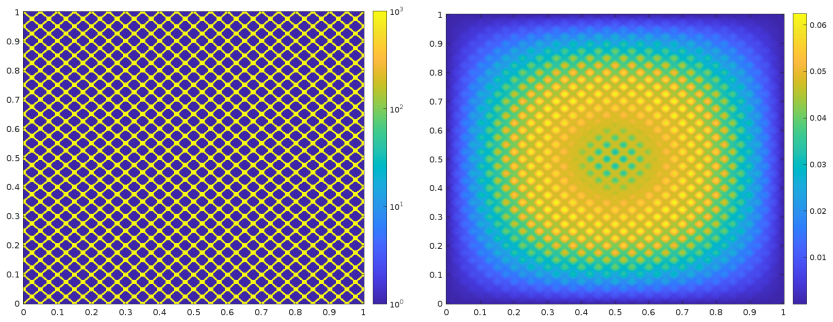
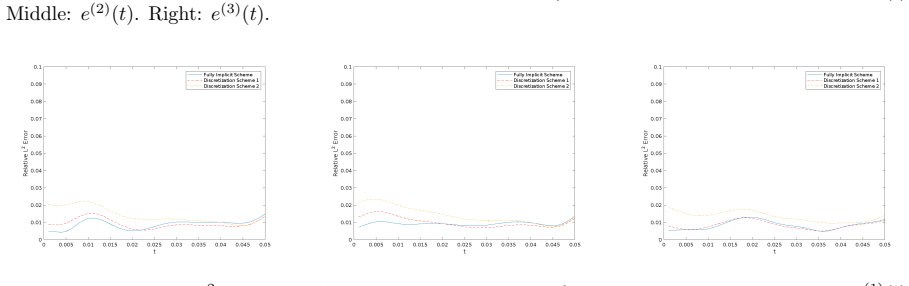
Summary. The paper proposes two three-level partially explicit time discretization schemes, (3.8) and (3.9), for the high-contrast wave equation, built on a multicontinuum homogenization space decomposition. Fast continua are updated implicitly and slow continua explicitly. A discrete energy identity is proved for scheme 1 (Theorem 1), and stability is derived as condition (3.26) (Theorem 2); an analogous stability condition (3.29) for scheme 2 is stated as Theorem 3 without proof. The paper claims that, with appropriately chosen continua, the stability conditions are independent of the coefficient contrast, citing the cell-problem construction in the overlapping-author preprint [37]. An optimized decomposition via a tensor Rayleigh quotient and a simplified generalized eigenvalue problem is discussed in Section 4. Numerical examples for layered and point fields with two and three continua show that the proposed schemes match the accuracy of the fully implicit scheme for contrast 10^3.
Significance. If the contrast-independence assertion were proved, the schemes would provide a practically useful way to remove the high-contrast CFL restriction while retaining accuracy comparable to implicit methods. The self-contained algebraic derivations of Theorem 1 and Theorem 2 are a genuine contribution, as is the formulation of the stability conditions in terms of the explicitly treated subspace. However, the headline property is not established within the manuscript: it is deferred to an unpublished preprint, and the numerical section does not vary the contrast. The paper is therefore conditionally acceptable after the central gap is closed.
major comments (4)
- [Section 3, after Eq. (3.29)] The claim that the stability conditions (3.26) and (3.29) are contrast-independent is the central advertised result, but the only support is the sentence following Theorem 3 stating that the m22-, a22-, and c22-norms are 'all independent of the contrast ... thanks to the construction of the cell problems [37]'. No estimate of these norms as functions of κmax/κmin is given, and [37] is an overlapping-author preprint on flow problems that does not obviously cover the wave-specific c22 term entering (3.29). Moreover, the constant γ in (3.24) appears in both conditions through the factor (1−γ2), and no argument shows that γ is bounded away from 1 uniformly in the contrast. Please provide a proof, or at minimum a quantitative estimate, of contrast-independence for all quantities appearing in (3.26) and (3.29).
- [Theorem 3] Theorem 3 is stated without proof: the text says only that 'similar energy conservation can be established' for scheme 2. Since scheme 2 is one of the two proposed time discretizations and its stability condition (3.29) is used in the numerical section, the energy identity and the stability argument should be written out in full or explicitly reduced to the proof of Theorem 2 with the c22 terms accounted for.
- [Section 4] The optimized decomposition section defers its central assertions to [37]: 'It can be shown that γ = 0' and 'The same stability results hold under certain assumption' are not proved, and the localization assumption that 'the decompositions for different coarse blocks are similar' is stated without justification. Because Section 4 is presented as a way to relax the stability conditions and decouple the schemes, these claims need to be either proved in the manuscript or clearly stated as assumptions with supporting numerical evidence.
- [Section 5] The numerical experiments do not test the contrast-independence claim. All examples use the single contrast ratio 10^3 and the single time step τ = 10^-3, and no maximum stable time step is reported as a function of κmax/κmin. To support the headline property, please add experiments with varying contrast (for example 10^2, 10^4, 10^5) and report the largest stable τ for each case, or otherwise verify empirically that the stability conditions are contrast-independent.
minor comments (5)
- [Section 1] The sentence 'the variation in material properties ... necessities extremely fine spatial discretization' should read 'necessitates', and the sentence is grammatically incomplete.
- [Section 3] The first line, 'Throughout this work, We begin by summarizing...', contains a stray comma and an uppercase 'We' in the middle of the sentence.
- [Equation (4.4)] The definition of the Rayleigh quotient contains unmatched parentheses, and the contraction A : (v⊗w) is not defined explicitly.
- [Section 6] The sentence 'requiring less computationally effort' should be 'requiring less computational effort'.
- [Tables 1-4] The tables report eigenvalues and eigenvectors but not the resulting stability restriction τmax; reporting this value would allow readers to check conditions (3.26) and (3.29) directly.
Circularity Check
Contrast-independence of the stability conditions is asserted via an overlapping-author preprint [37], while the discrete-energy stability proofs are self-contained.
-
self citation load bearing
[Section 3, paragraph after Theorem 3 (conditions (3.26) and (3.29))]
"The remaining question is how to determine the partition sets I1 and I2. For cases such as two-value fields, I1 and I2 can respectively be chosen as the index sets for the continua associated with the high- and low-value regions. It turns out that the m22-norm, the a22-norm and the c22-norm are all independent of the contrast, resulting in contrast-independent stability conditions, thanks to the construction of the cell problems [37]."
The advertised central benefit is that conditions (3.26) and (3.29) are contrast-independent. This is not proved in the paper: no estimate of the m22-, a22-, or c22-norms as functions of the contrast is given, and the only support is the self-cited flow preprint [37]. Moreover, the c22 term appears specifically in the wave scheme 2 condition (3.29), but no argument shows that the flow analysis in [37] covers this wave-specific term. The numerical experiments always use contrast 10^3 and tau = 1e-3, so they do not test the contrast-dependence claim. The paper's headline claim therefore reduces to an unverified self-citation rather than to an in-paper derivation.
-
self citation load bearing
[Section 4, first paragraph and paragraph after (4.5)]
"For detailed explanations and proofs, we refer the reader to [37]."
The optimized decomposition used in all numerical examples is introduced in Section 4, and the section explicitly defers its proofs to the same overlapping-author preprint [37]. The subsequent claims 'It can be shown that gamma = 0' and the explicit stability bounds are stated without derivation. Since gamma appears in the factors (1 - gamma^2) of both stability conditions (3.26) and (3.29), the relaxed stability and decoupling used in the numerical results depend on a self-cited preprint, not on a proof contained in this paper.
full rationale
The paper's own stability analysis is not circular: Theorems 1 and 2 derive discrete energy conservation and the stability condition (3.26) directly from the scheme equations, and Theorem 3 states the analogous condition (3.29). These are genuine independent derivations. The circularity concern is concentrated in the contrast-independence claim, which is the advertised practical benefit. The sentence after Theorem 3 asserts that the m22-, a22-, and c22-norms are contrast-independent 'thanks to the construction of the cell problems [37]', and Section 4 likewise refers all proofs of the optimized decomposition to [37]. [37] is an overlapping-author arXiv preprint on flow problems, not machine-checked or otherwise externally verified in this paper. No in-paper computation or estimate shows the required contrast-independence, especially for the wave-specific c22 term that enters condition (3.29). Therefore the central claim that the stability time step is contrast-free rests on a load-bearing self-citation. This is not a self-definitional reduction: the stability inequalities themselves are derived in the paper, so the appropriate score is moderate rather than extreme.
Assumptions & free parameters
free parameters (2)
- Number of explicitly treated slow modes i0 =
1 in Examples 1 and 2, 2 in Examples 3 and 4
- Oversampling layer count l =
l = ceil(-2 ln(H)), i.e., 5 for H = 1/10 and 6 for H = 1/20
assumptions (6)
- domain assumption Macroscopic variables U_i are smooth over coarse regions
- domain assumption Two-term multicontinuum expansion u approximately phi_i U_i + phi_i^m grad_m U_i suffices
- domain assumption b_ij(U_j,W_i) + b_ji(W_i,U_j) = 0
- ad hoc to paper For high/low continua, the m22, a22, and c22 norms are contrast-independent
- ad hoc to paper Optimized decompositions are similar across coarse blocks, so the Rayleigh quotient can be localized
- standard math Strengthened Cauchy-Schwarz inequality holds with gamma in (0,1)
Cite this review
Pith. "Pith review of Multicontinuum splitting schemes for multiscale wave problems." pith.science (2026). https://pith.science/paper/RR4RZRXC
@misc{pith2026250601670,
  author       = {Pith},
  title        = {Pith review of: Multicontinuum splitting schemes for multiscale wave problems},
  year         = {2026},
  howpublished = {\url{https://pith.science/paper/RR4RZRXC}},
  note         = {Machine review of arXiv:2506.01670}
}
read the original abstract
In this work, we propose multicontinuum splitting schemes for the wave equation with a high-contrast coefficient, extending our previous research on multiscale flow problems. The proposed approach consists of two main parts: decomposing the solution space into distinct components, and designing tailored time discretization schemes to enhance computational efficiency. To achieve the decomposition, we employ a multicontinuum homogenization method to introduce physically meaningful macroscopic variables and to separate fast and slow dynamics, effectively isolating contrast effects in high-contrast cases. This decomposition enables the design of schemes where the fast-dynamics (contrast-dependent) component is treated implicitly, while the slow-dynamics (contrast-independent) component is handled explicitly. The idea of discrete energy conservation is applied to derive the stability conditions, which are contrast-independent with appropriately chosen continua. We further discuss strategies for optimizing the space decomposition. These include a Rayleigh quotient problem involving tensors, and an alternative generalized eigenvalue decomposition to reduce computational effort. Finally, various numerical examples are presented to validate the accuracy and stability of our proposed method.
Figures


Figures from the paper (9 more)


Reference graph
Works this paper leans on
-
[37]
Multicontinuum splitting scheme for multiscale flow problems
Yalchin Efendiev, Wing Tat Leung, Buzheng Shan, and Min Wang. Multicontinuum splitting scheme for multiscale flow problems. arXiv preprint arXiv:2410.05253 , 2024
arXiv 2024
-
[1]
Sh-wave propagation in heterogeneous media: Velocity-stress finite-difference method
Jean Virieux. Sh-wave propagation in heterogeneous media: Velocity-stress finite-difference method. Geophysics, 49(11):1933–1942, 1984. 18
work page 1933
-
[2]
P-sv wave propagation in heterogeneous media: Velocity-stress finite-difference method
Jean Virieux. P-sv wave propagation in heterogeneous media: Velocity-stress finite-difference method. Geophysics, 51(4):889–901, 1986
work page 1986
-
[3]
A. Abdulle and P. Henning. Multiscale methods for wave problems in heterogeneous media. In R´ emi Abgrall and Chi-Wang Shu, editors,Handbook of Numerical Methods for Hyperbolic Problems, volume 18 of Handbook of Numerical Analysis , pages 545–576. Elsevier, 2017
work page 2017
-
[4]
Asymptotic analysis for periodic structures
George Papanicolau, Alain Bensoussan, and J-L Lions. Asymptotic analysis for periodic structures . Elsevier, 1978
work page 1978
-
[5]
Analysis of upscaling absolute permeability
Xiao-Hui Wu, Yalchin Efendiev, and Thomas Y Hou. Analysis of upscaling absolute permeability. Discrete and Continuous Dynamical Systems Series B , 2(2):185–204, 2002
work page 2002
-
[6]
Numerical homogenization of the acoustic wave equations with a continuum of scales
Houman Owhadi and Lei Zhang. Numerical homogenization of the acoustic wave equations with a continuum of scales. Computer Methods in Applied Mechanics and Engineering , 198(3-4):397–406, 2008
work page 2008
-
[7]
Homogenization and porous media , volume 6
Ulrich Hornung. Homogenization and porous media , volume 6. Springer Science & Business Media, 2012
work page 2012
Show all 39 references
-
[8]
A multiscale finite element method for elliptic problems in composite materials and porous media
Thomas Y Hou and Xiao-Hui Wu. A multiscale finite element method for elliptic problems in composite materials and porous media. Journal of Computational Physics , 134(1):169–189, 1997
1997
-
[9]
Convergence of a multiscale finite element method for elliptic problems with rapidly oscillating coefficients
Thomas Hou, Xiao-Hui Wu, and Zhiqiang Cai. Convergence of a multiscale finite element method for elliptic problems with rapidly oscillating coefficients. Mathematics of computation, 68(227):913–943, 1999
1999
-
[10]
Multiscale finite element methods: theory and applications , volume 4
Yalchin Efendiev and Thomas Y Hou. Multiscale finite element methods: theory and applications , volume 4. Springer Science & Business Media, 2009
2009
-
[11]
Analysis of global multiscale finite element meth- ods for wave equations with continuum spatial scales.Applied numerical mathematics, 60(8):862–876, 2010
Lijian Jiang, Yalchin Efendiev, and Victor Ginting. Analysis of global multiscale finite element meth- ods for wave equations with continuum spatial scales.Applied numerical mathematics, 60(8):862–876, 2010
2010
-
[12]
Localization of elliptic multiscale problems
Axel M ˚ alqvist and Daniel Peterseim. Localization of elliptic multiscale problems. Mathematics of Computation, 83(290):2583–2603, 2014
2014
-
[13]
Localized orthogonal decomposition techniques for boundary value problems
Patrick Henning and Axel M ˚ alqvist. Localized orthogonal decomposition techniques for boundary value problems. SIAM Journal on Scientific Computing , 36(4):A1609–A1634, 2014
2014
-
[14]
Localized orthogonal decomposition method for the wave equation with a continuum of scales
Assyr Abdulle and Patrick Henning. Localized orthogonal decomposition method for the wave equation with a continuum of scales. Mathematics of Computation , 86(304):549–587, 2017
2017
-
[15]
Generalized multiscale finite element methods (gmsfem)
Yalchin Efendiev, Juan Galvis, and Thomas Y Hou. Generalized multiscale finite element methods (gmsfem). Journal of Computational Physics , 251:116–135, 2013
2013
-
[16]
Generalized multiscale finite element methods for wave propagation in heterogeneous media
Eric T Chung, Yalchin Efendiev, and Wing Tat Leung. Generalized multiscale finite element methods for wave propagation in heterogeneous media. Multiscale Modeling & Simulation , 12(4):1691–1721, 2014
2014
-
[17]
Generalized multiscale finite-element method (gmsfem) for elastic wave propagation in heterogeneous, anisotropic media
Kai Gao, Shubin Fu, Richard L Gibson Jr, Eric T Chung, and Yalchin Efendiev. Generalized multiscale finite-element method (gmsfem) for elastic wave propagation in heterogeneous, anisotropic media. Journal of Computational Physics , 295:161–188, 2015
2015
-
[18]
Chung, Yalchin Efendiev, and Wing Tat Leung
Eric T. Chung, Yalchin Efendiev, and Wing Tat Leung. Constraint energy minimizing general- ized multiscale finite element method. Computer Methods in Applied Mechanics and Engineering , 339:298–319, 2018. 19
2018
-
[19]
Explicit and energy- conserving constraint energy minimizing generalized multiscale discontinuous galerkin method for wave propagation in heterogeneous media
Siu Wun Cheung, Eric T Chung, Yalchin Efendiev, and Wing Tat Leung. Explicit and energy- conserving constraint energy minimizing generalized multiscale discontinuous galerkin method for wave propagation in heterogeneous media. Multiscale Modeling & Simulation, 19(4):1736–1759, 2021
2021
-
[20]
Multiscale Model Reduction: Multiscale Finite Element Methods and Their Generalizations , volume 212
Eric Chung, Yalchin Efendiev, and Thomas Y Hou. Multiscale Model Reduction: Multiscale Finite Element Methods and Their Generalizations , volume 212. Springer Nature, 2023
2023
-
[21]
Heterogeneous multiscale methods: a review
E Weinan, Bjorn Engquist, Xiantao Li, Weiqing Ren, and Eric Vanden-Eijnden. Heterogeneous multiscale methods: a review. Communications in computational physics , 2(3):367–450, 2007
2007
-
[22]
The heterogeneous multiscale method
Assyr Abdulle, E Weinan, Bj¨ orn Engquist, and Eric Vanden-Eijnden. The heterogeneous multiscale method. Acta Numerica, 21:1–87, 2012
2012
-
[23]
Finite element heterogeneous multiscale method for the wave equation
Assyr Abdulle and Marcus J Grote. Finite element heterogeneous multiscale method for the wave equation. Multiscale Modeling & Simulation , 9(2):766–792, 2011
2011
-
[24]
The variational mul- tiscale method—a paradigm for computational mechanics
Thomas JR Hughes, Gonzalo R Feij´ oo, Luca Mazzei, and Jean-Baptiste Quincy. The variational mul- tiscale method—a paradigm for computational mechanics. Computer methods in applied mechanics and engineering, 166(1-2):3–24, 1998
1998
-
[25]
Chung, Yalchin Efendiev, Wing Tat Leung, Maria Vasilyeva, and Yating Wang
Eric T. Chung, Yalchin Efendiev, Wing Tat Leung, Maria Vasilyeva, and Yating Wang. Non-local multi-continua upscaling for flows in heterogeneous fractured media. Journal of Computational Physics, 372:22–34, 2018
2018
-
[26]
Nonlocal multicontinua upscaling for multicontinua flow problems in fractured porous media
Maria Vasilyeva, Eric T Chung, Siu Wun Cheung, Yating Wang, and Georgy Prokopev. Nonlocal multicontinua upscaling for multicontinua flow problems in fractured porous media. Journal of Computational and Applied Mathematics , 355:258–267, 2019
2019
-
[27]
Deep multiscale model learning
Yating Wang, Siu Wun Cheung, Eric T Chung, Yalchin Efendiev, and Min Wang. Deep multiscale model learning. Journal of Computational Physics , 406:109071, 2020
2020
-
[28]
Hybrid explicit–implicit learning for multiscale problems with time dependent source
Yalchin Efendiev, Wing Tat Leung, Wenyuan Li, and Zecheng Zhang. Hybrid explicit–implicit learning for multiscale problems with time dependent source. Communications in Nonlinear Science and Numerical Simulation , 120:107081, 2023
2023
-
[29]
Locally subspace-informed neural operators for efficient mul- tiscale pde solving
Alexander Rudikov, Vladimir Fanaskov, Sergei Stepanov, Buzheng Shan, Ekaterina Muravleva, Yalchin Efendiev, and Ivan Oseledets. Locally subspace-informed neural operators for efficient mul- tiscale pde solving. arXiv preprint arXiv:2505.16030 , 2025
2025
-
[30]
Multicontinuum homogenization and its relation to nonlocal multicontinuum theories
Yalchin Efendiev and Wing Tat Leung. Multicontinuum homogenization and its relation to nonlocal multicontinuum theories. Journal of Computational Physics , 474:111761, 2023
2023
-
[31]
Chung, Y
E. Chung, Y. Efendiev, J. Galvis, and W.T. Leung. Multicontinuum homogenization. general theory and applications. Journal of Computational Physics , 510:112980, 2024
2024
-
[32]
Multicontinuum homogeniza- tion for coupled flow and transport equations
Dmitry Ammosov, Jian Huang, Wing Tat Leung, and Buzheng Shan. Multicontinuum homogeniza- tion for coupled flow and transport equations. Journal of Computational and Applied Mathematics , 471:116736, 2026
2026
-
[33]
Multicontinuum homogenization in perforated domains
Wei Xie, Yalchin Efendiev, Yunqing Huang, Wing Tat Leung, and Yin Yang. Multicontinuum homogenization in perforated domains. Journal of Computational Physics , 530:113845, 2025
2025
-
[34]
Contrast-independent partially explicit time discretizations for multiscale flow problems.Journal of Computational Physics, 445:110578, 2021
Eric T Chung, Yalchin Efendiev, Wing Tat Leung, and Petr N Vabishchevich. Contrast-independent partially explicit time discretizations for multiscale flow problems.Journal of Computational Physics, 445:110578, 2021. 20
2021
-
[35]
Contrast-independent partially explicit time discretizations for multiscale wave problems
Eric T Chung, Yalchin Efendiev, Wing Tat Leung, and Petr N Vabishchevich. Contrast-independent partially explicit time discretizations for multiscale wave problems. Journal of Computational Physics, 466:111226, 2022
2022
-
[36]
Contrast-independent, partially- explicit time discretizations for nonlinear multiscale problems
Eric T Chung, Yalchin Efendiev, Wing Tat Leung, and Wenyuan Li. Contrast-independent, partially- explicit time discretizations for nonlinear multiscale problems. Mathematics, 9(23):3000, 2021
2021
-
[38]
Some convergence analysis for multicontinuum homogenization
Wing Tat Leung. Some convergence analysis for multicontinuum homogenization. arXiv preprint arXiv:2401.12799, 2024
2024 arXiv
-
[39]
Strengthened cauchy-schwarz and h¨ older inequalities
JM Aldaz. Strengthened cauchy-schwarz and h¨ older inequalities. JIPAM. Journal of Inequalities in Pure & Applied Mathematics [electronic only] , 10(4):Paper–No, 2009. 21
2009
Reviewed August 7, 2026 · model on record in the stance chip above.
Discussion (0). Sign in to comment.