REVIEW 3 major objections 4 minor 1 cited by
Unlocking Euclidean Problems with Isotropic Initialization
T0 review · 3 major / 4 minor · reviewed 2026-08-07 · deepseek-v4-flash
Pith's one-line read The paper proposes and demonstrates a general strategy: solve the hard Euclidean constraint problem in isotropic geometry first, then use the isotropic solution to initialize optimization that gradually switches the metric to Euclidean…
desk verdict A genuinely new initialization paradigm for hard Euclidean constraint problems, with convincing numerics and honest limitations; the main soft spot is the unproven basin-of-attraction assumption for the epsilon-continuation. read the letter →
The pith
A machine-rendered reading of the paper's core claim, the machinery that carries it, and where it could break.
The reading
What carries the argument
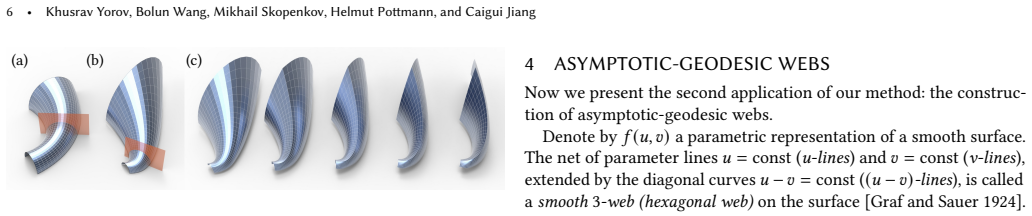
The load-bearing device is the isotropic-to-Euclidean metric interpolation $\langle p,q\rangle_{\varepsilon}=p_1q_1+p_2q_2+\varepsilon p_3q_3$, with $\varepsilon=0$ giving the isotropic semi-metric and $\varepsilon=1$ giving the Euclidean metric. At $\varepsilon=0$, geodesic constraints become quadratic because isotropic geodesics are straight in top view, and recent classifications of flexible isotropic Q-nets and isotropic AGAG webs provide complete families of exact starting shapes. For constant-angle surfaces, the isotropic reduction permits a second-order series solution $f(w)=f^{(0)}(w)+f^{(1)}(w)\varepsilon+f^{(2)}(w)\varepsilon^2/2$ in the small parameter $\varepsilon=\cos\gamma$, built from holomorphic data; this supplies an approximate isotropic constant-ratio surface that is then remeshed and optimized. The gradual increase of $\varepsilon$ is what carries the solution from the isotropic basin into the Euclidean basin.
What would settle it
Run the gradual-epsilon optimization on a dense family of isotropic AGAG webs whose top-view geodesics are tangent to a nearly parabolic conic; if the final hard-constraint energy does not drop below $10^{-5}$ for any of them, the claim that isotropic solutions initialize Euclidean solutions fails for that class. As a check, computing the residual of equation (4) for the approximate isotropic CRPC surface from Algorithm 3 when $h'$ has simple roots would reveal whether the missing square-root-branch analysis invalidates the second-order series for angles far from $90^\circ$.
Extended reading notes
Core claim
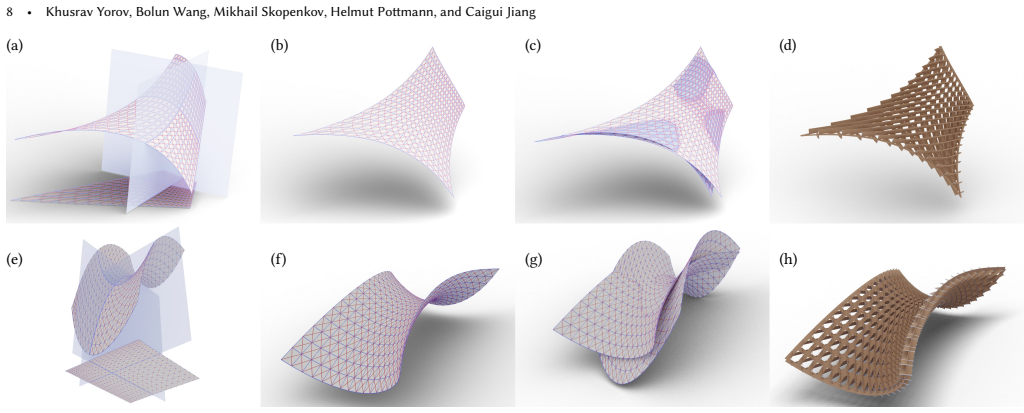
On its own terms, the paper's central claim is that isotropic geometry is not merely a degenerate toy but a structure-preserving simplification whose solutions sit close enough to Euclidean solutions that a guided projection with the interpolating metric $\langle p,q\rangle_{\varepsilon}=p_1q_1+p_2q_2+\varepsilon p_3q_3$ can walk from one to the other. Concretely, the paper constructs isotropic flexible quad meshes using a recent complete classification, builds isotropic GGG, AAG, and AGAG webs from classifications and a classical theorem on straight-line 3-webs, and produces approximate isotropic surfaces of constant principal-curvature ratio via a second-order series in $\varepsilon=\cos\gamma$ using complex analysis. Feeding these into optimization yields Euclidean mechanisms, Euclidean asymptotic-geodesic webs, and Euclidean constant-angle gridshells whose final constraint residuals are reported near machine precision. The paper does not prove that this path always exists; it presents the method as broadly supported by experiments, and notes that without the gradual metric the AGAG optimization consistently fails.
Load-bearing premise
The load-bearing premise is that for each problem class the isotropic solution lies in the basin of attraction of a Euclidean solution, so that gradually increasing $\varepsilon$ in the interpolated metric traces a converging path; the paper reports strong experimental evidence but gives no proof.
Editorial extensions
If this is right
- Flexible quad meshes, GGG/AAG/AGAG webs, and constant-angle asymptotic gridshells can all be initialized from isotropic counterparts, with final hard-constraint energies between $10^{-5}$ and $10^{-10}$.
- The gradual metric interpolation is critical: without it, AGAG optimization consistently fails, while GGG and AAG optimization loses smoothness or flattens the shape.
- Euclidean and isotropic mechanisms have nearly identical initial shapes but different isometric deformations, so every isotropic position can seed a different Euclidean mechanism.
- For AGAG webs, the paper provides a concrete computational route to discrete Euclidean AGAG webs, whose smooth counterparts were previously unknown to exist.
- The approximate isotropic constant-ratio surfaces give control over flat points and boundary curves, a capability not available in the known Euclidean constructions of such surfaces.
Reading between the lines
- If the basin-of-attraction assumption holds for other constraint classes, the same metric-interpolation trick should apply to any Euclidean problem whose isotropic counterpart is classified, such as conical meshes or meshes with planar supporting beams.
- The gradual $\varepsilon$ schedule is effectively a homotopy method; a testable refinement is adaptive step-size control of $\varepsilon$ based on the energy landscape, which could turn the empirical recipe into a more robust algorithm.
- The numerical existence of discrete Euclidean AGAG webs suggests that smooth Euclidean AGAG webs may also exist, since the discrete webs converge to smooth ones; a rigorous existence proof might start from the isotropic classification and a perturbation argument.
- The flat-point limitation is likely an artifact of the cross-field remeshing step rather than of the isotropic initialization; a remeshing method that respects prescribed flat points could extend the approach to more singular configurations.
Editorial analysis
A structured set of objections, weighed in public.
Referee Report
Summary. The paper proposes a general two-step method for hard Euclidean geometric design problems: first solve the analogous problem in isotropic geometry, then use that solution to initialize an optimization that gradually interpolates the metric from isotropic to Euclidean (Eq. 9) until the Euclidean constraints are satisfied. The approach is demonstrated on three problem classes: flexible quad meshes with planar faces (Section 3), GGG/AAG/AGAG asymptotic-geodesic webs (Section 4), and asymptotic gridshells with constant node angle, i.e., CRPC surfaces (Section 5). The paper contributes concrete constructions: isotropic flexible nets from a recent classification, two methods for constructing isotropic AAG webs (Algorithms 1 and 2), and an approximate analytic expression for isotropic CRPC surfaces (Algorithms 3 and 4). Numerical results in Table 1 report hard-constraint residual energies between 1e-5 and 1e-10 at the final iteration, and Figures 1-18 show produced mechanisms, webs, and gridshells.
Significance. If the proposed strategy is as general and reliable as claimed, it would provide a new and broadly applicable paradigm for initialization in geometric constraint solving, capitalizing on the fact that isotropic geometry is both simpler and equipped with classification results for objects whose Euclidean counterparts are open problems. The paper contains genuinely useful new constructions: the isotropic AAG web propagation (Algorithm 1) and the second-order analytic approximation of isotropic CRPC surfaces (Section 5) are nontrivial and go beyond existing isotropic-geometry toolboxes. The quantitative convergence evidence in Table 1 is encouraging, and the connection to classical work (Müntz, Graf-Sauer, Strubecker) is historically well placed. However, the paper does not supply code or data, several key derivations are asserted rather than proved, and the generality of the basin-of-attraction behavior is supported only by a small number of hand-picked examples. These issues make the central claim plausible but not yet fully verified.
major comments (3)
- [Section 5, Eqs. (5)-(8)] The series expansion of the CRPC surface in epsilon = cos gamma is asserted via 'a direct computation' (Section 5, Eq. (8)), and the square-root branch condition for g''(w) is explicitly deferred to a subsequent publication. This is load-bearing because Algorithms 3 and 4 construct the initial surfaces for all CRPC examples from this second-order truncation. Please provide the computation or a precise statement of the conditions (e.g., zeros of g'' have even multiplicity) under which the truncation is valid, and justify the regularization log(|h'(w)| + epsilon) used in Algorithms 3 and 4.
- [Section 4.3, Algorithm 1] Algorithm 1 is introduced with the sentence 'We omit the proofs and the definition of "general position"; cf. [Skopenkov et al. 2020].' The algorithm's correctness depends on the existence and uniqueness of the intersection of three planes at Step 5, on the non-vanishing of the computed normals, and on the two runs for the plus and minus signs producing a consistent AAG web. Since this construction is the basis for all AAG examples, either provide a proof or a precise definition of the generic conditions and verify them for the presented inputs.
- [Section 6.4 and Table 1] The gradual epsilon-continuation is stated to be critical ('optimization consistently failed without this approach' for AGAG webs), yet the paper offers no analysis of the continuation path or of its basin of attraction. Table 1 reports only one final residual per example; there is no information on the number of runs, the sensitivity to the epsilon schedule and weights, or the behavior at intermediate epsilon values. Because the paper's title and abstract claim a general approach, this empirical underdetermination is load-bearing. Please add a robustness study, e.g., multiple perturbed initializations, a plot of E_hard versus epsilon for each problem class, and a description of failure cases, or explicitly scope the claim to the demonstrated examples.
minor comments (4)
- [Eq. (20), Table 1, Section 7] The notation for the optimization weights is inconsistent: Eq. (20) uses omega0, omega1, omega2, but Table 1 and Section 7 use omega1, omega2, omega3. Please align the notation.
- [Section 7 and Table 1 caption] The acronym is spelled 'CRPC' throughout the paper, but Section 7 ('for CRCP surfaces') and the Table 1 caption ('CRCP') use 'CRCP'. Please correct the typos.
- [Algorithm 2, Step 11] Step 11 divides by (f_{s,s} - m_{s,s}); the paper does not state conditions that guarantee this difference is non-zero. Please add the necessary generic assumptions or a note on degeneracy handling.
- [Section 6.4] The sentence 'see supplementary materials for details' refers to materials not included in the arXiv v1 submission; please state in the text where the supplementary materials can be obtained.
Circularity Check
No circularity: isotropic constructions and Euclidean optimizations are distinct; low final energies are optimization residuals, not fitted predictions.
full rationale
The derivation chain is: construct an isotropic solution (using external or prior classifications or explicit algorithms), then run constrained optimization with the interpolated inner product (9), increasing epsilon from 0 to 1, to minimize Euclidean constraint energies (10), (11), (17). The target quantities—face planarity, geodesic/asymptotic properties, constant node angle—are enforced by residuals evaluated in the Euclidean metric at epsilon = 1, and they are not set to zero by construction. The isotropic inputs do not encode the Euclidean solutions: Section 6.4 states that AGAG optimization without the gradual approach 'consistently failed', and the CRPC boundary fitting in Algorithm 4 targets user-prescribed boundary data b(w), not the constant-angle condition. The cited isotropic classifications (Muller and Pottmann 2024; Pirahmad et al. 2025a,b) are prior mathematical theorems about isotropic webs and nets, not about Euclidean solutions, so using them as initial data does not import the target result. The low values in Table 1 are convergence residuals of the same constraints being optimized; this is numerical evidence of feasibility, not a self-definitional prediction. No equation is shown to be equivalent to an input by construction. The main weakness is the empirically assumed basin of attraction of the continuation path, which is a correctness/generalization risk rather than a circularity.
Assumptions & free parameters
free parameters (5)
- Optimization weights ω0, ω1, ω2 =
Table 1 values, e.g., 5e-3, 1e-2, 1e-3
- Convergence accuracy threshold =
1e-5
- Metric homotopy step size (ε schedule)
- Remeshing parameters (MIQ)
- Polynomial degrees k and boundary coefficients in Algorithm 4 =
k chosen by user; h_i, g_i fitted to boundary
assumptions (6)
- standard math Isotropic geometry background (isotropic norm, congruences, differential geometry)
- domain assumption Classification of isotropic flexible nets from Pirahmad et al. 2025b
- domain assumption Classification of isotropic AGAG webs from Müller and Pottmann 2024
- standard math Graf-Sauer theorem: any 3-web of straight lines is formed by tangents of an algebraic curve of class 3
- ad hoc to paper Series expansion of the CRPC surface in ε = cos γ is valid and the second-order truncation is a good approximation
- domain assumption Guided projection optimization converges from the isotropic initialization along the metric homotopy
Cite this review
Pith. "Pith review of Unlocking Euclidean Problems with Isotropic Initialization." pith.science (2026). https://pith.science/paper/ESSWHQ5Y
@misc{pith2026250601726,
  author       = {Pith},
  title        = {Pith review of: Unlocking Euclidean Problems with Isotropic Initialization},
  year         = {2026},
  howpublished = {\url{https://pith.science/paper/ESSWHQ5Y}},
  note         = {Machine review of arXiv:2506.01726}
}
read the original abstract
Many problems in Euclidean geometry, arising in computational design and fabrication, amount to a system of constraints, which is challenging to solve. We suggest a new general approach to the solution, which is to start with analogous problems in isotropic geometry. Isotropic geometry can be viewed as a structure-preserving simplification of Euclidean geometry. The solutions found in the isotropic case give insight and can initialize optimization algorithms to solve the original Euclidean problems. We illustrate this general approach with three examples: quad-mesh mechanisms, composite asymptotic-geodesic gridshells, and asymptotic gridshells with constant node angle.
Figures


Figures from the paper (14 more)






Forward citations
Cited by 1 Pith paper
-
Quasi-symmetric nets: A constructive approach to the equimodular elliptic type of Kokotsakis polyhedra
Quasi-symmetric nets are introduced and shown to be flexible realizations of the equimodular elliptic type of Kokotsakis polyhedra, with closed-form and numerical examples.
Reference graph
Works this paper leans on
-
[2014]
Form-finding with polyhedral meshes made simple. ACM Trans. Graph. 33, 4, Article 70 (July 2014), 9 pages. Xavier Tellier, Cyril Douthe, Laurent Hauswirth, and Oliver Baverel. 2021. Form-Finding with Isotropic Linear Weingarten Surfaces. In Advances in Architectural Geometry 2020. Champs-sur-Marne. Etienne Vouga, Mathias Höbinger, Johannes Wallner, and He...
work page 2012
-
[2019]
Flexible polyhedral nets in isotropic geometry
Visual smoothness of polyhedral surfaces. ACM Trans. Graphics 38, 4 (2019), 260:1–260:11. Proc. SIGGRAPH. Davide Pellis, Martin Kilian, Helmut Pottmann, and Mark Pauly. 2021. Computational design of weingarten surfaces. ACM Trans. Graph. 40, 4, Article 114 (July 2021), 11 pages. Davide Pellis, Hui Wang, Martin Kilian, Florian Rist, Helmut Pottmann, and Ch...
work page Pith review arXiv 2019
-
[2024]
Isometric Surfaces in Isotropic 3-Space
Quad mesh mechanisms. ACM Trans. Graph. 43, 6 (2024), 243:1–243:17. Proc. SIGGRAPH Asia. Caigui Jiang, Cheng Wang, Eike Schling, and Helmut Pottmann. 2021. Computational design and optimization of quad meshes based on diagonal meshes. In Advances in Architectural Geometry 2020. Presses des Ponts, Champs-sur-Marne, France, 38–60. Caigui Jiang, Cheng Wang, ...
work page Pith review arXiv 2024
Reviewed August 7, 2026 · model on record in the stance chip above.
Discussion (0). Sign in to comment.