REVIEW 3 major objections 4 minor 1 cited by
Rapid and accurate numerical evolution of linear cosmological perturbations with non-cold relics
T0 review · 3 major / 4 minor · reviewed 2026-08-07 · deepseek-v4-flash
Pith's one-line read This paper claims that non-cold relic perturbations can be computed by iterated integral equations, matching a fully converged Boltzmann hierarchy to better than 0.01% up to k = 100 Mpc$^{-1}$ without truncation artifacts.
desk verdict CLASSIER makes the integral-equation route to non-cold relic perturbations actually practical—public code, real speedups, <0.01% P(k) agreement—but the 'arbitrary NCDM' claim is broader than the evidence. read the letter →
The pith
A machine-rendered reading of the paper's core claim, the machinery that carries it, and where it could break.
The reading
What carries the argument
The central object is the integral solution of the Boltzmann equation along the particle trajectory, Eq. (4): each moment $\Psi_\ell$ is a convolution in $\xi = k\chi_q(\tau_i,\tau)$ of a source $G(\xi)$ built from metric derivatives weighted by $(\epsilon/qk)(d\ln f_0/d\ln q)$ with kernels $j_\ell$ and $j_\ell''$. The practical mechanism is splitting $G$ into a cubic-polynomial part integrated analytically plus two residual pieces whose Fourier transforms are computed with non-uniform fast Fourier transforms, which suppresses ringing from hard cutoffs and handles the very different early- and late-time timescales. A fixed-point iteration seeds the sources from the standard truncated hierarchy, then recomputes the relic moments until consecutive iterations agree; two iterations suffice in the demonstrated cases.
What would settle it
Construct a non-standard phase-space distribution with a sharp peak at low momentum and compare CLASSIER's $\delta_{\mathrm{NCDM}}(k,\tau)$ and $P(k)$ against a Boltzmann hierarchy run converged at $\ell_{\max}=500$; if the differences exceed roughly 0.01% or successive iterations fail to converge, the claim of model-independent accuracy is falsified.
Extended reading notes
Core claim
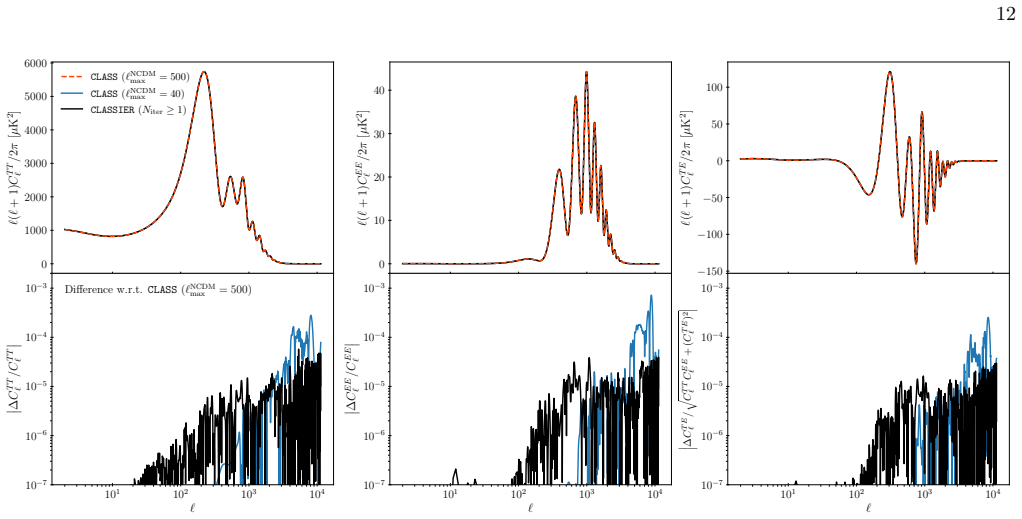
The paper establishes, on its own terms, that the linearized collisionless Boltzmann equation for a non-cold relic has an exact integral solution whose $\ell = 0,1,2$ moments are convolutions of metric-derivative source functions with spherical-Bessel kernels. Solving these convolutions numerically and iterating the coupled metric-relic system reproduces the result of a Boltzmann hierarchy truncated at $\ell_{\max}=500$: matter power spectrum agreement below 0.01% for $k$ up to $100\,\mathrm{Mpc}^{-1}$, CMB TT/EE/TE agreement below 0.01%, and no truncation-induced reflection artifacts in the relic density perturbation. The paper also demonstrates large speedups, for example 1 minute 22 seconds versus 25 minutes for the converged hierarchy at $k_{\max}=100\,\mathrm{Mpc}^{-1}$, and validates the method on a toy non-thermal phase-space distribution to argue that the approach is model-independent.
Load-bearing premise
The argument assumes that the iterative fixed-point scheme converges to the true solution for any non-cold relic phase-space distribution, whereas the paper demonstrates convergence only for a Fermi-Dirac massive neutrino and one toy distribution, with no a priori error bound for exotic cases.
Editorial extensions
If this is right
- The standard multipole ladder for non-cold relics can be replaced by an iterative integral-equation solve with no loss of accuracy for small-scale matter power spectra.
- Truncation artifacts, such as artificial reflections in neutrino density perturbations caused by cutting the hierarchy at finite maximum multipole, are absent in the integral solution.
- CMB temperature, polarization, and cross spectra match the fully converged hierarchy to better than 0.01% with just one or two iterations.
- The same code handles arbitrary phase-space distributions without building a model-specific fluid approximation, as demonstrated on a toy non-thermal distribution.
- Routine high-$k$ calculations become substantially faster: converged accuracy up to $k=100\,\mathrm{Mpc}^{-1}$ takes about one to one and a half minutes rather than about 25 minutes.
Reading between the lines
- Editorial extension: because only the moments up to quadrupole are computed and the convolution machinery is distribution-agnostic, the same pipeline should apply to warm dark matter, sterile neutrinos, or decaying dark matter; the natural stress test is a distribution with a sharp low-momentum peak, where the big-$q$ shortcut could fail.
- Editorial extension: the iteration-with-previous-iteration-source structure suggests treating collisional terms, such as neutrino self-interactions or dark-matter–neutrino scattering, as an additional source in the next pass, a direction the paper hints at but does not implement.
- Editorial extension: the runtime scaling implies that high-$k$ parameter searches with non-standard thermal histories become feasible at the precision needed for upcoming small-scale CMB and large-scale-structure analyses; one could test this by using the code as the forward model in a parameter forecast.
Editorial analysis
A structured set of objections, weighed in public.
Referee Report
Summary. The paper introduces CLASSIER, an implementation in CLASS that replaces the truncated Boltzmann hierarchy for non-cold relics with iterated integral equations. The integral equations are derived from the linearized collisionless Boltzmann equation, recast as convolutions with analytic kernels, and evaluated with non-uniform fast Fourier transforms and Gauss-Legendre quadrature. The method is demonstrated for a massive neutrino and for one toy non-thermal phase-space distribution. The central quantitative claims are that the matter power spectrum at z=0 agrees with a converged Boltzmann hierarchy (lmax=500) to better than 0.01% up to k=100 Mpc^-1, that CMB spectra agree at the same level, and that the computation is several times faster than a high-lmax hierarchy run. The code is publicly available.
Significance. If the claims hold, CLASSIER is a valuable new tool for precision cosmology: it gives an exact integral-equation reformulation of non-cold relic perturbations, provides analytic Fourier-space kernels, avoids the late-time fluid-approximation calibration that is model-specific, and ships with publicly available code. The paper reports credible empirical convergence tests for the standard massive-neutrino case, reproducible runtime comparisons, and an open implementation. The main weakness is that the advertised generality to arbitrary non-cold relics rests on only two phase-space distributions and on empirical evidence rather than on a contraction argument or an a priori error bound for the fixed-point iteration. There is also an acknowledged O(1%) early-time error in the neutrino density perturbation for high-k modes that should be clearly delineated in the accuracy claims.
major comments (3)
- [Sections IV.D and VI] The claim that the method is applicable to arbitrary NCDM species is not fully established by the two distributions tested. The fixed-point iteration of Section IV.D is shown to converge for a Fermi-Dirac massive neutrino and one broad, smooth toy distribution, but no contraction proof or a priori error bound is provided. The convergence behavior depends on the spectral radius of the linear iteration map, which can vary with the phase-space distribution, and the big-q approximation of Eq. (28) may become invalid for distributions with a strong low-momentum component. I recommend either adding stress tests with sharply peaked or low-momentum-heavy distributions, or explicitly restricting the claim to a class of sufficiently smooth distributions and stating that a general convergence guarantee is not proven.
- [Section V and Fig. 3] The paper acknowledges an O(1%) error in delta_nu for k=100 Mpc^-1 at tau about 1 Mpc, arising from the I2 convolution at xi=xi_star. Since one of the advertised advantages is the absence of truncation artifacts in perturbation variables, this residual error should be treated as a stated limitation or removed by increasing the resolution near the transition. The statement that this error 'does not affect any relevant observable' is supported only for the matter power spectrum and the CMB spectra shown; the paper should either quantify the impact on other derived quantities or limit the accuracy claim to those observables.
- [Section V and Fig. 1] The primary validation baseline, CLASS with lmax=500, itself exhibits truncation artifacts in delta_nu at late times, as shown in Fig. 1. For the matter power spectrum this baseline is likely converged, but the agreement in individual perturbation variables is not an independent check. To support the claim that CLASSIER is accurate for the perturbation variables themselves, a comparison against an independent high-accuracy method for at least a subset of modes would be valuable; the direct-convolution approach mentioned in Section IV.A could serve this purpose.
minor comments (4)
- [Section IV.B and IV.C] Equation (27) defines xi_star as max(xi_default_star, xi0/2), but the text in Section IV.C states that xi_star is min(xi_default_star, xi0/2). These are contradictory, and the printed Eq. (27) would set xi_star > xi0 for low-momentum bins. Please correct the inconsistency and make the definition unambiguous.
- [Fig. 5 caption] The caption of Fig. 5 says the fractional differences are with respect to the integral-equation approach, while the figure label and the running text compare with CLASS at lmax=500. This should be harmonized.
- [Section V text] There are several grammatical slips, for example 'we show results for an applications for a massive neutrino' and 'the times when the 0th iteration result start deviating'; these should be copyedited.
- [Abstract and Section VII] The phrase 'without relying on semi-analytic approximations at late times' is slightly stronger than what is demonstrated, since the 0th iteration in the massive-neutrino runs uses the fluid approximation; the conclusion correctly notes that this step is not required in general, but the abstract should be qualified accordingly.
Circularity Check
No circularity: the integral-equation derivation is self-contained and benchmarked externally; self-citations are motivational only.
full rationale
The central reformulation is derived from first principles: Eq. (4) follows by integrating the linearized collisionless Boltzmann equation, Eq. (1), along particle trajectories and applying the spherical-Bessel identity, Eq. (3). No target result is assumed in obtaining the integral kernels. The claimed predictions, such as the matter power spectrum and CMB spectra, are validated against the independent CLASS Boltzmann-hierarchy calculation with ℓmax=500, and the paper explicitly shows that successive iterations move away from the 0th-iteration seed. The 0th iteration is an initial guess, not a fitted parameter, and the convergence checks show that the final result does not reduce to that seed. The self-citations [29,30] are prior statements of the same integral-equation formalism, but the formalism is re-derived in this paper; they are motivational rather than load-bearing. The absence of a contraction proof and the limited diversity of tested phase-space distributions are robustness and correctness concerns, not circularity.
Assumptions & free parameters
free parameters (6)
- ξ⋆ (transition scale) =
max(100, ξ0/2)
- N1^(ξ) (GL order for G1) =
201
- N2^(ξ) (GL order for G2) =
k-dependent: 1000, 5000, 25000, 40000, 80000
- big-q tolerance =
10^-3
- NCDM time grid =
half log-spaced for τ≤10^3 Mpc, half linear-spaced after
- 0th iteration ℓmax and fluid onset =
ℓmax=17, fluid onset at τ=31/k
assumptions (6)
- domain assumption Linearized Einstein-Boltzmann system in synchronous gauge (Eq. 1) is the correct description of NCDM perturbations.
- domain assumption Initial condition Ψℓ(τi)=0 for ℓ>2 at early times.
- ad hoc to paper The analytic Fourier transforms of the kernels in Table I are correct, including the branch-cut handling for ln[(ω+1)/(ω-1)].
- ad hoc to paper The iterative scheme converges to the exact solution for arbitrary NCDM species.
- domain assumption The big-q approximation is valid for q-bins satisfying Eq. (28) with tolerance 10^-3.
- ad hoc to paper The finite Fourier sampling of G1 and G2 (with frequencies ωl as defined) has negligible aliasing/truncation error for the observables considered.
Cite this review
Pith. "Pith review of Rapid and accurate numerical evolution of linear cosmological perturbations with non-cold relics." pith.science (2026). https://pith.science/paper/Y4HUTTWI
@misc{pith2026250601956,
  author       = {Pith},
  title        = {Pith review of: Rapid and accurate numerical evolution of linear cosmological perturbations with non-cold relics},
  year         = {2026},
  howpublished = {\url{https://pith.science/paper/Y4HUTTWI}},
  note         = {Machine review of arXiv:2506.01956}
}
abstract
We describe the implementation of a new approach to the numerical evaluation of the effects of non-cold relics on the evolution of cosmological perturbations. The Boltzmann hierarchies used to compute the contributions of these relics to the stress-energy tensor are replaced with a set of integral equations. These integral equations take the form of convolutions and are solved iteratively with the rest of the system. We develop efficient algorithms for evaluating these convolutions using non-uniform fast Fourier transforms (NUFFTs). This approach enables efficient and accurate evaluation of the cosmic microwave background anisotropies and matter power spectra, all the way through the history of the Universe, without relying on semi-analytic approximations at late times. We implement this method in the Boltzmann solver CLASS, resulting in a new code called CLASSIER (for CLASS Integral Equation Revision), and apply it to massive-neutrino perturbations as a demonstration. The implementation is optimized to accurately capture the distinct behaviors of perturbations in both super-/near-horizon and sub-horizon regimes. Our results match the accuracy of a fully converged Boltzmann hierarchy solution while avoiding numerical artifacts from truncation of the Boltzmann hierarchy at finite multipole and offering substantial speedups depending on the required precision and the range of scales of interest. This new framework provides a practical and robust alternative for the truncated Boltzmann hierarchy approach, especially for studying beyond $\Lambda$CDM non-cold relics with signatures on small scales. CLASSIER is publicly available at https://github.com/nanoomlee/CLASSIER.
Figures


Figures from the paper (4 more)



Forward citations
Cited by 1 Pith paper
-
Cosmological evolution with decaying dark matter: an integral-equation approach
CLASSIER-DDM evaluates generic two-body decaying dark matter perturbations via iterative integral equations at O(0.1%) accuracy and O(1 min) cost without a Boltzmann hierarchy or fluid approximation.
Reference graph
Works this paper leans on
-
[1]
K. N. Abazajian et al. (CMB-S4), CMB-S4 Science Book, First Edition, (2016), arXiv:1610.02743 [astro-ph.CO]
arXiv 2016
-
[2]
K. Abazajian et al., CMB-S4 Science Case, Reference De- sign, and Project Plan, (2019), arXiv:1907.04473 [astro- ph.IM]
arXiv 2019
-
[3]
K. Abazajian et al., Snowmass 2021 CMB-S4 White Paper, in 2022 Snowmass Summer Study (2022) arXiv:2203.08024 [astro-ph.CO]
arXiv 2022
- [4]
-
[5]
M. H. Abitbol et al. (Simons Observatory), The Simons Observatory: Astro2020 Decadal Project Whitepaper, Bull. Am. Astron. Soc. 51, 147 (2019), arXiv:1907.08284 [astro-ph.IM]
arXiv 2019
-
[6]
N. Sehgal et al., CMB-HD: An Ultra-Deep, High- Resolution Millimeter-Wave Survey Over Half the Sky, (2019), arXiv:1906.10134 [astro-ph.CO]
arXiv 2019
-
[7]
S. Aiola et al. (CMB-HD), Snowmass2021 CMB-HD White Paper, (2022), arXiv:2203.05728 [astro-ph.CO]
arXiv 2022
-
[8]
A. Aghamousa et al. (DESI), The DESI Experiment Part I: Science,Targeting, and Survey Design, (2016), arXiv:1611.00036 [astro-ph.IM]
arXiv 2016
Show all 50 references
-
[9]
M. E. Levi et al. (DESI), The Dark Energy Spectroscopic Instrument (DESI), (2019), arXiv:1907.10688 [astro- ph.IM]
2019 arXiv
-
[10]
Ivezi´ cet al
v. Ivezi´ cet al. (LSST), LSST: from Science Drivers to Reference Design and Anticipated Data Products, As- trophys. J. 873, 111 (2019), arXiv:0805.2366 [astro-ph]
2019 arXiv
-
[11]
Abate et al
A. Abate et al. (LSST Dark Energy Science), Large Syn- optic Survey Telescope: Dark Energy Science Collabora- tion, (2012), arXiv:1211.0310 [astro-ph.CO]
2012 arXiv
-
[12]
Mandelbaum et al
R. Mandelbaum et al. (LSST Dark Energy Science), The LSST Dark Energy Science Collaboration (DESC) Sci- ence Requirements Document, (2018), arXiv:1809.01669 [astro-ph.CO]
2018 arXiv
-
[13]
Spergel et al., Wide-Field InfrarRed Survey Telescope- Astrophysics Focused Telescope Assets WFIRST-AFTA 2015 Report, (2015), arXiv:1503.03757 [astro-ph.IM]
D. Spergel et al., Wide-Field InfrarRed Survey Telescope- Astrophysics Focused Telescope Assets WFIRST-AFTA 2015 Report, (2015), arXiv:1503.03757 [astro-ph.IM]
2015 arXiv
-
[14]
Laureijs et al
R. Laureijs et al. (EUCLID), Euclid Definition Study Re- port, (2011), arXiv:1110.3193 [astro-ph.CO]
2011 arXiv
-
[15]
Lesgourgues and S
J. Lesgourgues and S. Pastor, Massive neutrinos and cosmology, Phys. Rept. 429, 307 (2006), arXiv:astro- ph/0603494
2006
-
[16]
Ma and E
C.-P. Ma and E. Bertschinger, Cosmological perturba- tion theory in the synchronous and conformal Newto- nian gauges, Astrophys. J. 455, 7 (1995), arXiv:astro- ph/9506072
1995
-
[17]
D. Blas, J. Lesgourgues, and T. Tram, The Cosmic Linear Anisotropy Solving System (CLASS) II: Approximation schemes, JCAP 07, 034, arXiv:1104.2933 [astro-ph.CO]
-
[18]
Lesgourgues and T
J. Lesgourgues and T. Tram, The Cosmic Lin- ear Anisotropy Solving System (CLASS) IV: efficient implementation of non-cold relics, JCAP 09, 032, arXiv:1104.2935 [astro-ph.CO]
-
[19]
Zaldarriaga and D
M. Zaldarriaga and D. D. Harari, Analytic approach to the polarization of the cosmic microwave background in flat and open universes, Phys. Rev. D 52, 3276 (1995), arXiv:astro-ph/9504085
1995 arXiv
-
[20]
Seljak and M
U. Seljak and M. Zaldarriaga, A Line of sight integration approach to cosmic microwave background anisotropies, Astrophys. J. 469, 437 (1996), arXiv:astro-ph/9603033
1996 arXiv
-
[21]
Lewis, A
A. Lewis, A. Challinor, and A. Lasenby, Efficient com- putation of CMB anisotropies in closed FR W models, Astrophys. J. 538, 473 (2000), arXiv:astro-ph/9911177
2000 arXiv
-
[22]
Howlett, A
C. Howlett, A. Lewis, A. Hall, and A. Challinor, CMB power spectrum parameter degeneracies in the era of pre- cision cosmology, JCAP 04, 027, arXiv:1201.3654 [astro- ph.CO]
-
[23]
Weinberg, Damping of tensor modes in cosmology, Phys
S. Weinberg, Damping of tensor modes in cosmology, Phys. Rev. D69, 023503 (2004), arXiv:astro-ph/0306304
2004 arXiv
-
[24]
Baskaran, L
D. Baskaran, L. P. Grishchuk, and A. G. Polnarev, Im- prints of Relic Gravitational Waves in Cosmic Microwave Background Radiation, Phys. Rev. D 74, 083008 (2006), arXiv:gr-qc/0605100
2006 arXiv
-
[25]
Weinberg, A No-Truncation Approach to Cosmic Mi- crowave Background Anisotropies, Phys
S. Weinberg, A No-Truncation Approach to Cosmic Mi- crowave Background Anisotropies, Phys. Rev. D 74, 063517 (2006), arXiv:astro-ph/0607076
2006 arXiv
-
[26]
J. R. Pritchard and M. Kamionkowski, Cosmic mi- crowave background fluctuations from gravitational waves: An Analytic approach, Annals Phys. 318, 2 (2005), arXiv:astro-ph/0412581
2005 arXiv
-
[27]
Flauger and S
R. Flauger and S. Weinberg, Tensor Microwave Back- ground Fluctuations for Large Multipole Order, Phys. Rev. D 75, 123505 (2007), arXiv:astro-ph/0703179. 14
2007 arXiv
-
[28]
Loverde and Z
M. Loverde and Z. J. Weiner, Probing neutrino interac- tions and dark radiation with gravitational waves, JCAP 02, 064, arXiv:2208.11714 [astro-ph.CO]
-
[29]
Kamionkowski, Cosmological perturbations without the Boltzmann hierarchy, Phys
M. Kamionkowski, Cosmological perturbations without the Boltzmann hierarchy, Phys. Rev. D 104, 063512 (2021), arXiv:2105.02887 [astro-ph.CO]
2021 arXiv
-
[30]
L. Ji, M. Kamionkowski, and J. L. Bernal, Cosmolog- ical perturbations: Noncold relics without the Boltz- mann hierarchy, Phys. Rev. D 106, 103531 (2022), arXiv:2201.11129 [astro-ph.CO]
2022 arXiv
-
[31]
Hu, Structure formation with generalized dark matter, Astrophys
W. Hu, Structure formation with generalized dark matter, Astrophys. J. 506, 485 (1998), arXiv:astro- ph/9801234
1998
-
[32]
Lewis and A
A. Lewis and A. Challinor, Evolution of cosmological dark matter perturbations, Phys. Rev. D 66, 023531 (2002), arXiv:astro-ph/0203507
2002 arXiv
-
[33]
Shoji and E
M. Shoji and E. Komatsu, Massive Neutrinos in Cosmol- ogy: Analytic Solutions and Fluid Approximation, Phys. Rev. D 81, 123516 (2010), [Erratum: Phys.Rev.D 82, 089901 (2010)], arXiv:1003.0942 [astro-ph.CO]
2010 arXiv
-
[34]
Nascimento, Accurate fluid approximation for mas- sive neutrinos in cosmology, Phys
C. Nascimento, Accurate fluid approximation for mas- sive neutrinos in cosmology, Phys. Rev. D 108, 023505 (2023), arXiv:2303.09580 [astro-ph.CO]
2023 arXiv
-
[35]
Franco Abell´ an, R
G. Franco Abell´ an, R. Murgia, V. Poulin, and J. Lavalle, Implications of the S8 tension for decaying dark matter with warm decay products, Phys. Rev. D 105, 063525 (2022), arXiv:2008.09615 [astro-ph.CO]
2022 arXiv
-
[36]
W. H. Press, S. A. Teukolsky, W. T. Vetterling, and B. P. Flannery, Numerical Recipes: The Art of Scientific Computing (Third Edition) (Cambridge University Press, 2007)
2007
-
[37]
exponential of semicircle
A. H. Barnett, J. F. Magland, and L. af Klinteberg, A parallel non-uniform fast fourier transform library based on an “exponential of semicircle” kernel (2019), arXiv:1808.06736 [math.NA]
2019 arXiv
-
[38]
A. H. Barnett, Aliasing error of the exp( β √ 1 − z2) ker- nel in the nonuniform fast fourier transform (2020), arXiv:2001.09405 [math.NA]
2020 arXiv
-
[39]
Archidiacono et al
M. Archidiacono et al. (Euclid), Euclid preparation - LIV. Sensitivity to neutrino parameters, Astron. Astro- phys. 693, A58 (2025), arXiv:2405.06047 [astro-ph.CO]
2025
-
[40]
Aoyama, T
S. Aoyama, T. Sekiguchi, K. Ichiki, and N. Sugiyama, Evolution of perturbations and cosmological constraints in decaying dark matter models with arbitrary decay mass products, JCAP 07, 021, arXiv:1402.2972 [astro- ph.CO]
-
[41]
Franco Abell´ an, R
G. Franco Abell´ an, R. Murgia, and V. Poulin, Linear cos- mological constraints on two-body decaying dark matter scenarios and the S8 tension, Phys. Rev. D 104, 123533 (2021), arXiv:2102.12498 [astro-ph.CO]
2021 arXiv
-
[42]
D’Eramo and A
F. D’Eramo and A. Lenoci, Lower mass bounds on FIMP dark matter produced via freeze-in, JCAP10, 045, arXiv:2012.01446 [hep-ph]
2012 arXiv
-
[43]
Banerjee, A
A. Banerjee, A. Bhattacharjee, S. Das, A. Maharana, and R. K. Sharma, Forecasting Constraints on Non-Thermal Light Massive Relics from Future CMB Experiments, (2025), arXiv:2505.22775 [astro-ph.CO]
2025
-
[44]
Venumadhav, F.-Y
T. Venumadhav, F.-Y. Cyr-Racine, K. N. Abazajian, and C. M. Hirata, Sterile neutrino dark matter: Weak inter- actions in the strong coupling epoch, Phys. Rev. D 94, 043515 (2016), arXiv:1507.06655 [astro-ph.CO]
2016 arXiv
-
[45]
K. N. Abazajian and A. Kusenko, Hidden treasures: Ster- ile neutrinos as dark matter with miraculous abundance, structure formation for different production mechanisms, and a solution to the σ8 problem, Phys. Rev. D 100, 103513 (2019), arXiv:1907.11696 [hep-ph]
2019 arXiv
-
[46]
Alvey, M
J. Alvey, M. Escudero, and N. Sabti, What can CMB observations tell us about the neutrino distribution function?, JCAP 02 (02), 037, arXiv:2111.12726 [astro- ph.CO]
-
[47]
Bansal, S
S. Bansal, S. Ghosh, M. Low, and Y. Tsai, A cosmolog- ical case study of a tower of warm dark matter states: N naturalness, (2024), arXiv:2410.19224 [astro-ph.CO]
2024 arXiv
-
[48]
I. M. Oldengott, T. Tram, C. Rampf, and Y. Y. Y. Wong, Interacting neutrinos in cosmology: exact description and constraints, JCAP 11, 027, arXiv:1706.02123 [astro- ph.CO]
-
[49]
M. R. Mosbech, C. Boehm, S. Hannestad, O. Mena, J. Stadler, and Y. Y. Y. Wong, The full Boltzmann hi- erarchy for dark matter-massive neutrino interactions, JCAP 03, 066, arXiv:2011.04206 [astro-ph.CO]
2011 arXiv
-
[50]
https://github.com/nanoomlee/CLASSIER
Reviewed August 7, 2026 · model on record in the stance chip above.
Discussion (0). Sign in to comment.