REVIEW 19 references
Linear optical sub-Doppler Ramsey resonances in ultrathin gas cells
T0 review · reviewed 2026-08-07 · deepseek-v4-flash
Pith's one-line read In an ultrathin gas cell, coherent atomic polarization transferred from a peripheral ring of a light beam to a central probe produces sub-Doppler Ramsey resonances, with gain possible at π phase difference.
The pith
A machine-rendered reading of the paper's core claim, the machinery that carries it, and where it could break.
The reading
Extended reading notes
Core claim
The cross term J2 ∝ E1 E2 in the absorbed power (Eq. 13) exhibits high-contrast sub-Doppler Ramsey resonances at δ = 0, with width approaching the natural linewidth, when the peripheral beam region is in phase with the central probe; for a π phase difference, the central region can amplify rather than absorb (Fig. 2, Section 3).
Load-bearing premise
The solution for the optical coherence (Eq. 5) assumes that atoms completely lose coherence when they hit the cell walls, so the only atoms that transfer coherence from the peripheral ring to the central probe are those with ballistic trajectories that avoid wall collisions. If walls partially preserve coherence or if gas collisions are non-negligible, the predicted resonances could be washed out.
Signed reviews
Editorial analysis
A structured set of objections, weighed in public.
Assumptions & free parameters
assumptions (4)
- standard math The atom-field interaction is described by the semiclassical optical Bloch equation for the coherence, linear in the field (Eqs. 2-4).
- domain assumption Atoms lose optical coherence completely upon colliding with the cell walls (statement before Eq. 5).
- domain assumption The gas is rarefied enough that interatomic collisions are negligible, and the atomic velocity distribution is Maxwellian (Eq. 6).
- domain assumption The detected central region is small enough that the optical coherence there can be approximated by its value on the central axis (r=0, Eq. 5).
Cite this review
Pith. "Pith review of Linear optical sub-Doppler Ramsey resonances in ultrathin gas cells." pith.science (2026). https://pith.science/paper/EAZE6PM5
@misc{pith2026250601999,
  author       = {Pith},
  title        = {Pith review of: Linear optical sub-Doppler Ramsey resonances in ultrathin gas cells},
  year         = {2026},
  howpublished = {\url{https://pith.science/paper/EAZE6PM5}},
  note         = {Machine review of arXiv:2506.01999}
}
read the original abstract
The paper theoretically establishes and studies the sub-Doppler linear optical Ramsey resonances that arise under certain conditions near centers of optical transitions in the absorption of a sufficiently weak monochromatic light beam during its stationary propagation in the normal direction through an ultrathin gas cell whose internal thickness is less than or of the order of the wavelength of this radiation. We consider a situation when the cross section of this beam consists of two coaxial spatially separated regions, with the absorption signal being detected in a comparatively narrow central part of the beam. The paper studies the significant dependence of the linear optical Ramsey resonances, that arise in such an absorption spectrum, on the distance between these regions, as well as on the phase difference between them. In particular, it is shown that if this phase difference is close to pi, then instead of absorption, amplification of the central part of the incident beam can occur. The Ramsey resonances under consideration are most clearly manifested when the internal thickness of the gas cell is equal to a small halfinteger number of wavelengths of the resonant radiation. However, these resonances do not arise if this thickness is equal to an integer number of such waves. The established Ramsey resonances, under certain conditions, can find application in ultrahigh resolution atomic (molecular) spectroscopy, as well as effective references in compact optical frequency standards.
Figures


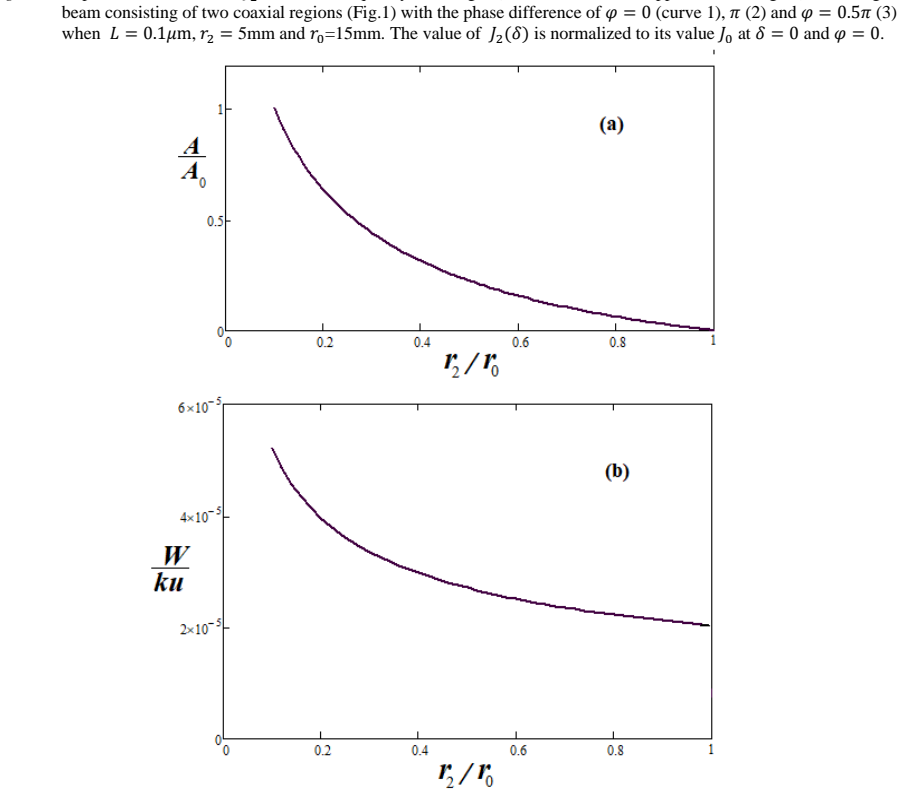
Figures from the paper (1 more)

Reference graph
Works this paper leans on
-
[1]
INTRODUCTION In ultrahigh resolution atomic (molecular) spectroscopy, a considerable reduction of the time -of- flight broadening of spectral lines could be achieved by the realization of the Ramsey method of separated electromagnetic fields [1,2]. This method can be used to obtain spectral absorption resonances without Doppler broadening with a width inv...
-
[2]
The gas is assumed to be sufficiently rarefied that interatomic collisions can be neglected
BASIC RELATIONSHIPS Let us consider an atomic (or molecular) gas that is contained in a transparent cylindrical cell with fairly small internal thickness 𝐿𝐿 and radius 𝑟𝑟 0 ≫ 𝐿𝐿 (Fig.1). The gas is assumed to be sufficiently rarefied that interatomic collisions can be neglected. Suppose that a weak monochromatic laser beam is propagating in the normal dir...
-
[3]
is the frequency detuning of the wave (1) from the resonance, 𝑣𝑣𝑧𝑧 is the atomic velocity projection on the wave vector. It is assumed that the induced linear optical coherence of atoms disappears when they collide with the cell walls. Then , from Eq.(4), we obtain the following solution for the component of this coherence 𝜉𝜉𝑎𝑎𝑏𝑏 at the central axis of th...
-
[4]
DISCUSSION OF RESULTS Our analysis will be performed using, as example, the data for the intercombination transition S0 − P1 31 (at the wavelength 𝜆𝜆 = 689.5 nm) between the ground term S0 1 and the metastable level P1 3 of strontium atoms [13], whose most probable speed in the gas at a temperature about 4000C is 𝑢𝑢 ≈ 350 m/s. A rather large lifetime 𝜏𝜏 ≈...
-
[5]
These sub-Doppler Ramsey resonances are caused directly by the transfer AZAD Ch
CONCLUSION We have established and analyzed linear optical Ramsey resonances that arise under certain conditions near centers of optical transitions in the absorption of a sufficiently weak monochromatic light beam during its stationary propagation in the normal direction through an ultrathin cell with rarefied gas . These sub-Doppler Ramsey resonances ar...
-
[6]
N.F. Ramsey. Molecular Beams, 1990 (Oxford: Oxford University Press)
work page 1990
- [7]
-
[8]
T.F. Cutler, W.J. Hamlyn, J. Renger, K. A. Whittaker, D. Pizzey, I.G. Hughes, V.Sandogdar and C.S. Adams. Nanostructured alkali -metal vapor cells , Phys. Rev. Applied , 2020, V. 14, 034054
work page 2020
Show all 19 references
-
[9]
M. Ducloy. Laser spectroscopy of nanometric gas cells, Europhysics News, 2004, V. 35, 40- 42
2004
-
[10]
Briaudeau, S
S. Briaudeau, S. Saltiel, G. Nienhuis, D. Bloch and M. Ducloy. Coherent Doppler narrowing in a thin vapor cell: Observation of the Dicke Regime in the optical domain , Phys. Rev. A, 1998, V. 57, R3169(R)
1998
-
[11]
Dutier, A
G. Dutier, A. Yarovitski, S. Saltiel, A. Papoyan, D. Sakisyan, D. Bloch and M. Ducloy. Collapse and revival of a Dicke-type coherent narrowing in a sub -micron thick vapor cell transmission spectroscopy, Europhysics Letters, 2003, V. 63, 35-41
2003
-
[12]
Sagsyan, Y
A. Sagsyan, Y. Pashayan-Leroy, C. Leroy and D. Sarkisyan. Collapse and revival of a Dicke - type coherent narrowing in potassium vapor confined in a nanometric thin cell , Journal of Physics B: Atomic Molecular and Optical Physics, 2016, V. 49, 075001
2016
-
[13]
Zambon and G
B. Zambon and G. Nienhuis. Reflection and transmission of light by thin vapor layers, Optics Communications, 1997, V. 143, 308-314
1997
-
[14]
Izmailov
A.Ch. Izmailov. Limiting Resolution of Linear Absorption Spectroscopy in Thin Gas Cells , Optics and Spectroscopy , 2010, V. 108, 893- 898
2010
-
[15]
Beverini and A.Ch
N. Beverini and A.Ch. Izmailov. Sub-Doppler spectroscopy of atoms excited in the regime of Rabi oscillations in a thin gas cell , Optics Communications, 2009, V. 282, 2527-2531
2009
-
[16]
Dickey and T.E
F.M. Dickey and T.E. Lizotte. Laser Beam Shaping Applications , 2019, (CRC Press, Taylor@Francis Group)
2019
-
[17]
Berman and V.S
P.R. Berman and V.S. Malinovsky. Principles of Laser Spectroscopy and Quantum Optics , 2011 (Princeton University Press)
2011
-
[18]
Radzig and B.M
A.A. Radzig and B.M. Smirnov. Reference Data on Atoms, Molecules and Ions , 2012 (Springer Berlin Heidelberg)
2012
-
[19]
F. Riehle. Frequency Standards -Basics and Applications, 2004 (Berlin: Wiley). Received: 02.04.2025
2004
Reviewed August 7, 2026 · model on record in the stance chip above.
Discussion (0). Continue with ORCID to comment.