REVIEW 3 major objections 4 minor 3 references
Stochastic Barnes-Hut Approximation for Fast Summation on the GPU
T0 review · 3 major / 4 minor · reviewed 2026-08-07 · deepseek-v4-flash
Pith's one-line read A randomized Barnes-Hut estimator matches deterministic error up to 9.4x faster on GPUs.
desk verdict Genuinely new unbiased kernel-sum estimator with a sound proof; the headline speedup is credible but rests on a self-implemented baseline with no external validation, so referee time is warranted but the empirical claims need hardening. read the letter →
The pith
A machine-rendered reading of the paper's core claim, the machinery that carries it, and where it could break.
The reading
What carries the argument
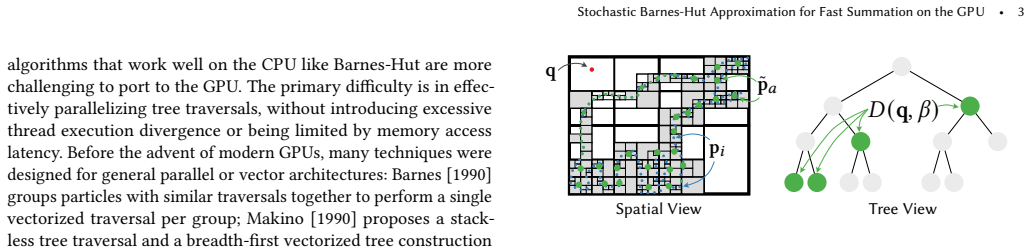
The machinery is a path Monte Carlo estimator built on a telescoping reinterpretation of Barnes-Hut. Each source point's descent through the tree is written as a telescoping sum of node-level approximations; the random truncation depth is drawn by Russian roulette with probability $p_{i,k}(\mathbf{q}) = \min(1, \max(1, \tilde{\beta}_i(\mathbf{q},k)) / \tilde{\beta}_i(\mathbf{q},k+1))$, which keeps paths short in the far field and long in the near field. The terms $\Delta_{i,k} = \sum_{c\in C(T_{i,k})} \tilde{m}_c f(\tilde{\mathbf{p}}_c,\mathbf{q}) - \tilde{m}_{i,k} f(\tilde{\mathbf{p}}_{i,k},\mathbf{q})$ are contribution swaps between a parent and its children, serving as antithetic control-variate corrections that can be aggregated over common path prefixes. The proof of unbiasedness is the load-bearing element: it guarantees that the correction terms, after division by their selection probabilities, reproduce the exact telescoping sum in expectation.
What would settle it
On the paper's own $2^{20}$-source, one-million-query Stanford-bunny workloads, benchmark the stochastic method against an independent, open-source GPU-optimized Barnes-Hut implementation not written by the authors; if that baseline reaches the same median error in equal or less time, the reported 9.4x advantage is an artifact of the internal baseline. To test Theorem 3.1 directly, average the estimator over enough samples on a small system (say $M=1000$) until the sample-mean error is far below the best deterministic Barnes-Hut error and check that it converges to the brute-force sum.
Extended reading notes
Core claim
The central result is Theorem 3.1: with the path-based telescoping construction, the estimator $\hat{F}_1(\mathbf{q})$ in Eq. 7 is an unbiased estimator of the exact sum $F(\mathbf{q}) = \sum_i m_i f(\mathbf{p}_i, \mathbf{q})$, i.e. $\mathbb{E}[\hat{F}_1(\mathbf{q})] = F(\mathbf{q})$. The proof in Appendix A expands the expectation over the sampled path index and path length, groups terms by common tree prefixes, and shows that the selection probabilities cancel exactly, leaving the full telescoping sum over every source path. Unbiasedness converts the deterministic truncation error of Barnes-Hut into variance, so an $S$-sample average converges to the exact sum rather than to a biased approximation. On practical GPU workloads the paper reports that this estimator matches the median absolute error of an optimized CUDA Barnes-Hut implementation in up to 9.4x less time, and it produces no ring-like error discontinuities because there is no deterministic far-field switch.
Load-bearing premise
The practical-advantage claim assumes that the authors' self-implemented CUDA Barnes-Hut is a fair representative of an optimized GPU Barnes-Hut, and that the heuristic Russian-roulette schedule keeps variance low enough at one sample per subdomain to preserve the reported speedups.
Editorial extensions
If this is right
- At one sample per subdomain, the method reaches the same median error as Barnes-Hut with graphics-typical accuracy settings (e.g. $\beta=2$) in roughly 2--9x less time across the tested source sets and query distributions.
- The estimator's error is unbiased noise rather than systematic bias, so it does not produce the ring-like artifacts that appear where deterministic Barnes-Hut switches its set of contribution nodes.
- At $M=2^{20}$ sources with $S=1$, the method is about 2x faster than the authors' Barnes-Hut baseline while reporting about 5x lower mean and 17x lower median absolute error across a 116-mesh corpus.
- Because path samples are independent and insensitive to query order, the method maps well to GPU execution: identical RNG seeds across warps limit divergence, and shuffling query positions removes visible spatial correlation.
- The construction is kernel-agnostic: the paper demonstrates it on Coulomb potentials, winding numbers, and smooth minimum distances, so other Barnes-Hut-summable kernels are natural candidates.
Reading between the lines
- A natural next step the paper leaves open is importance sampling the path index by distance or mass; because the estimator is unbiased for any nonzero path-selection distribution, such schemes could cut variance further, provided they stay GPU-friendly.
- The unbiasedness property suggests a practical diagnostic: averaging the estimator over enough samples should recover the exact brute-force sum to within Monte Carlo noise, so the method could double as a verification tool for other fast-summation implementations.
- If the variance of the one-sample-per-subdomain mode can be bounded analytically or improved through principled Russian-roulette design, the method's useful regime could extend from low-sample graphics approximations toward high-accuracy scientific N-body problems.
- The paper's core recipe, using a deterministic hierarchical approximation as a control variate and randomizing its truncation, applies beyond Barnes-Hut; multipole expansions or other telescoping fast-summation schemes could be randomized in the same way to yield unbiased GPU estimators.
Editorial analysis
A structured set of objections, weighed in public.
Referee Report
Summary. The paper proposes a stochastic variant of the Barnes-Hut approximation for all-pairs kernel sums on the GPU. It reinterprets the deterministic Barnes-Hut traversal as a set of telescoping path sums, then estimates the exact sum by sampling a random source-index path and a random path length via Russian roulette. This yields the unbiased estimator in Eq. (7), with the Barnes-Hut approximation acting as a hierarchy of control variates. The authors then stratify paths by starting them at the root's children, and evaluate the resulting method on Coulomb potentials, winding numbers, and smooth distances, reporting speedups over a self-implemented CUDA Barnes-Hut baseline at equal median error (up to 9.4x).
Significance. If the claims hold, this is a valuable contribution: it gives an unbiased Monte Carlo estimator for a classical deterministic approximation, with no fitted constants in the derivation, and it exploits GPU-friendly path sampling rather than deep divergent tree traversals. The proof of Theorem 3.1 in Appendix A is mathematically sound for the unstratified estimator, and the open-source implementation is a practical asset. The main reservations are that the benchmarked method in Algorithm 2 is not exactly the estimator covered by Theorem 3.1, and that the headline empirical speedup rests on a single self-implemented baseline. These issues are addressable and do not undermine the core theoretical idea.
major comments (3)
- [§4.1–4.2, Fig. 5, Table 1] The headline speedup of up to 9.4x is measured only against the authors' own CUDA Barnes-Hut implementation, which uses a different per-dimension branching factor (d=2) than the stochastic method (d=4), a stackless traversal, and warp voting. The text states that no open-source general-purpose GPU Barnes-Hut is known, but the paper cites existing high-performance implementations such as Burtscher and Pingali [2011] and Bédorf et al. [2012]; at minimum, the baseline's representativeness should be supported by an ablation of the branching factor and traversal choices, or by a direct comparison with an external implementation. As written, the claim that the method "outperforms a GPU-optimized implementation" depends on unverified properties of an in-house baseline.
- [§3.3.1, §4.1, Theorem 3.1, Appendix A, Algorithm 2] Theorem 3.1 proves unbiasedness for Eq. (7), where paths start at the common root T_0 and the denominator uses p(I∈T_{i,k-1}). The benchmarked Algorithm 2 instead roots paths at direct children of T_0, uses p_agg = |T_{I,k}|/|T_a| as the inclusion probability, and averages S samples per subdomain. No proof is provided that this stratified estimator is unbiased. The extension is plausible via a per-subdomain telescoping argument, but it is load-bearing because all experiments use Algorithm 2, not the estimator of Theorem 3.1. A short lemma or a remark in Appendix A is needed.
- [§4.2, Fig. 5] The error-versus-time curves for the stochastic method show no run-to-run variability: each point appears to be a single RNG seed, with no confidence intervals or seed-averaged statistics. Since the method is stochastic and the paper's central comparison is "equal median error," the reader cannot assess whether the reported speedups are robust to the RNG seed or whether the median-error comparison is stable. Reporting at least a few seeds with error bars (or percentile bands) would materially strengthen the empirical claim.
minor comments (4)
- [§3, Eq. (1)] In Eq. (1), the mass index appears as m_j while the summation runs over i and f(p_i,q); this should be m_i f(p_i,q).
- [Appendix A] In the proof, p(K=ℓ) and p(K≥k) are written without conditioning on the path index I; since the path length distribution depends on I, the notation should be p(K=ℓ | I=i) or equivalent, to avoid ambiguity.
- [§4.2, text after Table 1] The sentence "we match our outperform an optimized Barnes-Hut implementation" contains a typo and should read "match or outperform".
- [§4.3.3, Fig. 8] The smooth-distance application is explicitly biased because the logarithm is applied after estimation. It would be clearer to state this caveat in the figure caption or in the first paragraph of Section 4.3.3, so that readers do not infer that the unbiasedness claim applies to this application.
Circularity Check
No significant circularity found: the unbiasedness claim follows from the paper's own telescoping construction, and the empirical speedup comparison, while debatable, is not a fitted or self-referential prediction.
full rationale
The central mathematical claim, Theorem 3.1, is derived from the stated path-based telescoping decomposition, not from fitting or from a self-citation. Equation (7) is constructed so that the conditional denominators cancel the path-sampling probabilities, leaving the deterministic telescoping sum that equals F(q) by the identity in Eq. (3); the appendix proof carries out this cancellation explicitly. No parameter is calibrated to the benchmark results, and the Russian roulette schedule, stratification choice, and sample count S are design choices, not fitted values. The only load-bearing external assumption is the empirical claim that the authors' own CUDA Barnes-Hut implementation is representative, but this is a baseline-validity concern, not a circular derivation: the speedup is measured, not forced by construction. Self-citations, such as Madan and Levin [2022], are used as application references, and the paper explicitly departs from that prior work rather than relying on it for correctness. Thus no step of the derivation reduces to its own inputs.
Assumptions & free parameters
free parameters (4)
- per-dimension branching factor d (ours) =
4 (64-way)
- per-dimension branching factor d (Barnes-Hut baseline) =
2 (8-way)
- samples per subdomain S (default) =
1
- Russian-roulette probability clamps =
min(1, max(1, beta_tilde)/... )
assumptions (5)
- domain assumption Every leaf node contains exactly one source point
- standard math Path indices are sampled from a well-defined probability distribution p(I=j) over source points
- standard math The tree has a common root and finite depth, so the path-length distribution sums to one
- domain assumption The kernel f is well-defined at all centers of mass and all source points (no division by zero at coincident query/source positions)
- ad hoc to paper The Russian-roulette schedule of Eq. 5 gives adequate variance in the low-sample regime
Cite this review
Pith. "Pith review of Stochastic Barnes-Hut Approximation for Fast Summation on the GPU." pith.science (2026). https://pith.science/paper/CJQXCLWO
@misc{pith2026250602219,
  author       = {Pith},
  title        = {Pith review of: Stochastic Barnes-Hut Approximation for Fast Summation on the GPU},
  year         = {2026},
  howpublished = {\url{https://pith.science/paper/CJQXCLWO}},
  note         = {Machine review of arXiv:2506.02219}
}
read the original abstract
We present a novel stochastic version of the Barnes-Hut approximation. Regarding the level-of-detail (LOD) family of approximations as control variates, we construct an unbiased estimator of the kernel sum being approximated. Through several examples in graphics applications such as winding number computation and smooth distance evaluation, we demonstrate that our method is well-suited for GPU computation, capable of outperforming a GPU-optimized implementation of the deterministic Barnes-Hut approximation by achieving equal median error in up to 9.4x less time.
Figures


Figures from the paper (5 more)


Reference graph
Works this paper leans on
-
[2011]
InProceedings of the 27th Spring Conference on Computer Graphics
Efficient stack-less bvh traversal for ray tracing. InProceedings of the 27th Spring Conference on Computer Graphics. 7–12. Lars Hernquist. 1990. Vectorization of tree traversals.J. Comput. Phys.87, 1 (1990), 137–147. Alec Jacobson, Ladislav Kavan, and Olga Sorkine. 2013. Robust Inside-Outside Segmen- tation using Generalized Winding Numbers.ACM Trans. Gr...
-
[135]
http://vcg.isti.cnr.it/Publications/2014/MPZ14 Lars Nyland, Mark Harris, and Jan Prins. 2007. Fast n-body simulation with cuda.GPU gems3 (2007), 62–66. Art B. Owen. 2013.Monte Carlo theory, methods and examples. https://artowen.su. domains/mc/. Steven G Parker, James Bigler, Andreas Dietrich, Heiko Friedrich, Jared Hoberock, David Luebke, David McAllister...
arXiv 2007
-
[2023]
László Szirmay-Kalos, György Antal, and Mateu Sbert
A practical walk-on-boundary method for boundary value problems.ACM Transactions on Graphics (TOG)42, 4 (2023), 1–16. László Szirmay-Kalos, György Antal, and Mateu Sbert. 2005. Go with the Winners Strategy in Path Tracing.J. WSCG13, 2 (2005), 49–56. http://wscg.zcu.cz/wscg2005/ Papers_2005/Journal/!WSCG2005_Journal_Final.pdf Karthik Vaidyanathan, Sven Woo...
arXiv 2023
Reviewed August 7, 2026 · model on record in the stance chip above.
Discussion (0). Sign in to comment.