REVIEW 3 major objections 6 minor 27 references
Unicorn-CIM: Uncovering the Vulnerability and Improving the Resilience of High-Precision Compute-in-Memory
T0 review · 3 major / 6 minor · reviewed 2026-08-07 · deepseek-v4-flash
Pith's one-line read Soft errors in FP compute-in-memory break DNNs through exponent bits, not mantissa bits, and a one-for-N ECC fixes it at small cost.
desk verdict A useful first characterization of FP CIM exponent fragility with a clever co-design, but the fault model is weight-only, so the resilience claim is narrower than the title suggests. read the letter →
The pith
A machine-rendered reading of the paper's core claim, the machinery that carries it, and where it could break.
The reading
What carries the argument
The load-bearing mechanism is the One4N ECC (one-for-N error-correcting code), a row-based protection scheme that groups N weights along the input-channel direction and, after algorithm-level exponent alignment, stores only one exponent per group. For an N=8 block in a 256×256-bit array, the protected data is $T_B = 5\times16 + N\times16 = 208$ bits (one row of 16 exponent fields plus all sign bits), encoded with a Hamming SECDED code that corrects single-bit and detects double-bit errors. The ECC circuit sits between the exponent summation array and the adder; it re-encodes stored data, XORs the result with the saved code to form a syndrome, and flips the faulty bit when the syndrome indicates a single error. The exponent-alignment fine-tuning supplies the condition that makes this cheap protection sufficient: once all weights in a group share an exponent, a single protected exponent covers N weights.
What would settle it
Inject random bit flips only into the exponent fields of input activations at BER $10^{-6}$ while running a model with One4N ECC protecting only weight exponent/sign bits; if accuracy collapses to zero, the claim that weight-only exponent protection suffices is refuted.
Extended reading notes
Core claim
The central discovery is an asymmetry in how FP DNNs fail under memory soft errors: the exponent field is the single point of failure, while mantissa bit flips are tolerated across about three orders of magnitude higher BER. The paper establishes this by injecting random bit flips into sign, exponent, mantissa, or full FP16 weights of ResNet18, YOLOv5, nnUNet, and TinyViT across 24,000 runs. It then shows that exponent alignment—fine-tuning so all N weights in a block share one exponent—plus Hamming protection of only that shared exponent and sign bits restores accuracy at BER $10^{-6}$, with 8.98% logic overhead on the exponent processing path and 1.48% overall power overhead. The authors argue this makes FP CIM viable for high-precision inference and on-device training, where unprotected exponent flips otherwise cause training collapse through NaN.
Load-bearing premise
The paper assumes soft errors strike only the stored FP weights and that protecting weight exponent and sign bits is enough; input activation exponents and intermediate exponent values are left unprotected, yet a single flipped activation exponent could cause the same catastrophic accuracy collapse.
Editorial extensions
If this is right
- At a bit-error rate of $10^{-6}$, the standard-voltage operating point, unprotected FP CIM accuracy collapses to near zero; with One4N ECC, all four benchmark models keep their accuracy.
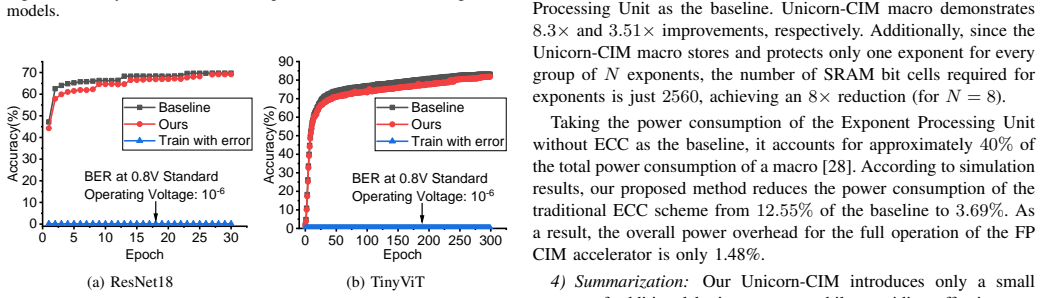
- On-device training, which fails with NaN under $10^{-6}$ BER in the unprotected baseline, converges normally under exponent-aligned fine-tuning with error injection.
- The 256×256-bit array needs only 512 redundant bits under One4N ECC, versus 40,960 bits for full-FP Hamming and 20,480 bits for exponent-and-sign Hamming: 80× and 40× reductions, with exponent SRAM cells cut 8×.
- Choosing N=8 and the 2nd or 3rd largest exponent in each group preserves more than 99% of the retrained baseline accuracy, while N=4 and N=16 degrade it.
- The Hamming code corrects every single-bit error and detects double-bit errors within a protected row; larger error bursts are assumed rare at the operating BER.
Reading between the lines
- My inference: the exponent-dominates-mantissa sensitivity is a property of FP number representation itself, not of CIM, so any FP accelerator whose exponent bits sit in unprotected SRAM should show the same collapse around $10^{-6}$ BER.
- My inference: the fine-tuning that fixes one exponent per block is a constrained exponent quantization; it could be combined with shared-exponent number formats to push N higher without accuracy loss.
- My inference: a natural extension is protecting input activation exponents too; the current scheme safeguards only weight exponent/sign bits, yet a single flipped activation exponent perturbs the alignment of many products.
- My inference: the approach could be tested at FP8, since FP8 has fewer exponent bits and a smaller dynamic range, which may shift the BER threshold at which exponent flips become catastrophic.
Editorial analysis
A structured set of objections, weighed in public.
Referee Report
Summary. The paper introduces Unicorn-CIM, a framework for characterizing and improving the resilience of SRAM-based floating-point compute-in-memory (FP CIM) accelerators. Using fault injection into the stored FP weights of four DNNs, it reports that exponent-field bit errors cause model accuracy to collapse at a bit error rate around 1e-6, while mantissa errors remain benign up to 1e-3. Based on this insight, the paper proposes an algorithm-hardware co-design: fine-tuning that enforces a shared exponent across groups of weights, and a One4N Hamming ECC scheme that protects only the shared exponent and sign bits. Evaluation reports 99% accuracy retention at BER 1e-6 with 8.98% logic overhead and 1.48% power overhead.
Significance. If the results hold, the vulnerability characterization and the lightweight protection scheme are useful contributions to the emerging area of FP CIM reliability. The central finding that exponent bits dominate vulnerability is empirical and does not presuppose the proposed fix, which is a strength. The hardware overhead estimates are concrete, and the ECC mechanism is clearly described. However, the fault model covers only stored weights, the fault-injection protocol is under-specified, and no code or data are provided, which limits reproducibility. The paper would be substantially strengthened by broadening the fault-injection coverage to input activations and intermediate values, and by validating the hyperparameter choice on unseen models.
major comments (3)
- [III-A, III-C2, Eq. (2)] The fault-injection study injects bit flips only into stored FP weights, and the One4N ECC protects only the weight exponent and sign bits read from the ESA array. The same voltage-scaled SRAM conditions that motivate the paper (Fig. 1(a)) also apply to the Input Buffer and DRAM in the architecture of Fig. 1(b); because Eq. (2) shows that mantissa alignment depends on the exponent sums XE,i + WE, a single flipped input exponent XE,i can misalign the mantissa as severely as a weight exponent error, and the proposed ECC does not correct it. The paper's general claim of "robust error protection" for FP CIM is therefore demonstrated only for weight-storage soft errors. I ask the authors to either extend the fault-injection and protection evaluation to input activations and intermediate exponent values, or explicitly restrict the resilience claim to weight-storage errors.
- [III-A, Fig. 6] The fault-injection protocol is under-specified. The paper does not state whether the reported BER is a per-bit probability applied uniformly to all bits in the chosen field, how many bits are flipped per trial, or how static and dynamic injection differ in the number of injected faults. Fig. 6 reports only the mean over 1000 runs for each BER with no error bars of variance, so the central claim that accuracy "degrades to zero at BER 1e-6" cannot be assessed for stability or independently reproduced. Please specify the exact injection distribution and report dispersion or worst-case statistics.
- [III-C, Table I, Fig. 6] The hyperparameters of the co-design, the group size N and the exponent index, are selected by sweeping the same four benchmarks (Table I) that later produce the headline accuracy retention in Fig. 6 with N=8 and index 2 or 3. This makes the reported 99% retention a selected optimum rather than a predictive result for unseen models. Please report the protected accuracy for all (N, index) combinations or use a held-out validation split, and comment on the variability of the accuracy retention across the four models.
minor comments (6)
- [III-A] Please clarify the arithmetic leading to 24,000 experiments; with four models, seven BER points, four injection fields, and 100 runs, the count is 11,200, so the total needs explanation.
- [III-B1] The numerical example first protects 96 bits per row and then protects 208 bits per N=8 block; the relationship between the row-based count and the block-based count should be stated more explicitly to avoid confusion.
- [IV-A, Table I] Please define the evaluation metric for each benchmark (e.g., top-1 accuracy for ResNet18 and TinyViT, mAP for YOLOv5, Dice for nnUNet) and state how the "retrained baseline 1" differs from the original pre-trained model.
- [IV-B3, Fig. 7] Please state explicitly whether the "Ours" training curve includes only the exponent-alignment fine-tuning or also the One4N ECC hardware; the main text says "our exponential alignment fine-tuning method" while the figure caption says "Wi/o ECC protection."
- [Fig. 6] The axis annotation "BER at the standard voltage (0.8V).6 8.82" appears garbled; please correct the labels.
- [V, References] The sentence "We will also explore new fine-tuning schemes (e.g., )" contains an empty example, and reference [28] is a duplicate of reference [8].
Circularity Check
Mild selection-on-test-statistic in the N/index choice; vulnerability and hardware results are otherwise independent.
-
fitted input called prediction
[Section IV-B1 (Table I) and Fig. 6]
"We observe that setting N = 8 offers the best trade-off, preserving over 99% of baseline accuracy (i.e., without exponent alignment). ... Thus, N = 8 with index 2 or 3 ensures optimal quantization performance."
The hyperparameters N and exponent index are selected by scanning the same accuracy-retention metric (Table I) on the same four benchmark models that are then used to report the co-design's success (Fig. 6). The '99% of baseline accuracy' claim is the maximum of that scan, so it is a selected optimum, not an independent prediction of the algorithm's accuracy after exponent alignment. Since no held-out model or dataset is used to validate the chosen N=8/index-2-3 configuration, the headline 'negligible accuracy loss' is partly forced by the selection. This is mild because the vulnerability trend (exponent sensitivity) and the hardware overhead (8.98% logic, 1.48% power) are measured independently of this selection.
full rationale
The vulnerability characterization (Section III-A1) is empirical and self-contained: bit flips are injected into FP weights and accuracy is measured; it does not presuppose the proposed ECC. The One4N ECC is a standard SECDED Hamming code applied to the exponent/sign bits identified as vulnerable, and its overhead (Table III) comes from synthesis, not from the accuracy measurements. The fine-tuning step is explicitly compared with a retrained baseline and reported as an accuracy ratio, so the algorithm contribution has independent content. No load-bearing argument reduces to a self-citation: references [11]-[13] describe FP CIM hardware used as context, not a uniqueness theorem or an unverified premise. The only mild issue is that N=8 and index 2/3 are selected from Table I on the same four models that later provide the '>99% accuracy retention' headline; that number is a selected optimum rather than an out-of-sample prediction. This does not affect the central vulnerability finding or the hardware overhead, so the overall circularity is low.
Assumptions & free parameters
free parameters (2)
- Group size N =
8
- Exponent index in sorted block =
2nd or 3rd largest
assumptions (5)
- standard math FP16 numbers follow IEEE 754 with a hidden leading mantissa bit.
- domain assumption Soft error bit error rate at standard 0.8V SRAM is approximately 1e-6.
- domain assumption Bit flips are independent and uniformly random across weight bits.
- ad hoc to paper Only stored weights are subject to memory soft errors; input buffers and intermediate values are error-free.
- domain assumption Fine-tuning with frozen exponents converges to a solution with negligible accuracy loss.
Cite this review
Pith. "Pith review of Unicorn-CIM: Uncovering the Vulnerability and Improving the Resilience of High-Precision Compute-in-Memory." pith.science (2026). https://pith.science/paper/3DQKRBKZ
@misc{pith2026250602311,
  author       = {Pith},
  title        = {Pith review of: Unicorn-CIM: Uncovering the Vulnerability and Improving the Resilience of High-Precision Compute-in-Memory},
  year         = {2026},
  howpublished = {\url{https://pith.science/paper/3DQKRBKZ}},
  note         = {Machine review of arXiv:2506.02311}
}
read the original abstract
Compute-in-memory (CIM) architecture has been widely explored to address the von Neumann bottleneck in accelerating deep neural networks (DNNs). However, its reliability remains largely understudied, particularly in the emerging domain of floating-point (FP) CIM, which is crucial for speeding up high-precision inference and on device training. This paper introduces Unicorn-CIM, a framework to uncover the vulnerability and improve the resilience of high-precision CIM, built on static random-access memory (SRAM)-based FP CIM architecture. Through the development of fault injection and extensive characterizations across multiple DNNs, Unicorn-CIM reveals how soft errors manifest in FP operations and impact overall model performance. Specifically, we find that high-precision DNNs are extremely sensitive to errors in the exponent part of FP numbers. Building on this insight, Unicorn-CIM develops an efficient algorithm-hardware co-design method that optimizes model exponent distribution through fine-tuning and incorporates a lightweight Error Correcting Code (ECC) scheme to safeguard high-precision DNNs on FP CIM. Comprehensive experiments show that our approach introduces just an 8.98% minimal logic overhead on the exponent processing path while providing robust error protection and maintaining model accuracy. This work paves the way for developing more reliable and efficient CIM hardware.
Figures


Figures from the paper (3 more)


Reference graph
Works this paper leans on
-
[1]
Neuro-inspired computing chips,
W. Zhang, B. Gao, J. Tang, P. Yao, S. Yu, M.-F. Chang, H.-J. Yoo, H. Qian, and H. Wu, “Neuro-inspired computing chips,” Nature Elec- tronics, vol. 3, pp. 371–382, 07 2020
work page 2020
-
[2]
J.-H. Yoon, M. Chang, W.-S. Khwa, Y .-D. Chih, M.-F. Chang, and A. Raychowdhury, “29.1 a 40nm 64kb 56.67tops/w read-disturb-tolerant compute-in-memory/digital rram macro with active-feedback-based read and in-situ write verification,” in 2021 IEEE International Solid-State Circuits Conference (ISSCC) , vol. 64, 2021, pp. 404–406
work page 2021
-
[3]
S. D. Spetalnick, M. Chang, B. Crafton, W.-S. Khwa, Y .-D. Chih, M.-F. Chang, and A. Raychowdhury, “A 40nm 64kb 26.56tops/w 2.37mb/mm2rram binary/compute-in-memory macro with 4.23x im- provement in density and 75% use of sensing dynamic range,” in 2022 IEEE International Solid-State Circuits Conference (ISSCC) , vol. 65, 2022, pp. 1–3
work page 2022
-
[4]
H. Fujiwara, H. Mori, W.-C. Zhao, K. Khare, C.-E. Lee, X. Peng, V . Joshi, C.-K. Chuang, S.-H. Hsu, T. Hashizume, T. Naganuma, C.- H. Tien, Y .-Y . Liu, Y .-C. Lai, C.-F. Lee, T.-L. Chou, K. Akarvardar, S. Adham, Y . Wang, Y .-D. Chih, Y .-H. Chen, H.-J. Liao, and T.- Y . J. Chang, “34.4 a 3nm, 32.5tops/w, 55.0tops/mm2 and 3.78mb/mm2 fully-digital compute...
work page 2024
-
[5]
P.-C. Wu, J.-W. Su, L.-Y . Hong, J.-S. Ren, C.-H. Chien, H.-Y . Chen, C.- E. Ke, H.-M. Hsiao, S.-H. Li, S.-S. Sheu, W.-C. Lo, S.-C. Chang, C.-C. Lo, R.-S. Liu, C.-C. Hsieh, K.-T. Tang, and M.-F. Chang, “A 22nm 832kb hybrid-domain floating-point sram in-memory-compute macro with 16.2-70.2tflops/w for high-accuracy ai-edge devices,” in 2023 IEEE Internation...
work page 2023
-
[6]
W.-S. Khwa, P.-C. Wu, J.-J. Wu, J.-W. Su, H.-Y . Chen, Z.-E. Ke, T.-C. Chiu, J.-M. Hsu, C.-Y . Cheng, Y .-C. Chen, C.-C. Lo, R.-S. Liu, C.-C. Hsieh, K.-T. Tang, and M.-F. Chang, “34.2 a 16nm 96kb integer/floating- point dual-mode-gain-cell-computing-in-memory macro achieving 73.3- 163.3tops/w and 33.2-91.2tflops/w for ai-edge devices,” in 2024 IEEE Intern...
work page 2024
-
[7]
34.8 a 22nm 16mb floating-point reram compute-in-memory macro with 31.2tflops/w for ai edge devices,
T.-H. Wen, H.-H. Hsu, W.-S. Khwa, W.-H. Huang, Z.-E. Ke, Y .-H. Chin, H.-J. Wen, Y .-C. Chang, W.-T. Hsu, C.-C. Lo, R.-S. Liu, C.-C. Hsieh, K.-T. Tang, S.-H. Teng, C.-C. Chou, Y .-D. Chih, T.-Y . J. Chang, and M.- F. Chang, “34.8 a 22nm 16mb floating-point reram compute-in-memory macro with 31.2tflops/w for ai edge devices,” in2024 IEEE International Soli...
work page 2024
-
[9]
Efficient processing of mlperf mobile workloads using digital compute- in-memory macros,
X. Sun, W. Cao, B. Crafton, K. Akarvardar, H. Mori, H. Fujiwara, H. Noguchi, Y .-D. Chih, M.-F. Chang, Y . Wang, and T.-Y . J. Chang, “Efficient processing of mlperf mobile workloads using digital compute- in-memory macros,” IEEE Transactions on Computer-Aided Design of Integrated Circuits and Systems , vol. 43, no. 4, pp. 1191–1205, 2024
work page 2024
Show all 27 references
-
[10]
14.2 a 16nm 216kb, 188.4tops/w and 133.5tflops/w microscaling multi- mode gain-cell cim macro edge-ai devices,
W.-S. Khwa, P.-C. Wu, J.-W. Su, C.-Y . Cheng, J.-M. Hsu, Y .-C. Chen, L.-J. Hsieh, J.-C. Bai, Y .-S. Kao, T.-H. Lou, A. S. Lele, J.-J. Wu, J.-C. Tien, C.-C. Lo, R.-S. Liu, C.-C. Hsieh, K.-T. Tang, and M.-F. Chang, “14.2 a 16nm 216kb, 188.4tops/w and 133.5tflops/w microscaling ...
2025
-
[11]
Addition is most you need: Efficient floating-point sram compute-in-memory by harnessing mantissa addition,
W. Cao, J. Gao, X. Xin, and X. Zhang, “Addition is most you need: Efficient floating-point sram compute-in-memory by harnessing mantissa addition,” in Proceedings of the 61st ACM/IEEE Design Automation Conference, 2024, pp. 1–6
2024
-
[12]
Neural- pim: Efficient processing-in-memory with neural approximation of pe- ripherals,
W. Cao, Y . Zhao, A. Boloor, Y . Han, X. Zhang, and L. Jiang, “Neural- pim: Efficient processing-in-memory with neural approximation of pe- ripherals,” IEEE Transactions on Computers , vol. 71, no. 9, pp. 2142– 2155, 2022
2022
-
[13]
A hybrid-domain floating-point compute- in-memory architecture for efficient acceleration of high-precision deep neural networks,
Z. Yi, Y . Liang, and W. Cao, “A hybrid-domain floating-point compute- in-memory architecture for efficient acceleration of high-precision deep neural networks,” 2025. [Online]. Available: https://arxiv.org/abs/2502. 07212
2025
-
[14]
A 5-nm 254-tops/w 221-tops/mm 2 fully-digital computing-in-memory macro supporting wide-range dynamic-voltage-frequency scaling and simultaneous mac and write operations,
H. Fujiwara, H. Mori, W.-C. Zhao, M.-C. Chuang, R. Naous, C.- K. Chuang, T. Hashizume, D. Sun, C.-F. Lee, K. Akarvardar et al. , “A 5-nm 254-tops/w 221-tops/mm 2 fully-digital computing-in-memory macro supporting wide-range dynamic-voltage-frequency scaling and simultaneous ma...
2022
-
[15]
Design possibilities and challenges of dnn models: a review on the perspective of end devices,
H. Hussain, P. Tamizharasan, and C. Rahul, “Design possibilities and challenges of dnn models: a review on the perspective of end devices,” Artificial Intelligence Review , pp. 1–59, 2022
2022
-
[16]
13.8 a 32kb sram for error-free and error-tolerant applications with dynamic energy-quality management in 28nm cmos,
F. Frustaci, M. Khayatzadeh, D. Blaauw, D. Sylvester, and M. Alioto, “13.8 a 32kb sram for error-free and error-tolerant applications with dynamic energy-quality management in 28nm cmos,” in 2014 IEEE International Solid-State Circuits Conference Digest of Technical Papers (IS...
2014
-
[17]
Etcim: An error-tolerant digital-cim processor with redundancy-free repair and run-time mac and cell error correction,
Y . Wang, Z. He, C. Zhao, Z. Wu, M. Gao, H. Han, S. Wei, Y . Hu, F. Tu, and S. Yin, “Etcim: An error-tolerant digital-cim processor with redundancy-free repair and run-time mac and cell error correction,” in 2024 IEEE Symposium on VLSI Technology and Circuits (VLSI Technology ...
2024
-
[18]
Cim-secded: A 40nm 64kb compute in-memory rram macro with ecc enabling reliable operation,
B. Crafton, S. Spetalnick, J.-H. Yoon, W. Wu, C. Tokunaga, V . De, and A. Raychowdhury, “Cim-secded: A 40nm 64kb compute in-memory rram macro with ecc enabling reliable operation,” in 2021 IEEE Asian Solid-State Circuits Conference (A-SSCC) , 2021, pp. 1–3
2021
-
[19]
Improving compute in-memory ecc relia- bility with successive correction,
B. Crafton, Z. Wan, S. Spetalnick, J.-H. Yoon, W. Wu, C. Tokunaga, V . De, and A. Raychowdhury, “Improving compute in-memory ecc relia- bility with successive correction,” in Proceedings of the 59th ACM/IEEE Design Automation Conference , ser. DAC ’22. New York, NY , USA: Asso...
2022
-
[20]
Pytorchfi: A runtime perturbation tool for dnns,
A. Mahmoud, N. Aggarwal, A. Nobbe, J. R. S. Vicarte, S. V . Adve, C. W. Fletcher, I. Frosio, and S. K. S. Hari, “Pytorchfi: A runtime perturbation tool for dnns,” in 2020 50th Annual IEEE/IFIP International Conference on Dependable Systems and Networks Workshops (DSN-W) , 2020...
2020
-
[21]
Tensorfi: A flexible fault injection framework for tensor- flow applications,
Z. Chen, N. Narayanan, B. Fang, G. Li, K. Pattabiraman, and N. De- Bardeleben, “Tensorfi: A flexible fault injection framework for tensor- flow applications,” 2020. [Online]. Available: https://arxiv.org/abs/2004. 01743
2020
-
[22]
Ares: A framework for quantifying the resilience of deep neural networks,
B. Reagen, U. Gupta, L. Pentecost, P. Whatmough, S. K. Lee, N. Mul- holland, D. Brooks, and G.-Y . Wei, “Ares: A framework for quantifying the resilience of deep neural networks,” in 2018 55th ACM/ESDA/IEEE Design Automation Conference (DAC) , 2018, pp. 1–6
2018
-
[23]
How accurately can soft error impact be estimated in black-box/white- box cases? – a case study with an edge ai soc –,
Q. Cheng, Q. Li, L. Lin, W. Liao, L. Dai, H. Yu, and M. Hashimoto, “How accurately can soft error impact be estimated in black-box/white- box cases? – a case study with an edge ai soc –,” in Proceedings of the 61st ACM/IEEE Design Automation Conference , ser. DAC ’24. New York...
2024
-
[24]
Low-cost concurrent error detection for floating-point unit (fpu) controllers,
M. Maniatakos, P. Kudva, B. M. Fleischer, and Y . Makris, “Low-cost concurrent error detection for floating-point unit (fpu) controllers,” IEEE Transactions on Computers, vol. 62, no. 7, pp. 1376–1388, 2012
2012
-
[25]
When single event upset meets deep neural networks: Observations, explorations, and remedies,
Z. Yan, Y . Shi, W. Liao, M. Hashimoto, X. Zhou, and C. Zhuo, “When single event upset meets deep neural networks: Observations, explorations, and remedies,” in 2020 25th Asia and South Pacific Design Automation Conference (ASP-DAC). IEEE, 2020, pp. 163–168
2020
-
[26]
Mac-ecc: In-situ error correction and its design methodology for reliable nvm-based compute-in-memory inference engine,
W. Li, J. Read, H. Jiang, and S. Yu, “Mac-ecc: In-situ error correction and its design methodology for reliable nvm-based compute-in-memory inference engine,” IEEE Journal on Emerging and Selected Topics in Circuits and Systems , vol. 12, no. 4, pp. 835–845, 2022
2022
-
[27]
What types of ecc should be used on flash memory,
S. Chen, “What types of ecc should be used on flash memory,” Application Note for SPANSION , 2007
2007
-
[28]
F. Tu, Y . Wang, Z. Wu, L. Liang, Y . Ding, B. Kim, L. Liu, S. Wei, Y . Xie, and S. Yin, “A 28nm 29.2tflops/w bf16 and 36.5tops/w int8 re- configurable digital cim processor with unified fp/int pipeline and bitwise in-memory booth multiplication for cloud deep learning acceler...
2022
Reviewed August 7, 2026 · model on record in the stance chip above.
Discussion (0). Sign in to comment.