REVIEW 2 major objections 3 minor 1 cited by
On the heat kernel of a Cayley graph of $\operatorname{PSL}_2\mathbb{Z}$
T0 review · 2 major / 3 minor · reviewed 2026-08-07 · deepseek-v4-flash
Pith's one-line read The heat kernel of the PSL(2,Z) Cayley graph is written explicitly as two exponentials plus two integrals, and the Laplacian spectrum is the union of two intervals and two isolated points.
desk verdict The explicit heat kernel formula is wrong for negative n; the line spectral analysis is solid, but Theorem 1.1 as stated fails. read the letter →
The pith
A machine-rendered reading of the paper's core claim, the machinery that carries it, and where it could break.
The reading
What carries the argument
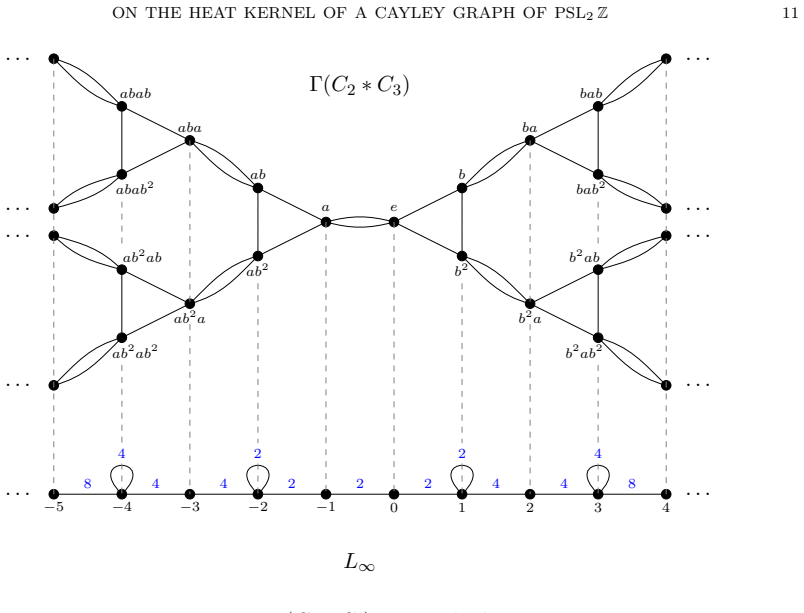
The carrier of the argument is a strong and regular covering of weighted graphs: the Cayley graph $\Gamma$ maps onto a weighted infinite line $L_\infty$ with vertex set $\mathbb{Z}$ and weights $w(2n+1,2n+1)=2^{n+1}$ and $w(2n-1,2n)=w(2n,2n+1)=2^{n+1}$. For strong and regular coverings the heat kernel lifts by a fiber-normalized formula, and here it becomes $k_t(x)=\sqrt{2}^{-\lceil n/2\rceil}h^{\mathrm{pr}}_t(0,n)$ with $n=\pi(x)$. On the line, the projected Laplacian is solved completely: its continuous spectral part is parametrized by $x\in[0,\pi]$ with eigenvalues $\tfrac{7}{8}\pm R_x/2$, and its two discrete eigenvalues $\tfrac{3}{4}$ and $\tfrac{7}{4}$ have explicit eigenfunctions.
What would settle it
Count the reduced words of each length that map to a fixed negative integer under $\pi$; for $n=-2$ the fiber has 2 elements rather than $2^{\lceil -2/2\rceil}=1/2$, so the printed normalization fails unless a separate negative-$n$ identity is supplied. Alternatively, expand $k_t$ for small $t$ on a word starting with $a$ from the graph's finite-neighborhood data and compare with (1.5).
Extended reading notes
Core claim
On the paper's own terms, the discovery is a complete spectral decomposition for the Cayley graph of $C_2*C_3\cong \operatorname{PSL}_2\mathbb{Z}$. The heat kernel is constant on the fibers of the projection $\pi:G\to\mathbb{Z}$ defined by word length and first letter, so $k_t(x)=K_t(\pi(x))$, and $K_t(n)$ is given by two exponential terms coming from the eigenvalues $\tfrac{3}{4}$ and $\tfrac{7}{4}$ plus two integrals over $s\in[0,\pi]$ involving $R_s=\sqrt{25/16+\sqrt{2}\cos s}$. The same decomposition identifies the spectrum of the normalized Laplacian on $\ell^2(G)$ as $[\lambda_0,\tfrac{7}{4}-\lambda_1]\cup\{\tfrac{3}{4}\}\cup[\lambda_1,\tfrac{7}{4}-\lambda_0]\cup\{\tfrac{7}{4}\}$, with $\lambda_0=0.01234\ldots$ and $\lambda_1=1.0675\ldots$, so the bottom of the spectrum is strictly positive.
Load-bearing premise
The lifting step assumes the fiber-size identity $|\pi^{-1}(n)|=2^{\lceil n/2\rceil}$ holds for every integer $n$; the paper prints it without a domain, and for negative $n$ the counts are different, so the normalization of the formula for words beginning with $a$ is not established as written.
Editorial extensions
If this is right
- The continuous-time random walk on $\Gamma$ has transition probabilities directly computable from a one-dimensional integral plus two exponential terms.
- The Laplacian has a spectral gap $\lambda_0\approx 0.01234>0$, which gives exponential decay in $t$ of the heat operator away from the identity at the scale set by $\lambda_0$.
- The isolated eigenvalues $\tfrac{3}{4}$ and $\tfrac{7}{4}$ come with explicit $\ell^2$ eigenfunctions obtained by lifting eigenfunctions of the projected line.
- The spectrum can be compared with the earlier harmonic-analysis spectrum for free products of cyclic groups, matching the shape of two bands plus two atoms.
Reading between the lines
- The same quotient-by-covering strategy could produce explicit heat kernels for other virtually free groups whose Cayley graphs project onto weighted lines with periodic weights, such as free products $C_m*C_n$ with asymmetric generators.
- If the finite-field conjecture holds, the fixed-generator Cayley graphs of $\operatorname{PSL}_2\mathbb{F}_p$ would have spectral gaps bounded below by $\lambda_0$ for all but finitely many $p$, giving a concrete expander statement tied to the infinite graph.
- The explicit spectral measure may allow quantitative return-probability estimates for the simple random walk on the modular group, a testable numerical prediction not developed in the paper.
Editorial analysis
A structured set of objections, weighed in public.
Referee Report
Summary. The paper studies the Cayley graph Γ of G = PSL₂ℤ ≅ C₂ ∗ C₃ with generators a (order 2, realized as a double edge) and b (order 3), together with the normalized Laplacian L defined in (1.2). The main result, Theorem 1.1, claims an explicit formula k_t(x) = K_t(π(x)) for the heat kernel, where π(x) is the signed word length from (1.4). The proof proceeds by viewing Γ as a strong regular covering of a weighted infinite line ℤ, solving the spectral problem for the projected Laplacian L^pr on ℤ (Theorem 5.1), and then lifting the line heat kernel back to Γ via the Chung–Yau transfer formula. Corollary 1.1 identifies the spectrum of L as two intervals together with the isolated points 3/4 and 7/4, with bottom λ₀ ≈ 0.01234, and the paper conjectures that λ₀ bounds the spectral gap of Cayley graphs of PSL₂𝔽ₚ with the same generators, with numerical evidence for small primes.
Significance. If Theorem 1.1 is corrected as indicated below, this is a substantial contribution: it gives an explicit heat kernel and spectrum for an infinite non-tree Cayley graph with torsion, obtained through a self-contained spectral resolution of a weighted line and a rigorous covering transfer argument. The main strengths are the closed-form spectral theorem for L^pr, the parameter-free derivation of the constants λ₀, λ₁, 3/4 and 7/4, and the explicit machine-checkable coefficients in the heat-kernel formula. The conjecture connecting λ₀ to Selberg's 1/4-conjecture is interesting and is supported by computations, even though it remains a conjecture.
major comments (2)
- [Section 5.4, proof of Theorem 1.1] The lifting step uses the identity |π^{-1}(n)| = 2^{⌈n/2⌉}, but this identity is valid only for n ≥ 0. For n < 0 the fiber size is |π^{-1}(n)| = 2^{⌊|n|/2⌋}; for example, π^{-1}(-2) = {ab, ab²} has two elements, while 2^{⌈-2/2⌉} = 1/2. Consequently the formula K_t(n) = √2^{-⌈n/2⌉} h^pr_t(0,n) is wrong on the negative branch. The correct prefactor for n < 0 is √2^{⌈n/2⌉} (the reciprocal of the printed one), and therefore the displayed coefficients α_n, β_n and γ_n^±(s) for n < 0 in (1.5) are also incorrect as printed: they should be multiplied by 2^{⌈n/2⌉}, equivalently the prefactor inside γ_n^± should be √2^{⌈n/2⌉} instead of √2^{-⌈n/2⌉}.
- [Theorem 1.1, n < 0 branch; equation (4.3)] The error is quantitative and falsifies Theorem 1.1 as stated. For x = ab, which has π(ab) = -2, the heat equation (4.3) with L from (1.2) gives k_t(ab) = (1/16)t² + O(t³): the only two-step path from e to ab is e → a → ab, with transition probabilities 1/2 and 1/4, contributing (1/2 · 1/4)/2 = 1/16. On the projected line, (5.3)–(5.4) give L^pr(0,-1) = -1/2 and L^pr(-1,-2) = -1/(2√2), so h^pr_t(0,-2) has t²-coefficient 1/(8√2). The printed prefactor √2 multiplies this to 1/8, which is twice the correct value. Thus formula (1.5) contradicts the defining heat equation for words beginning with a. Since Corollary 1.1 uses Theorem 1.1 as the upper-bound input, that proof is not complete as written; however, the error is local and the corrected prefactor still yields a heat kernel with spectral support in Sp(L^pr), so the spectral conclusion is plausibly recoverable.
minor comments (3)
- [Section 5.3, equation (5.7)] The sewing equation uses ̊check{v}_{-1}, but ̊check{v}_n was defined only for n ≥ 0; the notation should be adjusted, for example by writing f(0) = u₀ directly instead of ̊check{v}_{-1}.
- [Theorem 1.1, displayed formulas] The sentence 'In the formulas with double lines below, the first line corresponds to even n = 2m, and the second line to odd n = 2m + 1' should specify whether m ranges over all integers or only nonnegative integers when n < 0; this matters for the explicit evaluation of sin(ms) for negative m.
- [Title] The title contains a typo, 'HEA T KERNEL' should be 'HEAT KERNEL'.
Circularity Check
No circularity: the heat-kernel formula and spectrum are derived from a solved spectral problem on the covering line, with no fitted parameters and no load-bearing self-citation.
full rationale
The derivation is self-contained. The projected Laplacian Lpr on Z is defined from the explicit weights of the quotient line, and its spectral decomposition is solved directly in Propositions 5.2-5.4 and Theorem 5.1, yielding the eigenvalues λ0, 3/4, λ1, 7/4 and the spectral measure. The lifting from Lpr to the Cayley graph uses Proposition 4.2, which is proved in the paper from the covering relation, together with the fiber-size identity |π^{-1}(n)| = 2^{ceil(n/2)}. No parameter is fitted to any data: λ0 is the computed bottom of the spectrum, not adjusted to the PSL2(Fp) spectra, and the conjecture about finite quotients is explicitly conjectural with numerical evidence for small primes. Citations to the authors' earlier work are contextual, and the needed transfer lemma is proven here rather than imported. The possible issue that the fiber-count identity is stated without specifying n ≥ 0, and is false for n < 0, would be a correctness gap in the negative-n branch of the explicit formula, not a circularity: the formula would still be derived from the spectral solution rather than assumed as an input.
Assumptions & free parameters
assumptions (4)
- standard math Spectral theorem and spectral measures for self-adjoint operators on l^2(Z), including distributional orthogonality of the generalized eigenfunctions via the Poisson summation identities (5.42) and (5.43).
- domain assumption The Cayley graph of PSL2(Z) with presentation <a,b | a^2 = b^3 = 1> is the weighted graph of Fig. 1 with double edges for a, and the map pi of (1.4) is a strong regular covering of the weighted line, constructed from the action of the infinite product of C2's.
- domain assumption The fiber-size formulas alpha_n = beta_n = 2^n for n >= 0, together with the symmetry m -> -m - 1 of the projected Laplacian.
- standard math Completeness of the (generalized) eigenfunction expansion, Proposition 5.4.
Cite this review
Pith. "Pith review of On the heat kernel of a Cayley graph of $\operatorname{PSL}_2\mathbb{Z}$." pith.science (2026). https://pith.science/paper/QCX4EGLV
@misc{pith2026250602340,
  author       = {Pith},
  title        = {Pith review of: On the heat kernel of a Cayley graph of $\operatornamePSL_2\mathbbZ$},
  year         = {2026},
  howpublished = {\url{https://pith.science/paper/QCX4EGLV}},
  note         = {Machine review of arXiv:2506.02340}
}
abstract
In this paper, we obtain an explicit formula for the heat kernel on the Cayley graph of the modular group $PSL_2(Z)$, given by the presentation $\langle a,b\mid a^2=1, b^3=1\rangle$. Our approach extends a method of Chung--Yau by observing that the Cayley graph strongly and regularly covers a weighted infinite line. We solve the spectral problem on this line to obtain an integral expression for its heat kernel, and then lift this to the Cayley graph using spectral transfer principles for strongly regular coverings. The explicit formula allows us to determine the Laplace spectrum, containing eigenvalues and continuous parts. As a by-product, we suggest a conjecture on the lower bound for the spectral gap of Cayley graphs of $\operatorname{PSL}_2\mathbb{F}_p$ with our generators, inspired by the analogy with Selberg's $1/4$-conjecture. Numerical evidence to this conjecture is provided for small primes.
Figures


Figures from the paper (1 more)

Forward citations
Cited by 1 Pith paper
-
Localization of eigenfunctions in amenable unimodular random networks
In amenable unimodular random rooted networks, positive point mass in expected spectral measure implies positive probability of finite-support eigenfunction.
Reference graph
Works this paper leans on
-
[1]
and Gamburd, A., 2008, Uniform expansion bounds for Cayley graphs of SL 2(Fp), Ann
Bourgain, J. and Gamburd, A., 2008, Uniform expansion bounds for Cayley graphs of SL 2(Fp), Ann. of Math. (2), 167 , 625–642
work page 2008
-
[2]
W., 1986, Expanders and diffusers, SIAM J
Buck, M. W., 1986, Expanders and diffusers, SIAM J. Algebraic Discrete Methods, 7 , 282–304
work page 1986
-
[3]
Cartwright, D. I. and Soardi, P. M., 1986, Harmonic analysis on the free product of two cyclic groups, J. Funct. Anal., 65, 147–171
work page 1986
-
[4]
Chinta, G., Jorgenson, J. and Karlsson, A., 2015, Heat kernels on regular graphs and generalized Ihara zeta function formulas, Monatsh. Math., 178 , 171–190
work page 2015
-
[5]
and Yau, S.-T., 1999, Coverings, heat kernels and spanning trees, Electron
Chung, F. and Yau, S.-T., 1999, Coverings, heat kernels and spanning trees, Electron. J. Combin., 6 , Research Paper 12, 21 pp
work page 1999
-
[6]
Cowling, M., Meda, S. and Setti, A. G., 2000, Estimates for functions of the Laplace operator on homo- geneous trees, Trans. Amer. Math. Soc., 352 , 4271–4293
work page 2000
-
[7]
and P´ erez, A., 2022, On spectra and spectral measures of Schreier and Cayley graphs, Int
Grigorchuk, R., Nagnibeda, T. and P´ erez, A., 2022, On spectra and spectral measures of Schreier and Cayley graphs, Int. Math. Res. Not. IMRN, 2022 , 11957–12002
work page 2022
-
[8]
A., 2015, Growth in groups: ideas and perspectives, Bull
Helfgott, H. A., 2015, Growth in groups: ideas and perspectives, Bull. Amer. Math. Soc. (N.S.), 52 , 357–413
work page 2015
Show all 17 references
-
[9]
and Smajlovi´ c, L., 2026, Constructing heat kernels on infinite graphs, Anal
Jorgenson, J., Karlsson, A. and Smajlovi´ c, L., 2026, Constructing heat kernels on infinite graphs, Anal. Appl. (Singap.), 24 , 169–198
2026
-
[10]
Kowalski, E., 2013, Explicit growth and expansion for SL 2, Int. Math. Res. Not. IMRN, 2013, 5645–5708
2013
-
[11]
Birkh¨ auser Class., Birkh¨ auser Verlag, Basel
Lubotzky, A., 2010, Discrete groups, expanding graphs and invariant measures, Mod. Birkh¨ auser Class., Birkh¨ auser Verlag, Basel
2010
-
[12]
R., 2024, Optimal spectral gaps, Institute for Advanced Study, Princeton, lecture, video available at https://www.ias.edu/video/optimal-spectral-gaps
Magee, M. R., 2024, Optimal spectral gaps, Institute for Advanced Study, Princeton, lecture, video available at https://www.ias.edu/video/optimal-spectral-gaps
2024
-
[13]
and Rivin, I., 2010, Simplices and spectra of graphs, Discrete Comput
Mohar, B. and Rivin, I., 2010, Simplices and spectra of graphs, Discrete Comput. Geom., 43 , 516–521
2010
-
[14]
and Sardari, N
Rivin, I. and Sardari, N. T., 2019, Quantum chaos on random Cayley graphs of SL 2[Z/pZ], Exp. Math., 28, 328–341
2019
-
[15]
and Shkredov, I
Rudnev, M. and Shkredov, I. D., 2022, On the growth rate in SL 2(Fp), the affine group and sum-product type implications, Mathematika, 68 , 738–783
2022
-
[16]
Selberg, A., 1965, On the estimation of Fourier coefficients of modular forms, Proc. Sympos. Pure Math., 8, Amer. Math. Soc., Providence, RI, 1–15
1965
-
[17]
Math., Springer-Verlag, Berlin
Serre, J.-P., 2003, Trees, Springer Monogr. Math., Springer-Verlag, Berlin. Section de math ´ematiques, Universit´e de Gen `eve, rue du Conseil-G ´en´eral 7-9, 1205 Gen `eve, Suisse; Matematiska institutionen, Uppsala universitet, Box 256, 751 05, Uppsala, Sweden Email address...
2003
Reviewed August 7, 2026 · model on record in the stance chip above.
Discussion (0). Sign in to comment.