REVIEW 4 major objections 4 minor 77 references
On the fracture mechanics validity of small scale tests
T0 review · 4 major / 4 minor · reviewed 2026-08-07 · deepseek-v4-flash
Pith's one-line read This paper establishes numerical validity maps that fix the maximum $J$-integral ($J_{\max}$) at which an HRR field exists in small-scale fracture specimens, and argues that for low-hardening metals tested in notched cantilever beams the…
desk verdict Useful maps, plausible qualitative conclusion, but the quantitative Jmax threshold is arbitrary and needs sensitivity testing before the maps become a design tool. read the letter →
The pith
A machine-rendered reading of the paper's core claim, the machinery that carries it, and where it could break.
The reading
What carries the argument
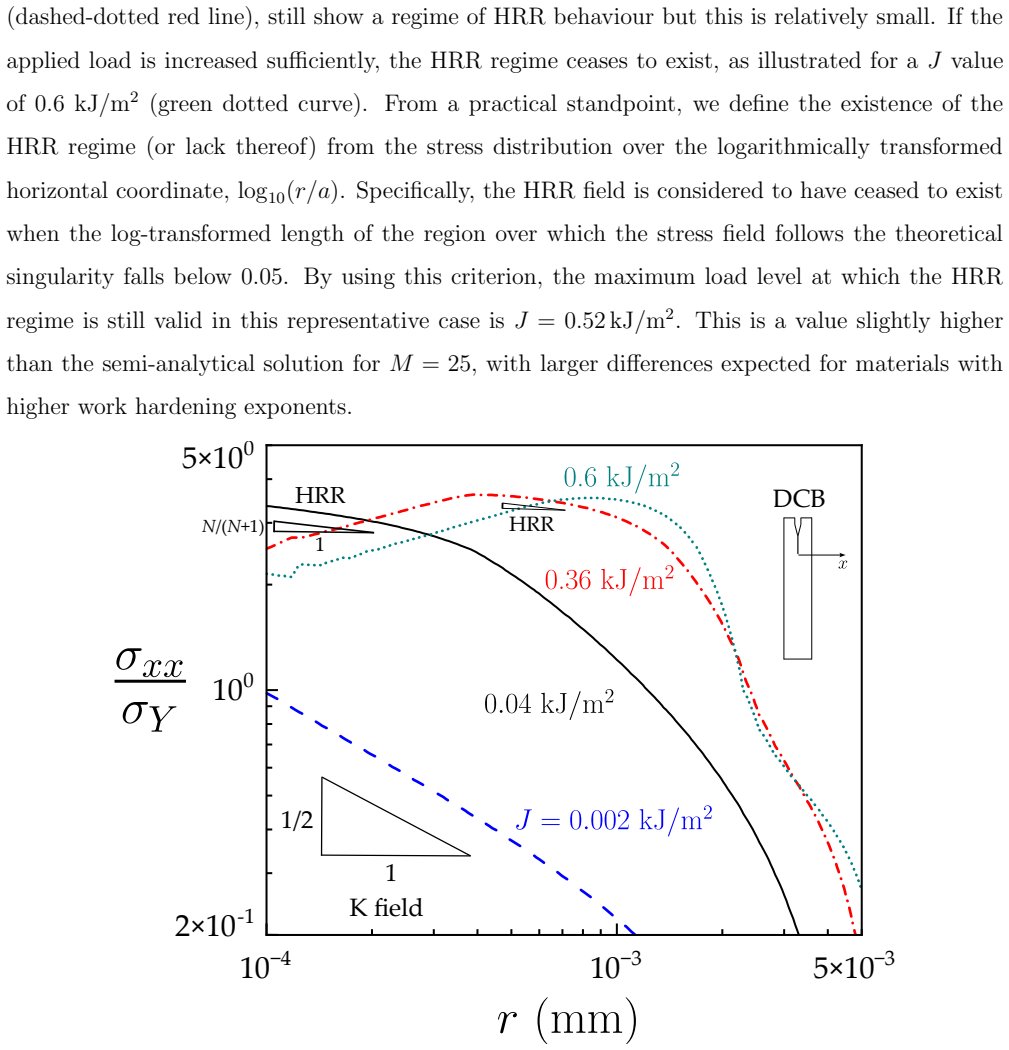
The central object is the HRR singular field, the power-law crack-tip stress distribution of slope $N/(N+1)$ in a log-log plot of opening stress against distance ahead of the crack. The operational criterion is that the HRR field is taken to exist when the region over which the computed stress follows that theoretical slope has a $\log_{10}(r/a)$-length of at least 0.05; the contour-integral $J$ at the load where this region shrinks below the threshold is defined as $J_{\max}$. Applying this threshold to large-strain plane-strain finite element solutions of the two specimen geometries converts J-dominance into a computable number, and the semi-analytical formula $J_{Ic} \leq (a,\, W-a)\,\sigma_Y / M$ provides the comparison baseline for $M = 10$, $25$, and $100$.
What would settle it
Repeat the same double cantilever beam and notched cantilever beam simulations with the HRR-existence threshold set to 0.01 and 0.1 instead of 0.05; if the resulting $J_{\max}$ values cross the $M=25$ or $M=10$ lines for low-hardening materials, the recommendation depends on the arbitrary threshold rather than on material behaviour. A complementary experiment is to machine notched cantilever beams from a low-hardening steel with ligament sizes chosen by $M=25$ and by $M=100$ and check whether the measured toughness is geometry-independent only for the larger samples.
Extended reading notes
Core claim
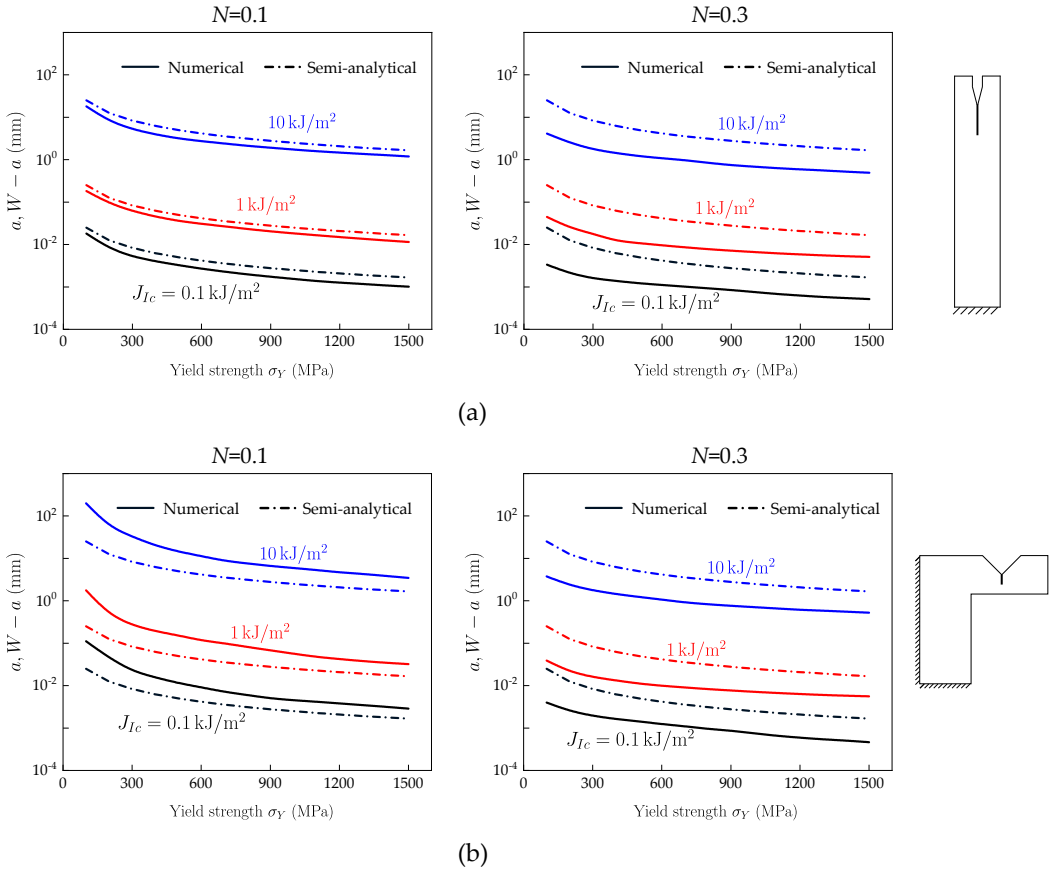
The paper establishes that the maximum $J$-integral at which an HRR field exists, $J_{\max}$, is not captured by a single constant size factor. In plane-strain finite element simulations of two representative micro-scale geometries, $J_{\max}$ scales roughly linearly with yield strength and with crack or ligament size, but it depends strongly on the hardening exponent $N$ and on whether validity is controlled by the crack (double cantilever beam) or by the ligament (notched cantilever beam). For $N=0.1$ the notched cantilever beam loses its HRR field before the semi-analytical $M=25$ prediction, so both $M=25$ and the ASTM E1820 $M=10$ criterion are not conservative for that configuration, while $M=100$ is conservative for both geometries. For $N=0.3$, $M=10$ remains sufficient and the difference between specimen types nearly vanishes. Applied to published experiments, the maps classify some micro-scale tests as valid and others, including tungsten and copper cantilever tests, as falling outside J-validity; applied to hydrogen-embrittled steels, they show size requirements falling by one to two orders of magnitude as $J_{Ic}$ drops.
Load-bearing premise
The load-bearing premise is that the numerical definition of when an HRR field ceases to exist, namely the log-scaled length of the matching stress region falling below 0.05, is a trustworthy proxy for real J-dominance; this threshold is chosen for practical convenience in the paper and is neither derived nor sensitivity-tested, so shifting it would move $J_{\max}$ and could alter the case for $M=100$.
Editorial extensions
If this is right
- For low-hardening materials ($N \approx 0.1$) tested in notched cantilever beams, specimen-size requirements should be based on $M=100$ rather than $M=10$ or $M=25$; using the smaller criteria risks reporting toughness values that depend on specimen geometry rather than being material properties.
- For high-hardening materials ($N \approx 0.3$), the current ASTM E1820 $M=10$ criterion is conservative enough, and the specimen type has little effect on $J_{\max}$.
- The numerical validity maps allow an experimentalist to read the minimum crack or ligament size directly from material properties, replacing a single global $M$ factor with hardening- and geometry-specific values.
- Because hydrogen embrittlement lowers $J_{Ic}$ by factors of 5 to 50 while leaving yield strength nearly unchanged, small-scale tests in hydrogen environments are more likely to satisfy J-validity than tests in air, with minimum required sizes decreasing by one to two orders of magnitude.
Reading between the lines
- Beyond the paper: if the threshold criterion is robust, many published micro-scale fracture toughness values for low-hardening metals obtained with notched cantilever beams and $M=25$ sizing should be treated as suspect upper bounds, since the tests may have fractured outside the HRR-dominated regime.
- Beyond the paper: the same map-building procedure could be run for plane-stress specimens, for additional hardening exponents such as $N=0.05$ or $N=0.2$, and for constitutive models that include damage, which would test whether $M=100$ remains the right margin when a fracture process zone of finite size is present.
- Beyond the paper: the hydrogen analysis suggests a concrete experimental programme: in-situ hydrogen-charged micro-cantilever tests on pipeline steels such as X80 or CrMo4130 should yield geometry-independent toughness values at ligament sizes of tens of microns, whereas identical air tests at those sizes should not.
Editorial analysis
A structured set of objections, weighed in public.
Referee Report
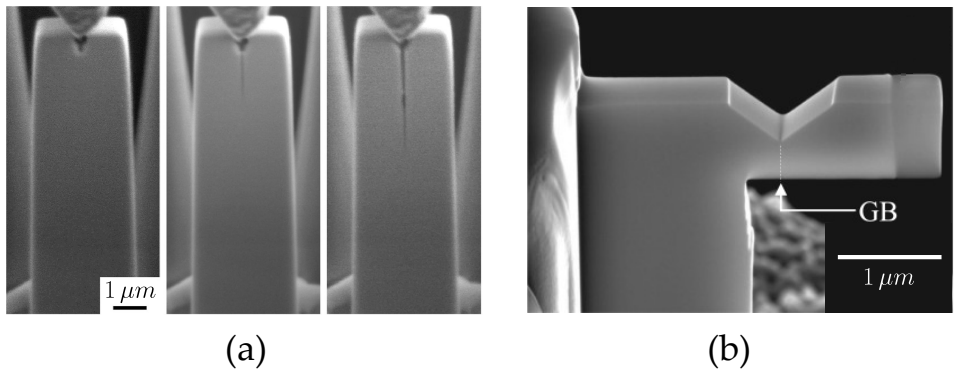
Summary. The paper combines semi-analytical estimates and large-strain finite element calculations to map the maximum J-integral value (Jmax) at which an HRR field is judged to exist ahead of a crack, for double cantilever beam (DCB) and notched cantilever beam specimens. The central claim is that the common size criteria M=25 and, in particular, the ASTM E1820 M=10 are non-conservative for low-hardening notched cantilever tests, and that a more conservative value M=100 should be used in ligament-controlled cases. The authors generate validity maps of Jmax versus yield strength and crack/ligament size for two hardening exponents, apply the maps to re-evaluate published small-scale fracture tests, and superimpose hydrogen-embrittled steels data on the maps to identify conditions under which quantitative micro-scale hydrogen experiments are possible.
Significance. If the quantitative maps are robust, the paper provides a practically useful design tool that goes beyond the simple constant-M size criteria, and the hydrogen-embrittlement application is timely and original. The finite element methodology is standard, the qualitative finding that low-hardening notched cantilever specimens lose J-dominance earlier than DCB specimens is plausible and consistent with earlier work, and the paper gives explicit, falsifiable guidance. The novel quantitative content, however, is currently tied to an unvalidated definition of Jmax and to a small number of material/geometry cases, so the significance is conditional on those limitations being addressed.
major comments (4)
- [Section 4.1] The definition of Jmax rests on an untested criterion: the HRR field is considered to have ceased to exist when the log10(r/a) interval over which the opening stress follows the HRR slope falls below 0.05. This threshold is introduced 'from a practical standpoint' with no derivation, benchmark, or sensitivity analysis, and the tolerance used for 'follows the theoretical singularity' is not specified. Since all validity maps (Fig. 9) and all literature validity calls in Section 4.4 are outputs of this criterion, a modest change in the threshold could shift validity boundaries. For example, the numerical Jmax for the notched cantilever at N=0.1, sigma_Y=900 MPa, a=0.01 mm is 0.18 kJ/m2 versus the semi-analytical 0.36 kJ/m2 with M=25; a factor-of-two shift from a threshold change could move points across the boundary and alter which literature tests are called valid. The M=100 recommendation would be substantially strengthened by reporting Jmax for several threshold values (e.g., 0.02, 0.05, 0.1) and showing that the conclusions are stable.
- [Sections 4.2 and 4.4] The general recommendation that M=100 should replace M=10 for low-hardening, ligament-controlled materials is based on only two hardening exponents (N=0.1 and N=0.3), two controlling sizes (0.01 mm and 1 mm), and fixed specimen aspect ratios (W/H=0.3, L1/H=0.3, L2/H=0.7, and the two a_n/W values given in Section 3). No intermediate hardening exponent such as N=0.05 is tested to confirm that N=0.1 is a conservative lower bound, and no analysis is presented of how W/H or a_n/W variations affect the maps. In addition, the paper does not quantify by how much M=100 overshoots the numerically required value, so the specific recommendation in Section 4.4 is not yet supported as a general criterion even if the qualitative conclusion is correct.
- [Section 4.1] The HRR-existence detection uses only the opening stress component sigma_xx/sigma_Y along theta=0. The HRR field is a multi-axial angular field, and J-dominance can be lost through other stress components or through the angular variation even when sigma_xx follows the expected slope. The criterion as stated should be documented and justified against standard J-dominance checks (e.g., comparison of the full stress tensor with the HRR fields), or at least the authors should demonstrate that the sigma_xx-only criterion is not less restrictive than the full-field check for the geometries considered.
- [Section 4.3, Fig. 9] The validity maps are presented as smooth, quantitative predictions, but they are built from 'over 100 Jmax data points' with no uncertainty or sensitivity information. Because the threshold dependence described in the first comment is inherited directly by every contour in Fig. 9, the absence of any reported sensitivity to the threshold definition makes the quantitative use of the maps uncertain. Reporting the maps with error bars or with contours for alternative thresholds would materially improve their usefulness to experimentalists.
minor comments (4)
- [Section 2.2, Eq. (10)] The notation M(sigma_Y/E, N) in Eq. (10) suggests that M depends on material parameters, but the semi-analytical solutions later use constant values M=10, 25, 100; the notation should be clarified to avoid implying a functional dependence that is not actually used.
- [Table 1] Several rows of Table 1 appear to be missing entries for sigma_Y(C) and JIc(C) (for example, the entries '83 / 49' and '19.5 /' are not aligned with the column headings), and the formatting should be corrected so that each material has complete air and hydrogen data.
- [Section 5] The hydrogen validity map in Fig. 11 uses only N=0.3, justified as giving the smallest size requirements. However, several hydrogen-embrittled low-alloy steels in Table 1 are low-hardening materials, so an N=0.1 map would be more relevant for assessing whether their micromechanical tests are quantitative; this limitation should be stated explicitly where Fig. 11 is discussed.
- [General] There are several typographical and editorial issues: 'priciple' in Section 2.2, 'an/W = 0.5' should likely be 'a_n/W = 0.5', 'agressive' in Section 5, and the degree symbol in Fig. 3 appears as '90。'.
Circularity Check
No circularity found: the Jmax maps and M-value comparisons are genuine numerical outputs, and the 0.05-decade HRR-existence threshold is an unbenchmarked definition but does not reduce the derivation to its inputs.
full rationale
The derivation chain is self-contained and not circular. The semi-analytical size requirement (Eq. 11) is assembled from standard external results: the HRR singularity from Hutchinson/Rice/Rosengren, the CTOD relation and dn from Shih, the finite-strain zone condition R≥3δ from McMeeking and Needleman/Tvergaard, and Shih's R≈0.07(W−a) for bending geometries, yielding the standard M=25 (with M=10 and M=100 taken from ASTM E1820-24). No parameter in this chain is fitted to the FE results; M is fixed before comparison. The numerical Jmax maps are generated by finite-element simulations over yield strengths of 100-1500 MPa, crack/ligament sizes of 0.001-100 mm, and hardening exponents N=0.1 and N=0.3, with Jmax extracted from the length of the region in log(r/a) space where the crack-tip opening stress follows the HRR slope N/(N+1). The comparisons in Figs. 6-10 are therefore genuine comparisons of independent numerical outputs with standard criteria, not fits renamed as predictions. The only definitional element is the 0.05-decade threshold in Section 4.1, which the paper itself labels a 'practical standpoint'; changing that threshold would move the maps. That is an arbitrariness/robustness limitation and a potential correctness risk, but not a circular reduction: the maps do not rely on the quantity they predict, and the M recommendations are not wired in by construction. Self-citations (e.g., Ref. 35) are used for standard energy-balance support and are not load-bearing; no uniqueness theorem is imported from the authors' prior work. Hence no circularity is established and the score is 0.
Assumptions & free parameters
free parameters (2)
- HRR-existence log-length threshold =
0.05
- Specimen geometry ratios =
DCB: L/W=0.25, a/W=0.125, e/L=0.2; cantilever: an/W=0.5 and 0.6, W/H=0.3, L1/H=0.3, L2/H=0.7
assumptions (5)
- domain assumption Plane strain conditions are assumed for both specimen geometries.
- domain assumption The material is homogeneous, isotropic, and described by the power-law hardening relation in Eq. (3).
- ad hoc to paper J-dominance is equivalent to the opening stress ahead of the crack following the HRR slope over a log-distance interval of length at least 0.05.
- domain assumption HRR fields from deformation theory remain the appropriate benchmark for incremental elastic-plastic FE results with finite strains.
- domain assumption The literature data in Table 1 for yield strength and fracture toughness in air and hydrogen are accurate and representative.
Cite this review
Pith. "Pith review of On the fracture mechanics validity of small scale tests." pith.science (2026). https://pith.science/paper/5MCYVPVS
@misc{pith2026250602538,
  author       = {Pith},
  title        = {Pith review of: On the fracture mechanics validity of small scale tests},
  year         = {2026},
  howpublished = {\url{https://pith.science/paper/5MCYVPVS}},
  note         = {Machine review of arXiv:2506.02538}
}
abstract
There is growing interest in conducting small-scale tests to gain additional insight into the fracture behaviour of components across a wide range of materials. For example, micro-scale mechanical tests inside of a microscope (\emph{in situ}) enable direct, high-resolution observation of the interplay between crack growth and microstructural phenomena (e.g., dislocation behaviour or the fracture resistance of a particular interface), and sub-size samples are increasingly used when only a limited amount of material is available. However, to obtain quantitative insight and extract relevant fracture parameters, the sample must be sufficiently large for a $J$- (HRR) or a $K$-field to exist. We conduct numerical and semi-analytical studies to map the conditions (sample geometry, material) that result in a valid, quantitative fracture experiment. Specifically, for a wide range of material properties, crack lengths and sample dimensions, we establish the maximum value of the $J$-integral where an HRR field ceases to exist (i.e., the maximum $J$ value at which fracture must occur for the test to be valid, $J_\mathrm{max}$). Maps are generated to establish the maximum valid $J$ value ($J_\mathrm{max}$) as a function of yield strength, strain hardening and minimum sample size. These maps are then used to discuss the existing experimental literature and provide guidance on how to conduct quantitative experiments. Finally, our study is particularised to the analysis of metals that have been embrittled due to hydrogen exposure. The response of relevant materials under hydrogen-containing environments are superimposed on the aforementioned maps, determining the conditions that will enable quantitative insight.
Figures


Figures from the paper (8 more)




Reference graph
Works this paper leans on
-
[1]
E. Mart ´ ınez-Pa˜ neda, T. E. Garc ´ ıa, C. Rodr ´ ıguez, Fracture toughness characterization through notched small punch test specimens, Materials Science and Engineering: A 657 (2016) 422– 430
work page 2016
-
[2]
Jayaram, Small-Scale Mechanical Testing, Annual Review of Materials Research 52 (2022) 473–523
V. Jayaram, Small-Scale Mechanical Testing, Annual Review of Materials Research 52 (2022) 473–523
work page 2022
-
[3]
Z. S. Patel, L. R. Meza, Toughness amplification via controlled nanostructure in lightweight nano-bouligand materials, Small 19 (50) (2023) 2207779
work page 2023
-
[4]
Z. S. Patel, A. O. Alrashed, K. Dwivedi, M. Salviato, L. R. Meza, Rethinking ductility—a study into the size-affected fracture of additively manufactured polymers, Additive Manufac- turing 84 (2024) 104113
work page 2024
-
[5]
R. Modlinski, R. Puers, I. De Wolf, AlCuMgMn micro-tensile samples: Mechanical character- ization of MEMS materials at micro-scale, Sensors and Actuators A: Physical 143 (1) (2008) 120–128
work page 2008
-
[6]
A. Xiao, H. Pape, B. Wunderle, K. Jansen, J. De Vreugd, L. Ernst, Interfacial fracture properties and failure modeling for microelectronics, in: 2008 58th electronic components and technology conference, IEEE, 2008, pp. 1724–1730
work page 2008
-
[7]
D. Wu, H. Xie, Y. Yin, M. Tang, Micro-scale delaminating and buckling of thin film on soft substrate, Journal of Micromechanics and Microengineering 23 (3) (2013) 035040. 27
work page 2013
-
[8]
G. Sernicola, T. Giovannini, P. Patel, J. R. Kermode, D. S. Balint, T. B. Britton, F. Giuliani, In situ stable crack growth at the micron scale, Nature Communications 8 (1) (2017) 108
work page 2017
Show all 77 references
-
[9]
Gavalda-Diaz, M
O. Gavalda-Diaz, M. Emmanuel, A. Berenov, K. Marquardt, E. Saiz, F. Giuliani, Observing the crack tip behavior at the nanoscale during fracture of ceramics, Proceedings of the National Academy of Sciences 121 (43) (2024) e2408292121
2024
-
[10]
Connolley, P
T. Connolley, P. E. Mchugh, M. Bruzzi, A review of deformation and fatigue of metals at small size scales, Fatigue & Fracture of Engineering Materials & Structures 28 (12) (2005) 1119–1152
2005
-
[11]
Zhang, L
B. Zhang, L. Li, X. Zhang, X. Sun, X. Zhao, Y. Zhang, Z. Zhang, In situ SEM fatigue testing technology for metallic materials: a review, Nanoscale 16 (28) (2024) 13300–13330
2024
-
[12]
Reiser, L
A. Reiser, L. Koch, K. A. Dunn, T. Matsuura, F. Iwata, O. Fogel, Z. Kotler, N. Zhou, K. Charipar, A. Piqu´ e, P. Rohner, D. Poulikakos, S. Lee, S. K. Seol, I. Utke, C. van Nisselroy, T. Zambelli, J. M. Wheeler, R. Spolenak, Metals by Micro-Scale Additive Manufacturing: Compari...
2020
-
[13]
M. H. Shahini, A. Kaveh, B. Zhang, H. Ghadimi, S. Guo, C. Zeng, W. J. Meng, Measuring fatigue crack growth using microscale specimens: Si-modified Inconel 939 alloy processed by laser powder bed fusion additive manufacturing, Materials Science and Engineering: A 913 (2024) 147032
2024
-
[14]
Kaveh, M
A. Kaveh, M. H. Shahini, X. Zhang, W. Xu, P. Z. Firouzabadi, B. Zhang, W. J. Meng, From a notch to a crack: Monitoring crack initiation from a notch through cyclic bending of microscale cantilevers, Materials Science and Engineering: A 931 (2025) 148187
2025
-
[15]
N. V. Malyar, H. Springer, J. Wichert, G. Dehm, C. Kirchlechner, Synthesis and mechanical testing of grain boundaries at the micro and sub-micro scale, Materials Testing 61 (1) (2019) 5–18
2019
-
[16]
Y. Wang, X. Liu, D. J. Murray, F. Teng, W. Jiang, M. Bachhav, L. Hawkins, E. Perez, C. Sun, X. Bai, J. Lian, C. D. Judge, J. H. Jackson, R. G. Carter, L. He, Measurement 28 of grain boundary strength of Inconel X-750 superalloy using in-situ micro-tensile testing techniques in...
2022
-
[17]
H. Chan, S. G. Roberts, J. Gong, Micro-scale fracture experiments on zirconium hydrides and phase boundaries, Journal of Nuclear Materials 475 (2016) 105–112
2016
-
[18]
W. Kang, M. Merrill, J. M. Wheeler, In situ thermomechanical testing methods for micro/nano-scale materials, Nanoscale 9 (8) (2017) 2666–2688
2017
-
[19]
Morris, B
A. Morris, B. Cacciapuoti, W. Sun, The role of small specimen creep testing within a life assessment framework for high temperature power plant, International Materials Reviews 63 (2) (2018) 102–137
2018
-
[20]
Fritz, D
R. Fritz, D. Kiener, Development and application of a heated in-situ SEM micro-testing device, Measurement 110 (2017) 356–366
2017
-
[21]
S. J. Lee, J. M. Park, S. W. Han, S. M. Hyun, J. H. Kim, H. J. Lee, Electromechanical Characterization of Au Thin Films using Micro-tensile Testing, Experimental Mechanics 50 (5) (2010) 643–649
2010
-
[22]
Wang, W.-L
B.-J. Wang, W.-L. Wu, X.-L. Wei, Q. Chen, Mechanical and electromechanical properties of 2D materials studied via in situ microscopy techniques, Nanoscale 17 (4) (2025) 1722–1763
2025
-
[23]
Takahashi, H
Y. Takahashi, H. Kondo, R. Asano, S. Arai, K. Higuchi, Y. Yamamoto, S. Muto, N. Tanaka, Direct evaluation of grain boundary hydrogen embrittlement: A micro-mechanical approach, Materials Science and Engineering: A 661 (2016) 211–216
2016
-
[24]
Y. Deng, T. Hajilou, D. Wan, N. Kheradmand, A. Barnoush, In-situ micro-cantilever bend- ing test in environmental scanning electron microscope: Real time observation of hydrogen enhanced cracking, Scripta Materialia 127 (2017) 19–23
2017
-
[25]
Asadipoor, A
M. Asadipoor, A. Pourkamali Anaraki, J. Kadkhodapour, S. M. H. Sharifi, A. Barnoush, Macro- and microscale investigations of hydrogen embrittlement in X70 pipeline steel by in- situ and ex-situ hydrogen charging tensile tests and in-situ electrochemical micro-cantilever bendin...
2020
-
[26]
P. Tao, W. Zhou, X. Miao, J. Peng, W. Liu, Review of Characterization on Hydrogen Em- brittlement by Micro-Sample Testing Methods, Metals 13 (10) (2023) 1753
2023
-
[27]
Cicero, M
S. Cicero, M. Lambrecht, H. Swan, P. Arffman, E. Altstadt, T. Petit, F. Obermeier, B. Arroyo, J. ´Alvarez, R. Lacalle, Fracture mechanics testing of irradiated rpv steels by means of sub-sized specimens: Fractesus project, Procedia Structural Integrity 28 (2020) 61–66
2020
-
[28]
Y. Madi, L. Santana, S. Belkacemi, V. Farrugia, A. Meddour, P. Marchais, M. Bertin, J. Fur- tado, Mechanical characterization of hydrogen embrittlement in a gaseous environment: An innovative test setup using sub-size specimens, Engineering failure analysis 162 (2024) 108362
2024
-
[29]
S. Wang, O. Gavalda-Diaz, J. Lyons, F. Giuliani, Shear and delamination behaviour of basal planes in Zr3AlC2 MAX phase studied by micromechanical testing, Scripta Materialia 240 (2024) 115829
2024
-
[30]
J. W. Hutchinson, Singular behaviour at the end of a tensile crack in a hardening material, Journal of the Mechanics and Physics of Solids 16 (1) (1968) 13–31
1968
-
[31]
J. R. Rice, G. F. Rosengren, Plane strain deformation near a crack tip in a power-law hardening material, Journal of the Mechanics and Physics of Solids 16 (1) (1968) 1–12
1968
-
[32]
M. B. Djukic, G. M. Bakic, V. Sijacki Zeravcic, A. Sedmak, B. Rajicic, The synergistic action and interplay of hydrogen embrittlement mechanisms in steels and iron: Localized plasticity and decohesion, Engineering Fracture Mechanics 216 (2019) 106528
2019
-
[33]
Y.-S. Chen, C. Huang, P.-Y. Liu, H.-W. Yen, R. Niu, P. Burr, K. L. Moore, E. Mart ´ ınez- Pa˜ neda, A. Atrens, J. M. Cairney, Hydrogen trapping and embrittlement in metals – A review, International Journal of Hydrogen Energy (2024)
2024
-
[34]
C. F. Shih, Relationships between the J -integral and the crack opening displacement for stationary and extending cracks, Journal of the Mechanics and Physics of Solids 29 (4) (1981) 305–326
1981
-
[35]
Mart ´ ınez-Pa˜ neda, N
E. Mart ´ ınez-Pa˜ neda, N. A. Fleck, Mode I crack tip fields: Strain gradient plasticity theory versus J2 flow theory, European Journal of Mechanics-A/Solids 75 (2019) 381–388. 30
2019
-
[36]
J. A. Begley, D. Landes, The J-integral as a fracture criterion, in: Fracture Toughness: Part II—STP 514, American Society for Testing and Materials, Philadelphia, 1972, pp. 1–23
1972
-
[37]
Landes, J
D. Landes, J. A. Begley, The Effect of Specimen Geometry on JIC, in: Fracture Toughness: Part II—STP 514, American Society for Testing and Materials, Philadelphia, 1972, pp. 24–39
1972
-
[38]
X.-K. Zhu, J. A. Joyce, Review of fracture toughness (G, K, J, CTOD, CTOA) testing and standardization, Engineering Fracture Mechanics 85 (2012) 1–46
2012
-
[39]
R. M. McMeeking, Finite deformation analysis of crack-tip opening in elastic-plastic materials and implications for fracture, Journal of the Mechanics and Physics of Solids 25 (5) (1977) 357–381
1977
-
[40]
Needleman, V
A. Needleman, V. Tvergaard, Crack tip stress and deformation fields in a solid with a vertex on its yield surface, in: Inelastic Crack Analysis Vol. I, ASTM STP 803, American Society for Testing and Materials, Philadelphia, 1983, pp. 80–115
1983
-
[41]
C. F. Shih, M. D. German, Requirements for a one parameter characterization of crack tip fields by the HRR singularity, International Journal of Fracture 17 (1) (1981) 27–43
1981
-
[42]
C. F. Shih, J-dominance under plane strain fully plastic conditions: the edge crack panel subject to combined tension and bending, International Journal of Fracture 29 (2) (1985) 73–84
1985
-
[43]
Y. J. Chao, X. Zhu, J-A2 Characterization of Crack-Tip Fields: Extent of J-A2 Dominance and Size Requirements, International Journal of Fracture 89 (3) (1998) 285–307
1998
-
[44]
Anderson, R
T. Anderson, R. Dodds, Jr, Specimen Size Requirements for Fracture Toughness Testing in the Transition Region, Journal of Testing and Evaluation 19 (2) (1991) 123–134
1991
-
[45]
Yoshida, S
T. Yoshida, S. Aoki, K. Kishimoto, M. Sakara, Specimen size requirement for J characteriza- tion under mixed mode loading, JSME international journal. Ser. 1, Solid mechanics, strength of materials 32 (1) (1989) 38–44
1989
-
[46]
Kobayashi, S
T. Kobayashi, S. Morita, H. Toda, Fracture Toughness Evaluation and Specimen Size Effect, Materials Transactions 42 (1) (2001) 52–57. 31
2001
-
[47]
J. W. Hutchinson, Fundamentals of the Phenomenological Theory of Nonlinear Fracture Me- chanics, Journal of Applied Mechanics 50 (4b) (1983) 1042–1051
1983
-
[48]
R. M. McMeeking, D. M. Parks, On Criteria for J-Dominance of Crack-Tip Fields In Large- Scale Yielding, in: Elastic-plastic fracture, ASTM International, 1979, pp. 783–802
1979
-
[49]
Standard test method for JIc , a measure of fracture toughness
ASTM E813-81. Standard test method for JIc , a measure of fracture toughness. American Society for Testing and Materials (1982)
1982
-
[50]
Standard test method for J-integral characterization of fracture toughness
ASTM E1737-96. Standard test method for J-integral characterization of fracture toughness. American Society for Testing and Materials (1996)
1996
-
[51]
Standard test method for measurement of fracture toughness
ASTM E1820-96. Standard test method for measurement of fracture toughness. American Society for Testing and Materials (1996)
1996
-
[52]
Standard test method for measurement of fracture toughness
ASTM E1820-24. Standard test method for measurement of fracture toughness. American Society for Testing and Materials (2024)
2024
-
[53]
Gavalda-Diaz, J
O. Gavalda-Diaz, J. Lyons, S. Wang, M. Emmanuel, K. Marquardt, E. Saiz, F. Giuliani, Basal Plane Delamination Energy Measurement in a Ti3SiC2 MAX Phase, JOM 73 (6) (2021) 1582– 1588
2021
-
[54]
Haghgouyan, C
B. Haghgouyan, C. Hayrettin, T. Baxevanis, I. Karaman, D. C. Lagoudas, Fracture toughness of niti–towards establishing standard test methods for phase transforming materials, Acta Materialia 162 (2019) 226–238
2019
-
[55]
Brown, C
B. Brown, C. Beachem, A study of the stress factor in corrosion cracking by use of the pre- cracked cantilever beam specimen, Corrosion Science 5 (11) (1965) 745–750
1965
-
[56]
B. N. Jaya, C. Kirchlechner, G. Dehm, Can microscale fracture tests provide reliable fracture toughness values? a case study in silicon, Journal of Materials Research 30 (5) (2015) 686–698
2015
-
[57]
B. D. Snartland, C. Thaulow, Fracture toughness testing at the micro-scale- the effect of the unloading compliance method, Engineering Fracture Mechanics 235 (2020) 107135
2020
-
[58]
Bohnert, N
C. Bohnert, N. Schmitt, S. Weygand, O. Kraft, R. Schwaiger, Fracture toughness character- ization of single-crystalline tungsten using notched micro-cantilever specimens, International Journal of Plasticity 81 (2016) 1–17. 32
2016
-
[59]
D. Hu, L. Du, M. Alfreider, J. Fan, D. Kiener, G. Zhang, Microscopic fracture toughness of notched porous sintered cu micro-cantilevers for power electronics packaging, Materials Science and Engineering: A 897 (2024) 146316
2024
-
[60]
W. L. Costin, O. Lavigne, A. Kotousov, R. Ghomashchi, V. Linton, Investigation of hydrogen assisted cracking in acicular ferrite using site-specific micro-fracture tests, Materials Science and Engineering: A 651 (2016) 859–868
2016
-
[61]
F. F. Dear, G. C. G. Skinner, Mechanisms of hydrogen embrittlement in steels: discussion, Philosophical Transactions of the Royal Society A: Mathematical, Physical and Engineering Sciences 375 (2098) (2017) 20170032
2017
-
[62]
Lynch, Discussion of some recent literature on hydrogen-embrittlement mechanisms: ad- dressing common misunderstandings, Corrosion Reviews 37 (5) (2019) 377–395
S. Lynch, Discussion of some recent literature on hydrogen-embrittlement mechanisms: ad- dressing common misunderstandings, Corrosion Reviews 37 (5) (2019) 377–395
2019
-
[63]
Guedes, L
D. Guedes, L. C. Malheiros, A. Oudriss, S. Cohendoz, J. Bouhattate, J. Creus, F. Th´ ebault, M. Piette, X. Feaugas, The role of plasticity and hydrogen flux in the fracture of a tempered martensitic steel: A new design of mechanical test until fracture to separate the influenc...
2020
-
[64]
R. P. Gangloff, Hydrogen-assisted cracking, in: Comprehensive structural integrity vol. 6, Elsevier Science, New York, NY, 2003, pp. 31–101
2003
-
[65]
C. Cui, P. Bortot, M. Ortolani, E. Mart ´ ınez-Pa˜ neda, Computational predictions of hydrogen- assisted fatigue crack growth, International Journal of Hydrogen Energy 72 (2024) 315–325
2024
-
[66]
Cupertino-Malheiros, T
L. Cupertino-Malheiros, T. K. Mandal, F. Th´ ebault, E. Mart ´ ınez-Pa˜ neda, On the suitability of single-edge notch tension (SENT) testing for assessing hydrogen-assisted cracking suscep- tibility, Engineering Failure Analysis 162 (2024) 108360
2024
-
[67]
K. Xu, R. Mahendra, Tensile and fracture properties of carbon and low alloy steels in high pressure hydrogen, ASM International, Wyoming, USA, 2009, pp. 349–356
2009
-
[68]
C. W. San Marchi, B. P. Somerday, Technical reference for hydrogen compatibility of mate- rials., Tech. rep., Sandia National Laboratories (SNL) (2012). 33
2012
-
[69]
Srinivas, G
M. Srinivas, G. Malakondaiah, P. R. Rao, Fracture toughness of f.c.c. nickel and strain ageing b.c.c. iron in the temperature range 77–773 K, Acta Metallurgica et Materialia 41 (4) (1993) 1301–1312
1993
-
[70]
Bechtle, M
S. Bechtle, M. Kumar, B. P. Somerday, M. E. Launey, R. O. Ritchie, Grain-boundary engi- neering markedly reduces susceptibility to intergranular hydrogen embrittlement in metallic materials, Acta Materialia 57 (14) (2009) 4148–4157
2009
-
[71]
D. M. Symons, The effect of hydrogen on the fracture toughness of alloy X-750 at elevated temperatures, Journal of Nuclear Materials 265 (3) (1999) 225–231
1999
-
[72]
Steiner, U
M. Steiner, U. Marewski, H. Silcher, DVGW project SyWeSt H 2: Investigation of steel ma- terials for gas pipelines and plants for assessment of their suitability with hydrogen, Final report, Bonn, Germany (2023)
2023
-
[73]
P. S. Lam, R. L. Sindelar, A. J. Duncan, T. M. Adams, Literature Survey of Gaseous Hydrogen Effects on the Mechanical Properties of Carbon and Low Alloy Steels, Journal of Pressure Vessel Technology 131 (041408) (2009)
2009
-
[74]
Y. Yang, L. Shi, Z. Xu, H. Lu, X. Chen, X. Wang, Fracture toughness of the materials in welded joint of X80 pipeline steel, Engineering Fracture Mechanics 148 (2015) 337–349
2015
-
[75]
´Alvarez, L
G. ´Alvarez, L. B. Peral, C. Rodr ´ ıguez, T. E. Garc ´ ıa, F. J. Belzunce, Hydrogen embrittle- ment of structural steels: Effect of the displacement rate on the fracture toughness of high- pressure hydrogen pre-charged samples, International Journal of Hydrogen Energy 44 (29)...
2019
-
[76]
J. A. Ronevich, E. J. Song, B. P. Somerday, C. W. San Marchi, Hydrogen-assisted fracture resistance of pipeline welds in gaseous hydrogen, International Journal of Hydrogen Energy 46 (10) (2021) 7601–7614
2021
-
[77]
L. B. Peral, A. Zafra, J. Belzunce, C. Rodr ´ ıguez, Effects of hydrogen on the fracture toughness of CrMo and CrMoV steels quenched and tempered at different temperatures, International Journal of Hydrogen Energy 44 (7) (2019) 3953–3965. 34
2019
Reviewed August 7, 2026 · model on record in the stance chip above.
Discussion (0). Sign in to comment.