REVIEW 3 major objections 4 minor 77 references
Impact of convective overshooting on the single-degenerate model of Type Ia supernovae
T0 review · 3 major / 4 minor · reviewed 2026-08-07 · deepseek-v4-flash
Pith's one-line read Convective overshooting changes Type Ia supernova birth rates non-monotonically, and can boost the predicted circumstellar-interaction fraction from 4% to 23%.
desk verdict The qualitative expansion of the parameter space for massive WDs is the solid result; the non-monotonic birth rates rest on a single grid boundary and should be treated as provisional. read the letter →
The pith
A machine-rendered reading of the paper's core claim, the machinery that carries it, and where it could break.
The reading
What carries the argument
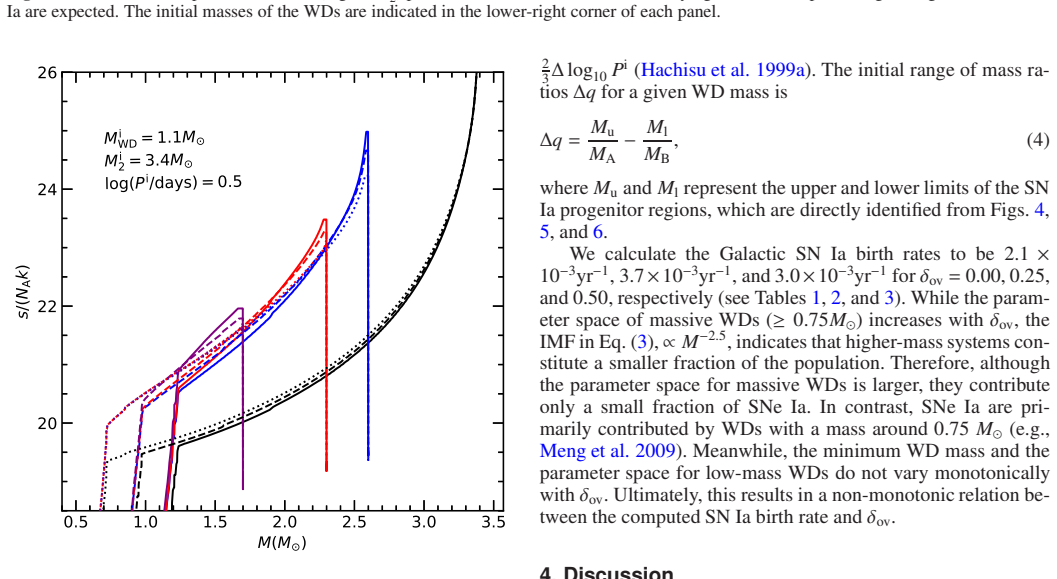
The central object is the common-envelope wind (CEW) model and its critical accretion cap. When the donor's mass-transfer rate $|\dot M_2|$ exceeds the critical rate $\dot M_{\rm cr} = 5.3\times10^{-7}\,(1.7-X)/X\,(M_{\rm WD}-0.4)\,M_\odot\,{\rm yr}^{-1}$, a common envelope forms and the white dwarf is assumed to accrete at exactly $\dot M_{\rm cr}$; otherwise it accretes at $\eta_{\rm He}\eta_{\rm H}|\dot M_2|$. This cap converts any overshooting-driven increase in mass transfer into matter lost from the system, which is why low-mass white dwarfs, needing more accreted mass to reach 1.378 M⊙, can be hurt rather than helped by stronger overshooting. A second piece of machinery is the donor's entropy gradient, which steepens with δov and delays the onset of dynamical instability, thereby raising the critical mass ratio and extending the upper boundary of the parameter space.
What would settle it
Rebuild the same binary grids with the accretion cap removed or replaced by a super-Eddington growth prescription and check whether the minimum white-dwarf mass for δov = 0.50 drops below 0.63 M⊙; observationally, a volume-limited census of SNe Ia-CSM with clean hydrogen-line classification would show whether the 22.89% prediction at high δov is plausible or whether a spin-down delay must intervene.
Extended reading notes
Core claim
On the paper's own terms: convective overshooting, the penetration of convective eddies beyond the Schwarzschild boundary, makes donor stars larger and more mixed at a given age, so systems with massive white dwarfs (≥ 0.75 M⊙) can start Roche-lobe overflow earlier and with more massive companions or longer orbital periods, expanding the parameter space that leads to Type Ia supernovae. But for low-mass white dwarfs the effect is non-monotonic: δov = 0.25 lowers the minimum white dwarf mass to 0.63 M⊙, while δov = 0.50 raises it to 0.675 M⊙, compared with 0.65 M⊙ at δov = 0.00. The reason is the accretion cap in the common-envelope wind model: when the mass-transfer rate exceeds the critical rate, the white dwarf accretes at exactly that critical rate, and any surplus is lost from the system, so more overshooting can actually starve a low-mass white dwarf of the extra mass it needs to reach the Chandrasekhar mass. Consequently the integrated Galactic birth rate, which is dominated by white dwarfs near 0.75 M⊙, peaks at the intermediate overshooting value rather than rising monotonically with δov.
Load-bearing premise
The whole calculation rests on the rule that when mass transfer exceeds the critical rate, the white dwarf accretes at exactly that critical rate and any surplus is lost; if real common-envelope accretion lets the white dwarf gain more mass, the non-monotonic trends could flatten or reverse.
Editorial extensions
If this is right
- The predicted Galactic Type Ia supernova birth rate from the single-degenerate channel is 2.1e-3, 3.7e-3, and 3.0e-3 yr^-1 for δov = 0.00, 0.25, and 0.50, so overshooting alone moves the rate by roughly 75% without any other model change.
- The minimum white dwarf mass that can produce Type Ia supernovae is 0.65, 0.63, and 0.675 M⊙ respectively, so the least-massive white dwarfs are not simply helped by more overshooting.
- Systems that explode during the common-envelope phase with a common-envelope mass above 0.1 M⊙, the candidate SNe Ia-CSM, grow from 4.20% to 8.40% to 22.89% of the predicted SNe Ia as δov goes from 0.00 to 0.25 to 0.50, so overshooting strongly boosts the predicted circumstellar-interacting fraction.
- The upper and right boundaries of the initial donor-mass and orbital-period parameter space expand with δov for white dwarf masses above 0.75 M⊙, enabling more massive companions and longer-period systems to contribute to the Type Ia population.
Reading between the lines
- If δov correlates with stellar mass as some asteroseismic studies suggest, the parameter-space expansion for massive white dwarfs would be stronger still, and the minimum white dwarf mass might drop further, pushing the peak birth rate to higher δov than 0.25.
- The non-monotonic birth rate implies that binary population synthesis studies that fix a single δov could be systematically off not just in overall normalization but in the relative contribution of different white-dwarf mass ranges; a population with a distribution of δov values would likely yield a rate between the extremes, possibly close to the δov = 0.25 value.
- The predicted 22.89% SNe Ia-CSM fraction at δov = 0.50 strongly exceeds the observed fraction of about 0.1% to 1%, so a natural resolution is a spin-down delay between the white dwarf reaching 1.378 M⊙ and the explosion, which would let the common envelope dissipate and remove the hydrogen lines; measuring the delay-time distribution of SNe Ia-CSM would then constrain both overshooting and the spi
- A direct numerical test would be to repeat the same binary grids with an exponential diffusive overshooting prescription or turbulent entrainment instead of the step scheme; if the non-monotonic minimum white-dwarf mass persists across mixing prescriptions, it is a robust feature of the CEW accretion cap rather than an artifact of the overshooting implementation.
Editorial analysis
A structured set of objections, weighed in public.
Referee Report
Summary. The paper uses MESA (r24.08.1) to evolve WD + MS binaries under the common-envelope wind (CEW) model for three convective-overshooting parameters, δ_ov = 0.00, 0.25, and 0.50. It maps the initial (orbital period, donor mass) parameter space that leads to SNe Ia for several initial WD masses, calculates Galactic birth rates via the Iben & Tutukov (1984) integral, and estimates the rates and fractions of SNe Ia-CSM. The main claims are that overshooting expands the upper and right boundaries of the parameter space for massive WDs (≥0.75 M⊙), but that the minimum WD mass and low-mass-WD parameter space, and hence the total birth rate, vary non-monotonically with δ_ov: reported minimum masses are 0.65, 0.63, 0.675 M⊙ and birth rates are 2.1, 3.7, 3.0 × 10^-3 yr^-1 for δ_ov = 0.00, 0.25, 0.50. The SNe Ia-CSM fraction is reported to increase with δ_ov, reaching 22.89% at δ_ov = 0.50.
Significance. If the quantitative results hold, the paper would demonstrate that convective overshooting is a first-order systematic for SD progenitor populations and for predicted SNe Ia-CSM rates, beyond the usual uncertainties in binary population synthesis. The qualitative result that overshooting expands the parameter space for massive WDs is convincingly supported by the MESA tracks and the entropy-gradient explanation in §2.3/Fig. 8 is physically plausible. The paper uses a standard MESA setup, covers multiple δ_ov values, and gives explicit birth-rate tables, which is a strength. However, the headline non-monotonic birth-rate result rests on boundary identifications at a very coarse WD-mass grid, and the reported SNe Ia-CSM fractions are not corrected for the spin-down effect that the authors themselves invoke. These issues make the quantitative conclusions fragile, even though the qualitative trends are likely robust.
major comments (3)
- [Sec. 3, Tables 1–3, Figs. 4–6] The central non-monotonic birth-rate result is not supported at the current grid resolution. The claimed minima M_WD = 0.65, 0.63, 0.675 M⊙ for δ_ov = 0.00, 0.25, 0.50 are separated by only one-to-two initial-WD-mass grid steps (panels at 0.63, 0.65, 0.675, 0.70 in Figs. 4–6), and the contour boundaries are read by eye without any uncertainty estimate. This matters quantitatively: Table 2's first row (0.63–0.7 M⊙) contributes 0.00128 yr^-1, i.e., about 34% of the δ_ov = 0.25 total of 0.0037 yr^-1, because the lower donor-mass boundary M_A = 2.04 M⊙ inflates Δq via Eq. (4). If a one-step shift moved the δ_ov = 0.25 minimum to 0.65 M⊙, that row would contribute at the level of Table 1's first row (0.00027 yr^-1) or Table 3's first row (0.00005 yr^-1); the total would fall below 0.0030 yr^-1 and the birth rate would become monotonic in δ_ov. Since the IMF weighting in Eq. (3) is ∝ M^-2.5, the low-mass boundary is the most sensitive part of the integral. I request additional WD-mass grid points bracketing each minimum (e.g., 0.62, 0.64, 0.66 for δ_ov = 0.25 and 0.66, 0.68 for δ_ov = 0.50), or a conservative range for the birth rates. Until this is done, the abstract's non-monotonic claim should be weakened.
- [Sec. 4.3 and Sec. 3] The SNe Ia-CSM birth rates/fractions are presented as results (6.9 × 10^-4 yr^-1 and 22.89% for δ_ov = 0.50) without applying the spin-down correction that the authors themselves discuss in the same section. The text notes that for a spin-down delay ≳10^5 yr, 'no more than 1.7 in 100 SNe Ia belong to the SN Ia-CSM class' (Meng & Podsiadlowski 2017) and that the observed fraction is 0.1%–1% (Dilday et al. 2012). Reporting 22.89% as a headline result while acknowledging this inconsistency is misleading. Please explicitly label the quoted fractions as upper limits without spin-down delay, and give corrected numbers for at least one representative spin-down timescale; alternatively, restrict the §4.3 discussion to the trend that CE mass, and hence CSM interaction, increases with δ_ov.
- [Sec. 2.1 and Sec. 2.3] The non-monotonic minimum WD mass is a direct consequence of the cap in Eq. (1) (Ṁ_WD = Ṁ_cr during CE) combined with the empirical Ṁ_cr in Eq. (2), as explained in §2.3 ('WD can only accrete material at a rate up to Ṁ_cr... strong wind from the CE surface'). Because the birth-rate ordering hinges on this cap and on the point-mass, immediate-explosion treatment of the WD, a sensitivity test is needed: for the boundary cases (e.g., δ_ov = 0.25 with M_WD = 0.63), vary the normalization of Ṁ_cr by a factor of two, or introduce a spin-up/spin-down delay before explosion, and report whether the non-monotonic ordering survives. Without such a test, the quantitative result is a prediction of the specific CEW prescription rather than a robust outcome of overshooting physics.
minor comments (4)
- [Tables 1–3 notes] The table notes refer to 'Figs. 2, 3, and 4' for the progenitor regions, but the relevant figures are Figs. 4, 5, and 6; this cross-reference should be corrected.
- [Fig. 4–6 captions] Several figure captions and axis labels contain OCR-like typographical corruption (e.g., 'd(namical nstab l ty' and 'log( P i /da(s)'); these should be fixed in the published version.
- [Sec. 2.1] For reproducibility, please provide the relevant MESA controls, at minimum the overshoot scheme and the f0/f values used for the 'step' overshooting prescription, rather than only naming MESA r24.08.1.
- [Eq. (5) in Sec. 4.2] The notation M_i^1 and M_i^2 in Eq. (5) is used without explicit definition; please define these as the initial accretor and donor masses to avoid confusion with the WD mass notation used elsewhere.
Circularity Check
No significant circularity: the convective-overshooting comparison is a new MESA computation, and the reported birth rates are computed outputs, not fitted inputs.
full rationale
The paper's derivation chain is self-contained for the central purpose of comparing convective-overshooting parameters. The parameter-space contours in Figs. 4-7 are produced by direct MESA binary evolution calculations with stated physics inputs (step overshooting, Kolb RLOF, point-mass WD, explosion at 1.378 Msun), not by fitting any target SN Ia rate. The birth-rate integrals in Eq. (3) use Delta-q and Delta-log-a values read from those computed contours, so the resulting rates 2.1e-3, 3.7e-3, and 3.0e-3 yr^-1 are outputs rather than inputs to the calculation. The CEW accretion cap in Eq. (1) and the critical accretion rate in Eq. (2) are model prescriptions cited from prior work, and the self-citations to the CEW model and to the M_CE > 0.1 Msun SNe Ia-CSM criterion are used as physical assumptions rather than as proofs of the paper's conclusions; moreover, the SNe Ia-CSM predictions are explicitly compared with the external Dilday et al. (2012) estimates, including an acknowledged overestimate. No equation reduces to another by construction, and no fitted parameter is renamed as a prediction. The admitted qualitative discussion of q_crit and the rectangular-region overestimate in Eq. (3) are limitations and correctness concerns, not circularity. The non-monotonic trend is a computed consequence of the adopted grid and formula, so it is a model prediction that may be numerically fragile but is not circular.
Assumptions & free parameters
free parameters (7)
- δov =
0.00, 0.25, 0.50
- Mixing length parameter α =
2
- Metallicity Z =
0.02
- Critical accretion rate ˙Mcr formula =
5.3e-7 (1.7-X)/X (MWD-0.4) Msun/yr
- Mass accumulation efficiencies ηH, ηHe =
not stated
- CE-mass threshold for SNe Ia-CSM =
0.1 Msun
- Birth-rate normalization =
0.2 yr^-1
assumptions (6)
- domain assumption The IMF of progenitor masses is ∝ M^-2.5 (Salpeter-like).
- domain assumption The initial binary distribution is uniform in log a and in mass ratio over the bins (implicit in Eq. 3).
- domain assumption The Schwarzschild criterion plus a step overshoot scheme with full mixing efficiency describes convective boundaries.
- domain assumption A WD that reaches 1.378 Msun explodes immediately as a SN Ia.
- domain assumption During CE phases the WD accretes at exactly ˙Mcr and loses all excess material.
- ad hoc to paper A spin-down delay between reaching MCh and explosion can dissipate the CE and reduce the SNe Ia-CSM fraction.
Cite this review
Pith. "Pith review of Impact of convective overshooting on the single-degenerate model of Type Ia supernovae." pith.science (2026). https://pith.science/paper/SPLPCT4W
@misc{pith2026250602551,
  author       = {Pith},
  title        = {Pith review of: Impact of convective overshooting on the single-degenerate model of Type Ia supernovae},
  year         = {2026},
  howpublished = {\url{https://pith.science/paper/SPLPCT4W}},
  note         = {Machine review of arXiv:2506.02551}
}
read the original abstract
The single-degenerate (SD) model is one of the principal models for the progenitors of Type Ia supernovae (SNe Ia). However, it faces some challenges, the primary being its inability to account for the observed SN Ia birth rate. Many studies have attempted to address this issue by expanding the parameter space, defined by the initial donor star mass and orbital period, that can lead to SNe Ia, as well as by improving binary population synthesis. While these efforts have led to significant progress, many uncertainties in stellar physics persist, which influences the outcomes of such studies. Convective overshooting, which can significantly affect the internal structure of a star and subsequently its evolution within a binary system, is one of the most significant sources of uncertainty in stellar physics. We investigate the effect of convective overshooting on the parameter space and birth rate of SNe Ia within the SD model. We employed the common-envelope wind (CEW) model, a new version of the SD model, as our progenitor model. Using MESA, we obtained the parameter space that leads to SNe Ia for three different convective overshooting parameters and calculated the corresponding SN Ia birth rate. Convective overshooting expands the upper boundaries (corresponding to a larger initial donor mass) and right boundaries (corresponding to a longer initial orbital period) of the parameter space for systems with massive white dwarfs (WDs; >= 0.75Msun). However, the minimum WD mass and the parameter space for low-mass WDs - and, consequently, the calculated SN Ia birth rate - vary non-monotonically with convective overshooting parameters. The CEW model may explain the SNe Ia that interact with the circumstellar medium (CSM), i.e., SNe Ia-CSM. We find that the parameter space for SNe Ia-CSM increases with convective overshooting parameters, as does their birth rate.
Figures


Figures from the paper (6 more)



Reference graph
Works this paper leans on
- [1]
-
[2]
Ahlborn, F., Kupka, F., Weiss, A., & Flaskamp, M. 2022, A&A, 6 67, A97
work page 2022
-
[3]
Bond, H. E., Gilliland, R. L., Schaefer, G. H., et al. 2015, Ap J, 813, 106
work page 2015
-
[4]
Cao, Y ., Kulkarni, S. R., Howell, D. A., et al. 2015, Nature, 5 21, 328
work page 2015
- [5]
-
[6]
Chen, X., Han, Z., & Tout, C. A. 2011, ApJ, 735, L31
work page 2011
-
[7]
& Torres, G
Claret, A. & Torres, G. 2016, A&A, 592, A15
2016
-
[8]
Demarque, P ., Sarajedini, A., & Guo, X. J. 1994, ApJ, 426, 165 Di Stefano, R. & Kilic, M. 2012, ApJ, 759, 56 Di Stefano, R., V oss, R., & Claeys, J. S. W. 2011, ApJ, 738, L1
work page 1994
Show all 77 references
-
[9]
A., Cenko, S
Dilday, B., Howell, D. A., Cenko, S. B., et al. 2012, Science, 337, 942
2012
-
[10]
Ganeshalingam, M., Li, W., & Filippenko, A. V . 2011, MNRAS, 416, 2607
2011
-
[11]
& Renzini, A
Greggio, L. & Renzini, A. 1983, A&A, 118, 217
1983
-
[12]
B., Demarque, P ., & Gruberbauer, M
Guenther, D. B., Demarque, P ., & Gruberbauer, M. 2014, ApJ, 7 87, 164
2014
-
[13]
1996, ApJ, 470, L97
Hachisu, I., Kato, M., & Nomoto, K. 1996, ApJ, 470, L97
1996
-
[14]
2008, ApJ, 679, 1390
Hachisu, I., Kato, M., & Nomoto, K. 2008, ApJ, 679, 1390
2008
-
[15]
2012, ApJ, 744, 6 9
Hachisu, I., Kato, M., Saio, H., & Nomoto, K. 2012, ApJ, 744, 6 9
2012
-
[16]
1998, MNRAS, 296, 1019
Han, Z. 1998, MNRAS, 296, 1019
1998
-
[17]
& Podsiadlowski, P
Han, Z. & Podsiadlowski, P . 2004, MNRAS, 350, 1301
2004
-
[18]
2000, A&A, 360, 952
Herwig, F. 2000, A&A, 360, 952
2000
-
[19]
2021, A&A, 646, A133
Higl, J., Müller, E., & Weiss, A. 2021, A&A, 646, A133
2021
-
[20]
Howell, D. A. 2011, Nature Communications, 2, 350
2011
-
[21]
& Fowler, W
Hoyle, F. & Fowler, W. A. 1960, ApJ, 132, 565
1960
-
[22]
& Tutukov, A
Iben, I., J. & Tutukov, A. V . 1984, ApJS, 54, 335
1984
-
[23]
S., Bauer, E
Jermyn, A. S., Bauer, E. B., Schwab, J., et al. 2023, ApJS, 265 , 15
2023
-
[24]
2011, ApJ, 730, L34
Justham, S. 2011, ApJ, 730, L34
2011
-
[25]
& Ritter, H
Kolb, U. & Ritter, H. 1990, A&A, 236, 385
1990
-
[26]
2000, A&A, 362, 1046
Langer, N., Deutschmann, A., Wellstein, S., & Höflich, P . 2000, A&A, 362, 1046
2000
-
[27]
Li, X. D. & van den Heuvel, E. P . J. 1997, A&A, 322, L9
1997
-
[28]
2024, ApJ, 974, 13
Li, Z., Wang, L., Han, Z., & Chen, X. 2024, ApJ, 974, 13
2024
-
[29]
2014, ApJ, 780, 152
Liu, Z., Y ang, W., Bi, S., et al. 2014, ApJ, 780, 152
2014
-
[30]
J., & Stancli ffe, R
Liu, Z.-W., Moriya, T. J., & Stancli ffe, R. J. 2015, MNRAS, 454, 1192
2015
-
[31]
K., & Han, Z
Liu, Z.-W., Röpke, F. K., & Han, Z. 2023, Research in Astronom y and Astro- physics, 23, 082001
2023
-
[32]
& Mermilliod, J
Maeder, A. & Mermilliod, J. C. 1981, A&A, 93, 136
1981
-
[33]
2013, MNRAS, 436 , 222
Maguire, K., Sullivan, M., Patat, F., et al. 2013, MNRAS, 436 , 222
2013
-
[34]
2014, ARA&A, 52, 107
Maoz, D., Mannucci, F., & Nelemans, G. 2014, ARA&A, 52, 107
2014
-
[35]
& Greggio, L
Matteucci, F. & Greggio, L. 1986, A&A, 154, 279
1986
-
[36]
Meakin, C. A. & Arnett, D. 2007, ApJ, 667, 448
2007
-
[37]
2009, MNRAS, 395, 2103
Meng, X., Chen, X., & Han, Z. 2009, MNRAS, 395, 2103
2009
-
[38]
2015, International Journal of Mo dern Physics D, 24, 1530029
Meng, X., Gao, Y ., & Han, Z. 2015, International Journal of Mo dern Physics D, 24, 1530029
2015
-
[39]
& Podsiadlowski, P
Meng, X. & Podsiadlowski, P . 2013, ApJ, 778, L35
2013
-
[40]
& Podsiadlowski, P
Meng, X. & Podsiadlowski, P . 2017, MNRAS, 469, 4763
2017
-
[41]
& Podsiadlowski, P
Meng, X. & Podsiadlowski, P . 2018, ApJ, 861, 127
2018
-
[42]
& Y ang, W
Meng, X. & Y ang, W. 2010, ApJ, 710, 1310
2010
-
[43]
P ., & De Donder, E
Mennekens, N., V anbeveren, D., De Greve, J. P ., & De Donder, E . 2010, A&A, 515, A89 Montalbán, J., Miglio, A., Noels, A., et al. 2013, ApJ, 766, 1 18
2010
-
[44]
R., Portegies Zwart, S
Nelemans, G., Y ungelson, L. R., Portegies Zwart, S. F., & V er bunt, F. 2001, A&A, 365, 491
2001
-
[45]
M., Kromer, M., Taubenberger, S., et al
Noebauer, U. M., Kromer, M., Taubenberger, S., et al. 2017, MNRAS, 472, 2787
2017
-
[46]
K., & Y okoi, K
Nomoto, K., Thielemann, F. K., & Y okoi, K. 1984, ApJ, 286, 644
1984
-
[47]
2011, ApJS, 192, 3
Paxton, B., Bildsten, L., Dotter, A., et al. 2011, ApJS, 192, 3
2011
-
[48]
2013, ApJS, 208, 4
Paxton, B., Cantiello, M., Arras, P ., et al. 2013, ApJS, 208, 4
2013
-
[49]
2015, ApJS, 220, 15
Paxton, B., Marchant, P ., Schwab, J., et al. 2015, ApJS, 220, 15
2015
-
[50]
B., et al
Paxton, B., Schwab, J., Bauer, E. B., et al. 2018, ApJS, 234, 3 4
2018
-
[51]
2019, ApJS, 243, 10
Paxton, B., Smolec, R., Schwab, J., et al. 2019, ApJS, 243, 10
2019
-
[52]
1999, Ap J, 517, 565
Perlmutter, S., Aldering, G., Goldhaber, G., et al. 1999, Ap J, 517, 565
1999
-
[53]
Piersanti, L., Tornambé, A., & Y ungelson, L. R. 2014, MNRAS, 445, 3239
2014
-
[54]
Piro, A. L. & Morozova, V . S. 2016, ApJ, 826, 96
2016
-
[55]
2008, New A Rev., 52, 381
Podsiadlowski, P ., Mazzali, P ., Lesaffre, P ., Han, Z., & Förster, F. 2008, New A Rev., 52, 381
2008
-
[56]
R., Tout, C
Pols, O. R., Tout, C. A., Schroder, K.-P ., Eggleton, P . P ., & M anners, J. 1997, MNRAS, 289, 869
1997
-
[57]
Prather, M. J. & Demarque, P . 1974, ApJ, 193, 109
1974
-
[58]
2000, MNRAS, 318, L55
Ribas, I., Jordi, C., & Giménez, Á. 2000, MNRAS, 318, L55
2000
-
[59]
G., Filippenko, A
Riess, A. G., Filippenko, A. V ., Challis, P ., et al. 1998, AJ, 116, 1009
1998
-
[60]
J., Belczynski, K., Sim, S
Ruiter, A. J., Belczynski, K., Sim, S. A., Seitenzahl, I. R., & Kwiatkowski, D. 2014, MNRAS, 440, L101
2014
-
[61]
Ruiter, A. J. & Seitenzahl, I. R. 2025, A&A Rev., 33, 1
2025
-
[62]
2014, New A Rev., 62, 15
Ruiz-Lapuente, P . 2014, New A Rev., 62, 15
2014
-
[63]
R., & Eggleton, P
Schroder, K.-P ., Pols, O. R., & Eggleton, P . P . 1997, MNRAS, 285, 696
1997
-
[64]
M., Nugent, P
Silverman, J. M., Nugent, P . E., Gal-Y am, A., et al. 2013, ApJS, 207, 3
2013
-
[65]
2019, New A Rev., 87, 101535
Soker, N. 2019, New A Rev., 87, 101535
2019
-
[66]
2012, A&A, 54 6, A70
Toonen, S., Nelemans, G., & Portegies Zwart, S. 2012, A&A, 54 6, A70
2012
-
[67]
2023, ApJ, 944, 204 V allely, P
Uno, K., Nagao, T., Maeda, K., et al. 2023, ApJ, 944, 204 V allely, P . J., Fausnaugh, M., Jha, S. W., et al. 2019, MNRAS,487, 2372
2023
-
[68]
Viani, L. S. & Basu, S. 2020, ApJ, 904, 22
2020
-
[69]
2018, Research in Astronomy and Astrophysics, 18, 0 49
Wang, B. 2018, Research in Astronomy and Astrophysics, 18, 0 49
2018
-
[70]
& Han, Z
Wang, B. & Han, Z. 2012, New A Rev., 56, 122
2012
-
[71]
W., et al
Wang, B., Justham, S., Liu, Z. W., et al. 2014, MNRAS, 445, 234 0
2014
-
[72]
2015, A&A, 584, A37
Wang, B., Li, Y ., Ma, X., et al. 2015, A&A, 584, A37
2015
-
[73]
2009, MNRAS, 395, 847
Wang, B., Meng, X., Chen, X., & Han, Z. 2009, MNRAS, 395, 847
2009
-
[74]
Webbink, R. F. 1984, ApJ, 277, 355
1984
-
[75]
Wheeler, J. C. 2012, ApJ, 758, 123
2012
-
[76]
& Iben, Icko, J
Whelan, J. & Iben, Icko, J. 1973, ApJ, 186, 1007 Y ang, W. 2015, arXiv e-prints, arXiv:1508.00955 Y ang, W. 2016, ApJ, 829, 68 Y ang, W., Tian, Z., Bi, S., et al. 2015, MNRAS, 453, 2094
1973 arXiv
-
[77]
Zhang, Q. S. 2012, ApJ, 761, 153 Article number, page 11
2012
Reviewed August 7, 2026 · model on record in the stance chip above.
Discussion (0). Sign in to comment.