REVIEW 3 major objections 6 minor 50 references
Time path of turbulence and multi-fractality of magnetic field in the evolution of an active region
T0 review · 3 major / 6 minor · reviewed 2026-08-07 · deepseek-v4-flash
Pith's one-line read The photospheric magnetic field's turbulence and multifractality indices in one active region show no abrupt response to an M3.8 flare, staying stable or shifting smoothly over five days and rising only as the region's magnetic morphology…
desk verdict Single-AR case study with a plausible null result on flare timing, but the kappa fixed-window fit needs scrutiny before the multifractality curve is trusted. read the letter →
The pith
A machine-rendered reading of the paper's core claim, the machinery that carries it, and where it could break.
The reading
What carries the argument
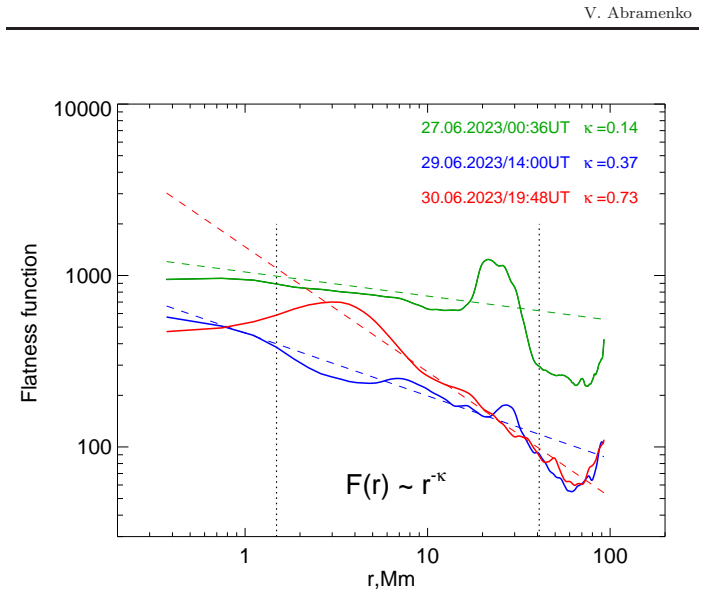
The argument is carried by two scaling laws computed from each magnetogram. The magnetic power spectrum obeys $E(k) \sim k^{-\alpha}$, with $\alpha$ obtained as the slope of a linear fit inside the inertial range of roughly $(2.5$-$10)$ Mm after integrating the squared 2D Fourier transform of the magnetogram in annuli of wavenumber. The flatness function is defined as $F(r) = S_6(r)/(S_2(r))^3 \sim r^{-\kappa}$, where $S_q(r) = \langle |B(x+r)-B(x)|^q \rangle$ is the $q$-th order structure function; a steeper flatness function, larger $\kappa$, indicates stronger multifractality and intermittency. These two slopes, evaluated for every magnetogram, become the time series $\alpha(t)$ and $\kappa(t)$ that are compared with GOES flare times, total unsigned flux, a running flare index $FI$, and the region's morphological class. The $\kappa$ series is fitted over a fixed interval from 1.5 to 40 Mm for all 599 magnetograms to keep the results comparable, although the paper notes that the multifractal scaling range shifts with time.
What would settle it
Recompute $\kappa$ for each magnetogram using that magnetogram's own locally determined scaling interval rather than the fixed 1.5 to 40 Mm window, then check whether the $\kappa$ time series still has no feature at the M3.8 flare onset and still rises only after the $\delta$-structure appears; if a flare-associated jump appears or the smooth rise disappears, the central null result is an artifact of the fixed fitting interval.
Extended reading notes
Core claim
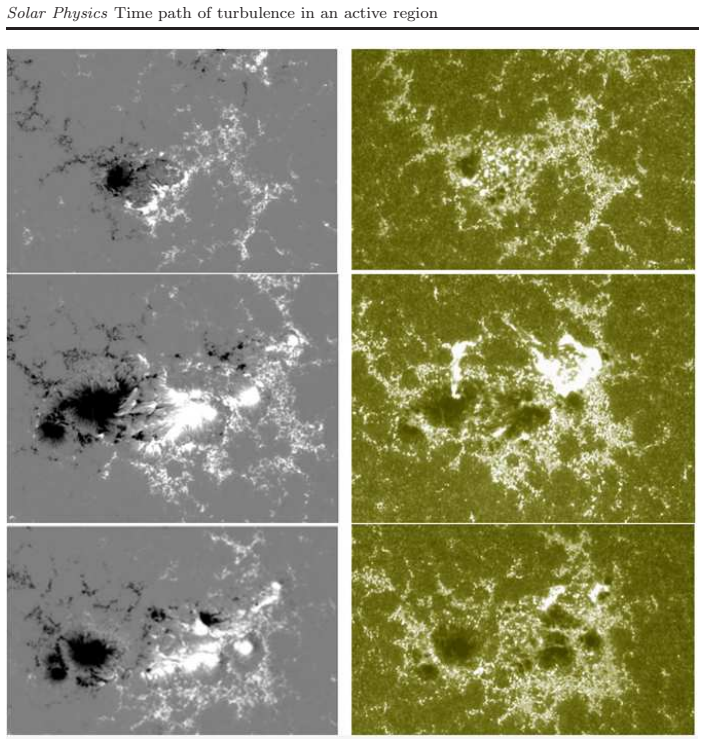
On the paper's own terms, the discovery is a null result with a positive counterpart. Over 599 HMI line-of-sight magnetograms collected from 27 June to 1 July 2023, the magnetic power spectrum index $\alpha$ undulates around the Kolmogorov value $5/3$, roughly between 1.5 and 1.8, and shows no systematic feature at the onset of the M3.8 flare at 14:00 UT on 29 June; the multifractality index $\kappa$ likewise shows no pre-flare or post-flare peculiarity. The only reliable persistent change in both indices occurs about two days before the X1.1 flare, when a $\delta$-structure begins to form and the active region's magneto-morphological class transitions from B2 to B3: $\alpha$ steepens toward 2.0 and $\kappa$ rises to values typical of highly flaring regions. The paper interprets this as evidence that the photospheric magnetic field is in a quasi-stationary, fully developed turbulent state of self-organization, that its complexity is set largely by sub-photospheric flux-tube distortion, and that it does not communicate with the corona on the timescale of individual flares.
Load-bearing premise
The load-bearing premise is that fitting $\kappa$ over the fixed interval from 1.5 to 40 Mm yields a genuine power-law index for every one of the 599 magnetograms, even though the paper itself notes that the multifractal scaling range shifts from roughly 1.5 to 15 Mm during emergence to 4 to 70 Mm later; if the fixed window is not the true power-law range at every time, the smooth $\kappa$ time series and the lack of an M3.8 flare response could be artifacts.
Editorial extensions
If this is right
- The photospheric turbulence state does not act as a flare trigger or an immediate flare response, because an M3.8 flare left no detectable imprint in $\alpha$ or $\kappa$.
- The persistent steepening of $\alpha$ toward 2.0 and the rise of $\kappa$ appear days before the X1.1 flare and coincide with $\delta$-structure emergence and the B2-to-B3 morphological transition, so the indices indicate growing complexity and flaring productivity but not flare onset time.
- The behavior of NOAA 13354 is consistent with prior statistical correlations between $\alpha$, $\kappa$, and the flare index, with this region's total flare index of 35 placing it near the regression line.
- The photosphere appears to be in a state of self-organization without self-organized criticality, evolving quasi-stationarily, while coronal flare energy release follows an intermittent SOC-like regime.
- Morphological and topological measures of an active region may be more useful for assessing flaring capability than the instantaneous turbulence or multifractality scaling indices.
- The result implies that global photospheric turbulence and multifractality indices cannot serve as short-term flare-onset predictors, even if they can indicate when an active region has become a highly productive flaring system.
- The recognition of a fixed structure-function interval as a power-law range is the step that carries the multifractality null result, so a scale-adaptive fitting procedure is the natural next test.
Reading between the lines
- If this single-region result generalizes, flare-prediction efforts should stop seeking pre-flare imprints in globally averaged turbulence or multifractality indices and concentrate on the magneto-morphological state and the free-energy reservoir, which change on day-long timescales.
- The paper's own observation that the multifractal scaling range migrates from small scales, about 1.5 to 15 Mm during emergence, toward larger scales, about 4 to 70 Mm later, suggests the migration itself could be a complexity signal; a scale-resolved analysis of $\kappa$ could test whether the apparent smoothness hides abrupt reorganization at the scales of the emerging $\delta$-spot.
- One active region with one moderate flare inside the monitoring window cannot separate 'the photosphere never reacts to flares' from 'this photosphere did not react to this flare'; applying the same index pipeline to another mature region with a central-meridian M- or X-class flare is the direct next test.
- If the photospheric state is indeed predetermined by the sub-photospheric flux-tube distortion that sets the morphological class, then emergence morphology offers a longer-horizon forecast of flaring productivity than any flare-timing precursor.
Editorial analysis
A structured set of objections, weighed in public.
Referee Report
Summary. The paper analyzes a five-day HMI/SHARP line-of-sight magnetogram sequence of active region NOAA 13354 and computes time series of two scaling diagnostics: the 2D magnetic power-spectrum exponent α (Section 3, Figure 3) and the flatness-function exponent κ characterizing multifractality (Section 4, Figure 5). The reported result is that neither index shows an abrupt change at the M3.8 flare of 29 June 2023; instead, both evolve smoothly, with a persistent rise beginning near the emergence of the δ-structure and the transition to B3 magneto-morphological class. The paper interprets this as evidence that photospheric turbulence and multifractality track the large-scale complexity and flaring productivity of the active region rather than the timing of individual flares, and connects this to a picture in which the photosphere is in a self-organized but not critical state, while the corona is in a SOC state.
Significance. If the null result is robust, the paper makes a useful contribution to the debate on whether turbulence/multifractality indices of photospheric magnetograms are flare-timing diagnostics or only indicators of the active region's overall evolutionary state. Its strengths include a continuous 12-minute-cadence time series (599 magnetograms), explicit use of an established structure-function method (Eq. 3), comparison with earlier case studies, and an attempt to connect the measured indices to an independent morphological classification and a flare-index curve. The result is also falsifiable: the prediction that the indices will not show flare-locked jumps can be tested on other regions. However, the multifractal pillar of the conclusion rests on a fixed fitting interval whose validity is questioned by the paper's own description of a shifting scaling range, and the 'no reaction to the flare' claim lacks statistical testing; the significance of the paper is therefore conditional on a careful robustness analysis.
major comments (3)
- [Section 4, Eq. (3), Figures 4 and 5] The κ time series is computed by fitting the flatness function over the fixed interval Δr = 1.5-40 Mm for all 599 magnetograms, yet the same section states (and Figure 4 shows) that the multifractal scaling range shifts from roughly 1.5-15 Mm during emergence to 4-70 Mm later. If the true power-law domain moves within or outside the fixed window, the fitted slope blends scaling and non-scaling portions of F(r), so the temporal smoothness of κ and its rise near the B3 transition could be fitting artifacts rather than physical changes. Because the central null result, no κ response to the M3.8 flare, is read directly off this curve, this issue is load-bearing. I ask the author to either determine the scaling range per magnetogram and recompute κ accordingly, or demonstrate that the fixed-window result is robust to plausible alternative windows (e.g., 1.5-15 Mm, 4-40 Mm, 4-70 Mm) and to excluding the low- and high-scale endpoints.
- [Section 4, Figure 5] Unlike Figure 3, which shows a 'typical plus-minus triple standard deviation' segment for α, Figure 5 has no error bars and no statistical comparison of κ in the pre-flare, flare, and post-flare epochs. The statement that 'No noticeable changes in κ happened before, during and after the M3.8 flare' is therefore not quantitatively supported. The author should add uncertainty estimates (fit errors, bootstrap, or scatter across sub-samples) and perform a simple test comparing the distributions of κ in windows around the flare, so that the claimed smoothness is distinguishable from the sampling noise of the exponent.
- [Section 5, Concluding remarks] The concluding inference that 'the photosphere, being in the state of self-organization, evolves independently from the highly intermittent, SOC-state corona' goes beyond what a single active region and a single M3.8 flare can establish. The 12-minute cadence and the spatial scales used in the power spectrum and flatness analysis may also miss flare-related changes occurring on shorter timescales or at smaller spatial scales. I recommend that the concluding statement be tempered to a hypothesis or a suggestion for further testing, with explicit acknowledgment of the single-region, single-flare basis of the evidence.
minor comments (6)
- [Abstract and throughout] There are numerous typographical errors that should be corrected before publication, including 'multi-fractalty', 'coaligneg bipols', 'Finaly', and 'of cause'.
- [Section 2, paragraph on flare index] The date '03.06/00:00 UT' in the list of 4-day window centers is inconsistent with the surrounding June-July sequence and should presumably read '03.07/00:00 UT'.
- [Figure 1 caption] The bottom-row date is given as '30 July 2023 (19:48 UT)' but the corresponding magnetogram and text refer to 30 June 2023; please correct the month.
- [Figure 5 caption] The caption says 'Notations are the same as in Figure 3', but the printed figure does not appear to include the ±3σ uncertainty segment that Figure 3 contains; please add the equivalent error estimate or explicitly note its absence.
- [Section 3, inertial-range choice] The statement that the inertial range should be (2.5-10) Mm relies on earlier analyses that 'large sunspots' distort spectra above 10 Mm; since this choice directly affects all α values, a brief quantitative justification or a sensitivity check over a somewhat wider interval would strengthen confidence in the α time series.
- [Section 2, region selection] The active region was deliberately selected because it produced a central-meridian M3.8 flare and later developed a δ-structure; this selection should be stated as a limitation when the paper generalizes from one region to a general property of photospheric magnetic fields.
Circularity Check
No significant circularity: the central alpha/kappa time series are direct measurements from new HMI magnetograms, and the author's self-cited MMC, flare-index, and SOC framing does not mathematically force the observed null result.
full rationale
The paper's primary empirical content is a 5-day time series of the magnetic power-spectrum index alpha and flatness-function index kappa computed directly from SDO/HMI SHARP magnetograms of AR 13354 via independent Fourier and structure-function estimators. The null result—no abrupt pre-/post-flare change around the M3.8 flare—is read off these newly measured series, not produced by fitting a model parameter to that same flare or by an equation that reduces to its inputs. The author's own prior definitions (flare index Eq. 1; MMC classes; SOC interpretation from Abramenko and Suleymanova 2024) are cited for framing and comparison, but they do not enter the calculation of alpha or kappa and therefore cannot force the observed time profiles. The fixed 1.5-40 Mm flatness window noted by the skeptic, while potentially a robustness concern given the paper's own statement that the multifractal scaling range shifts (Section 4, Figure 4), is a methodological validity issue rather than a circularity: a questionable fit range does not make the derived quantity equivalent to an input assumption. No self-citation chain or fitted-parameter renaming carries the central claim, so no circular step is identified.
Assumptions & free parameters
free parameters (3)
- Inertial range for alpha fit =
2.5-10 Mm
- Scaling range for kappa fit =
1.5-40 Mm
- Flux threshold for total unsigned flux =
18 Mx/cm^2
assumptions (5)
- domain assumption Annular-averaged 2D Fourier power spectrum of a LOS magnetogram is a valid turbulence diagnostic for the photospheric magnetic field.
- domain assumption The flatness function F(r) = S6/(S2)^3 with scaling index kappa measures multifractality degree.
- domain assumption MMC classes B1, B2, B3 correspond to increasing sub-photospheric flux-tube distortion and complexity.
- domain assumption The GOES-based flare index FI (Eq. 1) adequately represents flaring productivity of an AR.
- domain assumption The photospheric magnetic field is in a state of self-organization without SOC, based on exponential correlation functions from Abramenko and Suleymanova (2024).
Cite this review
Pith. "Pith review of Time path of turbulence and multi-fractality of magnetic field in the evolution of an active region." pith.science (2026). https://pith.science/paper/2MQHX2YT
@misc{pith2026250602586,
  author       = {Pith},
  title        = {Pith review of: Time path of turbulence and multi-fractality of magnetic field in the evolution of an active region},
  year         = {2026},
  howpublished = {\url{https://pith.science/paper/2MQHX2YT}},
  note         = {Machine review of arXiv:2506.02586}
}
abstract
Magnetograms acquired with the Helioseismic and Magnetic Imager (HMI) on board the Solar Dynamics Observatory (SDO) were used to calculate and analyze time variations of turbulence and multifractality in the photosphere during the development and flaring of a mature active region NOAA 13354 during its passage across the solar disk. Turbulence was explored with 2D magnetic power spectra from magnetograms, and multifractality was analyzed using the structure functions of magnetograms. Time variations of the magnetic power spectrum exponent $\alpha$ and of the multifractalty exponent $\kappa$ demonstrate no pre-flare or post-flare abrupt peculiarities, instead, long periods of stability with smooth transitions into other conditions were observed. A conclusion was inferred that the turbulence and multifractality time path in the photospheric magnetic field does not follow the timing of single flares, however, it tends to correspond to the levels of the magneto-morphological complexity and flaring productivity of an AR. So, in the sense of self-organized criticality (SOC), the photosphere, being in the state of self-organization, evolves independently from the highly intermittent, SOC-state corona.
Figures


Figures from the paper (2 more)

Reference graph
Works this paper leans on
-
[1]
barticle Abbett , W.P. , Fisher , G.H. , Fan , Y. : 2000 , The Three-dimensional Evolution of Rising, Twisted Magnetic Flux Tubes in a Gravitationally Stratified Model Convection Zone . 540 , 548 . https://doi.org/10.1086/309316 . 2000ApJ...540..548A . barticle
-
[2]
: 2005 a, Multifractal Analysis Of Solar Magnetograms
barticle Abramenko , V.I. : 2005 a, Multifractal Analysis Of Solar Magnetograms . 228 , 29 . https://doi.org/10.1007/s11207-005-3525-9 . 2005SoPh..228...29A . barticle
-
[3]
barticle Abramenko , V.I. : 2005 b, Relationship between Magnetic Power Spectrum and Flare Productivity in Solar Active Regions . 629 , 1141 . https://doi.org/10.1086/431732 . 2005ApJ...629.1141A . barticle
-
[4]
barticle Abramenko , V.I. : 2021 , Signature of the turbulent component of the solar dynamo on active region scales and its association with flaring activity . 507 , 3698 . https://doi.org/10.1093/mnras/stab2404 . 2021MNRAS.507.3698A . barticle
-
[5]
barticle Abramenko , V. , Suleymanova , R. : 2024 , Correlation Functions of Photospheric Magnetic Fields in Solar Active Regions . 299 , 31 . https://doi.org/10.1007/s11207-024-02274-2 . 2024SoPh..299...31A . barticle
-
[6]
barticle Abramenko , V. , Yurchyshyn , V. : 2010 a, Intermittency and Multifractality Spectra of the Magnetic Field in Solar Active Regions . 722 , 122 . https://doi.org/10.1088/0004-637X/722/1/122 . 2010ApJ...722..122A . barticle
-
[7]
barticle Abramenko , V. , Yurchyshyn , V. : 2010 b, Magnetic Energy Spectra in Solar Active Regions . 720 , 717 . https://doi.org/10.1088/0004-637X/720/1/717 . 2010ApJ...720..717A . barticle
-
[8]
barticle Abramenko , V. , Yurchyshyn , V. , Wang , H. , Goode , P.R. : 2001 , Magnetic Power Spectra Derived from Ground and Space Measurements of the Solar Magnetic Fields . 201 , 225 . https://doi.org/10.1023/A:1017544723973 . 2001SoPh..201..225A . barticle
Show all 50 references
-
[9]
: 1961 , Observation of a White-Light Flare
barticle Angle , K. : 1961 , Observation of a White-Light Flare . 73 , 227 . https://doi.org/10.1086/127663 . 1961PASP...73..227A . barticle
1961 doi
-
[10]
: 2008 , Magnetic flux emergence in the Sun
barticle Archontis , V. : 2008 , Magnetic flux emergence in the Sun . Journal of Geophysical Research (Space Physics) 113 , A03S04 . https://doi.org/10.1029/2007JA012422 . 2008JGRA..113.3S04A . barticle
2008 doi
-
[11]
, Crosby , N.B
barticle Aschwanden , M.J. , Crosby , N.B. , Dimitropoulou , M. , Georgoulis , M.K. , Hergarten , S. , McAteer , J. , Milovanov , A.V. , Mineshige , S. , Morales , L. , Nishizuka , N. , Pruessner , G. , Sanchez , R. , Sharma , A.S. , Strugarek , A. , Uritsky , V. : 2016 , 25 Y...
2016 doi
-
[12]
, Scholkmann , F
barticle Aschwanden , M.J. , Scholkmann , F. , B \'e thune , W. , Schmutz , W. , Abramenko , V. , Cheung , M.C.M. , M \"u ller , D. , Benz , A. , Chernov , G. , Kritsuk , A.G. , Scargle , J.D. , Melatos , A. , Wagoner , R.V. , Trimble , V. , Green , W.H. : 2018 , Order out of ...
2018 doi
-
[13]
, Shukla , P.K
barticle Bingham , R. , Shukla , P.K. , Eliasson , B. , Stenflo , L. : 2010 , Solar coronal heating by plasma waves . Journal of Plasma Physics 76 , 135 . https://doi.org/10.1017/S0022377809990031 . 2010JPlPh..76..135B . barticle
2010 doi
-
[14]
, Sun , X
barticle Bobra , M.G. , Sun , X. , Hoeksema , J.T. , Turmon , M. , Liu , Y. , Hayashi , K. , Barnes , G. , Leka , K.D. : 2014 , The Helioseismic and Magnetic Imager (HMI) Vector Magnetic Field Pipeline: SHARPs - Space-Weather HMI Active Region Patches . 289 , 3549 . https://do...
2014 doi
-
[15]
, Mart \' nez-Oliveros , J.C
barticle Burtseva , O. , Mart \' nez-Oliveros , J.C. , Petrie , G.J.D. , Pevtsov , A.A. : 2015 , Hard X-Ray Emission During Flares and Photospheric Field Changes . 806 , 173 . https://doi.org/10.1088/0004-637X/806/2/173 . 2015ApJ...806..173B . barticle
2015 doi
-
[16]
, Liu , C
barticle Chen , W.-Z. , Liu , C. , Song , H. , Deng , N. , Tan , C.-Y. , Wang , H.-M. : 2007 , A Statistical Study of Rapid Sunspot Structure Change Associated with Flares . 7 , 733 . https://doi.org/10.1088/1009-9271/7/5/14 . 2007ChJAA...7..733C . barticle
2007 doi
-
[17]
, McAteer , R.T.J
barticle Conlon , P.A. , McAteer , R.T.J. , Gallagher , P.T. , Fennell , L. : 2010 , Quantifying the Evolving Magnetic Structure of Active Regions . 722 , 577 . https://doi.org/10.1088/0004-637X/722/1/577 . 2010ApJ...722..577C . barticle
2010 doi
-
[18]
, Paizis , C
barticle Cortellessa , P. , Paizis , C. : 1975 , White Light Flares: Protons or Electrons? 42 , 421 . https://doi.org/10.1007/BF00149922 . 1975SoPh...42..421C . barticle
1975 doi
-
[19]
, Georgoulis , M
barticle Dimitropoulou , M. , Georgoulis , M. , Isliker , H. , Vlahos , L. , Anastasiadis , A. , Strintzi , D. , Moussas , X. : 2009 , The correlation of fractal structures in the photospheric and the coronal magnetic field . 505 , 1245 . https://doi.org/10.1051/0004-6361/2009...
2009 doi
-
[20]
: 2011 , Seismic Transients from Flares in Solar Cycle 23
barticle Donea , A. : 2011 , Seismic Transients from Flares in Solar Cycle 23 . 158 , 451 . https://doi.org/10.1007/s11214-011-9787-7 . 2011SSRv..158..451D . barticle
2011 doi
-
[21]
: 2009 , Magnetic Fields in the Solar Convection Zone
barticle Fan , Y. : 2009 , Magnetic Fields in the Solar Convection Zone . Living Reviews in Solar Physics 6 , 4 . https://doi.org/10.12942/lrsp-2009-4 . 2009LRSP....6....4F . barticle
2009 doi
-
[22]
, Manchester , W
barticle Fang , F. , Manchester , W. , Abbett , W.P. , van der Holst , B. : 2010 , Simulation of Flux Emergence from the Convection Zone to the Corona . 714 , 1649 . https://doi.org/10.1088/0004-637X/714/2/1649 . 2010ApJ...714.1649F . barticle
2010 doi
-
[23]
, Manchester , W
barticle Fang , F. , Manchester , W. IV , Abbett , W.P. , van der Holst , B. : 2012 , Buildup of Magnetic Shear and Free Energy during Flux Emergence and Cancellation . 754 , 15 . https://doi.org/10.1088/0004-637X/754/1/15 . 2012ApJ...754...15F . barticle
2012 doi
-
[24]
: 1995 , Turbulence
bbook Frisch , U. : 1995 , Turbulence. The legacy of A.N. Kolmogorov . https://doi.org/10.1017/CBO9781139170666 . 1995tlan.book.....F . bbook
1995 doi
-
[25]
, Kutsenko , A.S
barticle Fursyak , Y.A. , Kutsenko , A.S. , Abramenko , V.I. : 2020 , Distributed Electric Currents in Solar Active Regions . 295 , 19 . https://doi.org/10.1007/s11207-020-1584-6 . 2020SoPh..295...19F . barticle
2020 doi
-
[26]
, H \'e noux , J.C
barticle Gan , W.Q. , H \'e noux , J.C. , Fang , C. : 2000 , On the origin of solar white-light flares . 354 , 691 . 2000A&A...354..691G . barticle
2000
-
[27]
: 2012 , Are Solar Active Regions with Major Flares More Fractal, Multifractal, or Turbulent Than Others? 276 , 161
barticle Georgoulis , M.K. : 2012 , Are Solar Active Regions with Major Flares More Fractal, Multifractal, or Turbulent Than Others? 276 , 161 . https://doi.org/10.1007/s11207-010-9705-2 . 2012SoPh..276..161G . barticle
2012 doi
-
[28]
, Gallagher , P.T
barticle Hewett , R.J. , Gallagher , P.T. , McAteer , R.T.J. , Young , C.A. , Ireland , J. , Conlon , P.A. , Maguire , K. : 2008 , Multiscale Analysis of Active Region Evolution . 248 , 311 . https://doi.org/10.1007/s11207-007-9028-0 . 2008SoPh..248..311H . barticle
2008 doi
-
[29]
: 1972 , Thick-Target Processes and White-Light Flares
barticle Hudson , H.S. : 1972 , Thick-Target Processes and White-Light Flares . 24 , 414 . https://doi.org/10.1007/BF00153384 . 1972SoPh...24..414H . barticle
1972 doi
-
[30]
: 2016 , Chasing White-Light Flares
barticle Hudson , H.S. : 2016 , Chasing White-Light Flares . 291 , 1273 . https://doi.org/10.1007/s11207-016-0904-3 . 2016SoPh..291.1273H . barticle
2016 doi
-
[31]
, Kleint , L
barticle Judge , P.G. , Kleint , L. , Donea , A. , Sainz Dalda , A. , Fletcher , L. : 2014 , On the Origin of a Sunquake during the 2014 March 29 X1 Flare . 796 , 85 . https://doi.org/10.1088/0004-637X/796/2/85 . 2014ApJ...796...85J . barticle
2014 doi
-
[32]
, Lee , H
barticle Karimov , K. , Lee , H. , Jeong , H.-J. , Moon , Y.-J. , Kang , J. , Son , J. , Jeon , M. , Kusano , K. : 2024 , 3D Magnetic Free Energy and Flaring Activity Using 83 Major Solar Flares . 965 , L5 . https://doi.org/10.3847/2041-8213/ad3548 . 2024ApJ...965L...5K . barticle
2024 doi
-
[33]
: 1941 , The Local Structure of Turbulence in Incompressible Viscous Fluid for Very Large Reynolds' Numbers
barticle Kolmogorov , A. : 1941 , The Local Structure of Turbulence in Incompressible Viscous Fluid for Very Large Reynolds' Numbers . Akademiia Nauk SSSR Doklady 30 , 301 . 1941DoSSR..30..301K . barticle
1941
-
[34]
, Abramenko , V.I
barticle Kutsenko , A.S. , Abramenko , V.I. , Kutsenko , O.K. : 2021 , On the possibility of probing the flare productivity of an active region in the early stage of emergence . 501 , 6076 . https://doi.org/10.1093/mnras/staa3548 . 2021MNRAS.501.6076K . barticle
2021 doi
-
[35]
, Title , A.M
barticle Lemen , J.R. , Title , A.M. , Akin , D.J. , Boerner , P.F. , Chou , C. , Drake , J.F. , Duncan , D.W. , Edwards , C.G. , Friedlaender , F.M. , Heyman , G.F. , Hurlburt , N.E. , Katz , N.L. , Kushner , G.D. , Levay , M. , Lindgren , R.W. , Mathur , D.P. , McFeaters , E...
2012
-
[36]
, Hoeksema , J.T
barticle Liu , Y. , Hoeksema , J.T. , Scherrer , P.H. , Schou , J. , Couvidat , S. , Bush , R.I. , Duvall , T.L. , Hayashi , K. , Sun , X. , Zhao , X. : 2012 , Comparison of Line-of-Sight Magnetograms Taken by the Solar Dynamics Observatory/Helioseismic and Magnetic Imager and...
2012 doi
-
[37]
, Gallagher , P.T
barticle McAteer , R.T.J. , Gallagher , P.T. , Conlon , P.A. : 2010 , Turbulence, complexity, and solar flares . Advances in Space Research 45 , 1067 . https://doi.org/10.1016/j.asr.2009.08.026 . 2010AdSpR..45.1067M . barticle
2010 doi
-
[38]
, Aschwanden , M.J
barticle McAteer , R.T.J. , Aschwanden , M.J. , Dimitropoulou , M. , Georgoulis , M.K. , Pruessner , G. , Morales , L. , Ireland , J. , Abramenko , V. : 2016 , 25 Years of Self-organized Criticality: Numerical Detection Methods . 198 , 217 . https://doi.org/10.1007/s11214-015-...
2016 doi
-
[39]
: 2010 , Acceleration and Heating of Solar Wind Ions by Nonlinear Waves
bchapter Ofman , L. : 2010 , Acceleration and Heating of Solar Wind Ions by Nonlinear Waves . In: Duldig , M. (ed.) Advances in Geosciences, Volume 21: Solar Terrestrial (ST) 21 , 1 . https://doi.org/10.1142/9789812838209_0001 . 2010aogs...21....1O . bchapter
2010 doi
-
[40]
: 1984 , Solar magneto-hydrodynamics
bbook Priest , E.R. : 1984 , Solar magneto-hydrodynamics . 1984smh..book.....P . bbook
1984
-
[41]
, Mooney , M.K
barticle Russell , A.J.B. , Mooney , M.K. , Leake , J.E. , Hudson , H.S. : 2016 , Sunquake Generation by Coronal Magnetic Restructuring . 831 , 42 . https://doi.org/10.3847/0004-637X/831/1/42 . 2016ApJ...831...42R . barticle
2016 doi
-
[42]
, Schou , J
barticle Scherrer , P.H. , Schou , J. , Bush , R.I. , Kosovichev , A.G. , Bogart , R.S. , Hoeksema , J.T. , Liu , Y. , Duvall , T.L. , Zhao , J. , Title , A.M. , Schrijver , C.J. , Tarbell , T.D. , Tomczyk , S. : 2012 , The Helioseismic and Magnetic Imager (HMI) Investigation ...
2012 doi
-
[43]
, Scherrer , P.H
barticle Schou , J. , Scherrer , P.H. , Bush , R.I. , Wachter , R. , Couvidat , S. , Rabello-Soares , M.C. , Bogart , R.S. , Hoeksema , J.T. , Liu , Y. , Duvall , T.L. , Akin , D.J. , Allard , B.A. , Miles , J.W. , Rairden , R. , Shine , R.A. , Tarbell , T.D. , Title , A.M. , ...
2012
-
[44]
: 2009 , Driving major solar flares and eruptions: A review
barticle Schrijver , C.J. : 2009 , Driving major solar flares and eruptions: A review . Advances in Space Research 43 , 739 . https://doi.org/10.1016/j.asr.2008.11.004 . 2009AdSpR..43..739S . barticle
2009 doi
-
[45]
, Green , L.M
barticle van Driel-Gesztelyi , L. , Green , L.M. : 2015 , Evolution of Active Regions . Living Reviews in Solar Physics 12 , 1 . https://doi.org/10.1007/lrsp-2015-1 . 2015LRSP...12....1V . barticle
2015 doi
-
[46]
: 2016 , Storing free magnetic energy in the solar corona
barticle Vekstein , G. : 2016 , Storing free magnetic energy in the solar corona . Journal of Plasma Physics 82 , 925820401 . https://doi.org/10.1017/S0022377816000726 . 2016JPlPh..82d9201V . barticle
2016 doi
-
[47]
, Grappin , R
barticle Verdini , A. , Grappin , R. , Velli , M. : 2012 , Coronal heating in coupled photosphere-chromosphere-coronal systems: turbulence and leakage . 538 , A70 . https://doi.org/10.1051/0004-6361/201118046 . 2012A&A...538A..70V . barticle
2012 doi
-
[48]
, Georgoulis , M.K
barticle Vlahos , L. , Georgoulis , M.K. : 2004 , On the Self-Similarity of Unstable Magnetic Discontinuities in Solar Active Regions . 603 , L61 . https://doi.org/10.1086/383032 . 2004ApJ...603L..61V . barticle
2004 doi
-
[49]
, Liu , C
barticle Wang , H. , Liu , C. , Jing , J. , Yurchyshyn , V. : 2007 , Successive Flaring during the 2005 September 13 Eruption . 671 , 973 . https://doi.org/10.1086/522911 . 2007ApJ...671..973W . barticle
2007 doi
-
[50]
, Pruessner , G
barticle Watkins , N.W. , Pruessner , G. , Chapman , S.C. , Crosby , N.B. , Jensen , H.J. : 2016 , 25 Years of Self-organized Criticality: Concepts and Controversies . 198 , 3 . https://doi.org/10.1007/s11214-015-0155-x . 2016SSRv..198....3W . barticle
2016 doi
Reviewed August 7, 2026 · model on record in the stance chip above.
Discussion (0). Sign in to comment.