REVIEW 4 major objections 4 minor 36 references
Numerical methods for fully nonlinear degenerate diffusions
T0 review · 4 major / 4 minor · reviewed 2026-08-07 · deepseek-v4-flash
Pith's one-line read The paper constructs finite-difference schemes for degenerate fully nonlinear diffusion equations, including a free transmission variant, and proves they converge to viscosity solutions by smoothing the gradient degeneracy factor.
desk verdict The central scheme solves the wrong equation — the positive denominator cancels out of G_h = 0, so the convergence claims for (1) and (2) do not follow. read the letter →
The pith
A machine-rendered reading of the paper's core claim, the machinery that carries it, and where it could break.
The reading
What carries the argument
The load-bearing object is the regularization of the degeneracy factor. For the pure equation it replaces $|Du|^\theta F(D^2u)=f$ by $(\varepsilon + |Du^\varepsilon|^2)^{\theta/2}(\varepsilon u^\varepsilon + F(D^2u^\varepsilon))=f$, so that in the discrete scheme the gradient term sits in a positive denominator and no longer threatens monotonicity when multiplied by $F(D^2u)$. For the transmission problem the exponent itself is smoothed: $\theta_\varepsilon(\cdot)$ equals $\theta_1$ below $-\varepsilon$, $\theta_2$ above $\varepsilon$, and interpolates monotonically and smoothly in between, which lets the same denominator idea work even though the degeneracy rate depends on the solution. Around this sit three supporting mechanisms: an upwind one-sided discretization of $|Du|^2$ that preserves monotonicity, a minimax representation of $F$ with diagonally dominant matrices that permits a monotone discretization of the Hessian, and global sub- and super-solutions that serve as mesh-independent barriers, giving stability and, in the transmission case, forcing $\theta_\varepsilon$ to the endpoint values.
What would settle it
Run the scheme (16) on data for which the original transmission problem (2) is known to have two distinct viscosity solutions, taking $\varepsilon=h$ in one run and $\varepsilon=h^2$ in another: if the computed limits differ, then the $\varepsilon\to 0$ step is selecting rather than approximating, so Theorem 3's convergence claim cannot hold without the uniqueness assumption. Alternatively, exhibit two different viscosity solutions of the regularized problem (5) itself, which would directly falsify the hypothesis on which Theorem 3 rests.
Extended reading notes
Core claim
On the paper's own terms, the central claim is that the schemes (4) and (6) converge. For the pure equation, the method $G_h(u_h,x)=0$ in (8) is shown to be monotone, consistent with the regularized problem (3), and stable through global discrete barriers that do not depend on the mesh size; Theorem 2 then concludes that $u_h^\varepsilon \to u$ locally uniformly as $\varepsilon,h\to 0$, where $u$ is a viscosity solution of (1). For the transmission problem, the scheme (16) is likewise monotone, consistent with (5), and stable, with the nondecreasing smoothed exponent $\theta_\varepsilon$ forced to its endpoint values $\theta_1,\theta_2$ by specially constructed barriers. Theorem 3 concludes convergence to a viscosity solution of (2), conditional on the regularized problem (5) having a unique viscosity solution; Remark 2 notes that uniqueness for the original problems is not established and that the $\varepsilon\to 0$ limits select particular solutions. The discrete equations are solved by an explicit iteration whose contraction property requires a mesh-dependent stability condition of the form $\rho \ll h^{-2}$, and one-dimensional tests with $\varepsilon=h$ reproduce known exact solutions to about $10^{-2}$ accuracy.
Load-bearing premise
For the free transmission result, the paper assumes without proof that the smoothed problem (5) has exactly one viscosity solution, and Remark 2 concedes that uniqueness for the original problems (1) and (2) is open; if uniqueness fails, the stated convergence of the scheme collapses to convergence only along subsequences.
Editorial extensions
If this is right
- For the pure equation (1), the scheme (8) gives a computable approximation that converges locally uniformly to the viscosity solution as $\varepsilon,h\to 0$, so gradient-degenerate fully nonlinear problems of this type can be solved by standard fixed-point iteration.
- For the transmission problem, whenever the regularized problem (5) has a unique viscosity solution, the scheme (16) converges to a viscosity solution of the free transmission problem (2); without such uniqueness it still produces subsequential limits, each solving (2).
- The discrete barriers are uniform in $h$ and may depend on $\varepsilon$, so the stability argument remains available even when $F$ is not uniformly elliptic; only monotonicity and consistency need the ellipticity and control structure.
- The regularization strategy extends to broader classes of non-variational problems whose natural product discretizations fail to be monotone, including divergence-form relatives such as the $p$-Laplace and porous medium equations.
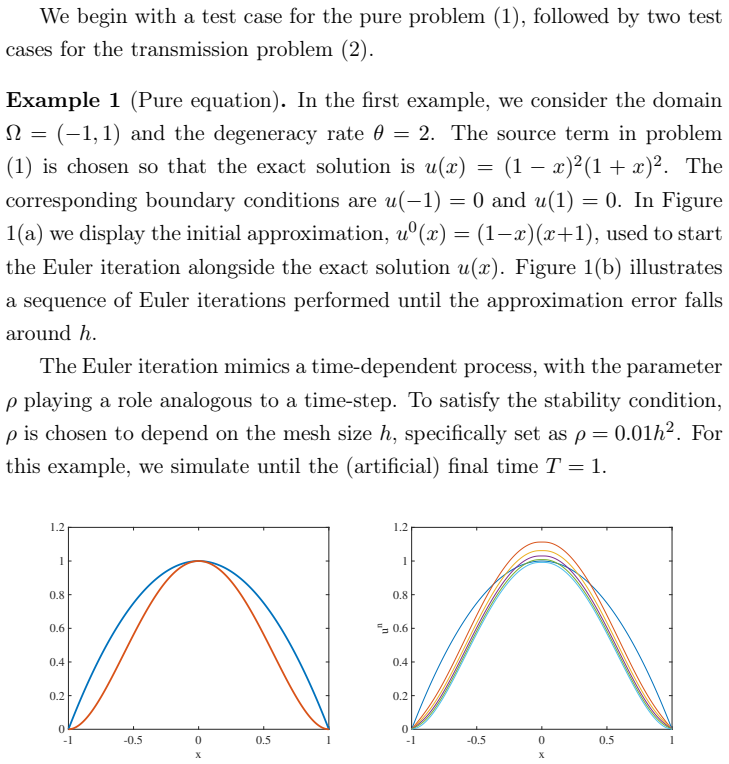
- In the reported one-dimensional experiments with $\varepsilon=h$, the explicit iteration reproduces smooth exact solutions of both (1) and (2) with maximum errors between $4\times 10^{-3}$ and $1.3\times 10^{-2}$, including a case where the gradient vanishes at the interface.
Reading between the lines
- A natural conjecture the paper does not pursue is that the observed experimental accuracy reflects an overall error of order $h+\varepsilon$ or better; one could test this by comparing runs with $\varepsilon=h$, $\varepsilon=h^2$, and $\varepsilon=\sqrt{h}$ on the same exact solutions.
- If the original transmission problem (2) has multiple viscosity solutions, the double limit of (16) along different $\varepsilon$-$h$ paths may select different solutions; this suggests using the smoothing path as an explicit selection rule and testing whether the selected solutions satisfy additional transmission conditions at $\{u=0\}$.
- The monotone-denominator regularization could be transplanted to finite-volume or finite-element settings for divergence-form degenerate equations, where monotonicity is harder to preserve; a first step would be writing the $p$-Laplace equation in the same product form and checking whether the $\varepsilon$-division restores a comparison principle.
- The stability bound in Theorem 3 degrades like $\varepsilon^{-1}$, so in practice one expects a trade-off between resolving the transition layer near $\{u=0\}$ and keeping the bound meaningful; an adaptive choice of $\varepsilon$ near the interface might improve accuracy without sacrificing convergence.
Editorial analysis
A structured set of objections, weighed in public.
Referee Report
Summary. The paper proposes finite difference schemes for the degenerate fully nonlinear elliptic problem (1) and for a two-phase free transmission problem (2). The strategy is to regularize the degeneracy, solve the regularized problem numerically, and then let the regularization parameter tend to zero. The main results, Theorems 2 and 3, claim that the proposed schemes are monotone, consistent, and stable, and hence converge, via the Barles--Souganidis theory, to viscosity solutions of (1) and (2). The paper also reports one-dimensional numerical experiments. The central construction, however, contains an algebraic mismatch: the schemes in (4), (8), and (16) divide by a positive denominator, which does not alter the zero set of the residual, so the schemes actually solve εu_h + F(D_h^2 u_h) = f rather than the stated regularized equations (3) and (5). As a consequence, the claimed convergence to the degenerate problems (1) and (2) is not established.
Significance. If the results were correct, the paper would supply the first convergent finite difference scheme for the degenerate free transmission problem (2) and a template for a broader class of non-variational problems. The paper also identifies a genuine technical difficulty, namely the loss of monotonicity when multiplying monotone discretizations of the gradient and Hessian terms, and it attempts to address it through a regularization that decouples the degeneracy. However, the central algebraic defect affects both main theorems, so the significance of the contribution cannot be assessed from the present manuscript. The numerical experiments do not compensate for this because the scheme being simulated is not the scheme that would approximate the stated PDEs.
major comments (4)
- [§4, Eq. (8) and Proposition 7] The scheme in (8) is G_h(u_h,x) = [εu_h + F(D_h^2 u_h) - f(x)] / (ε + |D_h u_h|^2)^{θ/2}. Since the denominator is bounded below by ε^{θ/2} > 0, the equation G_h = 0 is algebraically equivalent to εu_h + F(D_h^2 u_h) - f = 0. The gradient term therefore cancels completely, and the scheme is independent of |D_h u_h|. The consistency target G in (13) has exactly the same zero set, so Proposition 7 verifies consistency with εu + F(D^2u) = f, not with the regularized equation (3), which is (ε + |Du|^2)^{θ/2}(εu + F(D^2u)) = f. Sending ε → 0, the scheme converges to F(D^2u) = f, not to |Du|^θ F(D^2u) = f unless f ≡ 0. The same defect appears in (6) and (16): the exponent θ_ε(u_h) in the denominator does not alter the zero set. Thus Theorems 2 and 3 do not establish convergence to (1) or (2).
- [§4, Proposition 5] The proof of monotonicity contains an invalid inequality. From the facts that F(D_h^2 v_h) ≤ F(D_h^2 u_h), so the numerator for v_h is no larger than the numerator for u_h, and that |D_h v_h|^2 ≤ |D_h u_h|^2, so the denominator for v_h is no larger than the denominator for u_h, it does not follow that A/D(u_h) ≥ B/D(v_h) for A ≥ B and D(u_h) ≥ D(v_h). A simple numerical counterexample (A=10, B=9, D(u_h)=100, D(v_h)=1) shows the claimed inequality is false. Consequently the monotonicity of the scheme (8), which is a load-bearing hypothesis in the Barles--Souganidis convergence argument, is not established. The same gap appears in Proposition 10 for the transmission scheme (16).
- [§5, Theorem 3 and Remark 2] Theorem 3 is conditional on the existence of a unique viscosity solution to the regularized transmission problem (5), but this uniqueness is neither proved nor referenced. Remark 2 concedes that uniqueness for the original problems (1) and (2) has not been established. Without uniqueness of (5), the Barles--Souganidis argument yields only subsequential convergence as h → 0, and the further limit ε → 0 can only be taken along subsequences. The abstract and the introduction state the convergence as unconditional, which overstates what the proof can deliver even after the algebraic defect in the scheme is repaired.
- [§6, Examples 1–3] The numerical experiments compare the computed solution u_h with the exact solution u of the original problems (1) and (2), but the scheme actually implemented is the one in Section 6, whose residual is divided by the positive denominator and therefore solves εu_h + F(D_h^2 u_h) = f_i, not the regularized equations (3) or (5). The source term f is not specified explicitly in the examples, so the reported errors do not validate convergence to the original degenerate problems; they at best show that a nearby nondegenerate problem has a solution close to the chosen ansatz.
minor comments (4)
- [§4, proof of Proposition 9] In the display after (15), the scheme is written with a minus sign: εw - F(D_h^2 w) - f, whereas the scheme in (8) is εw + F(D_h^2 w) - f. This sign error obscures the comparison argument and should be corrected.
- [§4, Proposition 8] For the barrier w(x) = C_2 - (C_1/(2λd))\|x-x_0\|^2, the Hessian is -(C_1/(λd))I, not -C_1 I as written. This is presumably a scaling issue, but as stated the constant does not match the displayed formula.
- [§1, Remark 3] Remark 3 states that the homogeneous case f ≡ 0 requires adjustments and suggests replacing the zero right-hand side with the regularization parameter ε, but the consequences for the scheme and the convergence proofs are not developed.
- [§6] The text says that ε = h is chosen to satisfy the condition ε ≥ h stated just before; it would be clearer to explain why equality is an admissible and quantitatively appropriate choice for the experiments.
Circularity Check
The scheme (4) has the same zero set as εu+F(D²u)=f because its denominator is positive, so the claimed consistency with (3) and convergence to (1) reduce by construction to a different equation; Theorem 1's existence and comparison premises are also delegated to self-citations [29,35].
-
self definitional
[Section 4, Eq. (4)/(8) and Eq. (13), Proposition 7]
"we propose an approximation of the form [εu^ε_h(x)+F(D^2_h u^ε_h(x))−f(x)]/(ε+|D_h u^ε_h(x)|^2)^{θ/2}=0 in Ω_h (4) ... G(D^2u,Du,u,x):=[εu(x)+F(D^2u(x))−f(x)]/(ε+|Du(x)|^2)^{θ/2} in Ω (13). A viscosity solution to G=0 solves (3) in the viscosity sense."
The denominator in (4)/(8)/(13) is bounded below by ε^{θ/2}>0, so G_h=0 is algebraically equivalent to εu_h+F(D^2_hu_h)-f=0; the gradient factor cancels. Equation (3) is (ε+|Du|^2)^{θ/2}(εu+F(D^2u))=f, i.e. εu+F(D^2u)=f/(ε+|Du|^2)^{θ/2}, not f. The scheme is therefore independent of the degeneracy factor and cannot be consistent with (3). Proposition 7 only checks consistency with the quotient operator G, whose zero set is the numerator's zero set; the assertion that a solution of G=0 solves (3) is an algebraic equivalence by construction. The ε,h limit solves F(D^2u)=f, not |Du|^θF(D^2u)=f, so Theorem 2 does not follow.
-
self citation load bearing
[Section 3, Propositions 3-4, Lemma 1, and Theorem 1; Proposition 8]
"Proposition 3 (Comparison principle). ... The argument follows along the same lines as in the proof of [29, Proposition 4] and is omitted. Proposition 4 ... The argument follows along the same lines as in the proof of [29, Lemma 2] and is omitted. Lemma 1 ... Arguing as in the proof of [29, Corollary 2], one obtains the result."
Theorem 1 — unique existence of u^ε solving (3) and local uniform convergence to a solution of (1) — is the premise of Theorem 2's Barles-Souganidis step. Its comparison principle, global barriers, and compactness are not proved here; all are delegated to [29], which shares author Pimentel. Proposition 8 then obtains discrete barriers by modifying the sub and super-solutions in Proposition 4, so stability of (4) inherits the same self-citation. The convergence proof thus rests on a load-bearing self-citation chain rather than an independently verified theorem in this paper.
full rationale
The numerical part is not circular in the sense of fitting data; no parameters are fitted and the Barles-Souganidis framework is external. But two by-construction reductions affect the central claims. First, the discretization (4)/(8) and its consistency target (13) are quotients with strictly positive denominators; their zero sets are exactly the numerator's zero set, deleting the degeneracy factor from the equation. Hence the claimed consistency with (3) is not an external property: it is an equivalence with εu+F(D²u)=f, and the double limit in Theorem 2 solves the wrong equation. Second, the existence, comparison, barrier, and compactness input behind Theorem 1 is delegated to [29] with Pimentel as coauthor and the proofs omitted, while the discrete barriers in Proposition 8 are built from those same cited barriers. Theorem 3 inherits both defects and is additionally conditional on uniqueness of (5), which Remark 2 concedes is unproved for (1) and (2). Because the central convergence claims fail by construction and the regularity backbone is a self-citation chain, the paper is not a self-contained derivation; however, the monotonicity, stability, and Barles-Souganidis methodology themselves are not circular.
Assumptions & free parameters
assumptions (6)
- domain assumption Assumption A1: F is uniformly elliptic with constants 0 < lambda <= Lambda.
- domain assumption Assumption A2: F is of Isaacs type with diagonal dominance of the matrices A_alpha,beta.
- domain assumption Assumption A3: f is continuous and bounded, g is continuous.
- domain assumption Assumption A4: 1 <= theta_1 < theta_2.
- domain assumption Comparison principle and global barriers for the regularized problem (3) hold as in [29, Proposition 4 and Lemma 2].
- ad hoc to paper There exists a unique viscosity solution to the regularized transmission problem (5).
Cite this review
Pith. "Pith review of Numerical methods for fully nonlinear degenerate diffusions." pith.science (2026). https://pith.science/paper/YUGYD57M
@misc{pith2026250602595,
  author       = {Pith},
  title        = {Pith review of: Numerical methods for fully nonlinear degenerate diffusions},
  year         = {2026},
  howpublished = {\url{https://pith.science/paper/YUGYD57M}},
  note         = {Machine review of arXiv:2506.02595}
}
read the original abstract
We propose finite difference methods for degenerate fully nonlinear elliptic equations and prove the convergence of the schemes. Our focus is on the pure equation and a related free boundary problem of transmission type. The cornerstone of our argument is a regularisation procedure. It decouples the degeneracy term from the elliptic operator driving the diffusion process. In the free boundary setting, the absence of degenerate ellipticity entails new, genuine difficulties. To bypass them, we resort to the intrinsic properties of the regularised problem. We present numerical experiments supporting our theoretical results. Our methods are flexible, and our approach can be extended to a broader class of non-variational problems.
Figures


Reference graph
Works this paper leans on
-
[29]
Gerardo Huaroto, Edgard A. Pimentel, Giane C. Rampasso , and An- drzej Święch. A fully nonlinear degenerate free transmissi on problem. Ann. PDE , 10(1):30, 2024. Id/No 5
work page 2024
-
[35]
Edgard A. Pimentel and Andrzej Święch. Existence of sol utions to a fully nonlinear free transmission problem. J. Differ. Equations , 320:49– 63, 2022
work page 2022
-
[1]
Araújo, Gleydson Ricarte, and Eduardo V
Damião J. Araújo, Gleydson Ricarte, and Eduardo V. Teixe ira. Geo- metric gradient estimates for solutions to degenerate elli ptic equations. Calc. Var. Partial Differential Equations , 53(3-4):605–625, 2015
work page 2015
-
[2]
An approximation sch eme for the minimum time function
Martino Bardi and Maurizio Falcone. An approximation sch eme for the minimum time function. SIAM J. Control Optim. , 28(4):950–965, 1990
work page 1990
-
[3]
Guy Barles and Panagiotis E. Souganidis. Convergence of a pproxima- tion schemes for fully nonlinear second order equations. Asymptotic Anal., 4(3):271–283, 1991
work page 1991
-
[4]
Transmission problems: regularity theory, interfaces and beyond
Vincenzo Bianca, Edgard A. Pimentel, and José Miguel Urba no. Trans- mission problems: regularity theory, interfaces and beyon d. Preprint, arXiv:2306.15570 [math.AP] (2023), 2023
work page Pith review arXiv 2023
-
[5]
Comparison p rinciple and Liouville type results for singular fully nonlinear operat ors
Isabeau Birindelli and Françoise Demengel. Comparison p rinciple and Liouville type results for singular fully nonlinear operat ors. Ann. Fac. Sci. Toulouse Math. (6) , 13(2):261–287, 2004
work page 2004
-
[6]
First eigenv alue and max- imum principle for fully nonlinear singular operators
Isabeau Birindelli and Françoise Demengel. First eigenv alue and max- imum principle for fully nonlinear singular operators. Adv. Differential Equations, 11(1):91–119, 2006
work page 2006
Show all 36 references
-
[7]
The Dirichle t problem for singular fully nonlinear operators
Isabeau Birindelli and Françoise Demengel. The Dirichle t problem for singular fully nonlinear operators. Discrete Contin. Dyn. Syst. , pages 110–121, 2007
2007
-
[8]
Eigenvalue, maximum prin- ciple and regularity for fully non linear homogeneous opera tors
Isabeau Birindelli and Françoise Demengel. Eigenvalue, maximum prin- ciple and regularity for fully non linear homogeneous opera tors. Com- mun. Pure Appl. Anal. , 6(2):335–366, 2007
2007
-
[9]
Eigenvalue a nd Dirichlet problem for fully-nonlinear operators in non-smooth domai ns
Isabeau Birindelli and Françoise Demengel. Eigenvalue a nd Dirichlet problem for fully-nonlinear operators in non-smooth domai ns. J. Math. Anal. Appl. , 352(2):822–835, 2009
2009
-
[10]
C 1,β regularity for Dirich- let problems associated to fully nonlinear degenerate elli ptic equations
Isabeau Birindelli and Françoise Demengel. C 1,β regularity for Dirich- let problems associated to fully nonlinear degenerate elli ptic equations. ESAIM Control Optim. Calc. Var. , 20(4):1009–1024, 2014. 28
2014
-
[11]
Frédéric Bonnans and Housnaa Zidani
J. Frédéric Bonnans and Housnaa Zidani. Consistency of g eneralized finite difference schemes for the stochastic HJB equation. SIAM J. Numer. Anal. , 41(3):1008–1021, 2003
2003
-
[12]
Monotone finite difference discretization of degener- ate elliptic partial differential equations using Voronoi’ s first reduction
Guillaume Bonnet. Monotone finite difference discretization of degener- ate elliptic partial differential equations using Voronoi’ s first reduction . Theses, Université Paris-Saclay, December 2021
2021
-
[13]
Bronzi, Edgard A
Anne C. Bronzi, Edgard A. Pimentel, Giane C. Rampasso, an d Ed- uardo V. Teixeira. Regularity of solutions to a class of vari able-exponent fully nonlinear elliptic equations. J. Funct. Anal. , 279(12):108781, 31, 2020
2020
-
[14]
Caffarelli
Xavier Cabré and Luis A. Caffarelli. Interior C 2,α regularity theory for a class of nonconvex fully nonlinear elliptic equations. J. Math. Pures Appl. (9) , 82(5):573–612, 2003
2003
-
[15]
Caffarelli and Xavier Cabré
Luis A. Caffarelli and Xavier Cabré. Fully nonlinear elliptic equations , volume 43 of Colloq. Publ., Am. Math. Soc. Providence, RI: AMS, 1995
1995
-
[16]
Filippo Cagnetti, Diogo Gomes, and Hung V. Tran. Conver gence of a semi-discretization scheme for the Hamilton-Jacobi equa tion: a new approach with the adjoint method. Appl. Numer. Math. , 73:2–15, 2013
2013
-
[17]
Discrete d ynamic pro- gramming and viscosity solutions of the Bellman equation
Italo Capuzzo Dolcetta and Maurzio Falcone. Discrete d ynamic pro- gramming and viscosity solutions of the Bellman equation. Ann. Inst. Henri Poincaré, Anal. Non Linéaire , 6:161–183, 1989
1989
-
[18]
Approximate solutions of the Bellman equation of deterministic control theory
Italo Capuzzo Dolcetta and Hitoshi Ishii. Approximate solutions of the Bellman equation of deterministic control theory. Appl. Math. Optim. , 11:161–181, 1984
1984
-
[19]
Crandall, Lawrence C
Michael G. Crandall, Lawrence C. Evans, and Pierre-Lou is Lions. Some properties of viscosity solutions of Hamilton-Jacobi equa tions. Trans. Am. Math. Soc. , 282:487–502, 1984
1984
-
[20]
Crandall, Hitoshi Ishii, and Pierre-Louis L ions
Michael G. Crandall, Hitoshi Ishii, and Pierre-Louis L ions. User’s guide to viscosity solutions of second order partial differential equations. Bull. Am. Math. Soc., New Ser. , 27(1):1–67, 1992. 29
1992
-
[21]
Crandall and Pierre-Louis Lions
Michael G. Crandall and Pierre-Louis Lions. Viscosity solutions of Hamilton-Jacobi equations. Trans. Am. Math. Soc. , 277:1–42, 1983
1983
-
[22]
Alexandroff- Bakelman-Pucci estimate for singular or degenerate fully no nlinear el- liptic equations
Gonzalo Dávila, Patricio Felmer, and Alexander Quaas. Alexandroff- Bakelman-Pucci estimate for singular or degenerate fully no nlinear el- liptic equations. C. R. Math. Acad. Sci. Paris , 347(19-20):1165–1168, 2009
2009
-
[23]
Jakobsen
Kristian Debrabant and Espen R. Jakobsen. Semi-Lagran gian schemes for linear and fully non-linear diffusion equations. Math. Comp. , 82(283):1433–1462, 2013
2013
-
[24]
Jakobsen
Félix del Teso and Espen R. Jakobsen. A convergent finite difference- quadrature scheme for the porous medium equation with nonlo cal pres- sure. Preprint, arXiv:2303.05168 [math.NA] (2023), 2023
2023
-
[25]
A numerical approach to the infinite h orizon problem of deterministic control theory
Maurizio Falcone. A numerical approach to the infinite h orizon problem of deterministic control theory. Appl. Math. Optim. , 15(1):1–13, 1987
1987
-
[26]
The p-laplace equation – general properties and boundary behaviour
Frida Fejne. The p-laplace equation – general properties and boundary behaviour. Uppsala Universitet. U.U.D.M. Project Report , 36:78 pp., 2018
2018
-
[27]
Convergent semi-Lagrang ian methods for the Monge-Ampère equation on unstructured grids
Xiaobing Feng and Max Jensen. Convergent semi-Lagrang ian methods for the Monge-Ampère equation on unstructured grids. SIAM J. Numer. Anal., 55(2):691–712, 2017
2017
-
[28]
Froese, Adam M
Brittany D. Froese, Adam M. Oberman, and Tiago Salvador. Numerical methods for the 2-Hessian elliptic partial differential equ ation. IMA J. Numer. Anal. , 37(1):209–236, 2017
2017
-
[30]
C 1,α regularity of solutions of some degenerate fully non-linear elliptic equations
Cyril Imbert and Luis Silvestre. C 1,α regularity of solutions of some degenerate fully non-linear elliptic equations. Adv. Math., 233:196–206, 2013. 30
2013
-
[31]
Estimates on elliptic equations that hold only where the gradient is large
Cyril Imbert and Luis Silvestre. Estimates on elliptic equations that hold only where the gradient is large. J. Eur. Math. Soc. (JEMS) , 18(6):1321–1338, 2016
2016
-
[32]
Harnack inequality for degenerate and s ingular elliptic equations with unbounded drift
Connor Mooney. Harnack inequality for degenerate and s ingular elliptic equations with unbounded drift. J. Differential Equations , 258(5):1577– 1591, 2015
2015
-
[33]
Adam M. Oberman. Convergent difference schemes for dege nerate ellip- tic and parabolic equations: Hamilton-Jacobi equations an d free bound- ary problems. SIAM J. Numer. Anal. , 44(2):879–895, 2006
2006
-
[34]
Oberman and Tiago Salvador
Adam M. Oberman and Tiago Salvador. Filtered schemes fo r Hamilton- Jacobi equations: a simple construction of convergent accu rate differ- ence schemes. J. Comput. Phys. , 284:367–388, 2015
2015
-
[36]
Souganidis
Panagiotis E. Souganidis. Approximation schemes for v iscosity solutions of Hamilton-Jacobi equations. J. Differ. Equations , 59:1–43, 1985. Edgard A. Pimentel CMUC, Department of Mathematics University of Coimbra 3001-143 Coimbra, Portugal edgard.pimentel@mat.uc.pt Ercília Sou...
1985
Reviewed August 7, 2026 · model on record in the stance chip above.
Discussion (0). Sign in to comment.